Introduction
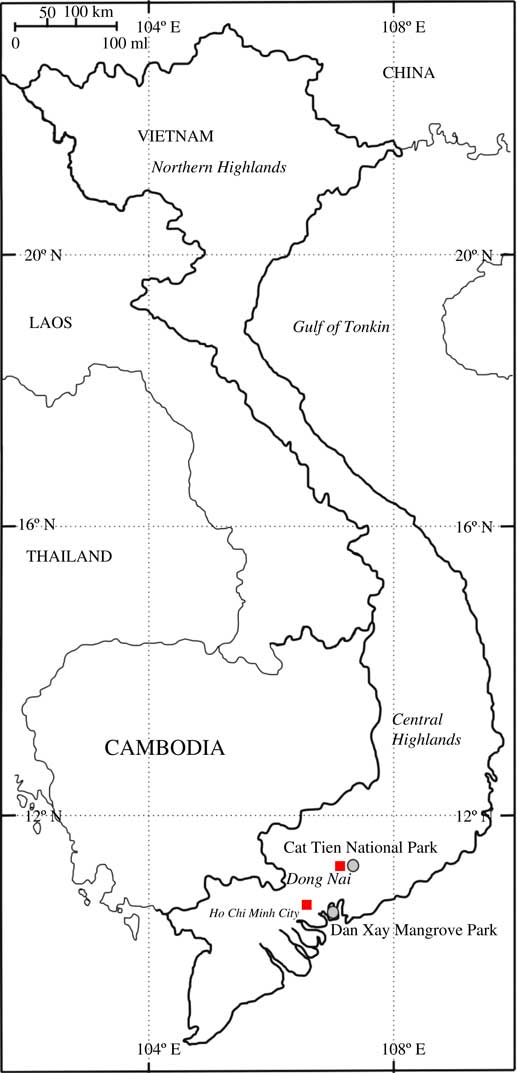
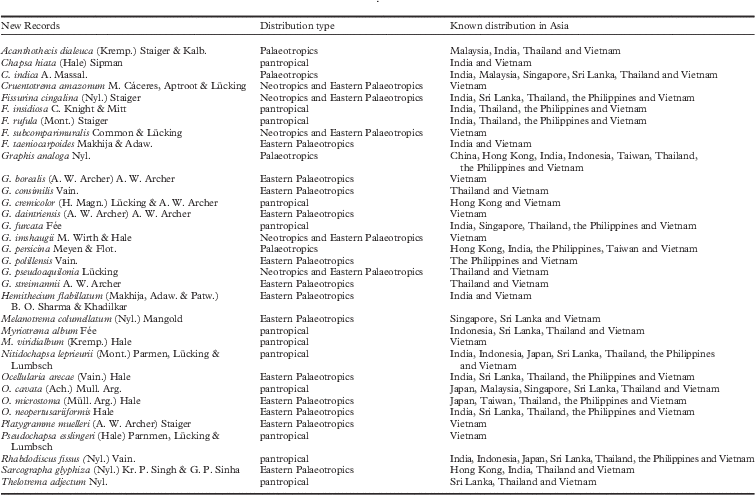
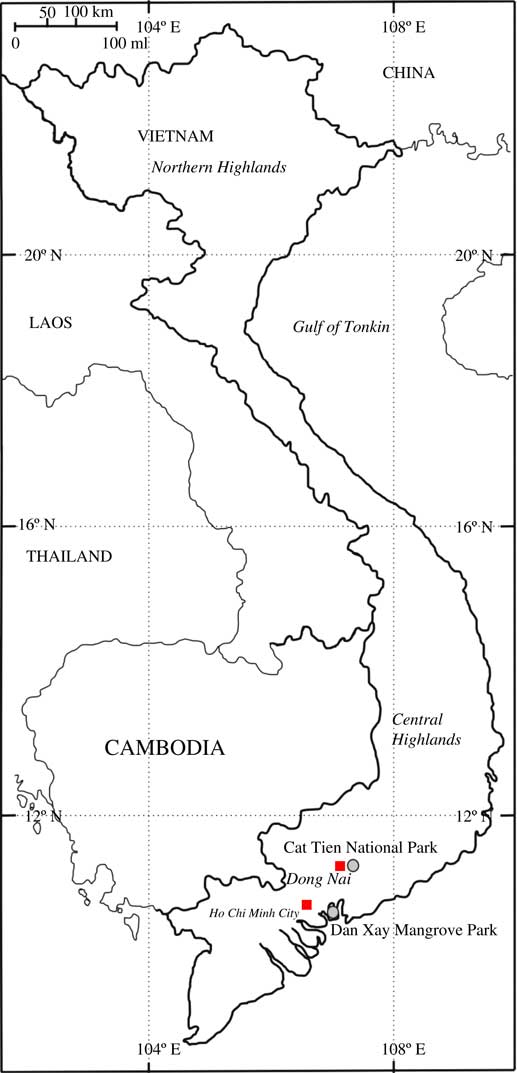
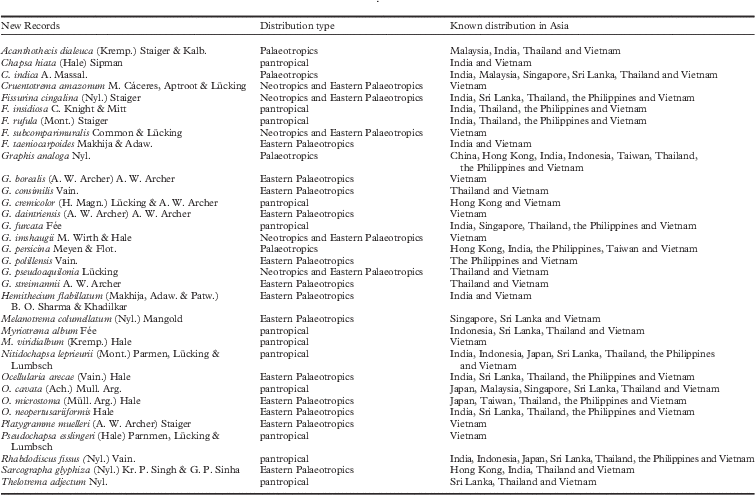
The family Graphidaceae (Ascomycota: Ostropales) is well represented in the tropical rainforests of the world. Although the family is one of the most species rich in the Palaeotropics, knowledge of the Vietnamese Graphidaceae has expanded significantly only in recent years resulting in reports of more than 70 species, belonging to 17 genera, from the tropical to subtropical regions of the country (Aptroot & Sparrius Reference Aptroot and Sparrius2006; Joshi et al. 2013 Reference Joshi, Jayalal, Oh, Koh, Nguyen, Dzung and Hura, Reference Joshi, Nguyen, Dzung, Jayalal, Oh and Hurb , Reference Joshi, Upreti, Rivas Plata, Nguyen, Nguyen, Oh and Hur2015 a, Reference Joshi, Nguyen, Dzung, Jayalal, Oh and Hurb ). Previous collections were made from the northern and central highlands; this paper reports the results of collecting in two national parks in the lowland tropical forests. Cat Tien National Park (CTNP) is situated in the south of Vietnam in Dong Nai, Binh Phuoc and Lam Dong Provinces. This national park is a transition between the Central-Southern Highland and the Southern Plain biogeographical areas and includes the lowland tropical rainforests of Vietnam. Day Xay Mangrove Park (DXMP) is located in the southern coastal region within the Can Gio Biosphere Reserve in Ho Chi Minh City Province (Fig. 1). In the current paper two new species, Acanthothecis verrucosa S. Joshi, Upreti & Hur and Graphis exuta S. Joshi, Upreti & Hur, are described and a note on a nomenclature change for the previously described Acanthothecis salazinica S. Joshi & Hur is provided. In addition, 34 new records in the Graphidaceae of Vietnam are reported (Table 1 & Supplementary Material, available online).
Map of Vietnam showing localities surveyed in this study.
New records of the Graphidaceae from Vietnam with their known distribution
Materials and Methods
Specimens were collected in December 2015 by J-S Hur and J. J. Woo from lowland areas of Cat Tien National Park in Dong Nai Province and Day Xay Mangrove Park in Ho Chi Minh City Province and are held in the herbarium of the Korean Lichen Research Institute, Suncheon, South Korea (KoLRI). The samples were studied at the CSIR-National Botanical Research Institute, Lucknow, India using standard techniques. Morphological and anatomical measurements were made on material mounted in water and studied under stereoscopic (MSZ-TR) and compound (LEICA DM 500) microscopes. Colour reaction spot tests and thin-layer chromatography (TLC) in solvent system A were used for the determination of lichen compounds following Orange et al. (Reference Orange, James and White2010). Relevant references (Staiger & Kalb Reference Staiger and Kalb1999; Staiger Reference Staiger2002; Frisch et al. Reference Frisch, Kalb and Grube2006; Makhija & Adawadkar Reference Makhija and Adawadkar2007; Archer Reference Archer2009; Lücking Reference Lücking2009; Lücking et al. Reference Lücking, Archer and Aptroot2009, Reference Lücking, Sutjaritturakan and Kalb2012; Mangold Reference Mangold2009; Rivas Plata et al. Reference Rivas Plata, Lücking, Sipman, Mangold, Kalb and Lumbsch2010; Singh & Sinha Reference Singh and Sinha2010; Lumbsch et al. Reference Lumbsch, Ahti, Altermann, Amo de Paz, Aptroot, Arup, Bárcenas Peña, Bawingan, Benatti and Betancourt2011; Sharma et al. Reference Sharma, Khadilkar and Makhija2012; Singh et al. Reference Singh, Singh and Bhatt2013; Bárcenas Peña et al. Reference Bárcenas Peña, Lücking, Miranda-González and Herrera-Campos2014; Cáceres et al. Reference Cáceres, Aptroot, Parnmen and Lücking2014) were used for identification. Lugol’s solution was used to check the amyloidity of the hymenium, asci and ascospores.
New Species
Acanthothecis verrucosa S. Joshi, Upreti & Hur sp. nov.
MycoBank No.: MB 819452
Similar to Acanthothecis consocians in producing psoromic acid, but differs in having muriform ascospores.
Type: Vietnam, Dong Nai Province, Tan Phu District, Nam Cat Tien Corn, Cat Tien National Park, eco-line road, 11°26'24·7''N, 107°24'54·8''E, elev. 151 m, on tree bark, 19 December 2015, Hur & Woo VN150304 (KoLRI—holotype).
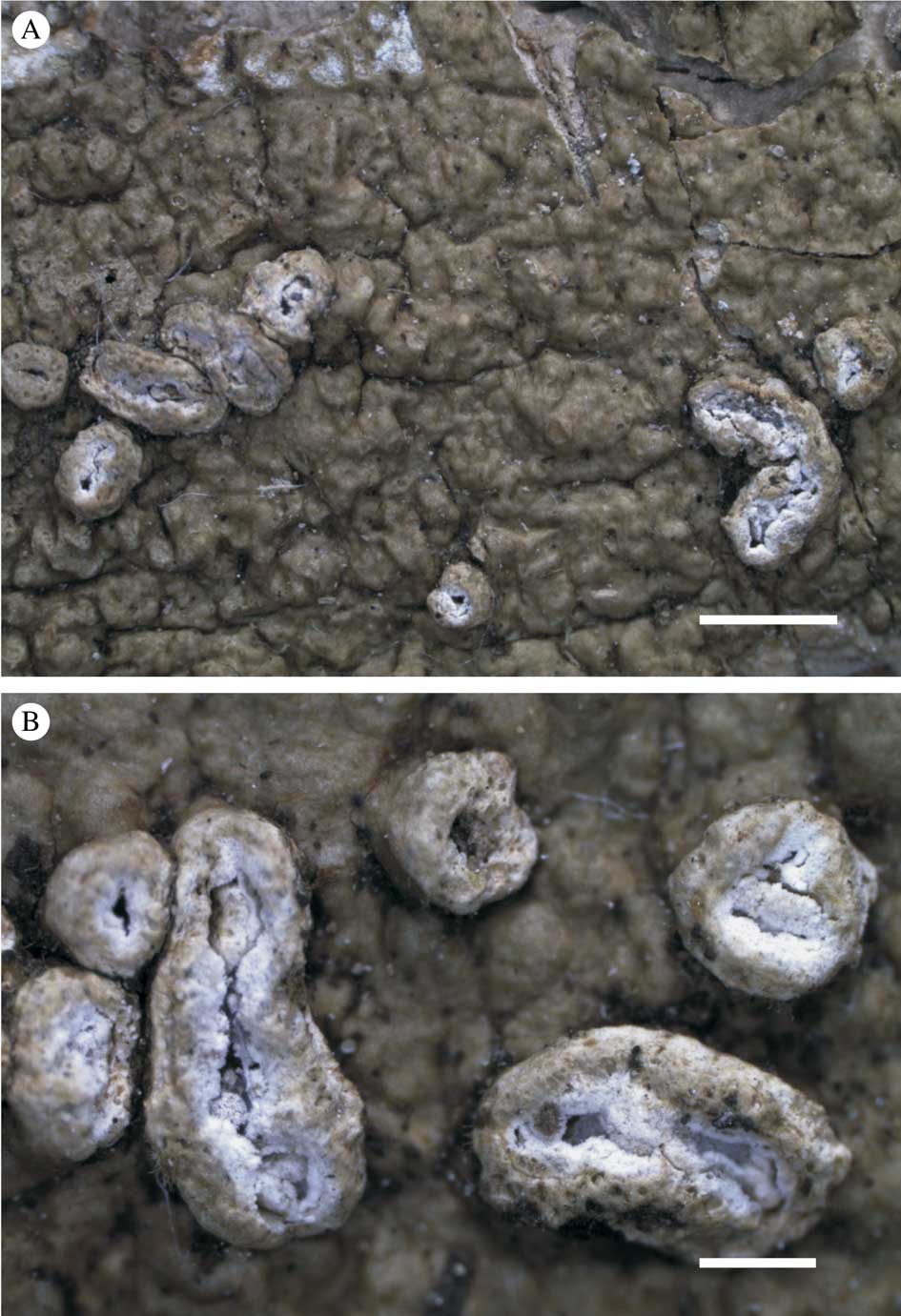
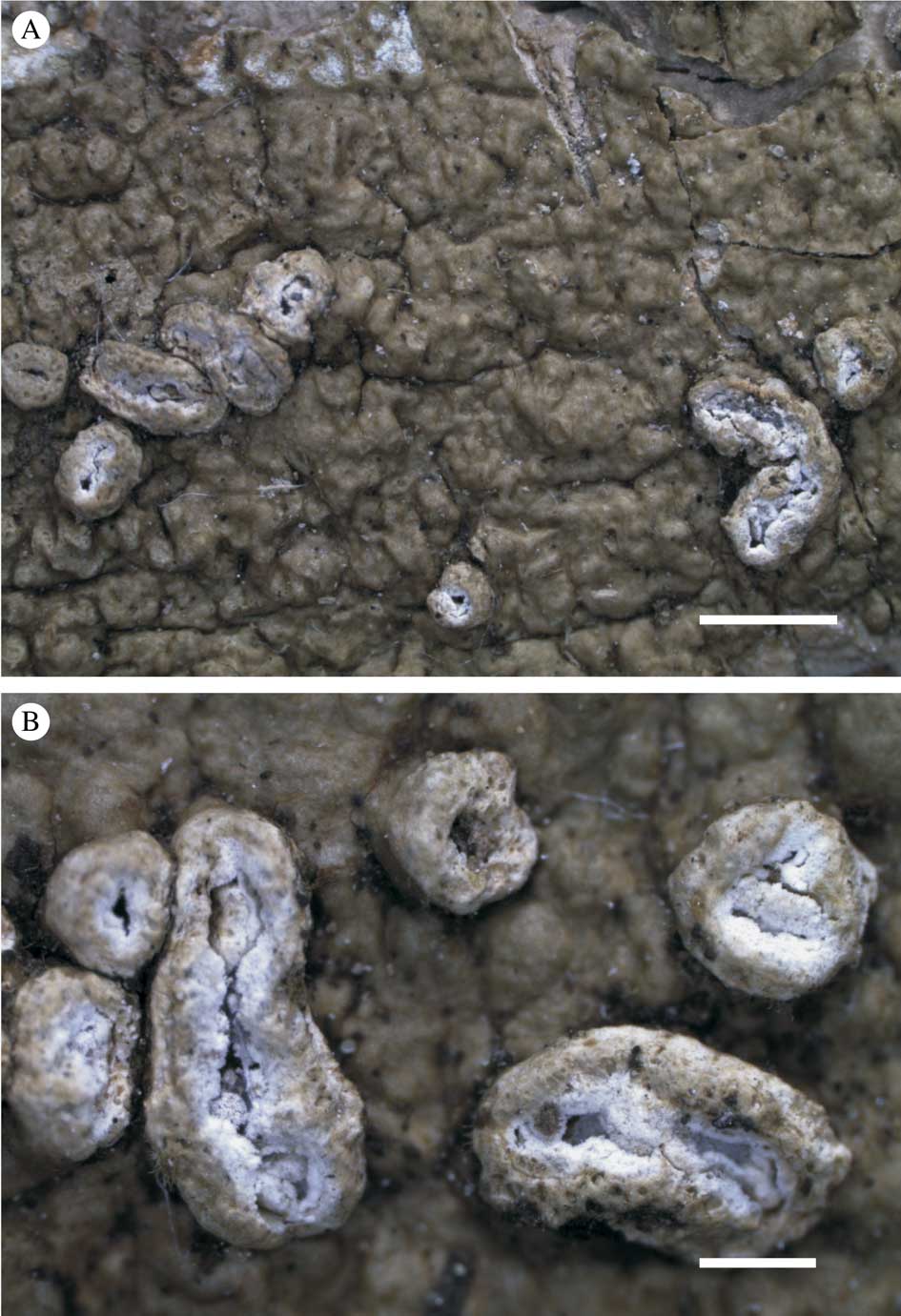
Acanthothecis verrucosa (holotype). A & B, habit & habitat. Scales: A=1 mm; B=0·5 mm. In colour online.
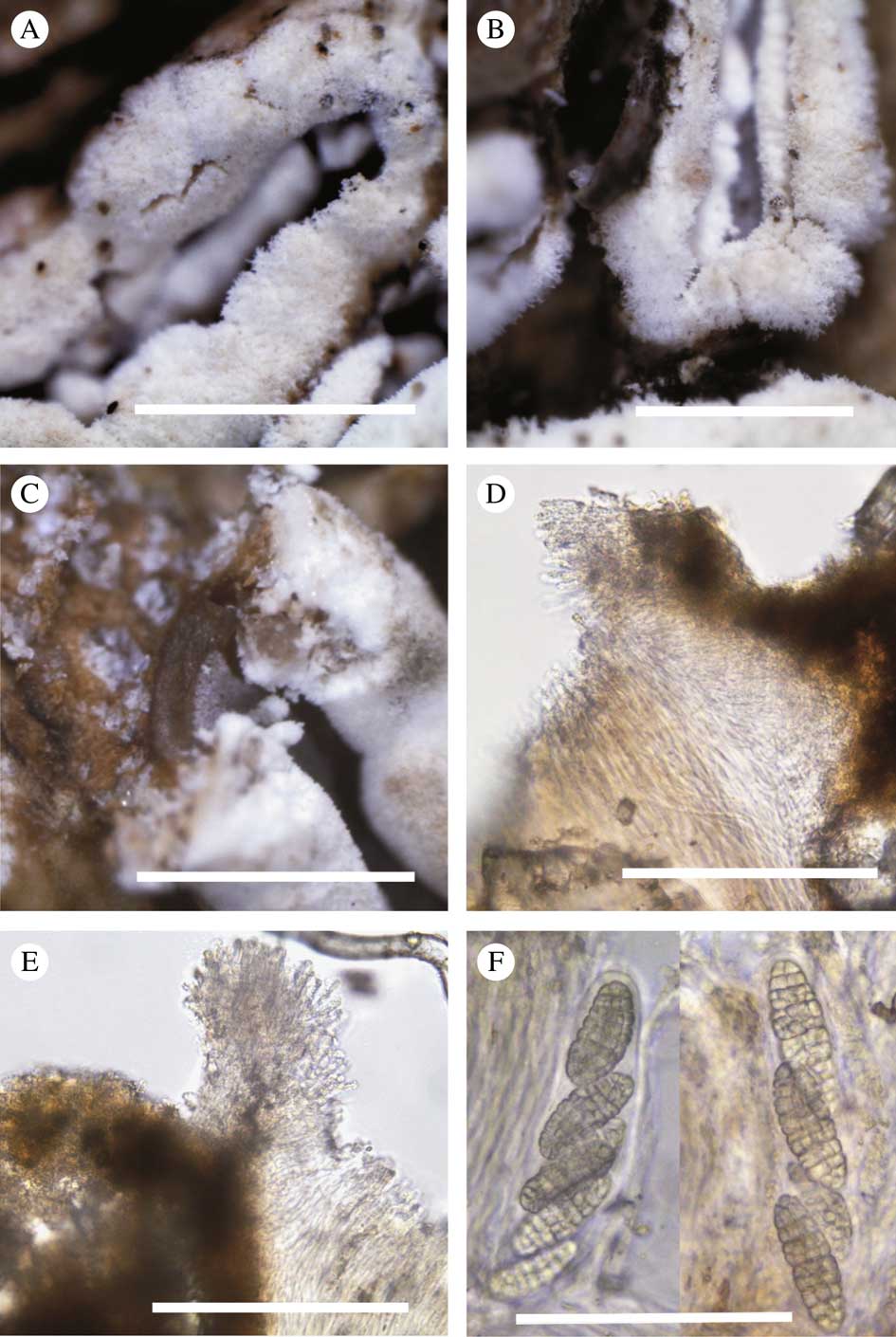
Acanthothecis verrucosa (holotype). A & B, apothecia showing robust periphysoids; C, apothecia showing hyaline to brownish proper exciple; D & E, cross-section of apothecia showing warty periphysoids; F, muriform ascospores. Scales: A–C=2 mm; D–F=100 µm. In colour online.
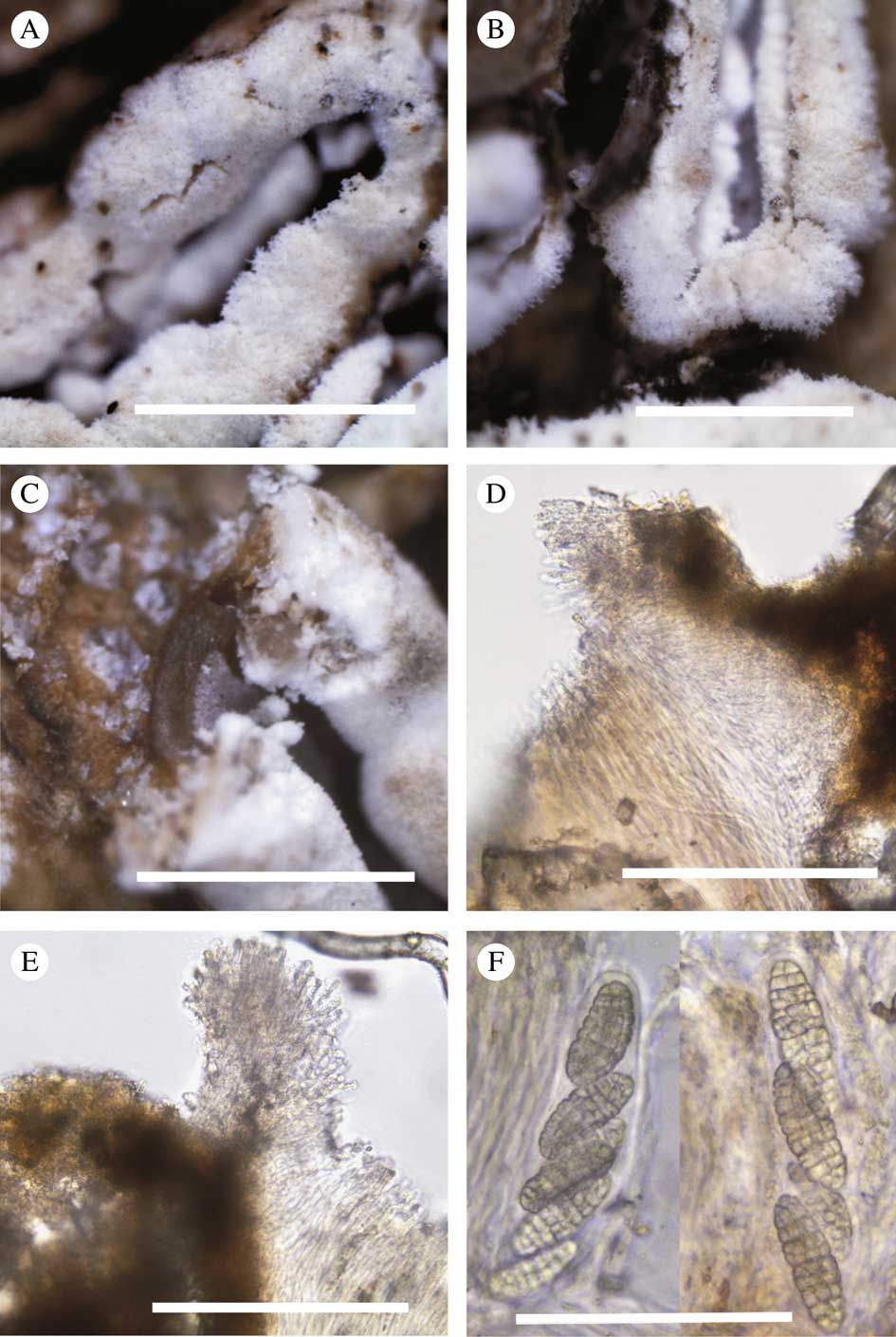
Thallus corticolous, olive-green, green or dark green, verrucose, spread in large patches, hard, glossy, continuous, 300–400 µm thick; cortex 25–45 µm thick, continuous; photobiont Trentepohlia, in a layer 50–100 µm thick, inspersed with crystals; medulla white, crystalline≤200 µm thick; prothallus whitish.
Apothecia irregular to shortly lirellate, sessile, 0·5–2·5×0·5–1·5 mm long, labiate; labia white, straight to sometimes folded internally; disc mostly concealed to slightly exposed, white pruinose; thalline margin 200–250 µm thick; proper exciple poorly developed, apically hyaline to brownish, becoming well developed at the base, 30–40 µm thick, internally lined by a distinct layer of warty, branched, robust periphysoids, 15–40 µm long, reaching above the hymenium; epihymenium greyish, crystalline, 15–25 µm high; hymenium hyaline, clear, 160–190(–200) µm high; subhymenium indistinct to 20 µm high; asci 2–8-spored, 150–190×20–27 µm; ascospores hyaline, ellipsoidal, muriform, 35–70 µm long and 15–20 µm wide, I−.
Chemistry
K−, PD+ yellow, C−; psoromic and subpsoromic acids detected by TLC.
Etymology
The specific epithet refers to the verrucose thallus of the new taxon.
Ecology and distribution
The new species was collected in the southern part of Vietnam, where it grew luxuriantly in large patches on thick and ± smooth barked trees in the tropical forests of the National Park. The new species resembles somewhat the genus Thecaria due to the large, thick thallus with distinct apothecia. The new taxon can also be confused with Rhabdodiscus species due to the sometimes internally folded labia, and also with Stegobolus and Fissurina which resemble it morphologically and in the non-carbonized proper exciple. In the type locality, Acanthothecis verrucosa grew in association with several other graphidioid and thelotremoid taxa spreading around the tree trunks.
Remarks
The new species is characterized by an olive-green, verrucose thallus, short lirellate, labiate apothecia covered by robust and branched periphysoids, and the presence of psoromic acid. Acanthothecis consocians (Nyl.) Staiger & Kalb and A. nivalis Makhija & Adwadkar are the other species in the genus with psoromic acid, but both differ from the new taxon in their morphological and anatomical characteristics. Acanthothecis consocians has a pale yellowish white thallus, immersed to slightly raised, 3–6 mm long apothecia, a hymenium 40–70 µm high and transversely septate ascospores 13–8×4–5 µm, while A. nivalis produces a brown thallus, 2–8 mm long apothecia, a hymenium 58–63 µm high and transversely septate ascospores 8·4–16·0×3–4 µm (Staiger & Kalb Reference Staiger and Kalb1999; Makhija & Adawadkar Reference Makhija and Adawadkar2003). Acanthothecis dialeuca is similar to A. verrucosa in having 2–8-spored asci and muriform ascospores (22–37×9–14 µm), but contains stictic acid and its satellites. Acanthothecis gracilis Staiger & Kalb, A. tetraphora (Nyl.) Staiger & Kalb and A. socotrina (Müll. Arg.) Staiger & Kalb also resemble the new taxon in having similar sized muriform ascospores but these species contain norstictic acid (Staiger & Kalb Reference Staiger and Kalb1999; Staiger Reference Staiger2002).
Additional specimens examined
Vietnam: Dong Nai Province: Tan Phu District, Nam Cat Tien Corn, Cat Tien National Park, eco-line road, 11°26'38·4''N, 107°24'55·1''E, elev. 152 m, on tree bark, 2015, Hur & Woo VN150380 (KoLRI); 11°26'24·7''N, 107°24'55·1''E, elev. 148 m, on tree bark, 2015, Hur & Woo VN150331 (KoLRI).
Acanthothecis yokdonensis S. Joshi & Hur nom. nov.
MycoBank No.: MB 819454
Acanthothecis salazinica S. Joshi & Hur, Lichenologist 45: 600 (2013); nom. illegit. (Arts 53.1 and 53.3).
Type: Vietnam, Dak Lak Province, Yok Don National Park, 12°517'20·0''N, 107°45'58·1''E, alt. c. 760 m, on tree, 22 April 2012, Hur & Oh 120211 (KoLRI—holotype).
Non Acanthothecis salazinica van den Boom & Sipman, Herzogia 26(1): 12 (2013).
During the preparation of our paper introducing the new species Acanthothecis salazinica (Joshi et al. 2013 Reference Joshi, Jayalal, Oh, Koh, Nguyen, Dzung and Hura ), we were unaware that an identical specific epithet had already been published for another species belonging to the same genus (van den Boom & Sipman Reference van den Boom and Sipman2013). Consequently, Acanthothecis salazinica S. Joshi & Hur becomes a later homonym of Acanthothecis salazinica van den Boom & Sipman and a new epithet is required for the species from Vietnam. The epithet ‘yokdonensis’ is derived from Yok Don National Park, the type locality, and ‘ensis’, place of origin.
The two species are readily differentiated by their ascospores. Acanthothecis salazinica has muriform, amyloid ascospores, 40–85×25–35 µm, whereas A. yokdonensis has elongate, non-amyloid ascospores, 70–21×7–14 µm, 28–30 locular.
Graphis exuta S. Joshi, Upreti & Hur sp. nov.
MycoBank No.: MB 819453
Resembles Graphis nuda but is distinguished by the presence of norstictic acid.
Type: Vietnam, Ho Chi Minh City Province, Can Gio District, An Thoi Don, Run Sac Street, Dan Xay Mangrove Park, roadside, 10°27'36·2''N, 106°54'14·0''E, elev. 9 m, on tree bark, 21 December 2015, Hur & Woo VN150438 (KoLRI—holotype).
(Fig. 4)
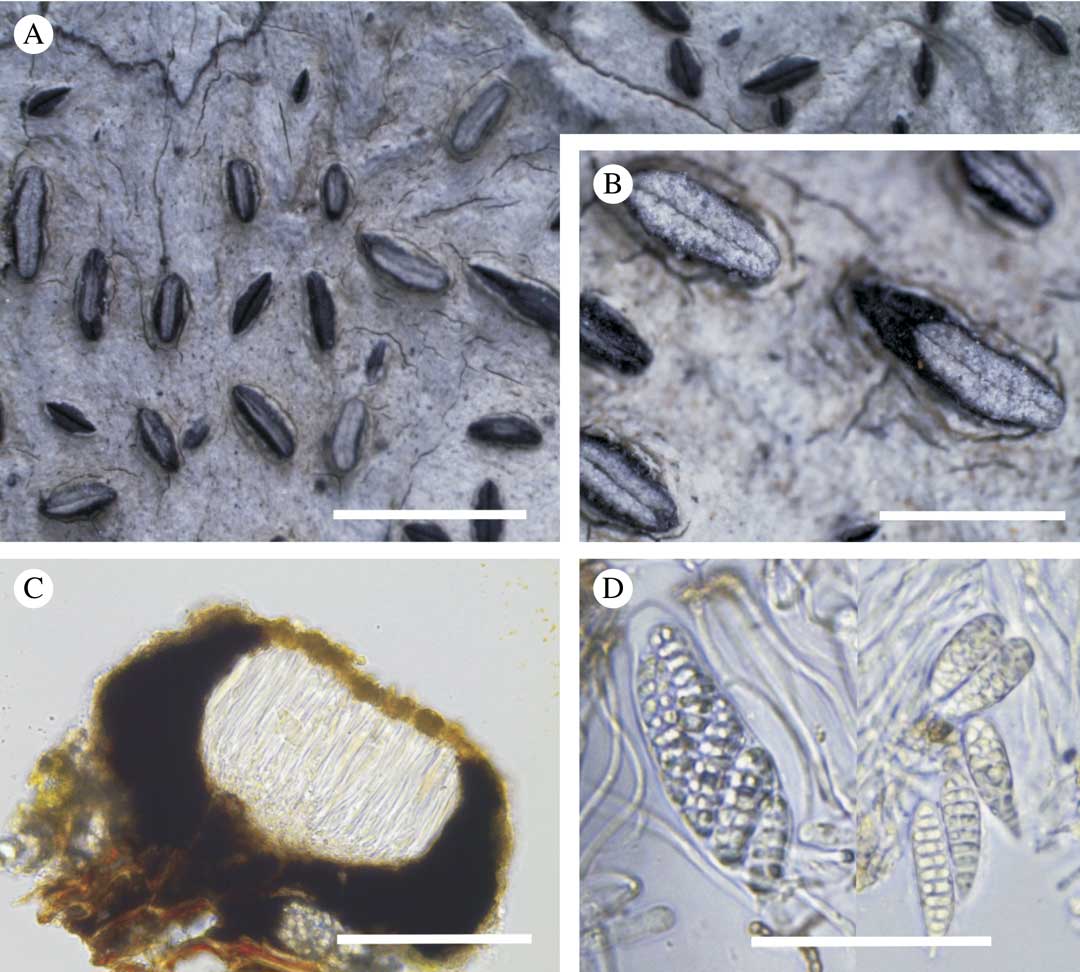
Graphis exuta (holotype). A & B, habit & habitat; C, cross-section of apothecia showing completely carbonized proper exciple; D, ascus and ascospores. Scales: A=1 mm; B=0·5 mm; C=100 µm; D=50 µm. In colour online.
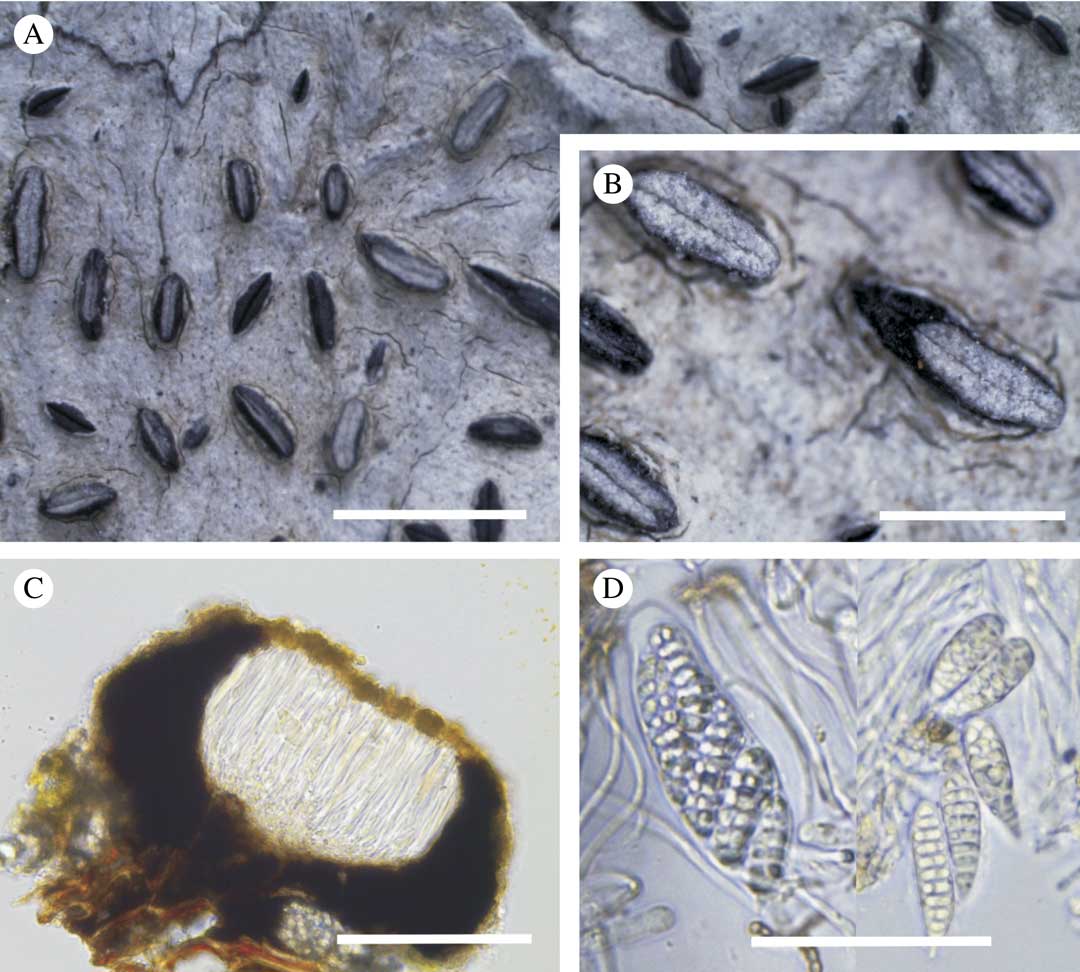
Thallus corticolous, greenish white, glossy, slightly cracked, smooth, continuous,≤100 µm thick; cortex≤20 µm thick; photobiont Trentepohlia, in a layer≤80 µm thick; medulla indistinct; prothallus dark brown.
Apothecia lirellate, short, simple, prominent lacking a thalline margin, 0·5–1·0×0·1–0·3 mm; labia entire, initially epruinose but old labia upturned exposing coarsely white pruina towards the slit; disc concealed; proper exciple completely carbonized, 35–70 µm thick; epihymenium brownish, granular, 15–20 µm high; hymenium hyaline, clear, 100–130 µm high; subhymenium 20–30 µm high; asci 8-spored, 80–100×15–20 µm; ascospores ellipsoidal, mostly acute at one end, muriform, 8–12×2–4 locular, 20–35 µm long and 10–13 µm wide, I+ violet.
Chemistry
K+ yellow turning red, PD−, C−; norstictic acid detected by TLC.
Etymology
The specific epithet ‘exuta’ is derived from the Latin ‘exutus’, meaning bare, a reference to the similarity of the new taxon to Graphis nuda, in having exposed or naked (bare) lirellae.
Ecology and distribution
The new species was collected from the wetland forests in the southern part of Vietnam, where it occurs in irregular patches on the thin, papery barks of trees in association with other graphidioid taxa including Graphis cremicolor.
Remarks
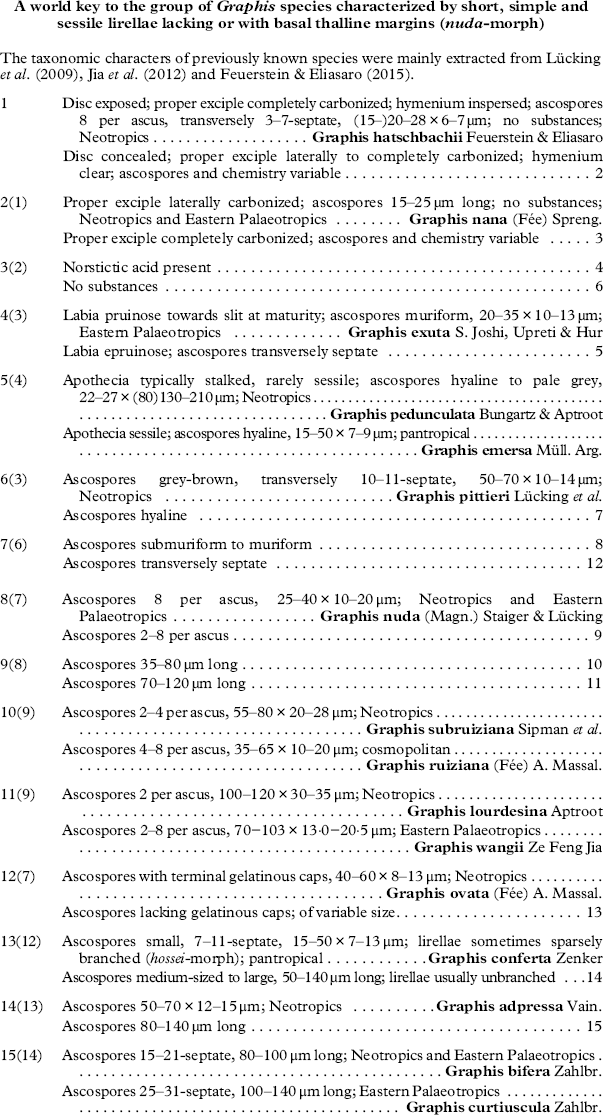
The new taxon is characterized by the short, simple lirellae lacking a thalline margin, entire labia, a completely carbonized proper exciple, a clear hymenium, muriform ascospores and the presence of norstictic acid. It closely resembles Graphis nuda (Magn.) Staiger & Lücking which has a similar morphology but lacks lichen compounds. Graphis naduriana Aptroot also resembles the new taxon in producing short, unbranched, prominent lirellae and norstictic acid, but differs in having a thick and complete thalline margin. The new taxon also resembles Graphis cremicolor (H. Magn.) Lücking & A. W. Archer in lirellae anatomy and the presence of norstictic acid, but this species differs in possessing immersed lirellae with a lateral thalline margin (Lücking et al. Reference Lücking, Archer and Aptroot2009).
Additional specimen examined
Vietnam: Ho Chi Minh City Province: Can Gio District, An Thoi Don, Run Sac Street, Dan Xay Mangrove Park, roadside, 10°27'34·6''N, 106°54'16·0''E, elev. 13 m, on tree bark, 2015, Hur & Woo VN150430 (KoLRI).
This work was supported by a grant from the Korean National Research Foundation (NRF-2015K2A1B7A01069080, NRF-2014M3A9B8002115) and the Korean Forest Service Program (KNA 2016) through the Korea National Arboretum. The authors are grateful to Dr Alan W. Archer (lichenologist and a native English speaker) for his valuable comments and suggestions on the paper. SJ thanks the Director, CSIR-National Botanical Research Institute, Lucknow, India for providing laboratory facilities to accomplish the work, and Dr Andre Aptroot (lichenologist) for his considerable help.
Supplementary Material
For supplementary material accompanying this paper visit https://doi.org/10.1017/S0024282917000172