


I. Introduction
The legal difficulty addressed in this article does not lie simply in whether omnibus legislation is permissible in the European Union. The harder question begins after that threshold has been crossed. It concerns what happens to the evidentiary and participatory conditions of EU lawmaking once regulatory change is bundled at scale across multiple instruments under the language of simplification, competitiveness and burden reduction.Footnote 1 In that setting, the central issue is no longer merely one of legislative technique. It becomes a question of whether the Union’s current omnibus turn preserves the conditions under which regulatory change remains contestable, and therefore politically and judicially accountable.
That question has acquired unusual practical urgency. The Commission’s 2025 Work Programme presented a first series of omnibus proposals on sustainability and investment simplification and linked them to a broader commitment to reduce administrative burdens by at least 25%, and by at least 35% for small and medium-sized enterprises.Footnote 2 The accompanying communication, A Simpler and Faster Europe, made clear that the omnibus packages in the 2025 Work Programme were only the first deliverables of a wider simplification agenda intended to continue across the mandate.Footnote 3 What had once appeared in EU law largely as an occasional vehicle for technical adjustment is thus being recast as a recurring instrument of substantive regulatory reform. The special issue call to which this article responds captures the scale of that shift with particular clarity. It describes an unprecedented wave of omnibus legislation beginning in January 2025, stretching from sustainability and investment to agriculture, chemicals, defence, digital regulation and beyond, and notes that more than half of the proposals planned for 2026 were expected to follow the same packaging logic.Footnote 4
This development matters because omnibus legislation does more than gather amendments together. It can alter the way legislative choice becomes visible. In ordinary settings, EU lawmaking is accompanied by a record that helps others understand why a change is proposed, what alternatives were considered, what evidence supports the preferred option and how likely distributive or compliance effects have been assessed. That record is not politically neutral, and it does not remove disagreement. Yet it helps make disagreement usable. The 2016 Interinstitutional Agreement on Better Law-MakingFootnote 5 and the Commission’s Better Regulation Guidelines both treat transparency, evidence, consultation and appraisal as central features of legislative preparation rather than decorative additions to it.Footnote 6 Article 11 TEU reinforces that procedural orientation by requiring open, transparent and regular dialogue with representative associations and civil society and by requiring broad consultations so that Union action may be coherent and transparent.Footnote 7 Taken together, these elements do not merely support better administration. They help sustain a legal environment in which regulatory change can still be followed, questioned and defended.
The present wave of omnibus reform places pressure on that environment in a distinctive way. Bundling several amendments into one package does not necessarily remove evidence, consultation or justification. The deeper difficulty is that it may compress them. Objectives may be stated at package level rather than at the level of each amended instrument. Trade-offs may be absorbed into a general narrative of simplification. Alternatives may become harder to identify in relation to particular amendments whose legal and practical consequences differ sharply from one another. Consultations may remain formally open while becoming less usable in practice for those who must follow several interacting changes at once. The problem, in other words, is not only opacity. It is evidentiary compression. Once that occurs, the question is no longer whether there is a record somewhere. It is whether the record remains sufficiently readable to sustain meaningful contest.
Existing scholarship has illuminated several pieces of this landscape, but it has not yet brought them fully together in the form required by the current omnibus moment. Comparative work on omnibus legislation has long explored the tension between efficiency and transparency in legislative design.Footnote 8 Recent intervention on the EU side has begun to identify the constitutional and procedural implications of the Commission’s new simplification strategy, including the risk that omnibus practice may undermine procedural integrity in the Union legal order.Footnote 9 At the same time, broader scholarship on better regulation has shown that impact assessments, evaluations and consultation processes matter not simply as managerial tools, but also as part of the conditions under which EU legislation is prepared and defended.Footnote 10 What remains underdeveloped is a legal account of how these strands connect once bundling becomes a governing strategy. The central problem is no longer only whether omnibus reform reduces burdens or accelerates lawmaking. It is whether it reorganises the justificatory record in a way that weakens contestability itself.
This article addresses that problem through the concept of contestability. For present purposes, contestability does not refer loosely to public controversy or political disagreement. It refers to a more specific legal condition. Regulatory change is contestable when its objectives, alternatives and supporting evidence remain sufficiently traceable to permit meaningful participation, institutional scrutiny and review. In that sense, contestability is not external to accountability. It is one of its working conditions. The article therefore argues that contemporary omnibus practice may cut not only red tape, but also the record required for meaningful scrutiny. That claim does not rest on the proposition that omnibus legislation is inherently incompatible with EU law. It rests on a narrower and more practical concern. The more that bundled reform makes the justificatory basis of individual amendments difficult to separate, the harder it becomes for affected actors, the Parliament and the courts to assess whether simplification remains legally and institutionally defensible.
That claim also has direct constitutional implications. Proportionality review in EU law presupposes more than a legitimate aim. It also requires a sufficiently intelligible relationship between the aim pursued, the means chosen and the reasons advanced for preferring those means over available alternatives.Footnote 11 The point is not that every legislative file must present judicially perfect reasoning or that courts are to substitute their assessment for that of the legislature in complex fields. The point is simpler and more important. Where the Union institutions act through broad and politically significant reform packages, the record through which necessity, burden and trade-off can be examined matters to the possibility of review itself. That issue becomes sharper still once one recalls the structural limits of direct challenge under Art. 263 TFEUFootnote 12 and the continuing significance of Art. 47 of the CharterFootnote 13 in the wider architecture of effective judicial protection. When standing is already difficult, the prior existence of a readable legislative record becomes more rather than less important.
Methodologically, the article combines doctrinal analysis with a documentary mapping of selected omnibus packages and scrutiny traces. The mapping is not designed as a quantitative census of every omnibus initiative announced since January 2025. Its purpose is narrower. It identifies the documentary conditions under which the current omnibus strategy makes legislative justification more or less traceable. For that reason, the article examines the public record surrounding Omnibus I as the baseline case, including Commission proposals, explanatory memoranda and the accompanying staff working document.Footnote 14 It then reads later and emerging packages, especially the Digital Omnibus, as scrutiny traces that reveal how package-level simplification may reshape consultation, parliamentary scrutiny and amendment-specific justification before legislative closure.Footnote 15 The variables used in the mapping are deliberately legal rather than statistical: the policy field affected, the stated simplification objective, the presence or absence of a full impact assessment, the form of supporting evidence, the availability of consultation or call-for-evidence materials, parliamentary scrutiny signals and the extent to which amendment-specific reasons can be separated from the package narrative. This method allows the article to test the claim of evidentiary compression without pretending that the current public record is complete or that all omnibus packages have reached the same stage of legislative maturity.
The article proceeds in six steps. Section II develops contestability as a legal infrastructure of accountability in EU risk regulation. Section III maps selected omnibus packages and scrutiny traces to show how omnibus reform compresses the legislative record. Section IV examines the role of impact assessments, consultations and related materials in sustaining the evidentiary basis of proportionality review. Section V turns to judicial review, standing and the accountability consequences of bundled reform. Section VI proposes design principles under which legislative bundling may remain compatible with meaningful scrutiny in a multi-level risk-regulatory order. Section VII concludes.
II. Contestability as a legal infrastructure of accountability
Contestability is often used in a broad and sometimes loose way. In public law debate, it may refer to disagreement, resistance, deliberation or the wider possibility of political challenge. That is not the sense in which the term is used here. For the purposes of this article, contestability refers to a more specific legal condition. Regulatory change is contestable when its objectives, alternatives and supporting evidence remain sufficiently traceable to allow those affected by it, the political institutions that scrutinise it, and the courts that may later review it to understand what is being changed, why that change is being pursued, and on what justificatory basis it rests.Footnote 16 In that narrower sense, contestability is not an optional democratic virtue that sits outside legality. It is one of the working conditions under which legality can still be tested in any meaningful way.
This matters especially in EU risk regulation. In that field, law rarely operates through simple prohibition alone. It usually works through calibration, justification and the management of trade-offs under conditions of scientific uncertainty, institutional complexity and uneven distributive effects. The legal question is therefore not exhausted by whether the Union legislature has acted within competence or identified a legitimate objective. Regulatory choice must also remain sufficiently intelligible for others to examine the relation between the objective pursued, the instruments selected and the reasons advanced for preferring those instruments over available alternatives.Footnote 17 Once that relation becomes too compressed or too difficult to reconstruct, accountability begins to thin out long before any formal defect is established. The same difficulty also bears on legal certainty, because those subject to recalibrated duties can no longer identify with sufficient clarity why one obligation has been altered rather than another within the broader package logic.Footnote 18
That is one reason why the better law-making framework matters more than is sometimes acknowledged in doctrinal debate. The 2016 Interinstitutional Agreement on Better Law-Making does not treat evidence, transparency and cooperation as merely managerial aspirations.Footnote 19 The Commission’s Better Regulation Guidelines move in the same direction. They present legislative preparation as a structured process in which policy options are developed, impacts are assessed, evidence is gathered and stakeholder views are integrated in a way that allows public authority to explain not only what it proposes to do, but why this course of action is preferred.Footnote 20 The related 2021 communication on better regulation is explicit on the point that the objective is not simply to produce more regulation or less regulation, but to improve the quality of legislative choice and the clarity of the reasons supporting it.Footnote 21 Read together, these instruments suggest that EU lawmaking is not built only on substantive standards. It also depends on a justificatory environment in which regulatory choice remains sufficiently visible to be interrogated.
In that setting, impact assessments, evaluations, consultation records and, where relevant, scientific or technical advice do more than accompany a legislative proposal. They help form the record through which legislative change becomes legally readable. This does not mean that the legislature is mechanically bound by impact assessment outcomes or that consultation results can dictate the final political choice. Nor does it mean that the absence of perfect evidence makes a proposal unlawful. The point is narrower. Once lawmaking in complex regulatory fields relies on structured appraisal, consultation and evaluation, these materials become part of the way justification is externalised. They are among the means by which other actors can see whether the chosen course of action has been separated from plausible alternatives and whether the burdens it creates have been weighed against the public interests invoked in its support.Footnote 22 A legislative change may therefore remain formally valid while becoming less contestable if the justificatory record on which it rests becomes harder to separate, follow or test.
The participatory dimension of this problem is equally important. Article 11 TEU does not constitutionalise an ideal model of deliberative democracy, nor does it guarantee that all interests will be equally heard or equally persuasive in the legislative process.Footnote 23 What it does establish, however, is a legal orientation towards openness, transparency and broad consultation. In practical terms, that orientation matters only if participation remains usable. Consultation ceases to function as a meaningful mode of contest when the material placed before stakeholders is organised at such a high level of aggregation that the legal and practical implications of individual amendments become difficult to isolate. Formal openness may survive under those conditions, but functional contestability weakens. A consultation process that is technically available but evidentially overloaded does not disappear. It simply becomes harder to use in a way that is proportionate to the complexity of the reform being advanced.Footnote 24
This is why contestability should not be reduced to transparency in the thin sense of document availability. A legislative file may be large, formally public and procedurally complete, yet still remain difficult to contest if its justificatory materials do not allow others to connect specific amendments to specific objectives, evidentiary assumptions and anticipated consequences. In that respect, contestability depends not only on disclosure, but also on readability and separability. It requires that the legal and evidentiary basis of change remain sufficiently organised for challenge to be more than symbolic. That is also why scholarship on omnibus legislation has long treated the tension between efficiency and transparency as more than a matter of legislative style.Footnote 25 Once multiple measures are gathered into one package, the problem is not only that there is more material to read. It is that the reasons supporting particular changes may become harder to disentangle from the package narrative as a whole.Footnote 26
The connection to judicial review follows from the same logic. Proportionality review in EU law presupposes more than the existence of a legitimate aim. It also requires a sufficiently intelligible relationship between the measure chosen and the reasons advanced for selecting it. In complex fields, the courts recognise that the legislature enjoys a broad discretion, particularly where it must make technical or predictive assessments. That deference, however, does not make the justificatory record irrelevant. On the contrary, case law makes clear that review remains tied to whether the measure adopted is manifestly inappropriate having regard to the objective pursued and whether the institutions can substantiate the legislative choice that has been made.Footnote 27 Where the underlying record is difficult to read, the practical conditions for proportionality review become thinner even if the doctrinal standard remains unchanged.Footnote 28
The same can be said of accountability more broadly once one recalls the structural limits of direct challenge to legislative acts. Art. 263 TFEU and the case law on standing have long made access to direct review difficult for many applicants affected by Union measures of general application.Footnote 29 Art. 47 of the Charter remains central to the wider architecture of effective judicial protection, but it does not erase those structural limits by itself.Footnote 30 In that setting, the quality of the legislative record matters not because it removes barriers to standing, but because it affects the extent to which legislative reasoning can be scrutinised within the review pathways that do exist.Footnote 31 When direct access is already constrained, the prior existence of a traceable and sufficiently separable record becomes more, not less, significant.
For the purposes of this article, then, contestability refers to the legal and evidentiary condition in which regulatory change remains sufficiently traceable for meaningful participation, institutional scrutiny and review. That condition does not require exhaustive certainty or frictionless transparency. It requires that the justificatory basis of change remain readable enough for others to contest it in a way that is legally usable. Once that premise is accepted, the problem raised by contemporary omnibus reform becomes sharper. The question is no longer only whether bundled reform is politically attractive or administratively efficient. It is whether bundling compresses the legislative record to the point that contestability itself begins to weaken. The next section turns to that problem directly.
III. Mapping the omnibus wave and evidentiary compression
If contestability depends on the continued readability of objectives, alternatives and supporting evidence, the next question is whether the Union’s current omnibus turn alters that condition in a systematic way. The answer cannot be supplied by abstract legal reasoning alone. It requires at least a modest mapping of the documentary record through which omnibus reform has been presented, justified and scrutinised. The point of this section is therefore not to count every omnibus initiative in a statistical sense, but to make visible the evidentiary pattern that has so far remained partly hidden behind the general language of simplification.
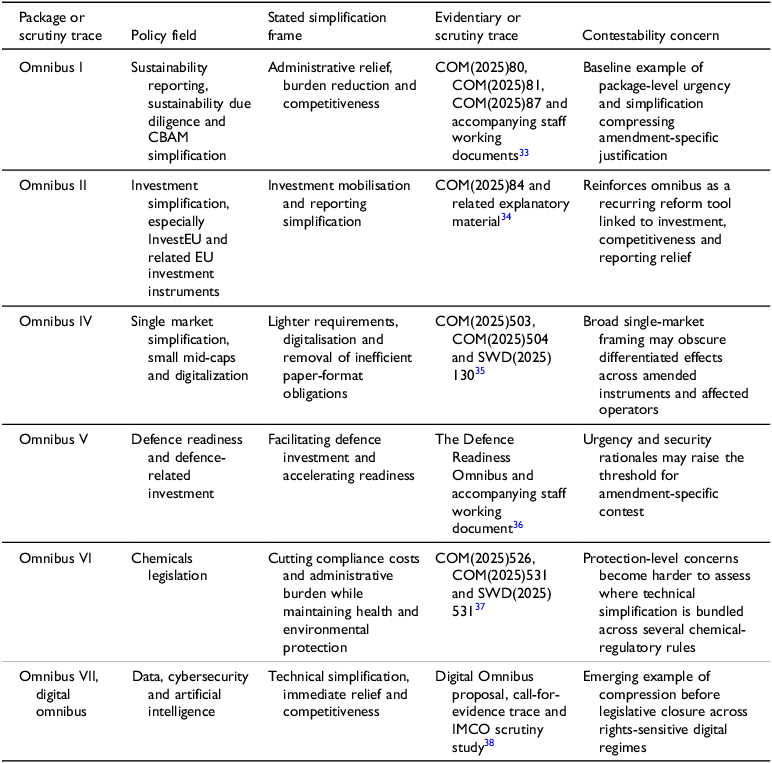
The mapping used here is documentary and legally oriented. It looks at the public materials that allow an external reader to reconstruct the justificatory chain of reform: Commission proposals, explanatory memoranda, staff working documents, consultation or call-for-evidence materials, and parliamentary scrutiny documents where available. The relevant variables are not only the policy field or the number of legal acts amended. More important for the present argument is the form in which the simplification objective is stated, the presence or absence of a full impact assessment, the level at which supporting evidence is organised, and the degree to which amendment-specific reasons can be separated from the package-level narrative. This is why Omnibus I is used as the baseline case. It is the first and most visible sustainability simplification package of the current wave, and it contains a particularly clear documentary trace of the relation between urgency, administrative burden reduction and a thinner impact-assessment format. Later packages are then used not as full case studies, but as scrutiny traces showing the institutional normalisation of omnibus reform across policy fields.Footnote 32
Documentary mapping of selected EU omnibus packages and scrutiny traces.

Table 1. Long description
A table with seven rows and five columns. The columns are labeled Package or scrutiny trace, Policy field, Stated simplification frame, Evidentiary or scrutiny trace, and Contestability concern. Row 1: Omnibus I, Sustainability reporting, sustainability due diligence and CBAM simplification, Administrative relief, burden reduction and competitiveness, COM(2025)80, COM(2025)81, COM(2025)87 and accompanying staff working documents, Baseline example of package-level urgency and simplification compressing amendment-specific justification. Row 2: Omnibus II, Investment simplification, especially InvestEU and related EU investment instruments, Investment mobilisation and reporting simplification, COM(2025)84 and related explanatory material, Reinforces omnibus as a recurring reform tool linked to investment, competitiveness and reporting relief. Row 3: Omnibus IV, Single market simplification, small mid-caps and digitalization, Lighter requirements, digitalisation and removal of inefficient paper-format obligations, COM(2025)503, COM(2025)504 and SWD(2025)130, Broad single-market framing may obscure differentiated effects across amended instruments and affected operators. Row 4: Omnibus V, Defence readiness and defence-related investment, Facilitating defence investment and accelerating readiness, The Defence Readiness Omnibus and accompanying staff working document, Urgency and security rationales may raise the threshold for amendment-specific contest. Row 5: Omnibus VI, Chemicals legislation, Cutting compliance costs and administrative burden while maintaining health and environmental protection, COM(2025)526, COM(2025)531 and SWD(2025)531, Protection-level concerns become harder to assess where technical simplification is bundled across several chemical-regulatory rules. Row 6: Omnibus VII, digital omnibus, Data, cybersecurity and artificial intelligence, Technical simplification, immediate relief and competitiveness, Digital Omnibus proposal, call-for-evidence trace and IMCO scrutiny study, Emerging example of compression before legislative closure across rights-sensitive digital regimes.
The table does not prove that each package has the same legal significance. It shows something more specific. Across the current reform cycle, omnibus legislation is no longer used merely as an occasional drafting technique. It is becoming a visible method for organising regulatory change across multiple policy areas. The Commission’s own simplification materials describe an omnibus proposal as a package of legislative proposals that amends multiple existing EU legal acts at the same time, usually across the same policy area. The same source records that, in 2025, the Commission proposed ten omnibus proposals expected to reduce recurrent administrative costs by EUR 11.9 billion.Footnote 39 That institutional framing matters because it shifts the question from whether a particular omnibus file is formally permissible to whether this method of reform preserves the record needed for legal contest.
Omnibus I provides the clearest baseline because its documentary record makes the compression mechanism unusually visible. The package was presented by the Commission on 26 February 2025 as a simplification initiative on sustainability and EU investments, with the Commission stating that it would deliver over EUR 6 billion in administrative relief.Footnote 40 The official Omnibus I page includes several proposal files, including COM(2025)80, COM(2025)81 and COM(2025)87, together with a staff working document accompanying COM(2025)80 and COM(2025)81.Footnote 41 The important point is not that the file lacked supporting documents altogether. It did not. The important point is that the justificatory format was thinner than a full impact-assessment pathway. In COM(2025)81, the Commission expressly stated that, given the urgency, the proposal did not allow for an impact assessment, while also noting that the existing legal acts had previously undergone comprehensive impact assessments and that insights from those earlier assessments, stakeholder input and practitioner discussions helped shape the proposal.Footnote 42
That formulation is central to the argument of this article. It does not show an empty record. It shows a displaced record. Evidence from earlier legislative cycles is invoked to justify a new package-level simplification exercise, while the immediate reform file is organised through urgency, burden reduction and competitiveness. In legal terms, that makes contestability more difficult because the reader must reconstruct the amendment-specific basis of the new recalibration from materials that were not necessarily produced for that recalibration. This is precisely what is meant here by evidentiary compression. The evidentiary chain is not severed, but it is shortened and reassembled at a higher level of abstraction.
The stop-the-clock component of Omnibus I illustrates the same point from a different angle. Directive (EU) 2025/794, adopted on 14 April 2025 and published in the Official Journal on 16 April 2025, amended Directives (EU) 2022/2464 and (EU) 2024/1760 as regards the dates from which certain corporate sustainability reporting and due diligence requirements would apply.Footnote 43 Its adoption gave legal effect to part of the Omnibus I strategy while the more substantive recalibration of sustainability reporting and due diligence obligations continued through the legislative process. The result is analytically important. The package did not operate as one simple legal act with one single effect. It generated a sequence of legal and political moves: postponement, substantive narrowing, burden-reduction claims and continuing scrutiny of the underlying protection structure. A package-level statement of simplification therefore gives the reader only part of the legal picture. The contestable question is not simply whether delay or simplification is legitimate in the abstract. It is whether each element of the package has a sufficiently separate evidentiary basis.
The same pattern becomes visible, though at an earlier stage, in the Digital Omnibus. In September 2025, the Commission opened a call for evidence to simplify rules on data, cybersecurity and artificial intelligence, describing it as the first step in simplifying the EU’s digital rulebook and keeping it open until 14 October 2025.Footnote 44 In November 2025, the Commission presented the Digital Omnibus proposal as a set of technical amendments to a large corpus of digital legislation, selected to bring immediate relief to businesses, public administrations and citizens, and to stimulate competitiveness.Footnote 45 A separate Commission press release described the package as streamlining rules on artificial intelligence, cybersecurity and data, and estimated that the simplification efforts could save up to EUR 5 billion in administrative costs by 2029.Footnote 46
The Digital Omnibus is not used here as a completed litigation record. Its value lies in the scrutiny traces it creates before legislative closure. Digital regulation is not a single regulatory field with one protection logic. Data protection, cybersecurity, artificial intelligence governance, platform regulation and data access rules rely on different institutional assumptions and distribute risks differently. A common simplification frame can therefore make the package politically readable while making the legal basis of each recalibration harder to isolate. The European Parliament’s IMCO study on the Digital Omnibus is significant for this reason. It explains that the Digital Omnibus package contains two separate proposals, one concerning the digital acquis related to data, privacy and cybersecurity and another focusing on the Artificial Intelligence Act, and it treats the package as part of a broader effort to identify interlinks and overlaps in digital legislation.Footnote 47 That scrutiny trace confirms that the difficulty is not imaginary. Even before adoption, the file requires institutional work to identify overlaps, links and possible recalibrations across a dense legal field.
This mapping supports three observations. First, the current omnibus wave is institutionally normalised through the language of simplification, administrative relief and competitiveness. These are not marginal rhetorical claims. They are the organising vocabulary through which packages are introduced and defended. Secondly, supporting evidence remains present, but it is often organised at a level that does not fully match the level at which legal consequences are produced. The relevant issue is therefore not the absence of evidence, but the separability of evidence. Thirdly, participation and scrutiny become more demanding because stakeholders and parliamentary actors must reconstruct the relationship between several amended instruments, several protection logics and one package-level simplification narrative. This does not make omnibus legislation unlawful as such. It does, however, show why bundling can weaken contestability even when the formal legislative record remains public.
Seen in this way, evidentiary compression is not merely an abstract theoretical risk. It is a pattern that can be observed in the documentary structure of the current omnibus wave. Omnibus I shows compression through the interaction between urgency, prior impact assessments, a staff working document and package-level simplification. The Digital Omnibus shows compression through pre-legislative consultation and parliamentary scrutiny of overlaps across multiple digital regimes. Later packages in investment, agriculture, single market, defence, chemicals, environment, automotive and food and feed safety reinforce the broader institutional point: omnibus legislation is becoming a recurring method for regulatory recalibration. The constitutional question is therefore not whether the Union may ever bundle legal amendments. It is whether each significant recalibration remains sufficiently traceable for affected actors, Parliament and courts to identify what is being changed, why it is being changed and on what evidentiary basis.
IV. Impact assessments, consultations and the record of justification
1. Impact assessments and the granularity of justification
If contestability depends on the continued readability of objectives, alternatives and supporting evidence, impact assessments occupy a central place in that structure. In the Union’s better regulation framework, impact assessment is not treated as an ornamental exercise appended to political choice after the fact. It is presented as a structured means of defining the problem, identifying policy options, examining likely consequences and explaining why one course of action is preferred over others.Footnote 48 In that sense, impact assessment matters not because it displaces politics, but because it externalises part of legislative reasoning. It gives other actors a way to see how a proposal has been framed before it is enacted.
The mapping in Section III matters because it shows that the difficulty is not the disappearance of the legislative record, but its reorganisation. Omnibus I and the Digital Omnibus both contain public materials, yet those materials are arranged in a way that often privileges the package-level objective of simplification over the amendment-specific chain of problem, evidence, alternative and justification. Impact assessment must therefore be examined not only as a formal procedural requirement, but also as a device for preserving the granularity of legislative reasoning.
That function becomes especially important in complex regulatory fields. In such settings, disagreement rarely concerns only the legitimacy of the objective pursued. More often, the harder dispute lies in whether the chosen measure is necessary, whether the burdens it imposes are justified, whether plausible alternatives were considered seriously enough, and whether the expected effects have been described in a sufficiently credible manner.Footnote 49 Impact assessment does not settle those questions conclusively. What it can do, however, is make them legally usable. It translates part of the justificatory pathway of legislative choice into a form that can be followed, challenged and later revisited.
Omnibus reform places pressure on that function because it alters the level at which justification is expressed. The legal difficulty is not that an omnibus package necessarily lacks an impact assessment. The harder problem is that the granularity of the supporting record may cease to match the granularity of the legal change being made. A package may amend several instruments at once, each with distinct obligations, affected constituencies and protection-level implications, while the justificatory structure of the file is increasingly organised around package-level aims such as simplification, coherence or competitiveness.Footnote 50 At that point, impact assessment continues to exist, but its contestatory value begins to thin. The issue is not evidentiary absence. It is evidentiary aggregation. The record remains present, but becomes less separable at the level where legal consequences actually arise.Footnote 51
This matters because contestability depends not on the mere existence of impact assessment, but on whether impact assessment remains usable at the level where legal change occurs. A package may still communicate why simplification is desirable in the abstract. It may become harder, however, to identify why a particular recalibration of obligation in a particular instrument was preferred over a narrower, slower or differently sequenced alternative. Once that happens, the file becomes more difficult to contest in legally precise terms. The question is no longer simply whether evidence has been produced. It is whether the evidence remains organised in a manner that allows amendment-specific scrutiny.
2. Consultations, Article 11 TEU and the functional usability of participation
The same pressure appears in the consultative dimension of EU lawmaking. Article 11 TEU does not establish a comprehensive constitutional theory of participatory democracy, nor does it guarantee that all affected interests will be equally persuasive in the legislative process.Footnote 52 What it does provide is a legal orientation towards openness, transparency and broad consultation. That orientation matters because participation is one of the principal means through which legislative reasoning is exposed to outside challenge before a measure is adopted.
In practice, however, participation has value only where it remains functionally usable. Formal openness is not enough. Consultation may be procedurally available while becoming materially difficult to use if the file placed before stakeholders is organised at too high a level of aggregation. That difficulty becomes sharper in omnibus packages. The participant is no longer responding to one recalibration, one group of duties or one distinct legislative intervention. The participant must move across several amended instruments at once, identify which changes matter most, reconstruct the relation between them and respond within a common procedural timetable.Footnote 53
The legal significance of this shift should not be understated. Consultation does not cease to exist merely because the informational burden rises. Documents are still published. Portals remain open. Observations can still be submitted. Yet contestability weakens when the capacity to challenge is diluted by the organisation of the file itself. A stakeholder may still object to the package in broad terms, but find it more difficult to contest the evidentiary basis of a single amendment when that basis has been folded into a wider narrative of simplification shared by several others.Footnote 54 At that point, formal participation survives, but its contestatory precision begins to weaken.
This is why consultation in the present context should be assessed not only through the language of access, but also through the language of usability. The relevant question is not simply whether stakeholders were invited to participate. It is whether the structure of the file allowed them to do so in a way proportionate to the complexity of the legal change proposed. A consultation process may remain open in form while becoming less effective in function if the reader can no longer connect individual amendments to sufficiently distinct justificatory materials.Footnote 55 What matters, then, is not openness in the thin sense of document availability, but openness in a thicker sense that still permits targeted contest of particular legal choices.
3. Evaluations, scientific advice and the evidentiary basis of proportionality review
Evaluations, fitness checks and scientific or technical advice play a related role in the justificatory environment of EU lawmaking. They help reconnect prospective reform to the prior operation of an existing regime. They can reveal implementation burdens, enforcement gaps, unintended effects or changing conditions that may justify regulatory adjustment.Footnote 56 In some policy areas, scientific or technical advice performs a similar function by clarifying why a given intervention is treated as plausible rather than speculative. None of these materials determines the final legislative outcome. Their significance lies elsewhere. They help preserve an intelligible pathway between past regulatory experience, present legislative choice and future legal consequences.
Omnibus reform can weaken that pathway when these materials are absorbed into a broad package rationale rather than preserved as differentiated support for specific changes. A prior evaluation may well justify revisiting part of a regime without equally supporting every amendment later grouped under the same legislative umbrella. Scientific or technical advice may be strongly relevant to some recalibrations and only indirectly relevant to others. Once such materials are drawn into an aggregated simplification narrative, their justificatory force becomes harder to trace at the point where legal burdens are actually adjusted.Footnote 57 The record remains there, but no longer speaks with the same specificity to each amendment it is supposed to support.
That shift matters most once one turns to proportionality review. The proportionality principle does not require judicially perfect legislative reasoning, and the Court has long accepted that the Union legislature enjoys a broad discretion in fields involving political, economic or technical assessment.Footnote 58 But that discretion does not detach review from the legislative record. Proportionality still presupposes that the relation between objective, means and burden can be examined in legally intelligible terms.Footnote 59 If evaluations, technical advice and other justificatory materials no longer allow a reviewer to identify with sufficient clarity the options considered, the burdens accepted and the alternatives rejected, the practical conditions of proportionality review become thinner even if the doctrinal standard itself remains unchanged.
The point here is not that every omnibus package becomes judicially suspect merely because it is broad. Nor is it that the courts should demand impossible levels of legislative disaggregation. The point is narrower and more important. Review depends not only on formal legal standards, but also on the evidentiary environment within which those standards must operate.Footnote 60 In a conventional file, a reviewer can more readily ask whether the burden created by a measure was necessary in light of the aim pursued and whether a less restrictive alternative was available. In a compressed file, those same questions become harder to direct with precision because the justificatory basis of change has become less separable. The result is not the disappearance of proportionality. It is a weaker evidentiary basis for making proportionality review operational in a meaningful way.
Impact assessments, consultations, evaluations and related materials should therefore not be treated as peripheral documents surrounding legislative change. In complex regulatory fields, they are part of the record that keeps change contestable. Their legal significance does not lie in dictating the final outcome. It lies in preserving a sufficiently readable pathway between the problem identified, the evidence gathered, the alternatives considered and the measure ultimately adopted. Once omnibus reform compresses that pathway, the consequence is not merely reduced transparency in a thin documentary sense. It is a weaker basis for participation, a weaker basis for scrutiny and a thinner evidentiary environment for proportionality review. The next section turns to what follows from that compression in the context of judicial review, standing and the wider accountability consequences of bundled reform.
V. Judicial review, standing and the accountability consequences of bundled reform
1. Reviewability and the thinning of the legislative record
If omnibus reform compresses the record of justification, its consequences do not stop at the stages of impact assessment and consultation. They extend to the conditions under which later review remains workable. The legal problem is not that the doctrinal standards of review suddenly change once reform is bundled. Proportionality remains the relevant principle, and the Court continues to recognise that the Union legislature enjoys a broad discretion in fields involving political, economic or technical assessment.Footnote 61 The difficulty lies elsewhere. Review depends not only on formal standards, but also on the evidentiary environment within which those standards must operate.
The documentary mapping above sharpens the problem of reviewability. Where a legislative package is supported by a staff working document, prior impact assessments, call-for-evidence material or parliamentary studies, the question is not whether a court has no record before it. The question is whether that record allows the burden, necessity and alternatives of a particular amendment to be reconstructed separately from the package-level rationale. This distinction is crucial in the context of omnibus reform, because judicial review may remain formally available while the evidentiary basis needed to make review meaningful becomes more difficult to isolate.
That point matters because judicial review of legislative choice in complex regulatory fields already proceeds under conditions of deference. The Court does not ask whether a legislature adopted the best possible measure. It asks, more narrowly, whether the measure is manifestly inappropriate having regard to the objective pursued.Footnote 62 Even under that standard, however, review still presupposes a record sufficiently intelligible to allow a court, or those challenging the measure, to understand how the relevant objective was framed, what burdens were accepted and why the chosen route was preferred over available alternatives. Where the justificatory structure of reform is increasingly expressed at package level, that pathway becomes harder to follow. The standard of review remains formally intact. Its practical basis becomes thinner.
This is why reviewability should not be equated with the bare existence of judicial competence. A legislative package may remain reviewable in principle while becoming more difficult to review in any meaningful way because the reasons supporting specific amendments have been absorbed into a broader simplification narrative. The result is not doctrinal closure. It is evidentiary dilution. What becomes harder to assess is not whether the package exists, but whether the burden, necessity and trade-off structure of a particular amendment can still be reconstructed with sufficient clarity for legal challenge.Footnote 63
2. Standing and the limits of direct challenge
The position becomes sharper once standing is brought into view. Article 263 TFEU provides the basic route for actions for annulment, but the structure of direct challenge has long made access difficult for many private applicants seeking to contest measures of general application.Footnote 64 That is not a new feature of EU law. The Court’s case law has consistently treated the standing requirements of Article 263 as restrictive, even after the Lisbon reforms introduced the category of regulatory acts which do not entail implementing measures.Footnote 65 The familiar result is that many affected actors cannot easily place a broad legislative file before the Union courts by way of direct action.
In that setting, the quality of the prior legislative record matters more, not less. A thin or weakly separable record does not itself determine standing. But it affects the context in which standing operates. Where direct challenge is already narrow, the possibility of scrutinising the justificatory basis of legislative choice depends heavily on how clearly that basis was externalised before adoption. The narrower the routes to direct review, the more significant it becomes that those who seek to contest a measure can at least identify the specific legal and evidentiary structure of the amendment they oppose.Footnote 66
This is where bundled reform creates a second layer of difficulty. The first difficulty lies in the compression of the record itself. The second lies in the fact that many of those most directly affected by a legislative package may face familiar barriers in bringing that package, or parts of it, directly before the Court. In such circumstances, package-level justification is not merely an inconvenience. It redistributes contestability costs onto those who must disentangle the rationale of specific amendments while operating within an already restrictive system of judicial access. Article 47 of the Charter does not remove that structural difficulty by itself.Footnote 67 The legal issue is therefore not only one of standing doctrine in the abstract. It is one of how standing doctrine interacts with legislative form.
Recent EJRR commentary on judicial protection in the EU energy market points in a similar direction. Although it arises in a different regulatory field, the concern is comparable. Questions of reviewability and standing become more acute where regulatory acts are technically dense, institutionally layered and difficult to contest through direct challenge.Footnote 68 The present problem differs in subject matter, but not in structure. Once bundled reform combines breadth of legislative intervention with a more aggregated record, the existing limits of direct review become more consequential for accountability.
3. From reviewability to accountability
The broader implication is that omnibus reform may weaken accountability even before litigation begins. Parliament, affected stakeholders and later reviewers do not approach legislative change in identical ways, but they rely on a common condition. They all need a record sufficiently intelligible to identify what is being changed, why it is being changed and on what basis that choice is defended. Once those conditions weaken, accountability does not disappear in a formal sense. Votes are still taken. Consultations may still occur. Courts retain their jurisdiction within existing limits. Yet the practical environment in which scrutiny operates becomes thinner.Footnote 69
That consequence should be understood carefully. The argument advanced here is not that every omnibus package is incompatible with accountability or that legislative bundling is necessarily unlawful. The narrower point is that bundled reform not only raises contestability costs, but also fragments justificatory responsibility across instruments and institutions. It becomes easier for institutions to defend a package at the macro level through a common narrative of simplification, coherence or competitiveness. It becomes harder, however, to identify which recalibration is being defended by whom, through which evidentiary basis, and under what scrutiny expectation once amendment-specific reasons are absorbed into package-level justification.Footnote 70 In that sense, omnibus reform does not merely accelerate lawmaking. It can also redistribute the burdens of reconstruction onto actors who are not equally placed to recover the amendment-specific logic of a broader reform file.
This is why the problem raised by omnibus reform is ultimately one of institutional design. The core legal difficulty does not lie in the existence of package legislation as such. It lies in whether the package form preserves a sufficiently traceable relationship between amendment, justification and review. Once that relationship begins to weaken, the result is not only a thinner basis for judicial challenge, but also a more fragile chain connecting participation, parliamentary scrutiny and institutional accountability across the legislative process. The difficulty is therefore not only evidentiary but also institutional, because package-level reasoning weakens the ordinary allocation of amendment-specific scrutiny across the legislative process.Footnote 71 That difficulty also bears on the ordinary balance of legislative functions, because package-level reasoning makes it harder to attach amendment-specific responsibility within the institutional structure of Union lawmaking.Footnote 72 If that is correct, the remaining question is not whether bundling must always be rejected, but under what conditions it can still remain compatible with meaningful contestability in a multi-level risk-regulatory order.
VI. Design principles for legitimate bundling
The argument developed in the preceding sections does not lead to the conclusion that omnibus legislation must be rejected as such. Bundling is not illegitimate simply because several amendments are placed within one legislative package. In some settings, it may serve coherent regulatory purposes, reduce duplication and facilitate coordinated legal adjustment across related instruments.Footnote 73 The difficulty begins when the package form weakens the conditions under which those adjustments can still be followed, contested and reviewed. If that is the real problem, the more useful question is not whether omnibus reform should exist at all, but under what conditions it can remain compatible with contestability in a multi-level risk-regulatory order.
A first requirement is separability of reasoning. A legislative package may pursue a common objective of simplification, but that common objective should not erase the ability to distinguish the rationale of each significant amendment. Where a proposal recalibrates duties, lowers protection levels or reorders the burden structure of an existing regime, the justificatory basis of that change should remain identifiable at the level where legal consequences are actually produced.Footnote 74 In institutional terms, that requirement falls first on the design of the Commission file itself. Explanatory memoranda, supporting documents and impact-related materials should preserve a sufficiently traceable relation between the package narrative and the amendment-specific reasons embedded within it. Without that degree of separability, the package form becomes too easy to justify in aggregate terms and too difficult to contest in legally precise ones.
A second requirement is traceable evidentiary reasoning. The central concern of this article has not been the total absence of evidence, but the compression of the record through which evidence is organised and made usable. Legitimate bundling therefore requires more than a general appeal to burden reduction, coherence or competitiveness. It requires legislative materials that allow the reader to trace, for each significant recalibration, the problem identified, the principal alternatives considered, the evidentiary assumptions relied on and the reason the selected option was preferred.Footnote 75 In practice, that may call for more differentiated explanatory memoranda, clearer signposting in impact-assessment materials or more explicit treatment of amendment-specific trade-offs. The institutional form can vary. What matters is that the justificatory pathway remain visible enough for scrutiny to operate on something more precise than the package as a whole.
A third requirement concerns participatory usability. Article 11 TEU and the Union’s better regulation framework are not satisfied by formal openness alone.Footnote 76 Consultation should remain usable in practice for those who seek to contest specific legal changes rather than merely support or oppose an omnibus package in broad political terms. That requirement bears directly on how consultation and supporting materials are organised. The clearer the relation between package-level aims and amendment-level effects, the more likely it is that stakeholders can engage the file in a targeted way rather than at the level of diffuse approval or resistance.Footnote 77 Bundling becomes harder to defend where consultation remains formally open but is structured in a way that makes amendment-specific response disproportionately difficult.
A fourth requirement concerns review discipline where omnibus reform lowers protection levels or significantly redistributes regulatory burden. In such settings, the package form should not be allowed to blur the need for more exacting justification.Footnote 78 Where legal duties are relaxed, enforcement structures recalibrated or pre-existing safeguards reduced, the case for preserving a more visible record of reasons becomes stronger rather than weaker. One response lies in clearer ex post review triggers, including evaluation points or more explicit justificatory obligations where the reform package materially alters the protective structure of an existing regime.Footnote 79 Another lies in ensuring that legislative materials identify, with greater precision, which amendments are expected to generate what type of burden relief and at what regulatory cost. The point is not to constitutionalise a rigid anti-omnibus rule. It is to recognise that the legitimacy of simplification depends on whether simplification remains reviewable in a legally usable form.
These requirements do not eliminate political discretion, nor do they promise a frictionless model of lawmaking. They do, however, identify the minimum design conditions under which bundling can remain compatible with contestability. Omnibus reform is most defensible where it preserves a sufficiently traceable relation between amendment, justification and review. It becomes more problematic when the package form no longer simply groups legal changes together, but begins to dissolve the evidentiary and participatory conditions through which those changes can still be meaningfully scrutinised. The issue, then, is not bundling in the abstract. It is whether the Union can simplify without weakening the very record that keeps simplification open to contest.
VII. Conclusion
The legal difficulty examined in this article does not lie simply in whether omnibus legislation can be used within the European Union. That threshold has already been crossed. The harder question begins after legal permissibility. It concerns whether large-scale bundling preserves the evidentiary and participatory conditions that keep regulatory change contestable, and therefore accountable.
The analysis developed above has argued, through a documentary mapping of selected omnibus packages and scrutiny traces, that the current omnibus turn should not be understood only as a matter of legislative efficiency or political preference. Its deeper significance lies in the way it reorganises the record of justification. Omnibus I makes the point visible through the relation between urgency, administrative relief, prior impact assessments and a staff working document rather than a full impact-assessment process. The Digital Omnibus shows a related problem at an earlier stage, where consultation and parliamentary scrutiny must already operate across several digital regimes under one simplification frame. In both settings, the issue is not that evidence disappears. It is that the record becomes harder to read at the level where legal consequences are actually produced. Impact assessments, consultations, evaluations and related materials therefore matter not because they dictate legislative outcomes, but because they help preserve a sufficiently readable pathway between problem, evidence, choice and review.
The central claim of this article has therefore been narrower than a general critique of bundling. Omnibus reform is not objectionable simply because it groups multiple amendments together. It becomes more difficult to defend when the package form weakens the relation between amendment, justification and scrutiny. In a multi-level risk-regulatory order, simplification remains a legitimate objective. But it cannot be treated as legally costless. The Union can simplify without compromising accountability only if simplification itself remains open to meaningful contest, institutional scrutiny and judicial review.
Financial support
This article was supported by the Banking Academy of Vietnam.
Competing interests
The authors declare none.

 Open access

