




No CrossRef data available.
Learning to Love Globalization: Education and Individual Attitudes Toward International Trade
Published online by Cambridge University Press: 24 April 2006
Abstract
Recent studies of public attitudes toward trade have converged on one central finding: support for trade restrictions is highest among respondents with the lowest levels of education. This has been interpreted as strong support for the Stolper-Samuelson theorem, the classic economic treatment of the income effects of trade that predicts that trade openness benefits those owning factors of production with which their economy is relatively well endowed (those with skills in the advanced economies) while hurting others (low-skilled workers). We reexamine the available survey data, showing that the impact of education on attitudes toward trade is almost identical among respondents in the active labor force and those who are not (even those who are retired). We also find that, while individuals with college-level educations are far more likely to favor trade openness than others, other types of education have no significant effects on attitudes, and some actually reduce the support for trade, even though they clearly contribute to skill acquisition. Combined, these results strongly suggest that the effects of education on individual trade preferences are not primarily a product of distributional concerns linked to job skills. We suggest that exposure to economic ideas and information among college-educated individuals plays a key role in shaping attitudes toward trade and globalization. This is not to say that distributional issues are not important in shaping attitudes toward trade—just that they are not clearly manifest in the simple, broad association between education levels and support for free trade.The authors would like to thank James Alt, Jeffry Frieden, Robert Lawrence, Dani Rodrik, Ron Rogowski, Ken Scheve, Andy Baker, Peter Gourevitch, and Beth Simmons for helpful comments on earlier drafts.
Information
- Type
- Research Note
- Information
- Copyright
- © 2006 The IO Foundation and Cambridge University Press
A growing body of scholarly research has examined survey data on attitudes toward trade among voters, focusing on individual determinants of protectionist sentiments. These studies have converged on one central finding: fears about the distributional effects of trade openness among less-educated, blue-collar workers lie at the heart of much of the backlash against globalization in the United States and other advanced economies. Support for new trade restrictions is highest among respondents with the lowest levels of education.1
See, for example, Scheve and Slaughter 2001a and 2001b; Mayda and Rodrik 2005; and O'Rourke and Sinnott 2002.
However, the positive relationship between education and support for trade liberalization might also—and perhaps primarily—reflect the facts that more educated respondents tend to be more exposed to economic ideas about the overall efficiency gains for the national economy associated with greater trade openness and tend to be less prone to nationalist and antiforeigner sentiments often linked with protectionism.2
See Bauer, Pool, and Dexter 1972, 103; and Holsti 1996, 87–88.
See Saunders 1980; and Gleason and van Scyoc 1995.
See for example, Campbell et al. 1960, 475–81; and Erikson, Luttbeg, and Tedin 1991, 155–56.
Which of these very different interpretations is more correct? The answer to this question is critical to our understanding of the political economy of trade and the nature of the political disagreements over globalization now taking place. Here we reexamine the available survey data on individual attitudes toward trade, conducting a simple test of the effects of education on support for trade that distinguishes clearly between the Stolper-Samuelson interpretation of this relationship and alternative ideational and cultural accounts. We find that the impact of education on attitudes toward trade is almost identical among respondents currently in the active labor force and among those who are not (even those who are retired). That the effects of education on trade policy preferences are not mediated by whether or not individuals are actually being paid for the employment of their skills strongly suggests that it is not primarily a product of distributional concerns. The analysis also reveals clear nonlinearities in the relationship between education and trade preferences: while individuals who have been exposed to college or university education are far more likely to favor trade openness than those who have not, other types of educational attainment have no significant effects on attitudes and some even reduce the likelihood that individuals support trade even though they clearly contribute to skill acquisition. These findings indicate that the particular ideational and/or cultural effects associated with college education, and not the gradual accumulation of skills, are critical in shaping individual attitudes toward trade.
We conclude that the impact of education on how voters' think about trade and globalization has more to do with exposure to economic ideas and information about the aggregate and varied effects of these economic phenomena, than it does with individual calculations about how trade affects personal income or job security. This is not to say that the latter types of calculations are not important in shaping individuals' views of trade—just that they are not being manifest in the simple association between education and support for trade openness. As we discuss in the concluding section, we think it is likely that concerns about the effects of trade on personal income and job security might actually hinge on the particular impact of trade openness in specific industries. One of the key implications of our findings is that future empirical tests of the determinants of individual trade preferences need to be substantially refined to identify the impact of distributional concerns on attitudes toward trade and globalization and distinguish these from the impact of ideational and cultural factors.
Explaining Attitudes Toward International Trade
To date, the analysis of survey data aimed at revealing the determinants of individual attitudes toward trade has focused predominantly on occupational differences among respondents. A principal aim has been to test standard economic models that describe the income effects of trade for different individuals as a function of the types of productive inputs they own. Examining data from recent American National Election Studies (NES) surveys in the United States, Scheve and Slaughter emphasized the importance of respondents' “human capital” or skills (measured principally by years of education), finding that individuals with lower skills were more likely to support restrictions on imports than those with higher skills.5
Mayda and Rodrik and O'Rourke and Sinnott came to similar conclusions after examining the data from the 1995 ISSP survey: again skill levels, measured either by years of education (Mayda and Rodrik) or occupational categories (O'Rourke and Sinnott), were found to have large effects on attitudes, with lower skilled individuals being the most protectionist in outlook.6See Mayda and Rodrik 2005; and O'Rourke and Sinnott 2002. Similar types of findings are reported by Balistreri 1997; and Beaulieu 2002, who examined data on support for the Canadian-U.S. Free Trade Agreement in Canada; Gabel 1998, who used Eurobarometer data on attitudes toward European integration; and Baker 2003, using similar survey data on attitudes toward trade in Latin American nations.
Stolper and Samuelson 1941. This theorem has been used extensively in the analysis of trade politics; see Rogowski 1989; and Hiscox 2002.
Mayda and Rodrik 2005, 1409.
Yet there are other, plausible, ways to interpret the positive relationship between the education levels of surveyed individuals and their support for trade openness. It seems particularly limiting to consider education only as a measure of workers' skill levels, relevant only in the way it affects the expected income effects of trade for each individual. Education may be relevant here for other reasons—other causal mechanisms may be generating the observed association between education levels and protrade attitudes. We think there are two likely candidates: an ideational mechanism that hinges on the role played by economic ideas and knowledge in the formation of economic policy preferences; and a cultural mechanism that relates commitments to key values, such as tolerance and cosmopolitanism, to attitudes toward foreign policy issues.
The ideational argument is fairly straightforward. Highly educated respondents are likely to think about international trade in different ways compared to less-educated counterparts; the highly educated use a more sophisticated set of ideas about cause-and-effect relationships and more information about the effects of trade for themselves and for others.10
Among scholars who have examined surveys of public attitudes toward trade, the topic is typically regarded as a complex issue about which most survey respondents have low levels of information; see Bauer, Pool, and Dexter 1972, 81–84; Destler 1995, 180; and Pryor 2002.
See Krugman 1993.
See, for example, Saunders 1980; and Gleason and van Scyoc 1995.
See Walstad 1997; and Walstad and Rebeck 2002. Walstad and Rebeck 2002 make the larger point that scholarly analysis of public opinion on economic issues makes the erroneous implicit assumption that survey respondents are undifferentiated in terms of their economic knowledge. In fact, individuals differ dramatically in their levels of economic knowledge, as measured by their scores on a set of test questions covering basic economic concepts and facts, and such knowledge scores are significant predictors of attitudes about a range of economic policy issues.
This type of ideational argument does have precedents in both the international political economy and broader international relations literatures. Ideas, viewed as beliefs about cause-and-effect relationships, have been assigned key roles in accounts of policymaking in a variety of areas, including international cooperation on environmental issues and arms control.14
For a general discussion, see Goldstein and Keohane 1993; on environmental negotiations, see Haas 1992; on arms control, see Adler 1992; and Price 1998.
See Kindleberger 1975; and Bhagwati 1988.
See Ruggie 1998; and Goldstein 1988. See also Hall 1989 for essays on the particular impact of Keynesian macroeconomic theory among policymakers in the 1930s and 1940s.
For example, Haas 1992; and Keck and Sikkink 1998.
Another plausible explanation for the relationship between education and attitudes toward trade focuses on differences in cultural values: highly educated individuals are less prone than others to nationalist and antiforeigner sentiments that are often linked with protectionism in political debates. There is a large scholarly literature showing that education, at least in the United States, tends to socialize students to have more tolerant, pro-outsider views of the world.18
For example, Campbell et al. 1960, 475–81; Erikson, Luttbeg, and Tedin 1991, 155–56; and McClosky and Brill 1983.
See Case, Greeley, and Fuchs 1989; and Allport 1954.
See Mayda and Rodrik 2005, 1414–16; and O'Rourke and Sinnott 2002, 173. On these points, see also Holsti 1996, 87–88.
This type of argument resonates with a growing body of research in international relations that focuses on the importance of cultural values and conceptions of identity and how they shape the interests pursued by policymakers in international affairs—in areas including military strategy, humanitarian intervention, and support for human rights.22
For general discussions, see Wendt 1999; Ruggie 1998; and Finnemore and Sikkink 1998. For studies of strategy, see Katzenstein 1996; on human rights, see Sikkink 1993.
For example, Bauer, Pool, and Dexter 1972, 103.
How then should we interpret the observed connection between education and support for trade? Besides the standard account, which focuses on Stolper-Samuelson–style distributional concerns, alternative accounts that stress the importance of economic ideas and related values also seem highly plausible. We suggest a simple test to establish whether the education connection is primarily reflecting concerns about the effects of trade on respondents' personal incomes or whether it is a manifestation of broader differences in ideas and/or values among surveyed individuals. We examine the impact of education levels on attitudes toward trade among respondents currently in the active labor force and among those who are not. If the Stolper-Samuelson interpretation of the education effect is accurate, this effect should be contingent on whether or not individuals are actually being paid for the employment of their skills in the labor market.24
Similar split-sample tests have been used in studies of anti-immigrant sentiments to help discern whether greater opposition to immigration among less educated survey respondents (compared with more educated counterparts) reflects different degrees of concern about having to compete with immigrants in the job market: see Scheve and Slaughter 2001c; Mayda 2004; and also Hainmueller and Hiscox 2004.
The Effects of Education on Trade Preferences
Our new empirical tests draw from two key sources of data on individual trade preferences: the NES and the International Social Survey Program (ISSP). These are the same data sets employed by the two most prominent studies of individual attitudes toward trade in recent years: the analyses by Scheve and Slaughter and Mayda and Rodrik.25
Scheve and Slaughter 2001a and 2001b; and Mayda and Rodrik 2005.
Tests Using the NES Data
The NES surveys are fielded in the United States around the time of presidential elections and designed to gather data on Americans' social backgrounds, political predispositions, opinions on questions of public policy, and participation in political life.26
For details, see Miller et al. 1992; and Rosenstone et al. 1996. For more on NES see 〈http://www.umich.edu/∼nes/〉. Accessed 10 January 2006.
Scheve and Slaughter used responses to this question from the 1992 NES survey as their measure of individual trade policy preferences.27
We have replicated their approach here to conduct the split-sample test, while also examining data from the 1996 NES survey that included the same trade question.28Also examined in Scheve and Slaughter 2001b.
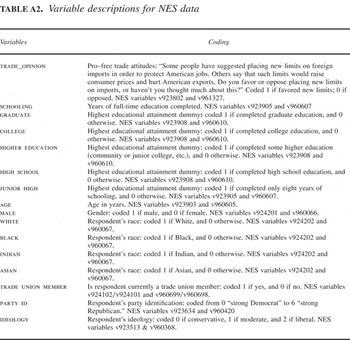
The principal measure of education is schooling, which simply records the years of full-time education completed by each respondent (a cap is set by the NES at seventeen years). This is the measure employed by Scheve and Slaughter. To allow for nonlinear education effects, we have also constructed a set of dummy variables indicating each respondent's highest level of educational attainment: junior high (1 = 8 years of schooling; 0 = otherwise); high school (1 = high school degree; 0 = otherwise); higher education (1 = some years of post–high school education, including junior or community college; 0 = otherwise); college (1 = four-year bachelor's degree; 0 = otherwise); and graduate (1 = postgraduate degree; 0 = otherwise).29
Note that there are too few respondents who failed to finish elementary school to allow us to estimate the separate effect of elementary-level education here: the excluded category in our analysis of education effects when using these dummy variables is all those with less than eight years of schooling.
For different subsamples of respondents, we estimated binary probit models using trade opinion as the dependent variable, testing for the effects of schooling or the different education dummy variables while controlling for a variety of other individual characteristics that might plausibly affect trade preferences. We estimated each model with two sets of covariates: a limited set of standard sociodemographic controls (age, in years, gender, and race), which preserved the maximum number of observations across the subsamples; and a more extensive set of controls (the standard controls plus indicators of union membership, party identification, and ideology), which closely matched the more extensive specifications used by Scheve and Slaughter.30
We have used age in years, because this is the most straightforward approach and is the measure provided in the NES data; Scheve and Slaughter 2001b instead included a range of dummy variables covering separate age brackets. We have reestimated all our results using the respective age dummies and the results are virtually identical. We have also used dummy variables for multiple racial categories here, while Scheve and Slaughter appear to have used a single-race dummy variable. Again, the results are almost identical regardless of how the race variable is entered in the models. The main variables we exclude are the ones constructed by Scheve and Slaughter using non-NES data: sector net export share (net exports as a share of output for the industry in which the respondent is employed), and sector tariff (customs duties as a share of the total value of imports for the industry in which the respondent is employed). Neither of these variables have significant effects on trade preferences, according to the results reported by Scheve and Slaughter (2001b, 59–60), and their inclusion in the estimations makes no difference at all to the estimated effects of education on trade opinion. We also excluded the other variables Scheve and Slaughter derive from non-NES data—the measure of occupation wage (the national average weekly wage for the respondent's occupation, which they use as an alternative to years of education as an indicator of skill level), and measures of county exposure to trade liberalization (the shares of total employment in the respondent's home county accounted for by industries with above average tariffs or net imports). Scheve and Slaughter find that county exposure, when interacted with a dichotomous indicator of home ownership, does have a significant negative impact on support for trade openness, but the inclusion of these added controls in their models has a minuscule and statistically insignificant effect on the estimated impact of education on trade preferences (2001a, 285; 2001b, 64), so we have not attempted to replicate the construction of these added controls here. Note that, because there is very little missing data for variables measured in the NES (the schooling measure has only 6 percent of observations missing in 1992, and 0 percent missing in 1996), and there is less missing data for all the other variables), we do not have to resort to imputation of missing data—Scheve and Slaughter (2001a, 278) report having to impute up to 73.4 percent of the observations for other (non-NES) variables they included in their analysis.
We expect the measures of education to be negatively associated with support for trade protection (as measured by trade opinion), either because highly skilled individuals expect trade to increase their real wages and poorly skilled respondents expect trade to decrease their real wages (à la Stolper-Samuelson), because more-educated respondents know more about the overall economic benefits associated with trade openness, and/or because the more-educated are less likely to nurture antiforeigner sentiments. If this link between education and individual attitudes toward trade is primarily due to expectations about wages, however, the results from our estimations of trade preferences among respondents not actively engaged in the labor market should differ substantially when compared with those from our estimations of preferences among respondents who are currently employed. To test for this difference, we created subsamples of the full NES survey sample, separating those who were in paid work from those not in paid work.31
The subsamples are determined by answers to a NES question asking respondents about their current employment status. Answer choices included the following: working now, temporarily laid-off, unemployed, retired, student, homemaker, and permanently disabled. Our “currently in paid work” subsample includes those that answered “in work now”; those answering otherwise are classified as “currently not in paid work.” Those with missing employment status are coded as missing. We also include those few retired/students/disabled/homemakers who also indicated that they are “currently working more than 20 hours per week” in our “currently in paid work” subsample. When the latter are excluded from the “currently in paid work” subsample, the magnitudes of the schooling effect become, if anything, more similar across the in- and out-of-paid-work subsamples than in the results we show here. Full results of these robustness tests are available on request.
While pensions for retired workers in some prominent U.S. industries (for example, steel) have been linked to the financial health of their former employers, this is the exception and not the rule. Recent studies of U.S. retirees indicate that less than 17 percent of retirement income in the median household comes from employer-provided pension plans (see Sass 2003, 6; and Social Security Administration 2002). The connection between employer-provided pensions and the financial health of the firm also is attenuated by the standards for funding and fiduciary conduct established by the Employee Retirement Income Security Act in 1974 (see Sass 1997). On this issue, we might also note that we get identical results when we perform the same tests comparing retirees with workers using the ISSP data (see below), drawn from a variety of countries with a variety of pension and retirement income systems.
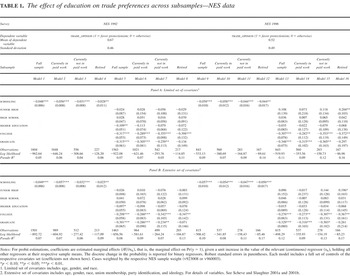
The key results from the estimations are reported in Table 1, which displays the estimated effects of education on individual trade preferences in the full NES sample and in each of the different subsamples. To facilitate comparison across subsamples, rather than showing estimated probit coefficients, we report estimated marginal effects: that is, the change in the probability of favoring protectionism associated with an infinitesimal change in schooling (for the specific dummy variables for levels of highest educational attainment, the discrete change in the probability is shown).
The effect of education on trade preferences across subsamples—NES data

Comparing the results across the subsamples, we find little difference in the estimated effects of education on attitudes toward trade. In all cases, the estimated effects of schooling are similar, both in terms of magnitude and level of statistical significance, across all models (none of the coefficients is significantly different from the others across subsamples at conventional levels). This is true for estimations using both the 1992 and the 1996 NES data. For example, in the case of the 1996 survey, using the extensive set of covariates, a change from zero to seventeen years of schooling (while holding the other covariates at their respective sample means) is associated with an average decrease in the probability of favoring protection of about 0.59 (s.e. 0.05) for the full sample, 0.51 (s.e. 0.09) for those currently in paid work, 0.48 (s.e. 0.11) for those currently not in paid work, and 0.53 (s.e. 0.11) for those who are retired (Models 9 to 12, Panel B).33
Predicted effects here, and below, are calculated using the “Clarify” software developed by King, Tomz, and Wittenberg 2001. For each such calculation, all other covariates are set at the sample mean values.
Note that since we show marginal effects, the magnitudes of the effects of the dichotomous education variables can be read directly from the table.
Overall, these results clearly indicate that the link between education and trade preferences reflects a causal mechanism that is not associated with concerns about the labor market and relative wage rates. The findings here are consistent with both types of alternative interpretations, however, suggesting that more-educated individuals favor free trade because they are more likely to understand the economic case for trade openness and/or because they possess more cosmopolitan (or less xenophobic) outlooks—because there is no reason to believe that the effects of education on the economic knowledge or cultural values possessed by different individuals is conditional at all on whether or not they are currently in the workforce.
These alternative interpretations are also supported by the clear nonlinearities that are apparent in the relationship between education and views about trade. Once we relax the linearity restriction imposed by simply counting years of education (the schooling measure), we can see that the effects of education on trade preferences are described by a nonlinear step function: college education has by far the greatest negative impact on support for protection, about three times larger than higher education (which is not itself a robust predictor), and about six times bigger than high school education (which is also not itself a robustly significant predictor and seems to have, if anything, a positive effect on support for protection) or completion of junior high education (which also enters mostly insignificant and with alternate signs); the impact of graduate education is almost identical to the effects of college education. For instance, looking again at the estimates in the 1996 NES (full sample), and the limited set of covariates, compared with individuals with less than a junior high education, completing college education reduces the probability of supporting protection by 0.31 (s.e. 0.08), compared to only 0.04 (s.e. 0.09) for higher education; finishing high school education raises the probability of support for protection by 0.04 (s.e. 0.08) and so does completing junior high grades by 0.11 (s.e. 0.14), though all three latter effects are not statistically significant. Meanwhile, completing graduate education reduces the probability of protectionist views by 0.35 (s.e. 0.08), an effect not significantly different from that associated with completing an undergraduate college education (see Model 13, Panel A).
There appears to be a clear “plateau” effect here, with exposure to college education being the critical contributor to the generally positive relationship between education and support for free trade. This college plateau effect seems out of place with the theory about labor market competition and its effects on trade preferences, especially because it applies to retirees as much as to those individuals currently active in the job market. On the other hand, this pattern fits much better with alternative approaches to explaining attitudes toward trade and foreign affairs that focus on competing ideational and cultural perspectives and the way education—but especially college education—teaches students to think about trade and globalization in different ways or to evaluate it by different standards.
Tests Using the ISSP Data
Our second data set is the 1995 National Identity module of the ISSP, the main data examined by Mayda and Rodrik in their recent study of the determinants of individual trade preferences.35
The ISSP collects cross-national data by coordinating and combining national surveys on a variety of topics: the 1995 module posed a variety of questions about national identity, patriotism, attachments to local communities, feelings about foreigners, and attitudes toward foreign trade and immigration.36For details, see ISSP 1998. See also 〈http://www.issp.org/〉.
The specific countries are West Germany, East Germany, Great Britain, United States, Austria, Hungary, Italy, Ireland, Netherlands, Norway, Sweden, Czech Republic, Slovenia, Poland, Bulgaria, Russia, New Zealand, Canada, Philippines, Japan, Spain, Latvia, and Slovak Republic.
Our treatment of the ISSP data follows precisely the measurement and estimation strategies employed by Mayda and Rodrik. Accordingly, we measure individual trade policy preferences using respondents' answers to the following question:38
See Mayda and Rodrik 2005, 1401, for a discussion of the potential problems associated with the question wording.
Now we would like to ask a few questions about relations between (respondent's country) and other countries. How much do you agree or disagree with the following statements: (Respondent's country) should limit the import of foreign products in order to protect its national economy.
Options:
- Agree strongly
- Agree
- Neither agree nor disagree
- Disagree
- Disagree strongly
- Can't choose, don't know
- NA, refused
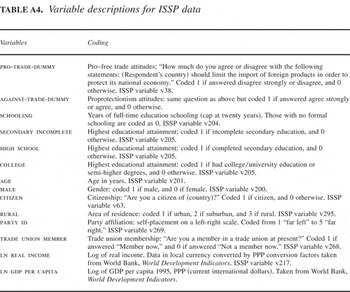
Following Mayda and Rodrik, we created two binary variables, labeled pro-trade-dummy and against-trade-dummy, based on responses to this question. pro-trade-dummy is coded 1 for individuals opposing trade protection (that is, for those replying “disagree” or “disagree strongly” to the question), and 0 otherwise. against-trade-dummy is coded 1 for individuals favoring trade protection (that is, for those replying “agree” or “agree strongly” to the question), and 0 otherwise. Accordingly, the “Can't choose, don't know” and “NA, refused” responses are coded as zero. Since the results from the estimations of the pro-trade-dummy and against-trade-dummy are substantively similar, we just emulate Mayda and Rodrik here and present only the results using the analysis of the pro-trade-dummy.39
Mayda and Rodrik note that their results are also unchanged if they treated “Can't choose, don't know” and “NA, refused” as missing data, and the same is true for our findings. In addition, Mayda and Rodrik report that they also used a categorical dependent variable (labeled trade_op) to estimate ordered logit (and OLS regression) models and obtained “very similar” substantive results (2005, 1397).
Once again the principal measure of education, schooling is simply a count of the years of full-time education completed by each respondent (we follow Mayda and Rodrik and set a cap at twenty years). In order to test for nonlinearities in the effects of education on attitudes, we again construct a set of highest educational attainment dummy variables that include secondary incomplete (1 = some secondary education; 0 = otherwise), high school (1 = high school degree; 0 = otherwise), and college (1 = university education; 0 = otherwise). The reference category here comprises those respondents who have only a primary school education (or less). Unlike the NES data, the ISSP does not allow us to distinguish any finer categories here; no separate coding for graduate education is available, so the college category here includes respondents with advanced or higher university degrees (and those who attended college but did not complete a degree).
Our estimation strategy is identical to the one we applied for the analysis of the NES data. We estimate two series of binary probit models in which the pro-trade-dummy is estimated using either schooling or the set of education dummy variables and other covariates. We estimated all the models for all subsamples using three sets of controls. Our limited set of controls includes just age, gender, and citizenship and a full set of country dummies. This mirrors precisely the baseline specification as presented in the analysis by Mayda and Rodrik.40
Mayda and Rodrik 2005, 1403, tab. 4, col. 1.
Following Mayda and Rodrik 2005, we compute real income using data in local currency from the ISSP dataset and purchasing power parity conversion factors taken from the World Bank's World Development Indicators database. See 〈http://www.worldbank.org/data/wdi2004/〉. Accessed 10 January 2006.
GDP per capita data is taken from the World Bank's World Development Indicators (1995 current international dollars, adjusted for purchasing power parity). Note that the direct effect of country GDP per capita on the attitudes of respondents is captured by the country dummies and is not estimated separately. See Mayda and Rodrik 2005, 1405, for a detailed discussion of the specification.
Again we created subsamples of the full ISSP survey sample, separating those who were “in paid” work from those “not in paid” work. Since the ISSP variable coding the employment status of respondents also differentiates between those in full- and part-time employment, we define those in (and not in) paid work using both possible combinations (just those in full-time work or all those working).43
The subsamples are determined by answers to a question asking respondents about their current employment status. Answer choices included the following: full-time employed, part-time employed, less than part-time employed, helping family member, unemployed, student, homemaker, retired, permanently disabled, and other. Our “currently in paid work” subsample includes all those answering “employed (either part-time or full-time)” to this question. Those with missing employment status are coded as missing. We also reestimated all models including those working “less than part-time” in the “currently in paid work” subsamples. The results are substantively identical to those in Table 2 (and are available on request).
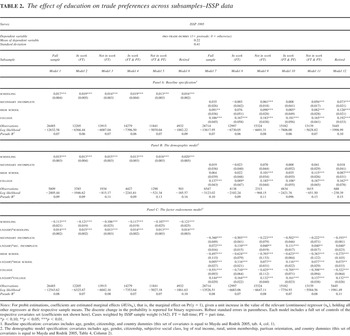
The effect of education on trade preferences across subsamples–ISSP data

Overall, the findings from the analysis of the ISSP data are similar to the results from the analysis of the NES data reported above. Here the estimated effects of schooling on attitudes toward trade are almost identical, both in terms of magnitude and level of statistical significance, across all subsamples, and regardless of whether we examine the baseline (Panel A), the demographic (Panel B), or the factor endowment models (Panel C). None of the schooling effects are significantly different from others across the subsamples at conventional levels. For example, in the baseline model, a shift from zero to twenty years of schooling (while holding the other covariates at their respective sample means) increases the probability of favoring trade by about 0.34 (s.e. 0.05) in the full sample, by 0.37 (s.e. 0.06) in the in (full-time) work subsample, by 0.31 (s.e. 0.05) for the not-in-full-time-work subsample, and by 0.33 (s.e. 0.05) in the retired subsample (Models 1 to 6, Panel A). These estimated effects of education are very similar regardless of whether those working on a part-time basis are included in the “paid work” subsample or not. The same holds true if we account for potential cross-country heterogeneity with respect to the education effect (Panel C). Both the direct effect of schooling and its interaction with GDP per capita are almost identical across subsamples. The similarity in these effects across the different subsamples of respondents is again clearly at odds with the claim that the schooling coefficients are primarily indicative of concerns among respondents about the effects of trade openness on labor markets and relative wages.
If we relax the linearity restriction and replace the schooling measure with the education dummy variables, it is clear that the impact of the education on trade preferences remains very similar across the subsamples. It also becomes apparent again that the effects of education on opinions about trade are nonlinear. Specifically, college education has by far the greatest positive effect on individual-level support for free trade, two-to-three times bigger than the impact of high school education (which is not a robustly significant predictor of attitudes); meanwhile, incomplete secondary education appears to have little if any effect on support for free trade (only very few of the coefficients enter significant at conventional levels and some even switch signs). For instance, in the demographic model (Model 7, Panel B), and comparing with individuals with only primary level education, college education shifts the probability of being protrade by 0.14 (s.e. 0.04) as compared to only 0.06 (s.e. 0.04) for completing high school education; and incomplete secondary education increases the probability of being pro free trade by a mere 0.02 (s.e. 0.04)—the latter two effects are insignificant at conventional levels. The same nonlinearities are clear when cross-country heterogeneity in the education effect is taken into account. For example, for the full sample in the factor endowments model (Model 7, Panel C), evaluated at the sample mean level of GDP per capita among the ISSP nations ($15,987), a college education raises the probability of being protrade by 0.18 (s.e. 0.01) compared to a primary level education; the corresponding effect is only 0.09 (s.e. 0.01) for completing high school education, and an incomplete secondary education increases the probability of being pro free trade by a mere 0.04 (s.e. 0.01). The pattern here strongly resembles the college “plateau” effect found in the analysis of the NES data, and again confirms—this time based on data drawn from surveyed twenty-three nations—that exposure to college education among individuals lies at the heart of the observable relationship between education and support for free trade. Regardless of which model we estimate, the college effect is strikingly similar across all subsamples.
One issue we need to address here concerns the cross-country heterogeneity with respect to the education effect that is evident in the results from the estimations of factor endowments model. As reported by Mayda and Rodrik, we find that the schooling*gdp interaction term is positive—in all of the subsamples. The implication is that the impact of education on individual attitudes toward trade varies by country depending on levels of economic development. For example, examining the full-sample estimates (Model 1, Panel C), a shift from zero to twenty years of schooling (other covariates at their respective sample means) increases the probability of favoring trade openness by about 0.49 (s.e. 0.03) in a country with GDP per capita of $22,039 (that is, Germany in 1995) but by only 0.27 (s.e. 0.02) in a country with GDP per capita of $11,720 (the Czech Republic in 1995).
This result is consistent with the Stolper-Samuelson theorem, but it also seems consistent with the alternative ideational and cultural accounts of the causal effects of education on attitudes toward trade (accounts that can also explain the similarity in the effects of education across labor-market subsamples in each country). In line with an ideational approach, it seems highly likely that there are important cross-national differences in the content and quality of instruction in economics at the college level that are related to cross-national differences in levels of development across these surveyed countries. Economists and other scholars in less-developed countries may be more concerned than their counterparts in wealthier nations about the adjustment costs associated with trade liberalization, or the fairness of trade negotiations and agreements, and convey these concerns to students. Or, more in line with a cultural account that stresses the link between education and values, it also seems plausible that education systems in richer ISSP nations, which have longer histories of democratic institutions than poorer nations, may place greater emphasis on inculcating tolerance among students, and thus may more effectively discourage antiforeigner (and protectionist) sentiments. The general point here is that there are plausible explanations for the observed differences between richer and poorer ISSP countries in the effects of education on attitudes toward trade that fit with the ideational and cultural accounts; the similarities in the effects of education across subsamples of individuals within each country, and the college plateau effect, are also consistent with these same accounts, but they contradict the Stolper-Samuelson view.44
In general we do not place great importance on the finding that the schooling*gdp interaction term is positive for the ISSP set of countries—in our analysis of the alternative Pew data on individual trade preferences, which includes a much larger and more varied set of countries (see discussion below), we do not find the same, simple positive relationship between GDP per capita and the magnitude of the education effect. The breakdown of this relationship among countries with more varied political and institutional histories suggests that it does not provide firm support for a Stolper-Samuelson interpretation. These results are available at 〈http://www.people.fas.harvard.edu/∼jhainm/HainmuellerHiscox_IOa.html〉.
Family Income Effects?
It seems impossible to square the findings we have reported above with a simple Stolper-Samuelson reading of the effects of education on trade policy preferences. One possible counterargument, in defense of the Stolper-Samuelson interpretation, is that individuals who themselves are not employed or seeking employment are nevertheless concerned about the distributional effects of trade because it will have an impact on their total family or household income. Thus individuals who are not employed and describe themselves as “homemakers” may actually be making calculations about the effects of trade on the earnings of their spouse or partner when responding to survey questions. Similarly, retired individuals may be taking into account the effects of trade on the earnings of their children. If these are powerful concerns, and if there is a strong and positive within-family correlation in levels of education, expectations about within-family income transfers might feasibly explain the results we are reporting here in a way that would still be broadly consistent with the spirit of the Stolper-Samuelson theorem. To the best of our knowledge, this family income extension of the theorem has not actually been advanced or tested before—no such claims are made by Scheve and Slaughter or Mayda and Rodrik. On the face of it, we think this potential explanation seems quite implausible, given the clear similarities between the education effects across subsamples, the imperfect correlation between individual education attainment and spouses' or partners' (or children's) education levels, and the uncertainty attached to within-family income transfers. The connection between retirees' incomes and the earnings of their children seems especially tenuous, because most retirees in Western countries rely overwhelmingly on personal savings, retirement accounts, and state-provided pensions for their retirement income.
We tested the alternative explanation using the NES data, which provide the best available data on individual marital status.45
Unfortunately, we cannot conduct a similar analysis for the ISSP survey, because far too much data is missing on the marital status of the respondents. We have repeated these tests using the data from the Pew survey, however, and have found substantively identical results (findings from these additional tests are also available from the authors).
We have also rerun our models for each subsample using a multiplicative term (partner*schooling) alongside the main effect of partner and the results are very similar to the ones reported below. Nonetheless, given the high correlation between the multiplicative and its lower-order terms we prefer the split-sample tests as our identification strategy.
Note too, that in the specifications that replace the single schooling variable with separate educational dummies, we also exclude the junior high attainment dummy, because there are no observations for this category in some subsamples.
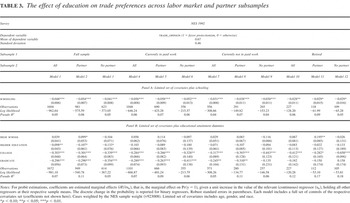
The effect of education on trade preferences across labor market and partner subsamples

The similarities in the effects of education across subsamples appear again here, regardless of whether we limit the analysis to those respondents who have a spouse/partner or to those who do not. In all cases the estimated effects of schooling are similar, both in terms of magnitude and level of statistical significance. Most importantly, within and across each subsample, we cannot reject the null hypothesis that the education effects are identical (at the 90 percent level). For example, for the full sample estimates, a change from zero to seventeen years of schooling (while holding the other covariates at their respective sample means) is associated with an average decrease in the probability of favoring protection of about 0.48 (s.e. 0.03) for all respondents, 0.50 (s.e. 0.04) for those respondents that have a partner/spouse, and 0.44 (s.e. 0.06) for those that do not have a partner/spouse. Looking only at those that are currently in paid work, the respective decrease is 0.50 (s.e. 0.04) for all respondents, 0.51 (s.e. 0.05) for those that have a partner/spouse, and 0.47 (s.e. 0.08) for those that do not. For those respondents that are out of the workforce, the respective decrease is 0.35 (s.e. 0.07) for all, 0.38 (s.e. 0.09) for with a partner, and 0.35 (s.e. 0.11) for those without. Finally, for the retired subsample, the respective decrease is again very similar, about 0.32 (s.e. 0.11) for all, 0.33 (s.e. 0.14) for those with and 0.33 (s.e. 0.18) for those without a partner/spouse.
The same results emerge when we rerun the models, replacing the schooling measure with the educational attainment dummies. Most importantly, the key college effect remains strikingly stable across models even if we divide the subsamples using the partner variable. For example for the full sample, completing college education decreases in the probability of favoring protection by about 0.30 (s.e. 0.05) for all respondents, by about 0.30 (s.e. 0.06) for those with partner/spouse, and by 0.34 (s.e. 0.08) for those without (all compared to those that did not complete a high school degree). For those currently in work, the respective decrease is 0.29 (s.e. 0.07) for all respondents, 0.27 (s.e. 0.08) for those with, and 0.33 (s.e. 0.14) for those without a partner/spouse. For those not working, the respective decrease is 0.32 (s.e. 0.09) for all respondents, 0.39 (s.e. 0.13) for those with, and 0.44 (s.e. 0.12) for those without a partner/spouse. The retired subsample reveals the greatest differences in magnitudes of the college effect. The decrease in proprotection attitudes associated with completing college is 0.41 (s.e. 0.12) for all respondents, 0.28 (s.e. 0.17) for those with, and 0.66 (s.e. 0.10) without a partner. This difference is, if anything, the opposite of what one would expect if one simply assumed that retirees with partners were assessing the effects of trade on the incomes of their (working and similarly educated) partners while retirees without partners were not.
If we just compare the effects of college (or schooling) across subsamples of respondents that do not have partners—a test that presumably excludes the bulk of any family income effects—it is clear that these effects are not significantly different, regardless of whether those respondents are working, not working, or retired. Certainly the effects are not significantly larger for those being paid for the employment of their skills than for others, as implied by a simple Stolper-Samuelson interpretation of the impact of education. Overall, the findings suggest that a broader family or household interpretation of the Stolper-Samuelson theorem cannot account for the results we have found.
Findings and Implications
Previous research has concluded that the simple association that is evident between education and support for trade openness among survey respondents in the United States and other Western nations is proof positive of the Stolper-Samuelson theorem. That is, this relationship is seen as a straightforward confirmation that high-skilled individuals in skill-abundant economies perceive that trade openness raises their real wages while low-skilled individuals calculate that their real wages decrease with trade liberalization. But if these calculations are paramount, the effects of education on individual trade policy preferences should be conditional on whether or not individuals are actually being paid for the employment of their skills in the labor market. Reexamining the available survey data on individual attitudes toward international trade in a variety of nations, we find that this is simply not the case. The impact of education on attitudes toward trade is almost identical among respondents currently in the active labor force and among those who are not—and even among those who are retired from work. In addition, the impact of education on attitudes is overwhelmingly attributable to college education. We have replicated all the tests we report above using two alternative cross-national survey data sets—the third wave of the World Values Survey carried out in 1995–97, and the Global Attitudes Project survey administered by Pew in 2003—and we have found substantively identical results.48
Full results from all these separate tests are available in a supplement to this paper that can be downloaded at 〈http://www.people.fas.harvard.edu/∼jhainm/HainmuellerHiscox_IOa.html〉.
Given these results, a fundamental reinterpretation of the survey evidence on attitudes toward trade and globalization appears to be in order. The results reported above indicate that the effects of education levels on trade policy preferences are not primarily a reflection of distributional concerns among survey respondents. We suggest instead that the impact of education on how individuals think about trade and globalization has more to do with ideas and information about the aggregate effects of these economic phenomena. Some part of the effect of education on attitudes toward trade might also reflect the fact that college-educated individuals are less likely than others to harbor antiforeigner sentiments. Which of these two causal mechanisms—ideational or cultural—is more important? Unfortunately, no opinion surveys (of which we are aware) gather all the data that one would need to answer this question definitively. That is, no surveys ask respondents about their views regarding trade, also ask questions designed to measure economic knowledge or exposure to economic ideas, and also ask questions that would gauge individuals' commitments to values such as tolerance and cosmopolitanism. For now we only have some clues provided by studies of partial sets of data—but these clues suggest to us that the smart betting would be on the ideational argument.
One major clue comes from the available data on economic knowledge among the public and its impact upon trade policy preferences. As far as we are aware, the only survey that has actually combined measures of both economic knowledge and attitudes toward trade is the 1992 poll conducted by William Walstad and Max Larsen for the National Center for Research on Economics Education and for Gallup.49
See Walstad 1997; and Walstad and Rebeck 2002.
See Walstad 1997, 201.
Full results from our tests using the Walstad and Larsen data are available at 〈http://www.people.fas.harvard.edu/∼jhainm/HainmuellerHiscox_IOa.html〉.
On the other side of this coin, adding various measures of individuals' commitments to various relevant cultural values (such as tolerance and cosmopolitanism) to estimations of attitudes toward trade appears to have almost no effect at all on the magnitude or significance of the effects of standard measures of education. For instance, using the ISSP survey data that asked a large number of “identity” questions, Mayda and Rodrik introduced an array of controls for (self-expressed) national pride and attachment to local their communities when estimating individual support for trade protection. Many of these cultural variables had significant and sizeable effects on trade preferences, but they had no significant effect at all on the estimated effects of education on such preferences.52
Mayda and Rodrik 2005, 1414–16.
Results from all these separate tests are available from the authors are available at 〈http://www.people.fas.harvard.edu/∼jhainm/HainmuellerHiscox_IOa.html〉.
Conclusions
Finally, it is important to note that while these results indicate that the impact of education on trade preferences has more to do with ideas and economic literacy than it does with calculations about how trade affects personal income or job security, this is not to say that the latter types of calculations are not important in shaping individuals' views of trade. Our conclusion in this article is just that the simple association between education and support for free trade among surveyed individuals is not a clear manifestation of such distributional concerns. We strongly suspect that concerns about the effects of trade on personal economic well-being do play a large role in shaping trade policy preferences, but they are related much more directly to the impact that trade openness is expected to have in particular industries and firms. “Specific factors” models of the distributional effects of trade that, unlike the Stolper-Samuelson theorem, allow that factors of production are not perfectly mobile between different sectors in the economy, predict that the real incomes of individuals are tied closely to the fortunes of the particular industries in which they are employed or invested.54
See Jones 1971; and Mussa 1974. The specific factors approach underpins much of the most recent analysis of the political economy of trade in contemporary advanced economies: see Magee 1980; Grossman and Helpman 1994; and Hiscox 2002.
To date, studies of individual trade preferences have indicated only weak (Mayda and Rodrik) or no (Scheve and Slaughter) support for the prediction that individuals employed in import-competing industries will be much less likely to support trade openness than those employed in exporting industries. But these studies have measured the industry-specific effects of trade in an indirect way, locating respondents by industry using answers to a standard question about the type of business in which they are employed, then controlling for the aggregate trade positions of those industries (for example, their degrees of import penetration) when estimating individual trade preferences.55
Scheve and Slaughter 2001a and 2001b examine industry effects using this approach and industry coding supplied in the NES. Mayda and Rodrik 2005 were forced to take an extra step: because the ISSP data does not provide coding by industry, they inferred industry of employment from occupational codes assigned to respondents instead.
When the staff at the Panel Study of Income Dynamics checked a random sample of surveys, for instance, they found that industry codes differed across coders in 14 percent of cases. See Panel Study of Income Dynamics 1999.
The standard concern about using import penetration as a measure of an industry's trade policy preference is that low levels of penetration may reflect the effectiveness of a protectionist lobby (not the absence of concerns about import competition).
One of the implications of our findings is that future survey-based measurements need to be substantially refined to better account for industry-specific effects if we are to accurately gauge the impact of distributional concerns on attitudes toward trade and globalization.58
One recent study, for instance, questioned respondents directly about the likely impact of trade on the security of their particular job, asking them whether they felt that increasing trade made their job more secure, less secure, or had no clear effect (see Hiscox 2004). The estimated probability of support for trade was some 45 percent higher among respondents for whom trade had raised job security compared with those reporting that trade made their job less secure.
Appendix: Summary Statistics and Variable Descriptions
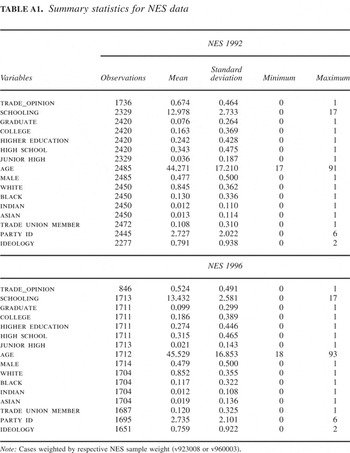
Summary statistics for NES data

Variable descriptions for NES data

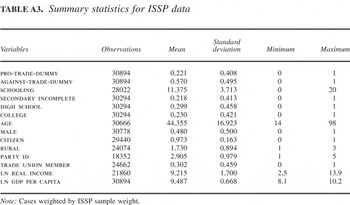
Summary statistics for ISSP data

Variable descriptions for ISSP data

References
REFERENCES
Adler, Emanuel.
1992.
The Emergence of Cooperation: National Epistemic Communities and the
International Evolution of the Idea of Nuclear Arms Control.
International Organization
46 (1):101–45.Google Scholar
Allport, G.
1954.
The Nature of Prejudice.
Reading, Mass.:
Addison & Wesley.
Baker, Andy.
2003.
Why Is Trade Reform so Popular in Latin America?
World Politics
55 (3):423–55.Google Scholar
Balistreri, Edward J.
1997.
The Performance of the Heckscher-Ohlin-Vanek Model in Predicting
Endogenous Policy Forces at the Individual Level.
Canadian Journal of Economics
30 (1):1–17.Google Scholar
Bauer, Raymond A.,
Ithiel de Sola Pool, and
Lewis Anthony Dexter.
1972.
American Business and Public Policy: The Politics of Foreign
Trade.
2d ed. Chicago:
Aldine-Atherton.
Beaulieu, Eugene.
2002.
Factor or Industry Cleavages in Trade Policy? An Empirical Analysis
of the Stolper-Samuelson Theorem.
Economics and Politics
14 (2):99–131.Google Scholar
Betts, Katherine.
1988.
Ideology and Immigration: Australia 1976 to 1987.
Melbourne, Australia:
Melbourne University Press.
Bhagwati, Jagdish.
1988.
Protectionism.
Cambridge, Mass.:
MIT Press.
Campbell, Angus,
Philip E. Converse,
Warren E. Miller, and
Donald E. Stokes.
1960.
The American Voter: Chicago.
Chicago:
University of Chicago Press.
Case, C. E.,
A. M. Greeley, and
S. Fuchs.
1989.
Social Determinants of Racial Prejudice.
Sociological Perspectives
32 (4):469–83.Google Scholar
Destler, I. M.
1995.
American Trade Politics.
3d ed. Washington, D.C.:
Institute for International Economics.
Erikson, Robert S.,
Norman R. Luttbeg, and
Kent L. Tedin.
1991.
American Public Opinion: Its Origins, Content, and Impact.
4th ed.
New York:
Macmillan.
Finnemore, Martha, and
Kathryn Sikkink.
1998.
International Norm Dynamics and Political Change.
International Organization
52 (4):887–917.Google Scholar
Gabel, Matthew J.
1998.
Interests and Integration: Market Liberalization, Public Opinion,
and European Union.
Ann Arbor:
University of Michigan Press.
Gleason, J., and
L. J. Van Scyoc.
1995.
A Report on the Economic Literacy of Adults.
Journal of Economic Education
26 (3):203–10.Google Scholar
Goldstein, Judith.
1988.
Ideas, Institutions, and American Trade Policy.
International Organization
42 (1):179–217.Google Scholar
Goldstein, Judith, and
Robert Keohane, eds.
1993.
Ideas and Foreign Policy: Beliefs, Institutions, and Political
Change.
Ithaca, N.Y.:
Cornell University Press.
Grossman, Gene, and
Elhanan Helpman.
1994.
Protection for Sale.
American Economic Review
84 (4):833–50.Google Scholar
Haas, Peter M., ed.
1992.
Knowledge, Power and International Policy Coordination.
Columbia:
University of South Carolina Press.
Hall, Peter A., ed.
1989.
The Political Power of Economic Ideas.
Princeton, N.J.:
Princeton University Press.
Hainmueller, Jens, and
Michael J. Hiscox.
2004.
Educated Preferences: Explaining Individual Attitudes Toward
Immigration in Europe.
Paper presented at the Annual Meeting of the American Political
Science Association, Chicago, September.
Hiscox, Michael J.
2002.
International Trade and Political Conflict.
Princeton, N.J.:
Princeton University Press.
Hiscox, Michael J.
2004.
Through a Glass and Darkly: Attitudes Towards International Trade
and the Curious Effects of Issue Framing.
Paper presented at the Annual Meeting of the American Political
Science Association, Chicago, September.
Holsti, Ole. R.
1996.
Public Opinion and American Foreign Policy.
Ann Arbor:
University of Michigan Press.
International Social Survey Program (ISSP).
1998.
International Social Survey Program: National Identity, 1995
[computer file].
ICPSR release.
Cologne, Germany:
Zentralarchiv für Empirische Sozialforschung/Ann
Arbor, Mich.:
Inter-University Consortium for Political and Social Research.
〈www.icpsr.umich.edu〉.
Jones, Ronald.
1971.
A Three-Factor Model in Theory, Trade, and History. In
Trade, Balance of Payments, and Growth, ed.
Jagdish Bhagwati,
Ronald Jones,
Robert A. Mundell, and
Jaroslav Vanek,
3–21.
Amsterdam:
North-Holland.
Katzenstein, Peter, ed.
1996.
The Culture of National Security: Norms and Identity in World
Politics.
New York:
Columbia University Press.
Keck, Margaret E., and
Kathryn Sikkink.
1998.
Activists Beyond Borders.
Ithaca, N.Y.:
Cornell University Press.
Kindleberger, Charles.
1975.
The Rise of Free Trade in Western Europe.
Journal of Economic History
35 (1):20–55.Google Scholar
King, Gary,
Michael Tomz, and
Jason Wittenberg.
2001.
Clarify: Software for Interpreting and Presenting Statistical
Results. Version 2.0.
Harvard University.
Krugman, Paul A.
1993.
What Do Undergrads Need to Know About Trade?
American Economic Review
83 (2):23–26.Google Scholar
Magee, Stephen.
1980.
Three Simple Tests of the Stolper-Samuelson Theorem. In
Issues in International Economics, edited by
P. Oppenheimer,
138–53.
London:
Oriel Press.
Mayda, Anna Maria.
2004.
Who Is Against Immigration? A Cross-Country Investigation of
Attitudes Towards Immigrants.
IZA Discussion Paper 1115.
Bonn, Germany:
Institute for the Study of Labor.
Mayda, Anna Maria, and
Dani Rodrik.
2005.
Why Are Some People (and Countries) More Protectionist than
Others?
European Economic Review
49 (6):1393–430.Google Scholar
McClosky, Herbert, and
Alida Brill.
1983.
Dimensions of Tolerance: What Americans Believe About Civil
Liberties.
New York:
Russell Sage Foundation.
Miller, Warren E.,
Donald R. Kinder,
Steven J. Rosenstone, and
the National Election Studies.
1992.
American National Election Study, 1992: Pre- and Post-Election
Survey [Enhanced with 1990 and 1991 Data] [computer
File]. 2d. ICPSR ed.
Ann Arbor:
University of Michigan, Center for Political Studies, and
Inter-University Consortium for Political and Social Research.
〈www.icpsr.umich.edu〉.
Mussa, M.
1974.
Tariffs and the Distribution of Income.
Journal of Political Economy
82 (6):1191–203.Google Scholar
O'Rourke, Kevin, and
Richard Sinnott.
2002.
The Determinants of Individual Trade Policy Preferences. In
Brookings Trade Forum, edited by
Susan M. Collins and
Dani Rodrik,
157–96.
Washington, D.C.:
Brookings Institution.
Panel Study of Income Dynamics.
1999.
1968–1980 Retrospective Occupation-Industry Files
Documentation.
Ann Arbor:
Survey Research Center, University of Michigan.
Price, Richard.
1998.
Reversing the Gun Sights: Transnational Civil Society Targets Land
Mines.
International Organization
52 (3):613–44.Google Scholar
Pryor, Frederic.
2002.
General Discussion. In
Brookings Trade Forum, edited by
Susan M Collins and
Dani Rodrik,
201–3.
Washington, D.C.:
Brookings Institution.
Rogowski, Ronald.
1989.
Commerce and Coalitions.
Princeton, N.J.:
Princeton University Press.
Rosenstone, Steven J.,
Donald R. Kinder,
Warren E. Miller, and
the National Election Studies.
1996.
American National Election Study, 1996: Pre- and Post-Election
Survey [Computer file]. 4th version.
Ann Arbor:
University of Michigan, Center for Political Studies
[producer], 1999.
Ann Arbor, MI:
Inter-university Consortium for Political and Social Research
[distributor], 2000.
Ruggie, John Gerard.
1998.
What Makes the World Hang Together?
International Organization
52 (4):855–85.Google Scholar
Sass, Steven.
1997.
The Promise of Private Pensions.
Cambridge:
Harvard University Press.
Sass, Steven.
2003.
Reforming the U.S. Retirement Income System: The Growing Role of
Work.
Issues in Brief 1;
Boston College, Mass.:
Center for Retirement Research.
Saunders, P.
1980.
The Lasting Effects of Introductory Economics Courses.
Journal of Economic Education
12 (1):1–14.Google Scholar
Scheve, Kenneth F., and
Matthew J. Slaughter.
2001a.
What Determines Individual Trade-Policy Preferences?
Journal of International Economics
54 (2):267–92.Google Scholar
Scheve, Kenneth F., and
Matthew J. Slaughter.
2001b.
Globalization and the Perceptions of American Workers.
Washington, D.C.:
Institute for International Economics.
Scheve, Kenneth F., and
Matthew J. Slaughter.
2001c.
Labor Market Competition and Individual Preferences over Immigration
Policy.
Review of Economics and Statistics
83 (1):133–145.Google Scholar
Sikkink, Kathryn.
1993.
Human Rights, Principled Issue-Networks, and Sovereignty in Latin
America.
International Organization
47 (3):411–42.Google Scholar
Social Security Administration.
2002.
2000 Income of the Aged Chartbook.
Washington, D.C.:
Government Printing Office.
Stolper, W., and
P. Samuelson.
1941.
Protection and Real Wages.
Review of Economic Studies
9 (1):58–73.Google Scholar
Walstad, William B.
1997.
The Effect of Economic Knowledge on Public Opinion of Economic
Issues.
Journal of Economic Education
28 (3):195–205.Google Scholar
Walstad, William B., and
Ken Rebeck.
2002.
Assessing the Economic Knowledge and Economic Opinions of
Adults.
Quarterly Review of Economics and Finance
42 (5):921–35.Google Scholar
Wendt, Alexander.
1999.
Social Theory of International Politics.
Cambridge:
Cambridge University Press.
World Bank.
Various years.
World Development Indicators.
Washington, D.C.:
World Bank.
The effect of education on trade preferences across subsamples—NES data
The effect of education on trade preferences across subsamples–ISSP data
The effect of education on trade preferences across labor market and partner subsamples
Summary statistics for NES data
Variable descriptions for NES data
Summary statistics for ISSP data
Variable descriptions for ISSP data
 You have
Access
- 362
- Cited by