

I rather hoped that what I’d done in capital theory would be continued by others. … [Completing it myself] would have meant working for a result which I already knew, but I had to prove.
(Friedrich Hayek Reference Hayek, Kresge and Wenar1994, p. 96)I. INTRODUCTION
Soon after the 1929 stock market crash, Friedrich Hayek’s lectures at the London School of Economics (LSE), highlighting an Austrian-school business cycle theory, inspired tremendous enthusiasm. According to Ludwig Lachmann (Reference Lachmann1982, p. 630), “Hayek’s triumphal entry on the London stage with his lectures on Prices and Production” meant that, for a time, “all important economists there [at the LSE] were Hayekians.” In his key LSE lectures, Hayek relied on Eugen von Böhm-Bawerk’s idea of roundaboutness—greater roundaboutness, depending on whether it were achieved by voluntary or “forced” saving, would enhance or diminish future efficiency and living standards. The prominence of Hayek’s Prices and Production, as Mark Skousen explains, was short-lived:
Joseph Schumpeter said that Hayek’s little book “met with a sweeping success that has never been equaled by any strictly theoretical book,” attracting young disciples John Hicks, Abba Lerner, Nicholas Kaldor, G.L.S. Shackle, E.F. Schumacher, and even Paul Sweezy. But within a few years, most wrote critically of Hayek’s capital theory, ultimately joining the Keynesians, except for Sweezy, who became a Marxist.
(Skousen Reference Skousen2005, pp. 163–164)Throughout the 1930s, Hayek’s explanation of business cycles withered under the blazing criticisms that Frank KnightFootnote 1 and others had of the Böhm-Bawerkian model of capital roundaboutness that Hayek’s cycle explanation was built upon.
Admitting inadequacies in the Böhm-Bawerkian undergirding of his business cycle thesis, Hayek began work in 1934 on a two-volume book on capital theory to provide a more solid undergirding for his thesis. John Hicks (Reference Hicks1939), in Value and Capital, provided a financial measure of roundaboutness that overcame many of the apt criticisms that had been leveled at Hayek’s Böhm-Bawerkian model. In 1941, Hayek published the first and only volume of his planned two-volume book. Although Value and Capital is listed in the bibliography of The Pure Theory of Capital, Hayek ([1941] Reference Hayek2009) makes no reference (in either the main text or footnotes) to Hicks’s (Reference Hicks1939) theory of production process duration as an alternative to Böhm-Bawerkian roundaboutness. In 1967, in “The Hayek Story,” John Hicks challenged, as inexplicable, assumed lags (of business cycles). Hayek, who abandoned capital theory in 1941, avoided formal re-engagement.
This paper offers a fresh look at Hayek’s abrupt 1941 turn away from seven years of trying to discover a theory of capital to replace his much criticized Böhm-Bawerkian model of roundaboutness. Curiously, although Hayek abandoned efforts to formalize a supporting capital theory, he continued to maintain that his thoughts on the nature and causes of business cycles were fundamentally sound. This paper considers this and two related puzzles: First, why did Hayek disregard Hicks’s theory of duration? Second, why did Hayek dismiss Hicks’s criticism that “The Hayek Story” was built upon inexplicable lags via a viscosity-of-honey analogy? In light of new knowledge and recent advances in Austrian economics, we suggest additional insight into Hayek’s transformation.Footnote 2
II. HAYEK’S BUSINESS CYCLE STORY
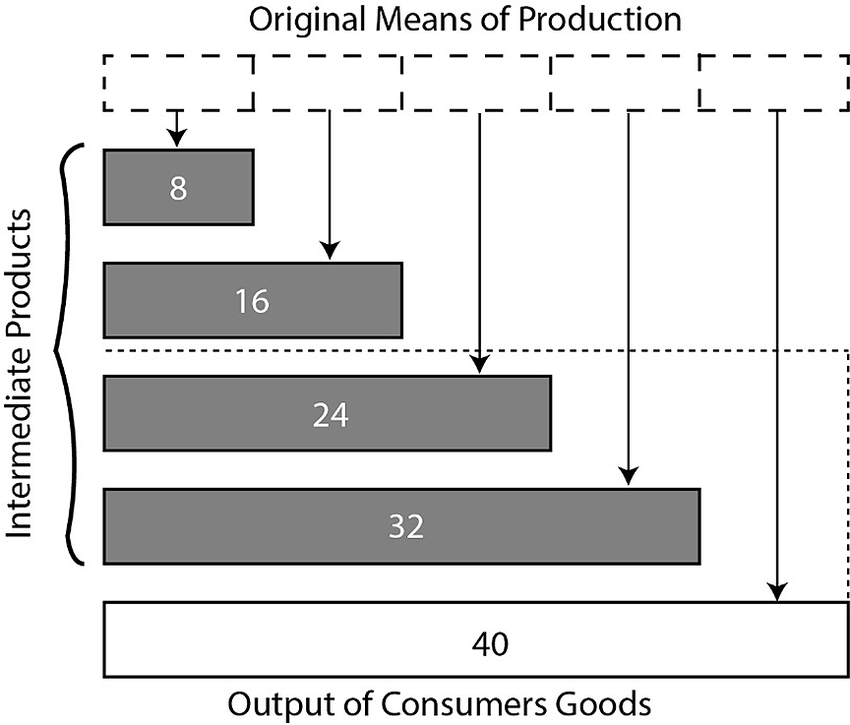
In Prices and Production (P&P), Hayek ([1931] Reference Hayek and Salerno2012) offered an explanation of business cycles that was built upon a Böhm-Bawerkian model of roundaboutness. According to this theory, the original means of production (land and labor) are combined with capital, where capital is defined in terms of intermediate products that progressively add value in stages of production that ultimately mature into consumption goods.
The Long-Standing Appeal of Saving-Driven Roundaboutness
At a high level of abstraction, the underlying basic idea in the above—again, of land, labor, and capital being combined in successive stages that culminate in consumption goods—was so straightforward and intuitive that John Hicks initially found it “irresistible”: “Nearly everyone who comes to the study of capital falls victim to Böhm-Bawerk’s theory at some stage or other. … [His] ideas give the subject an apparent clarity which is, at first sight, irresistible” (Hicks Reference Hicks1939, p. 193). Even Frank Knight, who “repeatedly and forcefully” (ibid.) throughout most of the 1930s criticized the particular details of the Hayek model used in Prices and Production, expressed similar thoughts about the “plausibility” of Böhm-Bawerkian roundaboutness in the abstract:
On the face of it, there must be plausible reasons for holding that the use of more capital is equivalent to the use of more time in production; otherwise the doctrine would not have been so generally expounded and believed. It unquestionably requires time to construct capital goods, and since these are subsequently used in processes requiring time, to make a product, and are more or less used up, it is natural to consider their production and use as an indirect in place of a direct application of the productive capacity going into them, and to consider the time involved in their creation, during which no final product is forthcoming, as added to that of their use to form a total production period for final product.
(Knight Reference Knight1935, p. 79)On its face, Knight agrees with Hicks that the concept of roundabout production has an unquestionable appeal.
The appeal of these ideas was built upon the common use by early capital theorists of engaging similes and examples to set the stage for analyses of capital in the complex, monetary economy. Here are three examples. In the first, the imagery of savages in trees is used to animate the notion that savings is a necessary condition for capital formation:
As capital, from its simplest form, to its most complicated state, means something produced, for the purpose of being employed, as the means toward a further production; it is evidently a result of what is called saving. Without saving there could be no capital. If all labour were employed upon objects of immediate consumption, all immediately consumed, such as the fruit for which the savage climbs the tree, no article of capital, no article to be employed, as a means to further production, would ever exist.
(Mill Reference Mill1826, p. 19)Following James Mill’s example, William Stanley Jevons contrasts capital-assisted cultivation of corn with what might be accomplished with one’s fingers only:
Capital simply allows us to expend labour in advance. Thus, to raise corn we need to turn over the surface of the soil. If we proceed straight to the work, and use the implements with which nature has furnished us—our fingers—we should spend an enormous amount of painful labour with very little result. It is far better, therefore, to spend the first part of our labour in making a spade or other implement to assist the rest of our labour. This spade represents so much labour which has been invested, and so far spent; but if it lasts three years its cost may be considered as repaid gradually during those three years. This labour, like that of digging [with fingers], has for its object the raising of corn, and the only essential difference is that it has to precede the production of corn by a longer interval.
(Jevons [1871] Reference Jevons1965, p. 225)In this final example, Böhm-Bawerk uses an engaging, Robinson Crusoe simile to explain capital formation, via production and saving:
In Economic science there are three theories current concerning the formation of capital. One ascribes the origination of capital to saving, another to production, and a third to both factors. … In order to begin with the simplest conceivable instance [of capital formation], let us imagine a recluse carrying on his economy completely devoid of capital, somewhat after the manner of a Robinson Crusoe cast ashore on a solitary island and entirely without resources of any kind. … Is saving enough to give birth to capital? Certainly not. Our Robinson can save and scrimp as he will with his fruit and berries, the most he can do is to amass a treasure of stored up consumption goods. But it certainly will not gain for him a single bow or arrow. It is quite obvious that those must be produced. Does production then suffice for the origination of capital, and is the second theory [of capital origination] correct? No more than the first. To be sure, once the point has been attained of starting the production of capital goods, then the formation of capital is as good as achieved. But before that period is attained something else has to be done that is by no means a matter of course. Productive forces have to be liberated for the proposed formation of capital and the only way to do that is by saving.
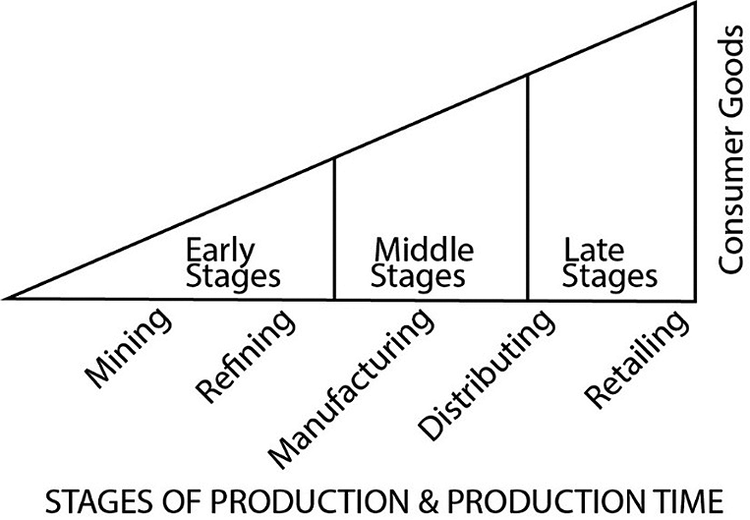
(Böhm-Bawerk [1889] Reference Böhm-Bawerk1959, p. 102; emphasis in original)Fast-forwarding from the nineteenth to the twenty-first century, a form of Hayek’s theory of roundaboutness remains in use and is widely seen as a valuable way of expositing a foundational understanding of capital structure macroeconomics at a high level of abstraction.Footnote 3 Time-structure roundabout production is the cornerstone of Roger Garrison’s (Reference Garrison2001) seminal book Time and Money, which has played a major role in the revival of Austrian economics and its business cycle theory. In Figure 1 below, we reproduce, with minor modifications, Garrison’s (Reference Garrison2001, p. 47) presentation of a Hayekian triangle:
Structure of Production (Hayekian) Triangle

In its general interpretation, Figure 1 is straightforward—producing consumer goods involves processes that take time and involve successive sequential stages. Such high-level interpretation of this modern Hayekian triangle pairs well with classic discussions of the emergent cooperation facilitated by market processes. For example, the graphite inserted into the centers of pencils comes to reside there and, thereafter, in the hands of consumers via a process that plays out over time and distances involving mining, refining, manufacturing, distributing, and retailing:
The graphite is mined in China and Sri Lanka. At the pencil factory, it’s mixed with clay, heat, and other materials before it’s extruded, dried, and baked in a kiln. People from different continents, different cultures, cooperate to bring these materials together with waxes and kilns and equipment from across the world. These too are the ancestors of the pencil.
(Competitive Enterprise Institute 2012)Hayek’s Theory of Forced Saving and Industrial Fluctuations
It was Hayek’s (Reference Hayek1929a) extensive critique of the William Foster and Waddill Catchings theory that voluntary saving (by consumers and/or businesses) caused economic cycles that inspired Lionel Robbins to invite Hayek to give the lectures at the London School of Economics that were subsequently published as Prices and Production.Footnote 4 Hayek is somewhat bewildered by the Foster and Catchings theory because:
[t]he proposition that saving can only bring about an increase in the volume of production by enabling a greater and more productive “roundaboutness” in the methods of production has been demonstrated so fully by the classical analysis of Böhm Bawerk that it does not require further explanation.
(Hayek [1929b] Reference Hayek and Salerno2012, p. 156.)The confidence that Hayek shows here is understandable. As explained in the previous section, the primitive-peoples analogies that were used to make the case that saving was necessary to the process of capital formation had great appeal. Unfortunately, as will be explained later in this paper, Hayek’s confidence that Böhm-Bawerkian roundaboutness applied just as readily to modern industrial economies was premature.
The cause of economic cycles, for Hayek, was forced saving rather than voluntary saving. His explanation of the trade cycle (i.e., industrial fluctuations) began with his acceptance of the finding that, “so long as we neglect monetary factors, there is an inherent tendency towards an equilibrium of the economic system.” He then proceeded in Prices and Production to show that “monetary factors may bring about a kind of disequilibrium in the economic system—which could not be explained without recourse to monetary factors” (Hayek Reference Hayek1932a, p. 238). In particular, Hayek hypothesized that the immediate effect of an excessive expansion of monetary credit would be to disturb the stages of production from an equilibrium state in which the intermediate products, flowing through each stage of production, were just sufficient to provide the anticipated amount to the next stage and maintain equipment.
Hayek argued that excessive credit expansion by the monetary authority would cause the rate of interest to fall below the natural rate, sending entrepreneurs, operating across the stages of production, the same signal that would arise from increased saving. He argued that the reaction of entrepreneurs to the monetary authority’s excessive credit expansion would be the same as if the interest rate had fallen naturally (that is, as a result of consumption freely curtailed and savings voluntarily increased). In either case, Hayek anticipated new investment would take place in early stages (see Figure 1). The difference between the cases, according to Hayek, is that when consumption is freely curtailed so that saving rises voluntarily, late-stage investment falls proportionately. But when the monetary authority is the source of the additional credit, late-stage investment is largely unchanged, due to the “considerable lag between the increase in the money used for production and the corresponding increase in the income of the factors—and the consequent increase in the demand for consumers’ goods” (Hayek Reference Hayek1932a, p. 242).Footnote 5
The disproportionate response in favor of early stages caused by excessive credit expansion does away with the proportionality that equilibrium across the stages of production requires. Hayek uses the term “forced saving” to describe disproportionate investments in early stages. This term was chosen to contrast these malinvestments with those early-stage investments that arise in proper proportion when prompted by voluntary increases in saving arising from freely curtailed consumption.
Key to the disproportionality in Hayek’s theory and the capital consumption that it causes is the aforementioned “considerable lag” of wage increases behind the early-stage capital goods expenditures toward which entrepreneurs direct the expansive credits. Albeit “considerable” in Hayek’s mind, this lag is finite: “even the money used for the purchase of new capital goods must ultimately be paid out to the factors … but [incomes] will rise to the full extent only when all the new money has passed backwards through the successive stages of production” (Reference Hayek1932a, p. 242). Capital consumption (wastage) is the consequence of this capital expenditure boom that Hayek anticipates. As the credit expansion slows or ends, as it inevitably must, and as wages rise, as they ultimately must, then “the proportion of his money receipts which is left to every individual entrepreneur to spend on capital goods is no greater than before [the boom when there was less capital to be maintained]” (ibid.).
In closing this section, consider the primitive-peoples simile that Hayek used in P&P to facilitate understanding of how malinvestment into an excessively roundabout production process leads to capital consumption:
The situation would be similar to that of a people on an isolated island, if, after having partially constructed an enormous machine which was to provide them with all necessities, they found out that they had exhausted all their savings and available free capital before the new machine could turn out its product. They would then have no choice but to abandon temporarily the work on the new process and to devote all their labor to producing their daily food without any capital. Only after they had put themselves in a position in which new supplies of food were available could they proceed to attempt to get the new machine into operation.
(Hayek [1931] Reference Hayek and Salerno2012, p. 272)In this simile, Hayek harkens back to the idea of a subsistence fund of food being capital as Jevons defined it—again, capital being anything that “allows us to expend labour in advance” (Jevons [1871] Reference Jevons1965, p. 225). Jevons illustrated subsistence fund capital by highlighting this explanation by Mill (Reference Mill1826, p. 9): “If the Man who subsists on animals cannot make sure of his prey in less than a day, he cannot have less than a whole day’s subsistence in advance. If hunting excursions are undertaken which occupy a week or a month, subsistence of several days may be required.”
III. HAYEK’S ABANDONMENT OF CAPITAL THEORY
As we emphasize in the introduction, Hayek’s business cycle theory lost traction throughout the 1930s as he agreed with critics about inadequacies in the theory’s undergirding Böhm-Bawerkian model of roundabout production. To understand these inadequacies in context, consider the schematic that Hayek ([1931] Reference Hayek and Salerno2012, p. 233) used in Prices and Production to illustrate his model of roundaboutness:
One inadequacy of Figure 2 that Hayek eventually acknowledged was its distinction between original means of production and intermediate products. Frank Knight (Reference Knight1935, pp. 78–82) argued that Hayek had, in drawing this distinction, adopted a subsistence-fund doctrine whose assumptions were “almost entirely false to the facts of modern industrial life” (Knight Reference Knight1935, p. 81). Chastened by Knight, Hayek distanced himself from this distinction: “It is quite erroneous to regard propositions concerning greater productivity of roundabout methods as depending upon the possibility of identifying the contribution of the ‘original’ factors” (Hayek Reference Hayek1936, p. 208).
Hayek’s Model of Roundaboutness in Prices and Production

A second feature of Figure 2, its delineation of a definite average period of production,Footnote 6 was problematic—leading to this lucid criticism by Knight:
Even with reference to such primitive agricultural conditions the really critical student (such as hardly exists) might have had disturbing queries in connection with treating quantity of capital as a matter of length of production cycle. In fact, the quantity of the capital bears no simple or definite relation either to its durability or to any definable time interval. Taking population as given, raising more plants of the same growth period will also require more "stock," but will not affect the length of the [production] cycle, while the addition to total production of new varieties of shorter growth, say yielding two harvests per year instead of one, will involve an increase in the capital, while shortening the average cycle [period of production].
(Knight Reference Knight1935, p. 81)Hayek (Reference Hayek1936, p. 206) conceded: “It is not proposed, and is in fact inadmissible, to reduce the description of the range of periods for which the different factors are invested to an expression of the type of a single time dimension such as the average period of production.”
Two other inadequacies implicit in Figure 2 were highlighted by Hayek himself ([1934] Reference Hayek and Salerno2012) in the preface of the second edition of Prices and Production. First, he lamented that “I had to leave durable goods simply out of account” (p. 195). Second, he acknowledged that its assumption that the stages were constructed of equal length had drawn sharp criticism because it imposed
a somewhat one-sided treatment of the problem of the velocity of circulation of money. It implied more or less that money passed through the successive stages at a constant rate which corresponded to the rate at which the goods advanced through the process of production, and in any case excluded consideration of changes in the velocity of circulation or the cash balances held in the different stages. The impossibility of dealing expressly with changes in velocity of circulation so long as this assumption [of separate stages of equal length] was maintained served to strengthen the misleading impression that the phenomena I was discussing would be caused only by actual changes in the quantity of money and not by every change in the money stream, which in the real world are probably caused at least as frequently, if not more frequently, by changes in the velocity than by changes in the actual quantity. It has been put to me that any treatment of monetary problems which neglected in this way the phenomenon of changes in the desire to hold money balances could not possibly say anything worthwhile.
(Hayek [1934] Reference Hayek and Salerno2012, p. 195)The opening paragraph of the preface of the second edition of Prices and Production is revealing. In it, Hayek ([1934] Reference Hayek and Salerno2012, pp. 191–192) does three things. First, he offers an explanation of the inadequacy of the theory of industrial fluctuations in Prices and Production—the University of London’s invitation to deliver four lectures on the topic had led to “an irresistible temptation” to publish “oversimplified” ideas prematurely.Footnote 7 Second, Hayek celebrates the criticism that made him realize that the underlying “‘Austrian’ theory of capital” in Prices and Production needed “to be developed in far greater detail” to be applicable. Third, Hayek expressed the hope that, as a consequence of all the criticisms that Prices and Production had inspired, a “more exhaustive” and “satisfactory” treatment of the “problems” of Prices and Production might be forthcoming at some “later” date.Footnote 8
Although 1934 marks the last revision of the final edition of Prices and Production, it does not mark the end of Hayek’s efforts to resolve its inadequacies. Quite the contrary: in 1934, Hayek began a seven-year quest to write a two-volume book on “Austrian” capital theory for the purpose of resolving the inadequacies of the Böhm-Bawerkian model of roundabout production in Prices and Production. Hayek only ever worked on one of the two volumes planned, The Pure Theory of Capital, which was published in 1941. Asked in 1994 about his incomplete capital theory project, Hayek reflected:
I had been criticized for the fact that in Prices and Production I had a very inadequate theory of capital; that in this crude Böhm-Bawerkian form of an average period of production, it was inadequate. So I started writing a great book on capital and money, which ultimately dealt with the monetary phenomenon. It took me very much longer than I thought; I worked seven years on the thing. I was dead tired of the subject before I got to the monetary aspects.
(Hayek Reference Hayek, Kresge and Wenar1994, pp. 90–91)Nevertheless, Hayek continued to maintain that Böhm-Bawerk had been fundamentally correct, notwithstanding the inapplicability of Böhm-Bawerkian roundaboutness to the real world:
[W]hile Böhm-Bawerk was fundamentally right, his exposition in terms of an average period of production was so oversimplified as to mislead in application. And that if we want to think the Böhm-Bawerk idea through, we have to introduce much more complex assumptions. Once you do this, the things become so damned complicated it’s almost impossible to follow it.
(Hayek Reference Hayek, Kresge and Wenar1994, p. 141)Hayek’s quest to construct a defensible “Austrian” theory of the time structure of capital by replacing Böhm-Bawerk’s average period of production with “much more complicated” assumptions was a dead end.Footnote 9 Hayek’s use of profanity in the above quotation is highly unusual; indeed it is the only case we are aware of in which he profanely expressed anger and/or frustration. So ended Hayek’s seven-year quest—he abandoned an incomplete theory of capital in 1941.Footnote 10
IV. HAYEK’S DISREGARD OF HICKS’S SUGGESTION AND CRITICISM
Böhm-Bawerk was not talking complete nonsense.
(John Hicks, Reference Hicks1939, p. 219)On two occasions in particular, Hayek appeared to be dismissive of ideas presented by John Hicks. The first was Hicks’s publication in 1939 of an alternative, financial measure to Böhm-Bawerk’s average period of production, which Hicks suggested as a means by which the Austrians could sidestep objections raised by Frank Knight. On the second occasion, in 1967, in an article entitled “The Hayek Story,” Hicks questioned what he saw as inexplicable lags. These two occasions are discussed in turn below.
Hayek’s Disregard for Hicks’s Measure of Average Period
In response to the deconstruction of the Böhm-Bawerkian average period of production (APP) that Hayek presented in Prices and Production, John Hicks (Reference Hicks1939) developed an alternative measure, average period (AP). Because Hicks’s measure is determined by financial streams rather than the length of time it takes to produce consumers’ goods, it avoids Knight’s objection that additional capital did not necessarily imply that production would require more time. For the stream of payments $ \left({x}_0,{x}_1,{x}_2,\dots +{x}_v\right) $, Hicks (Reference Hicks1939, p. 186) defines the capital value of this stream as
 $ {x}_0+{\beta x}_1+2{\beta}^2{x}_2+3{\beta}^3{x}_3+\dots +{\beta}^v{x}_v $, where β denotes the discount ratio 1/(1+i), and where “i” is the interest rate. Hicks’s average period is the elasticity of this capital value with respect to the discount ratio, again β, which is:
 $$ \frac{{\beta x}_1+2{\beta}^2{x}_2+3{\beta}^3{x}_3+\dots +{\beta}^v{x}_v}{x_0+{\beta x}_1+2{\beta}^2{x}_2+3{\beta}^3{x}_3+\dots +{\beta}^v{x}_v} $$
Hicks emphasizes that his average period measure resolves objections that Knight raised about the Böhm-Bawerkian capital theory that Hayek’s P&P was built upon.
His [Böhm-Bawerk’s] theory was valid enough for the cases he was considering; it ought to be possible to find a generalized concept which will meet Professor Knight’s objections, and will yet include Böhm-Bawerk’s argument as a special case. … we have it in our hands already. We have already, in the course of our argument, come across an average period which is proof against these [Knight’s] objections.
(Hicks Reference Hicks1939, p. 219)In the sentence following the above quotation, Hicks makes it crystal clear that he thought that the Austrians (Böhm-Bawerk, Hayek, and all those advancing the capital-consumption-based business cycle theory) were onto an underlying truth that they could not explain. Hicks says of his average period, “it was this which the Austrians were looking for” (Hicks Reference Hicks1939, p. 219).
Furthermore, Hicks provides the following illustration that his measure of average period yields a lengthening result similar to that emphasized by traditional Austrian capital theory:
Suppose that the production undertaken by a particular firm consists simply in the simultaneous carrying out of a number of quite separate processes, each of which takes n weeks from first to last. Suppose (initially) that the firm is in stationary equilibrium, with mn of these processes being carried on together; m new processes are started every week, to replace the m processes which are finished at the beginning of the week; thus the streams of total inputs and total outputs are both constant over time. The firm contents itself with no more than mn processes for reasons of risk; risk-coefficients increase as the scale of output expands; the entrepreneur declines to undertake extra processes, because their capitalized value (allowance being made for risk) would be negative. Now suppose that the rate of interest falls; the capitalized value of a new process will then be raised; and it may become profitable to undertake some extra processes, which were not profitable previously. Now there is absolutely no reason why the new processes should not have identically the same technical character as the old; nevertheless, in spite of that, just because they are new processes, undertaken only because the rate of interest has fallen, their inception must raise the average period of the plan.
(Hicks Reference Hicks1939, pp. 223–224)Given that Hicks published his measure of average period in 1939, the question arises: What did Hayek say about it in 1941 in The Pure Theory of Capital? The answer: Not one word. Importantly, Hayek’s silence in The Pure Theory of Capital about Hicks’s measure of average period was not because Hayek was unaware of the book within which Hicks had discussed this measure—Hicks’s Value and Capital is listed in Hayek’s ([1941] Reference Hayek2009) bibliography. Neither, as recent scholarship affirms,Footnote 11 was it because Hicks was incorrect to claim his average period measure overcame Knight’s objection to the average period of production measure that Hayek used in Prices and Production.
Hayek’s Unhelpful Explanation of the Lag in His Business Cycle Theory
After decades of his average period measure being ignored by the Austrians as a substitute for their average period of production, Hicks wrote a book chapter on Hayek’s explanation of industrial fluctuations, somewhat glibly entitled “The Hayek Story.”Footnote 12 There, Hicks observes that Hayek’s business cycle theory was built under the mantel of Knut Wicksell’s theory of the “cumulative process.”
In Wicksell, the ‘Cumulative Process’ is a matter of prices. When the ‘market rate’ of interest is reduced below the natural rate, prices rise. Nothing is said about the movement of quantities (inputs and outputs). On the bearing of his construction on the causation of Trade Cycles, Wicksell is open-minded. Hayek was asking the question: what happens to quantities in a Wicksellian process? He took his model very ‘pure’: much purer than Wicksell himself had been accustomed to take it. Prices (all prices) are perfectly flexible, adjusting instantaneously, or as nearly as matters. Price expectations are not introduced explicitly, for in 1930 their day had not yet come.
(Hicks Reference Hicks and Hicks1967, p. 206)Rethinking Hayek’s credit expansion theory of the business cycle in this light, Hicks reasoned that if the market rate of interest fell below the natural rate, then nominal prices would increase uniformly and leave real quantities unaffected. Similarly, Hicks (pp. 207–208) argued that if wages and prices are flexible, as Hayek had assumed, then, although a credit expansion would raise nominal savings and investment, the real economy would be unaffected. The initial effect of credit expansion may be to reduce the rate of interest below the natural rate, causing the money value of investment to increase along with the price of producers’ goods; however, the money value of labor, which is also a producer good, must increase as well. Nominal wages will therefore rise, and consumption spending will, Hicks argued, increase nearly instantaneously. The increased demand for consumer goods will cause their prices to increase until, relative to producers’ goods, they are the same as before the credit expansion—restoring equilibrium with Wicksellian swiftness.
According to Hicks, Hayek’s boom would end almost before it began. Recall from the discussion above: Hayek’s explanation of the credit expansion boom hinges upon the existence of a “considerable lag between the increase in the money used for production and the corresponding increase in the income of the factors—and the consequent increase in the demand for consumers’ goods” (Hayek Reference Hayek1932a, p. 242). Responding to the criticism of this lag by “Sir John,” Hayek pressed Hicks that its existence could be illustrated by an analogy regarding the viscosity of honey:
I find it useful to illustrate the general relationship by an analogy which seems worth stating here, though Sir John (in correspondence) did not find it helpful. The effect we are discussing is rather similar to that which appears when we pour a viscous liquid, such as honey, into a vessel. There will, of course, be a tendency for it to spread to an even surface. But if the stream hits the surface at one point, a little mound will form there from which the additional matter will slowly spread outward. Even after we have stopped pouring in more, it will take some time until the even surface will be fully restored. It will, of course, not reach the height which the top of the mound had reached when the inflow stopped. But as long as we pour at a constant rate, the mound will preserve its height relative to the surrounding pool—providing a very literal illustration of what I called before a fluid equilibrium.
(Hayek Reference Hayek1969, p. 281)So the question arises: Why did Hayek press Hicks with this analogy that Hicks found “unhelpful”? Given Hicks’s apparently flippant chapter title—"The Hayek Story”—and given Hayek’s seemingly glib reference to Hicks as “Sir John,” one possible answer is that Hayek’s mound-of-honey analogy was merely Hayek engaging in tit-for-tat—giving an unserious response to a disrespectful critic. But for reasons explained in the subsection below, this answer seems at best incomplete.Footnote 13
Hayek’s Honey Analogy and Disregard for Hicks’s Average Period Measure
Beyond Hayek just being flippant with “Sir John,” what else might explain his mound-of-honey analogy? Well-known Austrian business cycle theorist Roger Garrison (Reference Garrison2004, p. 344) referred to the lags in Hayek’s theory as “unsolved mysteries” and offered this explanation:Footnote 14
Hayek never realized that the element of overconsumption was critical in responding effectively to the criticisms offered by Sraffa and (later) John Hicks. Instead of allowing for overconsumption, Hayek (Reference Hayek1969) offered his mound-of-honey analogy to support the notion of a substantial lag between the increased investment spending and the subsequent increase in consumption. (Pouring money into the economy is like pouring honey into a vat: Where the honey hits the surface, a mound forms and persists as long as the pouring continues.)
(Garrison Reference Garrison2004, p. 336)To avoid the lags in consumption that Hicks criticized, Garrison followed Ludwig von Mises, rather than Hayek, in his explanation of the credit-inspired boom and bust.
The Garrison/Mises explanation of the business cycle has been a standard and important component of the Austrian school canon for decades. This explanation assumes that the boom is characterized not only by early-stage malinvestment but also by concurrent, immediate, unlagged overconsumption.Footnote 15 The boom turns to bust because the concurrent expansion of both early and late stages of production depicted in Figure 1 deprives the middle stages of the resources necessary to allow the enlarged amount of early-stage, intermediate products to ever mature into consumers’ goods. In this way, the Garrison/Mises explanation of the business cycle overcomes Hicks’s criticism in “The Hayek Story.”
Unfortunately, as explained in detail and at length by James McClure and David Chandler Thomas (Reference McClure and Thomas2018), such overconsumption is at odds with the now large body of evidence that indicates that consumption is sticky.Footnote 16 Crucially, the lags in Hayek’s theory cease to be the “unsolved mysteries” that Garrison thinks them to be, once it is evinced that Hayek had reached largely the same conclusion about consumption by simple observation—that consumption is sticky. Two pieces of evidence are these below.
First, we see that Hayek, in a book review of Trade, Depression, and the Way Out by Ralph Hawtrey (Reference Hawtrey1931), emphatically disagreed with Hawtrey’s presumption that changes in consumption are a leading rather than a lagging indicator of depression:
Against all empirical evidence, he insists that “the first symptom of contracting demand is a decline in sales to the consumer of final purchases” (p. 36). In fact, of course, depression has always begun with a decline in the demand, not for consumers’ goods but for capital goods, and the one marked phenomenon of the present depression was that the demand for consumers’ goods was very well maintained for a long while after the crisis occurred.
(Hayek Reference Hayek1932b, p. 127)Second, in a review article about Hayek’s industrial fluctuations theory, Alvin Hansen and Herbert Tout emphasize that Hayek was in the company of a diverse set of other business cycle theorists in the 1930s who all emphasized that “empirically” industrial (rather than consumptive) fluctuations were the drivers:
Empirically, we know that the most salient characteristic of cyclical movements of business is the fluctuation in the production of capital goods. This fact presents a challenge to the economist, and the problems which it suggests have been attacked by methods as diverse as those of Spiethoff and Cassel, Aftalion and J.M. Clark, Schumpeter and Robertson.
(Hansen and Tout Reference Hansen and Tout1933, p. 119)Hence, Garrison’s mystery is largely solved. Hayek maintained that consumption demand changes lagged booms and busts in capital goods demand because he, like others, had observed a characteristic pattern. Unwilling to theorize against observation, Hayek did not include immediate overconsumption in his explanation of the boom, as the Garrison/Mises model does, as a way of overcoming Hicks’s criticism.
Still, there remains the puzzle that Hayek did not resolve of how to explain the lags with Wicksellian price flexibility in play. We think that this may very well be the reason that Hayek ([1941] Reference Hayek2009), in The Pure Theory of Capital, offers not a word of discussion about Hicks’s average period measure. Recall from our earlier discussion that Hicks’s average period does provide a way around Knight’s criticisms of the Böhm-Bawerk average period of production measure Hayek emphasized in Prices and Production. We suggest two reasons to explain why Hayek eschewed Hicks’s average period:
First, we cannot see how Hicks’s average product measure would have offered Hayek a solution to the puzzle of how to explain the lag in consumption demand at the outset of the boom in his model without resort to an inexplicable suspension of Wicksellian price flexibility. Second, neither Hicks nor Hayek seems to have thought so, either. As far as we have been able to determine, neither one of them ever thought of Hicks’s average period measure as a way to explain the lag in consumption demand over the cycle.
V. OVERLOOKING SEQUESTERED CAPITAL
To set the stage for this section’s modification of the Hayek story—making sequestered capital the earliest component of the capital structure—a recap of our discussion so far is useful. Both Hicks and Knight argued that Hayek’s theory in Prices and Production, which was motivated by Robinson Crusoe imagery and primitive agriculture scenarios, was inapplicable to the modern industrial economy. Hayek ([1941] Reference Hayek2009) ignored Hicks’s (Reference Hicks1939) average period measure, despite its usefulness as a way to avoid Knight’s criticisms of the Böhm-Bawerkian model of roundaboutness found in Prices and Production. Hayek (Reference Hayek1969) pressed Hicks (Reference Hicks and Hicks1967) with an analogy about the viscosity of honey in response to criticism of the lags that Hayek hypothesized in his explanation of industrial fluctuations. Hicks’s average period is never considered as a means of resolving the lags in Hayek’s theory—not by Hayek or Hicks or by us or by anyone else.
An explanation for the Hayek lag has emerged in recent research in Austrian economics. A key omission has been discovered in the time structure of capital as it has traditionally been conceived of by Austrian business cycle theorists from Hayek and Mises in the twentieth century to Garrison in the twenty-first. In this tradition, the pre-market stages, in which new products are being invented, productized, and inventoried prior to being priced and put on the market in observable quantities for sale, are completely ignored. This omission is significant for three important reasons.
First, in the modern economy, enormous amounts of capital are at work in pre-market, research, and development efforts to invent, productize, and amass pre-product-launch inventories. Second, these pre-market stages, which precede the production of already-on-the-market intermediate products, are, by definition, the earliest components of the time structure of capital. Pre-product-launch endeavors, by definition, precede the appearance of priced, new products being available for sale in the marketplace. Third, and perhaps most significant, capital usages in new-product research and development (R&D) endeavors are fundamentally different from capital being used in enterprises that are in competition with others selling priced products that are already on the market. Capital used in new-product R&D is sequestered—meaning that it is uncoordinated by the knowledge of competitors’ prices and output availabilities.
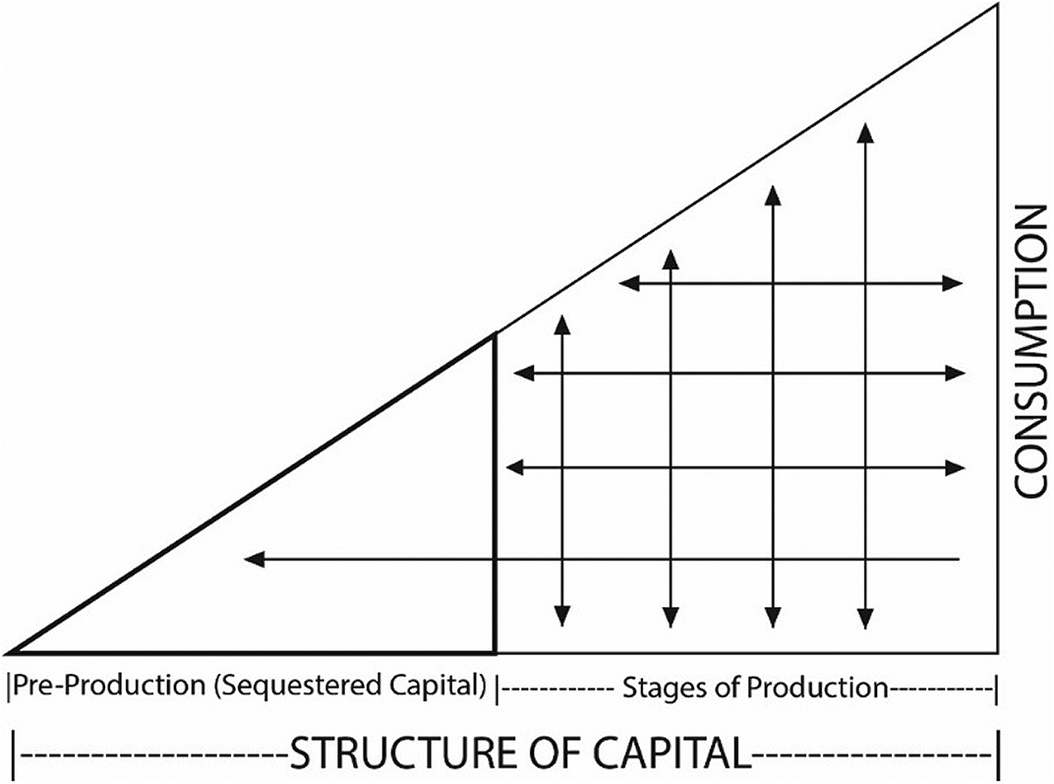
Recently, Nicholas Curott, McClure, and Thomas (Reference McClure and Thomas2019) reformulated Garrison’s Misesian model of the business cycle so that both sticky consumption and sequestered capital are in play. For purposes of comparison and contrast with Figure 1 and Figure 2 that we discussed above, consider the following figure from their article (p. 76).
In Figure 3, the stages of production correspond to the already on-the-market “intermediate products” that Hayek relates in Figure 2, and the stages “mining, manufacturing, distributing, and retailing” that Garrison delineates in Figure 1. As seen in Figure 3, Curott et al. have included a pre-production, sequestered capital stage that precedes the on-the-market stages that the Hayek and Garrison theories bring into play.
Hayekian Triangle with Sequestered Capital as the Earliest Component

The arrows in Figure 3 illustrate why pre-production capital is called “sequestered” capital. The lateral arrows in Figure 3 illustrate informational signaling between laterally competing firms across the stages of production. Firms with products on the market are able to observe one another’s prices and output sales and distributions. On the other hand, firms engaged in new-product R&D, those in pre-production (see Figure 3), are uninformed in these ways regarding laterally competing firms.Footnote 17 The horizontal arrows illustrate that across the stages of on-the-market production, price and output information is coordinating the step-by-step processes. As noted in a previous example, graphite is taken from mines in China through refining, manufacturing, and distribution to eventually become the cores of retailed pencils. Notice that there is only a one-way arrow extending into the pre-market stages from the stages of production. This is for two reasons: 1) because pre-production R&D is informed about the step-by-step processes taking place across the observable stages of production; and 2) because the step-by-step processes within the pre-market stages are sequestered.
The discovery of sequestered capital is pivotal to our understanding of Hayek’s abandonment of capital theory, of his disregard for Hicks’s average product measure, and of criticism of the lags in Hayek’s business cycle theory. Lacking sequestered capital as the earliest component of the structure of capital, Hayek was unable to create a theory of capital capable of supporting his explanation of the business cycle without suspending Wicksellian price flexibility (so that disproportionate malinvestments could pile up in the early stages of production).Footnote 18
Hayek argued that the key problem with non-monetary disproportionality theories of the trade cycle was that it was a “misconception of the deliberations that regulate the entrepreneur’s actions and of the significance of the price mechanism” to think that “under free competition … more and more people try to profit by the favorable situation, all ignoring one another’s preparations” (Hayek [1928] Reference Hayek and Salerno2012, p. 30). Hayek’s criticism here makes a great deal of sense when the criticism is considered within the stages-of-production framing that Hayek applied when thinking about business cycles. In these stages, lateral competitors observe one another’s prices and production and the step-by-step processes by which intermediate goods are maturing into consumers’ goods.
Again, Figure 3 illustrates these informational flows regulating the actions of entrepreneurs via the presence of both horizontal and vertical arrows. But in the pre-production stages, the stages that Hayek deliberately excluded from his analyses,Footnote 19 the “significance of the price mechanism” as a regulator of the actions of entrepreneurs is extremely limited. This is seen by the dearth of arrows in the sequestered capital triangle in Figure 3—illustrating that a dearth of market information about competitors’ activities applies to entrepreneurial usages of capital in this space.
Finally, it should be noted that the sequestered capital extension of Hayek’s business cycle theory offers an explanation of the timing of the bust that is lacking in all renderings of the Austrian business cycle. The bust occurs when signals regarding the quantities of capital emerge, informing market participants of malinvestment and of its extent. McClure and Thomas (Reference McClure and Thomas2017) use the sequestered capital extension of Austrian business cycle theory to explain the timing of the Tulipmania boom and bust. The Tulipmania boom occurred in the fall of 1636, when the bulbs were planted—sequestering information about the quantity of capital developing underground. The bust occurred in the spring of 1637, when the tulip bulbs sprouted (signaling to market participants the quantity of capital developing underground).Footnote 20
VI. CONCLUDING COMMENTS
Research on business cycle theory soared following the stock market crash in 1929. From 1928 to 1931, Friedrich Hayek’s theory emerged and gained traction in a series of publications.Footnote 21 Throughout the remainder of the 1930s, Hayek’s theory lost ground as he had to admit to critics that his underlying model of Böhm-Bawerkian roundaboutness was “inadequate” and “oversimplified.” In 1934, Hayek resolved to write a “great book,” consisting of two volumes, on capital theory that would undergird his business cycle theory. In 1941, Hayek published only the first of the two volumes, which ignored John Hicks’s (Reference Hicks1939) average period measure of roundaboutness, and abandoned forever his efforts to write the book’s second volume. Subsequently, in response to criticism by Hicks (Reference Hicks and Hicks1967), Hayek (Reference Hayek1969) responded in a way that Hicks found “unhelpful”—analogizing the lag of increased consumption behind early-stage investment during an unsustainable credit expansion boom with the time it takes a mound of honey to spread out after it ceases to be poured. In 2004, calling this analogy an “unsolved mystery,” Roger Garrison (Reference Garrison2001 and Reference Garrison2004) argued that a Misesian explanation of the credit cycle, which assumes immediate overconsumption during the boom, be used rather than Hayek’s to avoid its inexplicable lag.
This paper revisited Hayek’s transformation during the 1930s in an attempt to gain additional insights stemming from recent advances in Austrian economics that: 1) recognize the large body of evidence that indicates that consumption is a lagging rather than a leading indicator, consistent with Hayek’s thinking; and 2) revise the time structure of capital to bring new-product R&D (sequestered capital) into play as the earliest component of the capital structure, which Hayek excluded. This retrospective analysis suggests possible answers to a variety of questions.
First, Hayek appears to have been aware, as an empirical matter, that consumption is sticky. Could this have been the reason for his unwillingness to assume, as Mises and later Garrison did, that immediate overconsumption occurred during the boom? Further, this offers a plausible explanation for Hayek’s unhelpful mound-of-honey response to Hicks’s criticism of lagging consumption in Hayek’s theory. That is, this offers an explanation to what Garrison saw as an important “unsolved mystery.”
Second, Hayek never mentions Hicks’s average period measure of roundaboutness in The Pure Theory of Capital, despite Hayek’s ([1941] Reference Hayek2009) bibliographic listing of Value and Capital, in which Hicks (Reference Hicks1939) presents this measure. Why? As we explained, it is plausible that this was because Hicks’s average period measure did not provide Hayek with an explanation of the lagging (sticky) consumption that his explanation of the business cycle entails.
Finally, the recent discovery of sequestered capital as the earliest component of the Hayekian triangle (see Figure 3) offers a retrospective validation of the hope against hope that sustained Hayek during his seven-year effort to rethink Böhm-Bawerkian roundaboutness. Again:
[W]hile Böhm-Bawerk was fundamentally right, his exposition in terms of an average period of production was so oversimplified as to mislead in application. And that if we want to think the Böhm-Bawerk idea through, we have to introduce much more complex assumptions. Once you do this, the things become so damned complicated it’s almost impossible to follow it.
(Hayek Reference Hayek, Kresge and Wenar1994, p. 141)Hayek was fundamentally right that the structure of capital was crucial to understanding the nature and causes of industrial fluctuations. Unfortunately, as a result of overlooking sequestered capital as the earliest component of the structure of capital, as shown in Figure 3, he spent seven years studying only the figure’s stages of production. As we explained above, with sequestered capital as the earliest component of the structure of capital, malinvestment and sticky consumption, which Hayek maintained were characteristics of the credit expansion boom, pose no conflict with Wicksellian price flexibility (because there are, by definition, no priced products in the sequestered capital stages). Is it any surprise that Hayek, who defined the stages of production as the entire structure of capital, abandoned his quest to discover a theory of capital that would undergird his explanation of business cycles?