Introduction
Mental disorders are strongly related to disability and premature death across various nations (Whiteford et al. Reference Whiteford, Degenhardt, Rehm, Baxter, Ferrari, Erskine, Charlson, Norman, Flaxman, Johns, Burstein, Murray and Vos2013). The identification of individuals at high risk for mental disorder is crucial to adequately inform public policy and health care strategies. Numerous studies have shown high rates of common mental disorders such as posttraumatic stress disorder (PTSD), major depressive disorder and alcohol use disorders (AUD) in military personnel (Kang & Hyams, Reference Kang and Hyams2005; Gadermann et al. Reference Gadermann, Engel, Naifeh, Nock, Petukhova, Santiago, Wu, Zaslavsky and Kessler2012; Sirratt et al. Reference Sirratt, Ozanian and Traenkner2012; Wittchen et al. Reference Wittchen, Schönfeld, Kirschbaum, Trautmann, Thurau, Siegert, Höfler, Hauffa and Zimmermann2013). However, there is still debate on whether military personnel can be considered as a high risk population, compared with other populations (Hoge et al. Reference Hoge, Warner and Castro2014; Kessler et al. Reference Kessler, Nock and Schoenbaum2014a ). Although stressors related to military service have been linked to an increased risk for mental disorders (Jones et al. Reference Jones, Perrotta, Canham-Chervak, Nee and Brundage2000; Hoge et al. Reference Hoge, Castro, Messer, McGurk, Cotting and Koffman2004; Browne et al. Reference Browne, Hull, Horn, Jones, Murphy, Fear, Greenberg, French, Rona, Wessely and Hotopf2007), selection and retention criteria could facilitate the selection of resilient individuals. Moreover, there is evidence that only specific subsamples with high-risk exposures such as combat experiences, serious accidents and childhood adversities are at elevated risk for morbidity (Jones et al. Reference Jones, Sundin, Goodwin, Hull, Fear, Wessely and Rona2013). In fact, some epidemiological studies suggest that rates of mental disorders in military personnel are comparable with those in the general population (Riddle et al. Reference Riddle, Smith, Smith, Corbeil, Engel, Wells, Hoge, Adkins, Zamorski and Blazer2007; Klaassens et al. Reference Klaassens, van Veen, Weerts and Zitman2008; Fear et al. Reference Fear, Jones, Murphy, Hull, Iversen, Coker, Machell, Sundin, Woodhead, Jones, Greenberg, Landau, Dandeker, Rona, Hotopf and Wessely2010). The interpretability of direct comparisons between military and general population studies, however, is restricted since methodology often differs between studies. Moreover, military samples are predominantly male, relatively young and by definition exclude unemployed individuals, which can lead to different prevalence estimates compared with the general population (Jacobi et al. Reference Jacobi, Höfler, Siegert, Mack, Gerschler, Scholl, Busch, Hapke, Maske, Seiffert, Gaebel, Maier, Wagner, Zielasek and Wittchen2014; Kessler et al. Reference Kessler, Heeringa, Stein, Colpe, Fullerton, Hwang, Naifeh, Nock, Petukhova, Sampson, Schoenbaum, Zaslavsky and Ursano2014b ). Available data on mental disorders in comparable samples of soldiers and civilians using the same methodology is extremely limited. We are only aware of two studies that used comparable assessment methods as well as a rigorous calibration of military and civilian samples (by means of weighting procedures or statistical adjustments) taking at least differences in sex, age and employment status into account (Kessler et al. Reference Kessler, Heeringa, Stein, Colpe, Fullerton, Hwang, Naifeh, Nock, Petukhova, Sampson, Schoenbaum, Zaslavsky and Ursano2014b ; Goodwin et al. Reference Goodwin, Wessely, Hotopf, Jones, Greenberg, Rona, Hull and Fear2015). The first found a generally higher risk for current mental disorders in a large representative US army sample compared with civilians (Kessler et al. Reference Kessler, Heeringa, Stein, Colpe, Fullerton, Hwang, Naifeh, Nock, Petukhova, Sampson, Schoenbaum, Zaslavsky and Ursano2014b ). The second compared common mental disorders between UK serving military personnel and the general working population in the same age range and also observed higher rates in military personnel (Goodwin et al. Reference Goodwin, Wessely, Hotopf, Jones, Greenberg, Rona, Hull and Fear2015). These findings may not apply to other nations since there are cross-national differences in risk (e.g. experience of childhood adversities) and resilience factors (e.g. self-efficacy), but also in aspects of system culture (e.g. leadership) and perception of mental illness (e.g. stigmatisation). These factors might be related to mental health (Kessler et al. Reference Kessler, Davis and Kendler1997; Maciejewski et al. Reference Maciejewski, Prigerson and Mazure2000; Rüsch et al. Reference Rüsch, Angermeyer and Corrigan2005; Jones et al. Reference Jones, Seddon, Fear, McAllister, Wessely and Greenberg2012) and result in cross-national differences in rates of mental disorders found in military personnel (Hunt et al. Reference Hunt, Wessely, Jones, Rona and Greenberg2014; Sundin et al. Reference Sundin, Herrell, Hoge, Fear, Adler, Greenberg, Riviere, Thomas, Wessely and Bliese2014). Moreover, it remains unclear whether the differences reported in the abovementioned studies are attributable to military service in general or to previous deployments since comparisons were made with samples representative for the entire military including both previously deployed and never deployed soldiers (NS). This study presents data on the 12-month prevalence and severity of DSM-IV mental disorders from a sample of German DS, a comparable sample of NS and sociodemographically matched civilians.
Methods
Samples
Data for the DS and NS were taken from the Prevalence, Incidence and Determinants of Post Traumatic Stress and Other Mental Disorders-study (Wittchen et al. Reference Wittchen, Schoenfeld, Thurau, Trautmann, Galle, Mark, Hauffa, Zimmermann, Schaefer, Steudte, Siegert, Hoefler and Kirschbaum2012a ). The DS sample was drawn from a reference population of 9617 soldiers who were deployed to Afghanistan as part of the 20th and 21st contingents of the German International Security Assistance force (ISAF) mission in 2010. Power calculations indicated that sufficient determination of prevalence rates could be achieved with a 36% (n = 3493) sample of the total of 9617 soldiers, with assumed non-eligibility and refusal rates. The random sample was stratified, oversampling combat personnel as an assumed high-risk population. Of the 3493 DS, 1599 met eligibility criteria. To be classified as eligible, soldiers had to be at least 18 years old and had to be present at their home base location during the assessment periods. Moreover, only locations with a sufficient high number of eligible soldiers (n = 50) could be considered due to logistical and financial constraints. Examination of medical records revealed no evidence that non-eligible subjects differed from those being eligible regarding the prevalence of mental health problems (Wittchen et al. Reference Wittchen, Schoenfeld, Thurau, Trautmann, Galle, Mark, Hauffa, Zimmermann, Schaefer, Steudte, Siegert, Hoefler and Kirschbaum2012a ). Of all eligible soldiers, 102 refused participation, seven did not show up at the scheduled assessment and seven provided incomplete data. The final DS sample consisted of 1483 soldiers (response rate 92.8%). For the NS sample, 1758 soldiers were drawn from the same home base locations. Eligibility criteria were being at least 18 years old (as in the DS sample) and having never been deployed. From 932 soldiers being eligible, 40 refused participation and seven provided incomplete data. The final NS sample consisted of 889 soldiers (response rate 95.4%). For this study, all female soldiers (DS: 44, NS: 110) were excluded because these low numbers would not allow meaningful analyses.
For the civilian sample, a subsample was taken from the mental health module of the German Health Interview and Examination Survey for Adults, a representative examination of physical and mental health in the German adult general population (age 18–79). Design and methods of the mental health module of this survey are described elsewhere (Jacobi et al. Reference Jacobi, Mack, Gerschler, Scholl, Höfler, Siegert, Bürkner, Preiss, Spitzer, Busch, Hapke, Gaebel, Maier, Wagner, Zielasek and Wittchen2013). A total sample of 8152 was drawn for the main survey from local population registries. For the mental health module, 6027 met the eligibility criteria (aged between 18 and 79, completed assessment in the main survey, informed consent for the mental health supplement, sufficient language skills, being available during the assessment period). Of all eligible subjects, 527 refused participation, 197 could not be scheduled for assessment and 820 provided only partial information, resulting in a sample of 4483 subjects (response rate 74.4%). To assure comparability with the military samples, females, individuals older than 57 years and those not currently employed were excluded making a subsample of 1023 civilians available for analyses. Further adjustment of these samples according to sociodemographic variables is described below.
Data collection
In the military study, data were collected by non-military trained interviewers, dispatched to soldiers’ home bases. Soldiers were informed about the study approximately 2 months in advance to arrival of the study team via personal written invitation. Participation was strictly voluntary and confidential. All eligible soldiers were released from their routine duty irrespective of willingness to participate. Thus, participation was solely decided by the individual soldier directly before the scheduled interview without knowledge of their leaders. DS and NS were examined in parallel at their home bases. In the general population survey, interviews were conducted by clinically trained interviewers either at the respondent's home, at local study centres or at another place of the participant's choice if neither home or study centre were suitable. Interviews were conducted in strict confidentiality. All participants provided informed consent and the study procedure was approved by the TUD Ethics Board (EK 72022010).
Diagnostic assessment
The Munich-Composite International Diagnostic Interview (DIA-X/M-CIDI) (Wittchen & Pfister, Reference Wittchen and Pfister1997) was used in both studies. The DIA-X/M-CIDI allows the standardised assessment of symptoms, syndromes and diagnoses according to the criteria of DSM-IV-TR (American Psychiatric Association, 2000). The reliability and validity of the study instrument has been demonstrated in various studies (Lachner et al. Reference Lachner, Wittchen, Perkonigg, Holly, Schuster, Wunderlich, Turk, Garczynski and Pfister1998; Reed et al. Reference Reed, Gander, Pfister, Steiger, Sonntag, Trenkwalder, Sonntag, Hundt and Wittchen1998; Wittchen et al. Reference Wittchen, Lachner, Wunderlich and Pfister1998). For the purposes of this study we reported 12-month internalising disorders and substance use disorders (SUD), of which some disorders were grouped together because of small case numbers. Internalising disorders included panic disorder/agoraphobia, PTSD, phobias (social phobia, specific phobia, other anxiety disorders (obsessive compulsive disorder (OCD), generalised anxiety disorder (GAD)) major depressive disorder and bipolar disorder. SUD included alcohol abuse, alcohol dependence and nicotine dependence. Other disorders were either not assessed (e.g. attention-deficit/hyperactivity disorder, intermittent explosive disorder) or were too rare in at least one of the studies to permit meaningful analyses (e.g. psychotic disorders, SUD related to illicit or prescribed substances) (Wittchen et al. Reference Wittchen, Schönfeld, Kirschbaum, Trautmann, Thurau, Siegert, Höfler, Hauffa and Zimmermann2013; Trautmann et al. Reference Trautmann, Schönfeld, Behrendt, Höfler, Zimmermann and Wittchen2014).
Sociodemographic and military career variables
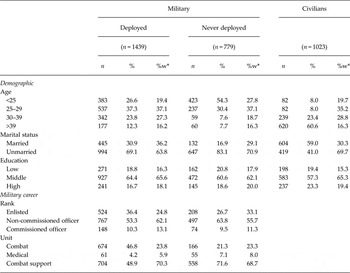
Sociodemographic variables that were assessed in both studies were age, marital status (married, unmarried), and education (low: 8th grade, middle: 10th grade, high: high school). Military career variables considered here to describe the military samples included rank (enlisted, non-commissioned officer, commissioned officer), unit (combat, medical, combat support) and number of deployments. The distributions of sociodemographic variables for the DS, NS and the civilian sample are shown in Table 1. For more detailed analyses in DS, the number of combat experiences was also assessed using the respective list of events of the Mental Health Advisory Team (Mental Health Advisory Team (MHAT IV), 2006) which includes 33 different events ranging from rather mild (e.g. seeing destroyed homes and villages) to severe events (e.g. being wounded or injured). DS experienced on average 6.9 (s.d. = 6.1) combat events. Detailed information on type and exposure for each single event is provided elsewhere (Wittchen et al. Reference Wittchen, Schoenfeld, Kirschbaum, Thurau, Trautmann, Steudte, Klotsche, Hoefler, Hauffa and Zimmermann2012b ). DS were then categorised into DS with low combat exposure (three or less events, 38.2%) and DS with combat events (more than three events, 61.8%).
Distribution of sociodemographic and military career variables in DS, NS and civilians

%w = weighted percentage.
* Weights were used to assure: (1) representativeness of the deployed sample for the reference population taking into account oversampling of combat units, eligibility and response according to rank, unit and location; (2) comparability of the deployed with the never deployed sample according to rank, unit, operational area, gender, age, educational level, number of years spent at school and having children; and (3) comparability of the general population sample with both military samples with regard to age, sex and marital status (individuals who were not employed were excluded from the general population sample).
Severity of mental disorders
The presence of comorbid disorders and self-rated impairment (for internalising disorders), as well as the number of reported symptoms (for SUD), were used as measures of disorder severity. For the assessment of impairment, respondents rated how much their daily life and activities were impaired by the symptoms of the respective disorder on a five-point scale ranging from 0 (no impairment) to 4 (very severe impairment). This item was also used to represent the impairment criteria (at least moderate impairment) of several DSM diagnoses in the CIDI diagnostic algorithms. This resulted in a low variance of disorder severity. Thus, the threshold for impairment in the diagnostic algorithm was lowered (at least mild impairment) for all analyses including the severity of internalising disorders. The severity of AUD and nicotine dependence was defined as the total number of symptoms that were endorsed. This measure of severity of SUD is in accordance with the approach that was introduced in DSM-5 (Hasin et al. Reference Hasin, O'Brien, Auriacombe, Borges, Bucholz, Budney, Compton, Crowley, Ling, Petry, Schuckit and Grant2013).
Statistical analysis
We used weighting procedures to achieve: (a) the representativeness of the DS sample for the reference population (N = 9617), (b) the comparability of the NS with the DS sample and (c) the civilian sample with the DS sample. The weighting procedure is described in detail in the online supplementary material.
For the comparison of both military samples with the civilian sample, logistic, multinomial logistic and linear regressions were applied for binary, multi-categorical and dimensional outcomes, respectively. For counted outcomes (i.e. the number of reported symptoms), negative binomial regressions were applied. Comparisons between DS and the civilian sample were always conducted for the total DS sample as well as separately for DS with low and high combat exposure since there is evidence that DS with high combat exposure have a higher risk for mental disorders (Iversen et al. Reference Iversen, Fear, Ehlers, Hughes, Hull, Earnshaw, Greenberg, Rona, Wessely and Hotopf2008; Jacobson et al. Reference Jacobson, Ryan, Hooper, Smith, Amoroso, Boyko, Gackstetter, Wells and Bell2008). Since differences in demographic characteristics between the three comparison groups could not be neutralised completely (see Table 1), we conducted a sensitivity analysis where we re-analysed differences between groups adjusting for age and marital status. All regressions used the robust Huber–White sandwich estimator for statistical inference in weighted data (Royall, Reference Royall1986). Associations were quantified with odds ratios (OR) for logistic and multinomial logistic and with incidence rate ratios (IRR) for negative binomial regressions. Statistical significance was assessed at the 5% level (two-sided tests). All analyses were conducted with Stata 12.1. (Stata Corp, 2012).
Results
Prevalence of 12-month mental disorders
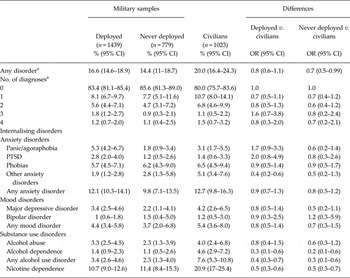
The prevalence of any 12-month mental disorder was lower in NS (14.4%) compared with civilians (20.0%; OR: 0.7, 95% CI: 0.5–0.99) but was not significantly different in DS (16.6%). Compared with civilians, NS had a lower probability of meeting criteria for alcohol (OR: 0.2, 95% CI: 0.1–0.6) and nicotine dependence (OR: 0.5, 95% CI: 0.3–0.7) but there were no differences regarding the prevalence of internalising disorders. DS had a lower prevalence of any other anxiety disorder (OCD, GAD) (OR: 0.4, 95% CI: 0.2–0.6), alcohol (OR: 0.3, 95% CI: 0.1–0.6) and nicotine dependence (OR: 0.5, 95% CI: 0.3–0.6) compared with civilians. The prevalence of all other specific diagnoses did not differ significantly between the military samples and civilians (Table 2). When differences between DS and civilians were analysed separately for DS with low and high combat exposure, DS with high combat exposure had a higher prevalence of panic/agoraphobia (OR: 2.7, 95% CI: 1.4–5.3) and PTSD (OR: 3.2, 95% CI: 1.3–8.0), while DS without combat exposure had a lower prevalence of any mood disorder (OR: 0.5, 95% CI: 0.4–0.8) compared with civilians. All other patterns of results were similar for DS with low and high combat exposure (Table S1). A sensitivity analysis adjusting for age and marital status showed the same differences between the three groups and estimates of associations were almost identical (data available on request).
Twelve-month prevalence of DSM-IV mental disorders in DS, NS and civilians

Phobias: Social phobia, specific phobia; other anxiety disorders: GAD, OCD.
a Without nicotine dependence.
Weights were used to assure: (1) representativeness of the deployed sample for the reference population taking into account oversampling of combat units, eligibility and response according to rank, unit and location; (2) comparability of the deployed with the never deployed sample according to rank, unit, operational area, gender, age, educational level, number of years spent at school and having children; and (3) comparability of the general population sample with both military samples with regard to age and marital status (individuals who were not employed were excluded from the general population sample).
Severity of 12-month mental disorders
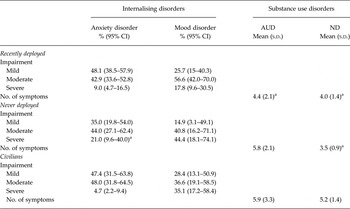
We analysed differences between military samples and civilians regarding comorbidity, self-rated impairment (for internalising disorders) and number of reported symptoms (for SUD) as measures of disorder severity (Table 3). For internalising disorders, logistic regressions revealed higher proportions of severe cases of anxiety disorders compared with civilians only among NS (OR: 5.4, 95% CI: 1.7–17.5). For SUD, the number of reported symptoms in individuals with ND was lower in both military samples (DS: IRR: 0.8, 95% CI: 0.7–0.8; NS: IRR: 0.7, 95% CI: 0.6–0.7) and it was also lower in individuals with AUD in the DS sample (IRR: 0.7, 95% CI: 0.6–0.9) compared with civilians. DS with low and high combat exposure showed a similar pattern of results compared with civilians regarding the severity of mental disorders except that DS with low combat exposure had a lower proportion of moderate cases of anxiety disorders compared with civilians (OR: 0.3, 95% CI: 0.1–0.9) which was not found for DS with high combat exposure (Table S2). Adjusting for age and marital status did not affect these results.
Severity of 12-month DSM-IV mental disorders in recently DS, NS and civilians

Anxiety disorder: any panic disorder, agoraphobia, posttraumatic stress disorder, social phobia, specific phobia, generalised anxiety disorder, obsessive compulsive disorder; mood disorders: any major depressive disorder, dysthymia; AUD, alcohol use disorder; ND, nicotine dependence.
a Significant difference compared with civilians (p < 0.05).
Discussion
This study compared military personnel with and without a history of deployment and sociodemographically comparable civilians regarding the prevalence and severity of 12-month DSM-IV mental disorders. The study is among the few that have been able to conduct a standardised comparison of military and civilian samples across the same timeframe using identical assessment methods. We found rather similar rates for internalising disorders and lower rates for SUD in both military samples compared with civilians. The same pattern was observed for measures of disorder severity where we found a lower severity of SUD and a comparable severity of most internalising disorders. Elevated rates among military personnel compared with civilians were only found for DS with high combat exposure and this was restricted to panic/agoraphobia and PTSD.
These findings differ from the US and the UK comparisons which found overall higher rates of mental disorders in military personnel compared with civilians (Kessler et al. Reference Kessler, Heeringa, Stein, Colpe, Fullerton, Hwang, Naifeh, Nock, Petukhova, Sampson, Schoenbaum, Zaslavsky and Ursano2014b ; Goodwin et al. Reference Goodwin, Wessely, Hotopf, Jones, Greenberg, Rona, Hull and Fear2015). Findings also differ from previous UK data suggesting higher rates of alcohol misuse in the military compared with the general population, although this study only stratified by gender and age (Fear et al. Reference Fear, Iversen, Meltzer, Workman, Hull, Greenberg, Barker, Browne, Earnshaw, Horn, Jones, Murphy, Rona, Hotopf and Wessely2007). There are several possible reasons for these divergent findings.
First, there are noteworthy differences in design and methods employed in this study compared with those reported by Kessler et al. (Reference Kessler, Heeringa, Stein, Colpe, Fullerton, Hwang, Naifeh, Nock, Petukhova, Sampson, Schoenbaum, Zaslavsky and Ursano2014b ) and Goodwin et al. (Reference Goodwin, Wessely, Hotopf, Jones, Greenberg, Rona, Hull and Fear2015). Military samples in these studies were representative of the serving military. The DS sample, which was used as reference for the calibration of both NS and civilians was only representative of two ISAF contingents. Selection mechanisms that led to the assignment to these contingents might have led to different prevalences of mental disorders than would have been observed in the entire serving military. Moreover, the UK study used a self-report instrument (General Health Questionnaire) and the US study used a self-administered version of the CIDI as well as the Posttraumatic stress disorder Checklist for the assessment of mental disorders instead of structured interviews that were employed in this study. However, this is unlikely to explain any cross-study differences since military and civilian samples were always assessed with the same instruments so potential bias would apply to both populations.
Second, there are differences in deployment characteristics and the military structure between Germany, UK and the USA in terms of tour length, preparation and involvement in combat events (Wittchen et al. Reference Wittchen, Schoenfeld, Kirschbaum, Thurau, Trautmann, Steudte, Klotsche, Hoefler, Hauffa and Zimmermann2012b ; Trautmann et al. Reference Trautmann, Schönfeld, Höfler, Heinrich, Hauffa, Zimmermann and Wittchen2013; Zimmermann et al. Reference Zimmermann, Höfler, Schönfeld, Trautmann, Hauffa, Kowalski and Wittchen2014) which might result in an overall lower degree of exposure to stressful experiences in German deployed personnel. This might explain why we found no elevated rates of mental disorders in deployed personnel compared with civilians. However, an overall effect of deployment on mental health only exists for the US but not for the UK military (Sundin et al. Reference Sundin, Herrell, Hoge, Fear, Adler, Greenberg, Riviere, Thomas, Wessely and Bliese2014) suggesting that these deployment characteristics might only explain the differences between the present study and the study of Kessler et al. (Reference Kessler, Heeringa, Stein, Colpe, Fullerton, Hwang, Naifeh, Nock, Petukhova, Sampson, Schoenbaum, Zaslavsky and Ursano2014b ) which included a high proportion of previously deployed personnel. Moreover, the US and UK military might differ from the German forces in terms of recruitment, career mechanisms, regulations and the availability and accessibility of supportive resources including mental health services. In particular, the lower rates of SUD in the German military compared with civilians might be the result of strict regulations regarding substance use (at least for alcohol use) and earlier treatment seeking compared with civilians, probably mediated by disciplinary measures in case of substance-related offenses and the corrective influence of the military unit (Zimmermann et al. Reference Zimmermann, Kowalski, Heinrich, Willmund and Heinz2012). Alternatively, differences in cultures between militaries with regard to substance use might also be relevant.
Third, both Kessler et al. (Reference Kessler, Heeringa, Stein, Colpe, Fullerton, Hwang, Naifeh, Nock, Petukhova, Sampson, Schoenbaum, Zaslavsky and Ursano2014b ) and Goodwin et al. (Reference Goodwin, Wessely, Hotopf, Jones, Greenberg, Rona, Hull and Fear2015) argue that predisposing vulnerability factors for the development of mental disorders (e.g. parental psychopathology (Knappe et al. Reference Knappe, Lieb, Beesdo, Fehm, Low, Gloster and Wittchen2009), early adverse experiences (Kessler et al. Reference Kessler, Davis and Kendler1997)) might be more common in military personnel compared with civilians which could be the result of self-selection processes (Kessler et al. Reference Kessler, Heeringa, Stein, Colpe, Fullerton, Hwang, Naifeh, Nock, Petukhova, Sampson, Schoenbaum, Zaslavsky and Ursano2014b ; Goodwin et al. Reference Goodwin, Wessely, Hotopf, Jones, Greenberg, Rona, Hull and Fear2015). If this was the case, our findings would suggest that this self-selection of vulnerable individuals into military service might exist to a lesser extent in the German military or that military selection and attrition processes might counteract these effects.
Finally, divergent findings compared with previous studies might be the result of cross-national differences in occupational cultures in general. Nations vary considerably in occupational factors such as working conditions, occupational health and safety systems as well as prevention and compensation approaches to work-related health problems, which might be related to the prevalence of mental disorders in the working population (World Health Organization, 2012). Another specific occupational aspect might be an over-reporting of mental health symptoms in studies which have been specifically designed to target an individual occupational group such as military personnel (Goodwin et al. Reference Goodwin, Ben-Zion, Fear, Hotopf, Stansfeld and Wessely2013, Reference Goodwin, Wessely, Hotopf, Jones, Greenberg, Rona, Hull and Fear2015). In addition to putative effects of assessment procedures, which can impact on this response bias (self-report questionnaire v. structured interviews), one might speculate that German military personnel are less likely to endorse sensitive private information such as mental health symptoms than US and UK military personnel. This could be explained by perceived roles, stigmatisation or suspected disadvantages related to disclosure of mental disorder which could differ between the German military and other forces. In summary, there are several putative reasons for differences in military-civilian comparison between the present German study and recent US and UK findings, which might be fruitful targets for future research.
Beyond differences to previous US and UK comparisons we observed two more specific findings that might have implications for service provision and intervention. First, elevated rates of mental disorders among DS compared with civilians were only found for PTSD and panic/agoraphobia. This is in line with research showing particularly strong relations between traumatic event exposure and these mental disorders (Ayazi et al. Reference Ayazi, Lien, Eide, Swartz and Hauff2014) which should be considered when screening for deployment-related mental health problems. Second, we found more severe cases of anxiety disorders in the NS sample compared with civilians. This might reflect a reduced recognition and treatment allocation of at least some anxiety disorders in the population of NS which warrants further investigation.
This study has some limitations. The DS sample was representative for two contingents of DS and does not represent the entire deployed population in the German forces. However, we have no evidence that these contingents differ considerably from others. In addition, we cannot rule out the possibility of an underreporting, especially for SUD. However, this would only mask differences between soldiers and the general population if this occurred to a higher extent in soldiers. Besides, previous studies have shown that the used interview and its confidential administration allow a valid estimation of prevalence rates for SUD (Kessler et al. Reference Kessler, Wittchen, Abelson, Mcgonagle, Schwarz, Kendler, Knäuper and Zhao1998; Lachner et al. Reference Lachner, Wittchen, Perkonigg, Holly, Schuster, Wunderlich, Turk, Garczynski and Pfister1998). We were also not able to assess females in this study because of the low number in the German military. Finally, interpretations regarding differences between military personnel and civilians have still to be done with caution since even a careful calibration of samples cannot consider all putatively relevant variables.
Conclusion
The findings of this study suggest that rates and severity of mental disorders are similar or even lower in the German military compared with sociodemographically matched civilians, irrespective of deployment. The concentration of available resources on an improved identification and care for high-risk subgroups, particularly among deployed personnel with high combat exposure, might therefore be the most appropriate strategy. Differences to comparisons from the USA and the UK, which observed higher rates of mental disorders in the military, might be explained by differences in study methods, deployment characteristics, military structures, self-selection processes and mental health in the working population. The findings of this study might apply to other nations (e.g. Netherlands, Australia) which report prevalence rates of mental disorders that are similar to those in the German military (Hodson et al. Reference Hodson, McFarlane, Van Hooff and Davies2011; Reijnen et al. Reference Reijnen, Rademaker, Vermetten and Geuze2015). Whilst the suggested methodological explanations for divergent findings should be considered in the conduct and interpretation of future studies, differences in recruitment strategies, selection processes and disclosure of mental disorder might be promising targets for further investigation of these mechanisms and the role they may have in determining military mental health.
Supplementary material
The supplementary material for this article can be found at http://dx.doi.org/10.1017/S204579601600024X.
Acknowledgements
The military project was logistically supported by the staff of the ‘Centre for Psychiatry and Posttraumatic Stress’ in Berlin. The military project was also supported by an internal military Steering and Advisory Board of the German Armed Forces. Dr Sabine Schönfeld and Dr Clemens Kirschbaum contributed to the planning of the study design of the military study. Christin Thurau and Michaela Galle were involved in the logistical handling of the military project. Lucie Scholl was involved in the logistical handling of the general population study.
Financial Support
The study was funded by the German Defense Ministry and the Medical Office thereof (Project Funding number M/SAB X/9A004). The sponsor of the study had no role in the study design, sampling, analyses or interpretation. LG is part funded by the National Institute for Health Research (NIHR) Mental Health Biomedical Research Centre at South London and Maudsley NHS Foundation Trust and King's College London.
Conflict of Interest
HUW is member of advisory boards and received grant support and travel compensation by Servier, Lundbeck, Novartis, Pfizer and Sanofi which could be perceived as a potential conflict of interest. PZ is employed by the German Armed Forces. His employment had no influence on the study design; the collection, analysis and interpretation of data. All other authors declare that they have no conflict of interests.
Ethical Standard
The study was approved by the TUD Ethics Board (EK 72022010), after internal Bundeswehr approval, and was performed according to ICH-GCP (Good Clinical Practice) Guidelines.