Introduction
Up to 50% of human immunodeficiency virus-type 1 (HIV) positive individuals will experience some form of neurocognitive decline during the course of their illness (Bloom and Rausch, Reference Bloom and Rausch1997), which can range from impaired motor skills and slowed information processing to severe dysfunction that affects activities of daily living (ADL; Heaton et al., Reference Heaton2004). The natural history of HIV-associated cognitive impairment has significantly changed in response to the introduction of highly active antiretroviral treatment (HAART; Bottiggi et al., Reference Bottiggi2007). Although the incidence of HIV-dementia has declined, prevalence rates have increased with increasing longevity (Bottiggi et al., Reference Bottiggi2007). The benefits of HAART vary considerably and there is a great deal of heterogeneity in the progression of cognitive impairment (e.g. Antinori et al., 2008). Accurate identification and classification of the extent of impairment are essential in understanding the nature of neuroAIDS, particularly when considering the changing nature of HIV-infection.
The AIDS Task Force of the American Academy of Neurology (AAN) published the first research case definitions for HIV-related neuropsychological disorders in 1991 (American Academy of Neurology, 1996; Janssen et al., Reference Janssen1991). HIV-1 associated dementia complex (HAD) and minor cognitive motor disorder (MCMD) emerged as two distinct HIV-associated neuropsychological phenomena. HAD required the presence of an acquired abnormality in at least two cognitive domains causing impairment in activities of daily living, as well as motor abnormalities or specified neuropsychiatric or psychosocial dysfunction. MCMD was also classified by the presence of neurocognitive dysfunction (though less severe than observed with HAD) or observed reduced coordination, emotional volatility, or apathy in addition to at least one indicator of decreased role function attributable, at least in part, to cognitive status. Several limitations of the AAN criteria exist that diminish its effectiveness in correctly diagnosing HIV-associated neurocognitive disorders. These include the overlap between the diagnostic criteria for HAD and MCMD with regard to the unspecified degree and number of neurocognitive impairments required, the high degree of reliance on motor and behavioral abnormalities in MCMD, the failure to assign a diagnosis to those presenting without overt functional decline, and perhaps an over-reliance on clinician judgment (Antinori et al., Reference Antinori2007; Cherner et al., Reference Cherner2007).
Grant et al. (Reference Grant, Heaton and Atkinson1995) proposed a classification scheme, later adopted by Antinori et al. (Reference Antinori2007; HIV-Associated Neurocognitive Disorders [HAND]), that gave greater priority to the cognitive aspects of impairment than psychosocial, emotional, or motor difficulties. Some data (Cherner et al., Reference Cherner2007) suggest that these criteria may be superior to the earlier AAN criteria in accurately classifying neurocognitive disorders in HIV. In comparing a neurocognitive diagnosis using the AAN and HAND criteria with neuropathological diagnosis of HIV encephalitis (HIVE) made at autopsy, 72% of cases were correctly classified with HAND criteria, whereas 64% were correctly diagnosed using AAN criteria. HAND also had better sensitivity (67% vs. 56%) and specificity (92% vs. 83%; Cherner et al., Reference Cherner2007). The definitional criteria included: HIV-associated dementia (HAD), HIV-associated mild neurocognitive disorder (MND), and asymptomatic neurocognitive impairment (ANI). Score cutoffs on cognitive and laboratory-based measures or subjective report on functional abilities measures are used to generate each of three categorical diagnoses. The addition of the ANI category addresses a gap in the previous AAN nosology by addressing the clinical reality that HIV-infection may affect cognition even without overt functional deficit. Building upon these initial studies, the present study sought to apply the updated HAND classification system using the operationalized criteria and to examine the resulting neuropsychological diagnostic profiles.
Methods
Participants
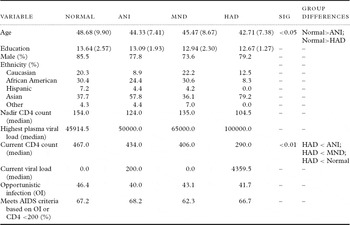
Participants included 210 post-HAART-era HIV+ adults who were recruited from community agencies and general medical centers. We excluded participants with a recent (past month) history of a psychiatric episode or substance abuse (last 12 months) or with a history of central nervous system (CNS) opportunistic infection. Descriptive statistics for the demographic data are presented in Table 1.
Participant characteristics according to HAND classification (N = 210)

ANI = Asymptomatic Neurocognitive Impairment; MND = Mild Neurocognitive Disorder; HAD = HIV-Associated Dementia.
Procedures
All participants completed comprehensive neuropsychological assessments that targeted the cognitive domains most susceptible to HIV-Associated Cognitive Decline. Neuropsychiatric data were collected using the Structured Clinical Interview for DSM-IV, Axis I Disorders (SCID; First et al., Reference First, Spitzer, Gibbon and Williams1995), the Beck Depression Inventory, 2nd edition (BDI-II; Beck et al., Reference Beck, Steer and Brown1996), and the Beck Anxiety Inventory (BAI; Beck and Steer, Reference Beck and Steer1993).
Neurocognitive assessment
All participants completed an extensive neuropsychological test battery administered by trained psychometrists and supervised by a board-certified neuropsychologist (CHH). However, since participants were drawn from one of two archival datasets, each containing test scores from slightly different assessment batteries, we elected to calculate domain scores from neuropsychological and functional measures that purportedly examine the same functions in order to increase comparability of the independent datasets. The neurocognitive and functional measures included within each dataset are designated by a for dataset 1 (n = 67) and b for dataset 2 (n = 143). There were no differences between datasets in the resulting HAND cells.
We assessed seven domains of cognitive function, and raw scores from all measures were converted to T-scores using published, demographically adjusted norms that included corrections for age and other demographic characteristics relevant to interpretation of performance on each test. Assessment included the following measures:
• Language/Verbal fluency – assessed with the Controlled Oral Word Association Test (FASab and Animal Naminga; Benton and Hamsher, Reference Benton and Hamsher1983)
• Executive functioning – assessed with the Trail Making Test, Bab (Reitan and Wolfson, Reference Reitan and Wolfson1993), the Wisconsin Card Sorting Test (WCST) Perseverative Responsesa, (Heaton and Staff, Reference Heaton and Staff2000), the Category Test, number of errorsb (Halstead, Reference Halstead1947), the Stroop Color and Word Test, Worda (Stroop, Reference Stroop1935), or the Stroop Color and Word Test, Interferenceb.
• Information processing speed – assessed with the Trail Making Test, Aab, the Stroop Color and Word Test, Wordab, the Stroop and Word Test, Colorb, WAIS-III Digit Symbol Codinga (Wechsler, Reference Wechsler1997), WAIS-III Symbol Searcha, and the Symbol Digit Modalities Testb (Smith, Reference Smith1991).
• Attention – assessed with the Paced Auditory Serial Addition Test (PASAT) Series 1a (Gronwall, Reference Gronwall1977), the PASAT Totalb, WAIS-III Letter/Number Sequencinga, or WAIS-III Digit Span Total Scoreb. Learning was assessed with the Brief Visual Memory Test, Revised (BVMT-R) Total Scorea (Benedict, Reference Benedict1997), the BVMT-R Trial 1a, the Hopkins Verbal Learning Test, Revised (HVLT-R) Total Scorea (Brandt, Reference Brandt1991), the HVLT-R Trial 1a, the California Verbal Learning Test, Adult Edition (CVLT) List A Trials 1–5 Totalb (Delis et al., Reference Delis, Kramer, Kaplan and Ober1987), and CVLT Short Delay Free Recallb.
• Memory – assessed with the BVMT-R Delayed Recalla, HVLT-R recalla, or CVLT Delayed Free Recallb.
• Motor functions – assessed with Grooved Pegboardab (Matthews and Klove, Reference Matthews and Klove1964).
• Premorbid intellectual functioning – assessed with the Wide Range Achievement Test, third edition (WRAT-III) Readinga (Wilkinson, Reference Wilkinson1993).
Functional assessment
Functional impairment was determined by performance-based instruments and subjective report. Self-reported assessment of functional impairment for the total sample was conducted using the Patient Assessment of Own Functioninga (PAOF; Lawton and Brody, Reference Lawton and Brody1969) or the Cognitive Failures Questionnaireb (CFQ; Broadbent et al., Reference Broadbent, Copper, Fitzgerald and Parkes1982). The PAOF and the CFQ are similar Likert-style measures of self-reported perceived daily cognitive lapses. Moderate-to-severe functional impairment was defined by self-reported increased difficulty with more than four aspects of cognition in daily life, and mild was defined by self-reported increased difficulty with two or three aspects of cognition in daily life. For the PAOF (n = 67), 24 (35.8%) were normal, 11 (16.4%) were mild, and 32 (47.8%) were moderate-to-severe. For the CFQ, 35 (24.5%) were normal, 30 (21%) were mild, and 78 (54.5%) were moderate-to-severe.
Laboratory-based assessment of functional impairment was conducted with the Columbia Medication Management Task, Reviseda (MMT; Albert et al., Reference Albert1999) or the Medication Event Monitoring Systemb (MEMS cap). The MMT is designed to measure medication management ability during laboratory testing, and includes several items assessing the participant's understanding of dosing, use, and length for a mock prescription medication, as well as items requiring the participant to perform medication management tasks. Total number correct on the MMT was the outcome variable. Using a 1SD cutoff for mild and 2SD cutoff for moderate-to-severe impairment, 61 (91.04%) were classified as functionally normal, 4 (5.98%) as mild, and 2 (2.99%) as moderate-to-severe. The MEMS cap is designed to measure actual medication adherence outside of the laboratory, and uses a pressure activated microprocessor in the medication bottle cap that records the date, time, and duration of bottle opening. Due to the skewed distribution of the MEMS cap data, we employed percent adherence cutpoints (good adherers: ≥95% adherence, suboptimal adherers: ≥80% and <95% adherence, poor adherers: <80% adherence). Results indicated 26 (23.9%) were classified as functionally normal, 30 (27.5%) as suboptimal adherers, and 53 (48.6%) as poor adherers. These data were not available for 34 of the participants in dataset 2; we applied their self-reported functional assessment score only for classification purposes. No differences were found between participants with MEMS cap data and those without psychiatric or self-reported data, or resulting HAND diagnoses.
Normative data
Since normative data have not been published for the MMT, using a sample of healthy seronegative controls (n = 17), we generated normative data to be employed in our algorithm. The normal controls were not different from HIV+ on age, education, gender, or ethnicity. The range for the seronegative group was 4–17 (Mean = 13.12, SD = 4.31). These data were converted to T-scores using our seronegative control cohort to provide a consistent scale for data comparison.
Classification method
Participants were classified using objective neuropsychological data and both subjective (self-reported) and objective (performance-based) functional data. In accordance with the HAND criteria specified by the working group of the National Institute of Mental Health (NIMH) and the National Institute of Neurological Diseases and Stroke (NINDS; Antinori et al., Reference Antinori2007):. a diagnosis of HIV-Associated Dementia (HAD) was made if the presentation included moderate-to-severe cognitive impairment as evidenced by either (a) 2+ domains of ≥−2.0 standard deviations (SD) of cognitive impairment, or (b) 1 domain of ≥−2.5 SD of cognitive impairment and 1 domain of ≥1.0 SD cognitive impairment, in addition to moderate-to-severe functional impairment as evidenced by (a) ≥−2.0 SD of functional impairment on performance-based assessments, and (b) increased difficulty with 4+ aspects of cognition in daily life on subjective assessment. Participants were classified with Mild Neurocognitive Disorder (MND) if they presented with mild cognitive impairment as evidenced by 2+ domains of ≥1.0 SD cognitive impairment, in addition to mild functional impairment as evidenced by (a) ≥1.0 SD functional impairment on performance-based assessments, and (b) increased difficulty with 2+ aspects of cognition in daily life on subjective assessment. Participants were classified with Asymptomatic Neurocognitive Impairment (ANI) if they presented with mild cognitive impairment as evidenced by 2+ domains of ≥1.0 SD of cognitive impairment in the absence of functional impairment. Participants complaining of functional impairment without objective cognitive decline were classified as normal. Because the HAND algorithm is dependent upon meeting objective thresholds of impairment for cognitive/functional outcomes, independent raters were not needed for establishing reliability and a computer algorithm carried out ratings as prescribed.
Results
Operationalization of the method
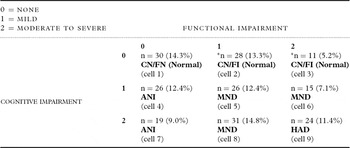
HAND diagnoses based upon the criteria specified above are shown in Table 2. Given that depressed patients often over-report cognitive/functional compromise (Hinkin et al., Reference Hinkin, van Gorp, Satz, Weisman, Thommes and Buckingham1992), we contrasted data from participants with self-reported functional compromise and BDI-II scores that exceeded 17 with the other participants, but no significant group variation was observed. Therefore, we included data from those with BDI-II scores exceeding 17 (n = 45).
HIV-Associated Neurocognitive Disorders (HAND) diagnostic assignment

*Participants fail to meet criteria for HAND diagnosis despite marked functional impairment.
CNFN = Cognitively Normal/Functionally Normal; CN/FI = Cognitively Normal/Functionally Impaired; ANI = Asymptomatic Neurocognitive Impairment; MND = Mild Neurocognitive Disorder; HAD = HIV-Associated Dementia.
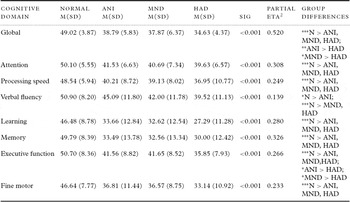
The algorithm yielded 69 (32.8%) normal, 45 (21.4%) with ANI, 72 (34.3%) with MND, and 24 (11.4%) with HAD. Analyses of variance (ANOVAs) were conducted between HAND groups on each of the seven domains of cognitive function that were used to arrive at diagnosis (see Table 3). Results showed group differences at p < 0.001 on each of the seven cognitive domains. Post hoc Tukey HSD comparisons were conducted for pairwise comparisons. Results showed significant differences between the normal group and each of the HAND diagnostic groups (ANI, MND, and HAD) on global neuropsychological function (normal > HAND groups). Results comparing HAND diagnostic groups indicated differences between HAD and ANI (ANI > HAD), and between HAD and MND (MND > HAD) on global neuropsychological function. When group differences were evaluated on domains of cognitive function, results again showed differences between the normal group and each of the HAND diagnostic groups (normal > HAND groups). ANOVAs comparing HAND diagnostic groups revealed differences between HAD and ANI (ANI > HAD), and between HAD and MND (MND > HAD) on executive functioning.
HAND diagnostic group differences on cognitive domains

N = normal; ANI = Asymptomatic Neurocognitive Impairment; MND = Mild Neurocognitive Disorder; HAD = HIV-Associated Dementia.
Post Hoc Tukey Pairwise Comparisons: *≤0.05; **≤0.01; ***≤0.001.
Characterizing Select Subgroups of Interest
Subgroup of Interest 1: CN/FI
Thirty nine (18.5%) participants fell into a subcategory reflected by mild to moderate/severe functional impairment in the absence of objective cognitive compromise (referred to hereafter as “Cognitively Normal/Functionally Impaired” [CN/FI]; see Table 2: cells 2 and 3). Both objective and subjective measures of functional status were employed (described above) for classification. Subjects who were cognitively normal but functionally impaired received impaired scores on both performance and subjective report of functional status.
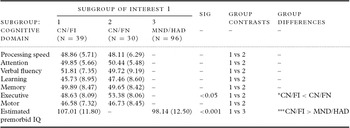
We examined whether these participants were neurocognitively distinct from more severe HAND categories or whether they constituted a subclinical impairment category characterized by early decline. ANOVAs were conducted to evaluate differences in cognitive ability between CN/FI and cognitively/functionally normal (CN/FN) (see Table 2: cells 2 and 3 versus cell 1). ANOVAs were also conducted to examine differences in estimated premorbid ability between CN/FI and those with prominent functional and cognitive decline (i.e. MND/HAD; see Table 2: cells 2 and 3 versus cells 5, 6, 8, and 9). Significant differences were found in premorbid IQ between CN/FI and those with both cognitive and functional impairment (CN/FI > MND, HAD in premorbid IQ; see Table 4). In comparison to other HAND groups, results further revealed that estimated premorbid IQ scores of CN/FI (107.0[11.8]) were consistent with CN/FN (109.4[11.6]), and greater than the scores of ANI (99.5[10.8]), MND (98.1[13.7]) and HAD (98.4[7.6]), suggesting that higher cognitive reserve (i.e. premorbid IQ) may function to reduce apparent cognitive impairment levels despite the presence of notable functional decline. Results also indicated significant differences between CN/FN and CN/FI on executive functioning (CN/FN > CN/FI; see Table 4). In comparison to other HAND groups, executive functioning of CN/FI (48.6[8.1]) fell significantly below CN/FN (53.4[8.1]), but significantly above ANI (41.6[8.8]). These results suggest the presence of sub-threshold decline that fails to meet designated cutpoints for HAND classification. Finally, since subjective report of functional decline contributes to diagnostic classification, we evaluated whether psychiatric symptoms might have accounted for the observed functional impairment. ANOVAs conducted between CN/FI and other HAND-defined groups failed to show group differences on the BDI-II (F = 2.530; p = 0.11; partial η2 = 0.01) or BAI (F = 2.111; p = 0.15; partial η2 = 0.01) total scores.
Subgroup of interest 1: Comparison across cognitive domains

CN/FN = Cognitively Normal, Functionally Normal; CN/FI = Cognitively Normal, Functionally Impaired; HAD = HIV-Associated Dementia.
*≤0.05; **≤0.01; ***≤0.001.
Subgroup of interest 2: severely cognitively impaired ANI and MCMD
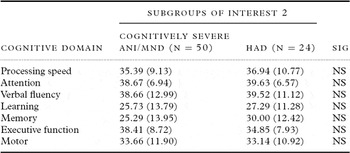
We then explored the cognitive profiles of two subgroups characterized by severe cognitive impairment, including a severely cognitively impaired ANI subgroup and a severely cognitively impaired MND subgroup (Table 2: cells 8 and 9). While both of these subgroups show severe cognitive impairment, the ANI group demonstrates no functional deficits while the MND group demonstrates minimal functional decline. ANOVAs were conducted to examine differences between these subgroups and HAD-classified participants on level of impairment within each cognitive domain (see Table 5). There were no differences between the severely cognitive impaired ANI/MND and HAD groups on mean performances within any of the seven cognitive domains (p > 0.05). These results suggest that the severely impaired ANI/MND and HAD groups may be indistinguishable from a cognitive standpoint.
Subgroup of interest 2: comparison across cognitive domains

ANI = Asymptomatic Neurocognitive Impairment; MND = Mild Neurocognitive Disorder; HAD = HIV-Associated Dementia.
Discussion
Operationalization of the updated HAND method
This study examined neurocognitive differences between and among HAND-defined groups and normal participants. Results showed group differences on all cognitive domains, with controls performing superior to ANI, MND, and HAD groups in all cases. For global neuropsychological and executive functioning, ANI and MND performed superior to HAD. These results suggest that the updated HAND algorithm effectively discriminates between patients at different levels of impairment, indicating adequate diagnostic utility. For executive functioning, differentiation among the HAND impairment groups was identified, with dementia participants performing significantly worse than asymptomatic and mildly impaired participants. These findings support the clinical utility of HAND and suggest the presence of identifiable patterns for resulting diagnostic groups.
Characterizing select subgroups of interest
CN/FI participants as a subclinical group
Over half of the cognitively normal participants in our sample presented with notable functional compromise (i.e. CN/FI). We sought to evaluate whether they differed from (a) more severely impaired participants in estimated premorbid IQ, and (b) normal participants in cognitive functioning, in order to evaluate whether they may be understood as a prodromal group. Results further revealed that the estimated premorbid IQ of CN/FI were similar to CN/FN, and significantly higher than ANI, MND, and HAD. Furthermore, executive functioning among CN/FI fell significantly below CN/FN, but significantly above the ANI, suggesting that despite failing to meet established standard deviation cutoffs set by the updated HAND criteria, patients with marked functional decline despite intact cognitive capacity may show mild subclinical executive dysfunction. It is important to note, however, that despite statistical significance, the groups' performances were not meaningfully clinically different. Further research is therefore clearly needed to support these findings. Furthermore, although individuals with clinically significant psychiatric illnesses were excluded from the study, we appreciate that emotional distress, even at subclinical levels, can often promote a false sense of disordered functional abilities. As a result, we examined differences between all HAND groups and CN/FN in psychiatric symptoms. Findings failed to reveal differences in depressive or anxiety symptoms, suggesting that functional declines are not attributable to emotional distress. CN/FI may therefore constitute a distinct subclinical category characterized by early subtle cognitive decrements and apparent functional decline. Continued investigation into this unique subgroup will be helpful in providing guidance to clinicians in making diagnostic decisions for ambiguous cases. Longitudinal research will be particularly helpful in determining if and how these individuals may progress to more severe HAND categories (e.g. MND, HAD). Being forced to collapse the CN/FI and CN/FN groups into a normal category appears to be a limitation of the current HAND nosology. Expanding the diagnostic framework to incorporate all individuals presenting with HIV-related impairment (both cognitive and functional) might expand scientific investigation into this unique subpopulation of patients with the goal of preventing or slowing the course of possible further cognitive deterioration.
Characterizing severely cognitively impaired ANI and MND
The current study revealed no differences between severely cognitively impaired ANI and MND groups, and HAD groups, on any of the seven cognitive domains used to generate HAND classifications, suggesting that a large subset of ANI and MND patients are cognitively indistinguishable from dementia. Future research should undertake longitudinal investigation to determine progression from ANI and MND to HAD and to seek to understand the significance of functional impairments, and the most viable methods for assessing daily living impairment.
Conclusions
Accurate and inclusive categorization of HIV-associated neurocognitive impairment is important in fostering our ability to understand individuals with varying levels of deficit, to enhance communication about HIV-related impairment, and to provide a basis for treatment intervention. The updated HAND criteria have corrected several limitations associated with the earlier AAN method for diagnosing HIV-neuropsychological impairment. The addition of the subclinical category affords greater inclusiveness in diagnostic assignment of patients without an overt increase functional dependence, as well as increased specificity of diagnosis. The data-driven classification algorithm, with specific cut points for varying levels of impairment, may avoid ambiguity, imprecision, and inter-rater reliability errors. Finally, the enhanced reliance upon cognition (vs motor or behavioral variables) in defining impairment increases applicability to neuropsychological diagnosis. These methodological improvements have created a classification algorithm that is both sensitive and specific in the diagnosis of HIV-cognitive impairment. The present study supported the diagnostic utility of the updated HAND algorithm, and revealed two sets of unique HAND subgroups (CN/FI and severely cognitively impaired ANI and MND) that require further investigation for improving characterization. It may be argued that evaluating HAND groups based upon domains of cognitive impairment is redundant and circular in nature. However, we find that distinguishing and characterizing groups across cognitive domains appears to be an informative strategy despite the fact that HAND groups are derived in part from cognitive scores. First, the classificatory algorithm uses functional data in addition to cognitive data, and therefore, patients with the same level of cognitive decline are in some cases assigned to differing groups (e.g. MND versus ANI), making level of cognitive function only partially determinant of diagnosis. Second, cutoff scores (e.g. ≥2SD of impairment on two cognitive domains) are employed when assigning patients, and thus the absolute extent of impairment on each domain is not apparent from group assignment alone. As a result, examining differences across cognitive domains allows for a more refined analysis of neuropsychological functioning for each of the HAND defined groups, and identifying the characteristics of these distinct groups is therefore not believed to impose danger of circularity. Future research should investigate whether individuals comprising various diagnostic groups present with distinct neuropathology warranting unique diagnostic classification. Longitudinal data of neuropsychological and neuropathological functioning will also be important in order to better appreciate whether underlying neurobiological changes are giving rise to cognitive progression, as well as the rate and extent to which individuals progress through the various HAND diagnostic categories over time. Each of these areas for development will serve to enhance our understanding of the nature of HIV and associated cognitive-behavioral disturbance, its neurobiological mechanisms and substrates, and the utility of the current updated classificatory system.
Conflict of interest
None.
Description of authors' roles
Jessica M. Foley formulated the research question, hypotheses and methodology, designed the study, conducted the statistical analyses, and wrote the paper. Matthew Wright and Mark Ettenhofer contributed significantly to the design and statistical analyses, and assisted with writing, revision and editing of the paper. Amanda L. Gooding, Michelle S. Kim and Melissa Choi contributed significantly to the literature review. Steven Castellon supervised collection of data, contributed significantly to revision and editing of the paper, and provided support with design and methodology. Joseph Sadek contributed significantly to the methodological design and writing, revision and editing of the paper. Robert Heaton, Wilfred van Gorp and Tom Marcotte contributed significantly with methodological design and writing, revision and editing of the paper. Charles Hinkin supervised collection of data, contributed significantly to revision and editing of the paper, and provided support with design and methodology.
Acknowledgments
This study was conducted at the University of California Los Angeles, and the West Los Angeles Veteran's Affairs Medical Center and was supported by: NIMH R01 MH58522, VA Merit Review: Aging and HIV/AIDS: Neurocognitive Sequelae and Functional Consequences to CHH.