In the last years of the nineteenth century, Arthur Conan Doyle, a prolific writer with a global reputation and readership, was settled with his family at Hindhead in Surrey. In his Memories and Adventures (M&A) he was to recall this period as an interlude of peace: “The country was lovely. My life was filled with alternate work and sport. As with me so with the nation” (151). This last sentence refers chiefly to the apparent placidity of the time, soon to be rudely spoilt by the outbreak of the South African war, which was to prove a critical and formative testing-ground for Great Britain and for Conan Doyle personally. But the sentence can also refer to the plenitude of a life divided between work and sport, and I will argue that Conan Doyle would be right to claim his experience here as representative of the national life. At the end of the century which invented modern sport, Conan Doyle's enthusiastic participation in sports, his writing about the subject, and his understanding of sporting culture have a great deal to tell us about Victorian Britain. As with him, so with the nation.
Conan Doyle is unusual among writers in the importance he accorded to sport in his life and the pleasure he derived from it. He may have been a professional writer living entirely by his pen, but he was pleased when, after they became the first men to travel on skis between Davos and Arosa in Switzerland, his companion Tobias Branger entered Conan Doyle's profession in the Arosa hotel registry as “Sportesmann” (M&A 293). As I will show, it is crucial to this question that Conan Doyle professed sport as an amateur. Further, I will argue that his sportsmanship does not make him less important or less interesting than more indoor authors, either as a literary writer or as that instantiation of the public intellectual which in his time was called a man of letters. To raise the question of sport is to activate the most vital issues of late Victorian and early twentieth-century culture, not only the stalwart trinity of gender, race, and class, but also physical and moral health, empire and war, modernity and tradition, freedom and community, pleasure and money.
Sport was particularly involved in the idea of the nation at a historical moment when this idea in England was undergoing an important metamorphosis. Richard Holt puts it this way:
The formation of a distinctive English national culture in the late Victorian and Edwardian era is undeniable but still not widely understood. The new consciousness of English culture that arose at this time ranged from an interest in the purity of the English language and its literature to music, folklore, landscape, and the idea of games as an embodiment of English spirit . . . Sports were not just the source of high-minded ideals, they were inseparably associated with the more down-to-earth, assertive, and patriotic Englishness. (263)
There has been a good deal of work on this late nineteenth-century development. Philip Dodd's essay “Englishness and the National Culture” was one important instigation. José Harris finds in the late Victorian period “a subterranean shift in the balance of social life away from the locality to the metropolis and the nation” (19). Stefan Collini has shown how “the ‘nationalization’ of English culture” was expressed in the creation or extension of national cultural institutions, and notably in the arrangement and celebration of a particular tradition of English literature as a curriculum subject and a national heritage (347). More recently, Krishan Kumar writes in The Making of English National Identity of a “moment of Englishness” at the end of the nineteenth century. The English had been senior partners in social structures and political systems – Great Britain, the British Empire – that directed their attention away from their own ethnic identities and somewhat inoculated them against the nationalism that was transforming Europe. “Ruling the roost, they felt it impolitic to crow” (187). Imperialism was felt to trump nationalism, Kumar argues. “In the Crystal Palace that housed the Exhibition [of 1851], the British half was divided into raw materials and industrial applications; the other half, devoted to the exhibits of other nations, followed no such order, and exhibits were classified by nation. The British contribution, in other words, was ‘universal’, that of other nations merely ‘national’” (193). But later in the century when new commercial and imperial rivals threatened Britain's supremacy, and other domestic nationalisms (especially the Irish)Footnote 1 grew more insistent, there appears an English cultural nationalism, a preoccupation with the “English spirit” and what Kumar calls a “wide-ranging discovery of England” (218). Sport plays a crucial part in this production or refurbishment of an English national character, and my wider argument is that Conan Doyle is among the most important participants in this ideological discourse.
This new and belated cultural nationalism, with its palaver of national identity and character, manifested itself in high culture – in historiography, in literary studies and teaching, in the founding of institutions like the National Trust (1895), the National Portrait Gallery (1896), and the Dictionary of National Biography (1885–1900) – and also in popular culture, from an appreciation of the countryside and pageantry to music hall songs to sport itself. Out of this self-consciousness emerged a generally satisfying sense of the English national spirit, with its individuality, sincerity, moderation, liberalism, love of freedom and justice, and incapacity for abstraction and system.Footnote 2 Conan Doyle played a very important role in this discourse of the nation, in theoretical and mythographic ways in his journalistic, historical and fictional writing, but also as a cultural sign in his own right. At the height of his celebrity, before his spiritualistic campaigns forfeited much of his credibility, Conan Doyle was a national writer like no other since the death of Dickens, and in this respect he stands as the most important English writer of his time. He merits the title of national writer by virtue of his extraordinary popularity, enabled by his talent and the material conditions of late-Victorian periodical and book publishing and by the existence of a reading public wider and better educated than ever before or since. But further, even in the absence of other credible candidates, his personal celebrity was constituted by qualities that seemed to coincide with the nation's image of itself, rather as an ego-ideal.
It was, to be sure, a gendered ideal. “His version of authorship was socially engaged and combative, his task as much the social performance of masculinity as the production of texts,” Diana Barsham argues (11); Conan Doyle's reputation “has been fixed in time as a museum piece of British manhood” (12). His contemporaries, who read his magazine stories and books, articles about and interviews with him, and his torrent of letters to the press, knew him as adventurous and responsible, manly and honourable: he was everything the English meant when they used the phrase “a good sport.”Footnote 3 While my chief focus here is on the way sport in Conan Doyle is important to both the formation and the expression of the nation, clearly Victorian ideas of sport and nation are themselves thoroughly imbricated with Victorian ideas of masculinity, and the history of the sportsman in the nineteenth century is an episode in the history of the man.
That history has been the object of a good deal of curiosity in recent scholarship. Feminism took the lead in giving attention to hegemonic modes of masculinity in the nineteenth century, ideas and images of the male which were seen as sustaining the patriarchal power relations that emerged from the cultural predominance of normative masculinities. The danger then becomes a “monolithic view of men as uncomplicated agents of oppression” (Dowling 117), a view which gender studies has set out to correct. This gave rise to an interest in alternative and counter-cultural forms of masculinity, in the demonized male others against whom the hegemonic male was defined, and – inevitably – to a recognition that patriarchal masculinity itself was never as secure as it sometimes seemed. There is now something of a consensus that Victorian manhood was neither monolithic nor stable, but on the contrary was riven with internal contradiction and fraught with anxieties.
It is clear that a cult of manliness was practiced in the Victorian patriarchy and sustained by stories of masculine heroism and adventure in the domains of war, empire, and exploration, whether historical, contemporary, or fictional. Conan Doyle himself became one of the leading contributors to this myth of manliness, in fiction and non-fiction, and also in his own robust and active person. There was a connection between this cult of manliness and the culture of Evangelical and Broad Church forms of Protestantism, above all in muscular Christianity; J. R. Watson, for example, has studied the blending of the ideals of soldier and saint in English hymns, and noticed a transition “from a defensive mode to an offensive one in fighting hymns [which] coincides with a recognition of manly heroism in nineteenth-century Britain” (18). Such manliness was given a national stamp by the example of soldier-saints like Henry Havelock, hero of the so-called Indian Mutiny, or General Gordon (whose portrait, we are told, hung on the wall of 221B Baker Street). But its particularly Protestant modality must have resonated in rather different ways for someone like Conan Doyle, brought up in the Roman Catholic faith which was popularly stereotyped in Victorian times, Carol Marie Engelhardt writes, “as an irrational, emotional and highly decorative religion, which particularly appealed to women and unmanly men” (47). While Conan Doyle drifted away from the Catholic Church, his later religious affiliations remained heterodox.
Herbert Sussman, in his influential study of what he calls “inscriptions of varied male practices of the self” (11), argues that for the Victorians “manhood is not an essence but a plot, a condition whose achievement and whose maintenance forms a narrative over time” (13). Configurations of masculinity (and femininity) are seen in this social constructionist paradigm as unstable, complex, and shifting. To see the matter in these terms is to get away from an essentialist discourse of gender, and this is certainly a liberating move so long as it does not cause us to forget that it was precisely on such an essence that the Victorians erected their male sense of identity. Sussman, and others following him (including Barsham in her work on Conan Doyle), see masculinity itself as an inner force, a strong libidinal current that constantly threatened to sweep men towards madness and disorder. Manliness, then, was the difficult and ongoing process by which Victorian masculinity was managed, controlled, and channeled into acceptable and useful forms of activity.
In his study of early Victorian masculine poetics Sussman sees this narrative organized into a recurring plot, in which the manly hero rejects both the perilous love of women and male-to-male intimacy – unless the latter is thoroughly desexualized; the monkish celibate male in a community of men “becomes the central figure through which the contradictions and anxieties about manhood are registered” (16). We might find a social form of this literary trope in the growing importance of sports in the all-male British public schools, where a healthily exhausting day on the football field was a prophylactic against impurity as well as an education in male teamwork.
The line of monkish comradely manliness Sussman traces in Carlyle and Browning and the early days of the Pre-Raphaelite Brotherhood could be extended easily enough to Sherlock Holmes, famously immune to Cupid's darts. But James Eli Adams, in Dandies and Desert Saints, traces a paradox in the way that a display or performance of ascetic manhood (notably in Carlyle's self-dramatization as a prophet) itself produces a kind of dandyism. In this too, Sherlock Holmes, that incorrigible show-off and self-admirer, is a later case in point. The monastic figure might be broadened to include the soldier-saint who must leave his mother to join a company of men. Various manly exploits in Conan Doyle's adventure fiction partake of this paradigm of ascetic manhood – though Conan Doyle's expeditionary heroes are often explicitly fighting for the reward of a woman's love. The chivalrous eponym of Sir Nigel and Edward Malone in The Lost World, who joins the all-male Challenger expedition in obedience to his fiancée's injunction to go away and do something heroic, are examples. Sporting activity itself almost always appears in Conan Doyle as a ritual of male companionship: it gets men out of the house and is something they do together.Footnote 4 It may be a healthy outlet for the boisterous drives of masculinity, but as I will show, it is also importantly a test and a guarantor of successful manhood.
In Conan Doyle we see not only the man of letters as sportsman, but the sportsman as man of letters. The age which made a hero of the unworldly creative artist and validated the woman writer was one in which social concerns about gender were implicated in the figure of the author. In English Romanticism the artist was somewhat feminized, an exceptional genius of sensitivity removed from the sphere of action. The Victorian age saw the birth of the artist as professional.Footnote 5 The novel, it was true, might have an agenda tuned to social realities and the world of action, yet the readership of Victorian fiction was mostly female. Another site for anxieties about manliness to express themselves thus emerges. Andrew Dowling shows how Forster's biographical portrait of his friend Dickens foregrounds Dickens's virility, a masculine “mingling of chaos and control” (31), and how fellow novelist Trollope nonetheless felt this portrait was compromised by revealing too much about its subject. Male writers were commonly assessed not only in terms of writing but in terms of manliness. In a later generation Conan Doyle, with his overwhelmingly masculine themes and his robust, plain style, certainly validates the manliness of the man of letters, whether or not we accept Diana Barsham's formulation, quoted above, that his task in writing “was as much the social performance of masculinity as the production of texts” (11).
With stories designed to give pleasure, in the words of the epigraph to The Lost World, “To the boy who's half a man,/And the man who's half a boy,” Conan Doyle seemed to stand as clearly for upright (straight) manhood and the manliness of the profession of letters as his contemporary Oscar Wilde embodied deviance from these ideals. If this contrast seemingly casts Doyle as a rather boring pillar of normative Victorian masculinity, it can perhaps be complicated by his warm admiration for Wilde (and his later championship of the even more scandalous and demonised homosexual Roger Casement) – not to mention Conan Doyle's public declarations of faith in the existence of fairies later in life. It is hard to imagine a more unmanly pronouncement, or one more damaging to Conan Doyle's status as a man of letters. That status was one that came with responsibility, visible in a letter to his mother in which Conan Doyle explained his decision to volunteer for military service at the time of the South African war. “What I feel is that I have perhaps the strongest influence over young men, especially young athletic sporting men, of anyone in England (bar Kipling)” (A Life in Letters 434).Footnote 6 It is a statement in which masculinity, writing, sport, and the nation come together. It is now time to return to the question of just what the nation was.
What nation, after all, did Conan Doyle belong to? We can describe him as an Irish Scots Englishman: of Irish ancestry, he was born in Scotland, and spent his professional life in southern England. To further complicate matters, he was a lapsed Catholic educated by Jesuits, twice stood for Parliament in Scottish constituencies as a Liberal Unionist, and used to refer to himself proudly as “Anglo-Celt” (Edwards 180). The tangle of Conan Doyle's own identity is a topic for another occasion, but in its way it too is representative of a widespread muddle about identity in Britain whose repercussions are still felt today. A Londoner asked to name his or her nation might hesitate between several options; and then as now it would not come very naturally for such a person to describe themselves as a Briton (or a Britisher). The Welsh and the Scots were and are used to being thought of as English; and so on. These telling confusions – or fusions – play out in interesting ways in Conan Doyle's writing about himself and the nation. He seems to have seen his own mixed ethnicity as the warrant for building a reconciling and inclusive sense of national identity, something like a British ethnicity.
Though his own nation turns out to be both a problematic and an idiosyncratic one, if we look at Conan Doyle's career as a whole it is possible to see that he quite self-consciously set himself the task of a nation-writing programme as self-conscious and populist as Shakespeare's history plays – though a more direct genealogy can be traced through Walter Scott – and that this project was partly a didactic one. Conan Doyle saw it as part of his writerly function not just to interpret his nation but also to change it, or rather, to give it a clearer sense of itself, both in its history and its potentiality. Sport is only one of the parameters, or discourses, in which this project expresses itself, but it is a neglected one, and it can give us important insight into the project's ambitions and problems. A number of sports had particular national significance for Conan Doyle, but none more than what he called “the noble old English sport of boxing” (M&A 272).
Boxing is the sport Conan Doyle wrote about most. However, it was essential to his idea of sportsmanship that he himself was not a specialist; rather, he participated in a bewildering number of sports. The few sports he claimed to be uninterested in tell us something important about him. He was not excited by horseracing, being of the opinion that sport is what a human being does, not what a horse does; besides, he wrote, given “the demoralization from betting, the rascality among some book-makers, and the collection of undesirable characters brought together by a race meeting, I cannot avoid the conclusion that the harm greatly outweighs the good from a broadly national point of view” (M&A 270). Target shooting fostered a vital national skill (Conan Doyle campaigned for the formation of shooting clubs after the British were thoroughly outclassed in marksmanship by Boer fighters during the South African war): shooting for the pot was justified but not a sport; he considered game shooting, with innocent birds or animals as the quarry, cruel. His explanation of this distinction hints at what he believed sport meant or should mean. “But there is another side of the question as to the effect of the sport upon ourselves – whether it does not blunt our own better feelings, harden our sympathies, brutalize our natures. A coward can do it as well as a brave man; a weakling can do it as well as a strong man. There is no ultimate good from it” (M&A 271). Here sport emerges as frankly ideological, its value measured in terms of its effect on health, moral even more than bodily. “Good” is the vital word. How much “good” was to be derived from it, as measured in somatic, psychic, constitutional, and spiritual health?Footnote 7 A sport should be good, and it should be true. A technology-dependent sport like shooting could not be relied on to tell the truth about the sportsman, to reveal the coward as cowardly or the weakling as weak. As with so many of the things of which he disapproved, Conan Doyle expressed the touching hope that game shooting would wither away with the progress of human civilization, and “in a more advanced age it will no longer be possible” (M&A 271). This disapproval did not extend to the sport of angling, whose victim was “a cold-blooded creature of low organization” (M&A 272).
Having cleared the field of those sports he was not keen on, Conan Doyle still had plenty left to enjoy. One or two, such as field athletics and baseball, he savoured only as a spectator, but he participated in an impressive list of sports. Apart from boxing, these include Rugby football and Association football (soccer), cricket, golf, hunting, skiing, fencing, shooting (marksmanship), fishing, archery, cycling, ballooning, climbing, motoring and motorbicycling, bowling, and billiards. He also claimed to have taken sporting pleasure in risky activities such as war and whaling. He took a course of muscular development with his friend Eugene Sandow, the strong man who was said to be able to lift an elephant. Among what might be called the negative highlights of his sporting career, he failed to teach golf to Rudyard Kipling on a visit to Vermont in 1894; he was widely – but wrongly – believed to be one of those spectators who helped the exhausted Italian marathon runner Dorando across the finishing line in the 1908 London Olympics, an event which led to Dorando's disqualification; he declined an invitation to referee the world heavyweight boxing championship bout between Jim Jeffries and Jack Johnson in 1910;Footnote 8 and he was chosen, after a campaign in the press, to coordinate British preparations for the scheduled 1916 Olympic Games in Berlin, which never took place.
“I have never specialized,” Conan Doyle wrote, “and have therefore been a second-rater in all things. I have made up for it by being an all-rounder, and have had, I dare say, as much fun out of sport as many an adept” (M&A 269). He continued playing football until the age of forty-four, and cricket for ten years more; on the whole cricket had, he said, given him more pleasure than any other branch of sport (M&A 281). Rugby was the finest team sport, in his opinion, while billiards was the best indoor game. Golf was “the coquette of games” (M&A 278), never quite to be mastered. But while these and other sports occupied his time and gave him pleasure, boxing above all captured his imagination. Featured more than any other sport in Conan Doyle's writing, boxing was invested with profound personal, national, even metaphysical significance. Remembering a dangerous bout of fever he suffered as a young man on the coast of West Africa, it seems to have come naturally to Conan Doyle to cast the experience in a boxing idiom: “I lay for several days fighting it out with Death in a very small ring and without a second” (M&A 52).
Sport is both a cultural and a competitive activity. It brings people together in order to set them in opposition. In a moment I will look at some of Conan Doyle's purely fictional stories about boxing, but first I will use the occurrence of man-to-man fist-fighting in his autobiographical writing to argue that Conan Doyle's account of his own experience in different narratives associates bouts of pugilism with what might be called liminal or threshold moments in his career. In choosing three such moments and indicating their striking structural similarities, I do not mean to allege that Conan Doyle was an unreliable historian of his own life – to do so would rank high, or low, among futile critical activities – but to claim that these stories, whatever their basis in experience, show that boxing was implicated in his conception of himself and the trajectory of his manhood. If, as we have seen, shooting could not be relied upon to tell the truth about a man, boxing was prized because that is precisely what it did.
In 1880, while still a medical student, Conan Doyle spent seven months at sea as ship's surgeon in the whaling vessel Hope. Seeing that the young doctor had brought two pairs of boxing gloves in his luggage, the steward Jack Lamb proposed a bout there and then. The steward was the smaller man and knew nothing of sparring; Conan Doyle describes how he “kept propping him off as he rushed at me,” and eventually “had to hit him out with some severity” (“Life on a Greenland Whaler” 482). Comically, his prowess as a boxer earned him the steward's respect as a doctor – “the best surr-geon we've had!” – and seems to have guaranteed good relations between the medical student and the working class crew.
The second incident is in The Stark Munro Letters (Stark Munro), an autobiographical novel of 1895 which Conan Doyle acknowledged to follow pretty accurately (with the exception of the Lord Saltire episode) his own experiences when setting out in life as a young adult. Here we see Stark Munro paying a visit to Cullingworth, a friend from student days, with whom he will soon go into partnership in a medical practice.Footnote 9 At Cullingworth's suggestion, they spar in the drawing room in the evening. “I led off, and then in he came hitting with both hands, and grunting like a pig at every blow. From what I could see of him he was no boxer at all, but just a formidable rough and tumble fighter” (32). Stark Munro, a trained amateur boxer, gets the better of Cullingworth, who loses his temper and demands that they fight without gloves, Mrs Cullingworth fortunately intervening in time to prevent this. Again, though this time against an antagonist of his own class, the protagonist proves his skill and character, particularly by containing the wildness of his opponent. But the bout also reveals the volatility and vindictiveness of Cullingworth, which eventually brings the partnership to an acrimonious end. (Cullingworth also proves to be not above unethical or unprofessional behaviour in his medical practice.)
Stark Munro sets up on his own in a new town, and on his first evening he undergoes another ordeal. Seeing a drunken man beating his wife in the street, he intervenes and discovers once again that his opponent is dangerous but unskilled: “The fellow was a round hand hitter, but so strong that he needed watching. A round blow is, as you know, more dangerous than a straight one if it gets home; for the angle of the jaw, the ear, and the temple, are the three weakest points which you present” (Stark Munro 174). Again, Stark Munro acquits himself well against this unorthodox opponent, and this augurs well for his professional and personal fortunes in the new place, where he will set up a successful practice and eventually marry. In his non-fictional account of the incident, Conan Doyle reports that his antagonist that night unwittingly became one of his first patients (M&A 63).
There is no particular reason to doubt that these incidents actually took place, but this does not disqualify the assertion that they are instances of a trope in Conan Doyle's life narrative which we may call a proof – in the double sense of test and demonstration, experiment and conclusion – and an idea of some importance to the author of the Sherlock Holmes stories. Like the biblical Jacob wrestling with his angel on the bank of a river, the Doyle protagonist finds himself on the threshold of a new and challenging experience and undergoes a test of character and manhood which will tell if he is fit for it. The association of sport, and above all boxing, with goodness and truth makes it a symbolically appropriate vehicle for the physical and moral ordeal which anticipates and in some sense guarantees an adventure on a much grander scale. This is a tropic pattern reproduced as a national drama in Conan Doyle's 1896 novel of pugilism, Rodney Stone.
Rodney Stone narrates the story, looking back from 1851 to the time of his youth before the battle of Trafalgar; in other words, this is a novel written at the end of the nineteenth century, about events at the beginning of the century, supposedly recollected in the middle of the century. At the dramatic centre of the novel is the sport of prizefighting, with its bare-knuckle champions and the aristocratic “fancy,” the Regency bucks who sponsor and bet on them.Footnote 10 Conan Doyle embeds this theme in a fairly preposterous melodrama involving a supposedly haunted house, a man falsely accused of murder, a blacksmith's nephew who is revealed to be the son of a lord, and an aristocratic rotter. All this takes place against the wider backdrop of the Napoleonic Wars, and ends with Rodney Stone and his father preparing to join the fleet that would eventually triumph at Trafalgar. As with all his historical novels, Rodney Stone is carefully researched. Conan Doyle took pains to make the historical detail, and especially the prizefighting, as accurate as he could. Several actual Regency fighters make an appearance, as well as figures like the Prince himself, Beau Brummel, and Lord Nelson.
Boxing was peculiarly British, as the anonymous Fistiana; or, The Oracle of the Ring patriotically claimed. “Among the sports and games for which this country is distinguished, perhaps there is not one so purely national, or so decidedly indigenous to our soil as that of boxing; and whether viewed as a sport, or as a means of settling those differences which are constantly arising among men, however peaceably disposed, it is equally deserving encouragement” (19). Rodney Stone himself carefully sets Regency prizefighting in the context of a national history and character.
Public opinion was then largely in its favour, and there were good reasons why it should be so. It was a time of war, when England with an army and navy composed only of those who volunteered to fight because they had fighting blood in them, had to encounter, as they would now have to encounter, a power which could by despotic law turn every citizen into a soldier. If the people had not been full of this lust for combat, it is certain that England must have been overborne. And it was thought, and is, on the face of it, reasonable, that a struggle between two indomitable men, with thirty thousand to view it and three million to discuss it, did help to set a standard of hardihood and endurance. Brutal it was, no doubt, and its brutality is the end of it; but it is not so brutal as war, which will survive it. (12)
This is what boxing meant to the nation. England (actually Britain, whatever Nelson expected), being a free country, had no official conscription and relied on volunteers to defend it. The country's fighting spirit was demonstrated and fostered by the spectacle of bare-knuckle fighting. Conan Doyle in his Memories and Adventures expressed very similar sentiments: “I have never concealed my opinion that the old prize-ring was an excellent thing from a national point of view – exactly as glove-fighting is now. Better that our sports should be a little too rough than that we should run a risk of effeminacy” (274).
This opinion explains the relation between the prizefighting foreground and the geopolitical background of Rodney Stone: in a narrative trope of the kind we have encountered before, the crisis of 1805 is a liminal moment in England's fortunes, and the boxing ring is the proof of Trafalgar, a kind of ritual prefiguring the victory to come. The national ethos, exemplified and fostered in competitive fair play, is the base upon which the superstructure of national success is erected: this is the theory. (A theory which also holds in Conan Doyle's 1891 medieval adventure, The White Company, where English military triumphs are prefigured by success in the jousting lists.) In Rodney Stone the sport, and its narrative climax in the meticulously described match between Crab Wilson and Champion Harrison, is the arena for the testing and display of the qualities of indigenous heroism that will defeat Napoleon and underwrite future imperial triumphs. These qualities include natural ability, endurance, the skills which contemporary handbooks insisted constituted a “science” of boxing, and what Conan Doyle called “the traditions of British fair play” (M&A 274). Importantly, both Wilson and Harrison, loser and winner, exemplify these values, which are shared by the other working-class professional fighters in the story.Footnote 11 And just as importantly, they are also embodied in the Corinthians, that class of sporting dandies exemplified by Rodney's uncle, Sir Charles Tregellis. Sir Charles is at first sight ludicrously foppish and affected, like Sir Nigel Loring in Conan Doyle's medieval adventure stories (the diminutive Sir Nigel and the effete Sir Charles should both caution us against an oversimplification of Conan Doyle's idea of masculine heroism). Sir Charles turns out to be both fearless and honourable, and the institution of prize-fighting is shown to be a collaborative venture, bringing together the working-class professionals who did the fighting and the aristocratic patrons who sponsored them. Boxing is in an absolute sense an individual sport. This is why for Conan Doyle it was so true. But boxing was also a shared experience, a ritual, an institution, and a culture in which fighters represented others and were interdependent with their supporters.Footnote 12
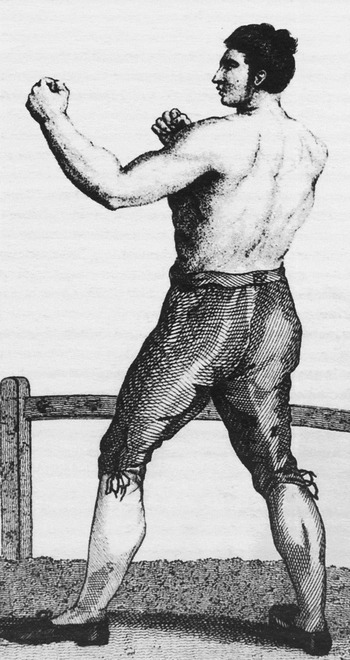
In fact this pugilistic utopia is yet more inclusive. There is a scene at the heart of the novel in which Sir Charles gives a supper to the fancy at the Waggon and Horses, a well-known sporting public house, inviting both the chief fighting-men of the day and the gentlemen of fashion most interested in the ring. This is where the wager is made that leads to the great match between Harrison and Wilson. The supper takes place in a large room, with Union Jacks and mottoes hung thickly upon the walls; the guests range from Prince George himself (incognito as the Earl of Chester) to Joe Berks, a drunken Whitechapel bruiser. The narrative emphasizes the inclusiveness of this scene, naming several famous pugilists present who were Irish, Jewish, or black American.Footnote 13 Others come from the midlands, the north of England, or the west (the two greatest Regency champions, Jem Belcher and Tom Cribb, were from Bristol). Cribb became a celebrity of sorts, and he was the subject of numerous popular prints (Figure 3). But above all it is a scene of national manhood, a social epitome exclusively masculine and specifically genealogized, the manners and powerful physique of the boxers reminding the narrator of their Norse or German ancestors, while here and there “the pale aquiline features of a sporting Corinthian recalled rather the Norman type” (Rodney Stone 163). Boxing brings together classes and ethnicities and demonstrates their commonalities; the Waggon and Horses thus offers a fantasy of the nation as union, indeed a version of pastoral with the boxer as swain (or arguably with the Corinthian as swain and the boxer as sheep).Footnote 14
Portrait of Tom Cribb, known as the “Black Diamond of Bristol.” Bristol History. Web. Courtesy of Paul Thomson.

The scene, so like one of those broad didactic social canvases of which the Victorians were fond, epitomizes the national fighting spirit.Footnote 15 Sir Charles, the host, makes a speech in which he claims that in the crisis of war “we should be forced to fall back upon native valour trained into hardihood by the practice and contemplation of manly sports” (Rodney Stone 174). My argument has been that the story of Rodney Stone proves this claim, the exhibition of English manhood in competitive sport guaranteeing success to come in the struggle against Napoleon promised on the last page. The battle of Waterloo may or may not have been won on the playing fields of Eton, but the battle of Trafalgar, the novel argues, was won in the prize ring. Conan Doyle himself, writing in the nineteen-twenties, felt that the revival of boxing in England, for which he took some credit, was vindicated in “the supreme test of all time,” the Great War, when “the combative spirit and aggressive quickness gave us the attacking fire and helped especially in bayonet work” (M&A 275).Footnote 16 France, now an ally, also benefited. “It was a great day for France when English sports, boxing, Rugby football and others came across to them, and when a young man's ideal ceased to be amatory adventure with an occasional duel. England has taught Europe much, but nothing of more value than this” (M&A 275). Further, Conan Doyle was an enthusiast for international competitive sport, but he understood it as a competition between sportsmen representing their nations; memories of the rancour of the America's Cup yacht races in 1893 and the rivalries of the Olympic Games of 1908 left him “by no means assured that sport has that international effect for good which some people have claimed for it” (M&A 231). He guessed that in ancient Greece the awards at Olympia may have started more wars than they stopped.
The fight between Jim Harrison and Crab Wilson is the narrative climax of Rodney Stone. It takes place on Crawley Downs in the rain before a crowd of thirty thousand, for as Rodney explains, “the love of the ring was confined to no class, but was a national peculiarity, deeply seated in the English nature.”
The ale-drinking, the rude good-fellowship, the heartiness, the laughter at discomforts, the craving to see the fight – all these may be set down as vulgar and trivial by those to whom they are distasteful; but to me, listening to the far-off and uncertain echoes of our distant past, they seem to have been the very bones upon which much that is most solid and virile in this ancient race was moulded. (251)
But this paradisiacal vision of essential Englishness contains a snake, and it is here that the relentless simplicities of Rodney Stone must admit a problem. The sporting crowd may be another image of utopian England, but it gets out of hand, and so does the fight itself. The very success and popularity of the prize ring guarantees its corruption by betting, match-fixing, and cheating. At the same time, Conan Doyle's melodrama requires a dastardly villain bent on ensuring that the best man loses. The excitement of the plot thus depends on the agency of the wicked – a bad sport. Villainous Sir Lothian Hume tries to nobble Sir Charles's fighter so as to win the huge wager by default. When the fight goes ahead and it becomes clear Crab Wilson is going to lose, Sir Lothian's armed thugs, a “vile crew of ring-side parasites and ruffians” (313), break the ring (in an organized pitch invasion), steal the time-keepers’ watches, and threaten Harrison. A draw has to be declared.
So even this supreme demonstration of English goodness, truth, and commonality is borne down by villainy, money, and the mob – the same corrupting elements, as we have seen, which convinced Conan Doyle that in horseracing too “the harm greatly outweighs the good from a broadly national point of view” (M&A 270). Rodney Stone from his mid-century vantage had already entered the corruption that overtook prize-fighting into the narrative record: “[f]or this reason the Ring is dying in England” (12). Conan Doyle makes the same point about this most English of sports in Memories and Adventures: “It was ruined by the villainous mobs who cared nothing for the chivalry of sport or the traditions of British fair play as compared with the money gain which the contest might bring. Their blackguardism drove out the good men – the men who really did uphold the ancient standards, and so the whole institution passed into rottenness and decay” (274). If sport tells the truth about England, then spoilsports, with their greed, cheating, and thuggery, are part of that truth. Here is the poignancy of nostalgia: to narrate what you feel nostalgia for is to tell the tale of how it disappeared. To adapt Proust, the only true story about paradise is paradise lost.
How could the sport, and the nation, counter the defilement that money and competitive greed seemed inevitably to spread like pitch on its sturdy traditions? The redeeming agent was, of course, the cult of the amateur, the embodiment of fair play and sport for its own sake (see Holt 74–134). The still-current sporting meaning of this word, which designates someone who does sport as a pastime and not for money, is a Victorian invention. The breeding ground for the ideology of the amateur was the great public schools, with their emphasis on sport as cultivator of the moral qualities that distinguished a gentleman, particularly in public and imperial service. There is an extensive literature on this subject.Footnote 17 We may be inclined to think of the professional sportsman as a phenomenon of modernity, but this is only true inasmuch as the professional is constituted by difference from the amateur, and it is the amateur that is the formation of an emergent cluster of nineteenth-century ethics, including muscular Christianity, team spirit, and “the white man's burden.”Footnote 18 Now, Rodney Stone had celebrated pugilism, but in doing so had also shown the inevitable corruption and discrediting of the fight game in England. A few years later, as if to purge the skullduggery of the earlier tale and restore boxing's proper meaning as a ritual of the true national ethos, Conan Doyle wrote another prize-fighting story, “The Croxley Master.”
How to reconcile the representative or popular notion of the sporting champion with the more disinterested and high-minded values of the gentlemanly amateur? In “The Croxley Master” this problem is solved through the almost metaphysical trope of the amateur professional. The young hero of the story is Montgomery, a sporting but poor medical student who accepts an invitation to box against an old professional, Silas Craggs, champion of the iron-workers at the Croxley smelting works, in Yorkshire.Footnote 19 This is not a bare-knuckle contest but a modern boxing match fought with gloves over twenty rounds according to Queensberry rules, with a celebrity referee brought up from London. In this bout Montgomery represents the workers of the Wilson coal-pits. For the student, winning the money prize will enable him to complete his medical studies at university and qualify as a doctor. Though fighting the Master for money means he will forever forfeit his amateur status, Montgomery sees no problem; he is quite content to show his mettle in this bout and never box again. Though he is an outsider, his manifest pluck makes him a local hero for the Yorkshire miners and, in a familiar way, a strangely idyllic image of the nation crystallizes around the fight.
Sometimes brutal, sometimes grotesque, the love of sport is still one of the great agencies which make for the happiness of our people. It lies very deeply in the springs of our nature, and when it has been educated out, a higher, more refined nature may be left, but it will not be of that robust British type which has left its mark so deeply on the world. Every one of these ruddled workers, slouching with his dog at his heels to see something of the fight, was a true unit of his race. (“The Croxley Master” 47–48)
As with Rodney Stone, the fight is at the centre of the tale, narrated at length and with much technical detail. Montgomery wins a fierce and fair bout that reflects credit on both him and his working-class opponent. He claims the prize, but resists his backers’ urging to make a career as a sportsman. He has turned professional for a day only to gain entry into his true profession, medicine. As with the young Conan Doyle on the whaler, Montgomery's prowess with the boxing gloves seems to guarantee his qualities as a physician, and he is invited to come back to practice medicine in the locality, being assured that “we've plenty of doctors, but you're the only man in the Riding that could smack the Croxley Master off his legs” (185). Montgomery is neither an aristocrat of the sporting class nor a horny-handed son of toil. Sport for Conan Doyle was an image of the nation, and one signal difference between the Regency fight and the Victorian one is the entry of the new national hegemon, the professional-administrative middle class.
An amateur was not just someone for whom sport was not a trade. He was, crucially, not bound to a single specialism. This can be seen most interestingly in the contrasting physique of the opponents in this story. The Master, a professional fighter, has huge shoulders and great arms out of proportion to his lower body: his is a chthonic masculinity. His single trade has made him ungainly and ugly, with a hint of a Mr. Hyde-like recession to the simian. “Montgomery, on the other hand, was as symmetrical as a Greek statue. It would be an encounter between a man who was specially fitted for one sport, and one who was equally capable of any” (157). Both of them are real men. But amateurism has made Montgomery, the all-rounder, a well-rounded man, and has given him the special gift of versatility which his class brought to administration and leadership at home and abroad. Government, and Government House, was not a place for narrow specialists: in this sense, Britain and the British Empire really were run by amateurs. A gentleman could exercise leadership quite literally anywhere. Colonial governors might be posted from one continent to another and expected to get on with the job, while ministers (like Churchill), subject to cabinet reshufflings, were counted on to be equally capable of running the Colonial Office, the Navy, or the Exchequer. Further, the ethos of British leadership emphasized that a man in authority, like any amateur, should not appear to be trying too hard. Conan Doyle was delighted to learn that Lord Cromer, de facto ruler of Egypt for a quarter of a century, was in the habit of bringing critical diplomatic interviews to an abrupt conclusion “with the explanation that the time had come for his daily lawn-tennis engagement” (M&A 128).
With his prodigious battery of sporting skills, it would be hard to find a better embodiment of the amateur ethos than Conan Doyle himself. He was an accomplished cricketer, playing on occasion for the MCC (the famous Marylebone Cricket Club), his best performance at Lords being seven wickets for fifty-one against Cambridgeshire in 1904; on one memorable occasion he bowled the legendary W. G. Grace. But he was just as happy to turn out for the ramshackle team put together by his friend J. M. Barrie, named the Allah-Akbarries in token of their inability to win without divine intervention. This was what might be called jocular amateurism. At the further end of the amateur scale were the great champions such as Grace himself, cricketing “gentlemen” who competed alongside waged professional “players” belonging to a lower social order. In cricket these two kinds of sportsman sustained a double narrative about sport and the nation, with one evoking the sturdy native qualities of the English that Conan Doyle had attributed to the prize-fighters of old, and the other exemplifying the unselfish accomplishments of superior men born and trained to lead and serve country and empire.Footnote 20
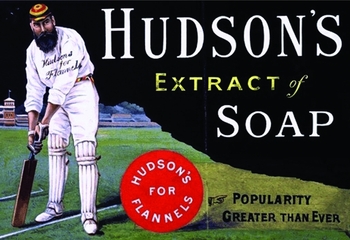
It looked like a serviceable allegory of the nation, but it never really worked. The more skilful and dedicated (and successful) the amateur, the more amateurism became burdened with contradictions. W. G. Grace himself was an example.Footnote 21 Though as an amateur he was not paid to play cricket, he was not above putting his celebrity to profitable use, for example endorsing Hudson's Extract of Soap, recommended for its ability to clean cricket whites (Figure 4). Nor was he always a good example of the amateur creed that it is more important to take part in a game than to win. As Derek Birley says, “many instances of his excessive keenness to win and the reluctance of umpires to give him out were recorded” (332). Grace charged large fees for organizing exhibition matches and for raising teams to tour overseas. In 1879 there were several testimonial matches for the great amateur and “[a]t a ceremony at Lords he was presented, after glowing tributes from the aristocracy, with a cheque for £1,400, as an aid to purchasing a medical practice” (333).Footnote 22 Less than a year earlier the Gloucestershire County Cricket Club had called a special meeting to investigate various charges of irregularity involving the Grace family (W. G.'s brother, E. M. Grace, was club secretary and kept the accounts). It could be very tricky keeping amateurism unsullied by money, as Conan Doyle himself discovered through his involvement with the committee assembled to ensure that Britain put up a better show in the 1916 Olympics than they had done in 1912, where British athletes’ performance was considered a national humiliation. Conan Doyle's committee launched an appeal for a fund of one hundred thousand pounds for athletic training and facilities – and was promptly accused on all sides of “developing professionalism” (M&A 235–37).
(Color online) Advertisement for Hudson's Extract of Soap, featuring the celebrity sportsman W. G. Grace. Courtesy of the National Archives, Kew, Richmond, Surrey.

Amateurism then proved in practice not quite the simplification of sport that it had seemed. But there was another crucial dimension to sport – and a justification for it. It was acknowledged in the amateur creed that sport, as Richard Holt puts it, “had not only to be played in good spirit, it had to be played with style” (Holt 99).Footnote 23 Sport might be healthy, educative, morally uplifting, and socially adhesive, but it was also beautiful – a quality repeatedly demonstrated in Conan Doyle's mildly homoerotic descriptions of boxers’ bodies. The gifted sportsman was an example of style, just as much as the gifted musician or orator. There was a beauty in what he did. Among Conan Doyle's sportsmen, the great exemplar of style is Lord John Roxton, who joins the expedition to the Amazon in The Lost World, and is described as “one of the great all-round sportsmen and athletes of his day” (52). An intrepid soldier, hunter, and crack shot, Lord John moves through the story with an apparently effortless grace which is as much aesthetic as athletic and moral – for example, when the others scramble and crawl across a sixty-foot tree trunk bridging a jungle precipice, Lord John simply walks across. In his bachelor apartment in the Albany, with its atmosphere of “masculine virility,” sketches of boxers, ballet girls, and racehorses adorn the walls, alongside paintings by Fragonard, Girardet, and Turner (52). The coolness and integrity of the true sportsman expresses itself in ethical terms too, for only three years earlier Lord John carried out a single-handed freelance war against Peruvian slave-drivers on the Putamayo River. This is not an international war, but an amateur one. “‘Declared it myself, waged it myself, ended it myself,’” Lord John tells the narrator Malone (56). This is the disinterestedness of the amateur, the determination of the competitor, and the panache of the stylist. For the true sportsman style is ethical and goodness is beautiful. The straight bat, and the straight left, could not be wielded by a crooked heart.Footnote 24
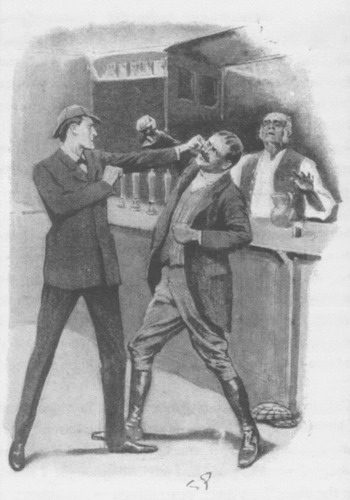
Those liminal encounters discussed above, in the whaling memoir and in The Stark Munro Letters, which pitched the trained sparring man against an undisciplined fighter, the straight left against the round hand hitter, were ethical as well as physical tests. Style underwrote goodness – or so Conan Doyle felt it should. His faith in this precept of straightness helps explain why he could not entirely approve his brother-in-law E. W. Hornung's character A. J. Raffles, the “amateur cracksman” who played cricket for England but was secretly a thief.Footnote 25 Straightness in sport was both the mark of a stylist and a bulwark against crooks like Sir Lothian Hume, unstable and unethical figures like Cullingworth, or ruffians like the wife-beating drunk in The Stark Munro Letters. One final instance in a story from 1903 concerns a gentleman who claims to have “some proficiency in the good old British sport of boxing.” Returning from a visit to the country with a black eye, he tells his friend about his enquiries in a local pub after a nefarious character called Woodley, also pictured in Sidney Paget's illustration in The Strand Magazine (Figure 5):
“A straight left against a slogging ruffian.” Sidney Paget, illustration for “The Adventure of the Solitary Cyclist,” by Arthur Conan Doyle, Strand Magazine 27 (Jan. 1904), 9.

We had got as far as this when who should walk in but the gentleman himself, who had been drinking his beer in the tap-room, and had heard the whole conversation. Who was I? What did I want? What did I mean by asking questions? He had a fine flow of language, and his adjectives were very vigorous. He ended a string of abuse by a vicious back-hander, which I failed to entirely avoid. The next few minutes were delicious. It was a straight left against a slogging ruffian. I emerged as you see me. Mr Woodley went home in a cart . . .Footnote 26 (“The Solitary Cyclist” 62–63).