Introduction
Recreational drug use is argued to be detrimental to normal physiological and psychological functioning. Various studies have found cognitive deficits in ecstasy/3,4-methylenedioxymethamphetamine (MDMA) users (Parrott & Lasky, Reference Parrott and Lasky1998; Wareing et al. Reference Wareing, Murphy and Fisk2004; Montgomery et al. Reference Montgomery, Hatton, Fisk, Ogden and Jansari2010). While some studies have shown deficits in executive functioning (Fisk et al. Reference Fisk, Montgomery, Murphy and Wareing2004; Montgomery et al. Reference Montgomery, Fisk, Newcombe and Murphy2005), a number of recent reviews have shown that the most prominent and persistent deficits are in learning and memory, particularly verbal recall (Kalechstein et al. Reference Kalechstein, De La Garza, Mahoney, Fantegrossi and Newton2007; Zakzanis et al. Reference Zakzanis, Campbell and Jovanovski2007; Gouzoulis-Mayfrank & Daumann, Reference Gouzoulis-Mayfrank and Daumann2009). The acute psychological and physiological effects are thought to result primarily from serotonin and dopamine agonism (McDowell & Kleber, Reference McDowell and Kleber1994), with repeated exposure purported to damage serotonin neurons resulting in problems with cognition, sleep and mood (Parrott et al. Reference Parrott, Sisk and Turner2000; Parrott, Reference Parrott2013). In animal studies MDMA administration mirroring human recreational doses has a deleterious effect on serotonergic neurons (Green et al. Reference Green, Cross and Goodwin1995). Such serotonergic neurotoxicity is a possibility in humans, especially with higher nightly doses (McCann et al. Reference McCann, Ridenour, Shaham and Ricaurte1994). Moreover, the neuronal areas implicated in working memory and executive functioning are often observed to be localized in the dorsolateral prefrontal cortex (DLPFC) (Curtis & D'Esposito, Reference Curtis and D'Esposito2003). These structures are densely innervated with serotonin (5-hydroxytryptamine; 5-HT) receptors (Pazos et al. Reference Pazos, Prosbit and Palacios1987), thus serotonergic neurotoxicity or down-regulation may result in cognitive deficits specific to functions that these areas maintain (Reneman et al. Reference Reneman, Schilt, de Win, Booij, Schmand, van den Brink and Bakker2006; Montgomery & Fisk, Reference Montgomery and Fisk2008).
Neuroimaging techniques [electroencephalography (EEG), functional magnetic resonance imaging (fMRI), functional near infrared spectroscopy (fNIRS)] are increasingly used in drug research to provide neurophysiological correlates of behavioural deficits, or indeed perhaps as a more sensitive measure of cognitive impairment. For example, Burgess et al. (Reference Burgess, Venables, Jones, Edwards and Parrott2011) assessed ecstasy users' performance on verbal and non-verbal recognition memory, with event related potential (ERP) measures compared with two control groups (drug-naive participants and polydrug users who do not use ecstasy). Ecstasy users displayed abnormalities in an ERP component associated with recollection of words but not faces, despite equivalent behavioural performance. Similarly, Kanayama et al. (Reference Kanayama, Rogowska, Pope, Gruber and Yurglun-Todd2004) observed fMRI differences in cannabis users compared with controls during a spatial working memory task despite the absence of behavioural differences. Bosch et al. (Reference Bosch, Wagner, Jessen, Kühn, Joe, Seifritz, Maier, Biersack and Quednow2013) have also shown a direct link between brain glucose metabolism in the DLPFC and level of MDMA use. MDMA users were impaired relative to controls on the Rey Auditory Verbal Learning Test (RAVLT) and showed significantly decreased glucose metabolism in various brain areas including the right hippocampus, bilateral DLFPC, bilateral thalamus and inferior parietal cortex. In the MDMA users, positive correlations were observed between glucose metabolism in the prefrontal and parietal areas and RAVLT performance. Importantly, lifetime MDMA dose was significantly negatively related to glucose metabolism in the left DLPFC. These studies highlight the importance of investigating brain indices of cognitive performance in addition to behavioural indices.
The present study employed fNIRS. fNIRS is a novel, non-invasive, optical neuroimaging technique that is portable and is used to measure the haemodynamic response to brain activation (Leff et al. Reference Leff, Orihuela-Espina, Elwell, Athanasiou, Delpy, Darzi and Yand2011). Typically, fNIRS will penetrate to structures around 2–3 mm of the cortex underlying the skull (Firbank et al. Reference Firbank, Okada and Delpy1998). Therefore forebrain structures such as the DLPFC can be easily accessed and observed. Activation of the DLPFC is prominent in higher-level processing, and due to these structures being easy to access with this type of imaging, it has been used in several studies observing motor control and learning (Leff et al. Reference Leff, Orihuela-Espina, Elwell, Athanasiou, Delpy, Darzi and Yand2011), as well as more complex tasks that involve working memory and category discrimination (Izzetoglu et al. Reference Izzetoglu, Bunce, Onaral, Pourrezaei and Chance2004). Generally, an increase in the chromophore Hbo2 (oxyhaemoglobin) coupled with a decrease in Hhb (deoxyhaemoglobin) is accepted as being reflective of activation to a certain brain region (Ehlis et al. Reference Ehlis, Bahne, Jacob, Herrmann and Fallgatter2008; Leff et al. Reference Leff, Elwell, Orihuela-Espina, Atallah, Delpy, Darzi and Yang2008, Reference Leff, Orihuela-Espina, Elwell, Athanasiou, Delpy, Darzi and Yand2011), and the distribution of this response is regionally specific. Thus, the cortical regions underlying certain optodes of the fNIRS headset are understood to be responsible for the observed response (Leff et al. Reference Leff, Orihuela-Espina, Elwell, Athanasiou, Delpy, Darzi and Yand2011).
Although currently there remains a paucity of studies conducted with fNIRS and substance use (specifically ecstasy/MDMA use), it has been used in other populations with working memory problems. Ehlis et al. (Reference Ehlis, Bahne, Jacob, Herrmann and Fallgatter2008) observed a significant reduction in Hbo2 over ventrolateral prefrontal cortex channels in attention-deficit/hyperactivity disorder (ADHD) patients compared with controls in relation to a working memory N-back task. It was argued that this reflects a reduction in activation of this area of the brain during task performance. Interestingly, this was not accompanied by significant behavioural differences (although a trend was observed). Similarly, Schecklmann et al. (Reference Schecklmann, Ehlis, Plichta, Romanos, Heine, Boreatti-Hümmer, Jacob and Falgatter2008) reported a lower concentration of Hbo2 in ADHD patients relative to controls during two versions of a verbal fluency task, suggesting that executive functioning deficits are associated with decreased oxygenation to the brain areas that underlie performance of these tasks.
The present study aims to investigate changes in prefrontal blood oxygenation in response to a demanding task in ecstasy users, polydrug users and non-users. The cerebral haemodynamic response to conducting several tasks at once will be measured as well as behavioural performance. It is hypothesized that ecstasy users will perform worse on the multitasking stressor and fNIRS will provide corollary data of this by displaying a reduction in oxygenated haemoglobin in comparison with the control groups.
Method
Design
For behavioural and fNIRS analysis a between-groups design was used, with a between-groups factor of drug user group with three levels (ecstasy user, polydrug user and drug-naive controls). Univariate analysis of variance (ANOVA) was conducted on the behavioural data with the total scores on each component of the task as the dependent variables (Stroop, mental arithmetic, tracking/target area – visual monitoring and warning/rising bars – visual monitoring). fNIRS data were analysed using univariate ANOVA with mean oxygenated haemoglobin at each voxel measured as the dependent variables (voxels 1–16; V1–V16). Any significant main effects were further investigated using Tukey's honestly significant difference test.
Participants
A total of 20 ecstasy users (mean age 21.61, s.d. = 0.52 years; 12 male), 17 non-ecstasy polydrug user controls (mean age 21.23, s.d. = 0.79 years; 12 male) and 19 drug-naive controls (mean age 21.60, s.d. = 0.84 years; six male) were recruited via direct approach to Liverpool John Moores University students. For inclusion in the study participants had to be aged between 18 and 29 years. For inclusion in the ecstasy/MDMA user group, participants must have used ecstasy/MDMA on at least five occasions over their lifetime (actual minimum = seven tablets) but may have used a range of substances in addition to MDMA. To be included in the non-ecstasy polydrug user group, participants must have consumed illicit drugs on at least three occasions in the last 12 months, but never have consumed ecstasy/MDMA, and finally for inclusion in the drug-naive control group participants must have never consumed any illicit drugs. All participants were asked to abstain from consuming ecstasy for a minimum of 7 days prior to testing. Participants were also requested to abstain from use of other illicit drugs for a minimum of 24 h prior to participating and ideally 7 days.
Materials
A background drug use questionnaire (Montgomery et al. Reference Montgomery, Fisk, Newcombe and Murphy2005) was administered. Estimates of total lifetime drug use of each drug were calculated (according to Montgomery et al. Reference Montgomery, Fisk, Newcombe and Murphy2005) as well as totals for drug use over the last 30 days and weekly drug use estimates.
State Anxiety Inventory – Visual Analogue Scale (SAI-VAS)
The SAI-VAS was completed pre- and post-testing period. This comprises six statements (I feel calm, I feel tense, I feel upset, I feel relaxed, I feel content, I feel worried) and participants have to indicate on a 100 mm line how much they agree with the statement, ranging from 0 – not at all, to 100 – very much.
Multitasking stress test
The multitasking framework (Purple Research Solutions, UK) is a personal computer (PC)-run platform used to elicit acute psychological stress (Wetherell & Sidgreaves, Reference Wetherell and Sidgreaves2005). The same combination of four stressor modules (Stroop, mental arithmetic, tracking/target area – visual monitoring, and warning/rising bars – visual monitoring) was used for all participants, at a medium-intensity workload. The task requires participants to attend to the four different components/modules of the task simultaneously. The set of tasks includes a mental arithmetic task whereby participants are required to calculate a series of 2 × 3 digit addition sums; visual monitoring (target area) whereby participants must monitor the position of a moving cursor and reset this cursor when it enters a points zone; a second visual monitoring module (rising bars) comprises of a set of six bars that rise towards a target line at varying speeds. Once the bars have reached the target, participants must select the order in which the bars reached the target, fastest first. Finally, a Stroop task module involves colour names appearing onscreen in various colours; participants must correctly select the colour the word appears in, rather than the written word. For more information on the different modules of the framework, see Wetherell & Sidgreaves (Reference Wetherell and Sidgreaves2005).
Equipment
Haemodynamic response to task was monitored using a continuous-wave fNIRS system developed by Drexel University (Philadelphia, PA) and supplied by Biopac Systems (USA). The fNIR sensor has a temporal resolution of 500 ms per scan (2 Hz), with a source-detector separation of 2.5 cm allowing 1.25 cm penetration depth (Ayaz et al. Reference Ayaz, Shewokis, Bunce, Izzetoglu, Willems and Onaral2012). An fNIR100 control box and data acquisition and visualization software COBI studio (Drexel University) were used during data collection (according to Ayaz et al. Reference Ayaz, Shewokis, Curtin, Izzetoglu, Izzetoglu and Onaral2011, Reference Ayaz, Shewokis, Bunce, Izzetoglu, Willems and Onaral2012) with a serial cable between display and acquisition PCs to identify task markers.
Procedure
Participants were required to attend the laboratory on two occasions. On Time 1, upon entering the laboratory participants were informed of what the study would entail and written consent was obtained. Participants were given the background drug use questionnaire and an assessment of fluid intelligence [Raven's Progressive Matrices (RPM); Raven et al. Reference Raven, Raven and Court1998] to complete. On Time 2, a pre-task SAI-VAS was given upon entering the laboratory. After this the fNIRS sensor pad was attached to the participants' forehead whilst they read instructions on how to complete the task. Participants then completed an easy 2-min practice trial of the task. The fNIRS signals were displayed on a desktop computer running COBI studio (Drexel University) in an room adjacent to the testing room. Providing the signals from the fNIRS were stable, a baseline of inactivity was recorded before the participants were instructed to complete a 20-min session of the multitasking stressor task on a desktop computer running the purple framework (Purple Solutions, UK). After the 20 min had elapsed, participants completed a post-task SAI-VAS. The NASA Task Load Index (TLX; Hart et al. Reference Hart, Staveland, Hancock and Meshkati1988) was completed post-task to measure perceived workload. Finally, participants were debriefed and paid £20 in store vouchers. The study was approved by Liverpool John Moores University Research Ethics Committee, and was administered in accordance with the ethical guidelines of the British Psychological Society.
fNIRS analysis
fNIRS raw data from COBI studio were pre-processed using fNIRSOFT (Ayaz, Reference Ayaz2010). All 16 optodes (oxy- and deoxyhaemoglobin) were visually inspected for any saturated channels, and any saturated channels were discarded. A high-pass filter (0.1 Hz cut-off) and a linear-phase filter (order of 20) were used to remove high-frequency noise and noise due to respiration (Ayaz et al. Reference Ayaz, Shewokis, Curtin, Izzetoglu, Izzetoglu and Onaral2011, Reference Ayaz, Shewokis, Bunce, Izzetoglu, Willems and Onaral2012). Using the modified Beer–Lambert law logarithm in fNIRSOFT (Ayaz, Reference Ayaz2010), we calculated total blood oxygenation, deoxygenation and volume changes relative to baseline over the entire epoch for the 16 channels.
Results
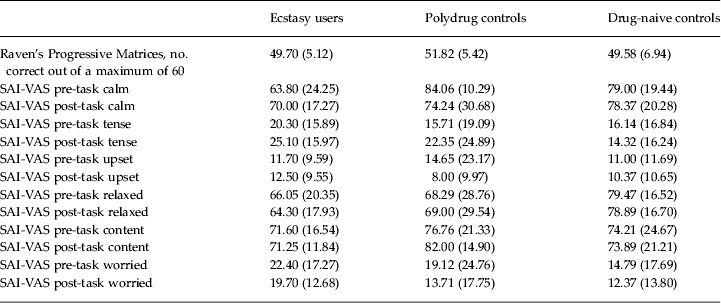
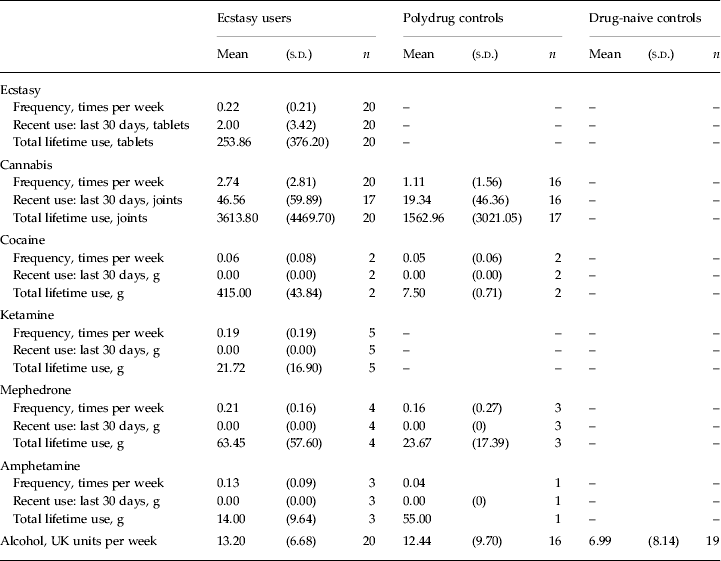
RPM scores and pre- and post-task SAI-VAS scores are displayed in Table 1. Indices of other drug and alcohol use are displayed in Table 2.
Fluid intelligence and mood variables

Data are given as mean (standard deviation).
SAI-VAS, State Anxiety Inventory – Visual Analogue Scale.
Indices of drug use

s.d., Standard deviation.
One-way ANOVA revealed that there were no significant between-group differences on age and fluid intelligence (p > 0.05 in both cases). Pre- and post-task SAI-VAS scores for each of the six subscales (calm, tense, relaxed, content, upset and worried) were analysed using a mixed ANOVA, with user group as the between-subject factor and time point (pre/post) as the within-subjects factor. For ‘calm’ there was no significant main effect of time point (F 1,53 = 0.19, p > 0.05) and no time point × group interaction (F 2,53 = 1.97, p > 0.05), but there was a main effect of group (F 2,53 = 3.08, p ⩽ 0.05). Pairwise comparisons showed that ecstasy users felt less calm than both other groups (p < 0.05). For ‘tense’ there was a significant main effect of time point (F 1,53 = 3.95, p ⩽ 0.05), with ecstasy and polydrug users showing increases at Time 2, but no time point × group interaction (F 2,53 = 0.32, p > 0.05), and no main effect of group (F 2,53 = 1.75, p > 0.05). ‘Upset’ showed no main effect of time point (F 1,53 = 1.69, p > 0.05), no time point × group interaction (F 2,53 = 1.82, p > 0.05) and no main effect of group (F 2,53 = 0.07, p > 0.05). ‘Relaxed’ also showed no main effect of time point (F 1,53 = 0.03, p > 0.05) and no time point × group interaction (F 2,53 = 0.05, p > 0.05), but did show a significant main effect of group (F 2,53 = 3.04, p ⩽ 0.05). Pairwise comparisons revealed that drug-naive controls were significantly more relaxed than ecstasy users (p < 0.05). ‘Content’ revealed no significant effect of time point (F 1,53 = 0.25, p > 0.05), no time point × group interaction (F 2,53 = 0.33, p > 0.05), and no main effect of group (F 2,53 = 1.39, p > 0.05). Finally, ‘worried’ revealed a main effect of time point (F 2,53 = 3.04, p ⩽ 0.05), with worry being greatest pre-task, but no time point × group interaction (F 2,53 = 0.27, p > 0.05), and no main effect of group (F 2,53 = 1.06, p > 0.05).
ANOVA revealed a between-group difference in the amount of alcohol consumed (weekly) (F 2,52 = 3.28, p < 0.05). Pairwise comparisons revealed that the ecstasy users drank significantly more than drug-naive controls (p ⩽ 0.05).
Behavioural data analysis
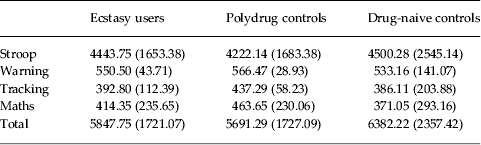
The multitasking stressor task was developed by Purple Solutions (UK) and performance was analysed using SPSS (version 20; IBM, USA). Due to eight participants (four ecstasy users, three polydrug users and one drug-naive control) not following instructions correctly on the Stroop task and consistently answering incorrectly on the task, their data on this component on the task were not analysed any further. These participants were also excluded from fNIRS analysis. Performance data can be observed in Table 3.
Performance data for the four tasks

Data are given as mean (standard deviation).
There were no significant differences between groups on any of the components of the task: Stroop (F 2,45 = 0.08, p > 0.05); Maths (F 2,53 = 0.56, p > 0.05); Tracking/target visual monitoring (F 2,53 = 0.50, p > 0.05). Levene's statistic was violated on the warning/rising bars scores, therefore an independent-samples Kruskall–Wallis test was conducted. This revealed that there were no significant differences between ecstasy users (rank = 560), polydrug controls (rank = 570) and drug-naive controls (rank = 580) on this component of the task (H2 = 1.43, p > 0.05). On the composite total score, ANOVA revealed no significant between-group differences (F 2,45 = 0.55, p > 0.05).
Post-task NASA TLX scores were analysed using multivariate ANOVA (MANOVA). This revealed no overall between-group differences in task load (F 12,96 = 1.25, p > 0.05) for Pillai's trace, nor any between-group differences on the individual subscales (Mental demand: F 2,52 = 1.32, p > 0.05; Physical demand: F 2,52 = 0.11, p > 0.05; Temporal demand: F 2,52 = 0.10, p > 0.05; Effort: F 2,52 = 1.97, p > 0.05; Performance: F 2,52 = 2.39, p > 0.05; Frustration: F 2,52 = 2.65, p > 0.05).
fNIRS analysis
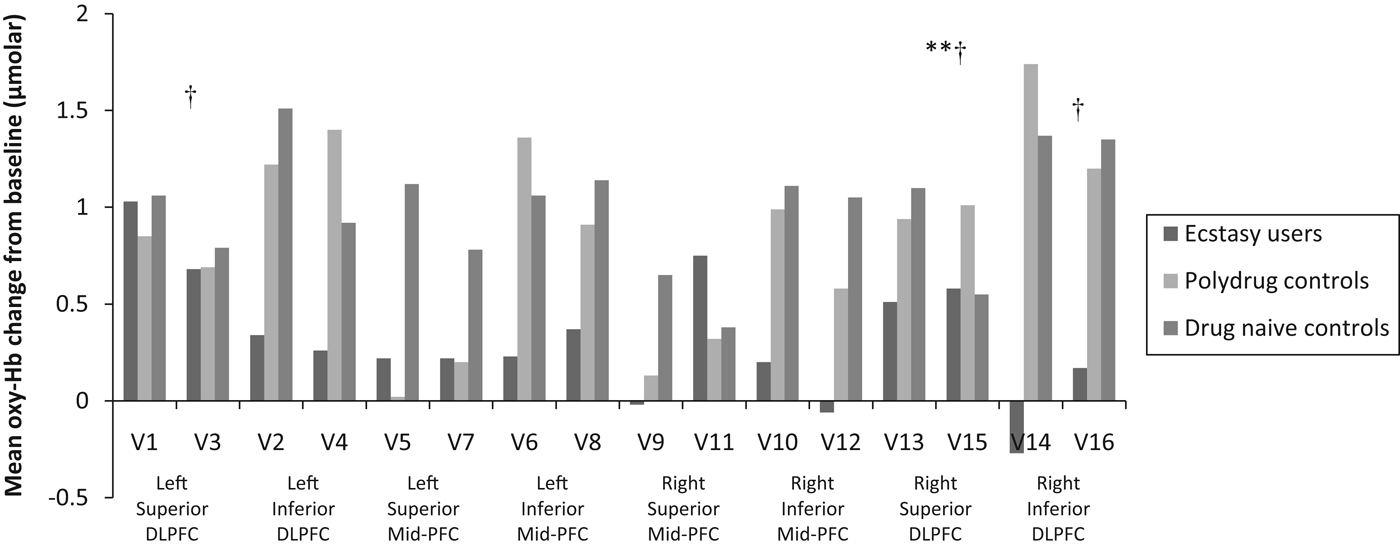
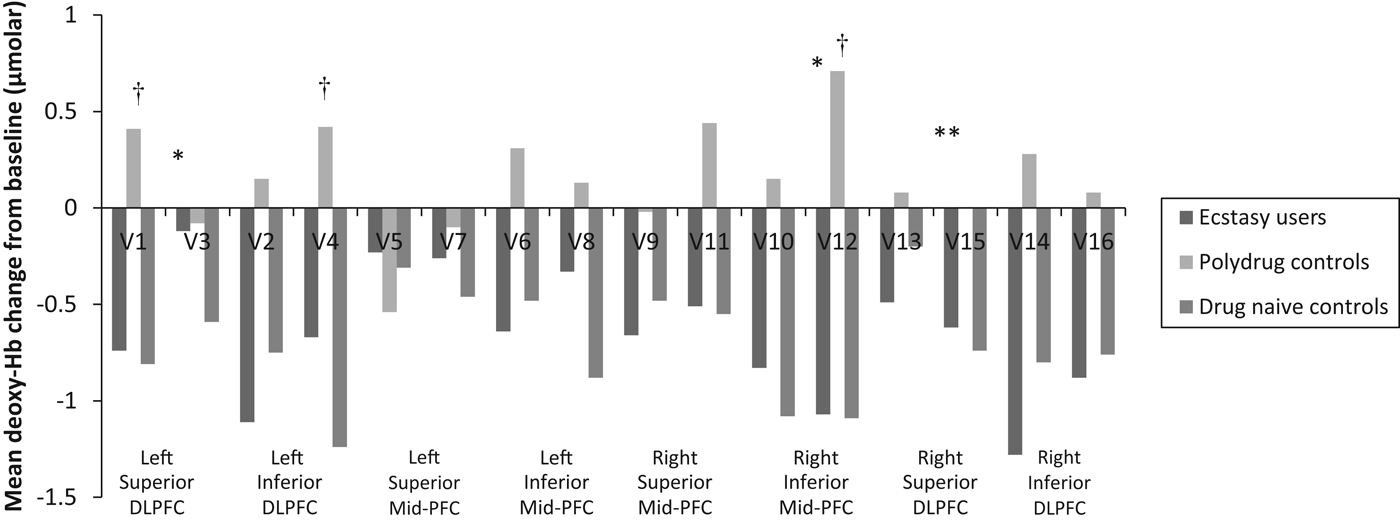
Averaged oxygenated and deoxygenated haemoglobin changes from baseline are displayed in Figs. 1 and 2. A series of ANOVAsFootnote 1 Footnote † were used to assess group differences in changes from baseline. This analysis was conducted due to large concentration increases in oxygenated haemoglobin and decreases in deoxygenated haemoglobin being understood to represent increased levels of neurological activation (Hoshi et al. Reference Hoshi, Kobayashi and Tamura2001; Cui et al. Reference Cui, Bray and Reiss2010; Ayaz et al. Reference Ayaz, Shewokis, Curtin, Izzetoglu, Izzetoglu and Onaral2011) and also due to each voxel theoretically relating to a different brain region.
Mean oxyhaemoglobin (oxy-Hb) change (μmolar) from baseline during the entire multitasking epoch (20 min) for ecstasy users, polydrug controls and drug-naive controls. ** Significantly different from polydrug controls (p < 0.01). † Significantly different from drug-naive controls (p < 0.05). V, Voxel; DLPFC, dorsolateral prefrontal cortex; PFC, prefrontal cortex.

Mean deoxyhaemoglobin (deoxy-Hb) change (μmolar) from baseline during the entire multitasking epoch (20 min) for ecstasy users, polydrug controls and drug-naive controls. Significantly different from polydrug controls: * p < 0.05, ** p < 0.01. † Significantly different from drug-naive controls (p < 0.05). V, Voxel; DLPFC, dorsolateral prefrontal cortex; PFC, prefrontal cortex.

ANOVA revealed significant between-group differences in average oxyhaemoglobin changes at V2 (F 2,43 = 4.78, p < 0.05), V14 (F 2,43 = 6.37, p < 0.01) and V16 (F 2,42 = 3.32, p < 0.05). There were no significant between-group differences at any of the other voxels measured (p > 0.05).
Pairwise comparisons revealed that at V2 ecstasy users showed a significantly reduced oxyhaemoglobin change compared with drug-naive controls (p < 0.05). At V14 ecstasy users showed significantly lower oxyhaemoglobin than both polydrug controls (p < 0.01) and drug-naive controls (p < 0.05). At V16 ecstasy users again showed significantly lower oxyhaemoglobin than drug-naive controls (p < 0.05).
ANOVA on deoxyhaemoglobin changes from baseline revealed significant between-group differences at V1 (F 2,42 = 3.96, p < 0.05), V2 (F 2,43 = 4.71, p < 0.05), V4 (F 2,30 = 3.66, p < 0.05), V12 (F 2,30 = 5.04, p < 0.05) and V14 (F 2,43 = 5.09, p < 0.01). There were no significant between-group differences at any of the other voxels measured (p > 0.05).
Pairwise comparisons revealed that at V1, polydrug controls showed significantly greater deoxyhaemoglobin than drug-naive controls (p < 0.05), and this difference approached significance compared with ecstasy users (p = 0.07). At V2, polydrug controls showed significantly greater deoxyhaemoglobin increase than ecstasy users (p < 0.05) and this difference approached significance compared with drug-naive controls (p = 0.08). At V4 polydrug controls showed significantly increased deoxyhaemoglobin compared with drug-naive controls (p < 0.05). At V12 polydrug controls showed significantly increased deoxyhaemoglobin compared with both ecstasy users and drug-naive controls (p < 0.05 in both cases) and at V14 polydrug controls showed significantly greater deoxyhaemoglobin compared with ecstasy users (p < 0.01). Ecstasy users and drug-naive controls did not differ significantly from each other at any of these voxels.
These results show a general blunted increase in oxygenated haemoglobin during the tasks for ecstasy users relative to drug-naive controls at V2, V14 and V16. Ecstasy users also displayed significantly reduced oxyhaemoglobin change at V14 compared with polydrug controls. Furthermore, as to be expected due to a general inverse correlation between oxygenated and deoxygenated haemoglobin usually observed in neurological activity, ecstasy users showed a significantly reduced decrease in deoxygenated haemoglobin compared with drug-naive controls at V1, and relative to polydrug controls at V2, V12 and V14.
Relationship between cortical blood changes and drug use
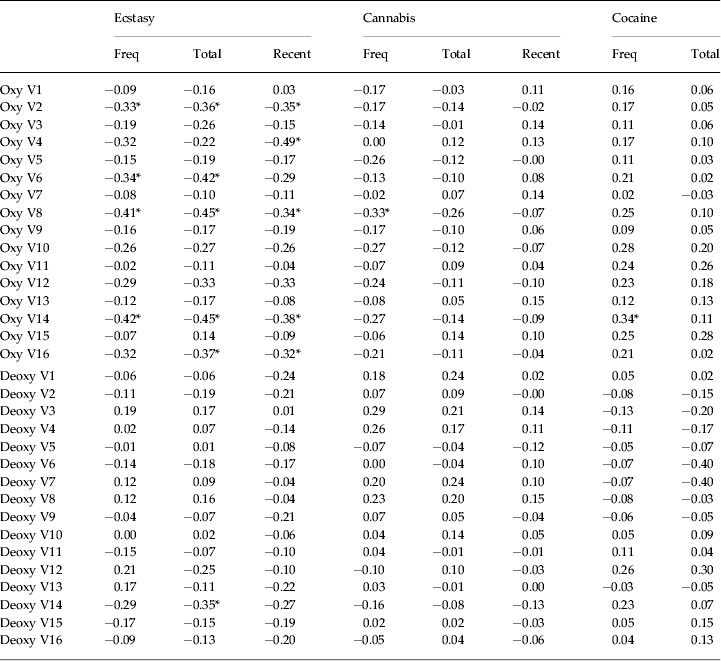
To assess the relationship between the changes in cortical blood flow observed using fNIRS and parameters of drug use, we used Spearman's correlations. Results are displayed in Table 4; all correlations were evaluated at p < 0.01 to adjust for multiple comparisons (Sankoh et al. Reference Sankoh, Huque and Dubey1997).
Correlations with indices of drug use

Freq, Frequency (times per week); total, total lifetime use; recent, recent use over last 30 days; oxy, oxygenation change; V, voxel; deoxy, deoxygenation change.
* Correlation significant at p < 0.01.
There were a number of significant correlations between ecstasy use and oxygenation change. Notably, frequency of use was significantly correlated with V2 (left inferior DLPFC), V6 and V8 (left inferior mid prefrontal cortex) and V14 (right inferior DLPFC), total lifetime dose with V2 (left inferior DLPFC), V6 and V8 (left inferior mid prefrontal cortex) and V14 and V16 (right inferior DLPFC), while amount used in the last 30 days was significantly correlated with V2 and V4 (left inferior DLPFC), V8 (left inferior mid prefrontal cortex) and V14 and V16 (right inferior DLPFC). There were two significant correlations with indices of drug use, with frequency of cannabis use correlated with V8 and frequency of cocaine use with V14. In both cases the correlations were weaker than those for ecstasy. For deoxygenation change, total lifetime dose of ecstasy was significantly correlated with V14 (right inferior DLPFC).
Discussion
The aim of the current study was to investigate the effects of ecstasy use on a multitasking stress test and to assess drug-related differences in haemodynamic response to task. The ecstasy users in this study did not differ significantly from controls on background variables such as perceived stress, fluid intelligence or age. Nor did they differ significantly on any of the individual components that made up the multitasking stressor task, or on perceived workload as measured by the NASA TLX. There were, however, differences on subscales of the SAI-VAS, indicating that ecstasy users felt less calm than both other groups overall and less relaxed than drug-naive controls. Furthermore, as to be expected, all groups were less worried post-task.
Despite an absence of between-group differences on behavioural measures, the fNIRS data revealed several significant differences that are worthy of discussion. Ecstasy users displayed a significant reduction in oxygenated haemoglobin compared with both polydrug users and drug-naive controls at V14 pertaining to the inferior side of the right DLPFC. At V2 and V16, ecstasy users had significantly smaller change in oxygenated haemoglobin relative to drug-naive controls. V2 relates to the inferior side of the left DLPFC, and V16 relates to the inferior side of the right DLPFC. As such, the results imply reduced activation of the DLPFC in ecstasy users that is bilateral. A blunted decrease of deoxygenated haemoglobin in ecstasy users compared with drug-naive controls at V1 and relative to polydrug controls at V2 and V12 are also suggestive of similar differential functioning between ecstasy users and controls over the left DLPFC area. Furthermore, V12 pertains to the right medial prefrontal cortex, suggesting that MDMA's effects on haemodynamic response are apparent across several areas of the prefrontal cortex. In addition to these between-group differences, indices of ecstasy use were significantly correlated with oxygenation change in the right and left inferior DLPFC and the inferior mid prefrontal cortex. These correlations were negative, suggesting that more frequent ecstasy use, a higher lifetime dose and a larger amount used in the 30 days prior to testing were associated with a smaller oxygenation change from baseline.
In animal studies it is well documented that MDMA is a selective brain serotonin neurotoxin (Green et al. Reference Green, Mechan, Elliot, O'Shea and Colado2003). Moreover, the DLPFC is densely innervated with 5-HT neurons (Curtis & D'Esposito, Reference Curtis and D'Esposito2003) and if MDMA is also a selective serotonin neurotoxin in humans, then differential functioning of areas of the DLPFC and the cognitive processes maintained by these areas should be observable in ecstasy users. In line with this, the current results suggest a differential pattern of cognitive function in ecstasy users relative to controls that relate to areas of the DLPFC. Similar findings from other neuroimaging studies have also suggested impairment in ecstasy users that are localized to areas of the prefrontal cortex. Jager et al. (Reference Jager, de Win, van der Tweel, Schilt, Kahn, van den Brink, van Ree and Ramsey2008) observed altered brain activity patterns in relation to associative learning in the left DLPFC as well as the right middle occipital gyrus in an fMRI study. However, it was conceded that this does not necessarily signify serotonergic neurotoxicity; it does, though, go some way to substantiating the idea of widespread loss of serotonin axons with repeated use of MDMA. Moreover, serotonergic modulation of the DLPFC has been observed in a tryptophan depletion study with fMRI (Evers et al. Reference Evers, Cools, Clark, van der Veen, Jolles, Sahakian and Robbins2005), where it was observed that behavioural reversal after tryptophan depletion was accompanied by changes in signals presenting from the right ventromedial prefrontal cortex, as well as the dorsomedial prefrontal cortex. More recently Bosch et al. (Reference Bosch, Wagner, Jessen, Kühn, Joe, Seifritz, Maier, Biersack and Quednow2013) have linked brain glucose metabolism in the DLPFC to level of MDMA use, with higher use being associated with lower levels of glucose metabolism. MDMA users had dysfunction in glucose metabolism in a range of brain areas which is consistent with serotonergic neurotoxicity; specifically, the decreases in the raphe nuclei, where serotonergic neurons stem from, provide corollary evidence of neurotoxicity/short-term degradation.
This suggests that performance on cognitive tasks can be altered by transient depletion of serotonin in brain regions, such as the DLPFC that relate to higher-level cognitive tasks, such as reversal learning.
Other support for serotonergic neurotoxicity following ecstasy use in humans comes from Kish et al. (Reference Kish, Lerch, Furukawa, Tong, McCluskey, Wilkins, Houle, Meyer, Mundo, Wilson, Rusjan, Saint-Cyr, Guttman, Collins, Shapiro, Warsh and Boileau2010) who reported significantly decreased serotonin transporter binding in all cerebral cortices and the hippocampus, with the decrease related to amount of drug use. Similar decreases in serotonin transporter (SERT) binding in ecstasy users were reported by Erritzoe et al. (Reference Erritzoe, Frokjaer, Holst, Christoffersen, Johansen, Svarer, Madsen, Rasmussen, Ramsøy, Jernigan and Knudsen2011) in a positron emission tomography (PET) study. Moreover, Benningfield & Cowan (Reference Benningfield and Cowan2013) reviewed recent studies of brain imaging in ecstasy users and concluded that recreational ecstasy use in humans is associated with increases in the 5-HT-2A receptors and decreases in SERT. These findings suggest the neurotoxic potential of ecstasy, and given that behavioural studies have reported performance deficits in executive functioning tasks that are maintained by areas highly populated with 5-HT neurons, evidence is growing to suggest possible serotonergic neurotoxicity in the prefrontal cortex. This idea is further corroborated by the current study, with the observation of a differential pattern of functioning in these areas in ecstasy users. It is important to note that the direction of oxygenation change is not as predicted. One possible reason for this may be related to the sympathomimetic effect of ecstasy. A number of previous studies have noted increased vasoconstriction in human ecstasy users not only while on the drug, but for prolonged periods of abstinence. Chang et al. (Reference Chang, Grob, Ernst, Itti, Mishkin, Jose-Melchor and Poland2000) found protracted vasoconstriction evidenced by decreases in regional cerebral blood flow (rCBF) in dorsolateral areas of the prefrontal cortex. In addition, Reneman et al. (Reference Reneman, Habraken, Majoie, Booij and den Heeten2000) noted that reduced serotonergic binding in a single photon emission computerized tomography (SPECT) study was significantly correlated with rCBF, with low CBF (indicating vasoconstriction) associated with low binding. Taussky et al. (Reference Taussky, O'Neal, Daugherty, Luke, Thorpe, Pooley, Evans, Hanel and Freeman2012) found a strong linear relationship between fNIRS measurements and rCBF measurements taken via perfusion computerized tomography (CT) scanning, suggesting that fNIRS measurements may be sensitive to the same changes in neuromicrovasculature. Taken together, one possible reason for the reduction in oxygenation in ecstasy users is that damage to the serotonin system has caused prolonged vasoconstriction resulting in decreased rCBF in frontal areas. Consequently, the change in oxygenation is less pronounced as there is less blood flow altogether.
The DLPFC is implicated in higher-level cognitive functioning, and behavioural studies have shown that ecstasy users' performance on tasks that load on higher-level executive functions such as memory updating is reduced relative to controls (Montgomery & Fisk, Reference Montgomery and Fisk2008). Moreover ecstasy-related cognitive deficits have been observed to be increased with task/cognitive load (Fisk et al. Reference Fisk, Montgomery and Hadjiefthyvoulou2011). As such, the current study is in line with previous findings of ecstasy users showing cognitive deficits with increased workload, as the multitasking paradigm loads heavily on cognitive functions and alterations to normal functioning of areas of the DLPFC have been observed. The multitasking framework used in the present study required participants to perform several demanding cognitive tasks simultaneously. It has been shown to elicit subjective stress in non-users (Wetherell & Sidgreaves, Reference Wetherell and Sidgreaves2005). To further support this, Wetherell et al. (Reference Wetherell, Atherton, Grainger, Brosnan and Scholey2012) found that recreational ecstasy/MDMA users perceive significantly greater time pressure and levels of mental effort, compared with non-user controls, during the multitasking framework. It is also noteworthy that seven of the eight participants' data that were excluded from analysis of the Stroop task module, due to incorrect interpretation of instructions, were drug users (four ecstasy users). It has been observed previously that ecstasy users made more errors when completing a web-based questionnaire (Rodgers et al. Reference Rodgers, Buchanan, Scoley, Heffernan, Ling and Parrott2003) than other drug users and drug-naive controls. Therefore it is possible that there are deficits in the processing of instructional information associated with ecstasy use.
fNIRS, due to its specificity to the prefrontal cortex, is useful for studies in ecstasy users as it is these frontal structures that are densely innervated with 5-HT neurons and are perhaps most susceptible to degradation with ecstasy use. However, the level of demand and relatively high mental workload involved in the multitasking paradigm could require recruitment of additional brain areas that are currently not monitored with this device (Ayaz et al. Reference Ayaz, Shewokis, Bunce, Izzetoglu, Willems and Onaral2012). Perhaps if this equipment enabled coverage of the whole brain, or indeed it was accompanied by other neuroimaging techniques such as fMRI, a better understanding of the underlying mechanisms could be achieved. Future research should seek to clarify the nature of these changes in the brain, in the absence of behavioural differences.
Although there are significant findings in the current study in relation to ecstasy users' CDF, as with any study pertaining to cognitive deficits and ecstasy use certain limitations require a degree of caution when interpreting results. Attempts were made to control for use of other drugs with an inclusion of a polydrug user group (namely cannabis users) that were ecstasy naive. However, the ecstasy group used a range of other drugs and as such it is still possible that any observed differences could be attributable to other drug use, or perhaps concomitant use of other drugs with ecstasy. Nevertheless, the results from pairwise comparisons did show a differential pattern of DLPFC activation in ecstasy users compared with both control groups, which suggests that cognitive impairment is observable in ecstasy-using populations. It should also be noted that while the multitasking framework is a good task for eliciting high mental effort and psychological/psychobiological indices of stress, multitasking as a function may be less reliant on 5-HT compared with other cognitive functions such as verbal recall (Robbins & Arnsten, Reference Robbins and Arnsten2009). Future research should seek to investigate fNIRS parameters of performance utilizing verbal recall tasks.
The necessity of a quasi-experimental design in this study can also be considered a limitation and the possibility that some other individual differences, besides drug use, may be responsible for the effects observed here cannot be ruled out (although we attempted to control for many of these, including fluid intelligence and perceived workload). Furthermore, self-reports of background drug use are problematic due to recall of quantities and frequencies, etc. not being entirely accurate, not least given the implications for memory deficits with drug use. However, due to the legal status of the drug being investigated, this is the most appropriate method for attaining an estimate of lifetime drug use and is the most commonly used method in the literature investigating drug use and cognition (Fox et al. Reference Fox, Parrott and Turner2001; Montgomery et al. Reference Montgomery, Fisk, Newcombe and Murphy2005, Reference Montgomery, Hatton, Fisk, Ogden and Jansari2010). Additional uncertainty about purity of ecstasy tablets consumed, as well as cocaine purity and cannabis strength, cannot be assured. However, ecstasy tablets collected from amnesty bins in nightclubs in the UK have been reported to be approaching 100% purity (Parrott, Reference Parrott2004). Nevertheless, if this is incorrect and the purity is, in fact, much lower, then perhaps the magnitude of the cognitive effects observed is even more concerning (Montgomery et al. Reference Montgomery, Hatton, Fisk, Ogden and Jansari2010). In the present study, resources limited us to subjective confirmation of drug use and abstinence, and we concede that an objective measure would be advantageous (e.g. from hair or urine samples). Reliance on self-report measures of drug use is common in this field of research, and there are many published studies that do not report objective measures (e.g. Rodgers, Reference Rodgers2000; Fox et al. Reference Fox, McLean, Turner, Parrott, Rogers and Sahakian2002; Montgomery et al. Reference Montgomery, Fisk, Newcombe and Murphy2005). A comparison of subjective versus objective measures of drug use (Scholey et al. Reference Scholey, Owen, Gates, Rodgers, Buchanan, Ling, Heffernan, Swan, Stough and Parrott2011) has recently shown that self-reports of ecstasy use are consistent with objective analysis of hair samples in ecstasy users. More recently, research from our own laboratory suggests that participants are adhering to our inclusion criteria of drug abstinence (Roberts et al. Reference Roberts, Fairclough, Fisk, Tames and Montgomery2013a , Reference Roberts, Fairclough, Fisk, Tames and Montgomery b ); very low levels of metabolites were found in the urine of recent users and excluding these participants from analysis did not affect the results. Thus, while we have no reason to believe that sub-acute intoxication would affect the results of the present study, future research should seek to utilize an objective measure of drug use.
The present study provides evidence of aberrant neural functioning, in ecstasy polydrug users, in relation to DLPFC oxygenated and deoxygenated haemoglobin. Reductions in the increase of oxygenated haemoglobin to the inferior right DLPFC, as well as the left inferior DLPFC, during a task that requires a high mental workload suggest that ecstasy users have changes in these networks that support higher-level cognitive functioning. These changes may be attenuating any observable behavioural differences. These findings are in line with the literature suggesting that such changes in blood flow may be due to serotonergic neurotoxicity in forebrain structures.
Acknowledgements
No external funding was received for this work.
Declaration of Interest
None.