Implications
There is little information on the normal lying behaviour of horses over full 24 h periods and what factors affect lying in horses. Housing is a form of confinement but the effects of different housing systems have not been elucidated. This study describes the lying and activity of horses in four housing conditions. It seems lying behaviour may not be a sensitive indicator of welfare in horses unlike in other animals, such as cattle. The duration of rebound behaviour following confinement is also described, and knowledge of this could be used to improve rider safety.
Introduction
Although it is commonly asserted that horses can sleep standing up, Dallaire and Ruckebusch (Reference Dallaire and Ruckebusch1974) showed that recumbency is necessary for paradoxical sleep to occur. Although the exact functions of sleep, and paradoxical sleep in particular, have not yet been elucidated (Siegel, Reference Siegel2005) it is clear that sleep deprivation is disruptive to normal functioning.
Lying behaviour is a useful welfare indicator in cattle as it is a necessary behaviour which is responsive to changes in management and environment (Chaplin, Reference Chaplin2000). A desirable range of total lying times can be identified for cows, with total lying times that are too long or too short indicating a welfare problem. However, the effects of management on recumbency in domesticated horses, and the welfare consequences are not clear. Under managed conditions increased lying times have been associated with: high rank compared with low ranking horses (Fader and Sambraus, Reference Fader and Sambraus2004); exercised horses compared with those that were not exercised (Caanitz et al., Reference Caanitz, O’Leary, Houpt, Petersson and Hintz1991); a young pony compared with two older ponies (Dallaire and Ruckebusch, Reference Dallaire and Ruckebusch1974); the same ponies on a diet of oats compared with hay (Dallaire and Ruckebusch, Reference Dallaire and Ruckebusch1974); and straw bedding compared with wood shavings (Pedersen et al., Reference Pedersen, Sondergaard and Ladewig2004). These results indicate that lying behaviour is likely to be affected by management conditions as suggested by Littlejohn (Reference Littlejohn1972), with longer lying times indicative of better welfare. However, the condition of straw bedding had no effect on lying behaviour (Aoyama et al., Reference Aoyama, Yoshimura, Sugita and Kusumose2004) and the proportion of time spent lying was no different pre- and post-partum in pony mares (Houpt et al., Reference Houpt, O’Connell, Houpt and Carbonaro1986). Furthermore, Heleski et al. (Reference Heleski, Shelle, Nielsen and Zanella2002) suggested, however, that too much recumbency could be detrimental in horses and found that weanlings housed in stalls lay for longer and had lower bone density than those kept in paddocks. Therefore it seems likely that, as for cattle, there is a non-linear relationship between total lying times and welfare.
Confinement is one of the most artificial conditions imposed on horses in modern equine management systems. There are four common methods for keeping horses in a domestic environment: fully stabled (FS), partly stabled (PS), yarded or fully paddocked (McBane, Reference McBane1988). The objective of this study was to determine if activity and lying behaviour of horses are affected by housing conditions.
Material and methods
This trial was conducted at The University of Melbourne’s Glenormiston Campus Equine Centre in early 2002 (Australian summertime). The University of Melbourne’s Institute of Land and Food Resources’ Animal Ethics Experimentation Committee granted approval (AEEC No.: 2124).
Experimental design
Eight horses were randomly allocated to pairs and each pair was housed for 1 week in each of four housing treatments, in a Latin square design. Housing treatments were: fully stabled (FS), FS day and night, in a 3.5 m × 3.5 m loose box within a barn style complex; partly stabled (PS), stabled during the day and turned out into a paddock at night; yarded, yarded in an outdoors enclosure less than 0.4 ha without grass; paddocked (P), fully kept in a large (>1 ha) paddock. Horses were kept in each housing treatment for 7 consecutive days, comprising 6 days acclimatisation with measurements recorded on the last day before subjects were moved to their next treatment. Apart from the paddock treatment, where two horses shared one paddock, horses were housed individually but in neighbouring yards or stables so that social isolation did not become a confounding variable.
Animals, housing and management
The eight horses used were as similar as possible in physical characteristics and were sourced from The University of Melbourne’s Glenormiston Campus Equine Centre. They were a mixture of Thoroughbreds and Standardbreds, which had previously had some harness racing or race training, and ranged in age from 2 to 7 years. All horses were only in light work, had previous experience of all housing treatments and were paddocked together prior to the trial.
Stables had a concrete floor and were well bedded with fresh straw. Stables and yards were fully cleaned once daily and had additional manure removed as necessary. Fully stabled horses were turned out for up to 1 h whilst their stable was cleaned during the acclimatisation period. On measurement days, care was taken to ensure the horses were stabled for a complete 24 h period before being turned out for their stall to be cleaned. In the PS treatment, horses were stabled during the day and turned out at night (1800 h to 0800 h), as there was limited shade and the trial was conducted in summer. Partly stabled horses were housed in loose boxes adjacent to the FS horses. The weather conditions were dry and hot. Yards had hard, bare ground and paddocks had dry standing feed. All horses were fed twice daily and had constant access to clean water.
Behaviour recording
Recording for the two horses in each pair was staggered so that, for example, day 1 for the second horse in the pair occurred 24 h after day 1 for the first horse. Hence only one horse at a time was the subject of behaviour recording.
On the seventh day of each housing treatment, a dual channel Tiny Tag® data logger with a tilt switch (for recording lying behaviour) and motion sensor (to record activity) attached was fitted onto each horse on the near (left) fetlock. The data logger was attached at 0900 h and recording continued until 0900 h the following morning. The data logger recorded responses at 6 s intervals. If lying or activity (according to the sensor) was detected at any time during the 6 s, a positive would be recorded. The device has been validated in work by Chaplin and Hannigan (unpublished data, 2004) and had also been tested on horses prior to the start of the trial.
Lying bouts were defined as lasting >1 min. Bouts apparently lasting less than 1 min were classified as false positives and not included in analysis as horses cannot lie down and stand-up again in this time. Lying bouts were classified as starting between 0100 and 0900 h (early morning), 0900 and 1700 h (day), and between 1700 and 0100 h (night).
The duration of fast activity (running or active play, as defined by Jørgensen and Bøe (Reference Jørgensen and Bøe2007) occurring in the 5 min following release from confinement was continuously recorded by visual observation, using a stop-watch, on days 1 and 5 of PS treatment and at the same time of day on day 5 of P treatment. Pre-trial observations indicated that no longer than 5 min was needed to record rebound behaviour.
Statistical analysis
Genstat Release 9.1© (Lawes Agricultural Trust, 2006) was used for statistical analysis. On one occasion during the trial sensors became dislodged from the data logger affecting data collection. This was recorded as missing data.
A general linear model ANOVA was used on total activity, total lying time, maximum lying bout length and minimum lying bout length. The effects of treatment, treatment order and interactions were investigated with pair as blocks. Order of treatment was not significant in any analyses and was therefore excluded from the final model.
A Kruskal-Wallis test was used to analyse the effect of treatment on the number of lying bouts and timing of lying bouts. Paired t tests were used to compare the duration of activity in the 5 min after horses were released from confinement on day 1 and day 5 of PS with the same time of day in P. For further analysis, a χ 2 test was used to analyse the effect of time of day on frequency of lying bouts.
Results
Activity
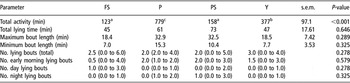
Horses were significantly more active when paddocked and least active when FS (P < 0.001, Table 1). In fact, when paddocked, horses spent more than half their time active (12.9 h/day) compared with only around 2 h/day when stabled or partially stabled.
Effect of housing treatment on activity and lying behaviour (mean or median (range))

FS = fully stabled; P = paddock; PS = partly stabled; Y = yard.
a,b,csuperscripts within a row that are different indicate a statistically significant difference (P < 0.05).
Lying behaviour
Housing had no effect on any parameters of lying behaviour: total lying time (P = 0.646), maximum bout length (P = 0.289), minimum bout length (P = 0.325), total number of lying bouts (H = 1.56, 3 d.f. P = 0.657) or timing of lying bouts (early morning, H3 = 1.97, P = 0.529; day, H3 = 2.64, P = 0.278; night, H3 = 2.58, P = 0.325). On several occasions horses did not lie down at all during the 24 h recording period. (Table 1)
When data from all horses in all treatments was pooled, the effect of time of day on frequency of lying bouts was highly significant (P < 0.001). In total, 45 lying bouts occurred between 0100 h and 0900 h, compared with 17 bouts occurring between 0900 h and 1700 h and the 16 bouts between 1700 h and 0100 h.
Rebound activity
The duration of activity upon release from confinement on days 1 and 5 of PS was significantly different to that shown in the paddock at the same time of day on day 5 (P = 0.006 and P = 0.025, respectively).
Discussion
Activity
As expected horses demonstrated far greater levels of activity when fully paddocked than in other housing treatments. Clearly, there is greater space and freedom of movement in a paddock than when in more confined conditions. Total activity levels recorded for partially stabled horses might have been greater if the horses were given access to a paddock during the day rather than at night as horses tend to be more active during the daytime. These results are also in agreement with prior research indicating that horses walked for 3% of the time at night when on pasture, compared to 1% when stabled (Houpt, Reference Houpt1998).
Rebound behaviour
The greater amount of activity displayed after releasing horses from stables in PS may have been partly a reaction to the change in environment, as well as a response due to release from confined conditions. It is possible that the horses had adapted to the routine by the end of the acclimatisation period, consequently reducing the amount of rebound behaviour shown after 5 days. Conversely, Houpt et al. (Reference Houpt, Houpt, Johnson, Erb and Yeon2001) found rebound activity was greater after 14 days of confinement than after 23 h of confinement.
The horses in the study were released daily for 1 h during stable cleaning and yet there was still evidence of rebound behaviour after 5 days of acclimatisation, although less than on the first day of confinement. Vices such as bolting when ridden could occur if a horse is ridden after a period of continuous confinement. Allowing just 5 min of paddock activity or perhaps lungeing before riding could be sufficient to reduce the risk of such vices occurring.
Lying behaviour
The range of housing treatments in this trial had no effect on any of the measured parameters of lying behaviour. Both cattle and horses are prey animals but cattle respond to threats by a defence posture whereas horses respond by flight. The postures they assume in rising from lying are correspondingly different and the form of their lying behaviour is also different (Fraser and Broom, 1997). Boyd et al. (Reference Boyd, Carbonaro and Houpt1988) suggested that sternal recumbency was more common than lateral recumbency in horses to allow a faster response to threats. Perhaps the responsiveness of lying behaviour to housing treatment differs also.
As in this study, there are numerous reports in the literature of individual horses which do not lie down at all during observational periods (e.g. Sweeting and Houpt, Reference Sweeting and Houpt1987; Houpt et al., Reference Houpt, Houpt, Johnson, Erb and Yeon2001; Jongman et al., Reference Jongman, Bidstrup and Hemsworth2005). Individual differences seem to have a large effect on horse lying behaviour.
Lying bouts most frequently occurred between 0100 h and 0900 h, with 58% of lying bouts occurring during this time period. This is consistent with previous findings that most sleep behaviour in a horse’s natural state occurs during 2000 h to 0500 h (Dallaire and Ruckebusch, Reference Dallaire and Ruckebusch1974). This also supports previous studies on equine time budgets, which indicate that horses spent 15% to 20% of their time lying in the late night/early morning, but during the remainder of the day, only 1% to 5% of their time lying (Heleski et al., Reference Heleski, Shelle, Nielsen and Zanella2002).
Lying behaviour was not affected by the range of housing treatments in this trial but the role of lying behaviour in the welfare of horses needs to be clarified. Activity levels may be a more sensitive indicator of welfare as activity was affected by housing treatment and showed a rebound effect.
Acknowledgements
We would like to thank Peter Cakebread and Jane Williams formerly of the Glenormiston College Equine Centre for their help in this trial and Marnie Collins for her statistical advice.