Antisocial behavior (ASB) is of key importance in several psychiatric disorders, both in children and adults. The American Psychiatric Association's Diagnostic and Statistical Manual of Mental Disorders, Fourth Edition, Text Revision (DSM-IV-TR; American Psychiatric Association, 2004) definitions for oppositional defiant disorder and conduct disorder in children, as well as antisocial personality disorder in adults, all include some form of ASB in their symptoms, whereas aggression features significantly in conduct disorder and antisocial personality disorder. Furthermore, these primary disorders for which ASB is symptomatic are often comorbid with other disorders, including attention-deficit/hyperactivity disorder and substance dependence, whereas aggression is either a comorbid condition of (or is central to) many psychiatric disorders, including autism, schizophrenia, depression, dementia, and intermittent explosive disorder. Alcohol and other substance abuse are often considered forms of ASB, because of the harm they bring to family members, friends and neighbors, or society as a whole. Although not currently defined in the DSM-IV-TR, psychopathy is another disorder for which ASB plays a major role (Hare, Reference Hare1985).
Strong genetic influences have been reported for ASB, with heritability estimates averaging 50–60% across twin and adoption studies (Rhee & Waldman, Reference Rhee and Waldman2002) and above 80–90% for composite measures across raters (Baker, Jacobson, Raine, Lozano, & Bezdjian, Reference Baker, Jacobson, Raine, Lozano and Bezdjian2007), situations (Arsenault et al., Reference Arsenault, Moffitt, Caspi, Taylor, Rijsdijk and Jaffee2003), and different forms of ASB (Krueger et al., Reference Krueger, Hicks, Patrick, Carlson, Iacono and McGue2002). Despite these advances, a significant gap in our knowledge is that the biological mechanisms underlying the genetic contribution to antisocial and aggressive behavior remain largely unknown, and there is little understanding of gene–behavior processes and pathways. A few candidate genes have begun to emerge as risk factors for some of the root causes of deviant behavior, including alcohol, drug dependence, conduct disorder, antisocial personality disorder, novelty and sensation seeking (Dick et al., Reference Dick, Aliev, Wang, Grucza, Schuckit and Kuperman2008), impulsivity and attention problems (Rommelse et al., Reference Rommelse, Arias-Vasquez, Altink, Buschgens, Fliers and Asherson2008), and reward mechanisms (Blum, Cull, Braverman, & Comings, Reference Blum, Cull, Braverman and Comings1996). Nevertheless, these high risk alleles (a) are likely to explain quite small amounts of variance (Plomin, Reference Plomin2005; Plomin, DeFries, Craig, & McGuffin, Reference Plomin, DeFries, Craig, McGuffin, Plomin, DeFries, Craig and McGuffin2003); (b) may depend on environmental factors for expression, for example, Caspi et al. (Reference Caspi, McClay, Moffitt, Mill, Martin and Craig2002); and (c) have yet to be linked directly to the risk for the wider spectrum of externalizing problem behavior in children or adolescents. Thus, genetic influences on the development of ASB currently remain a relatively large black box. In the quest for understanding relationships among genes, brain and behavior, behavior genetic studies focused on measured biological risk factors can be highly informative and help to unpack both the gene and environment black boxes.
Several biological correlates of ASB have been identified, based on psychophysiological (Raine, Baker, & Liu, Reference Raine, Baker, Liu and Raine2006), endocrinological (van Goozen & Fairchild, Reference van Goozen and Fairchild2008), and neuroimaging studies (Raine & Yang, Reference Raine and Yang2006), and several of these indicators themselves are heritable, making them good candidates as endophenotypes for ASB. By and large, however, these variables have been studied outside the realm of genetically informative designs, and thus the extent to which known biological risk factors may individually or collectively account for the substantial genetic risk for ASB has not been determined. The goal of this paper is to investigate one particularly robust biological marker for ASB—resting heart rate—and its role in the large genetic component that underlies ASB and its development in pre- to early adolescent children. Given the dominance of right hemisphere of the brain in autonomic arousal (Raine, Reference Raine2002), investigating heart rate and its genetic relationship to ASB aids in our understanding of the genes–brain–behavior pathways involved in ASB and the psychiatric disorders for which it is of central importance.
Resting heart rate levels (HRLs) have been shown through meta-analysis to be a well-replicated risk factor for ASB in youth (Ortiz & Raine, Reference Ortiz and Raine2004). Although the overall effect size is only moderate (d = −.44; r = −.21), it holds across gender and throughout both childhood and adolescence. Moreover, potential confounds of the HRL–ASB relationship have been ruled out, such as body size (Farrington, Reference Farrington, Raine, Brennan, Farrington and Mednick1997; Raine, Venables, & Mednick, Reference Raine, Venables and Mednick1997; Wadsworth, Reference Wadsworth1976), physical fitness (Farrington, Reference Farrington, Raine, Brennan, Farrington and Mednick1997; Wadsworth, Reference Wadsworth1976), substance use (Raine et al., Reference Raine, Venables and Mednick1997), and cognitive deficits (Farrington, Reference Farrington, Raine, Brennan, Farrington and Mednick1997; Raine, Venables, & Williams, Reference Raine, Venables and Williams1990). As in other research on biological markers for ASB, these cardiovascular studies reviewed by (Ortiz & Raine, Reference Ortiz and Raine2004) were all conducted outside of genetic designs, and consequently, it is not known whether the heart rate ASB relationship is genetically or environmentally mediated.
Theoretical explanations of low resting heart rate in antisocial youth have been proposed. Low resting heart rate is one of a number of classic indicators of physiological underarousal. Homeostatic mechanisms may lead underaroused individuals to engage in stimulation seeking or risky behaviors as a means of raising their autonomic activity to more desirable, optimal levels (Eysenck, Reference Eysenck, Raine, Brennan, Farrington and Mednick1997; Quay, Reference Quay1965; Raine et al., Reference Raine, Venables and Mednick1997). Low arousal and poor control processes may result in lack of fear, and hence, poor conditioning to potentially threatening stimuli such as punishment. In turn, children with low resting heart rate may be less able to be socialized and engage in greater levels of aggression, rule breaking, and defiance.
There is also evidence that right hemisphere brain dysfunction may result in autonomic underarousal, including reduced heart rate. Deficient right hemisphere functioning (particularly anterior regions) has been linked to deficits in the withdrawal system, which promotes retreat from aversive and dangerous situations (Davidson, Reference Davidson1998; Davidson, Eckman, Saron, Senulis, & Friesen, Reference Davidson, Eckman, Saron, Senulis and Friesen1990). Furthermore, individuals with right hemisphere lesions have shown lower HRL and skin conductance responses to films depicting negative emotions, compared to individuals with left hemisphere lesions (Zoccolotti, Caltagirone, Beneditti, & Gainotti, Reference Zoccolotti, Caltagirone, Beneditti and Gainotti1986). Reduced right hemisphere functioning may thus result in a weaker withdrawal system, which could make children less averse to dangerous, risky situations that increase the probability of ASB (Ortiz & Raine, Reference Ortiz and Raine2004; Raine, Reference Raine2002).
To the extent that resting heart rate is heritable, genetic factors could explain the inverse relationship between HRL and ASB in children. Significant heritability has been found for heart rate itself (Rice et al., Reference Rice, An, Gagnon, Leon, Skinner and Wilmore2002; Snieder, Harshfield, & Treiber, Reference Snieder, Harshfield and Treiber2003), including the sample on which the present study is based (Tuvblad, Isen, Baker, Raine, Lozano, & Jacobson, Reference Tuvblad, Isen, Baker, Raine, Lozano and Jacobson2009). The fact that both heart rate and childhood ASB are heritable gives rise to the prediction that a common genetic influence may underlie the HR–ASB relation, and also that genetically influenced heart rate could explain at least a portion of the large genetic variance in ASB. In contrast, the heritable component of ASB in children could be entirely independent of the genetic factors in heart rate, such that the HRL–ASB relationship arises primarily through environmental mechanisms. The facts that these two traits are (a) heritable and (b) phenotypically correlated, do not necessitate them being influenced by common genetic pathways.
There are also important environmental influences on both HRL and ASB in children, the latter depending to some extent on its definition and method of assessment (see Rhee & Waldman, Reference Rhee and Waldman2002). Heritability estimates for HRL are far from unity, ranging from .36 to .64 (Rice et al., Reference Rice, An, Gagnon, Leon, Skinner and Wilmore2002; Snieder et al., Reference Snieder, Harshfield and Treiber2003), despite being generally reliable in measurement over repeated occasions. Thus, it is entirely possible for the HRL–ASB relationship to be mediated entirely by environmental (i.e., nongenetic) factors that underlie low heart rate and behavior problems in children. Both genetic and environmental factors could conceivably contribute to the HRL–ASB relationship and a genetically informative design, such as a twin study, is required to investigate the extent to which these influences may each play a role.
Neurophysiological markers for ASB have also been considered to be of potential importance in various subgroups of antisocial individuals, depending on the developmental trajectories of ASB. It has been proposed, for example, that biological and cognitive deficits may be of greater importance in life-course persistent offenders compared to those individuals who show transient periods of ASB, such as during adolescence (Moffitt, Reference Moffitt1993; Raine et al., Reference Raine, Moffitt, Caspi, Loeber, Stouthamer-Loeber and Lynam2005). Although low resting heart rate appears to predict ASB to the same degree at different ages (Ortiz & Raine, Reference Ortiz and Raine2004), no study to date has investigated how developmental trajectories (i.e., intraindividual changes in ASB over time) may be related to HRL, particularly in a genetically informative design.
This paper investigates the phenotypic relationship of HRL and ASB during childhood and adolescence, and aims to understand the underlying genetic and environmental mediation of this relationship from age 9 to 14 years. Based on data from an ongoing longitudinal twin study of childhood behavior problems, we studied the HRL–ASB relationship for a set of measures that included aggression, delinquency, and psychopathic personality traits in boys and girls assessed at two time points between the ages of 9 and 14. Age variation within each wave of assessment (age 9–10 during Wave 1 assessment; age 11–14 during Wave 2 assessment) provided a powerful design for examining both initial levels and change in ASB during childhood and early adolescence using latent growth models (McArdle, Reference McArdle2006). We thus examined the biometrical structure of ASB over time, and how HRL may explain both phenotypic aspects of ASB and also its underlying genetic and environmental components of variance. Specifically, we address the following questions: (a) to what extent does HRL predict both levels of ASB during childhood and adolescence, and its change (and stability) over time? (b) To what extent can HRL be used to “explain” the genetic variance in ASB, both within and across ages? In other words, we investigate the genetic and environmental underpinnings of the relationship of HRL to both levels of ASB at a given age, as well as individual differences in change in ASB across time. This study particularly illustrates the utility of biometrical growth models in longitudinal twin studies for understanding physiology–behavior relationships and how these may influence pathways toward deviant behavior and psychopathology.
Method
Subjects
The sample was drawn from participants in the University of Southern California Twin Study of Risk Factors for Antisocial Behavior. The Twin Study of Risk Factors for Antisocial Behavior is an ongoing prospective longitudinal study of the interplay of genetic, environmental, social, and biological factors on the development of antisocial and aggressive behavior from childhood to emerging adulthood. The twins were evaluated using an extensive protocol, including cognitive, behavioral, psychosocial, and psychophysiological measures. The twins and their parents were recruited from the Los Angeles community and the sample is representative of the ethnic and socioeconomic diversity of the greater Los Angeles area (Baker, Barton, Lozano, Raine, & Fowler, Reference Baker, Barton, Lozano, Raine and Fowler2006; Baker, Barton, & Raine, Reference Baker, Barton and Raine2002). The sample consists of 616 families (607 twin pairs and 9 sets of triplets), for a total of 1,241 children.
In the first wave of assessment during 2000–2004 (Wave 1), the twins and their primary caregiver participated in a 6–8 hr laboratory assessment at University of Southern California. The twins were 9–10 years old (mean age = 9.6, SD = 0.58) and caregiver participation was primarily (92%) the biological mothers. In the second wave during 2003–2006 (Wave 2), approximately 2 years following their first wave assessment, the twins were 11–14 years old (mean age = 11.8, SD = 0.90). Of the 562 (553 twin pairs and 9 triplets) eligible families (i.e., in which twins had reached the target age range within the testing time frame), a total of 436 parents of 429 twin pairs and 7 triplet sets (response rate = 78%) completed the second wave follow-up assessment (Tuvblad, Raine, & Baker, 2008).
Zygosity was based on DNA microsatellite analysis (greater than seven concordant and zero discordant markers = monozygotic [MZ]; one or more discordant markers = dizygotic [DZ]) for 87% of the same-sex twin pairs. For the remaining same-sex twin pairs, zygosity was established by questionnaire items about the twins' physical similarity and the frequency with which people confuse them. The questionnaire was used only when DNA samples were insufficient for one or both twins. When both questionnaire and DNA results were available, there was a 90% agreement between the two (Baker et al., Reference Baker, Barton, Lozano, Raine and Fowler2006, Reference Baker, Jacobson, Raine, Lozano and Bezdjian2007).
Measures
The present study used five different measures of ASB in the children, taken from four different published instruments: the Child Psychopathy Scale (CPS; Lynam, Reference Lynam1997), the Reactive–Proactive Aggression Questionnaire (RPQ; Raine et al., Reference Raine, Dodge, Loeber, Gatzke-Kopp, Lynam and Reynolds2006), the Child Behavior Checklist (CBCL; Achenbach, Reference Achenbach1991), and the Diagnostic Interview Schedule for Children—Version IV (DISC-IV; Shaffer, Fisher, Lucas, & Comer, Reference Shaffer, Fisher, Lucas and Comer2000). Details on the procedures are described elsewhere (Baker et al., Reference Baker, Barton, Lozano, Raine and Fowler2006, Reference Baker, Jacobson, Raine, Lozano and Bezdjian2007). Information about each of the four instruments (administered at both Waves 1 and 2) is provided here, as well as a description of how resting heart rate was measured in the children (during Wave 1).
Psychopathic personality traits were measured using an extended version of the revised and validated CPS—Revised Extended (CPS-RE; Lynam, Reference Lynam1997, Reference Lynam2002). The CPS-RE was administered in interview format to the caregivers when the twins were 9–10 years (during Wave 1) and again at 11–14 years old (Wave 2). The CPS-RE contains 58 yes or no questions that together form 14 subscales and one total scale. The CPS-RE was specifically designed to measure the following traits and behaviors: glibness, untruthfulness, lack of guilt, callousness, impulsiveness, boredom susceptibility, manipulation, poverty of affect, parasitic lifestyle, behavioral dyscontrol, lack of planning, unreliability, failure to accept responsibility, and grandiosity. In the present study the total CPS-RE score was used.
The RPQ was administered in interview format to the caregivers during Waves 1 and 2 (Raine et al., Reference Raine, Baker, Liu and Raine2006). The RPQ assesses overall aggression as well as proactive and reactive subforms of aggression. It consists of 11 reactive items (e.g., hits others when teased) and 12 proactive items (e.g., fights to show who's on top). The items have a 3-point response format: 0 = if never, 1 = if sometimes, 2 = if often.
The CBCL (Achenbach, Reference Achenbach1991) is a widely used measure of general behavioral and emotional problems in children and adolescents. The CBCL consists of eight scales: aggressive behavior, attention problems, delinquent (or rule-breaking) behavior, depression/anxiety, social problems, somatic complaints, thought problems, and withdrawal. The CBCL has been shown in several studies to be a reliable and valid instrument for assessment of behavioral and emotional problems in children and adolescents (Achenbach & Rescorla, Reference Achenbach and Rescorla2000). The CBCL was administered in either (paper) survey or interview form to the caregiver. The CBCL was administered to the caregivers in interview format rather than in paper form if the subject's reading comprehension skills were determined to be at or below a second-grade level as determined by the Woodcock–Johnson Reading Achievement Test (Woodcock & Johnson, Reference Woodcock and Johnson1989). In the present study, the aggressive and delinquent behavior scales were obtained for each twin based on the CBCL administered at both Waves 1 and 2. The aggression scale is based on 20 items, including both physically aggressive ASBs such as destroying one's own and other's belongings, fighting with other children, and attacking others, as well as personality-type items such as argues a lot, brags and boasts, and being stubborn. The delinquent behavior scale consists of 13 items, including more ASBs such as lying, and stealing at home or elsewhere. The items had a 3-point response format: 0 = if the item is not true, 1 = if it is sometimes or somewhat true, and 2 = if is very true or often true. CBCL aggression and delinquency scales were created by summing within groups of items.
To measure conduct disorder symptoms in the twins, the DISC-IV (Shaffer et al., Reference Shaffer, Fisher, Lucas and Comer2000) was completed by caregivers during both Waves 1 and 2. The DISC-IV is a highly structured interview that has been adapted from DSM-IV-TR (American Psychiatric Association, 2004) to assess psychiatric disorders and symptoms in children and adolescents. The DISC-IV has been designed to be administered by well-trained lay interviewers and responses of DISC interviews are mostly limited to yes and no, although some have an additional “sometimes” or “somewhat” response option or a close-ended frequency choice. Both symptom scores and diagnoses are provided through computerized scoring of the modules. The DISC-IV distinguishes between symptoms present during the “past year” and symptoms that are “current” within the past 4 weeks. The present study only uses the past year conduct disorder symptom scores.
Procedures
Resting HRLs
During the lab assessment at the first wave of data collection, psychophysiological tasks were administered separately to each of the twins. While the electrodes and a bellows respiration belt were attached to the child, the interviewer conversed with the child to help the child relax (around 10–20 min). Once the electrodes and the respiration belt were attached to the child the interviewer left the room, and observed the child from a video monitor in an adjacent room. Before administering several psychophysiological tasks, baseline recordings were obtained using both electrodermal and electrocardiographic channels for 3 min, during which time the child was instructed to sit quietly and relax.
Recording of electrocardiogram: Heart rate
All psychophysiological data were collected with equipment and software from the James Long Company (1999; Caroga Lake, New York). A 38-channel Isolated Bioelectric Amplifier was used and physiological data were recorded online directly into a data acquisition computer. The channels of the grounded electrocardiograph were recorded through disposable electrodes that were attached to either side of the participant's lowest ribs. Before attaching the electrodes target skin areas were cleaned with alcohol wipes. Heart rate data were analyzed using the Interbeat Interval Analysis Software program (James Long Company). The R-waves were sampled every 0.1 s. For the present study, heart rate (beats/min) was computed as the average of all interbeat intervals across the 3-min time interval (Tuvblad, Raine, et al., Reference Tuvblad, Raine and Baker2009).
Standardization and ASB factor composite formation
To facilitate comparisons of mean levels across the two waves, and for purposes of creating a composite measure of ASB based on the various scales within each wave, all raw subscales were standardized. The first wave subscales were first transformed into Z scores based on their own means and standard deviation, and then the second wave subscales were standardized using the first wave means and standard deviations. This standardization thus retained the mean changes, if any, between first and second waves. Principal component analyses of the first wave subscales have been previously reported (Baker et al., Reference Baker, Jacobson, Raine, Lozano and Bezdjian2007), showing a single factor accounting for 58.7% of the variance in these subscales, with loadings and factor score coefficients being approximately equal across the subscales. Thus, composite measures of ASB were computed using equal weights by taking the average of the standardized caregiver-report subscales within each wave (i.e., PFAC1 and PFAC2 for first and second waves, respectively). Logarithmic transformations were then performed on each ASB composite (i.e., 100 × ln[PFACi + 3]) to reduce their skewness and kurtosis. All subsequent analyses were performed on the standardized subscales and the log-transformed ASB composites.
Analyses
Genetic and environmental influences in ASB
Prior to addressing the two primary study questions concerning HRL and ASB, we performed a set of preliminary analyses to investigate the genetic and environmental influences on ASB in Wave 1 (age 9–10 years) and Wave 2 (age 11–14 years) assessments. These included univariate biometrical analyses of ASB within wave (i.e., ignoring age variation within each wave), as well as bivariate models investigating the stability of genetic and environmental influences between the two waves.
Biometrical latent growth models were then used to investigate the genetic and environmental influences on the change in ASB. This approach considers the individual differences in change over time, such that some children may increase or decrease in their ASB to a greater or lesser extent than others. Examining both intercept and growth variation in twins involves comparison of co-twins in their overall levels of ASB as well as their change from one age of measurement to the next. For identification of the growth model with only two waves of assessment, we related the ASB scores to the exact ages of each participant. Thus, a two-wave model was rewritten as a multiple wave model with incomplete data. This approach is also called planned missingness. It allows all of the available information for any subject on any data point to be used to build up the overall likelihood function for the model, and the model parameters are optimized with respect to all the available data (Duncan, Duncan, & Strycker, Reference Duncan, Duncan and Strycker2006; McArdle, Prescott, Hamagami, & Horn, Reference McArdle, Prescott, Hamagami and Horn1998; Rubin, Reference Rubin1976).
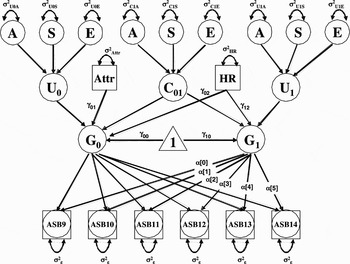
Figure 1 is a diagram for the biometric latent growth model adapted from McArdle, (Reference McArdle2006). Some particular aspects of this diagram need to be pointed out: (a) the triangle is used to represent the unit constant where one-headed arrows from the unit constant represent means; (b) all paths that are not explicitly labeled in the diagram are set to one; (c) following McArdle et al. (Reference McArdle, Prescott, Hamagami and Horn1998), the circle within a square symbol is used to designate a variable that may be observed for some individuals but not all individuals. In this study, individuals were measured at only one or two specific ages, but variation of the ages of assessment across subjects effectively leads to collective observation of all age points from 9 to 14 years old as shown in Figure 1.
Biometric growth model for antisocial behavior (ASB) during Wave 1 (age 9–10) and Wave 2 (age 11–14); ASB, factor composite; G0, intercept (initial level at age 9); G1, growth (rate of change across years); A, additive genetic; S, shared environment; E, nonshared environment; Attr, attrition.

The model in Figure 1 estimates the genetic and environmental influences on both level (G0) and rate of change (G1) over the full age range (9–14) in both waves, by examining both intercept (γ00) and age-based slope (γ10) values for the ASB factor composites, respectively. The basis coefficients α[t] are weights used to represent some function of the timing of the observations. In the current study the elements of this vector were centered at age 9 or α[i] = age −9. Thus, the intercept reflects initial levels of ASB at 9 years old.
A concept that is unique to the model in Figure 1 is the covariation of G0 and G1, which is represented as a single common factor (C01). By using this variance decomposition approach, the latent growth model is expressed as sum of a set of orthogonal components G0, G1, and C01 (McArdle, Reference McArdle1986). Note this orthogonal decomposition does not set a lower bound of zero for the variance components, and negative variance components may be informative of the model fit in some cases.
The unique intercept variance, slope variance, and their covariation can be further decomposed into genetic and environmental components, that is, genetic (A), shared environmental (S), and nonshared environmental (E) variance components. They can be viewed as a second-order analysis by adding biometric components as predictors of the initial and slope. In addition, the effects of attrition in Wave 2 because of ethnicity were taken into account by including a variable indicating the probability of participation in Wave 2 based on ethnicity (Attr in Figure 1) as a predictor of initial level G0 (McArdle, Reference McArdle2006; McArdle & Prescott, Reference McArdle and Prescott2005).
The model shown in Figure 1 also allowed inclusion of HRL as a predictor of level and growth in ASB, as described in the next section, to investigate further the contribution of low resting heart rate on both phenotypic levels and change (Study Question 1) as well as underlying genetic and environmental variance in ASB (Study Question 2).
Phenotypic associations between HRL and ASB (Study Question 1)
The relationship between HRL and ASB was investigated first at the phenotypic level, through both simple correlations (to examine the extent to which children with low HRL at age 9–10 years are more antisocial during both Wave 1 and Wave 2 assessments), and multiple regression (to examine the extent to which children with low HRL may become more or less antisocial between the two waves). For the latter, we tested the partial regression of ASB at Wave 2 on HRL while controlling for initial ASB at Wave 1.
Additional analyses of the HRL –ASB relationship were conducted using latent growth models (see Figure 1), by adding HRL as a predictor of both level (G0) and rate of change (G1) in the phenotypic growth model used in the preliminary analyses. With the inclusion of HRL as a fixed effect, deviation from the average intercept (ASB scores at age 9) and average slope (i.e., growth intercept) can be predicted and any remaining systematic growth variance assessed. This conditional hierarchical linear model is sometimes referred to as an intercept and slope as outcomes model (Duncan et al., Reference Duncan, Duncan and Strycker2006).
Biometrical analyses of the HRL–ASB relationship (Study Question 2)
The underlying genetic and environmental variance components in the HRL – ASB relationship were investigated in two ways. First, the biometrical latent growth models of ASB from age 9 to 14 (Figure 1) were modified to include HR as a fixed effect predictor of both G0 and G1, to examine the residual variance in level and slope, respectively, that is, the variance in both initial levels and change in ASB over age, after removing the variation because of resting heart rate. Computing the reduction in variance components after removing variation because of HRL provided one means of understanding the extent to which low resting heart rate could explain the heritability of ASB and its developmental course.
Second, we used additional multivariate biometrical analyses of the Wave 1 and Wave 2 ASB factor composites (i.e., ignoring age variation within each wave) to investigate the contribution of HRL to genetic variance at each wave, as well as to the stable variance in ASB between the two waves. These analyses provided estimates of the genetic covariation between HRL and ASB within each wave, as well as between waves, to understand the extent to which the HRL –ASB relationship is genetic and environmentally mediated. We used Cholesky decomposition of the variances and covariances among the ASB factors computed for Wave 1 and Wave 2, along with HRL measured during Wave 1. For example, the variance – covariance component for additive genetic effects A was defined in terms of three factors: A1 with loadings on HRL and both ASB factors, A2 with loadings on the two ASB factors only, and A3 with a single loading on ASB at Wave 2. The Cholesky model specification allowed estimates of the genetic variance in ASB at each wave which is shared with genetic effects on heart rate at age 9–10, as well as the extent to which shared variance between ASB at the two waves (i.e., stable genetic variance) could be explained by genetic variability in heart rate.
Parameter estimation and goodness of fit
Models were fit to raw data in all biometrical and latent growth analyses, using SAS Proc Mixed (SAS, 2005) for the latent growth models in which age variation was considered (for details, see McArdle, Reference McArdle2006), and Mx (Neale, Boker, Xie, & Maes, Reference Neale, Boker, Xie and Maes2003) for additional analyses, which ignored age variation within each wave (i.e., univariate genetic models of HR and ASB, and Cholesky factor models for estimating genetic covariance between ASB and HR). Maximum likelihood estimation procedures were used to obtain best-fitting parameter estimates, providing −2 times log-likelihood values (−2LL) that were used for model comparisons. Both the Akaike information criterion (AIC; Akaike, Reference Akaike1987) and Bayesian information criterion (BIC; Raftery, Reference Raftery1995) were computed for various models fit to the data, and they were used as indices to determine the best-fitting and most parsimonious models.
Results
Intraclass correlations
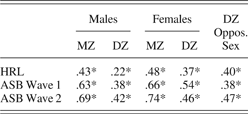
Intraclass correlations for HRL measured in Wave 1 and the transformed ASB factor composites (both in Waves 1 and 2) are presented in Table 1. The MZ intraclass correlations were higher than DZ intraclass correlations, suggesting genetic influences for these measures. For example, the intraclass correlations for HRL, Wave 1, was 0.43 for MZ boys and 0.48 for MZ girls. The corresponding numbers for DZ twins were lower, 0.22 and 0.37. The DZ intraclass correlations were more than half the MZ intraclass correlations, suggesting shared environmental effects. MZ intraclass correlations were all less than 1, which suggest influence of nonshared environment.
Twin Correlations for HRL (Wave 1) and (log-transformed) ASB factor composites in Waves 1 and 2
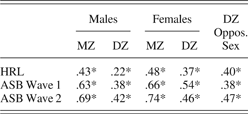
Note: HRL, resting heart rate level; ASB, antisocial behavior; MZ, monozygotic; DZ, dizygotic.
* p < .05.
Univariate biometrical model fitting
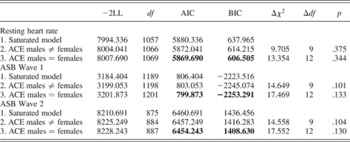
Univariate ACE models were fit separately to each measure, both for HRL measured in Wave 1 and the transformed ASB factor composites (both Waves 1 and 2). A model constraining genetic and environmental components to be equal across sexes fit the data better than a saturated model for heart rate, Δχ 2 (12) = 13.354, p = .34, for ASB caregiver report Wave 1, Δχ2 = 17.469, p = .101, and for ASB caregiver report Wave 2, Δχ 2 (12) = 17.552, p = .13. A summary of the univariate model-fitting results is provided in Table A.1 in Appendix A.
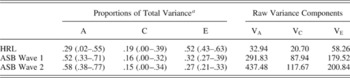
Table 2 displays the estimated variance components for each measure, expressed both as relative components of variance as well as raw variance components. For heart rate, genetic influences accounted for one-third of the variance (29%, p < .05), shared environmental influences were nonsignificant (19%), whereas the nonshared environment was substantial and significant (52%, p < .05). For ASB measured in Wave 1, genetic influences accounted for 52% (p < .05), shared environment 16% and nonshared environment 32% (p < .05). For ASB in Wave 2, genetic effects explained 58% (p < .05); shared environment was nonsignificant (15%), and the nonshared environment accounted for 27% (p < .05).
Univariate biometric parameter estimates for HRL (Wave 1) and (log-transformed) ASB factor composites (Waves 1 and 2)

Note: HRL, restingheart rate level; ASB, antisocial behavior; A, additive genetic variance; C, shared environmental variance; E, nonshared environmental variance; V, variance.
aThe 95% confidence interval is provided in parentheses.
Although these univariate genetic models suggest that relative effects of genes and environment on ASB appear quite stable between Wave 1 (age 9–10) and Wave 2 (age 11–14) in the case of parent ratings, the raw variance components give a somewhat different indication that both genetic and environmental variability may be increasing between childhood and early adolescence. These patterns of change in the raw variance components, in particular, give some clues that important changes may occur in both overall genetic and environmental variance despite the lack of apparent changes in relative effects. Latent growth models can be especially helpful in resolving the extent to which these changes occur.
Latent growth models of ASB
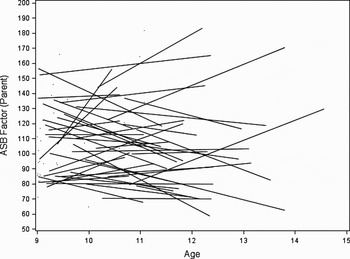
Prior to latent growth curve analysis, descriptive statistics and preliminary tests of significance regarding phenotypic change and stability were considered, both for the ASB factor composites as well as the subscales on which these were based. In 2 (Sex) × 2 (Wave) analyses of variance there were significant main effects for Wave in ASB in three of the five parent-rating scales (RPQ aggression: F = 23.92, p < .05; CPS total score: F = 7.17, p < .05; CBCL aggression: F = 21.71, p < .05), as well as in the ASB factor composite (F = 14.96, p < .05). Although sex differences were significant for all parent-rated subscales and the ASB factor composites (p < .05), there were no significant Wave × Sex interactions, indicating that any changes (i.e., decreases in parent reports of ASB) were consistent for both boys and girls. Analyses of the mean levels of ASB within each wave, however, do not take into account the possibility of interindividual differences in change and stability over time. In fact, an inspection of individual ASB profiles from Wave 1 to Wave 2 shows considerable variability in both level and change within this sample (see Figure 2 for a random sampling of profiles). Despite the significant decrease in average ASB ratings from Waves 1 to 2, some children declined more than others, whereas some showed no change and even others showed an increase in ASB across occasions. These individual differences were investigated further in phenotypic latent growth models, followed by biometrical latent growth models to investigate the genetic and environmental contributions to growth and intercept variations. These models considered the age variation within each Wave, in order to provide a more detailed picture of the developmental course of ASB and its underlying etiology.
Intraindividual change in parent ratings of antisocial behavior between Wave 1 (age 9–10) and Wave 2 (age 11–14).

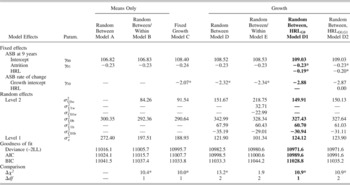
Table A.2 in Appendix A provides a summary of various models fit to investigate the phenotypic level and change in ASB from ages 9 to 14, while accounting for attrition. First, a no-change phenotypic growth model, also denoted an intercept-only model, was fit to each ASB factor composite (Model A), in which only means were estimated across wave and only random between-pair effects contributed to the variation in means. This baseline model proposes that only familial effects contributes to the average ASB scores across waves, whereas occasion-specific variance contributes to residual variance, which may include both familial and nonfamilial variance. Model B added a random within-pair effect to the mean estimated across wave suggesting that person-specific (nonshared environmental) variance contributed to the average ASB score across wave. Model C added a fixed linear growth rate to the model, centered at age 9, suggesting that growth does not vary across individuals or between pairs; furthermore, the intercept now reflects ASB scores at age 9. Model D included a between-pair variation in linear rate of change suggesting that linear trends vary because of familial factors. Finally Model E included random within-pair effects on the linear slope suggesting that that person-specific (nonshared environmental) variance contributed to the rate of change between Waves 1 and 2. Additional models adding heart rate as a predictor of intercept or slope were considered after establishing the best growth model (A–E) while accounting for attrition.
For parent ratings of ASB, a best-fitting phenotypic growth model was established (based on lowest AIC and BIC values; see Table A.1) where between-pair variation contributed to both intercept and slope variation and within-in pair variation contributed to intercept variation (Model D). This model was used as a starting point in later analyses of HRL and its relationship to both level and slope in ASB.
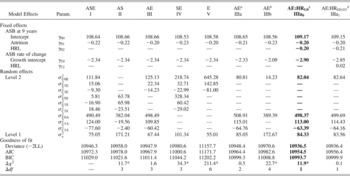
Having established significant growth (actually, negative growth on average because ASB means decrease across ages), and more importantly, that significant individual differences exist in this growth, the next step was to investigate the underlying genetic and environmental etiology of individual differences in both level and change in ASB. Thus, we next fit a series of biometrical growth models to the ASB composite, as summarized in Table A.3 in Appendix A. Given that phenotypic growth models indicated the importance of individual differences (variation) in the slope for ASB, we began with a full model (Model I), which included growth variation, and where nonshared person-specific environment (E), shared environment (S), and additive genetic variation (A) contributed to both intercept, that is, ASB scores at age 9, and linear slope. Model I was used as a comparison model for subsequent reduced models (Models II–V), which dropped familial effects A or S, as well as E effects on growth parameters. Based on AIC values, an AE model was the most parsimonious biometrical model (Model III), suggesting that the familial effects observed for phenotypic models were because of additive genetic effects alone. Furthermore, given that phenotypic models suggested that within-pair variation was not needed to explain linear slope variance, nonshared environmental contributions to slope variance were removed from the best-fitting biometric growth model (Model IIIa) without significant loss of fit (see Table A.3).
Parameter estimates from the full ACE growth model with correlated intercept and slope (Model I in Table A.3) can be used to derive the relative effects of genes and environment on both level and change in ASB for this sample. For the intercept, the total variance C composed of both the variance components unique to the intercept (σ2U0E, σ 2U0S, σ 2U0A) as well as the components because of the common factor shared with the slope (σ 2C1E, σ2C1S, σ2C1A): (111.84 + 5.81 + 490.49) + (−9.30 + 18.46 – 77.60) = 539.70. The intercept variance because of additive genetic effects is thus σ2U0A + σ2C1A = 490.49 − 77.60 = 412.89, which divided by the total intercept variance, gives a relative genetic influence of .765 or 76.5%. Thus, over three quarters (76.5%) of the levels of ASB are explained by genetic differences among children. Similarly, shared twin environment effects on the intercept variance are 5.81+18.46 = 24.27, accounting for 4.5% of variance in levels in ASB, whereas nonshared environment accounts for the remaining 19% of the variance. Relative effects of genes and environment can be calculated for the slope variation (total variance = σ2U1E + σ2U1S + σ2U1A + σ2C1E + σ2C1S + σ2C1A = 15.06 – 16.90 + 124 – 9.30 + 18.46 – 77.60 = 53.72), such that genetic, shared, and nonshared environmental effects account for 86%, 3%, and 11% of the slope variance, respectively. Thus, genetic factors strongly explain individual differences in both level and change in ASB, based on parental ratings. It should be noted, however, that much greater variation exists in overall level (intercept) than in change (slope), because the respective variance components are 539.70 and 53.72.
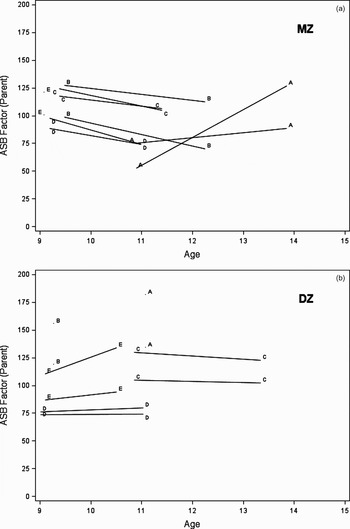
To help illustrate the source of these biometrical components in intercept and growth, a selected sample of twin pairs are shown in Figure 3. For the MZ pairs (top panel of Figure 3), there are visibly smaller differences in level (intercept) for the four pairs with complete data at both waves (pairs A through D), as well as for the one pair (E) with only Wave 1 data, compared to the DZ pairs (bottom panel of Figure 3). Although less apparent than the twin similarity for ASB levels, there are also somewhat greater differences within DZ than MZ twin pairs in their change in ASB (slope) across occasions (Figure 3). The comparative differences in slope similarity between MZ and DZ pairs is more difficult to discern in part because of the relatively smaller variation in systematic change in relation to variation in intercept, as illustrated in the previous paragraph.
Twin similarity for change in antisocial behavior (ASB) over time, for (a) monozygotic (MZ) pairs and (b) dizygotic (DZ) pairs. A–E represent different twin pairs, and dotted and dashed lines represent the co-twins within each pair. ASB ratings are obtained for each twin on two occasions, with the exception of Pair E, which was measured only during the first occasion.

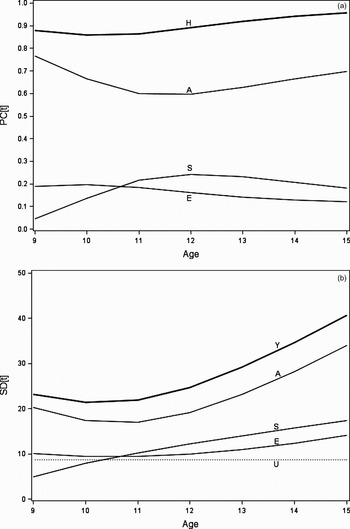
Figure 4a shows the relative proportions of genetic and environmental influence on ASB across the full age range (9 –14 years) in Waves 1 and 2, based on the parameter estimates in the full biometric growth model, Model I. Similar to what was found in the univariate biometrical estimates (see Table 2, Figure 3a), additive genetic effects primarily account for twin similarity, with shared environmental effects being small in comparison. Moreover, these relative effects do not vary appreciably across age for parent ratings of ASB during childhood and early adolescence.
(a) Antisocial behavior (ASB) proportions of variance as a function of age: full ACE model. Proportion of variance over the total growth variance as a function of age; A, additive genetic heritability; S, shared environmentality; E, nonshared environmentality; H, reliable growth variance over total score variance at each age. (b) ASB deviation components as a function of age, based on full ACE model (Model I in Table 4). Deviation of ASB scores as a function of age; A, additive genetic deviations; S, shared environmental deviations; E, nonshared environmental variation; U, and occasion-specific variation; Y, total deviation including growth deviation and occasion-specific deviation.

In comparison, the raw deviation components (shown in Figure 4b) do indicate some variation across development in genetic and environmental influences on ASB. All components of variation increase with age, save the occasion-specific variation (U), which is necessarily constrained to be equal across all ages. The largest increase is seen with respect to additive genetic deviations. This pattern suggests that genetic influences, and to a lesser extent environmental influences, on ASB become amplified with the emergence of adolescence.
HRL –ASB relationship: Phenotypic analyses (Study Question 1)
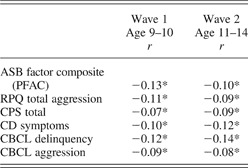
Correlations between HRL and ASB are presented in Table 3, both for individual subscales and the factor composites at each wave. Correlations between HRL and ASB do not appear to differ substantially across measures, and are significant (p < .05) for ASB at both waves. The overall association is somewhat smaller than the average effect size reported in the Ortize and Raine (Reference Raine2002) meta-analysis, but well within the range of what has been found for other studies of children and adolescents. Multiple regression analyses were used to investigate the extent to which HRL could predict changes in ASB over time, by regressing ASB Wave 2 onto ASB Wave 1 and HR together. Partial regression coefficients were not significant in any case (for individual subscales or factor composites), suggesting HR predicts initial level of ASB (at age 9–10) but not change in ASB over time.
Correlations between resting heart rate (Wave 1) and ASB (Waves 1 and 2)

Note: ASB, antisocial behavior; RPQ, Reactive–Proactive Aggression Questionnaire (Raine et al., Reference Raine, Dodge, Loeber, Gatzke-Kopp, Lynam and Reynolds2006); CPS, Child Psychopathy Scale (Lynam, Reference Lynam1997); CD, conduct disorder; CBCL, Child Behavior Checklist (Achenbach, Reference Achenbach1991).
Additional analyses of the HR–ASB relationship were conducted using the phenotypic latent growth models, in which HRL was included as a predictor of both level and growth (see Figure 1). As shown in the last two columns in Table A.3, HRL accounted for phenotypic variation in intercept but not slope (Model D1). These results are consistent with the multiple regression analyses described above, showing HRL to be related to ASB at Wave 1, but not the change between waves. Estimates suggest that between-pair variation (i.e., twin similarity) for intercept, that is, ASB scores at age 9, was reduced by 3.67% when including heart rate in the model. In comparison, within-pair variation decreased by 1.12% when including heart rate in the model. This finding suggests some familial component to the HR–ASB relationship, although the extent to which it is explained by shared genes or shared environment required further investigation in biometrical growth models, as described next.
HRL –ASB relationship: Biometrical analyses (Study Question 2)
Inclusion of HRL into the biometrical growth model provided an initial view of the contribution of low heart rate to the genetic and environmental components in ASB. Thus, HRL rate was added as a fixed effect to the biometrical growth model (see Models IIIa0 and IIIa1 in Table A.3) where we observed the extent of reduction of genetic and environmental growth variance because of its inclusion as a predictor of intercept, or ASB scores at age 9. Heart rate was a significant predictor of intercept, explaining 2% of the genetic variance in ASB scores at age 9; however, as indicated by the phenotypic models, HRL did not explain individual differences in growth rate.
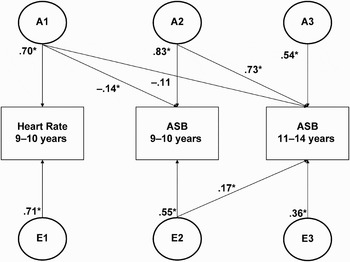
To examine further the relationship between heart rate and ASB we fitted a series of multivariate biometrical models to data from HRL and the ASB factor composites at Waves 1 and 2. These included (a) a fully saturated model in which variances and covariances were free to vary across twin groups and (b) a Cholesky decomposition model to account for the additive genetic, shared environment, and nonshared environment components of variation and covariation among HR and the ASB factors for each wave. The fully saturated model was used as a baseline to which subsequent models were compared (HRL and ASB: −2LL = −2373.320, AIC = −8553.320, BIC = −11115.585, df = 3090). The Cholesky model provided a better fit of the data based on BIC and AIC criteria (−2LL = −2592.426, AIC = −8906.426, BIC = −11440.425, df = 3157). In accordance with the results from the univariate analyses, genetic and environmental influences could be equated across sex (−2LL = −2559.978, AIC = −8909.978, BIC = −11482.040, df = 3175). The final and best-fitting model allowed shared environment to be dropped, as well as the nonshared environment pathways from HR to ASB at both waves (−2LL = −2553.304, AIC = −8915.304, BIC = −11497.982, df = 3181). Parameter estimates from the final model are provided in Figure 5.
Biometrical model of resting heart rate level (HRL) and antisocial behavior (ASB) at Waves 1 (age 9–10) and 2 (age 11–14).

The estimates in Figure 5 can be used to calculate how much of the genetic influences in ASB that is explained by heart rate. Heart rate explained only 2.77% [(−0.14 × −0.14)/(0.83 × 0.83 + (−0.14 × −0.14))] of the genetic influence in parent-rated ASB at Wave 1 and 0.98% [(−0.11 × −0.11)/(0.73 × 0.73 + 0.83 × 0.83 + (−0.11 × −0.11))] of the genetic influence in ASB at Wave 2.
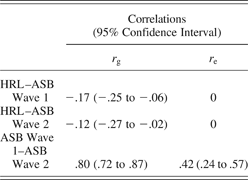
Table 4 displays genetic and nonshared environmental correlations between heart rate and ASB Wave 1, heart rate and ASB Wave 2, and ASB Wave 1 and Wave 2. The genetic correlation was r g = −.17 (p < .05) between heart rate and ASB at Wave 1. The genetic correlation between heart rate and ASB Wave 2 was lower (r g = −.12, p = .10). The genetic correlation between ASB Wave 1 and Wave 2 was r g = .80 (p < .05), suggesting a significant genetic stability in ASB between the two waves. The nonshared environmental influences also show a significant overlap for ASB across the two waves (r e = .42, p < .05).
Correlations from bivariate models between HRL and ASB Wave 1, between HRL and ASB Wave 2, and between ASB Wave 1 and ASB Wave 2
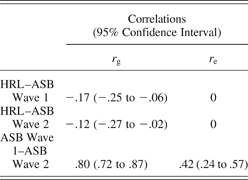
Note: HRL, resting heart rate level; ASB, antisocial behavior; r g, genetic correlation; r e, nonshared environmental correlation.
Child-reported ASB
The present study also obtained self-report measures of ASB from the children themselves, providing an opportunity to compare results across different raters. Findings using child self-reports showed many similar findings compared to parent reports, in that (a) HRL correlates significantly (p < .05) and inversely with ASB to a similar degree (r = −.10 to − .15 across instruments), which is primarily the result of shared genetic covariation between HRL and ASB. Similar to what was found using parent ratings, HRL explains less than 2% of the genetic variance in ASB. Two important differences did emerge, however, with respect to changes in ASB across time and its underlying genetic and environmental effects. Specifically, we found no significant change in either average levels of child-reported ASB (based on t tests), and no systematic individual differences in growth (based on latent growth models). Nonetheless, we did observe an overall increase in common environment and decrease in genetic influence over time in child reports, a finding that highlights the importance of considering rater differences in investigations of ASB in youth. Of importance, HRL was significantly related to levels of ASB in both parent ratings and child reports, but was unrelated to patterns of change over time in either case (results available upon request).
Discussion
The present study extends our earlier findings of significant heritability of externalizing behavior problems in children in several ways. First, new longitudinal data demonstrate that genetic influences remain important for caregiver ratings of their children's problem behavior, with the relative portions of variance explained by genetic influences being stable over the 9- to 14-year age range. Second, individual differences in low resting heart rate, which are also heritable at age 9 –10, explain a small but significant portion of the genetic variability in ASB in childhood. Consistent with prior research, the phenotypic association between low resting heart rate and ASB is small but significant, and does not appear to vary across measuring instruments that tap into different aspects of the externalizing spectrum, including aggression, delinquency, and psychopathic traits. To our knowledge, this is the first study to demonstrate that this correlation is almost entirely because of the genetic covariation between heart rate and ASB.
Despite the lack of apparent change in relative genetic influence on ASB over age in these data, there is evidence of change in several ways. Mean levels of ASB (as rated by the parents) decrease between the two waves of assessment during childhood (age 9 –10) and early adolescence (age 9 –14). Latent growth models, furthermore, revealed significant variation in the change in ASB across age, demonstrating important individual differences in both the direction and degree of change over time. Although the average slope is negative, indicating reduction in ratings of ASB as children enter adolescence, clearly some children decrease more than others, and some even increase according to their parents' ratings.
Although it is tempting to speculate that the average decrease in ASB could reflect increasing socialization as children move from primary to middle schools, this interpretation is not warranted in light of the finding that slope variation is not influenced by shared environment between the twins. The between-family effects on slope variation in phenotypic growth models was entirely explained by additive genetic effects in the biometrical growth models, suggesting that the degree of change in ASB over time may be more determined by (heritable) constitutional factors instead of environmental influences. It is interesting to note, also, that shared environmental effects that can result as an artifact of rater bias (Bartels et al., Reference Bartels, Boomsma, Hudziak, Rietveld, van Beijsterveldt and van den Oord2004) were not significant for the current analyses of parent ratings of ASB. It should be noted that our previous analyses (Baker et al., Reference Baker, Jacobson, Raine, Lozano and Bezdjian2007) did find a significant effect of shared environment in parental ratings of ASB in Wave 1 (age 9–10). We attribute the lack of effect in the present growth model analyses of the same data to be because of the fact that age variation (which can also lead to spurious shared environmental effects) has been taken into account.
Other evidence for change is found in the raw variance components for ASB as estimated in both multivariate biometrical models fit to the ASB factor composites as well as the biometrical latent growth models that incorporated within-wave age variation. Although proportional effects of genes and environment do not appear to change over age, both phenotypic and raw genetic variance do increase as children move into early adolescence. Thus, individual differences in problem behaviors become more substantial during early adolescence, both genetically and phenotypically.
How is heart rate associated with ASB and its developmental course? Low resting heart rate does appear to be a significant factor in explaining ASB in phenotypic analyses, but is only important in explaining initial levels and not change in ASB over time. That is, heart rate was a significant predictor of the intercept but not the slope in latent growth models. This finding was also evident in multiple regression analyses showing lack of significance of partial regression coefficients for heart rate as a predictor of adolescent ASB (Wave 2), after controlling for initial levels during childhood (Wave 1). Children with low resting heart rate at age 9 are significantly more antisocial overall, but the reduction in ASB with age was not associated with heart rate. These findings suggest that low heart rate is a fixed, static neurobiological risk factor for ASB that does not predict desistance from ASB, at least throughout the early adolescent period. Whether low heart rate ultimately predicts the variance in sustained life-course persistent offending that is under genetic control is a future long-term goal of this study.
Does heart rate account for any significant portion of the sizable genetic component of ASB, either in terms of initial levels in childhood or changes over development? Based on our biometrical analyses, the answer is “yes.” Although the phenotypic association between heart rate and ASB is quite typically low (Ortiz & Raine, Reference Ortiz and Raine2004), the association is significantly mediated by genetic factors common to them. Although the genetic variance in heart rate explains a small amount of the heritable variance in childhood and adolescent ASB, it is broadly in line with meta-analytic findings that show that heart rate explains about 4% of the variation in ASB. The percent of genetic variance in ASB explained by its shared relationship with heart rate is comparable to what is typically found in QTL studies (1– 4%), emphasizing the difficulty in trying to explain this genetic variability with single genes or even single biological risk variables such as heart rate. It may require combinations of many heritable risk factors, perhaps in combination with environmental moderator variables (Rutter, Moffitt, & Caspi, Reference Rutter, Moffitt and Caspi2006), to explain the sizable genetic variance in psychopathological disorders.
Moreover, the phenotypic and biometric growth model findings suggest that heart rate, while explaining a small proportion of variance in childhood ASB, wanes in effect with age as variability in ASB scores increases. To the extent that some of the later measurement of ASB includes adolescent limited forms, which may be less related to biological risk factors such as heart rate, these could explain the waning effects over time. It would be ideal to have longitudinal data on heart rate, measured concurrently with ASB, to see if there are dynamic lead–lag relationships to explain HR–ASB relationships observed in earlier studies (Raine et al., Reference Raine, Venables and Mednick1997).
Several limitations in the present study must be kept in mind when considering these findings. The measures of ASB were based primarily on parental ratings, which are known to be affected by rater bias (Bartels et al., Reference Bartels, Boomsma, Hudziak, Rietveld, van Beijsterveldt and van den Oord2004). Findings concerning decreasing levels of ASB, for example, may not indicate true decline in the children's behavior, but may instead reflect changes in the parents' perceptions (based in part on their reduced ability to observe their children as they become more independent during adolescence and entry into middle school). Parents may also change in their willingness to report certain behaviors in their children. Indeed, the child ratings of ASB did not show significant change over age or wave of measurement, although the relative contributions of shared environmental factors gained in importance, whereas genetic influences decreased over time. Data from other raters, such as teachers, could be examined for comparison to results based on parent and child ratings. Additional analyses of raters and individual ASB measures are also being conducted in this study (e.g., Tuvblad, Owen, Baker, & McArdle, Reference Tuvblad, Owen, Baker and McArdle2009). One must also consider that the availability of only two time points for the present analyses limits conclusions to be drawn about the shape of the antisocial trajectory over time, and how much person specific (nonshared) environmental factors might affect individual change. Such analyses require more time points to fully understand the growth process, and will be possible as future waves of assessment are completed.
It remains to be seen how these effects (mean levels, raw variance components, and relative effects of genes and environment) will appear as the children become older and a greater number of them enter middle school and high school. Additional analyses of future waves of assessment will help elucidate the larger developmental course of ASB and its genetic and environmental etiology.
Appendix A
Univariate model fitting results

Note: −2LL, −2 log likelihood; AIE, Akaike information criterion; BIC, Bayesian information criterion; ASB, antisocial behavior; A, additive genetic component; C, shared environmental component; E, nonshared environmental component.
Phenotypic models of growth: With and without heart rate as predictor of ASB factor

Note: ASB, antisocial behavior; G0, ASB at 9 years; G1, ASB rate of change; HRL, resting heart rate level; −2LL, −2 log likelihood; AIC, Akaike information criterion; BIC, Bayesian information criterion. Model B is compared to A, Model C is compared to B, Model D is compared to C, Model E is compared to D, and Models D1 and D2 are compared to D.
*Indicates significance at the .05 level.
Biometric models of growth: With and without heart rate as predictor of ASB factor (caregiver ratings)

Note: ASB, antisocial behavior; G0, ASB at 9 years; G1, ASB rate of change; HRL, resting heart rate level; –2LL, –2 log likelihood; AIC, Akaike information criterion; BIC, Bayesian information criterion. Models II–IV are compared to Model I, Models IIIa–IIIb are compared to Model III, Model IIIa0 is compared to Model IIIa, and Model IIIa1 is compared to Model IIIa0.
aU1E, C01E = 0.
bU1E, C01E, U1A, C01A = 0.
cU01E, C01E = 0.
dU01E, C01E = 0.