Strong cognitive abilities are important in our ever-changing society, where attention, memory, and executive functions are placed at a premium to keep up with the evolving technology and the constant influx of new information. Unfortunately, aging is often associated with a certain amount of decline in cognitive abilities, which can in some circumstances have maladaptive impacts and is often accompanied or exacerbated by psychological distress. This is likely to be the case for the 3 to 19 per cent of the elderly population who suffer from mild cognitive impairment (MCI). Individuals with MCI (Gauthier, Reisberg, Zaudig, Petersen, Ritchie, Broich et al., Reference Gauthier, Reisberg, Zaudig, Petersen, Ritchie and Broich2006; Petersen, Doody, Kurz, Mohs, Morris, Rabins et al., Reference Petersen, Doody, Kurz, Mohs, Morris and Rabins2001; Petersen, Smith, Waring, Ivnik, Tangalos, & Kokmen, Reference Petersen, Smith, Waring, Ivnik, Tangalos and Kokmen1999) experience atypical cognitive changes and perform below expected norms based on their age and education on formal cognitive measures, yet fail to meet criteria for Alzheimer’s disease (AD) (Petersen et al., Reference Petersen, Doody, Kurz, Mohs, Morris and Rabins2001). Follow-up studies have shown that a large proportion of persons meeting criteria for MCI will eventually progress to dementia (Gauthier et al., Reference Gauthier, Reisberg, Zaudig, Petersen, Ritchie and Broich2006).
While the majority of studies have documented the cognitive profile of individuals with MCI, few have detailed a psychological assessment of MCI. Yet recent studies indicate that MCI could be associated with a substantial burden on patients’ lives because it diminishes well-being and creates concerns about changing family roles due to cognitive impairment (Frank, Lloyd, Flynn, Kleinman, Matza, Margolis et al., Reference Frank, Lloyd, Flynn, Kleinman, Matza and Margolis2006). Furthermore, it has been observed that depression is common in individuals with MCI (Gabryelewicz, Stycznska, Pfeffer, Wasiak, Barczak, Luczywek et al., Reference Gabryelewicz, Styczynska, Pfeffer, Wasiak, Barczak and Luczywek2004; Kumar, Parslow, Jorm, Rosenman, Maller, Meslin et al., Reference Kumar, Parslow, Jorm, Rosenman, Maller and Meslin2006), and that their mood disturbances, much like their cognitive capacities, are typically at an intermediate level between AD patients and healthy older adults (Li, Meyer, & Thornby, Reference Li, Meyer and Thornby2001; Lyketsos, Lopez, Jones, Fitzpatrick, Breitner, and DeKosky, Reference Lyketsos, Lopez, Jones, Fitzpatrick, Breitner and DeKosky2002), but can even be at the same level as AD patients (Hwang, Masterman, Ortiz, Fairbanks, & Cummings, Reference Hwang, Masterman, Ortiz, Fairbanks and Cummings2004; Lopez, Becker, & Sweet, Reference Lopez, Becker and Sweet2005). In addition, depression is a risk factor for the development of MCI in older persons (Kumar et al., Reference Kumar, Parslow, Jorm, Rosenman, Maller and Meslin2006; Lopez, Jagust, Dulberg, Becker, DeKosky, Fitzpatrick et al., Reference Lopez, Jagust, Dulberg, Becker, DeKosky and Fitzpatrick2003) and there is also some indication that depression is a risk factor for progression to AD (Li et al., Reference Li, Meyer and Thornby2001; Modrego & Ferrandez, Reference Modrego and Ferrandez2004 but see Copeland, Daly, Hines, Mastromauro, Zaitchik, Gunther et al., Reference Copeland, Daly, Hines, Mastromauro, Zaitchik and Gunther2003; Robert, Berr, Volteau, Bertogliati, Benoit, Sarazin et al., Reference Robert, Berr, Volteau, Bertogliati, Benoit and Sarazin2006). These findings suggest that cognitive decline may be associated with psychological distress. However, factors other than depression, such as hostility and morale, are rarely assessed in MCI, and consequently, little is known about their impact on personality changes; furthermore, the interaction between cognition and psychological distress is not well understood in persons with MCI.
Although virtually nothing is known about the complex relationship between personality, cognition, and psychological health in MCI, it is now known that in healthy aging the amount of psychological distress associated with the cognitive decline can be mediated to a certain extent by personality traits. For instance, a strong internal locus of control and a low level of neuroticism appear to be protective in older adults when experiencing impairments in general cognitive functioning, fluid intelligence, memory, or information processing speed (Van den Heuvel, Smits, Deeg, & Beekman, Reference Van den Heuvel, Smits, Deeg and Beekman1996). Along the same line, high neuroticism and low mastery predict the onset of depression (Steunenberg, Beekman, Deeg, & Kerkhof, Reference Steunenberg, Beekman, Deeg and Kerkhof2006) in the elderly population. Interestingly, openness (intellectual curiosity, imagination, and a preference for variety and mental stimulation), extraversion (excitement-seeking and warmth), and neuroticism (nervousness, impulsivity, and moodiness) are positively correlated with a number of cognitive functions, including general ability, executive functions, memory, and fluid intelligence (Booth, Schinka, Brown, Mortimer, & Borenstein, Reference Booth, Schinka, Brown, Mortimer and Borenstein2006; Jorm, Mackinnon, Christensen, Henderson, Scott, & Korten, Reference Jorm, Mackinnon, Christensen, Henderson, Scott and Korten1993; Meier, Perrig-Chiello, & Perrig, Reference Meier, Perrig-Chiello and Perrig2002 but see Jelicic, Bosma, Ponds, Van Boxtel, Houx, & Jolles, Reference Jelicic, Bosma, Ponds, Van Boxtel, Houx and Jolles2003). In summary, there is some indication that personality traits can influence the psychological response to a decline in cognitive abilities in older adults, and that they are associated with cognitive functioning to a certain extent.
Personality seems to be quite stable in older adults, reaching a peak trait consistency of approximately 0.74 between the ages of 50 and 70 years (see Roberts & DelVecchio, Reference Roberts and DelVecchio2000, for an extensive meta-analysis of 152 longitudinal studies). Ample evidence exists, however to indicate that personality is altered by neurodegenerative disease due to brain lesions in areas that are involved in complex emotional processing. Though the location of these regions is still controversial, some key regions of the prefrontal cortex (dorsolateral prefrontal cortex, anterior cingulate cortex, and orbitofrontal cortex) and of the limbic structures (amygdala, hippocampus, and nucleus accumbens) have been found to be associated with temperament (Talassi, Cipriani, Bianchetti, & Trabucchi, Reference Talassi, Cipriani, Bianchetti and Trabucchi2007), and their dysfunction in AD (Arnold, Hyman, Flory, Damasio, & Van Hoesen, Reference Arnold, Hyman, Flory, Damasio and Van Hoesen1991; Braak & Braak, Reference Braak and Braak1991) may result in personality changes. Accordingly, many studies have reported personality changes in patients with AD (Aitken, Simpson, & Burns, Reference Aitken, Simpson and Burns1999; Jacomb & Jorm, Reference Jacomb and Jorm1996; Petry, Cummings, Hill, & Shapira, Reference Petry, Cummings, Hill and Shapira1989; Talassi et al., Reference Talassi, Cipriani, Bianchetti and Trabucchi2007), and some have reported a positive correlation between the magnitude of these changes and cognitive impairment (Aitken et al., Reference Aitken, Simpson and Burns1999; Talassi et al., Reference Talassi, Cipriani, Bianchetti and Trabucchi2007, but see Petry et al., Reference Petry, Cummings, Hill and Shapira1989).
Using a longitudinal design, Strauss & Pasupathi (Reference Strauss and Pasupathi1994) found that AD patients experienced an increase of neuroticism, a decrease in the level of extraversion, and a diminished level of conscientiousness over a one-year period. There is thus strong support for the notion that AD is accompanied by a gradual change in personality traits. In contrast, only a few studies have investigated personality in prodromal AD while no studies have included persons with MCI. Meins and Dammast (Reference Meins and Dammast2000) found that AD patients showed a lower pre-morbid level of neuroticism than Parkinson’s disease (PD) patients, but their study did not include a comparison with healthy older adults. Copeland and colleagues (Reference Copeland, Daly, Hines, Mastromauro, Zaitchik and Gunther2003) found that personality change in older adults with questionable dementia (that is, those with a clinical dementia rating [CDR] of 0.5) was a risk factor for converting to AD. The finding is thus inconsistent regarding the presence of personality changes in prodromal AD, and nothing is known regarding MCI in conjunction with prodromal AD. Because many of those with MCI will develop dementia, personality traits can be expected to be altered in those individuals. In turn, many studies have reported that the prefrontal cortex is functional in MCI (Chetelat, Desgranges, De La Sayette, Viader, Eustache, & Baron, Reference Chetelat, Desgranges, De La Sayette, Viader, Eustache and Baron2002; Pennanen, Testa, Laakso, Hallikainen, Helkala, Hanninen et al., Reference Pennanen, Testa, Laakso, Hallikainen, Helkala and Hanninen2005; Whitwell, Przybelski, Weigand, Knopman, Boeve, Petersen et al., Reference Whitwell, Przybelski, Weigand, Knopman, Boeve and Petersen2007), suggesting that personality or temperament may not be modified in this population.
The goal of our study was to compare the psychological profile of individuals with MCI and the profile of healthy older adults by assessing personality traits (neuroticism, extraversion, self-efficacy, and self-actualization) and psychological health (depression, anxiety, hostility, and morale). In addition, we investigated the association between personality traits, psychological health, and cognitive functions (general cognitive functioning, memory, perception, and executive functions). We hypothesized that persons with MCI would show more psychological distress than healthy older adults. Mood disturbances and morale would be particularly affected, as suggested by the reviewed literature, and we expected mood disturbances to be positively correlated with cognitive impairment in MCI. Whether MCI persons would differ from healthy controls on personality traits was unclear on the basis of the published literature, but considering the lack of frontal dysfunction in this population, it was hypothesized that individuals with MCI would not experience personality changes or disturbances. Hence no correlation was expected between cognitive functions and personality traits in MCI. Lastly, we hypothesized that the way personality and psychological health influence each other would not differ in persons with MCI and in healthy older adults.
Method
Participants
The current study included 57 older participants: 30 persons with MCI (14 males) and 27 education- and age-matched healthy older adults (7 males). Participants with MCI were recruited from memory clinics in the Montreal area. Healthy older adults were recruited from the same community,Footnote 1 and thus from a similar sociocultural background, through advertisements in newspapers or seniors clubs. Healthy older participants were matched to MCI participants on socio-demographic factors. The average age was 68.19 years (SD = 8.37) for the healthy older adults and 65.97 years (SD = 10.43) for individuals with MCI. Healthy older adults had a mean of 14.11 years of education (SD = 4.01) while persons with MCI had an average of 14.5 years of education (SD = 4.66).
MCI individuals went through an extensive medical, neurological, and neuroradiological examination to exclude the presence of any other significant disease that could explain their cognitive difficulties. They were identified as having MCI by experienced clinical neurologists or geriatricians and following extensive neuropsychological and clinical assessment. The clinical assessment included the Mini-Mental State Examination (MMSE; Folstein, Folstein, & McHugh, Reference Folstein, Folstein and McHugh1975), the Mattis Dementia Rating Scale (MDRS; Mattis, Reference Mattis, Bellak and Karasu1976), the Geriatric Depression Scale (GDS; Yesavage, Reference Yesavage1988), the Hachinski scale to measure vascular risk (Hachinski, Iliff, Zilka, et al., Reference Hachinski, Iliff and Zilka1975), the Self-Evaluation Questionnaire to measure memory complaint (QAM; Van der Linden, Wijns, Von Frenkell, Coyette, & Seron, Reference Van der Linden, Wijns, Von Frenkell, Coyette and Seron1989), and the Functional Autonomy Measurement System (SMAF; Desrosiers, Bravo, Hebert, & Dubuc, Reference Desrosiers, Bravo, Hebert and Dubuc1995) to measure functional independence. We also used a section of the Older Americans Resources and Services (OARS) multidimensional functional assessment questionnaire to measure functional status (MFAQ; Fillenbaum & Smyer, Reference Fillenbaum and Smyer1981). The original OARS instrument measured the functional level of adults and elders according to five dimensions: social functioning, economical provisions, mental health, physical health, and day-to-day activities. We used the physical health and social functioning sections, which have been validated in French.
The standardized neuropsychological battery measured memory (a cued and free word recall task, RL/RI-16; Van der Linden, Adam, Agniel, Baisset-Mouly, Bardet, Coyette et al., Reference Van der Linden, Adam, Agniel, Baisset-Mouly, Bardet and Coyette2004), executive functions (Stroop-Victoria; Regard, Reference Regard1981), and visuospatial processing (Copy of Rey’s Complex Figure, Rey, Reference Rey1959). The RL/RI-16 reflects memory capacities when effective processing is provided. Participants were presented with a list of 16 words encoded as a function for their semantic category (e.g., dentist as a profession). They were then asked to recall all words without semantic cues (free recall) or with the cues used at encoding (cued recall). Learning was repeated over three trials followed by delayed recall 20 minutes later. The third sheet of the Stroop-Victoria was used to assess executive functions where participants were asked to name the color of the ink of incongruent-color words (e.g., the word blue printed in yellow; Regard, Reference Regard1981). The score on the copy of the Rey’s complex figure was also used as a measure of copy planning and strategy. Participants with MCI met the four criteria proposed by Petersen for the amnestic subtype of MCI (Petersen et al., Reference Petersen, Doody, Kurz, Mohs, Morris and Rabins2001): (a) Presence of a complaint, preferably corroborated by an informant, based on the clinical interview or on performance on a Memory Self-Evaluation Questionnaire (QAM; Van der Linden et al., Reference Van der Linden, Wijns, Von Frenkell, Coyette and Seron1989); (b) performance at least 1.5 SD below the average level of persons of a similar age and educational background based on a standardized memory test (cued and free word recall task: RL/RI-16; Van der Linden et al., Reference Van der Linden, Adam, Agniel, Baisset-Mouly, Bardet and Coyette2004) for single-domain amnestic MCI, or on standardized memory plus impairment on any of the other non-memory tests included in the neuropsychological assessment for multiple domain amnestic MCI; (c) performance above the age- and education-adjusted threshold for dementia on the MMSE; and (d) no significant impact on activities of daily living as reported in the clinical interview and measured by the SMAF functional impairment scale. On the basis of these criteria, four of our participants were identified as single-domain amnestic MCI, and 26 were identified as multiple-domain amnestic MCI. As no functional impairment was noted in the SMAF scale nor from the clinical interview, none of these participants met the DSM-IV criteria for dementia. Healthy older adults completed the same neuropsychological and clinical protocol as persons with MCI, and none of them met the criteria for MCI.
All participants spoke French as their first language. Accordingly, all testing was conducted in French. They all met the following six exclusion criteria: (a) Diagnosis of probable AD or other form of dementia (for MCI, this was based on clinical criteria prior to referral, based on a medical, neuroradiological, and neuropsychological examination), (b) history of neurological or severe psychiatric disorder, (c) history of cardiovascular disease, (d) alcoholism, (e) drug addiction, and (f) using psychoactive drugs or a general anesthesia during the past six months. This study was approved by the Institut Universitaire de Gériatrie de Montréal Human Ethics Committee.
Tests and Questionnaires
Questionnaires covering psychological health and personality were administered to participants. This was conducted in a single two-hour session by two qualified interviewers (Ph.D. candidates in clinical neuropsychology).
Psychological Health
The short version of the Indices de Détresse Psychologique (Préville, Boyer, Potvin, Perrault, & Légaré, Reference Préville, Boyer, Potvin, Perrault and Légaré1992), a French translation of the Psychiatric Symptom Index, was used to measure psychological health (Illfeld, Reference Illfeld1976). This 14-item questionnaire measures symptoms of depression, anxiety, and hostility. It has been conceived to evaluate a non-specific symptomatology designated as “psychological distress.” Participants are asked if they have experienced, over the past seven days, symptoms described via a 4-point scale ranging from 1 (“never”) to 4 (“very often”) (norms published by Boyer, Préville, Légaré, & Valois, Reference Boyer, Préville, Légaré and Valois1993). The IDPESQ has good internal consistency (Cronbach’s alpha coefficient of 0.89; Préville et al., Reference Préville, Boyer, Potvin, Perrault and Légaré1992).
The French version of the revised Philadelphia Geriatric Center Morale Scale (PGC-MS; Lawton, Reference Lawton1975) was used to measure the morale of the participants. This questionnaire includes 17 yes/no questions that cover three main constructs: (a) “agitation,” (b) “attitude toward own aging,” and (c) “lonely dissatisfaction.” The PGC-MS has been shown to have a good internal consistency (Cronbach’s alpha coefficient of 0.85; Lawton, Reference Lawton1975).
Personality
The Eysenck Personality Inventory (EPI) was used to assess personality traits (Eysenck & Eysenck, Reference Eysenck and Eysenck1968). The EPI is composed of 57 yes/no questions. It provides information about participants’ level of extraversion-introversion and neuroticism-stability. Both subscales are highly reliable (from 0.84 to 0.94; Eysenck & Eysenck, Reference Eysenck and Eysenck1968).
The French version of Schwarzer’s Generalized Self-Efficacy Scale (GSES) was used to appraise self-efficacy (1994). This questionnaire is composed of 10 statements from which the participants must position themselves on a 4-point scale (e.g., 1 point is given if the statement is judged as entirely false, 4 points if it is evaluated as completely true). The GSES has good internal consistency and reliability (Cronbach’s alpha coefficient ranging from 0.76 to 0.90) and a good criteria-related validity.
The Mesure d’actualisation du potentiel (MAP) was used as a measure of self-actualization (Leclerc, Lefrançois, Dubé, Hébert, & Gaulin, Reference Leclerc, Lefrançois, Dubé, Hébert and Gaulin1998). This questionnaire is composed of 27 self-rated items (scored from 1 to 5), each describing typical traits of people who actualize themselves. The final score ranges between 1 (weak actualization) and 5 (strong actualization). The score can be separated into two dimensions: (a) Self-reference (adaptation and autonomy), and (b) openness to experience (openness to self, openness to life, and openness to others). The MAP has good internal consistency (Cronbach’s alpha coefficient ranging from 0.86 to 0.89) and reliability (one week retest: r = 0.87).
Results
Socio-Demographic Data
To ensure that groups were well matched on education, age, and physical and social functioning, four one-way analyses of variance (ANOVAs) with Group (MCI, Control) as a between-subject factor were performed on age, education, physical health, and social functioning. The analysis did not indicate a main Group effect for age, F(1,55) = 0.77, N.S.; for education, F(1,55) = 0.11, N.S.; for physical health, F(1,55) = 1.97, N.S.; and for social functioning, F(1,55) = 0.56, N.S. A chi square analysis revealed that the gender distribution of the two groups did not differ significantly (χ2 = 2.62, p > 0.05). Nevertheless, gender was used as a covariate in further analyses because gender has been shown to interact with the stability of personality traits in older adults (Small, Hertzog, Hultsch, & Dixon, Reference Small, Hertzog, Hultsch and Dixon2003).
Neuropsychological Variables
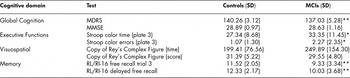
Table 1 shows the mean scores on the cognitive measures for controls and MCIs. To reduce the number of variables, control for type 1 errors, increase signal-to-noise ratio, and to control for trade-off effects in certain tests (e.g., making fewer errors but taking more time), neuropsychological tests were grouped into four composite scores to reflect different cognitive domains: a composite score for the memory cognitive domain, a composite score for the executive domain, a composite score for the visuospatial domain, and an overall score of severity. First, the neuropsychological tasks were placed on the same scale by calculating individual Z-scores using the mean and SD of the control group as a reference. The memory composite score was obtained using the average Z-scores on RL/RI-16 free recall Trial 3, and RL/RI-16 delayed free recall. The executive composite score was obtained using the average Z-scores on the time and the error score of the Stroop-Victoria (to keep higher Z-scores as indicating higher performance, Z-scores for time and for the number of errors were transformed into negative Z-scores). The visuospatial composite score was obtained using the average Z-scores on the time and the score of the copy of Rey’s complex figure (to keep higher Z-scores as indicating higher performance, Z-scores for time were transformed into negative Z-scores). The global cognition composite score was obtained using the average Z-scores on the MMSE and MDRS. The results obtained on the composite scores by patients with MCI are –0.61 for Global Cognition, –0.51 for Visuospatial, –0.81 for Executive, and –1.07 for Memory (by definition, the average Z-score of control participants is 0).
Mean scores on the cognitive measures for controls and persons with MCI

Note
* p < 0.05. ** p < 0.01.
One-way analyses of covariance (ANCOVAs) with Group (MCI, Control) as a between-subject factor and gender as a covariate were performed on the composite scores: Global Cognition, Visuospatial, Executive, and Memory. As expected, individuals with MCI were impaired relative to controls on all composite scores. A lower level of performance was found in persons with MCI relative to controls on the Global Cognition, F(1,54) = 3.99, p = 0.05; Visuospatial, F(1,54) = 4.00, p = 0.05; Executive, F(1,54) = 8.42, p < 0.01; and Memory, F(1,54) = 5.57, p < 0.05, composite scores.
Psychological Health
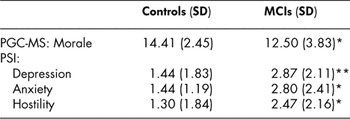
A one–way Multiple Analysis of Covariance (MANCOVA) with Group (MCI, Control) as a between-subject factor and gender as a covariate was used to compare groups on the psychological health measures. MANOVA is used in designs that have multiple dependent measures likely to be correlated as is the case here. It forms a new dependent variable that is a linear combination of the measured dependent variables. It is a conservative test that reduces the likelihood of type 1 error (Tabachnick & Fidell, Reference Tabachnick and Fidell2007). In case of a significant group difference with MANOVA, analyses of the location of the difference can be done by performing ANOVAs on the individual sections. A main Group effect for the MANCOVA was found: Λ = 0.69, F(10,45) = 2.06, p < 0.05. A main Group effect was found for the following psychological health measures: PGC-MS (morale), F(1,54) = 6.80, p < 0.05; depression, F(1,54) = 8.66, p < 0.01; anxiety, F(1,54) = 8.14, p < 0.01; and hostility, F(1,54) = 6.18, p < 0.05. These results indicate that MCI patients have lower morale and greater depression, anxiety, and hostility than healthy controls (see Table 2).
Level of psychological health among controls and persons with MCI
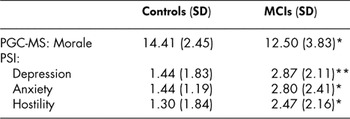
Note
* p < 0.05. ** p < 0.01.
Personality Traits
Five one-way ANCOVAs with Group (MCI, Control) as a between-subject factor and gender as a covariate were used to assess group differences on the neuroticism, extraversion, self-efficacy, self-reference, and openness-to-experience scores. No significant group differences were found—F(1,54) = 2.10, N.S., F(1,54) = 1.75, N.S., F(1,54) = 0.36, N.S, F(1,54) = 0.08, N.S, F(1,54) = 0.33, N.S—for neuroticism, extraversion, self-efficacy, self-reference, and openness to experience, respectively. In addition, the mean score of each of these scales was within the range of normative values for both groups. To control for type 1 errors, only the two personality traits that have been mostly used in the literature (i.e., neuroticism and extraversion) were kept for measures of association.
Associations between Cognition, Psychological Health, and Personality
Partial correlations (controlling for gender) were calculated between psychological health variables and the neuropsychological composite scores. In MCI persons, significant associations were found between their morale score and their Executive composite score, r = 0.37, p < 0.05, and between their depression score and their Global Cognition composite score, r = –0.37, p < 0.05. No association between psychological health and cognitive functions was found in healthy controls (see Table 3).
Correlations between composite scores and psychological health for controls and persons with MCI

Note
* p < 0.05.
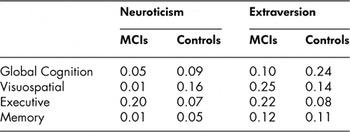
Pearson’s partial correlations (controlling for gender) assessed the relation between the two Eysenck personality traits that were measured and the neuropsychological composite scores. As shown in Table 4, the level of neuroticism and of extraversion was not significantly associated with any of our cognitive measures in persons with MCI or in healthy controls.
Correlations between composite scores and personality traits for controls and persons with MCI

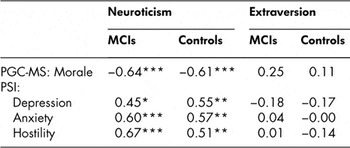
Finally, the relation between personality and psychological health was assessed by performing partial correlations (controlling for gender) between the two personality traits and the psychological health measures. As shown in Table 5, only neuroticism was associated with the psychological health measures with morale being negatively correlated with neuroticism, and depression, anxiety, and hostility being positively correlated with neuroticism. The association was found to be identical in both groups.
Correlations between personality traits and psychological health for controls and persons with MCI

Note
* p < 0.05. ** p < 0.01. *** p < 0.001.
Findings
The goal of this study was to shed light on the psychosocial profile of older persons with MCI by assessing personality traits and psychological health. We also measured the associations between personality, cognitive functions, and psychological health to verify if personality was related to psychological health in a similar way in MCI as it is in healthy older adults and to assess if personality alterations and psychological disturbances are related to cognitive deficits in MCI.
Participants with MCI exhibited significantly more mood disturbances (depression, anxiety, and hostility) and lower morale than matched healthy older adults. This study is consistent with previous findings indicating reduced psychological health in MCI (Gabryelewicz et al., Reference Gabryelewicz, Styczynska, Pfeffer, Wasiak, Barczak and Luczywek2004; Hwang et al., Reference Hwang, Masterman, Ortiz, Fairbanks and Cummings2004; Kumar et al., Reference Kumar, Parslow, Jorm, Rosenman, Maller and Meslin2006; Li et al., Reference Li, Meyer and Thornby2001; Lopez et al., Reference Lopez, Becker and Sweet2005; Lyketsos et al., Reference Lyketsos, Lopez, Jones, Fitzpatrick, Breitner and DeKosky2002). It is worth noting that the aforementioned studies have typically relied on the Neuropsychiatric Inventory (e.g., Hwang et al., Reference Hwang, Masterman, Ortiz, Fairbanks and Cummings2004; Lyketsos et al., Reference Lyketsos, Lopez, Jones, Fitzpatrick, Breitner and DeKosky2002) to assess psychological health. Using different scales, our study provides validity to the assertion that there is reduced psychological health in MCI relative to healthy older adults in spite of the fact that physical health and social functioning were equivalent across both groups. Thus, our findings cannot be related to withdrawal in persons with MCI or reduced interactions with their social or physical environment (i.e., people, experiences).
One of our main findings is that older persons with MCI do not show different personality traits than matched older persons without cognitive deficit. Indeed, no difference in neuroticism, extraversion, self-efficacy, and self-actualization (self-reference and openness to experiences) was found between participants with MCI and a group of healthy older controls matched on socio-demographic factors and recruited from a similar sociocultural background. Thus, contrary to AD (Aitken et al., Reference Aitken, Simpson and Burns1999; Jacomb & Jorm, Reference Jacomb and Jorm1996; Petry et al., Reference Petry, Cummings, Hill and Shapira1989; Strauss & Pasupathi, Reference Strauss and Pasupathi1994), MCI is not associated with marked personality changes or disturbances. This is consistent with the absence of prefrontal anomalies in persons with MCI. This finding implies that older persons who seek consultation for their memory problems and experience mild cognitive decline may not be markedly different in terms of their personality than older adults without cognitive deficits. This is important because one might have predicted that people with a high level of neuroticism may be more likely to consult and/or experience cognitive deficits. The findings of the present study do not support this notion and are consistent with previous research indicating that neuroticism is not associated with either current cognitive performance or cognitive decline over a period of 3 years (Jelicic et al., Reference Jelicic, Bosma, Ponds, Van Boxtel, Houx and Jolles2003).
One other important finding in MCI was the presence of a negative correlation between their Global Cognition composite score and their depression score and the converging positive correlation between their Executive functions composite score and their morale score. Two other studies have shown that the level of depression in MCI is intermediate to healthy older participants and participants with dementia (Li et al., Reference Li, Meyer and Thornby2001; Lyketsos et al., Reference Lyketsos, Lopez, Jones, Fitzpatrick, Breitner and DeKosky2002), a notion confirmed by the results of this study, suggesting that an increase in cognitive impairment is associated with an increase in depressive symptoms.
No association between personality traits and cognitive performance was found for persons with MCI and healthy older adults. Our results indicating that neuroticism and extraversion are not associated with cognitive performance in older adults are compatible with those of Booth et al. (Reference Booth, Schinka, Brown, Mortimer and Borenstein2006) and Jelicic et al. (Reference Jelicic, Bosma, Ponds, Van Boxtel, Houx and Jolles2003). The current study extends this finding to older individuals with MCI. Lack of an association between personality traits and cognition in MCI is also consistent with our finding that MCI individuals do not experience personality disturbances.
When measuring the associations between personality and psychological health, we found that higher neuroticism was related to increased psychological distress and that this was the case in both individuals with MCI and healthy older adults. Thus, although psychological distress is associated with neuroticism in MCI, this relationship is not specific to MCI. Extraversion was not associated with any psychological health variable, and again, this was found in both groups. Overall, our results indicate that the association between personality and psychological health in healthy controls is not modified in MCI persons. Again, this is consistent with our finding that personality is not disturbed in these individuals.
Study Limitations
The size of our sample (27 healthy older adults and 30 MCI individuals) was relatively small, and statistical power may be an issue. However, we do not believe that our results were severely hindered by lack of power because the negative results that we reported were far from significant in the majority of cases. Results that were significant were characterized by medium to large effect sizes according to Cohen’s standard (Cohen, Reference Cohen1988), with seven of our correlations reaching an r value above 0.50 (r 2 = 0.25; large effect size) and five reaching an r value between 0.30 (r 2 = 0.09) and 0.50 (r 2 = 0.25; medium effect size). By contrast, although we have attempted to reduce the likelihood of type 1 error by using composite scores for cognitive measures, the number of comparisons remain relatively high and could have inflated the risk of type 1 error. However, it is worth noting that the effects we found are consistent with the findings expected on the basis of our initial hypotheses and the results of previous work on older adults. The fact that we recruited our participants with MCI exclusively from memory clinics may be seen as a limitation, as the results cannot be generalized to the general population of cognitively impaired older adults. However, our recruitment strategy bears the advantage that the data are more representative of the population that clinicians from memory clinics will encounter in their daily practice. A third limitation is the use of the Eysenck Personality Inventory to assess personality instead of an instrument that could have measured a larger number of personality traits (such as the Revised NEO Personality Inventory). Thus, future research should be aimed at using more extensive personality tools in the study of personality and MCI.
Another limitation is that the design of this study is cross-sectional and not longitudinal. It is therefore impossible to be certain that all MCI will convert to AD and that we did not include individuals with simply poor cognitive functioning rather than with a cognitive decline. We stress, however, that this limitation should not preclude studying this particular population because in day-to-day practice, clinicians do not know in advance whether their patient will be among those who will or will not evolve to AD. Also, the fact that we used a cognitive complaint measure may decrease the probability of including individuals with no cognitive decline as cognitive complaints usually comes as a result of patients’ noticing a change of cognitive abilities relative to their previous state. Nevertheless, these results need to be replicated in a longitudinal study that will follow MCI until their progression to AD. Finally, it is important to note that correlations do not imply causal links, and hence, our results must be interpreted with caution.
Conclusion
In summary, the goal of the current study was to establish the psychological profile of individuals with MCI and to compare it to that of healthy older adults. We found that MCI individuals do not show personality disturbances, in contrast with what has been reported in persons with AD. Contrary to personality traits, persons with MCI report a significant amount of psychological distress and the magnitude of their depressive symptoms is positively correlated with the severity of their cognitive dysfunction.
The present data have important implications at the clinical level. First, these results indicate that older adults facing cognitive deficits, even if relatively minor, are likely to experience a significant level of psychological discomfort that needs to be acknowledged and properly addressed by clinicians. Second, our findings indicate that the psychological distress experienced by persons with MCI is not merely due to the fact that they belong to a particular type of personality trait like neuroticism. Finally, the importance of the psychological distress reported here by individuals with MCI stresses the relevance of designing interventions, whether pharmacological or non-pharmacological that would target these symptoms. Because of the relation between cognitive symptoms and psychological distress, interventions that would address both cognitive impairments and psychological distress in a multifactorial manner, are likely to have a synergistic effect in persons with MCI. This could potentially be done by combining psychotherapy and/or pharmacological medication to cognitive training (Belleville, Reference Belleville2008).