

The correlation of agriculture and civilization is deeply engrained in Western culture, even more so by the seminal twentieth-century writings of V. Gordon Childe (e.g., Reference Childe1936) that promote the connection as part of the Neolithic revolution. It is not surprising, then, that as leading North American prehistorians began to craft the culture history of the eastern Woodlands, they posited the Hopewell and Mississippian cultural florescences were linked to maize (e.g., Griffin Reference Griffin1960, Reference Griffin1967). Since that time, many researchers have demonstrated that there is a frequent disconnect between agriculture and complexity, particularly in the eastern Woodlands (e.g., Alt Reference Alt2010; Price Reference Price, Jeske and Charles2003; Price and Brown Reference Price and Brown1985; Van der Leeuw Reference Van der Leeuw1981). In their recent reevaluation of the impact of maize agriculture in the northeastern United States, Hart and Lovis (Reference Hart and Lovis2013) concluded that despite its suspected millennial-long history, the introduction of maize did not generate significant cultural transformations.
Our current understanding of the history of maize use in the eastern Woodlands is long-standing and extensively documented by the pioneering efforts of many investigators. This research and the patterns observed have been thoroughly discussed in the literature (e.g., Bird et al. Reference Bird, Wilson, Gilhooly, Steinman and Stamps2017:Table S3; Chilton Reference Chilton, Staller, Tykott and Benz2006; Crawford et al. Reference Crawford, Saunders, Smith, Staller, Tykot and Benz2006; Fritz Reference Fritz and Smith2011:504–506, Reference Fritz2019; Greenlee Reference Greenlee, Staller, Tykott and Benz2006; Hart and Lovis Reference Hart and Lovis2013; Katzenberg Reference Katzenberg, Staller, Tykot and Benz2006; Lusteck Reference Lusteck, Staller, Tykot and Benz2006; Reber Reference Reber, Staller, Tykot and Benz2006; Simon Reference Simon, Raviele and Lovis2014:98–104, Table 1; Simon and Parker Reference Simon and Parker2006) and are briefly summarized here. One perspective contends that maize may have appeared in the eastern United States first in Early to Middle Woodland times but played a minimal role in the dietary practices of the inhabitants. Furthermore, there is a widespread recognition and consensus that maize only became an important dietary component after AD 800–1000. The dramatic increase in the importance of maize is supported by the high density of maize fragments in post-AD 1000 archaeological sites and by the dietary isotope record. This marked increase in maize in native diets at AD 1000 ± 100 is so consistent that it forms a virtual horizon marker for this domesticate across the eastern United States. However, it is also recognized that there are important regional variations in the histories of maize's introduction, utilization, and dietary importance.
The place of maize in west-central Illinois has been subject to extensive and intensive investigations and publication since the 1970s by such pioneering archaeobotanists as Nancy Asch, David Asch, Gayle Fritz, Sissel Johannessen, Neil Lopinot, Katherine Parker, and Mary Simon. The first systematic research on the archaeobotany of the American Bottom began in the 1970s investigations of the FAI-270 Project (Johannessen Reference Johannessen, Bareis and Porter1984). Johannessen demonstrated the presence of the Early Agricultural Complex (EAC) during Middle and Late Woodland times and proposed that maize first appeared in substantial amounts only after circa AD 800 (Johannessen Reference Johannessen, Bareis and Porter1984:201–203). FAI-270 researchers believed the appearance of maize was such a critical turning point in regional culture history that they used it to demark the beginning of an Emergent Mississippian period (Bareis and Porter Reference Bareis and Porter1984; Kelly Reference Kelly and Woods1992; Kelly et al. Reference Kelly, Ozuk, Jackson, McElrath, Finney, Esarey, Bareis and Porter1984; now referenced as the Terminal Late Woodland period [Fortier et al. Reference Fortier, Emerson and McElrath2006]). This scenario was challenged when Riley and colleagues (Reference Riley, Walz, Bareis, Fortier and Parker1994) dated apparent maize cupules collected from the American Bottom to early Middle Woodland times. Thus, the most recent regional archaeobotanical summary by Simon and Parker (Reference Simon and Parker2006) postulated a low level of maize and EAC agriculture for Middle and Late Woodland groups. Our understanding of regional maize history shifted again when Simon (Reference Simon, Raviele and Lovis2014, Reference Simon2017) determined that maize could not be reliably identified prior to AD 900. Our research builds on this work and seeks to identify and better understand the role of maize in the context of Cahokia and the American Bottom. This is now possible because of the ongoing acquisition of archaeobotanical and dietary isotope information. We also reexamine the correlation of maize's history with local social, political, and religious transformations.
Previously, we held the view that early maize was minimally connected with the abrupt emergence of social and political complexity in the American Bottom circa AD 1050. Now, given the considerable accumulation of macrobotanical, stable carbon isotope, and archaeological evidence reported here, the relationship between maize and social transformation at Cahokia needs to be reconsidered. The new data confirms that maize initially appeared at Cahokia circa AD 900 and correlated with a subsequent two-centuries-long period of sea changes in dietary preferences and food processing (including maize nixtamalization), the appearance of a new array of vessel forms, the presence of dynamic and fluctuating population nucleation and density fueled by immigration, and the construction of religious and political monuments. Ultimately, these transitions form the foundation for Greater Cahokia, the largest and most complex native polity in North America (e.g., Emerson Reference Emerson1997, Reference Emerson, Emerson, Koldehoff and Brennan2018; Milner Reference Milner1990, Reference Milner1998; Pauketat Reference Pauketat2004, Reference Pauketat2007, Reference Pauketat2009, Reference Pauketat, Emerson, Koldehoff and Brennan2018; Pauketat et al. Reference Pauketat, Alt, Krutchen and Yoffee2015).
Evaluating Maize Macrobotanical Evidence
Maize at Greater Cahokia
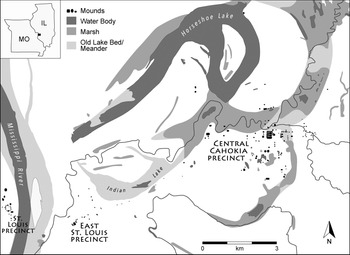
Greater Cahokia (AD 1050–1350) was located near East St. Louis, Illinois, in the Mississippi River floodplain of western Illinois, an area referred to as the America Bottom. The central core area and towns making up Greater Cahokia extended over 14.5 km2 and encompassed a regional population of at least 40,000 people, an estimated 20,000 or more of whom lived in and around the three contemporaneous civic-ceremonial precincts of Cahokia, St. Louis, and East St. Louis (Figure 1; Brennan et al. Reference Brennan, Betzenhauser, Landsdell, Plocher, Potter, Blodgett, Emerson, Koldehoff and Brennan2018; Emerson Reference Emerson, Emerson, Koldehoff and Brennan2018; Milner Reference Milner1998; Pauketat Reference Pauketat2004; Pauketat and Lopinot Reference Pauketat, Lopinot, Pauketat and Emerson1997; Pauketat et al. Reference Pauketat, Emerson, Alt, Emerson, Koldehoff and Brennan2018). Provisioning this vast number of people presented a challenge. Extensive archaeobotanical evidence exists among American Bottom Middle and Late Woodland sites that the residents farmed the species usually grouped within the EAC (Johannessen Reference Johannessen, Bareis and Porter1984; Simon and Parker Reference Simon and Parker2006: 219–228; see also Fritz Reference Fritz2019). During the Terminal Late Woodland (AD 900–1050) the EAC starchy and oily seeds were combined with maize crops to form “a relatively equal or balanced agricultural strategy” (Simon and Parker Reference Simon and Parker2006:228; see also Johannessen Reference Johannessen, Bareis and Porter1984). The Mississippian era archaeobotanical record makes clear that maize (Zea mays L.) increasingly contributed a significant portion of the food base with its ubiquity in archaeological features often reaching 100% (e.g., Fritz Reference Fritz2019; Hedman et al. Reference Albert, Kooiman, Clark and Lovis2002; Johannessen Reference Johannessen, Bareis and Porter1984; Lopinot Reference Lopinot, Pauketat and Emerson1997; Simon and Parker Reference Simon and Parker2006).
Greater Cahokia showing Cahokia, East St. Louis, and St. Louis Precincts (adapted from Emerson Reference Emerson, Emerson, Koldehoff and Brennan2018:Figure 14.1).

Our research provides isotopic confirmation for the specific timing and intensity of maize consumption at Cahokia, adding dietary isotope information derived from the skeletal remains of people and domestic dogs to the available macrobotanical evidence. Additionally, we present the evidence for population, settlement, iconographic, and foodway changes that corroborate the first appearance and rapid adoption of maize after about AD 900 in the American Bottom.
We have amassed extensive macrobotanical data from well over 125 American Bottom regional sites (Simon Reference Simon, Raviele and Lovis2014; Simon and Parker Reference Simon and Parker2006). Our previous interpretations of maize usage posited a Middle Woodland introduction as early as about 200 BC with a gradual increase in dependence through time, culminating in heavy maize reliance after AD 1050 (e.g., Riley et al. Reference Riley, Walz, Bareis, Fortier and Parker1994; Simon Reference Simon, Emerson, McElrath and Fortier2000; Simon and Parker Reference Simon and Parker2006). The key to establishing the 200 BC date for maize was the Middle Woodland Holding site (Riley et al. Reference Riley, Walz, Bareis, Fortier and Parker1994). However, reanalysis by Simon (Reference Simon2017) revealed an elevated δ13C signature of the two dated samples, invalidating their original identification as maize and eliminating the only Middle Woodland (150 BC–AD 300) evidence for maize in the American Bottom.Footnote 1
Simon (Reference Simon, Raviele and Lovis2014) then reexamined the evidence for Initial Late Woodland (AD 400–650) and Late Woodland (AD 650–900) maize, spurred on by the observation that extensive American Bottom Late Woodland archaeobotanical assemblages failed to produce maize unless that site also had a post-AD 900 Terminal Late Woodland (AD 900–1050) or Mississippian (AD 1050–1350) component. After examining flotation records from over 97,000 liters of cultural fill collected from more than 4,500 features at 110 sites (Simon Reference Simon, Raviele and Lovis2014:Tables 4 and 5), she concluded that maize in Late Woodland contexts was invariably a contaminant from later maize-growing inhabitants. To validate this, Simon (Reference Simon, Raviele and Lovis2014) obtained carbon isotope ratios from suspected Late Woodland maize samples to verify visual identifications and then directly dated the confirmed maize samples. The results of these analyses failed to identify pre-AD 900 macrobotanical evidence of maize in the American Bottom.Footnote 2
Maize Pathways into the Eastern Woodlands
The specific history of maize's Eastern Woodland introduction, adoption, and proliferation is unclear but likely involved the movement of maize out of the Southwest into the eastern United States (see Fritz [Reference Fritz and Smith2011:505–506] for a discussion of the various models). Ongoing archaeological, anatomical, molecular, and linguistic studies show that maize was introduced into the southwestern United States from the central Mexican uplands some 4,000 years ago. By AD 100, it was an established economic resource across that subcontinental area, extending northward to the Colorado Plateau (e.g., Adams Reference Adams, Johannessen and Hastorf1994; Hill Reference Hill, Staller, Tykot and Benz2010; Huckell Reference Huckell, Staller, Tykott and Benz2006). East of the Mississippi River, the oldest reported macrobotanical maize occurrences are from Middle Woodland contexts (ca. AD 100) at the Icehouse Bottom (Tennessee) and Edwin Harness (Ohio) sites (Chapman and Crites Reference Chapman and Crites1987) and (ca. AD 500) in Ontario (Crawford et al. Reference Crawford, Smith and Bowyer1997).Footnote 3 However, the first significant consumption of maize in Illinois (and most of the eastern Woodlands) dates to post-AD 900 (for example, see Bird et al. Reference Bird, Wilson, Gilhooly, Steinman and Stamps2017:Table S3).
Most macrobotanical records from the Midwest and Great Plains are temporally in accordance with those from the American Bottom. To the west in the Missouri River drainage, Wright and Shaffer (Reference Wright, Shaffer, Raviele and Lovis2014:Table 1) report macrobotanical samples of maize from associated deposits dating between AD 650 and AD 900, while Adair and Drass (Reference Adair, Drass and Smith2011:325) confirm that farther west in the central plains, the earliest radiocarbon dated macrobotanical remains of maize are dated to about AD 800. Caddoan human dietary isotopes showing high maize dependence postdate AD 1000 (Perttula Reference Perttula2008; Wilson and Perttula Reference Wilson and Perttula2013). These data suggest that the timing of maize dependence in the region drained by the central Mississippi River is relatively consistent.
The history of maize in the eastern Woodlands has recently taken an interesting turn under the research agenda forwarded by John Hart, William Lovis, and others employing microbotanical evidence to identify maize phytoliths and starch grains, especially in the charred cooking residues on early pottery (Hart and Lovis Reference Albert, Kooiman, Clark and Lovis2007, Reference Hart and Lovis2013:188–191, Reference Hart and Lovis2014; Hart et al. Reference Hart, Lovis, Jeske and Richards2012). Based on microbotanical identification and AMS dates of cooking residues, researchers have pushed the earliest evidence for maize back to as early as 300 BC in New York and Ontario and to 200 BC in Michigan (e.g., Albert et al. Reference Albert, Kooiman, Clark and Lovis2018; Hart and Lovis Reference Hart and Lovis2013; Hart et al. Reference Hart, Lovis, Jeske and Richards2012). However, Chilton (Reference Chilton, Staller, Tykott and Benz2006:Tables 39-1 and 39-2) found Northeastern macrobotanical evidence of maize usually dates circa AD 1000 or later, and Lusteck (Reference Lusteck, Staller, Tykot and Benz2006:524) reports that in the interior south-central region of the eastern Woodlands, the oldest remains date circa AD 1000, well within the time frame outlined here.
The reason for the disconnect between the early northeastern and upper Great Lakes microbotanical and later Eastern Woodland macrobotanical records of maize remains an enigma. The presence of early northeastern maize becomes more perplexing when one considers that phylogenetic analysis of eastern maize landraces, including those most commonly cultivated in the northeast at the time of contact, demonstrate that the later were derived from southwestern landraces (Matsuoka et al. Reference Matsuoka, Vigouroux, Goodman, Sanchez, Buckler and Doebley2002; Vigouroux Reference Vigouroux, Glaubitz, Matsuoka, Goodman, Sánchez and Doebley2008:Figure 4). How could maize arrive in the Northeast from the Southwest at such an early date yet leave behind no traces of its passage? Future research is required targeting pre-AD 900 maize and dietary isotopes in the eastern United States to shed light on the apparent variation in chronology and pathways of early maize into the region.
Evaluating the Greater Cahokia Dietary Isotope Evidence
The most direct evidence for the presence of maize in the native subsistence systems are the dietary isotopes of the people themselves. Stable isotope analysis of bone collagen and bone or enamel apatite is a well-established technique for dietary reconstruction, particularly for studies of maize consumption (Supplemental Text 1).
Isotopic Analyses of Diet: Carbon, Nitrogen, and Oxygen Isotopes in the Environment
Carbon is incorporated into plants via two major photosynthetic pathways, C3 or C4, with a third (less common) pathway, Crassulacean acid metabolism (CAM), occurring primarily in plants (e.g., succulents) grown in areas with high aridity and heat (Supplemental Text 2). These three pathways differ in their processes of carbon uptake, thereby producing differences in the δ13C values of the plant's tissues. These differences in the 13C/12C are maintained in consumer tissues and can be measured and expressed as isotopic ratios normalized to an international standard scale in delta (δ) notation (VPDB for organic carbon and carbonate δ13C, ratio of atmospheric N2 15N/14N isotopes for δ15N, and VPDB and/or VSMOW for δ18O) in parts per thousand (‰). Delta (δ) is calculated as follows: (R sample / R standard) – 1 × 1000.
Since carbon isotope values of plants and animals are recorded in consumer tissue (e.g., bone and teeth), they can be used to estimate the contribution of C3 and C4 resources to the diet. In the northeastern United States, most native plants (and the animals that consumed them) have a C3 isotopic signature. While a few C4 plants (e.g., amaranths and some members of the Chenopodiaceae family, although not the genus Chenopodium sp. [see Jacobs Reference Jacobs2001] and some aquatic plants [see Chappuis et al. Reference Chappuis, Seriñá, Martí, Ballesteros and Gacia2017]) and the animals that consumed them (dogs, some waterfowl, and freshwater fish) contributed to the diet of midwestern populations, maize represents the only C4 plant resource thought to have contributed in significant quantities to the diet and isotopic signature of late prehistoric inhabitants of this region. Few CAM plants are associated with the study region, and their contribution to the isotopic signature of populations remains largely unexplored (see discussion in Tankersley et al. Reference Tankersley, Clover and Lentz2016).Footnote 4
The δ13C values of C3 plants range between −22‰ and −38‰ with an average of −26.5‰ (Ambrose Reference Ambrose and Sandford1993); δ13C values of C4 plants range between −8‰ and −14‰ with an average of −2.5‰ (Blake Reference Blake, Staller, Tykot and Benz2006:66); and those of CAM plants range between −10‰ and −20‰, depending on growing conditions, and overlapping with δ13C values of both C3 and C4 plants (O'Leary Reference O'Leary1988; Tankersley et al. Reference Tankersley, Clover and Lentz2016). Individuals consuming a predominantly C3-based plant-and-animal diet have collagen δ13C values between −21‰ and −18‰ and apatite carbonate δ13C values between −16‰ and −14‰. In comparison, individuals consuming a diet high in C4 plants (e.g., maize) have collagen δ13C values between −13‰ and −8‰, and apatite δ13C values that range between approximately −8‰ and −2‰. Individuals consuming a mixed diet of C3 and C4 resources will have intermediate collagen and apatite δ13C values. These ranges are based on calculations of the estimated percent C4 dietary contributions reflected in collagen and apatite (based on Ambrose et al. Reference Ambrose, Buikstra and Krueger2003; see Supplemental Table 1).
Ambrose and Norr (Reference Ambrose, Norr, Lambert and Grupe1993) found that the difference between δ13C values of the diet and bone carbonate of the consumer was always 9.4‰. The difference between δ13C values of the diet and bone collagen, was about 5‰ when δ13C of dietary protein and nonprotein were the same (e.g., C3 plants and animals that consumed C3 plants). The spacing between bone carbonate and bone collagen δ13C values (Δ13CCA-CO) will vary from 4.4‰ of a monoisotopic diet (9.4‰ – 5‰ = 4.4‰) depending on whether the dietary protein is isotopically lighter or heavier than that of whole diet (Ambrose et al. Reference Ambrose, Butler, Hanson, Hunter-Anderson and Krueger1997; Harrison and Katzenberg Reference Katzenberg, Staller, Tykot and Benz2006). In a diet where the protein is less enriched in the heavier isotope than that of a whole diet (e.g., a diet of C4 carbohydrates like maize and C3 animals), the Δ13CCA-CO is greater than 4.4‰. The Δ13CCA-CO will be less than 4.4‰ when dietary protein is more enriched in the heavier isotope than that of whole diet (e.g., marine protein and C3 plants). While experimental diets can produce Δ13CCA-CO greater than 10‰ (see examples in Ambrose and Norr Reference Ambrose, Norr, Lambert and Grupe1993), in those cases where C4-energy/carbohydrates accounted for about 75% of the digestible carbon, the collagen δ13C was also enriched.
In our study area, where maize is considered the most likely and most significant source of C4 enrichment in the diet, when collagen δ13C suggests a C3 diet but bone carbonate suggests maize or other C4 resources may have been a significant component to whole diet, diagenesis of bone mineral must be considered, as must possible nonmaize sources for C4 enrichment (see Supplemental Text 2). Bone collagen (the organic component of bone) δ13C disproportionately reflects the isotopic composition of the protein components of the diet, while bone and enamel apatite carbonate δ13C reflect that of the whole diet, including carbohydrates, fats, and proteins (Ambrose Reference Ambrose and Sandford1993; Ambrose and Norr Reference Ambrose, Norr, Lambert and Grupe1993; DeNiro and Epstein Reference DeNiro and Epstein1978; Tieszen and Fagre Reference Tieszen, Fagre, Lambert and Grupe1993). Because maize contains little protein, very low levels of maize in the diet may not be apparent in the collagen isotope ratios; however, they will be reflected in carbonate δ13C values (Harrison and Katzenberg Reference Harrison and Katzenberg2003). It should be cautioned that bone is much more susceptible to the processes of diagenesis than tooth enamel (Lee-Thorp Reference Lee-Thorp2002; Lee-Thorp and Van der Merwe Reference Lee-Thorp and van der Merwe1987, Reference Lee-Thorp and van der Merwe1991; Schoeninger and DeNiro Reference Schoeninger and DeNiro1982); thus, enamel is the more reliable material for paleodietary analysis of whole diet carbon.
Nitrogen isotopes provide information on the approximate trophic level of the protein consumed by an individual. The δ15N of bone collagen is approximately 3‰–5‰ greater than that of the diet (DeNiro and Epstein Reference DeNiro and Epstein1981; Minagawa and Wada Reference Minagawa and Wada1984). This fractionation effect results in an increase in the δ15N of consumers at each step of the food web. Since most plants have δ15N between 0‰ and 5‰, the nitrogen values of populations relying heavily on plants and terrestrial fauna average about 9‰. Aquatic fauna tend to have larger and more complex food webs leading to higher δ15N values in consumers.
Materials and Methods
Bone and Enamel Samples
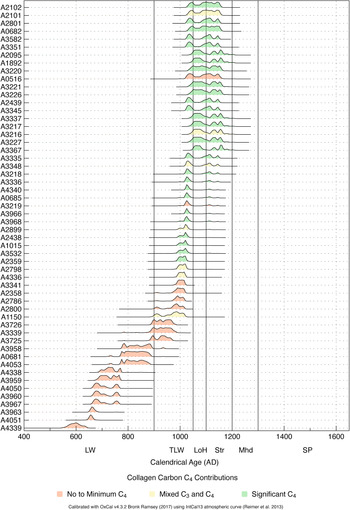
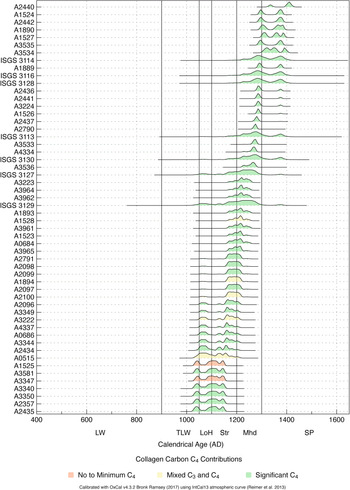
In this study, we consider carbon isotope ratios and AMS dates obtained from skeletal material representing 108 individuals and 19 regional mortuary locations within western Illinois and the Greater Cahokia locality (Figures 2a and 2b; Supplemental Tables 1 and 2; Reimer et al. Reference Reimer, Bard, Bayliss, Beck, Glackwell, Ramsey, Buck, Cheng, Edwards, Friedrich, Grootes, Guilderson, Haflidason, Hajdas, Hatté, Heaton, Hoffman, Hogg, Hughen, Kaiser, Kromer, Manning and Niu2013). Also included are isotope data and AMS dates for 15 dogs from the multicomponent Janey B. Goode and Late Woodland Cunningham sites (Supplemental Tables 5 and 6; Galloy Reference Galloy2010; Kuehn Reference Kuehn2014; Meinkoth et al. Reference Meinkoth, Hedman and McElrath2001). The dogs provide critical dietary evidence on the levels of δ13C values in the Late Woodland diet, supplementing the limited data for Late Woodland human populations (Emerson et al. Reference Emerson, Hargrave, Hedman, Jeske and Charles2003). There is extensive literature on the use of domestic dogs as proxies in studies of human diet, and—given their proclivity as opportunistic village scavengers—if maize was present, it should be detectable in their isotope values (e.g., Allitt et al. Reference Allitt, Michael Stewart and Messner2008; Burleigh and Brothwell Reference Burleigh and Brothwell1978; Edwards et al. Reference Edwards, Jeske and Coltrain2017; Guiry Reference Guiry2012, Reference Guiry2013). In addition to bone collagen and apatite carbonate, enamel apatite carbonate δ13C data is available for 47 individuals and five dogs. Unlike bone, tooth enamel does not remodel during the life of an individual, thus (for humans) providing information on the isotopic characteristics of the childhood diet, when tooth enamel was forming. Tooth enamel is more resistant to diagenetic alternation than bone and therefore provides a means of evaluating the reliability of bone carbonate isotope results. Only stable carbon isotopes are considered here. Sample preparation, methods for stable isotope analysis, and a discussion of AMS dates and a possible freshwater reservoir effect are presented in Supplemental Text 1.
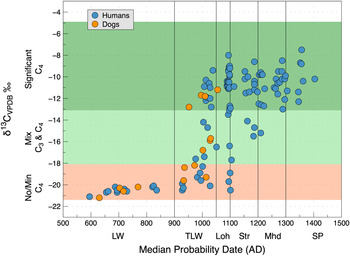
Collagen C4 contributions by calendrical age (cal AD 600–1050). (Color online)

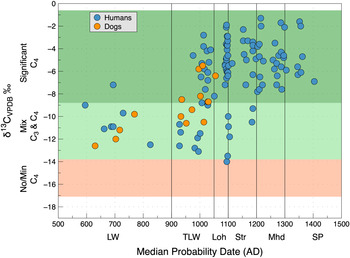
Collagen C4 contributions by calendrical age (cal AD 1050–1400). (Color online)

Human Dietary Isotopes Results
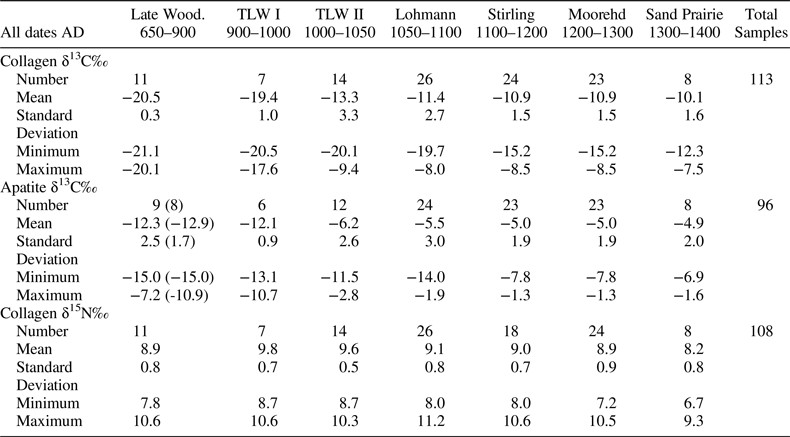
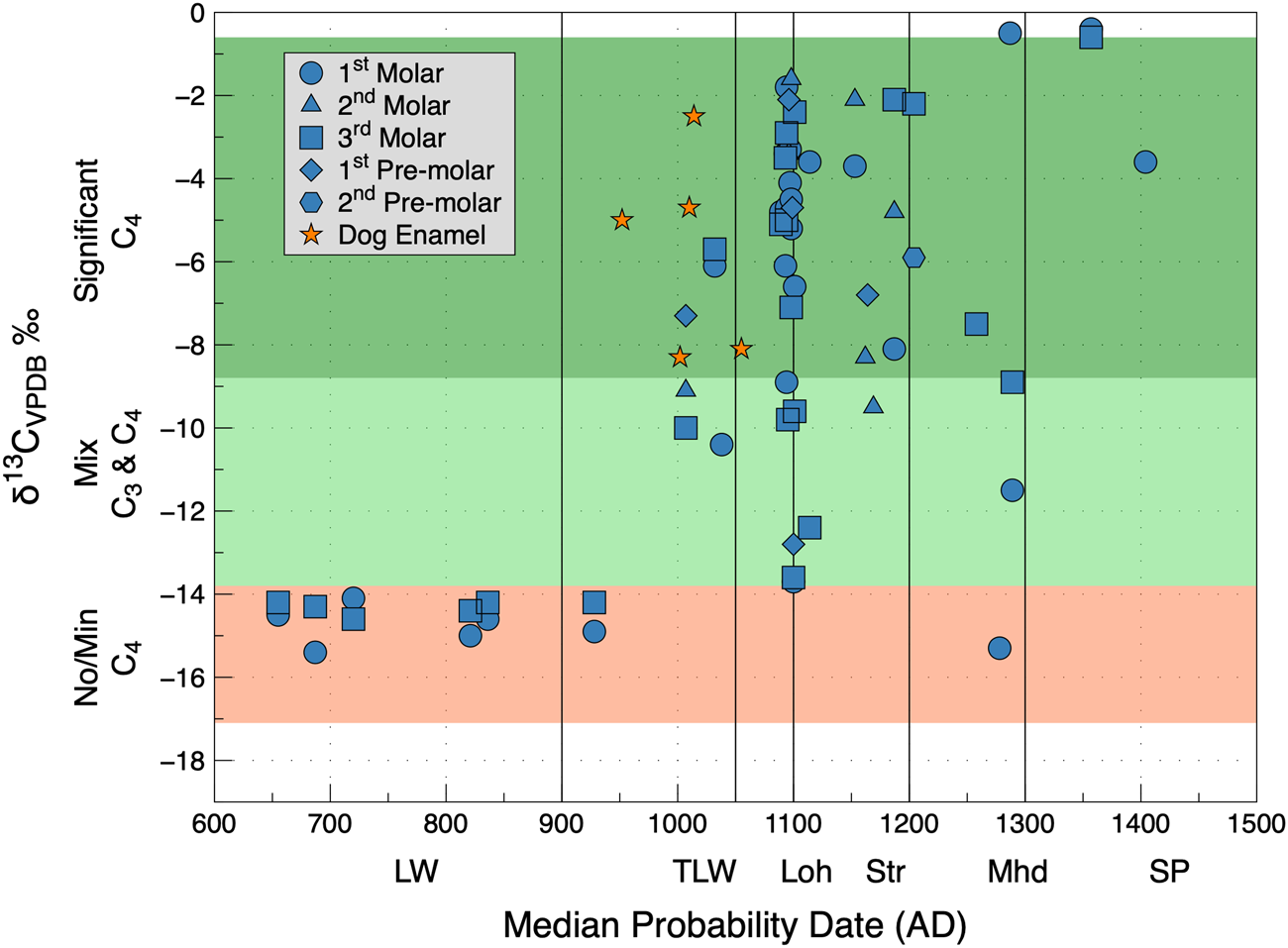
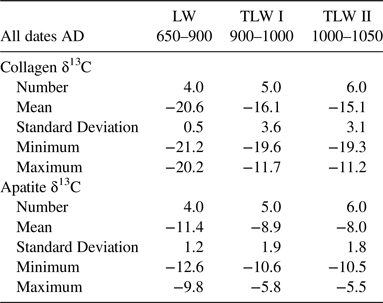
Summary statistics of stable isotope results are presented by temporal component in Table 1. The 11 Late Woodland (LW) individuals dating from the mid-seventh to the early tenth centuries exhibit a mean bone collagen δ13C value of −20.5‰ ± 0.3, while 8 of these individuals had a mean bone apatite carbonate value of −12.9‰ ± 1.7‰. Of the 11 individuals from the Late Woodland period, five had at least one enamel sample analyzed for δ13C (see Table 1). Combining first and third molars δ13C values for these individuals averaged −14.5‰ ± 0.4‰ (n = 11). Bone carbonate δ13C values are divergent from those derived from enamel apatite for these individuals and likely reflect the effects of diagenesis on bone carbonate. These carbonate δ13C results indicate a slight enrichment in C4 during the Late Woodland period directly comparable to carbonate δ13C results for premaize Archaic populations in Illinois (see Fort et al. Reference Fort, Hedman, Ambrose, McElrath and Evans2016; discussed in Supplemental Text 2), consequently, we do not attribute this minor enrichment in δ13C to maize. In comparison, a dramatic spike in consumption of C4 resources (i.e., maize) is indicated in mean bone collagen, apatite carbonate, and enamel carbonate δ13C values for the subsequent later Terminal Late Woodland period (ca. AD 1000–1050: the TLW II period; Table 1; Figures 2a, 2b, 3, 4, and 5).
Summary Statistics of Human Bone Stable Isotope Data for Western Illinois and the American Bottom.

Notes: See Supplemental Data Table 1 for associated stable isotope results and AMS dates. (Without aberrant apatite carbon values.) Apatite δ13C values do not include enamel apatite.
Bone collagen δ13C by median probability date. (Color online)

Bone carbonate δ13C by median probability date. (Color online)

Tooth enamel carbonate δ13C by median probability date. (Color online)

Carbon isotope values show that beginning post-AD 900 and extending through the Lohmann and Stirling phases of the Early Mississippian period, maize consumption varied considerably among individuals living in and around Cahokia (see Figures 2a, 2b, 3, 4, and 5). This pattern also characterizes the transition to extensive maize use, as found in other regional studies (Cook and Price Reference Cook and Price2015; Lynott et al. Reference Lynott, Boutton, Price and Nelson1986; Schurr and Redmond Reference Schurr and Redmond1991; Shuler et al. Reference Shuler, Hodge, Danforth and Cook2012). Some people consumed little to no maize, while others had heavily maize-dependent diets. To some degree, the extreme variation evidenced at Cahokia is likely explained by the immigration of EAC agricultural people from surrounding areas where maize agriculture did not yet have a foothold, as well as by nonagricultural groups, during the Early Mississippian period (Emerson and Hedman Reference Emerson, Hedman and Faulseit2016; Hedman et al. Reference Hedman, Slater, Fort, Emerson and Lambert2018; Slater et al. Reference Slater, Hedman and Emerson2014). By the thirteenth century, maize consumption appears to be consistently high. This pattern, characterized by the sudden appearance and steady increase in the contribution of maize to the human diet, is congruent with the archaeobotanical record for the same period (see Simon and Parker Reference Simon and Parker2006 and above discussions).
Dog Isotopes Results
Carbon isotope values from bone collagen and bone carbonate for domestic dogs provide supplemental support for the pattern established with direct dating of maize and the stable isotope data from the pre-Mississippian human population (see Table 2). The samples of directly dated dogs are from the multicomponent Janey B. Goode site and the Late Woodland Cunningham site. The collagen δ13C results show no evidence for maize consumption by pre-AD 900 Late Woodland dogs (see Table 2 and Figure 3). After AD 900, dogs—like the human population—show evidence of variable maize consumption ranging from virtually none to fairly significant amounts (see Table 2). Although the overall patterns of initial maize consumption in the human population and in dogs in the American Bottom are very similar, carbonate δ13C for these dogs shows slight enrichment in C4 in the diet earlier and at slightly higher levels than for the humans in this study (see Figures 4 and 5).
Summary Statistics of Dog Bone and Enamel Stable Isotope Data for the American Bottom.

Note: See Supplemental Data Tables 5-6 for associated stable isotope results and AMS dates.
Reassessing the Earlier Stable Isotope Regional Record for Maize Consumption
Early stable isotope studies of human skeletal remains from western Illinois, the American Bottom, and southern Wisconsin suggest that maize may have been consumed in this region as early as the Middle Woodland period (~100 BC–AD 300; Bender et al. Reference Bender, Baerreis and Steventon1981; Buikstra and Milner Reference Buikstra and Milner1991; Buikstra et al. Reference Buikstra, Rose, Milner and Green1994; Van der Merwe and Vogel Reference Van der Merwe and Vogel1978). Our studies of skeletal collagen and dental carbonate remains from this region indicate no significant enrichment in δ13C until after AD 900 (e.g., Tables 1–3). A similar pattern has been identified in the central Ohio River valley (Greenlee Reference Greenlee, Staller, Tykott and Benz2006), and several other researchers have stressed this variation in both timing and intensity of maize adoption (Cook and Price Reference Cook and Price2015; Lynott et al. Reference Lynott, Boutton, Price and Nelson1986; Schurr and Redmond Reference Schurr and Redmond1991; Shuler et al. Reference Shuler, Hodge, Danforth and Cook2012; Wilson and Perttula Reference Wilson and Perttula2013).
Late Woodland (~ AD 400–900) burials from southern Ontario have low δ13C collagen ratios (δ13C < −18.0‰) but enriched bone carbonate (δ13C > −13‰) values, interpreted by those researchers to mean that maize made up a small portion of the diet by AD 700 (Harrison and Katzenberg Reference Harrison and Katzenberg2003:230, Table 2; Katzenberg Reference Katzenberg, Staller, Tykot and Benz2006). These values are in accordance with early macrobotanical maize finds from that region (Crawford et al. Reference Crawford, Smith and Bowyer1997). However, the bone carbonate δ13C values reported by Harrison and Katzenberg (Reference Harrison and Katzenberg2003) are comparable to those obtained from premaize Archaic and Middle Woodland populations in Illinois, strongly suggesting that this enrichment may reflect a dietary resource other than maize or diagenetic processes that disproportionately affect the mineral phase of bone over that of collagen (Table 3; Fort et al. Reference Fort, Hedman, Ambrose, McElrath and Evans2016; discussion in Supplemental Text 2, Supplemental Tables 3 and 4, Supplemental Figures 1–3).
Isotope studies focusing on skeletal materials from western Illinois (Rose Reference Rose2008; see also Schober Reference Schober1998) have been cited as evidence for pre-AD 900 Late Woodland maize consumption in that region (Hart Reference Hart, Raviele and Lovis2014). While we do not dispute the validity of the isotope data itself, we think direct dating of the interments to confirm their alleged antiquity—in particular some of the “early Late Woodland” burials from Joe Gay, Knight, and Koster Mounds—is in order (Rose Reference Rose2008:422, Table 3).
Summary of Stable Isotope Results for Illinois Archaic and Middle Woodland Populations.

1 Includes multiple teeth from one individual.
2 Data on file at ISAS.
Temporal associations for these sites are primarily based on a few diagnostic artifacts and burial propinquity (Farnsworth and Wiant Reference Farnsworth and Wiant2006). These sites are known to be complex multicomponent mortuary mounds and cemeteries, which makes the potential for intrusive interments probable. Recent AMS dating of “Mississippian” burials from Schild and Kane Mounds by the authors have yielded several solid Late Woodland dates, confirming the multicomponent nature of these mound and cemetery assemblages and the difficulty of recognizing intrusive burials in these loess settings even by very experienced excavators (e.g., Emerson and Hargrave Reference Emerson and Hargrave2000:7, 10; Supplemental Tables 1 and 2). A series of skeletal dates compiled for the “early” Koster Mounds site range from about AD 700 to 1200 (Schober Reference Schober1998:Table 4.2, recalibrated using Calib 7.1 [Stuiver and Reimer Reference Stuiver and Reimer2016]).
Similarly, significant variation in diet and clear evidence for maize consumption are reported for the “late Late Woodland” Joe Gay, Yokem, and Schild sites (Rose Reference Rose2008:423–424, Table 4). In another study, radiocarbon dates compiled by Schober for Yokem and Schild range from about AD 480 to 1130 (Schober Reference Schober1998:Table 4.3), with the youngest skeletal materials returning the least negative δ13C values. Obviously, the later part of this date range is well within the proposed timing for regional maize consumption. Significantly, for the small number of directly dated regional individuals for whom stable isotope data is available, maize consumption is associated with those whose burials postdate AD 900 (Greenlee Reference Greenlee, Staller, Tykott and Benz2006:219, Table 16.1; Lynott et al. Reference Lynott, Boutton, Price and Nelson1986:54–55, Table 1; Schober Reference Schober1998, Tables 4.2 and 4.3). Clearly, these earlier findings of maize consumption suggesting a pre-AD 900 context need to be reexamined in the absence of direct radiocarbon dates for such individuals.
Correlating the Greater Cahokia Archaeological Evidence for Post-AD 900 Change
The macrobotanical and isotopic evidence gathered in our research and presented above provide a powerful argument that past models that envisioned a long period of pre-AD 900 maize agriculture in the American Bottom should be reconsidered. It is now apparent that maize is not part of pre-AD 900 agriculture that instead concentrated on crops of the EAC (Fritz Reference Fritz2019; Johannessen Reference Johannessen, Bareis and Porter1984; Simon and Parker Reference Simon and Parker2006). We suspect, in fact, that the millennium-long experience of Middle and Late Woodland American Bottom groups associated with such farming practices acted to pre-adapt them to incorporate maize cultivation when it was introduced into the area at AD 900. It is interesting that the 1,000 years of experience with EAC did not produce visible transformation of American Bottom societies. It apparently took the addition of a maize supplement to provide a foundation for change. It seems that this combined EAC-maize agricultural complex provided a stable subsistence base for the subsequent political, religious, and social florescence of Cahokia. In the following sections, we explore the events that correlate with this AD 900 subsistence shift.
Population and Settlement Changes
Simon's (Reference Simon, Raviele and Lovis2014, Reference Simon2017) historical reconstruction of maize use based on macrobotanical evidence and our isotopic evidence correlate well with changes in the archaeological record that exhibits significant shifts in population nucleation and settlement organization at roughly AD 900 (Fortier and Jackson Reference Fortier, Jackson, Emerson, McElrath and Fortier2000; Fortier and McElrath Reference Fortier and McElrath2002; Fortier et al. Reference Fortier, Emerson and McElrath2006; Kelly Reference Kelly, Emerson, McElrath and Fortier2000; McElrath et al. Reference McElrath, Emerson, Fortier, Emerson, McElrath and Fortier2000). The Initial Late Woodland Patrick phase, beginning at about AD 650, is characterized by sites containing dozens of structures and hundreds of storage pits. Patrick phase structure and feature density was initially interpreted as reflecting large-scale population increases, settlement nucleation, incipient sedentism, and increasing social and political complexity generated in part by an increased dependence on maize agriculture (Kelly Reference Kelly, Emerson, McElrath and Fortier2000; Kelly et al. Reference Kelly, Ozuk, Jackson, McElrath, Finney, Esarey, Bareis and Porter1984).
However, based on a review of the extensive Late Woodland archaeological evidence, Koldehoff and Galloy (Reference Koldehoff and Galloy2006:294) proposed that the observed Patrick phase characteristics are the hallmarks of mobile tribal societies engaged in a forest-fallow system of swidden land use. The archaeobotanical and archaeological evidence seems to argue for Patrick- and Sponemann-phase people as premaize Eastern Agricultural Complex agriculturalists who lived in small family groups widely dispersed across the American Bottom floodplain and uplands (Fortier Reference Fortier2015; Fortier and Jackson Reference Fortier, Jackson, Emerson, McElrath and Fortier2000; Fritz Reference Fritz2019; Koldehoff and Galloy Reference Koldehoff and Galloy2006; Simon Reference Simon, Raviele and Lovis2014).What had been interpreted as large villages are increasingly recognized as seasonally occupied focal points on the landscape, representing multiple repeated gatherings by Patrick-phase families.
At the beginning of the Terminal Late Woodland period, or at about AD 900, settlement organization changed. Based on data from 25 communities containing 615 excavated structures and nearly 3,400 pits, we now see clear evidence for sedentary villages ranging in size from small hamlets to those with more than 150 structures (Fortier and McElrath Reference Fortier and McElrath2002). Excavations at the Range site revealed that in the later part of the Terminal Late Woodland period (TLW II, post-AD 975/1000), a large village was organized around courtyards or plazas containing ritual features and/or special elite or ritual structures (Kelly Reference Kelly and Smith1990, Reference Kelly, Emerson, McElrath and Fortier2000). Recent large-scale Illinois State Archaeological Survey (ISAS) investigations at the East St. Louis Precinct revealed a similar shift in village size from a few dozen TLW I houses to several hundred houses during the TLW II period (Brennan et al. Reference Brennan, Betzenhauser, Landsdell, Plocher, Potter, Blodgett, Emerson, Koldehoff and Brennan2018). The change from families of mobile horticulturalists to village farmers was rapid: within several generations of AD 900, settled agricultural villages became the norm in the American Bottom. This pattern is reinforced by evidence for both increased population sizes (perhaps through internal growth and in-migration) and population nucleation at a few sites just prior to the Mississippian coalescence (Emerson Reference Emerson, Emerson, Koldehoff and Brennan2018; Fortier and McElrath Reference Fortier and McElrath2002:187–192; Hedman et al. Reference Hedman, Slater, Fort, Emerson and Lambert2018; Kelly Reference Kelly, Emerson, McElrath and Fortier2000; Pauketat Reference Pauketat2004, Reference Pauketat, Emerson, Koldehoff and Brennan2018; Slater et al. Reference Slater, Hedman and Emerson2014).
The Archaeology of Hominy
It has been well established that the processing of maize with alkali (nixtamalization) to produce hominy is critical to maximizing the release of the nutrients and essential amino acids in the crop (Katz et al. Reference Katz, Hediger and Valleroy1974; also see Warinner and Tuross Reference Warinner and Tuross2009). Meyers (Reference Meyers, Staller, Tykot and Benz2006; see also Briggs Reference Briggs2015) has detailed the widespread presence of hominy production across the eastern Woodlands and, furthermore, has proposed that the American Bottom may have been involved in the introduction of hominy technology into the eastern United States. Pauketat (Reference Pauketat, Emerson, Koldehoff and Brennan2018) summarizes the evidence for American Bottom hominy production as follows: (1) the TLW II appearance of stumpware vessels hypothesized to hold a lime, ash, and water alkali solution (Benchley Reference Benchley2003); (2) the significant increase in burned limestone in TLW II villages (McElrath et al. Reference McElrath, Emerson, Fortier, Emerson, McElrath and Fortier2000); (3) the appearance of massive central storage pits with huge capacities (in one case, storing 550 bushels of maize [Brennan et al. Reference Brennan, Betzenhauser, Landsdell, Plocher, Potter, Blodgett, Emerson, Koldehoff and Brennan2018]); and (4) the appearance of large bowls suggested to have served as containers for baking corn bread (Kelly Reference Kelly1980). The increased isotopic evidence for maize consumption coincides with this series of technological changes, suggesting hominy preparation as one of the ways that maize was processed. It also strongly suggests that maize and nixtamalization may have entered the American Bottom together.
Iconography and Ritual
The development of Cahokia, circa AD 1050, also marks the beginning of what is recognized as systematized religious ritual practices (Emerson Reference Emerson1997) that some have likened to native historic period agricultural celebrations (e.g., Fortier Reference Fortier, Jackson, Fortier and Williams1992a). Ethnographic accounts by European and American observers indicate many ceremonial practices of Eastern Woodland native farmers were focused on agricultural fertility and life renewal—for example, the annual ritual Green Corn cycle and harvest ceremonies that have continued into the present day (e.g., Howard Reference Howard1968; Hudson Reference Hudson1976). Given the importance of maize in post-AD 900 Cahokia and Cahokia's importance in generating religious beliefs and practices that spread across much of the eastern Woodlands, Green Corn and World Renewal ceremonialism may have been significantly elaborated at Cahokia. The practices and objects cited as evidence include large flint-clay female figurines, world renewal or Green Corn pits containing evidence of ritual destruction and disposal of food and valued items, temple complexes that suggest the maintenance of sacred fires, the use of ceramic vessels marked with symbols of fertility and the underworld, and the incorporation of Black Drink and associated ceramic beaker forms into ritual practices (Alt Reference Alt2018; Crown et al. Reference Crown, Emerson, Gu, Jeffrey Hurst, Pauketat and Ward2012; Emerson Reference Emerson and Galloway1989, Reference Emerson1997, Reference Emerson, Pauketat and Alt2015; Emerson et al. Reference Emerson, Alt, Pauketat and Fogelin2008; Fortier Reference Fortier, Jackson, Fortier and Williams1992a, Reference Fortier, Jackson, Fortier and Williams1992b; Pauketat Reference Pauketat2012; Pauketat and Emerson Reference Pauketat and Emerson1991; Reilly Reference Reilly, Townsend and Sharp2004).
Counterintuitively, recognizable maize symbolism and iconography are singularly lacking at Cahokia (e.g., Brown and Kelly Reference Brown, Kelly and Ahler2000; Emerson Reference Emerson1997). This is especially significant because plant icons are a common referent on the corpus of female figures that typify twelfth-century Cahokia. These figurines are thought to be associated with world renewal and fertility symbolism that precede the ethnohistorically recorded Corn Mother as representing the mythic figure known as the Old Grandmother, among whose attributes are those that reflect fertility (Duncan and Diaz-Granados Reference Duncan, Diaz-Granados, Diaz-Granados and Duncan2004; Emerson Reference Emerson1997, Reference Emerson, Pauketat and Alt2015; Fritz Reference Fritz2019; Mueller and Fritz Reference Mueller, Fritz and Claassen2016; Prentice Reference Prentice1986).
While these female figures with their serpent and plant icons have sometimes been associated with the historically known Corn Mother, Mueller and Fritz (Reference Mueller, Fritz and Claassen2016:121) have reasoned that association should be tempered. They note that the plants readily identifiable on Cahokia figures are sunflowers and squash, both premaize cultigens. The lack of maize images in these highly symbolic twelfth-century religious figurines suggests that the figures’ symbolism is “a representation of a very old mythological concept in the Eastern Woodlands that precedes the introduction and widespread acceptance of maize in Late Woodland/Mississippian times. It provides, in effect, the basis from which the Corn Mother mythology developed during the later full-scale agricultural period” (Emerson Reference Emerson1982:10). This suggests to us that maize was a “newcomer” to the Cahokia subsistence system and had not yet supplanted the older traditional crops in the symbolic and mythological milieu.
Post-AD 900, maize became an important comestible and was readily incorporated into the subsistence economy; however, it was not in and of itself yet the dominant “sacred” crop it was by historic times in the eastern Woodlands. This perspective is supported by research (e.g., Fritz Reference Fritz2019; Fritz and Lopinot Reference Fritz, Lopinot and Warren2007; Pauketat et al. Reference Pauketat, Kelly, Fritz and Lopinot2002:266, 273) demonstrating the relative low density of maize in early ritual/communal feasting remains from the large multilayered SubMound 51 Borrow Pit Lohmann-phase deposits—situations in which we might expect maize to have predominated if it had been a heavily charged ritual crop with a millennial-long history in the region.
Concluding Remarks
Multifaceted studies are critical for understanding the history of maize. The combined macrobotanical, dietary isotopes, and archaeological evidence from the American Bottom coincide to indicate that maize was not present in the region before AD 900, thus clarifying earlier models of maize history (Johannessen Reference Johannessen, Bareis and Porter1984). When maize cultivation did appear, it became intertwined with the preexisting Eastern Agricultural Complex crops and was adopted over a period of about one to two centuries to become the principal subsistence crop. This adjustment period, during which maize increasingly became a dominant part of Cahokian subsistence, supports the contention that it represents a new crop, one whose adaptation may have fueled lifestyle changes in the local population. It is clear that, as early FAI-270 investigation researchers (e.g., Bareis and Porter Reference Bareis and Porter1984) suspected, the consequences of the initial AD 900 arrival of maize in the central Mississippi valley were significant. Because maize cultivation requires a degree of settlement stability and regularity, its incorporation into the existing subsistence regime depended on and contributed to population consolidation, nucleation, and growth in the American Bottom. The process was mutualistic and, in some respects, recursive. That is, increasing dependence on maize cultivation encouraged increasing sedentism and nucleation that increased the potential for population growth. As sedentism increased, maize fields could become larger, and populations could grow still further. Thus, maize was instrumental in precipitating, allowing, and supporting social change.
One factor is clearly generative in the role of maize at Greater Cahokia: the explosion in population numbers and density just before AD 1050. The tens of thousands of inhabitants, pilgrims, traders, dignitaries, and visitors documented in Greater Cahokia with the onset of Pauketat's “Big Bang” (Reference Pauketat2004) required the addition to the existing indigenous EAC crops of large-scale production and consumption of maize for sustenance. American Bottom populations and maize seem to have met abruptly at about AD 900 and, within a few centuries, become inseparable in what is best characterized as a distinct identifiable historical event (e.g., Pauketat Reference Pauketat2001). For the American Bottom and Cahokia, the adoption of maize truly does seem to have correlated with a series of cultural changes to produce a transformative outcome.
In pointing out the abrupt introduction and adoption of maize, we do not advocate a return to maize determinism, but we do support the position that maize was a key factor in supplementing existing Terminal Late Woodland Eastern Complex agricultural production and acknowledge its important role in allowing and accelerating the development of the Cahokian polity. These lines of evidence—archaeological, archaeobotanical, and bioarchaeological—support the conclusion that the introduction and large-scale adoption of maize cultivation and the nixtamalization process occurred during the tenth century AD. Furthermore, these conclusions suggest that this expanded subsistence base dramatically facilitated the development of Cahokia post-AD 1050. The idea that Cahokia was at least in part “fueled by maize” is not new, but until now, detailed evidence for the timing and dietary importance of maize was not available. In other words, it is not that Greater Cahokian origins, development, and collapse were not firmly enmeshed within the realm of sociopolitical and religious factors (e.g., Emerson Reference Emerson, Emerson, Koldehoff and Brennan2018; Emerson and Hedman Reference Emerson, Hedman and Faulseit2016; Pauketat Reference Pauketat2004, 2012), but we may need to reconfigure our understanding of those political and religious variables around the maize plant.
Supplemental Materials
Supplemental materials are linked to the online version of the paper, accessible via the SAA member login at www.saa.org/members-login and https://doi.org/10.1017/aaq.2020.7.
Supplemental Text 1. Stable Isotope Methodology and AMS Dating (Matthew A. Fort).
Supplemental Text 2. Stable Isotopes and Premaize Populations (Matthew A. Fort and Kristin M. Hedman).
Supplemental Figure 1. Archaic and Middle Woodland Bone Collagen δ13C by δ15N.
Supplemental Figure 2. Archaic and Middle Woodland Bone Carbonate δ13C by Collagen δ15N.
Supplemental Figure 3. Archaic and Middle Woodland Bone and Tooth Enamel Carbonate δ13C by Individual.
Supplemental Table 1. Stable Isotope Data for Bone for AMS Dated Western Illinois and American Bottom Individuals (Human).
Supplemental Table 2. Stable Isotope Data for Enamel from AMS Dated Western Illinois and American Bottom Individuals (Human).
Supplemental Table 3. Stable Isotope Data for Bone from Archaic and Middle Woodland Individuals (Human).
Supplemental Table 4. Stable Isotope Data for Enamel from Archaic and Middle Woodland Individuals (Human).
Supplemental Table 5. Stable Isotope Data from Bone for AMS Dated American Bottom Dogs.
Supplemental Table 6. Stable Isotope Data from Enamel for AMS Dated American Bottom Dogs.
Acknowledgments
This paper is the result of many collaborative efforts among the individual authors and numerous interactions with our colleagues Stanley Ambrose, Andrew Fortier, Gayle Fritz, Dale McElrath, Kathryn Parker, and Timothy Pauketat. In addition to the mutual support provided, we want to thank a number of other individuals who contributed substantially to this work. Kathryn Parker was the first to notice our anomalous macrobotanical patterns in maize recovery and question the antiquity of those remains. This helped spur the ongoing archaeobotanical and isotope research being conducted on Midwestern Mississippian populations, leading to the results presented here. Several individuals and institutions contributed to this project: the Illinois State Museum, Dee Ann Watt, Marjorie Schroeder, Terry Martin, and Bonnie Styles; Indiana University, Della Cook and Andrew Thompson; Department of Anthropology, University of Illinois at Urbana-Champaign. Aimee Carbaugh and Eve Hargrave contributed information on the human remains, while analysis of faunal remains was provided by Steve Kuehn and Joe Galloy. Isotope analyses were conducted by Matthew Fort, Aimee Carbaugh, Sophia Dent, Kelsey Witt, and Kristin Hedman in the Environmental Isotope Paleobiogeochemistry Laboratory at the University of Illinois under the direction of Dr. Stanley Ambrose. All stable isotope values and AMS dates were obtained through the Illinois State Geological Survey under the direction of Dr. Hong Wang. Mary Lou Wilshaw-Watts provided technical editorial assistance. Alejandro Figueroa provided the Spanish abstract. Finally, we are greatly appreciative of the assistance of Dr. Lynn Gamble and Hugh Radde, American Antiquity editor and editorial assistant, in honing the final presentation of this research for publication. All figures are used with permission of the Illinois State Archaeological Survey.
Funding for this research was provided by the Illinois State Archaeological Survey courtesy of ISAS directors Thomas E. Emerson (now emeritus) and Timothy Pauketat. This project included data whose collection was funded by the Illinois Department of Transportation.
Data Availability Statement
The archaeobotanical, dog remains, archaeological materials, and data discussed in this text are curated at the Illinois State Archaeological Survey (ISAS), University of Illinois, Champaign. Collection access and records are available upon request to the ISAS director. Human remains are curated at the Illinois State Museum, Springfield, and the Department of Anthropology at the University of Illinois. Requests to access those collections should be directed to the relevant institution. Human skeletal analysis data records are on file with ISAS and are available by request from K. Hedman, assistant director for Interdisciplinary Research.