

Introduction
The whitefly Bemisia tabaci Gennadius (Homoptera: Aleyrodidae) and the strawberry spider mite Tetranychus turkestani Ugarov & Nikolski (Acari: Tetranichidae) are economically important pests of greenhouse and field vegetables such as sweet pepper and cucumber around the world (Stansly and Natwick, Reference Stansly, Natwick, Stansly and Naranjo2010). The sweet potato whitefly, B. tabaci, attacks numerous plant species that are found in tropical and warm temperate regions of the world (Breene et al., Reference Breene, Meagher Jnr, Nordlund and Wang1992; Stansly and Natwick, Reference Stansly, Natwick, Stansly and Naranjo2010). Bemisia tabaci transmits viruses and can cause direct damage through feeding and indirect damage by honeydew excretion that creates favourable conditions for the rapid growth of sooty mould fungi (Breene et al., Reference Breene, Meagher Jnr, Nordlund and Wang1992). Tetranychus turkestani is a polyphagous cosmopolitan pest (Jeppson et al., Reference Jeppson, Keifer and Baker1975; Mossadegh and Kocheili, Reference Mossadegh and Kocheili2003). This mite is one of the best-known pests in tropical ecosystems, causing significant damage to cucurbitaceous, leguminous and other field and horticultural plants (Jeppson et al., Reference Jeppson, Keifer and Baker1975; Kamali et al., Reference Kamali, Ostovan and Atamehr2004).
Control of B. tabaci and T. turkestani depends mainly on pesticide application. Concerns over pesticide risk has led to research into alternative pest control measures, including biological control agents (Ashley, Reference Ashley2003). Insect generalist predators attack various prey species, because they have the plasticity to adapt their biology to different prey (Sobhy et al., Reference Sobhy, Sarhan, Shoukry, El-Kady, Mandour and Reitz2010). Species of predatory bugs of genus Orius are an important group of insects predating on economically important pests (Lattin, Reference Lattin1999) such as thrips (Tommasini and Nicoli, Reference Tommasini and Nicoli1996), mites and aphids (Akramovskaya, Reference Akramovskaya1978; Yasunaga, Reference van Baalen, Krivan, van Rijin and Sabelis1997), eggs of pentatomids (Pericart, Reference Pericart1972) and whiteflies (Stansly and Natwick, Reference Stansly, Natwick, Stansly and Naranjo2010). Orius albidipennis Reuter is a common predator in many regions of Iran, and it has been shown to have the potential of being a biological control agent under field and greenhouse conditions (Dehghani Zahedani et al., Reference Dehghani Zahedani, Sarafrazi, Ostovan and Mardi2011). However, generalist predators may exhibit prey preference in the presence of mixed prey species (Dicke et al., Reference Dicke, Sabelis and van den Berg1989; Nordlund and Morrison, Reference Nordlund and Morrison1990; Cheng et al., Reference Cheng, Nechols, Margolies, Campbell and Yang2010) so the use of O. albidipennis for biological control might be complicated in a situation where both B. tabaci and T. turkestani are found on the same plant (Stansly and Natwick, Reference Stansly, Natwick, Stansly and Naranjo2010). Prey preference by biological control agents can affect their ability to effectively control target pests (Nordlund and Morrison, Reference Nordlund and Morrison1990; Cheng et al., Reference Cheng, Nechols, Margolies, Campbell and Yang2010). Prey switching may be frequency-dependent if the predator preferentially consumes the most common type of prey. ‘Positive switching’ occurs when the abundance of two prey species in the diet of a predator increase proportionately faster than in the environment that could influence the stability of the prey populations (Murdoch, Reference Murdoch1969; Chesson, Reference Chesson1984; Van Baalen, Reference Yasunaga2001). Conversely, in the situation of ‘negative/anti-switching’, the ratio of the two prey species in the diet of a predator increases commensurately slower than in the environment (Chesson, Reference Chesson1984). In other words, switching is a behavioural phenomenon whereby a predator alters its preference for the prey species as prey relative densities change (Oaten and Murdoch, Reference Oaten and Murdoch1975).
Plants possess a variety of ecologically important traits that affect the outcome of enemy–prey interactions, in some cases enhancing enemy attack and in others interfering with it (Price et al., Reference Price, Denno, Eubanks, Finke and Kaplan2011). Nutritional qualities and structural features of the host plant can influence the prey–predator behaviour, and the host plant can influence the behaviour of the predatory bugs (Eubanks and Denno, Reference Eubanks and Denno1999; Hossini et al., Reference Hossini, Ashouri, Enkegaard, Weisser, Goldansaz, Mahalati and Sarraf Moayeri2010).
Bemisia tabaci and T. turkestani may co-exist on sweet pepper and cucumber crops. In this study, the predation rate, preference and switching behaviour of O. albidipennis on B. tabaci and T. turkestani as food sources were evaluated on sweet pepper and cucumber crops under laboratory conditions to understand the potential of O. albidipennis as a control agent for these two pest species.
Material and methods
Predator and prey rearing
Seeds of sweet pepper (Capsicum annuum L.) and cucumber (Cucumeris sativus L.) were grown in plastic pots (diameter 20 cm). Pots were incubated in a greenhouse until plants were 20–25 cm high with 5–6 leaves. Each plant was then maintained separately in insect cages (0.5 m × 0.5 m × 2 m) inside an air-conditioned room at 25 ± 1 °C, 65 ± 10% RH, and a LD-16:8 h photoperiod.
Whiteflies (B. tabaci) and spider mites (T. turckestani) were collected from sweet pepper and cucumber fields in greenhouses in Ahvaz District, Iran. Adults of whiteflies and spider mites were released in the cage with their own host plants, in separate cages (0.5 m × 0.5 m × 1 m) at 25 ±1 °C with a photoperiod of LD-16:8 h.
Orius albidipennis bugs were obtained from unsprayed open maize fields. A single female from the collected bugs was put into a Plexiglas cylinder (18 cm length, 7.5 cm diameter) covered with a fine gauze lid. At least one male was selected from the offspring of each female, and was identified by keys of Pericart (Reference Pericart1972). To initiate pilot rearing, 50 newly emerged adults of O. albidipennis were put together in the Plexiglas cylinder, and fed on the eggs of Mediterranean flour moth Ephestia kuehniella Zeller (Lepidoptera: Pyralidae). Leaves of Swedish begonia Plectranthus verticillatus Druce and bean pods were supplied as oviposition substrates. Leaf petiole of P. verticillatus was maintained in water. The Plexiglas cylinders were lined with crumpled paper tissue to provide a hiding place to rest and reduce cannibalism. Rearing took place in an incubator at 25 ± 1 °C, 60 ± 5% RH, and a photoperiod of LD-16:8 h.
Predation rates
The effect of the host plant on predation rates was investigated using 2-day-old pupae of B. tabaci and 2-day-old female adults of T. turkestani as prey, and 2-day-old adults of O. albidipennis as predator. Only female adults of B. tabaci and T. turkestani were used in the experiments (Madadi et al., Reference Madadi, Enkegaard, Brødsgaard, Kharrazi-Pakdel, Ashouri and Mohaghegh-Neishabouri2009). The developmental stages of B. tabaci and T. turkestani were obtained by introducing adults (50 adults per plant) on each host plant (cucumber and sweet pepper) in the insect cage. The adults were removed and the eggs on the plants allowed to develop to appropriate stage for the experiments. Pupae (2-day-old) of B. tabaci and female adults (2-day-old) of T. turkestani were obtained after 16 and 12 days after removal of the B. tabaci and T. turkestani adults, respectively. The experimental arena consisted of an octagon dish of 10-cm diameter and 3.8-cm height. To facilitate ventilation, a hole was made on top of the dish (2.5 cm) and covered with fine mesh. Each arena contained a cucumber or sweet pepper leaf disk placed upside down on a 20-ml layer of agar (5%) (Montserrat et al., Reference Montserrat, Albajes and Castañé2000). Based on preliminary tests, densities of 0, 5, 10 and 20 whiteflies and 0, 5, 10 and 20 spider mites per arena per one O. albidipennis female were used in the experiments. Each density of prey was replicated four times. After 24 hrs, the predatory bug was removed and the numbers of killed prey recorded. The mortality data were corrected using Abbott's formula (Abbot, Reference Abbot1925). All predator–prey experiments were performed at 25 ± 2 °C, 60 ± 5%, and a photoperiod of LD-16:8 h.
Prey preference
The conditions of prey preference experiments were similar to predation rate experiments. The arena consisted of 10:10 and 20:20 ratio of B. tabaci pupae and female adults of T. turkestani that were placed on leaf discs of each host plant. Experiments were performed with one female of O. albidipennis simultaneously, which were starved for 24 hrs before release.
Experiment containers were placed in the incubator at 25 ± 1 °C, 60 ± 5% RH and a LD-16:8 h photoperiod. Each trial was repeated 14 times and the number of prey eaten by each predator recorded after 24 h. Manly´s α index was applied to measure prey preference (Manly, Reference Manly1974; Chesson, Reference Chesson1984; Krebs, Reference Krebs1989):
 $$\begin{equation}
\alpha \equiv \frac{{\ln ( {({n_{i0}} - {r_i})/{n_{i0}}} )}}{{\sum\nolimits_{j = 1}^m {\ln \left( {({n_{j0}} - {r_j})/{n_{j0}}} \right)} }},i = 1,, \ldots ,m,
\end{equation}$$
where α is Manly's α index for prey type, ni0 is initial number of prey items of type i, ri is the number of prey items of type i consumed by the predator and m is the number of prey types in the experiment. The α index gives values between 0 and 1, and the number of the different prey types always sum up to one. In several experiments, all individuals of both prey species were consumed. To calculate Manly's α index in these cases, the formula was modified by adding one prey individual of the completely depleted prey type to corresponding ni0 and nj0 in the above equation. This correction is based on the assumption that if another individual of the prey in question were present, it would survive. The corresponding estimate of αi is slightly conservative (Klečka, Reference Klečka2010).
Switching
Prey switching was evaluated for O. albidipennis by providing pupae of B. tabaci and female adults of T. turkestani. Female adult of O. albidipennis was confined in the disposable container (18-cm length, 9-cm width and 5.5-cm high) with different combinations of the two prey species at one of the three ratios of B. tabaci to T. turkestani: 10:20, 15:15 or 20:10. The experimental container consisted of two Petri dishes, one for each prey on separate leaf discs. Leaf discs were placed on wet filter paper to keep them fresh. A paper tape connected the two Petri dishes to facilitate movement of the bugs. Sweet pepper and cucumber leaf discs were separately used in each experiment. After 12 hr, the predator was removed and the number of prey eaten recorded. Each treatment had 14 replications.
It is a simple predation model that demonstrates results from experiments in which O. albidipennis exhibited a preference between two prey species, which are presented to one predator species. The first requirement is a criterion for switching, and this involves establishing a ‘null case’, that is, the expected results in the absence of switching. Essentially, this null case is a simple model of predation. The model (Oaten and Murdoch, Reference Oaten and Murdoch1975) is
 $$\begin{equation}
{P_1}/{P_2} = C{\rm{ }}{N_1}/{N_2},
\end{equation}$$
where P 1/P 2 is the expected ratio of the two prey species in the diet (the food eaten), N 1/N 2 is the ratio given, and C is normalization constant in equal density of prey type 1 and 2 described as
 $$\begin{equation}
C \equiv \frac{{{n_1}par}}{{{n_2}par}},
\end{equation}$$
where, n 1 par is average number of prey type 1 eaten, n 2 par is average number of prey type 2 eaten. C is the measured preference and can be defined as the ratio of Species 1 to Species 2 that are eaten when the two prey species are equally abundant. When C = 1, there is no preference. When C > 1, there is a preference for type 1. When C < 1, there is a preference for type 2 (Murdoch, Reference Murdoch1969).
Finally, to test the occurrence of switching, the observed ratio with the expected ratio based on the ratios given was compared. When the observed ratio E1/E2 is higher than expected ratio at high values of N1/N2, switching occurs (Murdoch and Marks, Reference Murdoch and Marks1973).
Data analysis
Comparisons of predation rates between the cultivars and Manly's α index between two prey were done by independent t-test. Data were normalized using arcsine transformation. All analyses were done with SPSS software version 16 (SPSS Inc., Chicago, USA) (SPSS, 2007).
Results
Predation rates
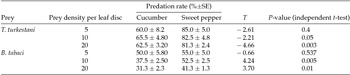
The number of mites and whiteflies that O. albidipennis consumed at different prey densities on cucumber and sweet pepper leaves is shown in Table 1. For all prey densities, consumption rates of O. albidipennis on T. turkestani and B. tabaci on sweet pepper leaf were significantly higher than on cucumber leaf. Also, predation rates of the predator on T. turkestani were higher compared with B. tabaci.
Mean ± SE consumption rates of Tetranychus turkestani and Bemisia tabaci by Orius albidipennis on cucumber and sweet pepper leaves (df = 6) in non-choice tests

Prey preference and switching behaviour
On cucumber at 10:10 and 20:20 ratios, Manley's α index was 0.79 and 0.78 for T. turkestani, and 0.21 and 0.22 for B. tabaci. Also on sweet pepper at 10:10 and 20:20 ratio, Manly's α index was 0.77 and 0.72 for T. turkestani and 0.23, and 0.28 for B. tabaci (Table 2). Therefore, the predator preferred T. turkestani for feeding when these pests simultaneously existed in the leaves of both host plants at all prey density ratios.
Mean of Manly's α index values ± SE of prey preference of predatory bug Orius albidipennis for Tetranychus turkestani and Bemisia tabaci in equal quantities

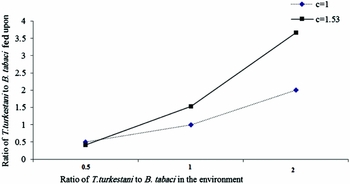
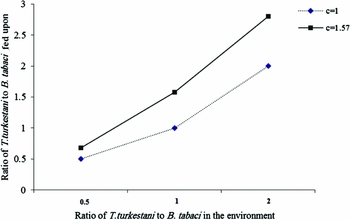
By using Murdoch's index, the preference values (C) were 1.53 and 1.57 on cucumber and sweet pepper, respectively (in comparison with the values 0.66 and 0.63 for B. tabaci) (Figs. 1 and 2). The higher C value shows that the predatory bugs prefer T. turkestani to B. tabaci. The switching behaviour experiment of O. albidipennis on T. turkestani and B. tabaci also shows that the predator prefers T. turkestani to B. tabaci. As shown in Figs. 1 and 2, prey mortality increased with prey density; thus, prey positive switching was observed in the predator when exposed to various ratios of T. turkestani and B. tabaci on cucumber and sweet pepper.
Predation of Orius albidipennis females on Tetranychus turkestani and Bemisia tabaci when offered together in different ratios on cucumber.

Predation of Orius albidipennis females on Tetranychus turkestani and Bemisia tabaci when offered together in different ratios on pepper.

Discussion
Predation rates of O. albidipennis were greater on sweet pepper than on cucumber. The properties or morphology of the host plants of their prey can influence the foraging success and predation of natural enemies. It has been shown that plant morphological and chemical characteristics can affect different predator traits, including survival, fecundity, and foraging success (Price et al., Reference Price, Bouton, Gross, McPheron, Thompson and Weis1980). Host plant features (such as leaf trichomes), slow predator movement, thereby decreasing prey encounters or decreasing manoeuvrability (Reynolds, Reference Reynolds2011; Reynolds and Cuddington, Reference Reynolds and Cuddington2012). The high predation rate on sweet pepper suggests that O. albidipennis searches for prey more effectively on sweet pepper than cucumber. It could be due to the hairy surface of cucumber leaf that limits the predator foraging or its prey refuging. According to Krips et al. (Reference Krips, Kleijn, Willems, Gols and Dicke1999), leaf hairs may hamper biological control of T. urticae by Phytoseiulus persimilis. Host plant trichomes affect predation rate in the predatory bug Anthocoris confusus Reuter (Evans, Reference Evans2008).
The presence and abundance of alternative prey species that share the same enemy indirectly affect predation of a prey species by a generalist predator (such as O. albidipennis) (Tschanz et al., Reference Tschnaz, Bersier and Basher2007; Jaworski et al., Reference Jaworski, Bompard, Genies, Amiens-Desneux and Desneux2013). Our results show that O. albidipennis prefers T. turkestani to B. tabaci on leaves of both cucumber and sweet pepper. The capacity of the predator to detect prey, accessibility of prey for the predator, prey defences against the predator and capacity to effectively feed on prey are four main factors that determine ease of attacking a given prey by a generalist predator (Jaworski et al., Reference Jaworski, Bompard, Genies, Amiens-Desneux and Desneux2013). Influence of the host plant leaf trichomes can be one of the main factors. Hassell (Reference Hassell1978) reported that polyphagous predators exhibit a preference for one or more prey types when exposed to a variety of prey species. Kousari and Kharazi-Pakdel (Reference Kousari and Kharazi-Pakdel2006) examined prey preference of the predatory bug O. albidipennis on onion thrips and two-spotted spider mite on cucumber leaf under laboratory conditions. Their experiments demonstrated that the predatory bug preferred the second instar larvae of T. tabaci Lindeman to T. urticae Koch.
Results of the switching experiment indicate that the predators switch their prey preference from B. tabaci to T. turkestani on cucumber when T. turkestani/B. tabaci ratios are 2 and 3. Chow et al. (Reference Chow, Chau and Heinz2008) showed that total and relative predation of O. insidiosus on thrips and/or mites depends on the types of available prey. The predator tended to switch to the most abundant type of prey. The switching behaviour of their generalist predator can stabilize the prey populations. The stabilizing effect of the predator on prey population may have useful applications for simultaneously managing multiple pest species in agroecosystems (Jaworski et al., Reference Jaworski, Bompard, Genies, Amiens-Desneux and Desneux2013).
Conclusion
Our results show that O. albidipennis prefers T. turkestani to B. tabaci on both host plants but its preference for T. turkestani on sweet pepper is significantly greater than on cucumber. The findings suggest that morphological defence traits of plants (such as hairy leaves of cucumber), may effectively change prey preference and reduce predation success of O. albidipennis. Our laboratory studies, albeit on a small scale, show that the type of host plant should be considered in release of O. albidipennis for biocontrol of insect pests. Further studies are necessary to confirm if this behaviour also occurs on a large scale in the field.