Introduction
The timing of seed germination is an important trait that determines the environmental conditions encountered during the life of a plant. Seed dormancy is a major factor in the control of germination, by preventing germination of a viable seed during (temporary) favourable conditions in an otherwise unfavourable season (Finch-Savage and Leubner-Metzger, Reference Finch-Savage and Leubner-Metzger2006). A low level of seed dormancy in plants growing under natural conditions can lead to germination before the start of a favourable growth season, risking mortality. In contrast, high seed dormancy levels delay germination and can lead to a reduction in the length of the growth season (Donohue et al., Reference Donohue, Rubio de Casas, Burghardt, Kovach and Willis2010). For most crop plants, the timing of germination is determined by the moment when seeds are sown. These seeds should germinate immediately, making seed dormancy an unnecessary and even negative trait. Therefore, selection for low seed dormancy levels occurred during the domestication process (Olsen and Wendel, Reference Olsen and Wendel2013). As a result, most crop plants show a uniform and fast germination after sowing.
Oilseed rape (Brassica napus) is one of the most important cultivated oilseed crops worldwide. B. napus plants are prone to seed scattering due to preharvest pod shatter and crop disturbance during harvest. It has been estimated that, on average, 300–500 kg ha− 1 can be lost, equivalent to around 10,000 seeds m− 2 (Price et al., Reference Price, Hobson, Neale and Bruce1996; Pekrun et al., Reference Pekrun, Lutman and Baeumer1997). Like most domesticated plants, B. napus has low primary dormancy levels, and most scattered seeds germinate rapidly and can subsequently be killed by tilling methods that follow harvest. However, when conditions for germination are not optimal, secondary dormancy can occur (Pekrun et al., Reference Pekrun, Lutman and Baeumer1997; López-Granados and Lutman, Reference López-Granados and Lutman1998) and seeds can remain viable in the soil for over 10 years (Lutman et al., Reference Lutman, Freeman and Pekrun2003). This secondary dormancy is light sensitive (López-Granados and Lutman, Reference López-Granados and Lutman1998). When seeds are close to the soil surface and favourable conditions for germination occur, dormant seeds can germinate and become weeds or volunteer rape plants. Their numbers can be so high that the use of herbicides may be required. Other problems include loss, or a reduction, in seed quality of newly planted rapeseed crops, due to cross-pollination or mixture of seeds with the volunteer crops (Schatzki et al., Reference Schatzki, Allam, Klöppel, Nagel, Börner and Möllers2013). Volunteer rape in subsequent rape crops can also be problematic, due to mixing of B. napus types causing contamination problems of the harvested crop for consumption or industrial use (Pekrun et al., Reference Pekrun, Lutman and Baeumer1997).
The use of cultivars with low secondary seed dormancy capacity can help reduce the number of volunteer rapeseeds in the soil seed banks. This strategy would benefit from a better understanding of the factors and regulators that control the induction of secondary seed dormancy in oilseed rape. Several studies of gene expression and hormones in B. napus genotypes sensitive to secondary dormancy induction suggested that this induction is controlled by an abscisic acid (ABA)-related mechanism (Gulden et al., Reference Gulden, Chiwocha, Abrams, McGregor, Kermode and Shirtliffe2004; Fei et al., Reference Fei, Tsang and Cutler2007, Reference Fei, Ferhatoglu, Tsang, Huang and Cutler2009).
Most recent knowledge about the regulation of seed dormancy has been obtained from genetic and physiological studies with the model plant Arabidopsis thaliana (Arabidopsis). Several plant hormones and genes have been found to regulate dormancy, among which ABA was identified as an essential factor for the induction and maintenance of dormancy (Graeber et al., Reference Graeber, Nakabayashi, Miatton, Leubner-Metzger and Soppe2012; Arc et al., Reference Arc, Sechet, Corbineau, Rajjou and Marion-Poll2013). In a study of the natural variation of dormancy between Arabidopsis accessions, several dormancy quantitative trait loci (QTL) were identified (Alonso-Blanco et al., Reference Alonso-Blanco, Bentsink, Hanhart, Blankestijn-de Vries and Koornneef2003). One of these QTL, named DELAY OF GERMINATION 1 (DOG1) was cloned and shown to encode a protein with unknown function (Bentsink et al., Reference Bentsink, Jowett, Hanhart and Koornneef2006). The dog1 mutant is completely non-dormant and lacks obvious pleiotropic phenotypes, indicating that DOG1 is a key player specific for the induction of seed dormancy. We have shown that DOG1 transcript and protein levels in freshly harvested seeds correlate highly with their dormancy levels (Nakabayashi et al., Reference Nakabayashi, Bartsch, Xiang, Miatton, Pellengahr, Yano, Seo and Soppe2012). Variation in DOG1 expression was found between Arabidopsis accessions. In southern accessions, which are more dormant, DOG1 is expressed earlier during seed maturation and achieves higher expression levels at the end of silique development than in northern accessions with lower dormancy levels (Chiang et al., Reference Chiang, Bartsch, Barua, Nakabayashi, Debieu, Kronholm, Koornneef, Soppe, Donohue and De Meaux2011). In addition, a study with buried Arabidopsis seeds showed dynamic changes in dormancy levels which had a strong correlation with DOG1 expression levels (Footitt et al., Reference Footitt, Douterelo-Soler, Clay and Finch-Savage2011).
DOG1 is highly conserved throughout the plant kingdom. Its homologues have been found in several species that are closely related to Arabidopsis, such as Lepidium sativum and Brassica rapa (Graeber et al., Reference Graeber, Linkies, Müller, Wunchova, Rott and Leubner-Metzger2010), but also in more distant ones, such as the monocot Oryza sativa (Sugimoto et al., Reference Sugimoto, Takeuchi, Ebana, Miyao, Hirochika, Hara, Ishiyama, Kobayashi, Ban, Hattori and Yano2010). Several of these DOG1 homologues have been shown to be functionally conserved and are able to enhance seed dormancy in L. sativum (Graeber et al., Reference Graeber, Linkies, Steinbrecher, Mummenhoff, Tarkowská, Turečková, Ignatz, Sperber, Voegele, de Jong, Urbanová, Strnad and Leubner-Metzger2014) and Triticum aestivum (Ashikawa et al., Reference Ashikawa, Mori, Nakamura and Abe2014).
B. napus is an amphidiploid, containing the genomes of B. rapa (A genome) and Brassica oleracea (C genome), and is closely related to Arabidopsis. In this work, we identified DOG1 homologous genes in B. napus. The transcripts of these genes are seed-specific and their levels increased after the induction of secondary dormancy, suggesting a role for BnaDOG1 in the induction of secondary dormancy.
Materials and methods
Plant material and growth conditions
All experiments were performed using the B. napus genotype NPZ-WR-1, which was obtained from NPZ Lembke (Hohenlieth, Germany). NPZ-WR-1 had been scored as being susceptible for the induction of dormancy. Plants were grown in single pots in an uncooled glasshouse during April–September 2013. Two weeks after sowing, the plants were vernalized in a cold room at 4°C for 6 weeks to induce flowering, and were subsequently placed back in the glasshouse until harvest.
Germination assays
Germination assays were performed in biological triplicates by placing seeds in 9-cm Petri dishes (100 seeds per dish, three technical replicates) on a filter paper (MN618, 85 mm radius, 0.32 mm thickness, 140 g m− 2 from Macherey-Nagel, Düren, Germany) imbibed with 6 ml of deionized water. Petri dishes were incubated in complete darkness at 18°C and radicle emergence (3 mm) was scored after 2, 4 and 14 d. All steps were performed in the dark under green light. When 100% germination was not reached after 14 d in the dark, Petri dishes were incubated under light cycling conditions – 12 h darkness/12 h light – and germination was counted after 7 d to determine the viability of the seed batches.
Secondary dormancy induction
Secondary dormancy was induced by imbibition of seeds in the dark at a low osmotic potential ( − 1.5 MP) as described by Gruber et al. (Reference Gruber, Pekrun and Claupein2004) and Schatzki et al. (Reference Schatzki, Allam, Klöppel, Nagel, Börner and Möllers2013). The secondary dormancy induction treatment was performed by placing the seeds in 9-cm Petri dishes on a filter paper imbibed with 8 ml of a solution containing 357.37 g l− 1 PEG 6000 (AppliChem, Darmstadt, Germany). Petri dishes were incubated in complete darkness at 18°C for 14 d. Seeds were then collected and washed extensively with deionized water to remove all traces of PEG. Secondary dormancy induced seeds were used for germination assays immediately after the induction treatment.
Labelling of flowers
Flowers on the main branches of ten plants were labelled with coloured threads upon the onset of opening at 2-day intervals. When the siliques developed from the first-labelled flowers were fully ripe, all labelled siliques were harvested and stored at − 80°C. Siliques harvested from the same time points were pooled.
Library screening
An arrayed bacterial artificial chromosome (BAC) genomic library made from the B. napus line SynRg_1 (a summer type breeding line) was obtained from Christiane Kiefer and George Coupland (MPIPZ, Cologne, Germany). This library contained 24,192 clones and had a two times genome coverage. Screening of the library was performed by hybridization of a high-density colony filter with a radiolabelled DNA fragment containing the full-length Arabidopsis DOG1 coding sequence under low stringency conditions. The labelled pIndigoBAC-5 vector (Epicentre Inc., Madison, Wisconsin, USA) was included as a background probe to allow better scoring of the positive clones. To isolate DNA from identified clones, the Qiagen Midi kit (Qiagen, Hilden, Germany) was used according to the manufacturer's instructions recommended for isolating DNA from BAC clones.
Total RNA extraction and cDNA synthesis
Seeds (50–60 mg dry weight) or plant tissues (100 mg wet weight) were ground in liquid nitrogen and total RNA extraction was performed using RNAqueous columns and RNA isolation aid (Ambion, Kaufungen, Germany), as described by Kushiro et al. (Reference Kushiro, Okamoto, Nakabayashi, Yamagishi, Kitamura, Asami, Hirai, Koshiba, Kamiya and Nambara2004). RNA quality and concentration were assessed spectrophotometrically (ratio A260/A230 and A260/A280) and by electrophoresis in denaturing conditions. cDNAs were synthesized using the QuantiTect reverse transcription kit (Qiagen) from 1 μg of total RNA in a volume of 20 μl, and diluted tenfold with water for subsequent polymerase chain reaction (PCR).
Semi-quantitative analysis of transcript levels by RT-PCR
Gene expression profiling in different tissues and during seed maturation was conducted by semi-quantitative reverse transcription-PCR (RT-PCR). Primers BnDOG1FW and BnDOG1RE were designed to amplify a 156 bp product from all B. napus DOG1 homologues simultaneously, and were based on exon sequences that were identical in the three homologues (see supplementary Table S1). As control genes for the semi-quantitative transcript analysis, the B. napus homologues of the Arabidopsis genes UBIQUITIN-CONJUGATING ENZYME 21 (UBC) and IAP-LIKE PROTEIN (ILP1) were used. Transcript levels of UBC and ILP1 are stable in different tissues and during seed maturation, respectively (Graeber et al., Reference Graeber, Linkies, Wood and Leubner-Metzger2011; Dekkers et al., Reference Dekkers, Willems, Bassel, Van Bolderen-Veldkamp, Ligterink, Hilhorst and Bentsink2012). A 199 bp fragment of BnaUBC was amplified with primers BnUBCFW and BnUBCRE and a 201 bp fragment of BnaILP1 was amplified with primers BnILP1FW and BnILP1RE (see supplementary Table S1). Both primer pairs were designed based on the available UBC and ILP1 sequences from B. oleracea and B. rapa in the Brassica database (http://brassicadb.org/brad/). The accumulation of PCR products was examined using different numbers of amplification cycles ranging from 28 to 40 for BnaDOG1 and from 35 to 37 for the reference genes. PCR products were analysed by electrophoresis using 3% w/v agarose gels in Tris—acetate—EDTA (TAE).
Quantitative analysis of transcript levels by quantitative real time PCR (QRT-PCR)
BnaDOG1 transcript levels in dry, 24-h imbibed (in water and PEG 6000) and secondary dormancy induced seeds were analysed by quantitative real time (QRT)-PCR using biological triplicate reactions for each sample. QRT-PCR was performed with QuantiTect SYBR Green PCR (Qiagen) on a Mastercycler RealPlex2 system (Eppendorf, Hamburg, Germany) with the BnDOG1FW and BnDOG1RE primers. The results were standardized by comparing the amplification of BnaDOG1 with that of two reference genes, BnaILP1 and BnaHOBBIT (BnaHBT) that are constitutively expressed in seeds (Graeber et al., Reference Graeber, Linkies, Wood and Leubner-Metzger2011; Dekkers et al., Reference Dekkers, Willems, Bassel, Van Bolderen-Veldkamp, Ligterink, Hilhorst and Bentsink2012). BnaHBT was amplified with primers BnHBTFW and BnHBTRE, and BnaILP1 was amplified with primers BnILP1FW and BnILP1RE (see supplementary Table S1). Both primer pairs were designed based on the available HBT and ILP1 sequences from B. oleracea and B. rapa in the Brassica database. The PCR programme was as follows: 15 min at 95°C, followed by 45 cycles of 15 s at 95°C, 20 s at 60°C, and 20 s at 68°C. Single product amplification was validated by melting curve analysis. Relative expression of DOG1 was calculated using the 2− ΔΔCT method (Livak and Schmittgen, Reference Livak and Schmittgen2001).
Sequence analyses
Sequence alignments have been made using DIALIGN (http://bibiserv.techfak.uni-bielefeld.de/dialign/submission.html) (Morgenstern, Reference Morgenstern2004) and BoxShade (http://www.ch.embnet.org/software/BOX_form.html). Phylogenetic analyses have been performed using http://www.phylogeny.fr/version2_cgi/simple_phylogeny.cgi (Dereeper et al., Reference Dereeper, Guignon, Blanc, Audic, Buffet, Chevenet, Dufayard, Guindon, Lefort, Lescot, Claverie and Gascuel2008). The chosen substitution model was HKY85. Protein sequences were aligned using DIALIGN. Locus and allele nomenclature of the DOG1 homologues follows the standardized convention proposed by Østergaard and King (Reference Østergaard and King2008). Gene sequences can be found in GenBank under the following accession numbers: BnaA.DOG1.a, KM373223; BnaC.DOG1.a, KM373224; BnaC.DOG1.b, KM373225.
Results
Identification of DOG1 homologues in B. napus
B. napus is an amphidiploid, containing the genomes of B. rapa and B. oleracea. The B. oleracea and B. rapa genomes both contain two genes that are highly homologous to Arabidopsis DOG1 as determined by BLAST in the Brassica database (http://brassicadb.org/brad/). Therefore, we expected the presence of four DOG1 homologous genes in B. napus.
A high-density colony filter of an arrayed B. napus BAC library was screened with a 912 bp DNA fragment containing the complete coding sequence of the Arabidopsis DOG1 gene. The BAC clones corresponding to the 25 strongest hybridization signals were grown and their DNA was isolated. The presence of a DOG1 homologue in these clones was confirmed by PCR, using primers that were designed for the most conserved regions of the first and second exon of DOG1, based on the Arabidopsis sequence that we obtained in our lab and sequences from the DOG1 homologues in B. rapa and B. oleracea. Eleven of the clones could be confirmed and were further characterized by restriction analysis using the enzyme HindIII. This showed that several of them were overlapping. Four clones (BAC1, 3, 4 and 7) with different restriction patterns were selected to sequence the DOG1 gene directly from the BACs. The first primer used for sequencing was DOG1EX2R (see supplementary Table S1). Further primers for sequencing were based on the obtained sequences. Comparisons of the first obtained sequences revealed that BACs 3 and 7 contained an identical DOG1 homologue. Therefore only BAC3 was used for further sequencing. We obtained the complete genomic sequences of three B. napus DOG1 homologous genes from the start codon up to the stop codon. The remaining seven BACs were screened for the presence of a fourth DOG1 homologue by sequencing a DOG1 fragment, amplified by PCR from these BACs. However, all of the obtained sequences corresponded to one of the three DOG1 homologues that had already been sequenced. Therefore, we could only identify three different DOG1 homologous genes in B. napus (for their complete genomic sequences see supplementary Figure S1). All the identified DOG1 genes contained two exons that were similar to the DOG1-β transcript in Arabidopsis, which encodes for the shortest DOG1 isoform. The complete DOG1 gene in Arabidopsis contains three exons and the second intron is alternatively spliced (Bentsink et al., Reference Bentsink, Jowett, Hanhart and Koornneef2006).
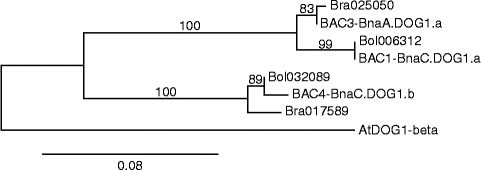
We performed a phylogenetic analysis of the genomic sequences of the three sequenced B. napus DOG1 homologues with the DOG1 homologues of B. oleracea and B. rapa and AtDOG1-β (Fig. 1). The B. rapa and B. oleracea DOG1 homologues fall in two groups, each consisting of a B. rapa and a B. oleracea DOG1 gene. The sequenced B. napus genes are highly similar to their corresponding B. rapa and B. oleracea genes. Two of them had a similar sequence to the B. oleracea DOG1 homologues Bol006312 and Bol032089, and one was similar to the B. rapa DOG1 homologue Bra025050 (Fig. 1). Therefore, two of the B. napus DOG1 homologues are from the C genome and one from the A genome. We named the identified B. napus DOG1 homologues of BACs 3, 1 and 4, respectively, BnaA.DOG1.a, BnaC.DOG1.a and BnaC.DOG1.b.
Maximum likelihood phylogenetic tree showing the relationships between the genomic DOG1 sequences of A. thaliana, B. rapa, B. oleraceae and the three identified B. napus BACs. Branch lengths are proportional to the bar indicating 0.08 substitutions per site. Branch support values are based on 100 bootstrap replicates.

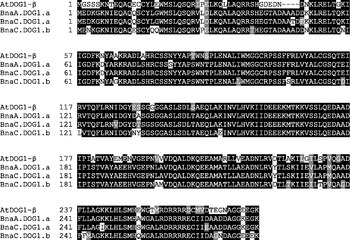
The three predicted proteins of the identified B. napus DOG1 homologues were aligned with the predicted DOG1-β protein from Arabidopsis (Fig. 2). The BnaA.DOG1.a, BnaC.DOG1.a and BnaC.DOG1.b proteins have respectively 80%, 79% and 79% sequence identity with the Arabidopsis DOG1-β protein. The BnaC.DOG1.b protein is slightly different from the other two B. napus DOG1 proteins and shows, respectively, 88% and 86% identity with BnaA.DOG1.a and BnaC.DOG1.a, which are highly similar and show 97% identity with each other.
Sequence alignment of the A. thaliana DOG1-β protein and its B. napus DOG1 homologues. Identical amino acids are shaded in black and conserved amino acids in grey.

BnaDOG1 is only expressed in seeds
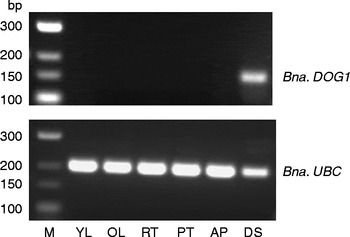
The high similarity of the B. napus DOG1 genes with the Arabidopsis DOG1 gene suggests a similar function for these genes. Arabidopsis DOG1 is only expressed in seeds and regulates seed dormancy (Bentsink et al., Reference Bentsink, Jowett, Hanhart and Koornneef2006; Nakabayashi et al., Reference Nakabayashi, Bartsch, Xiang, Miatton, Pellengahr, Yano, Seo and Soppe2012). We analysed the expression pattern of B. napus DOG1 in different tissues by semi-quantitative PCR. We were unable to design primers that could reliably discriminate between the three identified B. napus DOG1 genes because of their high similarity. Therefore, primers were designed on exon sequences that were identical in all three DOG1 homologues to detect all three transcripts simultaneously. RNA was isolated from young leaves, old leaves, roots, petioles, dissected apex and dry seeds of B. napus plants grown in the greenhouse. The control gene BnaUBC showed similar transcript levels in all tissues, whereas transcript of the DOG1 homologues could only be detected in seeds (Fig. 3).
RT-PCR analysis of the BnaDOG1 transcripts in tissues of B. napus plants. Lanes: M, marker; YL, young leaves; OL, old leaves, RT, roots; PT, petioles; AP, apex; DS, dry seeds. bp, base pair. BnaUBC was used as a loading control. BnaDOG1 has been amplified for 40 cycles; the control gene BnaUBC has been amplified for 37 cycles.

Temporal expression pattern of BnaDOG1 during seed maturation
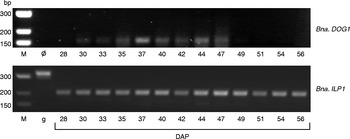
Transcript of the Arabidopsis DOG1 gene can first be detected at the beginning of the seed maturation phase, it peaks around mid-maturation and decreases toward the end of seed maturation (Bentsink et al., Reference Bentsink, Jowett, Hanhart and Koornneef2006; Nakabayashi et al., Reference Nakabayashi, Bartsch, Xiang, Miatton, Pellengahr, Yano, Seo and Soppe2012). Seed development in Arabidopsis takes about 20 d from pollination until ripe seeds under ambient conditions. Under our greenhouse conditions, seed development in the B. napus genotype NPZ-WR-1 took 56 d. We started measuring DOG1 transcript levels at 28 d after pollination, which was expected to correspond roughly to the start of the seed maturation phase. At this time, a very low level of DOG1 transcript could be detected. The highest DOG1 transcript levels were found between about 37 and 44 d after pollination, corresponding to the mid-maturation phase. At the end of seed maturation, from 51 until 56 d after pollination, DOG1 transcript levels were very low (Fig. 4). This pattern of DOG1 transcript abundance was highly similar to that previously observed in Arabidopsis. The high sequence similarity of the B. napus DOG1 homologues that we identified, and the similar expression pattern, strongly suggest a role for the B. napus DOG1 homologues in seed dormancy.
Semi-quantitative RT-PCR analysis of the BnaDOG1 transcript levels during seed maturation. Lanes: M, marker; DAP, days after pollination; g, genomic DNA; Ø, empty lane. BnaDOG1 has been amplified for 37 cycles; the control gene BnaILP1 has been amplified for 36 cycles.

Induction of secondary dormancy in B. napus is associated with enhanced BnaDOG1 transcript levels
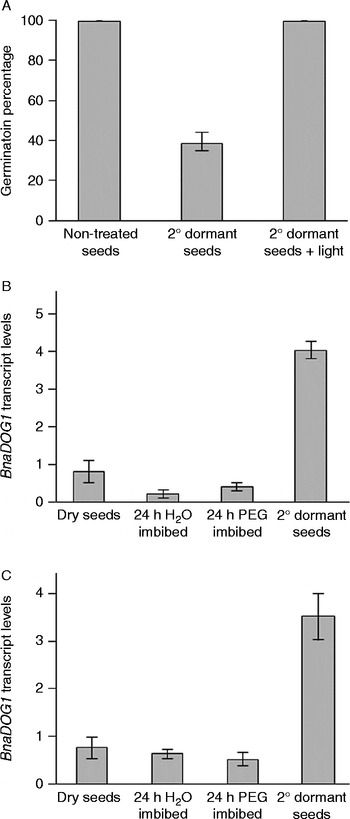
Mutant and transgenic analysis in Arabidopsis demonstrated an important role for DOG1 in primary dormancy. In addition, DOG1 transcript levels were highly correlated with primary dormancy levels (Bentsink et al., Reference Bentsink, Jowett, Hanhart and Koornneef2006; Nakabayashi et al., Reference Nakabayashi, Bartsch, Xiang, Miatton, Pellengahr, Yano, Seo and Soppe2012). B. napus is a crop plant with low primary seed dormancy levels and an important role of DOG1 in the regulation of primary dormancy would therefore not be expected. However, B. napus is prone to the induction of secondary dormancy (Pekrun et al., Reference Pekrun, Lutman and Baeumer1997; Momoh et al., Reference Momoh, Zhou and Kristiansson2002). We studied whether the induction of secondary dormancy is correlated with changes in DOG1 transcript levels. Secondary dormancy was induced by imbibition of seeds from the B. napus genotype NPZ-WR-1 in PEG 6000 at 18°C for 14 d, based on the protocols of Gruber et al. (Reference Gruber, Pekrun and Claupein2004) and Schatzki et al. (Reference Schatzki, Allam, Klöppel, Nagel, Börner and Möllers2013). Imbibition of seeds in a PEG 6000 solution for 2 weeks reduced the germination percentage from 100% to 39%. Subsequent seed imbibition in the presence of light to break dormancy led to 100% germination, indicating that seeds are viable after the PEG 6000 treatment. Taken together, these results demonstrate the induction of secondary dormancy (Fig. 5A).
Quantitative analysis of BnaDOG1 transcript levels in secondary dormant seeds. (A) Germination percentage of B. napus seeds before and after induction of secondary (2°) dormancy by PEG treatment. Viability of the secondary dormant seeds was determined by germination in the presence of light. (B, C) Quantitative QRT-PCR analysis of BnaDOG1 transcript levels in dry seeds, seeds that have been imbibed for 24 h in water or PEG and secondary dormancy induced seeds that were imbibed in PEG for 2 weeks. Transcript levels are shown in arbitrary units relative to the B. napus homologues of the Arabidopsis control genes HBT (B) and ILP1 (C). Bars indicate the standard deviation of three biological replicates.

The BnaDOG1 transcript levels in these seeds were analysed by QRT-PCR. We used primers designed to amplify the B. napus homologues of the two Arabidopsis control genes, BnaHBT and BnaILP1. These genes had been shown to be very stable in seeds in a cross-species comparison within the Brassicaceae (Graeber et al., Reference Graeber, Linkies, Wood and Leubner-Metzger2011). For BnaHBT and BnaILP1 we found, respectively, 4.9- and 4.5-fold increase in BnaDOG1 transcript levels after the induction of secondary dormancy compared to dry seeds (Fig. 5B, C). We also analysed the transcript levels at 24 h in water and PEG 6000 imbibed seeds, and found no increase in transcript levels. These results support a role for BnaDOG1 in the induction of secondary dormancy.
Discussion
DOG1 has been identified as an essential gene for seed dormancy in Arabidopsis (Bentsink et al., Reference Bentsink, Jowett, Hanhart and Koornneef2006; Nakabayashi et al., Reference Nakabayashi, Bartsch, Xiang, Miatton, Pellengahr, Yano, Seo and Soppe2012). This role of DOG1 has mainly been studied in relation to primary dormancy, and its importance in secondary dormancy is unknown. Footitt et al. (Reference Footitt, Douterelo-Soler, Clay and Finch-Savage2011) showed a correlation of DOG1 transcript levels with the induction of secondary dormancy of Arabidopsis seeds buried in the soil (Footitt et al., Reference Footitt, Douterelo-Soler, Clay and Finch-Savage2011). This suggests that DOG1 controls both primary and secondary dormancy. DOG1 has been shown to be a highly conserved plant gene with a conserved role in dormancy (Graeber et al., Reference Graeber, Linkies, Müller, Wunchova, Rott and Leubner-Metzger2010, Reference Graeber, Linkies, Steinbrecher, Mummenhoff, Tarkowská, Turečková, Ignatz, Sperber, Voegele, de Jong, Urbanová, Strnad and Leubner-Metzger2014; Sugimoto et al., Reference Sugimoto, Takeuchi, Ebana, Miyao, Hirochika, Hara, Ishiyama, Kobayashi, Ban, Hattori and Yano2010; Ashikawa et al., Reference Ashikawa, Mori, Nakamura and Abe2014). In this work, we identified homologues of DOG1 in the crop plant B. napus and showed a correlation of BnaDOG1 transcript levels with the induction of secondary dormancy.
The BnaDOG1 sequences that we obtained contained two exons, whereas the Arabidopsis DOG1 gene has three exons. The parts of the B. napus genome that we sequenced were based on the available sequences in the Brassica database of the B. rapa and B. oleracea DOG1 genes, which have two annotated DOG1 exons. However, the presence of a third DOG1 exon cannot be excluded in B. napus. Interestingly, a small region downstream of the second exon of the DOG1 homologues in B. rapa and B. oleracea shows enhanced homology to the third DOG1 exon in Arabidopsis, suggesting that the B. napus DOG1 genes might also contain a third exon. Further sequencing of DNA and cDNAs from B. napus is required to verify this possibility.
B. napus is an amphidiploid containing the genomes of B. rapa and B. oleracea. This suggests the presence of four DOG1 homologues. However, we have only identified three homologues in B. napus, suggesting that one of the DOG1 homologues has not been detected in the BAC screening. Alternatively, it is possible that B. napus contains only three DOG1 homologues. An analysis with marker loci showed that in rare cases (7 out of 134) three loci were found in B. napus (Parkin et al., Reference Parkin, Sharpe and Lydiate2003).
The relative transcript abundance and functionality of the three individual DOG1 homologues in B. napus are still unknown. The protein sequences are full length, indicating that the three proteins could all be functional. A functional analysis of the BnaDOG1 homologues, for instance by transforming individual genes into the Arabidopsis dog1 mutant, is required to determine whether they are all able to induce seed dormancy. We have designed primers to distinguish transcripts from three different BnaDOG1 genes, which were not fully reliable. However, a preliminary experiment suggested that BnaC.DOG1.a transcripts are far more abundant than transcripts of the other two DOG1 homologues, suggesting differentiation in expression between the homologues. Detection of transcripts with improved primers is required to validate these results.
The role of DOG1 in seed dormancy is conserved among plant species (Nakabayashi et al., Reference Nakabayashi, Bartsch, Xiang, Miatton, Pellengahr, Yano, Seo and Soppe2012; Ashikawa et al., Reference Ashikawa, Mori, Nakamura and Abe2014; Graeber et al., Reference Graeber, Linkies, Steinbrecher, Mummenhoff, Tarkowská, Turečková, Ignatz, Sperber, Voegele, de Jong, Urbanová, Strnad and Leubner-Metzger2014). Therefore, the increased transcript level after the induction of secondary dormancy in the studied B. napus genotype suggests a role for BnaDOG1 in this process. BnaDOG1 transcripts were also detected during seed maturation (Fig. 4) despite the very low primary dormancy levels in B. napus cultivars. This implies that expression of BnaDOG1 during maturation is not sufficient for primary dormancy induction. It is possible that another factor required for dormancy induction during seed maturation is absent in B. napus cultivars.
Reduction of the number of volunteer rape plants in the years after a crop has been grown is a goal in B. napus breeding. Our work indicated that BnaDOG1 is mainly involved in secondary dormancy. Therefore, genotypes with high and low sensitivity for secondary dormancy could be compared for sequence polymorphisms in their BnaDOG1 genes. If correlations are found, these polymorphisms could be used as markers in breeding programmes for the selection of cultivars with reduced levels of secondary dormancy. In addition, the BnaDOG1 expression level has the potential to be used as an indicator for the secondary dormancy level of B. napus seeds in existing cultivars.
Acknowledgements
We thank Christiane Kiefer and George Coupland for making available the B. napus BAC library and Simon Goertz (NPZ-Lembke) for providing B. napus seeds. We also thank Maria Albani for hybridization of the BAC filters and Christina Philipp for technical assistance.
Financial support
This work was supported by the Max Planck Society.
Conflicts of interest
None.
Supplementary material
To view supplementary material for this article, please visit http://dx.doi.org/10.1017/S0960258514000427