

INTRODUCTION
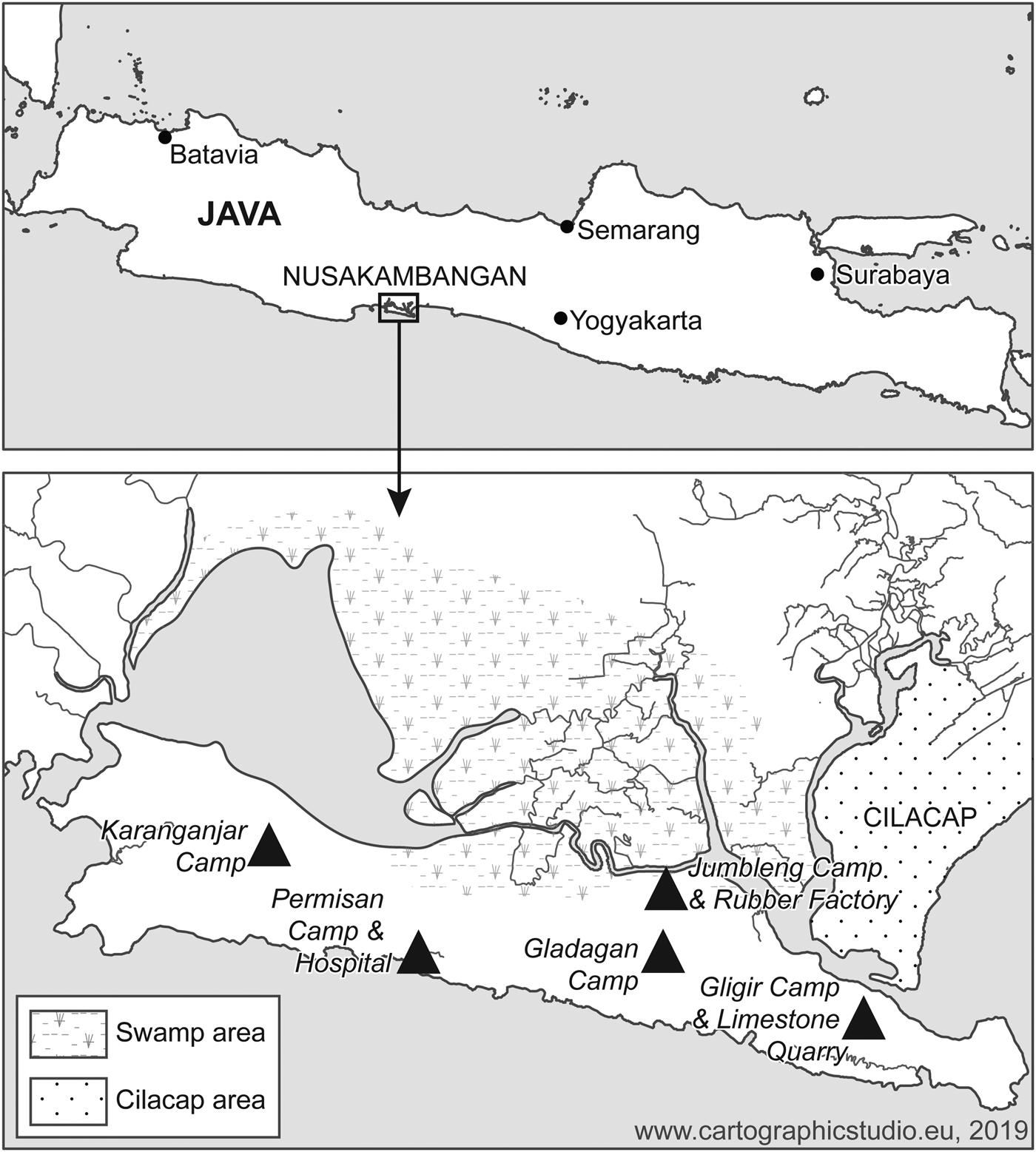
From across the water, the dense forests and steep hills of Nusakambangan made the island appear as an impenetrable fortress. Lying just off the southern coast of Central Java, Indonesia, Nusakambangan (Figure 1) was accessible only by boat from the town of Cilacap, so that the island's natural isolation made it an ideal place for a penal colony. In 1905, the Dutch colonial authorities built the first prison camp here to alleviate the overcrowded prisons of Central Java. Before long, thousands of Acehnese prisoners of war had been deported to Nusakambangan as the infamous Aceh War of 1873–1914 drew to its close. Later, hundreds of communists were interned on the island after the failed revolt of 1926, followed by Republican POWs during the Indonesian war of independence between 1945 and 1949. Then, there were alleged communists after 1965 and, in the early 2000s, Acehnese separatist guerrillas. Today, the island is the most heavily guarded penal site in Indonesia, where people sentenced to death are detained along with radical Muslims, refugees, and other criminal or criminalized groups.
Map of the island of Nusakambangan, surrounded by water and swamps, with the main prison camps between 1905 and 1942.
Despite the deliberate isolation of the respective convict groups from their home communities and from the country at large, the island was always and still is highly prominent as a site of punishment, with a long history and a particularly bad name. This article examines Nusakambangan's social and spatial embedding in the broader society of the Dutch East Indies during the period between 1905 and 1933 by studying the images, reputations, and stigmas of the island that circulated within the colony. In colonial times, the island was compared to “tropical Siberia”, New Caledonia, and Devil's Island in French Guyana. Pandu Nusa, who was imprisoned on Nusakambangan as a communist between 1965 and 1969, described it as an “island of terror”. He recalled that, even in the Dutch period, “the name alone would send chills up and down Indonesian spines”.Footnote 1 However, other images of the island circulated in the colony. According to certain colonial commentators, the penal regime was too lenient, with the convicts living comfortable lives unfettered by guards or regulations. Others focused on the productive qualities of the island, where the convicts were deployed on rubber plantations, construction works, and food production.
In general, the reputations of prisons reach far beyond the social networks of their inmates and staff, in fact constituting their most mobile but also long-lasting elements. A prison's reputation is established partly by inmates and former inmates themselves, and by guards and other officials, but also by communities established near prison sites. All are in a position to describe the living conditions in the prison from first-hand experience. Then, there are prison islands, such as Alcatraz, Robben Island, or Devil's Island, which acquired formidable reputations as inescapable places of horror through constant depiction and reaffirmation in books, songs, films, museum exhibits, and other cultural articulations.
To examine Nusakambangan's reputation, I have chosen to focus on a third group, who travelled between the penal colony and the outside world. Journalists, priests, and politicians regularly paid short authorized visits to the island, after which they reported their impressions and experiences to newspapers and in journals and speeches.Footnote 2 That group of informed outsiders occupied an intermediary position between the isolated penal population of Nusakambangan, which was largely illiterate and culturally marginalized, and the rest of Dutch East Indies society, who tried to formulate an idea of what life on Nusakambangan might be like. Far from being hidden from the public eye, to a large extent Nusakambangan gained its symbolic value as a site of punishment and rehabilitation – or indeed of production – from the evaluations and conclusions of such informed outsiders.
My choice to focus on informed outsiders was dictated by practical as well as methodological considerations. In contrast to Boven Digul, which, together with the island of Buru, was historically the most notorious penal complex in the Dutch East Indies, no convicts’ accounts or literary interpretations from Nusakambangan have survived. As a result, apart from archive material, press reports are the only extant sources from which popular images can be derived. As a method, then, the reports of informed outsiders can provide us with a better understanding of the multiplicity of reputations that circulated in the colony, especially when set against existing literature, which tends to focus on single ideological connotations. Although there is considerable scholarship about the reputation of Boven Digul, Nusakambangan has been the subject of only one study, contained in a chapter of a book by Christien Bruinink-Darlang, who did not discuss the popular image of the island in Dutch East Indies society.Footnote 3 In 1996, Takashi Shiraishi pointed out that, even though Boven Digul was extremely isolated, the authorities made sure that a selection of images reached Indies society as a warning to Indonesian activists and politicians.Footnote 4 Rudolf Mrázek, for his part, focused on the propagandistic function of Boven Digul, comparing it with the Nazi concentration camp of Theresienstadt, which was presented as a model camp to deceive international observers.Footnote 5 Both articles failed to go beyond the intention of the authorities to present to the Indies an image of Boven Digul as a “phantom world” of colonial discipline. Nobuto Yamamoto and Elizabeth Chandra shifted the focus from the intentions of the authorities to the impressions of outsiders – Dutch and Sino-Malay language journalists and novelists – but did not show how far those accounts deviated from the preferred narrative of the camp authorities, nor how they differed from one another.Footnote 6
In other words, there is a great need for a thorough analysis of who the visitors were who formed their own opinions and passed them on to Dutch East Indies society. As we shall see, their judgements about what they experienced varied considerably and were often at odds with the preferred message of the authorities. That is important, especially since we know from various contributions in the collection of international case studies compiled by Christian De Vito and Alex Lichtenstein that reputations were only partly controlled by state and prison authorities, and often evolved into long-lasting stigmatizations of penal colonies.Footnote 7 In a colonial context such as the Dutch East Indies, the opinions of Dutch colonial commentators reflected intense political discussions about the general direction of colonial policy. Instead of approaching the island as an isolated site of total control, we must therefore place Nusakambangan and the debates concerning its management and function within the context of the rest of Dutch East Indies society.
Moreover, it is worthwhile studying penal facilities other than Boven Digul, which was exceptional in the larger penal system of the Dutch East Indies. Technically, Boven Digul was not even a prison camp but a “free” colony of political deportees in exile, who had not been formally convicted. Unlike normal prisons and penal camps, the exiles in Boven Digul were not forced to work and were treated relatively well. To form an idea of the position of prisons and penal institutions in Dutch East Indies society, it therefore makes more sense to turn to a site such as Nusakambangan. Together with the Ombilin coal mines, the rubber plantations on Nusakambangan accommodated the largest number of convicts in the Dutch East Indies in the late colonial period, although in economic terms production was insignificant, with a share of total Dutch East Indies rubber production of approximately 0.14 per cent in 1924.Footnote 8 That said, the plantation's establishment in 1905 signalled a period of considerable penal reform in the colony, with the standardization and centralization of the penal system and rationalization of convict labour. The reforms reflected new ways of thinking about the function of punishment and imprisonment in a colonial society, not only among penal reformers, but also among commentators in the wider Dutch East Indies society, in which the “informed outsiders” held prominent positions.
For this article, I selected sixteen longer articles and article series by authors who had spent one or more days on the island.Footnote 9 The accounts selected appeared in Dutch-language newspapers both in the Dutch East Indies and the Netherlands between 1907 and 1933, and represent more than 150 smaller articles and reports written between 1906 and 1941. It is difficult to trace Malay-language accounts about Nusakambangan, because so few Malay-language newspapers have been preserved, while monthly “overviews of native and Malay-Chinese press” compiled by the colonial Kantoor voor de Volkslectuur (Office of People's Literature) mentioned Nusakambangan only a handful of times in passing.Footnote 10 Yamamoto remarked about Boven Digul that Indonesian journalists were not granted permission to enter the penal colony for fear of negative reporting, and that they relied on Dutch newspapers to form their opinions.Footnote 11 It is likely that the same applied to the case of Nusakambangan.
THE PRESS IN THE DUTCH EAST INDIES
Before we concentrate on Nusakambangan, it is worthwhile offering an impression of the journalistic landscape of the Dutch East Indies. The articles selected had considerable reach among the Dutch and Eurasian colonial communities and the educated Indonesian and Chinese-Indonesian upper classes of the colony. Gerard Termorshuizen has demonstrated in his overview of the colonial press that newspapers in the Dutch East Indies had an important social and political function. Circulation figures were not especially high, with an average of six to eight thousand subscriptions to large newspapers in around 1905 among a population of eighty thousand Europeans and forty million Indonesians; but journalists were the “interpreters and leaders” of colonial public opinion in the Dutch East Indies.Footnote 12 Dutch-language newspapers were not affiliated to political parties but, in general, were positioned between a social-liberal extreme, which argued for modernization and development of the colony and democratization and participation of the Indonesian population in its administration, and a conservative colonial extreme that, often with racist undertones, was fiercely opposed to any such things and supported a strong authoritarian state.
Het Nieuws van den Dag voor Nederlandsch-Indië [The Dutch Indies Daily News, NvdD] was the most vocal representative of the conservative extreme. Established in 1900 in Batavia, the NvdD grew to become the largest newspaper in the Dutch East Indies and was feared for its provocative and aggressive style of journalism and its reactionary position. We shall examine contributions to the paper by one of its most eminent journalists, Henri Carel Zentgraaff, who, under the acronym “Z”, published articles about Nusakambangan in 1909, 1914, and 1922. A veteran of the Dutch colonial army, “Z” was one of the most important opinion formers in the colony and favoured a strong authoritarian state. “Z” rejected any form of power sharing with Indonesians and, at the end of the 1920s, would be one of the driving forces behind the establishment of the conservative Vaderlandsche Club. For a few years in the 1930s, he even sympathized with the Dutch national socialist party, the NSB.Footnote 13
At the other end of the political spectrum were smaller-circulation newspapers, such as De Locomotief [The Locomotive], Bataviaasch Nieuwsblad [Batavian Newssheet], and De Indische Courant [The Indies Gazette]. De Locomotief was established in Semarang in 1863 and was the largest social-liberal newspaper in the colony, while the Bataviaasch Nieuwsblad came into existence in 1885 and advocated the emancipation of the Indo-European population. De Indische Courant was launched rather later, in 1921, in Surabaya, by De Suikerbond, a social democratic union of sugar employees. Its first chief editor was Dirk Frederik van der Pant, who had visited Nusakambangan in 1916 while working for the Bataviaasch Nieuwsblad. As chief editor of De Indische Courant, Van der Pant was responsible for the publication of a series of articles about the island in 1922 written by a certain “Hs”. Politically, Van der Pant was left leaning; indeed, he was even accused of communist sympathies around the time of his visit to Nusakambangan. However, in the 1930s, Van der Pant's views changed radically, to the extent that he, too, became a member of the NSB.Footnote 14
Other visitors to Nusakambangan worthy of special mention were the Jesuit missionary F. Sträter and socialist politician Henri van Kol. Sträter worked for the parish of Yogyakarta, which included Nusakambangan, and wrote for St. Claverbond, a Dutch Jesuit journal that aimed to arouse interest among Catholic readers in the Netherlands in missionary work on Java. Van Kol was a Member of Parliament for the socialist SDAP until 1909 and was considered the colonial expert in his party. He visited Nusakambangan during a longer trip to the Dutch East Indies in 1912 and reported on his experiences in De Locomotief.
NUSAKAMBANGAN AS AN ISLAND OF ACEHNESE
Nusakambangan first appeared in Dutch East Indies’ newspapers in relation to the accommodation of convicts in 1905. Then, the Resident of Banyumas, the most senior European official in the district to which Nusakambangan belonged, suggested the island as a solution to the problems caused by the severely overcrowded prisons in his residency. Together with officials from the colonial Department of Justice, he initiated a large-scale cultivation project in which convicts would be used to clear and develop parts of the densely forested island. The first batches of labour convicts from the region arrived in November 1905 and were immediately instructed to clear a few hectares of terrain three kilometres inland and to build barracks using timber from the forest. The convicts were ordered to make a start on planting rubber trees on the cleared terrain, to turn Nusakambangan into a rubber-producing island. That first prison camp on Nusakambangan was designed to accommodate roughly three hundred convicts and twelve guards and was named Gladagan (Figure 1).Footnote 15
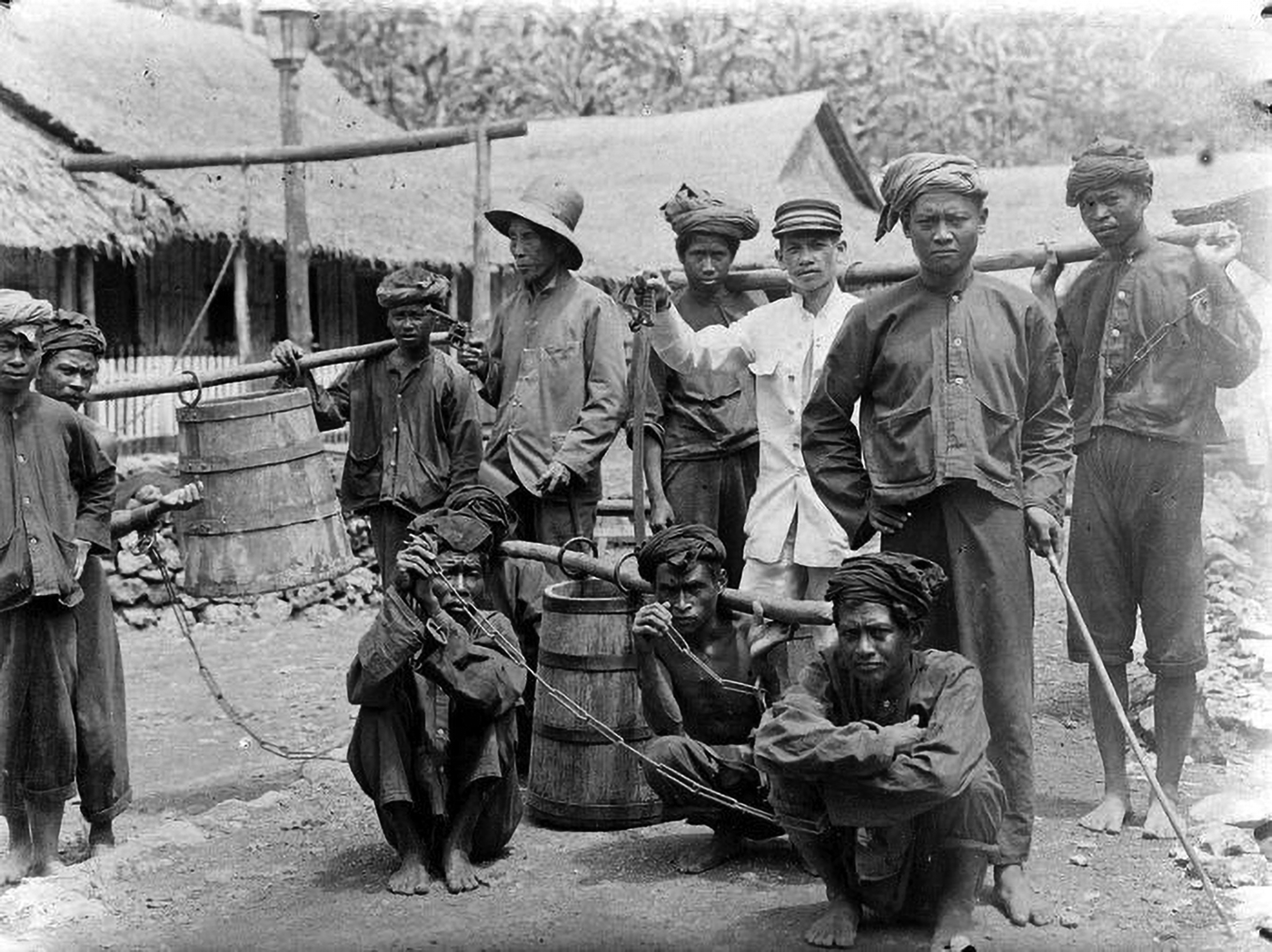
Convicts and armed guards in Nusakambangan carrying baskets of latex.
The establishment of prison camps on Nusakambangan was the direct result of penal reforms between 1903 and 1908. From early modern times, the employment of convicts in the Dutch East Indies had a strongly local character. The legal system of the Dutch East Indies subdivided people into three legal categories as “Europeans”, “natives”, and “foreign orientals”. “Native” offenders were rarely sentenced either to imprisonment or the payment of fines. Moreover, corporal punishment had been officially abolished in 1866, although not within prison camps or in the army. Consequently, the majority of convicts were sentenced to labour at local “public works”, which included the construction of roads and irrigation works, the maintenance of government buildings and compounds, or the collection of refuse. People given sentences of longer than one year were sent to the Ombilin coal mines in Sumatra or employed as bearers on military expeditions.Footnote 16
From the late nineteenth century, with the expansion of the state and a growing demand for labour to service the colonial government, officials began to complain about inadequate supervision of local convicts and the waste of invaluable labour by local authorities. Therefore, 1905 saw a series of reforms, one of which was the establishment of large prisons in regional centres. There, all convicts would be concentrated who had been sentenced to more than a year's forced labour, and they would be put to work in new prison workshops for the production of shoes, uniforms, sails, books, and other handicrafts. Anyone unwilling to submit to the new labour regime, or unfit to do so, was sent to work in the Ombilin coal mines, to join military expeditions, or to work on the new rubber plantations of Nusakambangan. By shifting local convict labour from the public sphere into the central prisons, the authorities expected to increase productivity and revenue, improve the rehabilitation of convicts, and counter the endemic overpopulation within local prisons.Footnote 17 Paradoxically, the establishment of new and highly visible penal institutions also led to new public interest in the function and management of the hitherto invisible intramural labour being done inside the new institutions. The penal system became a topic of the emerging and increasingly vocal Indies press.
In the first months of the new Nusakambangan prison camp's existence the Dutch East Indies’ newspapers showed little interest in it. However, that changed considerably when officials from the Department of Justice decided to use the island to relocate Acehnese prisoners of war.Footnote 18 These were insurgents, captured in the final stages of the lengthy war between the Dutch colonial army and the Sultanate of Aceh on the northernmost tip of Sumatra. They were a great nuisance to the colonial authorities and many of them had received jail terms of twenty years for armed resistance to the Dutch colonial army. They could not have been put to work in Aceh or northern Sumatra because of the risk of escape into the local population, who could be expected to conceal them. Colonial authorities in other peripheral regions of the archipelago were not equipped to control and supervise large groups of rebels and, as a consequence, most of the Acehnese convicts ended up in the city jails of Java, which were in a state of decay and often severely overcrowded. The Acehnese, who spoke their own language and many of whom had combat experience, soon gained a reputation for being extremely insubordinate and unwilling to work. The perfect solution seemed to be deportation to Nusakambangan, where they could be subdivided into smaller working groups and where labour supervision was easier to organize.Footnote 19 In 1906, an initial group of two hundred Acehnese convicts arrived on Nusakambangan, and although the Resident of Banyumas soon began to complain about their defiance and refusal to work, their numbers would rise to a thousand by 1913. Official statistics are incomplete, but it seems that the Acehnese presence on Nusakambangan lasted until at least the end of the 1920s.
The Acehnese were not the only group imprisoned on Nusakambangan, nor were they the only category of convicts detained en masse there. Throughout late colonial history and subsequently, the island provided an easy solution for groups who, because of their numbers or uncooperative attitude, proved difficult for the Dutch East Indies penal system to accommodate. Another such group were the more than 2,000 Buginese and Toraja convicts transported to Nusakambangan after a military expedition in South Sulawesi in 1905–1906, and after the Toraja rebellion of 1917.Footnote 20 The 1908 anti-tax rebellion among Minangkabau peasants on the west coast of Sumatra was perhaps the reason why a group of more than 500 “West-Sumatrans” appear in the statistics for 1913.Footnote 21 Moreover, between 1927 and 1932, 800 communists were detained on Nusakambangan after their arrest in the aftermath of the communist revolt of November 1926.Footnote 22
Overall, the number of convicts on Nusakambangan increased from a few hundred in the first few years after 1905 to more than 2,000 in 1912, more than 4,000 in 1929, and more than 6,000 in 1938, and it seems that only in the first few years were the Acehnese in the majority. In 1913, for example, they comprised no more than twenty-nine per cent of the total of 3,241 convicts, while the Buginese made up forty-six per cent.Footnote 23 Nevertheless, the Acehnese were greatly overrepresented in reports on Nusakambangan in the Dutch East Indies, which gave the island its “Acehnese” reputation. Indeed, the bad name of the Acehnese convicts among the Dutch population, a reputation closely linked to the lengthy and traumatic Aceh war, had negative repercussions for the reputation of Nusakambangan itself as a prison island.Footnote 24 For a long time, the island was inextricably linked to the presence of dangerous Acehnese convicts in news reports from across the political spectrum.
NUSAKAMBANGAN AS A “BEGGARS’ PARADISE”
The alarm with which Dutch East Indies newspapers received news of Acehnese convicts in open-air detention on Nusakambangan was only aggravated when it was revealed that the island was not as isolated as had been believed. Until 1931, when a new surveillance system was introduced, the number of successful escape attempts was extraordinarily high. Within the first four months of the colony's opening, the proportion of escaped convicts in relation to the total population quickly climbed to more than ten per cent, and for most subsequent years with reliable data that figure would remain between ten and twenty-five per cent.Footnote 25 Even though more than seventy per cent of fugitives were caught within a week of escape – in many cases before they could leave the island – groups of convicts did manage to reach Java, where they caused great disruption among Dutch colonial and Indonesian communities. Consequently, many articles appeared about “Acehnese” absconders, who raided Javanese fishing communities, raped the women, and advanced on the colonial town of Cilacap, armed with knives, axes, and sometimes even the rifles of guards they had overpowered.Footnote 26 For example, a piece in the Bataviaasch Nieuwsblad in 1913 read, “Many Acehnese walk and drive around in the town of Cilacap on a daily basis and without guards. This situation is unlikely to change without first a catastrophe.”Footnote 27 To make things worse, there were periodic reports of prison guards being killed by convicts on work sites. Between 1907 and 1927, no fewer than ten guards lost their lives in confrontations with convicts.
Most vocal in protesting the failing custody of convicts was the conservative newspaper NvdD. After every new instance of escape, the NvdD severely criticized both the penal authorities and the colonial administration generally. It also published letters from worried Dutchmen, living in nearby Cilacap, who were panicking about the lack of protection. According to the NvdD, the prison guards were too few, too poorly paid, too poorly trained, and too badly armed. Moreover, the organization of penal facilities on the island necessarily led to dangerous situations. Following the first prison camp of Gladagan, four more camps were established in the west of the island and on its northern and southern shores. From those camps, convicts were deployed to the surrounding rubber plantations. Not only were the guards therefore separated from each other by kilometres of dense rainforest, it was also relatively easy for convicts to escape and hide in the forest. According to the NvdD, the official response was inadequate; the paper even accused the authorities of suppressing undesirable information.Footnote 28
To assess the situation on Nusakambangan, the NvdD commissioned H.C. Zentgraaff, the aforementioned “Z”, to visit the island in January 1909. On his return, “Z” wrote a sneering series of articles entitled “Beggars’ Paradise”, in which he criticized the lack of discipline among the convicts and the too-light labour regime to which they were subjected. According to Zentgraaff, anarchy ruled on the island. He wrote that, “[t]he 1,100 criminals who work as convict labourers live an easy life, are well-fed, they sacrifice to Venus and Bacchus, organize a massacre or raid every now and then, in short: they feel like they are living in heaven on earth”.Footnote 29 Sarcastically, he described how the convicts on Nusakambangan were left completely unattended by the guards, who were too afraid to enforce discipline. It was a matter of concern to Zentgraaff that, in his judgement, convicts on Nusakambangan did less work than free labourers. For Zentgraaff, working hard was an essential element of the punishment of convict labourers: “One should let a forced labourer work hard, as hard as possible, and in any case longer and heavier than free coolies. After all, a forced labourer works not only to repay the food and clothes he receives, but above all for punishment. Do not make a sinecure out of it.”Footnote 30
Although in his articles in 1909, 1914, and 1922 Zentgraaff was the most vociferous in attacking the penal authorities, other visitors were also struck by the indiscipline and lack of hard labour on Nusakambangan. In 1922, “Hs.” of the Indische Courant criticized the lethargic behaviour of convicts on the rubber plantations, and “Br.” of the conservative newspaper Nieuwsblad van het Noorden stressed the importance of “unrelenting obedience and constant discipline” on the island.Footnote 31 Certain authors even went so far as to suggest that the high number of returned fugitives might be explained by the harsh conditions outside the prison camps. Runaway convicts tended to surrender themselves to the authorities as soon as they discovered that it was much more difficult to survive outside than inside the camps.Footnote 32
The underlying message of the articles cited, most of which appeared in the conservative NvdD, was that conditions for the convicts on Nusakambangan were too easy for a prison island surely intended, primarily, as a place of punishment. Apart from discipline that should be enforced through solitary confinement and the rattan cane, a strengthening of the labour regime was important, for that would make the convicts aware that they were there for punishment. Racist presumptions about Indonesian convicts often played a role in such arguments. According to “Br.”, for example, imprisonment alone was not enough because Indonesians cared much less about freedom than Europeans did. As long as Indonesians were assured of food, shelter, and cigarettes, they did not perceive a prolonged stay on Nusakambangan as punishment. Hard labour under harsh circumstances was the only punishment an Indonesian was sensitive to;Footnote 33 the attitudes of conservative commentators were the extreme consequence of their attitudes to colonial Indonesian society in general.
NUSAKAMBANGAN AS A PLACE OF REHABILITATION
Other newspapers felt provoked to respond to the series of reports by Zentgraaff and the NvdD, lamenting the failure of the authorities to establish a regime of discipline and punishment on Nusakambangan and to provide security for Dutch and Indonesian communities on Java's mainland. De Locomotief complained that the effect of such “sensationalist articles” was that it instilled in the local population of Cilacap a panicked fear of Acehnese murderers.Footnote 34 The Bataviaasch Nieuwsblad described as “ridiculous” the reaction of some European families, who evacuated their children from Cilacap.Footnote 35 Although almost all visitors to Nusakambangan acknowledged that supervision of the convicts was inadequate and that the barracks and prison facilities were of poor quality, Christian and progressive reports did not complain about lazy or undisciplined convicts. In fact, they had a completely different view of the function of labour, which was a reflection of the new “ethical policy” in Dutch colonial politics. According to reports from those circles, work was not to be seen as punishment but as education and rehabilitation. Van der Pant, who visited the island in 1916, mentioned that the deployment of convicts was based on the principle that they should perform useful labour, from which they could learn and which could help them to earn a living in free society.Footnote 36 According to that line of thought, the employment of Acehnese on rubber plantations was deliberate, because the government wanted to encourage private rubber production in northern Sumatra.Footnote 37
How was labour in Nusakambangan organized? Upon arrival on Nusakambangan, convicts underwent a physical examination and were subdivided into four categories. By default, they were placed in category D for hard labour on the rubber plantations and food production. There was a much smaller group of category C convicts, whose duties tended to be less arduous, such as working in the rubber factory, transporting goods between the camps and the ferry, or performing skilled tasks. Category B was for physically weaker convicts, who were temporarily unable to perform heavy duties and so carried out light tasks in and around the camps. A few category A convicts were deemed unfit for hard labour because of their age or physical condition. In 1922, 66 per cent of convicts were placed in category D, and 26 per cent, 8 per cent, and 0.5 per cent in categories C, B, and A, respectively.
A normal working day for category D convicts began at a quarter to six in the morning and lasted nine hours, including walking to and from the worksite. The convicts, barefoot but dressed in brown uniforms with a large letter “D” emblazoned on the chest, worked in groups of approximately twenty-five. They carried axes, hoes, and billhooks, and were often chained while walking to and from camp. A foreman (called a kepala or voorman) was selected from among their number. He was recognizable by his armband with the letter “V” and he was allowed to carry a stick. The group was accompanied by two guards, mandoers, each armed with a revolver and a sabre. Apart from clearing the ground and preparing it for new planting, the work included maintaining the rubber trees and collecting the baskets of latex tapped from them as the raw material for rubber (Figure 3). In a factory in the Jumbleng prison camp, category C convicts solidified the latex into sheets, using a process of smoking and drying, after which the material was shipped to Cilacap. Other tasks done by penal labour included work on camp premises, construction and maintenance of buildings and roads, and fieldwork to produce food crops.
Convicts at work in a deforestation project near the Gladagan prison camp in Nusakambangan.

It seems opinions differed considerably on the question of whether or not the convicts really benefited from their labour regime. The Jesuit priest F. Sträter, who visited the island in 1920, saw improvements mainly in character and morale. He was pleasantly surprised by the behaviour of men perceived as ruthless murderers. According to Sträter, the convicts were in general obedient and manageable, and living on the island had a salutary effect on their savage natures. “It is pleasant to see the diligence with which the prisoners perform their work. For them, it is truly an exceptional opportunity to learn a handicraft thoroughly. As soon as they are released, they can be employed immediately, especially in the rubber-producing industry.”Footnote 38 The positive effect of meaningful labour on the behaviour of convicts was also acknowledged by Van der Sleen, who visited Nusakambangan in September 1929, commissioned by the Dutch newspaper Provinciale Overijsselsche en Zwolsche Courant. He had expected hostility from professional killers, but instead encountered only polite convicts, who had become accustomed to life on Nusakambangan and had reconciled themselves to their fate.Footnote 39
On the other hand, the progressive journals De Locomotief and De Indische Courant were more sceptical of the rehabilitative value of labour on Nusakambangan. Most explicit was the socialist Henri van Kol after a two-day visit to Nusakambangan in 1911. At direct variance with Zentgraaff, Sträter, and Van der Sleen, Van Kol argued that the convicts had to work too hard and that their clothing, personal hygiene, and accommodation were far below acceptable standards. Many convicts were suffering from ulcers, skin diseases, tuberculosis, and malaria, which became endemic after the forest had been removed. Such circumstances were detrimental to the morale of the convicts too. They revolted, escaped, and sought ways to satisfy their sexual desires. According to Van Kol, the penal authorities were ill-equipped either to socialize or educate the convicts, and the organization and control of labour encouraged cruelty from the guards.Footnote 40 Writing in De Indische Courant, “Hs.” argued along the same lines. According to him, rehabilitation of convicts could not be achieved as long as hundreds of men were locked up together – youths among mature men, petty criminals alongside dangerous murderers – and all of them subjected to a harsh penal regime.Footnote 41
The observations of Sträter and Van der Sleen, of Van Kol and “Hs.”, differed considerably not only in their tones of appreciation and condemnation, but also in the evaluation of the effectiveness of the labour and penal regime on Nusakambangan. However, what all the accounts had in common was that they judged Nusakambangan primarily as a place of rehabilitation rather than punishment – in stark contrast to the reports by Zentgraaff and other conservative commentators.
NUSAKAMBANGAN AS A SITE OF PRODUCTION
Not all visitors to Nusakambangan went there with the aim of inspecting the prison facilities and living conditions of the convicts. A third category of authors were interested primarily in the economic management of Nusakambangan and its organization. Their articles focused on the production of rubber, the financial results, and the organizational balance between the prison's governor and its chief of production. We must not forget that while the prison barracks were generally in a state of decay, a managerial imbalance between the penal and production departments of Nusakambangan meant that the rubber-production facilities were very modern and certainly worthy of mention by journalists. Although the prison's governor came under the authority of the Office of Prisons within the Department of Justice, the Department of Agriculture appointed the Deputy Director – or “Administrator” – and was in charge of the plantations and factory. The Department of Agriculture received supplementary funds (regularisatiegelden) to enable them to lease penal labour from the Department of Justice against a fixed tariff. While the prison governor laboured under a permanent lack of funding from the Department of Justice, Nusakambangan turned into a highly favourable business for the Department of Agriculture, which could keep the revenues for itself.
On the island, that management structure affected the allocation and conditions of the facilities. The factories and plantations, which were managed by the Administrator, were well maintained. He kept an office at the prison camp of Jumbleng, to the north of Gladagan and close to the landing stage for the ferry to Cilacap. Jumbleng became the centre for the processing of rubber on the island and contained a factory, a number of barns, and sheds in which the rubber was processed. Jumbleng also housed the employees who supervised the rubber production. Meanwhile the prison governor was in charge of all the prison camps, the hospital, all infrastructure, and was responsible for the well-being of the convicts. His offices were in the town of Cilacap and the Permisan prison camp on the southern coast of the island, where there was a makeshift hospital, isolation cells for offenders, and a whipping post.
It struck many visitors to Nusakambangan that the facilities of the Department of Agriculture in Jumbleng were in a much better state than the buildings and barracks of the Department of Justice in Permisan and elsewhere on the island.Footnote 42 The office of the Administrator was a large white-stuccoed Dutch colonial building on a hilltop near Jumbleng, and the factory was equipped with modern European and American machines. The barracks of the convicts and the houses of the prison guards, by contrast, were built mostly of natural materials, with straw roofing and bare-earth floors lending the prison camps of Nusakambangan a dilapidated air.
It is no surprise that the guides of the visiting journalists were eager to emphasize Nusakambangan's well-maintained plantations, modern rubber factory, and impressive production figures. In some articles, the convicts appeared almost as a footnote to a larger success story about rubber cultivation and production on the island. After Van der Pant's 1916 visit, commissioned by the Bataviaasch Nieuwsblad, he began his lengthy report describing the expansion of the plantations on Nusakambangan, the type of vegetation on the island, and the harvesting of the various species of rubber trees. He also described the type of machine and engine used to process the rubber, the paid workforce, and the financial results of the rubber plantation. “K.” of the Provinciale Overijsselsche en Zwolsche Courant, who arrived on Nusakambangan in 1921, discussed the sharp fluctuations in the price of rubber on the world market as well as the process used to tap the rubber trees.
It was not that such articles ignored the presence of convicts altogether, but the consensus seems to have been that their labour had no function other than to maximize the output of the rubber plantations. There was no reference to punishment or rehabilitation. In the articles, Nusakambangan was neither a prison island, a beggars’ paradise, nor tropical Siberia; it was simply a government rubber company – a “gouvernements caoutchouconderneming” – with no mention of the fact that the regularisatiegelden for convicts being much less than the normal pay of free workers was the primary reason that the enterprise had been established on Nusakambangan and not elsewhere. It is indeed illuminating that “K.” ended his article by expressing the hope that he had provided his readers with a good impression of a “government company, which was entirely run by prisoners”, and not of a penal colony in which rubber was produced.Footnote 43
UNFAVOURABLE REPRESENTATIONS
Only some of the abovementioned impressions of life and labour in Nusakambangan were beneficial to the state and penal authorities, and it seems they were unable to avoid negative reporting about the island by those given tours of its facilities. The hostile criticism of socialist politicians like Henri van Kol must have worried the penal authorities as much as that of reactionary journalists like Zentgraaff and the NvdD, but the prominent status and wide reach of those commentators made it impossible to refuse their requests for access to Nusakambangan.
Sometimes, negative news directly affected the management of the island. In 1907, the Department of Justice complained to the Governor General that the fear created by “untruthful and exaggerated newspaper articles” in the NvdD was making it difficult to recruit guards.Footnote 44 On the other hand, the authorities used alarming reports in their own arguments for measures such as additional funding for guards, the acquisition of motorized boats, or permission for armed guards to fire upon unarmed runaway convicts.Footnote 45 More fundamentally, the negative reporting about Nusakambangan in the Dutch-language press influenced support for the establishment of similar deportation schemes for other islands in the Dutch East Indies archipelago. In 1916, for example, a proposal for colonization through the deportation of convicts following the example of the British Andaman Islands was quickly voted down by Dutch MPs, who feared a second Nusakambangan.Footnote 46 The complex balancing act of the Dutch political authorities to defend the name of Nusakambangan against critical attacks from political opponents is evident in a 1909 speech recorded in the Dutch parliament by Van Idenburg, Minister for the Colonies. On the one hand, Van Idenburg deemed it necessary to emphasize that the disturbances among Acehnese convicts were “strongly exaggerated” by “several alarming newspaper articles” and were certainly not the result of lack of supervision or control by the penal authorities. But he went on to reject the suggestion of programmes of re-socialization and education aimed at rehabilitating ex-convicts. According to Van Idenburg, convict labour was primarily a form of punishment and retribution by society. Educating convicts would be unfair to non-criminal free workers, who naturally could not expect to receive accommodation and food from the state.Footnote 47
Such debates demonstrate that the reputation of labour and punishment in Nusakambangan was by no means unquestioned; certainly, it was not simply something wholly managed by the authorities as an example of colonial discipline. Instead, the symbolic position of Nusakambangan in Dutch East Indies society was continually under negotiation, not only between convicts and penal authorities, but also between European commentators and the colonial authorities generally. Nusakambangan therefore symbolized not only the power of the colonial state to discipline those who acted against its interests, as with the propaganda and censorship concerning Boven Digul, but also its inability to enforce peace and order in the colony. While, in Shiraishi's words, Boven Digul was a metaphor for the benevolence, strength, and effectiveness of the Dutch colonial state, Nusakambangan – at least in the opinions of Zentgraaff, Van Kol, and “Hs.” and many of their readers – was its exact opposite.Footnote 48 As Zentgraaff wondered in 1909: “Can't we make sure that 1,200 forced labourers are subjected to our will, and do exactly as we tell them to? If the answer is no, then let us not have forced labourers.”Footnote 49
CONCLUSION
The sixteen articles analysed above reflect the assumptions behind more than 150 shorter newspaper articles about Nusakambangan in Dutch-language newspapers during the final forty years of colonial rule. This selection of reports demonstrates that different images of the island coexisted in the colony; all these views were mobilized selectively by authors from various political denominations. The island was generally associated with the presence of dangerous Acehnese prisoners of war and became notorious for the high number of successful escapes. Most of the authors agreed that better equipment was needed for the guards. However, alongside the image of Nusakambangan as a failing place of punishment and deterrence, without discipline and with a mild labour regime, there was the image of Nusakambangan as an education project – regardless of whether it was successful or not – and of rehabilitation through labour. Finally, Nusakambangan was regarded as a productive facility that used prisoners to reduce labour costs.
Those images were shaped by the emerging Dutch East Indies press, disseminated among various mostly European communities in the colony, and frequently used to attack the authorities on their penal and colonial policies. Complementary to studies that emphasize the everyday intramural negotiation of power and privileges between the convict population and their guards, this article has attempted to escape from the prison site and situate the debate about penal policies and practices in the wider colonial society. Especially in a colonial context, in which notions of disciplining, developing, and exploiting the colonized native were all pervasive, it is important to see how penal debates ran parallel with broader political discussions of how to manage the colony. The example of Nusakambangan therefore challenges the hermetic conception of the penal site as an institution in isolation. Instead, it demonstrates that, in important ways, Nusakambangan's character was determined from across the water.



