Introduction
For close to half a century, tourism scholars have been concerned with exploring and understanding tourism development and the role and impacts of tourism in local communities (Mason, Reference Mason2003; Müller, Lundmark, & Lemelin, Reference Müller, Lundmark, Lemelin, Müller, Lundmark and Lemelin2012; Wall & Mathieson, Reference Wall and Mathieson2006). This exploration has been framed within tourism management studies as well as more critical tourism research through the understanding of tourism as a clearly delimited entity and research subject. Tourism, in this vein, is something to pin down and define, to measure or interpret, something subjected to growth or to de-growth through a calculation of its carrying capacity or through discourses of overtourism.
Recently, however, concerns have increasingly been voiced about how, looking close up, tourism is not a well-defined activity but rather an entangled outcome of a multitude of practices that are not only about tourism (van der Duim, Ren, & Jóhannesson, Reference van der Duim, Ren and Jóhannesson2017). Such approaches seek to destabilise tourism as a contained industry or sector “out there”. Instead, they encourage the thinking of tourism as a highly assembled, distributed and collaborative achievement, as an ordering (Franklin, Reference Franklin2004). This proposition sees activities such as tourism entrepreneurship as something much less solitary and much more entangled with places and environments, more-than-tourism concerns and more-than-human actors than usually thought of.
In this article, we follow this proposition to East Greenland, stepping closer to account for the threats, failures, capacities and vitalities in an awe-inspiring landscape marked by climate changes and social distress but also various sorts of creative activities, some of which termed as tourism development. By doing so, we hope to unravel how tourism becomes-with other concerns and practices on the ground. To help us on this journey of rethinking what tourism is and may be about, we draw on some of the rich and seriously playful intellectual apparatus of Donna Haraway and related thinkers in feminist new materialism. We specifically find useful the concept of worlding to address alternative ways to imagine tourism and engage with livable futures in an Arctic area threatened by climate changes and what Varnajot & Saarinen (Reference Varnajot and Saarinen2021) talk of as “post-Arctic future”.
In this article, we use tourism as a point of entry into everyday worlding and as a – partial – proposition to how other worlds are possible and always already in the making, hereby tending to tourism as a process of becoming-with (Ren & Jóhannesson, Reference Ren, Jóhannesson, Ren, Jóhannesson and van der Duim2018). To do so, we first introduce Arctic tourism research, focusing on recent attempts to develop a more complex understanding of the Arctic as a terrain of the everyday and similar efforts, often informed by relational thinking, to rethink the workings of tourism within this Arctic everyday.
We argue that feminist new materialism, and more specifically the lively work of Donna Haraway, can enrich these current discussions. We propose the concept of worlding as a way to think about how Arctic communities as tourist destinations live with and balance the promise or weight of growing tourism – or reversely, as seen with the COVID-19 pandemic shutting down all tourism activities the year following the fieldwork for this article, its disappearance. In the methodology section, we propose and discuss how to research tourism worlding, illustrating this move through the method of life mapping. In our analysis of tourism worlding in East Greenland, we introduce the analytical figures of tourism friction, companions and string figures, showing in our analysis how tourism interferes with other activities that actors are “busy doing”. In conclusion, we discuss how current understandings of tourism as a human and rational endeavour may be enriched by other ways of accounting for tourism’s entanglement with a highly distributed, negotiated and collaborative topology.
Becoming-with in (Arctic) tourism research
While Arctic tourism dates back over 150 years, research on Arctic and polar tourism is a much more recent phenomenon (Stewart, Draper & Johnston, Reference Stewart, Draper and Johnston2005). Arctic tourism scholars have shown how similar to explorers, missionaries and artists from the South in past centuries, tourism marketers and tourists envision and portray the Arctic in exotifying ways, thinking and representing the Arctic as pristine and void of people (de la Barre, Reference de la Barre2013). In line with Said’s concept of orientalism (1978), Ryall et al. have described how such discourses have shaped the interplay between expectation and experience, labelling this phenomenon “Arcticism” (Ryall et al., Reference Ryall, Schimanski and Wærp2010). To challenge such reductionist Arctic imaginaries, Grimwood (Reference Grimwood2015) proposes the use of alternative metaphors to convey the Arctic as an inhabited home, rather than an empty canvas for tourism adventure. According to Grimwood, such shifts in the discourse can foster cooperative spaces for just and sustainable Arctic tourism, as also elaborated on in recent work on culturally sensitive Arctic tourism (Viken et al., Reference Viken, Höckert and Grimwood2021).
Concurrent to this discussion, tourism in the Arctic is intensifying side by side with significant changes in Arctic tourism from the beginning of the new millennium. This has led to the development of a complex system of visitors, communities and the Arctic environments (Maher, Reference Maher2007). As tourism products diversified and tourist numbers increased, local communities – human and non-human – came under considerable strain and disclosed critical environmental and socio-cultural issues (see, for example, Dressler, Berkes, & Mathias, Reference Dressler, Berkes and Mathias2001). With regard to East Greenland, Tommasini (Reference Tommasini2013) discusses this complex system by illuminating potential conflicts between tourism actors, environmental and conservational interest groups and economic driven projects of the mining and petroleum sector. According to Latola and Savela (Reference Latola and Savela2016), the impacts and controversies emerging and accelerating in Arctic tourism call for a more holistic understanding in Arctic tourism research. Johnston (Reference Johnston, Maher, Stewart and Lück2011, p. 23) also points out the necessity of Arctic tourism development “to proceed with the current views and future aspirations of local people, along with environmental considerations, as the foundations”.
For this purpose, a type of tourism research is needed that fosters and supports an understanding of the inter-woven and co-produced relations between local communities and businesses as well as more-than-humans and the environment. Such research is concerned with mapping out new territories of entanglement and nurturing new sensitivities to capture the relationality of tourism actors, human or non-human, discursive, technological or performative, on a planetary or microbiological scale.
As argued by Ren, Jóhannesson and van der Duim (Reference Ren, Jóhannesson, van der Duim, Ren, Jóhannesson and van der Duim2018, p. 6), this more open-ended view of tourism invites us to know tourism through the “multitude of discreet and often unacknowledged builders and building stones with many different values, characteristics and rationales”. Such a way of thinking about tourism and its “builders” sensitizes tourism researchers to explore potential contributors to the collaborative shaping of tourism beyond the “usual suspects”. In addition, it enables accounting for “tourism others” often left invisible and unaccounted for: those which have been made absent or whose practices and stories have been left out of traditional tourism models.
In tourism research, we find scattered, but growing attempts to bring forward the inconvenient, the disregarded and the non-human into tourism, such as the body (Veijola & Jokinen, Reference Veijola and Jokinen1994), affect (Robinson & Picard, Reference Robinson, Picard, Robinson and Picard2016), untidy guests (Veijola et al., Reference Veijola, Molz, Pyyhtinen, Höckert and Grit2014), the Earth (Gren & Huijbens, Reference Gren and Huijbens2016), mosquitos (Valtonen, Rantala, & Salmela, Reference Valtonen, Rantala and Salmela2020) and lice (Benali & Ren, Reference Benali and Ren2019) to name a few examples. These are but some, out of many, to include into the tourism (knowledge) collective (van der Duim et al., Reference van der Duim, Ren and Jóhannesson2017). In so doing, binary world views maintaining a fantasy of mastery, control and rationality are challenged while the uncertain, entangled, messy and relational character of the common tourism worlding becomes acknowledged.
A worlding methodology
The concept of worlding as introduced by Donna Haraway resists the temptation to make imagined futures safe (or the contrary – doomed), even in troubled times. Achieving another world is possible, but only if we are not “ensorcelled in despair, cynicism, or optimism, and the belief/disbelief discourse of Progress” (Haraway, Reference Haraway2018, p. 62). Instead, Haraway argues that we must (re)learn to be truly present through situated and partial connections. Only in this way, Haraway argues, are we able to stay with and hence render ourselves committed to the trouble we are in on a planetary scale.
Worlding does not offer quick solutions to paradoxes or controversies. It does not resort to universals or particulars or to dystopic accounts, which locks our opportunities for response-ability. Worlding does not seek to discard or fix “mess” and abstains from absolutes. Unlike other attempts to create alternative ontologies, worlding does not seek to build vast cosmologies. Instead, it tends to the present and the situated. It explores how worlds are made through practical activities (see also Tsing Reference Tsing2015, p. 22). By tending to tourism as worlding rather than as development, as business, as rational, as human, we wish to bring forward stories of its in-between and unfinished spaces, in looking “around rather than ahead” (ibid.).
But how, more specifically, to study worlding? How to stay with the trouble in tourism research and how to research the messy becoming with many (Beard, Scarles, & Tribe, Reference Beard, Scarles and Tribe2016) in tourism worlding? Tourism worlding intends not only to represent or tell tourism ‘as a whole’ since Haraway (Reference Haraway1988, p. 581) rejects “the god trick of seeing everything from nowhere”. Instead, she insists, “only partial perspective promises objective vision” (p. 583). Tourism worlding does not seek to offer solutions or critique, but proceed by ways, which Annemarie Mol has described as “ongoing, adaptive, tinkering and open ended” (Heuts & Mol, Reference Heuts and Mol2013, p. 130). Worlding engages with (possible) becoming, with how things could be different and thus also with ontological politics (Mol, Reference Mol1999; see also Jóhannesson, Ren, & van der Duim, Reference Jóhannesson, Ren and van der Duim2015). This ontological politics, our choices as researchers, our own worlding through research, plays a serious part. In terms of knowledge politics, how we study and represent tourism things and agencies, how we tell and think with tourism, has world-making effects. It demands of us to voice how we take part in worlding through research and hence begs the question of which worlds (rather than others) we engage in co-creating.
The positionality we strive to achieve is that of critical proximity (Latour, Reference Latour2005), which challenges the conventional imperative of maintaining a distance to one’s object of study. According to Latour, our research must defy the temptation to critique from a distance. While analytical distance might have its strengths, it also risks of blinding us to the task of paying close empirical attention to local concerns. Critical proximity to the field blurs traditional divides between research subjects and objects, and it challenges the ideal of objectivity and of “seeing everything from nowhere” (Haraway, Reference Haraway1988). Critical proximity is committed to local concerns and seeks to abstain from premature claims of what a given phenomenon is “really” about. Instead, careful investigations are needed to explore “what there is in the world” (Law, Reference Law2009: 4). Such research, in the words of Law & Lin (Reference Law and Lin2020) “…is slow, it is iterative, it is modest, and it tries to find ways of holding things together for a moment” (Law & Lin, Reference Law and Lin2020). As opposed to distance, proximity is able to distinguish ambiguity. This ambiguity is not mess, which should be disregarded, but a productive condition, fostering response-able knowledge (Haraway, Reference Haraway2016). Response-ability, which enables responses to expressed, relevant exigencies by insisting on “other ways to reworld, reimagine, relive, and reconnect with each other” (Haraway, Reference Haraway2018, p. 62).
With this explicit wish to engage in critical proximity, first author visited East Greenlandic tourism actors in four towns and settlements as part of doctoral research on tourism development in Greenland during a ten-day research trip. During interviews with eight tourism actors, tourism actors shared their views, practices and concerns on their collaborative practices in their daily work with tourism. Furthermore, life mapping was used as a method to convey alternative stories (described in further depth below). A field journal was used during the stay to record observations and reflections. Prior to and after the research stay, online and print media as well as tourism policy and strategy documents were collected with a focus on how East Greenland is represented in political, media and tourism discourses. In addition to this specific project, both authors have a yearlong connection to tourism and its actors in Greenland. For instance, both have organised and actively participated in national and regional workshops, seminars, webinars, conferences, field visits and conversations across Greenland at many occasions.
Life mapping
As a method allowing for further critical proximity and as a way to enable alternative stories of tourism worlding, tourism actors were invited to draw their collaborations using a life mapping method (hidden reference for blind review, 2020). The idea with the mapping was to serve as a way to visualise collaboration and relations in tourism, which at times can be difficult to explain in depth in words. Also, and as we will now elaborate, the visual outcomes of the life maps enable to interfere with common, often celebratory or superficial accounts of collaboration in tourism.
The two life maps (Fig. 1) below represent the tourism landscape in East Greenland through the eyes, or pencils, of Paalu and Enoq, both founders and managers of an incoming tour operator in East Greenland. The two tourism actors are close colleagues, and the maps could say to represent the same tourism landscape. That is perhaps why it is so surprisingly that the life maps are very different from each other. On the left side, Paalu has drawn a broken mirror, illustrating at first impression something destroyed, a torn tourism landscape. In contrast, Enoq’s life map on the right side shows an organised and well-established business surrounding consisting of multiple business actors making up tourism as we seem to know it from tourism management textbooks.
Life maps of the tourism landscape in East Greenland, drawn by tourism actors (Paalu and Enoq, July 2019, East Greenland).

In the interview, Paalu elaborated on his “destroyed” life map, which depicts a mirror, a hammer and a glue bottle. To him, tourism should ideally be a whole, made up and held together by tourism companies and other tourism actors. Joined, these pieces would make up a perfect mirror, a well-functioning tourism landscape. However, the landscape was damaged at some point, as represented by the hammer. According to Paalu, there are possibilities to fix it, which he underlines by drawing the glue bottle. However, he also highlights that something impedes the restauration processes of the tourism landscape as “the cap is still on. That means that something prevents it from working” (Paalu, July 2019, East Greenland). Paalu states: “there are still some connecting points, not a lot, but we do work with quite a lot of people” (Paalu, July 2019, East Greenland 2019). Thus, he points to the awaiting difficult but necessary steps of mending pieces. He visualises it by drawing connected mirror pieces, thus softening the hard first impression of the life map.
Enoq explains how his life map displays existing as well as planned and desired business expansions. In contrast to Paalu, his map gives the impression of a smooth situation. It depicts structure and order, perhaps even hopes for a prosperous future for his business and the tourism landscape. While Enoq also faces challenges, as becomes clear during the interview, he is motivated to develop his business and the local community, which he illustrates through plans of expanding and engaging with even more local suppliers. As he highlights:
“Once we get it to work, then it will be locally owned. […] We have a governmental fund that can go in and give a guarantee for lending money. They are positive about this. My luck is that right now, the municipality and the politicians need a good project that gives benefits to the community. If all this works then we have work for at least 18 people” (Enoq, July 2019, East Greenland).
At first sight, the life maps show despair and frustration on one side, and on the other, an organised, well-structured business. Two different worlds, side by side. By looking closer and tying additional conversations and contexts to the life maps, we discover new details and new concerns. What unites the tourism stories conveyed through the life mapping conversations is the ongoing, steady work with tourism, the community, national actors, funding instruments and political ideas of “good projects”. In between frustrations and challenging surroundings, hopes and ideas, tourism actors run their businesses, slowly working sometimes back, sometimes forward in their work.
In these maps and talks, tourism is a part of an everyday, of getting by, feeling left out, but also of being together. The narratives are rooted neither solely in despair nor in the certain belief in progress. Rather, they are concrete examples for response-ability in frustrating, collaborative, exciting, mundane situations. Methodologically, the life map approach shows that when looking and listening more closely, stories of tourism worlding emerge.
About stories
In our analysis of our material – the maps, the interviews, field notes, policy documents, reports and news articles, we focus on stories as a way to explore the way, in which actors dwell in complex environments. As argued by Kramvig and Førde (Reference Kramvig and Førde2020), and as illustrated through their stories of Samí tourism practices as reconciliation, storytelling can work as an analytical lens but can also serve in a process of re-empowerment.
Haraway asks: “Why tell stories, when there are only more and more openings and no bottom lines? Because there are quite definite response-abilities that are strengthened in such stories” (Haraway, Reference Haraway2016, p. 29). Stories offer ways into different modes of knowing and into articulating different worlds (Blaser, Reference Blaser2010) and are valuable as “it matters what matters we use to think other matters with; it matters what stories we tell to tell other stories with; it matters what knots knot knots, what thoughts think thoughts, what descriptions describe descriptions, what ties tie ties” (Haraway, Reference Haraway2016, p. 12). Stories, or narratives, render us response-able by tending with care to things or, as explained by Puig de la Bellacasa, to “tasks that make living better in interdependence, but which are often considered petty and unimportant, however vital they are for liveable relations” (Reference Puig de la Bellacasa2011:93). This is why “details matter. The detail links actual beings to actual response-abilities” (Haraway, Reference Haraway2016, p. 29).
More specifically, narrating places, for instance in political or tourism discourses or through research, performs and transforms them. Also, and as argued by Grimwood et al. (Reference Grimwood, Stinson and King2019) “tourism stories, including those circulating within tourism research, often propagate colonizing stories” (p. 2). Narratives carry effects in (dis)enabling certain pathways, certain ways of thinking and speaking of places and of their futures. In the context of East Greenland, Greenlandic media and public often narrate its towns and settlements in contrast to a denser populated and more “developed” West Greenland (Thisted Reference Thisted2002; Sommer Reference Sommer2014). Greenlandic Inuit consist of three major groups: the Kalaallit of West Greenland; the Tunumiut of Tunu (East Greenland) and the Inughuit/Avanersuarmiut of the north. In a Greenlandic context, Tunumiut and Inughuit still fight for receiving recognition in a culture dominated by Kalaallit. These struggles come with multiple implications, e.g. in terms recognition of the Tunumiut language. As we will see, the term Tunumiut, referring to East Greenlanders as ethnic group, was widely used by local in conversations as part of fieldwork.
In a review with the telling title “How the rear side is displayed”, Glendøs (Reference Glendøs2017) found that much of the social, psychological and health research conducted in Greenland about East Greenland is quantitative and focused on problematising, rather than offering solutions to the field of study. Based on the assumption that knowledge is dependent on how it is generated, Glendøs criticises such quantitative approaches for reproducing already existing, stereotypical, negative and stigmatising views on East Greenland.
Summing up her fieldwork and research on quality of life and subjective well-being in East Greenland, Naja Steenholdt (Reference Steenholdt2021) states: “That life is not easy in East Greenland is not an esoteric insight or something that only the people living there or the visitors can see. It is evident in the statistics and the ongoing discourse about East Greenland in public and the media” (p. 14). However, and contrary to what one might think, East Greenland follows a tendency in the Arctic that “despite major social problems, such as unemployment, alcohol abuse, and suicide, most people are satisfied with their lives in their communities” (Poppel, Reference Poppel2015)” (Steenholdt Reference Steenholdt2021, p. 1).
This suggests that dwelling in and telling places is an achievement of multiplicity. It can be done, felt and imagined in many different ways, and these ways might only be partially coherent, as also displayed in the life mapping example. They may be messy and in tension. Following Law (Reference Law2009), we concur to seeing narratives and methods through which such narratives are enacted, as performative. Thus, offering alternative stories and worlding is critical. In an attempt to contribute to the multiple telling of East Greenland, we propose tourism as an entry point to tell the present and to imagine alternative futures. Before proceeding to this, let us first, however, look into how East Greenland is narrated – and hence, enacted – from a distance, using statistics, media, political and research discourses and tourism policies.
East Greenland from a distance
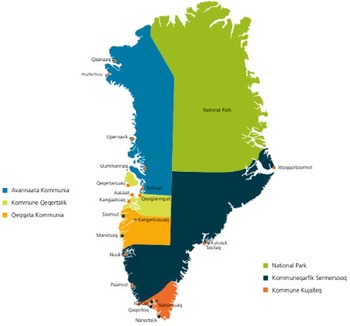
We zoom in on East Greenland, a 3000 km long coastline and the home of around 3,500 inhabitants. On this vast shore, we find two towns and five settlements. East Greenland is part of Sermersooq municipality, Greenland’s largest municipality (see Fig. 2). Counting close to 23,000 inhabitants, the municipality was established in 2008 by merging large parts of West and East Greenland. This means that the administrative center of East Greenlandic is now located on the West coast in the town of Nuuk, Greenland’s largest town and also its capital (Kommuneqarfik Sermersooq, 2020). Because of distances and its modest and highly dispersed population, East Greenland is often narrated in popular and tourism literature as a remote and disconnected place.
Greenland map with municipalities (Statistics Greenland, 2020).

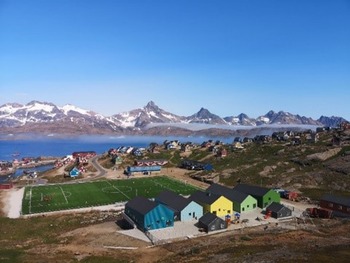
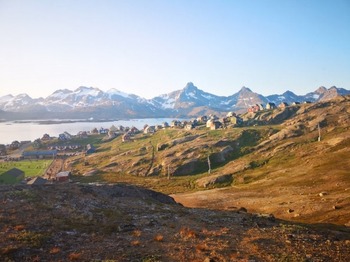
Similar to all other areas in Greenland, no two cities or settlements are connected in East Greenland. The largest and southernmost town of East Greenland is Tasiilaq (see Fig. 3) with 2,000 inhabitants followed by the next largest town of Ittoqqortoormiit with 450 inhabitants. Settlements are Sermiligaaq, Isertoq, Kulusuk (home of the airport connecting East Greenland to Iceland), Tiilerilaaq and Kuummiiut (see Fig. 4). Depending on the location, towns and settlements in East Greenland are only reachable by ship or air from the West coast of Greenland and Iceland between two and six months a year. Depending on the cover of ice on sea and fjords, places may also be reached by boat, dog sled or snowmobile during specific times of the year.
The town Tasiilaq in East Greenland (Chimirri, Daniela (2019)).

The settlement Kuummiiut in East Greenland (Chimirri, Daniela (2019)).

The statistics tell a story of out-migration and unemployment. Just from 2019 to 2020, the population in the East Greenlandic towns of Tasiilaq and Ittoqortoormiit have decreased by 4% and 3% (Statistics Greenland, 2020). While unemployment rate has dropped from 25% in 2015 to 21% in 2018 in the district of Tasiilaq, it still contrasts the country’s average unemployment rate of 5.8% (Statistics Greenland, 2018). In Greenlandic and Danish media, East Greenland is predominantly portrayed in negative, even devastating ways in reports on alcohol, suicides and sexual abuse manifested in headlines such as
”Shocking facts about Tasiilaq citizens. 81 percent of all women in Tasiilaq, born after the year 1970, have been subject to sexual assault. This is the result of the latest public survey from 2018. Also, 42 percent of all men in Tasiilaq have been sexually abused.” (Schultz-Nielsen, Reference Schultz-Nielsen2019)
Recent documentaries (see e.g. Schultz-Nielsen, Reference Schultz-Nielsen2019; Sermitsiaq, 2016; Turnowsky, Reference Turnowsky2019) and political initiatives (see e.g. Meeqqat Pisinnaatitaaffiinik Sullissivik/Children’s rights association, 2016) support this reality.
East Greenland as tourist destination
In starch contrast to the above reports of East Greenland as a place of despair, the tourism discourse – both in marketing and policy – is characterised by an optimism based on prospects and forecasts of growth (Naalakkersuisut, 2016), or, following Haraway, “the belief in the discourse of Progress”.
In tourism marketing, East Greenland is framed as an exotic, last frontier destination. Online promotional websites talk of East Greenland as “one of the most magical places on earth. It transforms from one extreme to another; from cold and dark in the wintertime to hot and sunny in summer. You can find sharp peaks that are cut by retreating glaciers creating deep valleys and blossoming life in summer. There are lush valleys that transform into endless white planes in parts of winter. Around every corner and different from season to season lies a new adventure” (Destination East Greenland, n.d.-a). While destination marketing is by default persuasive, tourism data support (until the COVID-19 pandemic) the growth in visitor numbers and images such as in Figure 5 give an impression of why tourists aspire to visit East Greenland.
Tasiilaq (Chimirri, Daniela (2019)).

Up until the COVID-19 pandemic and looking into the future, much hope is accorded in Greenland to the development of tourism. On a national level, tourism is set to economically supplement export revenues from fishing, which currently represents the dominant economic pillar in Greenlandic economy, covering 92% of the national exports (Wennecke, Jacobsen, & Ren, Reference Wennecke, Jacobsen and Ren2019). In 2018, 21.239 overnight guests stayed in East Greenland (Visit Greenland, 2020), which was the largest increase in international overnight stays in Greenland. Forecasts expect tourism numbers to grow in the decades to come based on the estimated number of tourists forecasted to arrive through the planned airport in Tasiilaq, and in connection with the extension of the airports in Nuuk and Ilulissat (Naalakkersuisut, 2016).
Contrasting the national and municipal administrative structure, where East Greenlandic towns and settlements are governed from the West Coast, East Greenland, is considered as a self-standing tourist destination – Destination East Greenland (DEG). DEG has its own destination manager and an office in Tasiilaq. The three main tasks of DEG are destination marketing, tourism development in Tasiilaq and its surroundings, the running of a souvenir shop and cooperation with the local artists (conversation with DEG employee, July 2019). The municipal Sermersooq Business Council (SBC) is responsible for the economic development of businesses and entrepreneurs in the municipality.
Analysis: East Greenland at proximity
Documents of various sorts provide us, already from our desk research, with “shocking facts”, which we do not wish to reject, nor to contest. Nor do we seek to contest East Greenland as “one of the most magical places on earth”. What we are interested in is rather how we can know if not more, then differently? According to Haraway, “Alone, in our separate kinds of expertise and experience, we know both too much and too little, and so we succumb to despair or to hope, and neither is a sensible attitude.” (2016: 4). Knowing differently in order to become response-able prompts us to turn to the entanglements and co-presences of expertise and experience. In our case, it entails the careful and detailed exploration of how East Greenlandic tourism actors engage in worlding by tinkering not separately, but together, with and around tourism.
Tourism friction
Tourism companies in East Greenland experience the tensions produced within a tourist destination caught in between discourses of social despair and hopeful futures. An example is managing of tourist expectations, which includes the necessity to explicitly voice and interpret the concerns and impressions of the growing numbers of tourists visiting towns and settlements, where obvious social problems are impossible to ignore. An example of this balancing act is a flyer distributed to visitors at the tourist information office in Tasiilaq by DEG. Here, often-conspicuous alcohol consumption is addressed in the following way:
“What else meets the eye – On payday and during weekends, it is not uncommon to meet people under the influence of alcohol. They are, however, friendly, and they have great appreciation for tourist; therefore, if you are approached by a person in a festive mood, it will not be in aggressive manner. If you do not feel like spending your time on a lengthy conversation, just smile and walk on”. (Destination East Greenland, n.d.-b, p. 29)
While not attempting to discard or hide alcohol abuse, the leaflet proposes to the tourist some tactics to handle – or exit – a potentially unpleasant situation, proposing tourists to either becoming the target of festive appreciation (at length) or casually walking away. In a light and disarming attempt, the leaflet straightforwardly addresses a potential and likely encounter between tourists and influenced citizens by means of what Haraway terms staying with the trouble. The leaflet describes such an encounter as common and offers suggestions of how to enter – or exit – this social situation.
The first author experienced such an encounter herself, while walking around with another colleague in a settlement:
“One day on our fieldwork travel, my colleague and I walked around in […] waiting for the supermarket to open up again after its lunch break. While strolling around in the village, we passed two locals sitting on a bench on our way towards the church. They seemed engaged in a highly emotional conversation as one of them was heavily crying and wildly gesticulating. On our way back from the church, where we took some picture, a small group of tourists came towards us talking about these two locals shaking their heads. While passing them, we overheard that they seemed embarrassed by the apparent approach of the locals to talk to them. At the time, we passed the two locals on our way back, they spontaneously greeted and welcomed us. They wanted to start a conversation and asked where we came from. We could sense that both were under the influence of alcohol. The one, who was still crying just a second ago before we came closer, changed instantly to a state of smile and good mood. The situation felt strange and surreal on the one hand, but one the other hand, both of them were genuine and very much interested in talking to us. ”.
The field journal excerpt narrates the alcohol-induced host/guest encounter as ripe with affect and emotions – joy, outcries, embarrassment, dismay, surprise – disrupting usual tourism activities such as strolling the destination, shopping and taking photos. In the process, desirable holiday feelings, such as well-being, relaxation or awe, are replaced with strangeness and surrealism.
As a situated, present and unfinished practice dealing with such encounters, the leaflet displays tourism worlding addressing – as opposed to hiding and denying – the potentially unsettling, but also productive co-presence of tourism companions. The leaflet and the excerpts from the field journal illustrate how tourism and social challenges clash, co-exist and entangle as tourism worlding through its encounters. The tourist flyer shows that local tourism actors are aware of the existing circumstances and act on it to manage potential friction. In communicating directly to the visitors, they attempt to prepare the tourist for friction alluding to the existing circumstances.
By addressing the state that they are in, tourism actors attempt to stay with the trouble along the lines suggested by Ren (Reference Ren2021), in which “trouble is not an issue to be overcome, but rather a condition that we are in and in which we all become-with tourism” (p. 135). As seen from the journal excerpt, friction is not only problematic but also productive, expanding the stories of East Greenland and inviting us to re-imagine what tourism is “really” about, turning our attention to, as we shall explore in further depth here, how tourism is becoming-with.
Tourism companions
In tourism research, the concept of communities is often taken at face value and seen to represent relatively homogeneous entities, directly or indirectly linked to tourism. However, “communities tend to be incomplete, divided and changeable” (Tolkach & King, Reference Tolkach and King2015, p. 389). This is also the case in East Greenland. In settlements such as Kulusuk, very different lives are lived, based on income and employment, origin and relations to the land. Many inhabitants still hunt and fish, pursuing a traditional Greenlandic lifestyle. Others, however, are employed in the public sector, while others again are unemployed. Only very few are employed directly within what we might term “the tourism industry”. However, and as we shall now see, tourism companions abound.
A story to trace this is that of the “Heritage museum” (not named or further described for the purpose of anonymity) founded by a single person, born and raised in the settlement, and run next to her full-time occupation as a teacher. In the following, Malik, her husband, unravels the beginnings:
Malik: The story of [this place] is that my wife’s father started to collect all the objects that you see here. […] She had the idea that she wanted to show it to the people, to the tourists. […]. Now, the tourists can come in and visit the museum and she offers to give a tour and talks about the history and the area.
Researcher: Both of you are working here and somewhere else?
Malik : Yes, we are actually both fulltime teachers.
Researcher: So, you do all of this in your free time?
Malik: Yes, only in our free time. It does not give us food. It is only a hobby. We know that there are many tourists coming [here], but there are not many places for them to go. My wife is a big K like Kulusuk. She wants people to have a place where they can go to learn about [the place] […]
Researcher: Are locals visiting as well?
Malik: Many are very interested, not so much in coming, but in donating things. We also sell souvenirs made by locals living in the area. It is important for local people that tourists also buy souvenirs. That way, we can also help the local artisans. She wants to keep it local. If she can pay the bills, she is satisfied.
We could read this as an account of building and running a small, local museum, which very many outside visitors come to visit. An example of very concrete and successful development of an attraction. And it is indeed all of this. Nevertheless, it is also something else. It is also a story of how the museum comes together and is sustained through a bundle of practices, actors and artefacts: private artefacts turned into museum objects, artisanal souvenirs and tours. It is a story of history, heritage, family and locality. For the museum manager and her husband, it is an activity next to their “real” teaching jobs.
In that sense, it is not a “proper” tourism job, at least in economic terms. It does not provide food on the table, but it creates satisfaction. It is a source of great joy and pride – for the founder, her family and for the people donating things. As we are told, the museum is enabled through unpaid volunteer labor, local support and interest. Local support is not manifested by visiting the museum – this is a role delegated to tourists, but through the donation of family objects of historical interest. While locals show support for the project through donations, the museum reversely offers community support by enabling a place for selling local handicraft.
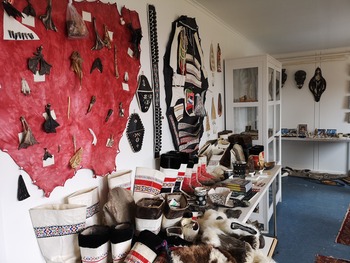
Entering the museum, attention is easily drawn to a sealskin, dyed flaming red and fastened on the wall. The skin is adorned with an abundance of duck and rabbit feet, teeth, claws, dried fish and various animals skulls feathers and pinned or hanging in clear plastic bags (Fig. 6). While we could think of these as museum objects, they are also other things. As non-human companions, they bear witness of local hunting, fishing and gathering practices of preservation techniques. Brought together in a colourful aesthetics, the skin is a witness of an abundant animal life in the sea and lands surrounding the settlement, the skills of hunting and of preparing and tanning the sealskin. The sealskin carries the weight of climate changes threatening wildlife and hunting of depopulation and modern ways of life challenging traditional ways of life. Togther with the other museum companions, the flaming red seal skin tells the story of worlds present, disappearing and in the making.
Museum in East Greenland (Chimirri, Daniela (2019)).

The ongoing tinkering with the museum, in ways which might at first glance seem modest, is unimportant – in lack, for instance of a clear tourism strategy or exhibition structure – exemplifies the work of the multitude of discreet and often-unacknowledged actors, which as suggested by Ren et al. (Reference Ren, Jóhannesson, van der Duim, Ren, Jóhannesson and van der Duim2018) are often overlooked in tourism (research). Besides acting as a custodian of history and traditions, the museum works as a companionship, as a site of sustained and entangled care, tinkering and embodied engagement and concern of the founder, local families donating, visitors, objects, buildings and changing landscapes and wildlife. The objects, such as the red sealskin, tell of Kulusuk and its companions. By bringing these messmates to the fore, the museum exemplifies tourism worlding in-between discourses of hope and despair.
String figures: getting on with and through tourism
In conversation with Jacob, a local tourism entrepreneur in Tasiilaq, he describes a difficult situation:
“We try constantly to develop [the destination]. However, what does it mean, ‘developing’? It is difficult to say. With developing, we also change the landscape. Development initiates change. Is that really good? […]. The Tunumiut [East Greenlanders] that live here are a minority in their own country. They have the right to live how they want to live, but they are wrong in living how they do, because they have lost. That is a contradiction, an extreme contradiction. I don’t know how to solve the problem. What I do know, is that we have to decide. I really dislike decisions that are made by one person or a small group. Coming back to our business here, when there is a decision to make, I ask everyone that works here. I include them all. Everyone! We are one and we have to decide together. That is difficult of course, but necessary” (Jacob, operational manager of an accommodation in Tasiilaq, East Greenland, July 2019)
Coming back to the story of Jacob. It is a confluence of difficulties, contradictions, development, frustration and hope. To him, every becoming is grounded in collaborative decisions and entangled in conditions of working and living together. Not pointing to despair, nor to progress, his story is about the tentative steps taken in the ongoing attempt to change and adapt. It suggests decisions as collaborative and to the entangled condition of working and living together. While the research conversation was framed around tourism, the narrative “strays” to include also the land, the Tunumiut people and culture, history and loss.
Jacob has spent more than 30 years working within the tourism field and being active in the community. According to him, not everything has succeeded along the way and many challenges have impeded well-meant plans. However, he still firmly believes that “only by working together, can we be in symbiosis and be prepared for the future” (Jacob, East Greenland, July 2019). Jacob tells that he did not have a clear vision when first starting to develop tourism decades ago, neither does he want nor is able to shape the future alone. Instead, the past, present and future are about finding ways in which tourism companions become and get on together.
As opposed to thinking of collaboration as the exchange of boxed-in ideas or messages, Haraway’s (Reference Haraway2016, Reference Haraway2018) metaphor of the string figure can serve as a way to think about collaboration as something beyond a model of transaction or a systematic process. Playing string figures refers to “giving and receiving patterns, dropping threads and failing but sometimes finding something that works, something consequential and maybe even beautiful, that wasn’t there before, of relaying connections that matter”(Haraway, Reference Haraway2016, p. 10). As Haraway terms it, “String figures are like stories; they propose and enact patterns for participants to inhabit” (Haraway, Reference Haraway2016, p. 10). This and other stories of the ongoing collaboration and cohabitation of tourism companions in East Greenland show what Haraway calls “the modest possibilities of partial recuperation and getting on together”(p. 2016). The tourism worlding stories from East Greenland reflect the constant processes of negotiating and co-creating ways of balancing current situations, but also becoming with these existing circumstances.
As tourism companions, Jacob, Paalu and Enoq are in a constant process of becoming-with tourism, identifying and negotiating ways of balancing tensions, friction and existing circumstances in tourism worlding. As argued by Jacob, “I will not live forever, but it needs to go on. I am certain that it will go on. […] People are engaged. I believe they will continuing and this will keep on contributing” (Jacob, East Greenland, July 2019). Pointing beyond his own lifespan, Jacob forecasts the ongoing, collaborative work of preparing for a not further specifies future, working together closely. It is unclear who and what it is that contributes to what, but the process of moving forward resembles Haraway’s idea of staying with the trouble, which entails “relays, string figures, passing patterns back and forth, giving and receiving, patterning, holding the unasked-for pattern in one’s hands”(Haraway, Reference Haraway2018, p. 62).
Conclusion
In this article, we used the practical ways of enacting tourism – tourism worlding – as a way to know East Greenland. This entailed foregrounding tourism actors and their ability to problematise their own issues and concerns (Birkbak, Petersen, & Jensen, Reference Birkbak, Krogh Petersen and Elgaard Jensen2015). By attempting to do so through critical proximity, we sought to align with recently voiced concerns in Greenland to produce societally relevant research and to include citizens into its (co-)production (Hansen & Ren, Reference Hansen and Ren2020; Ren & Thomsen, Reference Ren, Thomsen, Merrild Hansen and Ren2020). Through conversations and life mapping, past, present and possible future stories of tourism were crafted, enacting new positions and relations in and to the world become possible in-between prevailing discourses of hope and despair.
Abstaining from answering questions posed and contemplated from afar, our analysis seeks to display openings rather than closings and to add insights to ongoing conversations of situated concerns, conversations that must be iterative, open-ended and inclusive to all actors, wishing to be part of it. The stories in our article challenge traditional accounts of tourism as a purely economic or socio-cultural undertaking and unravel it as intrinsically linked to and co-constructed with a multitude of practices usually perceived as “outside” of tourism (Jóhannesson et al., Reference Jóhannesson, Ren and van der Duim2015). Tourism in East Greenland is not a contained industry or sector but a highly assembled, distributed, negotiated achievement. Tourism disrupts the social, and this is the reason why debates need to be continuous and unsettling. More than anything, the stories challenge the understanding of tourism development as a straightforward, rational process of progress and invites us instead to consider tourism as part of a much larger and more complex process of worlding.
Acknowledgments
The authors would like to thank the citizens of Kulusuk, Sermiligaaq, Kummiut and Tasiilaq for sharing concerns and stories of their everyday life. Also, the authors would like to acknowledge the extremely thorough and valuable comments and recommendations provided by the reviewers. The academic world would be a better place if all reviewers could be like you!