Introduction
Deer flies (Diptera: Tabanidae) are an annoying pest in recreational areas in North America. They are blood-feeding ectoparasites that can disperse over several kilometres over a long time (Sheppard and Wilson Reference Sheppard and Wilson1976) and can fly among hosts over tens of metres in a short time (Foil Reference Foil1983). A few tropical species are active in the forest canopy, but most species are active within only a few metres of the ground (de Souza Amorim et al. Reference de Souza Amorim, Brown, Boscolo, Ale-Rocha, Moises Alvares-Garcia and Balbi2022). In Canada, flies typically ambush people in open areas along forest trails and at picnic areas near lakes. In areas with many flies, such as Algonquin Park in Ontario, Canada (Ossowski and Hunter Reference Ossowski and Hunter2000), flies swarm around people’s heads during mid- to late summer. They are also a nuisance in residential settings and are aggressive biters of dogs. They feed on wild mammals such as white-tailed deer, Odocoileus virginianus, and moose, Alces americanus (Cervidae) (Smith et al. Reference Smith, Davies and Golini1970), and are common pests of livestock (Teskey Reference Teskey1960; Lewis and Leprince Reference Lewis and Leprince1981). During peak seasonal abundance, maximum catches up to 1000 per hour (mostly Chrysops vittatus Wiedemann) were obtained in a sweep net survey in Michigan, United States of America (Strickler and Walker Reference Strickler and Walker1993). Chrysops vittatus is particularly attracted to people, accounting for 78% of tabanids caught in sweep nets versus only 5% in Malaise traps in New Jersey, United States of America (Tallamy et al. Reference Tallamy, Hansens and Denno1976).
In Africa, Chrysops silacea (Austen) and Chrysops dimidiata (Wulp) are of medical significance as vectors of Loa loa Cobbold, a filarial parasite responsible for the disease loiasis (Kelly-Hope et al. Reference Kelly-Hope, Paulo, Thomas, Brito, Unnasch and Molyneux2017). Catches of Chrysops Meigen as a whole are often 1% or less of all tabanids in all but a few African trapping studies (Sinshaw et al. Reference Sinshaw, Abebe, Desquesnes and Yoni2006; Koné et al. Reference Koné, N’Goran, Sidibe, Kombassere and Bouyer2011; Acapovi-Yao et al. Reference Acapovi-Yao, Kohagne, Tra Bi Ta and Mavoungou2017). Hence, sweep nets are used for critical sampling in the study of loiasis (Pryce et al. Reference Pryce, Pilotte, Menze, Sirois, Zulch and Agbor2022). In the absence of convenient sampling methods, the biology of deer flies is not well documented, with most studies recording only their presence and species composition.
Researchers have explored only a few alternatives other than traps for sampling deer flies – for example, sticky weather balloons (Snoddy Reference Snoddy1970), trolling with mobile sticky objects (Mizell et al. Reference Mizell, Mizell and Mizell2002 ), and use of sticky patches on clothing (Cilek Reference Cilek2000 ). More practical collection methods have received little attention other than the development of the large two-tier box trap for two salt marsh species (French and Hagan Reference French and Hagan1995). The upper tier of the box trap, at 1.8 m, is very effective for Chrysops atlanticus Pechuman and Chrysops fuliginosus Wiedemann. Mean catches of up to about 600/day were achieved in both tiers in 1-octen-3-ol–baited traps. Unfortunately, this large and heavy trap is cumbersome and is practical only for fixed applications. Chrysops atlanticus can also be captured in the large Townsville Malaise trap (Schreck et al. Reference Schreck, Kline, Williams and Tidwell1993).
Two-tier box traps do not catch other species of deer flies in large numbers; for example, means of approximately seven per day in unbaited traps in Vermont, United States of America (Freeman Reference Freeman2017) and similar numbers in traps baited with CO2 in Florida, United States of America (Cilek and Olson Reference Cilek and Olson2008), are common. Overall, in 80 representative tabanid studies reviewed by the author, low catches in any trap are the norm, including those in Malaise traps (Skvarla et al. Reference Skvarla, Larson, Fisher and Dowling2021). The one exception is for another coastal species, Chrysops flavidus Wiedemann. One hundred or more per day can be captured in the large Stoneville Malaise trap in Mississippi, United States of America, especially with CO2 (Roberts Reference Roberts1972, Reference Roberts1975, Reference Roberts1976, Reference Roberts1978). Catches of deer flies are increased by baiting traps with CO2 or 1-octen-3-ol (Wilson and Richardson Reference Wilson and Richardson1970; Cilek and Olson Reference Cilek and Olson2008) but not with other baits targeting tsetse or horse flies (Mihok and Lange Reference Mihok and Lange2012).
To address the need for a simple and portable trapping device, I have revisited the basic design of the multipurpose blue–black Nzi trap (Mihok Reference Mihok2002) for the high-flying behaviour of deer flies. The experiments reported here may also be applicable to tabanids with similar behaviour, in particular Haematopota Meigen in Europe (Thomson and Saunders Reference Thomson and Saunders1986). A typical example of the high-flying behaviour of Chrysops is from Algonquin Park (Bennett and Smith Reference Bennett and Smith1968). In that study, equal numbers of Chrysops were caught in CO2–baited cage traps with entrances at 36 or 86 cm above ground level, whereas most Hybomitra Enderlein (84%) were captured at the lower height. A similar contrast in height of landing has also been documented for Chrysops versus Tabanus Linnaeus landing on a sticky enclosure surrounding a Nzi trap (Mihok and Carlson Reference Mihok and Carlson2007).
The Nzi trap has been useful for sampling biting flies worldwide (Mihok et al. Reference Mihok, Sakolsky-Hoopes, Morris, Dargantes and Mohamed-Ahmed2022), with 129 studies in 43 countries, 93 of which have included data on tabanids and 60 of which have included data on stable flies (Stomoxys Geoffroy). The Nzi trap catches Chrysops well in Canada (maximum catches of up to 190 per day; 8987 trap-days to date). Capture efficiency has not been measured in detail but appears high (81%; 51/(50+13); Mihok et al. Reference Mihok, Carlson and Ndegwa2007). This has made it a useful tool for testing odour baits (Mihok and Lange Reference Mihok and Lange2012) relative to more cumbersome fabric traps – for example, the 6-m Gressitt Malaise trap (Ringrose et al. Reference Ringrose, Abraham and Beresford2014). The Nzi trap is also unique in catching Stomoxys while maintaining equitable catches of tabanids (Tunnakundacha et al. Reference Tunnakundacha, Desquesnes and Masmeatathip2017), a feature that was incorporated in its development (Mihok Reference Mihok2002). Hence, biting fly surveys have often included Nzi traps in addition to Stomoxys-specific traps such as the Vavoua trap (Mihok et al. Reference Mihok, Kang’ethe and Kamau1995; Onju et al. Reference Onju, Thaisungnoen, Masmeatathip, Duvallet and Desquesnes2020).
Here, I report on a simple modification to the design of the Nzi trap that improves the catch of deer flies and that does not require traps to be set at an inconvenient height, without unduly affecting the catch of horseflies and stable flies.
Material and methods
Experiments were conducted in 2020 in a residential turfgrass setting on the outskirts of Russell, Ontario, Canada (Mihok et al. Reference Mihok, Carlson, Krafsur and Foil2006), and at a hobby farm with cattle, pigs, and poultry 6.5 km north (a new location) of the residence. A standard Nzi trap (Supplementary material, Fig. S1A) in phthalogen blue (TDV Industries, Laval, France; type IF3GM, copper phthalocyanine, CuPc) or phthalogen turquoise cotton (home-dyed 5% sulphonated CuPc) was included in each experiment as the control (Mihok and Carlson Reference Mihok and Carlson2021). Turquoise traps (Supplementary material, Fig. S1K) were used at the farm because this colour is particularly effective for Hybomitra, which was expected to be common at the farm. Modified traps were in the same colour within experiments as the control was. Sunbrella marine acrylic (Pacific Blue; Glen Raven Inc., Glen Raven, North Carolina, United States of America) or Top Notch polyester (Blue #563; Marlen Textiles, New Haven, Missouri, United States of America) was used for black. Ultraviolet light–resistant white polyester mosquito netting (Mosquito Curtains, Alpharetta, Georgia, United States of America) was used.
Experiments were mostly replicated Latin squares with treatments rotated among sites separated by 10–25 m. The exception was when a Plexiglas® trap (at a fixed location) was compared to a fabric Nzi trap set nearby in experiments P1–P3. All traps were baited with an octenol lure (1-octen-3-ol; Biosensory Inc., Putnam, Connecticut, United States of America) and were set 5–10 cm above ground level. Other baits were added in some experiments to provide contrasts in how different designs performed for ways in which Nzi traps are sometimes baited. These included household ammonia (changed every few days; 5%), aged cattle urine (Mihok and Lange Reference Mihok and Lange2012), and fresh cattle manure (faeces intermingled with some straw; 2 kg). At the farm, livestock were near traps and sometimes roamed freely.
Experiments focused on testing a modified Nzi trap by increasing the entrance area, as in the multiple entrance tetra trap (Dia et al. Reference Dia, Desquesnes, Hamadou, Bouyer, Yoni and Gouro2008), but keeping the existing layout for simplicity. To do this, the bottom half of the blue front horizontal panel was removed (Fig. 1). The horizontal inner shelf was retained and was connected at the back to a new inset vertical baffle. This was done to limit escape as in the final design phase of the Nzi trap. These modifications partitioned the trap into a lower compartment and an upper compartment. A photo of this new design is provided in Fig. 2.
Side view of the layout of a modified Nzi trap with an additional upper front entrance and a new vertical inner baffle: A, new vertical inner baffle, B, existing horizontal netting shelf, and C reduced front horizontal blue shelf.

Photograph of a phthalogen blue cotton bi-level Nzi trap with a flexible plumbing pipe used to suspend the cone. Note the netting sleeve and plastic chamber collection system. This is an example of the “horizontal” configuration.
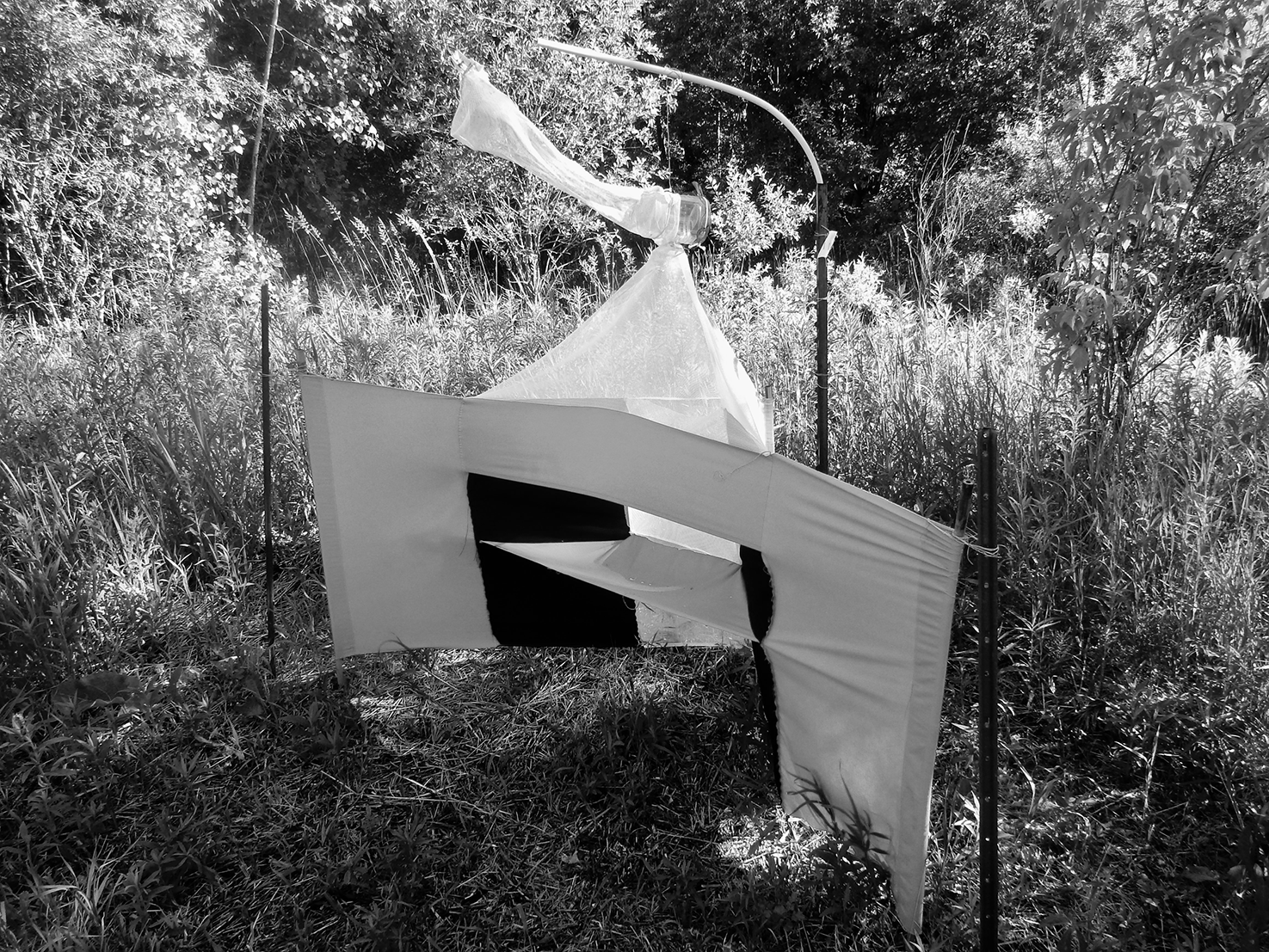
The trap is best set with bamboo poles inserted into corner sleeves with guy wires or metal poles used for obtaining a symmetrical shape. These stretch the top of the trap and result in a smooth cone. The cone can be suspended from a sapling or any flexible pole (13-mm-diameter CPVC plumbing pipe). A practical collection system consists of a sturdy 2-L plastic juice bottle cut to provide a short funnel exit (32 mm diameter) and an intermediate chamber (the back should be cut off and closed with netting for less wind resistance and increased drainage of water and to keep flies in good shape for identification). A white netting collection sleeve (50 cm long) is attached to the chamber with light sewing elastic.
The designs tested are summarised in Table 1 (H for Home (or residence); F for Farm) with a breakdown of the detransformed mean catches by genus in the standard Nzi trap provided for each experiment. At the farm, three experiments were also conducted with a special Plexiglas trap set next to a pig pen (coded as P1–P3; Supplementary material, Fig. S1AD). The trap was made from blue (#2114) and black Plexiglas; the Plexiglas was previously used for two seasons in Mihok and Carlson (Reference Mihok and Carlson2021). The trap was modified to have two netting cones so that flies entering through either the high or low entrances could be enumerated (Supplementary material, Fig. S1AF). Catches were compared with a standard fabric Nzi trap rotated among nearby locations in experiments F2–F4. In 2021 and 2022, this trap was also operated in a variety of alternative materials to supplement 2020 data. Data are reported in the present study only for the heights at which tabanids entered.
Experimental summary with the detransformed mean catches for the control Nzi trap. Catch indices for experimental traps in tables and figures are relative to this standard trap within each experiment.

Note: N, sample size for each trap (e.g., 4 traps rotated among 4 sites × 4 replicates are N = 16 per trap).
Means for each genus of biting flies are the detransformed × log (x + 1) values.
Total, catch of all tabanids in all traps, except for two entries for total catches of stable flies in F5 and F6.
Species, top three species by raw catch, typically accounting for about 90% or more of the total.
An extra trap set for other purposes in experiments H3 and F1 is not reported in this paper.
Empty cells represent no or few catches.
ANOVA, analysis of variance; Rep, replicates (number of days each trap was set); Tabanids/Tabanidae, Tab, Tabanus; Chr, Chrysops; Hyb, Hybomitra; Sc, S. calcitrans; Cc, C. cincticornis; Ca, C. aberrans; Cu, C. univittatus; Hi, H. illota (Osten Sacken); Hl, H. lasiophthalma; Tl, T. lineola; Ts, T. similis; Tq, T. quinquevittatus; O, octenol lure; U, cattle urine; M, cattle manure; A, household ammonia.
The logic of changing the Nzi trap design for high flyers originated in the tabanid literature and from an observation that some deer flies likely approach Nzi traps above a height of 1 m (Mihok et al. Reference Mihok, Carlson and Ndegwa2007). I report further on this phenomenon in a test of trap height at the residence (H0) in 2001. In that test, an unbaited Nzi trap was alternately set at ground level or at 50 cm off the ground for 34 days.
The goal of the design changes was to find an entrance configuration that would provide a representative sample of species flying at various heights, while minimising escape of high- and low-above-ground flyers. The choice of what to test was empirical and incremental, with promising designs retested as the tabanid fauna changed. Work focused on opaque or transparent panels of phthalogen blue, phthalogen turquoise, black, or netting for the horizontal shelf, the vertical inner baffle, or both. The starting point was based on insights gained during the design phase of the Nzi trap (Mihok Reference Mihok2002). Those experiments showed that transparency in the centre of the trap was the key factor leading to improved performance. However, little attention was paid to incorporating blue or black materials for a small “target” area to improve trap entry.
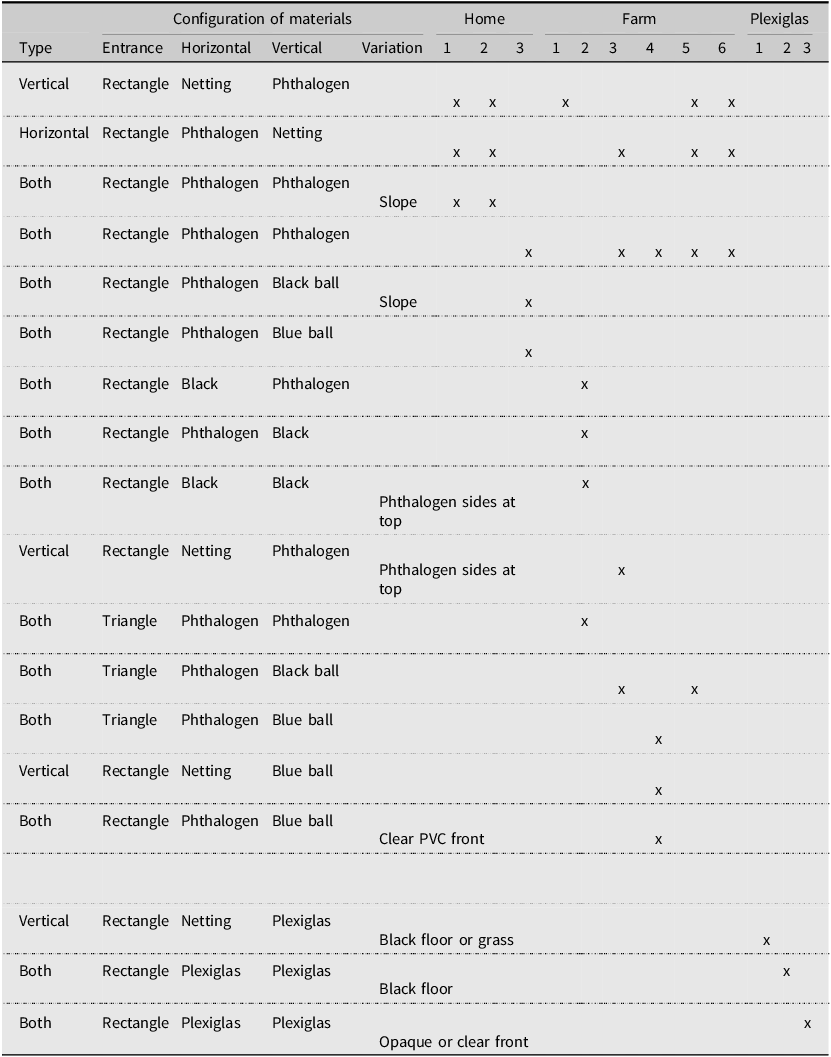
The position of opaque materials was the focus of many comparisons, given how tabanids behave towards horizontal and vertical features of objects at different angles and heights (Horváth et al. Reference Horváth, Pereszlényi, Egri, Fritz, Guttmann and Lemmer2020). Lastly, a glossy phthalogen blue vinyl or black spray–painted ball (33 cm diameter) was tested in place of an opaque vertical baffle. This was done to test whether specular reflection inside the trap would improve catches by exploiting the attraction of tabanids to polarised light (Egri et al. Reference Egri, Blahó, Sándor, Kriska, Gyurkovszky, Farkas and Horváth2012). The balls used moved freely in the wind and would also have provided a random movement cue. Each experiment tested a theme of simple contrasts for clarity in choosing what to test next. For reporting, three configurations are referred to as horizontal, vertical, or “both”, reflecting where an opaque object (fabric or ball) was used in place of transparent netting. Figure 3 shows these configurations. Table 2 summarises all configurations by experiment. Supplementary material, Fig. S1 provides photos of all traps with detailed descriptions.

Summary of the trap configurations in experiments H1–3, F1–6, and P1–3.

Note:
Type: Whether an opaque material (phthalogen or black cotton/suspended ball or phthalogen Plexiglas) was used for the horizontal inner shelf, the vertical inner baffle, or both panels, for clarity, and for grouping data in presentations.
H1: Simple contrasts, slope trap had a single phthalogen panel extending from the middle of the trap at the front to the middle of the trap sides at the bottom of the cone.
H2: Same traps as H1 but with a clear, reflective piece of PVC placed over the netting at the front of the cone.
H3: Slope trap modified to a shallower panel extending to 23 cm from the bottom of the cone, balls also tested.
F1: Only one trap tested with a vertical phthalogen baffle and a netting horizontal shelf as in H1 and H2.
F2: Variations on black instead of turquoise or netting, one trap had turquoise top sides, and one had a triangular entrance.
F3: Retesting simple designs, also testing a triangular front entrance with a black ball.
F4: Exploring the use of a blue ball instead of a baffle, first test of a transparent front shelf as a physical barrier only.
F5: Autumn test at seasonal peak of stable flies, retesting some designs and inclusion of a pyramidal trap as a 2nd control.
F6: Repeat test of the simplest designs for stable flies at the highest numbers to confirm best design.
P1: Plexiglas trap with horizontal netting shelf and vertical blue baffle, a triangular black Plexiglas “floor” was set inside the trap on the ground on alternate days; presence/absence of this target did not affect the catch.
P2: Plexiglas trap retested from P1 with a blue horizontal shelf, black floor used on alternate days (not significant).
P3: Plexiglas trap retested from P2 with ground level black target now present throughout, front blue Plexiglas shelf alternated with clear Plexiglas (not significant).
Sixty half-hour high-definition or 4K videos were also taken at the front of traps to document the kinds of behaviour the author has observed over the last two decades. A representative clip of deer fly behaviour is presented for a trap baited with octenol at the residence (Supplementary material, Video S1). Horse fly behaviour varied among species and was difficult to document well. Hence, a few videos were taken in an area with many species (White Lake, Ontario, 45° 15.8 N, 76° 41.1 W). A representative clip is presented for a trap baited with octenol, dry ice, ammonia, and cattle urine (Supplementary material, Video S2).
Statistical analyses
Analyses of variance were performed for log(x + 1)-transformed catches (Mihok and Lange Reference Mihok and Lange2012). Results are summarised as detransformed mean catches per day, with relative catch indices and 95% confidence intervals provided for cross-comparison, as in many previous experimental studies (Vale Reference Vale1993). The catch index is the ratio of the detransformed mean of the test trap to the standard; it is more explicitly defined as a response ratio in the statistical literature (Hedges et al. Reference Hedges, Gurevitch and Curtis1999). The outcome was an a priori test for a significant difference relative to a standard Nzi trap (P < 0.05 based on the analysis of variance mean square error), considering sites and days. A detailed example of a statistical analysis for a typical Latin square experiment is in Mihok and Carlson’s (2021) Supplemental material, Appendix S2.
Results
The total catch was 10 132 female tabanids (66% Tabanus, 23% Chrysops, 11% Hybomitra) and 21 males. The tabanid fauna was similar to that caught in past work, with 28 species recorded. Mean catch was 12.9 tabanids/trap/day, with a maximum of 121. In addition, 1859 stable flies were captured (83% males), most of these catches occurring at the farm. As an example of the power of experiments, the average least significant difference in H and F experiments translated into being able to detect a 42% (1.42 × Tabanus) or 52% (1.52 × Chrysops) change in catch for a test trap relative to the control at P < 0.05. Log transformation typically normalised data (Shapiro–Wilk test; e.g., Tabanidae in H2: W = 0.99, P = 0.67; F2: W = 0.97, P = 0.07).
In experiment H0, a Nzi trap set 50 cm above ground caught as many tabanids as a trap set at ground level in a late-season experiment dominated by Tabanus quinquevittatus Wiedemann and Chrysops aberrans Philip (catch index = 0.94, 95% confidence interval 0.52–1.73). A nonsignificant shift in fauna occurred, with higher captures of Chrysops (index = 1.54) and lower captures of Tabanus (index = 0.73) at 50 cm.
Over 12 experiments in 2020, useful data were obtained for 29 comparisons of catches by genus (Table 1) for 18 modifications of Nzi traps (Table 2). Two representative experiments at high numbers are presented in full for phthalogen blue and turquoise traps, followed by a graphical summary across all experiments.
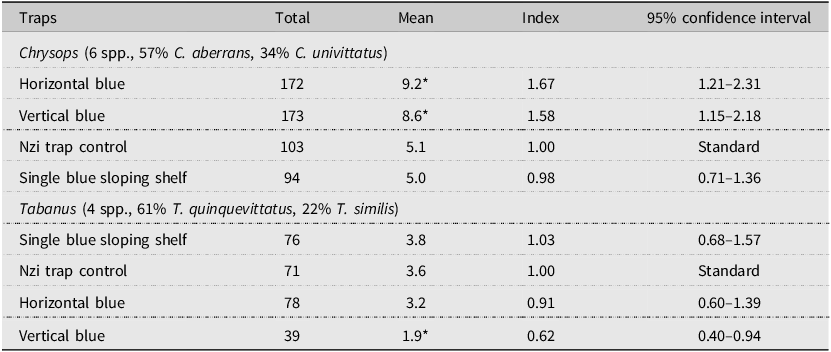
In experiment H2 at the highest mean catch of Chrysops (Table 3), traps with a blue horizontal shelf (Supplementary material, Fig. S1D) or a blue vertical baffle (Supplementary material, Fig. S1C) caught significantly more Chrysops than the standard Nzi trap did, with similar patterns among species (Table 3). Catches of Chrysops with a single sloping shelf (Supplementary material, Fig. S1E) were equal to the control. Catches of Tabanus were equal to the control for two variations and slightly significantly lower for one variation (index = 0.62, confidence interval 0.40–0.94; Table 3). Tabanus quinquevittatus, T. similis Macquart, and T. lineola Fabricius accounted for most of the catch. A sloping shelf was not explored further because this configuration caught many nontarget Diptera (muscids, Syrphidae) and Hymenoptera (especially Vespidae).
Experiment H2 at the residence in Russell, Ontario, Canada in early July 2020 (N = 16 per trap) in phthalogen blue traps. Total catches per trap, detransformed mean catches (flies/trap/day), and catch indices with 95% confidence intervals for two genera of Tabanidae relative to a standard phthalogen blue Nzi trap.

Note: All traps had a clear PVC panel covering the front of the netting cone.
Vertical refers to a blue baffle with a horizontal netting shelf; horizontal refers to a horizontal blue shelf with a netting baffle; the single sloping shelf was blue.
Index: ratio of detransformed mean catch in the experimental trap to the detransformed mean catch in the standard trap.
* Significant at P < 0.05 in a priori comparison versus the standard trap.
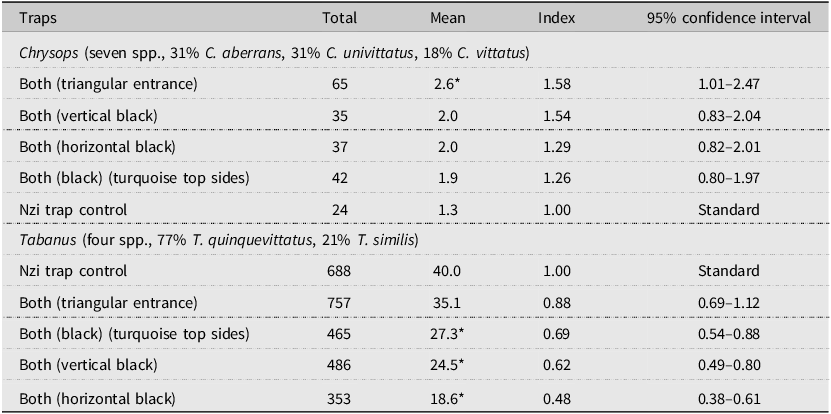
Experiment F2 was conducted at the farm at high numbers of Tabanus and was run at the same time as experiment H2. It explored black for one or both inner panels, relative to a trap with turquoise for both (with a triangular rather than a rectangular entrance). The trap with turquoise for both panels (Supplementary material, Fig. S1M) caught significantly more Chrysops (index = 1.58; Table 4) than the control did while catching equal numbers of Tabanus (index = 0.88) as the control. Catches of Tabanus were lower in traps with any inner black (Supplementary material, Figs. S1N–P; index 0.48–0.69), with catches of Chrysops equal to those of the control. Because of this, use of black for inner panels was not explored further.
Experiment F2 at the farm in Russell, Ontario, Canada in early July 2020 (N = 15 per trap) in phthalogen turquoise traps. Total catches per trap, detransformed mean catches (flies/trap/day), and catch indices with 95% confidence intervals for two genera of Tabanidae relative to a standard phthalogen turquoise Nzi trap.

Note: All trap variations had turquoise or turquoise and black panels, with the position of any black panels noted in parentheses along with a variation with turquoise top sides.
Index: ratio of detransformed mean catch in the experimental trap to the detransformed mean catch in the standard trap.
* Significant at P < 0.05 in a priori comparison versus the standard trap.
To simplify cross-comparisons, catch indices are presented over all experiments by genus for meaningful data in Figs. 4, 5, and 6, with an index to photos in Supplementary material, Fig. S1 provided in each caption. Significant increases in catch relative to the control are green, equal catches are blue, and lower catches are red. All traps with an upper entrance performed well for Chrysops, with 11 of 24 tests resulting in significantly increased catches (index 1.5–2.7; Fig. 4) and with 13 tests resulting in catches that were equal to those of the control. Addition of a polarising feature to the trap did not improve catches (Supplementary material, Fig. S1F, clear UV-absorbing vinyl attached to the cone in H2; Supplementary material, Fig. S1J, blue or black balls suspended in H3, F3). The highly reflective Plexiglas trap in P1–3 (Supplementary material, Fig. S1AJ) was nevertheless one of the best traps.
Catch indices with 95% confidence intervals for Chrysops. Indices are relative to the catch in a standard Nzi trap within experiments. Trap designs are grouped in terms of the three configurations for the position of opaque materials: vertical, horizontal, or both. Substitutions of the phthalogen panel for black or other minor variations noted. For example, vertical (black) refers to a trap with an opaque black vertical baffle instead of a phthalogen baffle, and with a netting horizontal shelf. Green bars represent catches significantly greater than the control, blue bars represent equal to the control, and red bars represent lower than the control. The detransformed mean catch in the modified trap is provided in each label. The last element of the caption is a reference to a photograph of the trap in Supplementary material, Fig. S1.

Catch indices with 95% confidence intervals for Tabanus and Hybomitra. See Fig. 4 caption for an explanation of the Y-axis legend and the colours.

Catch indices with 95% confidence intervals for Stomoxys. See Fig. 4 caption for an explanation of the Y-axis legend and the colours.

Catches of Tabanus were equal to those of the control in 15 of 25 tests and lower than those of the control in 10 tests (Fig. 5). Results were similar for analyses of variance conducted separately for the three common Tabanus (data not shown). Lower catches occurred when a reflective object or black was used, with a few exceptions. For example, use of a shiny black ball (Supplementary material, Figs. S1Q and S1AC, experiments H3 and F3) did not affect catches; catches were lower than that of the control when the substitution was a shiny blue ball (Supplementary material, Fig. S1I and S1W, experiments H3 and F4). Lower catches also occurred when the vertical baffle was blue Plexiglas (Supplementary material, Fig. S1AG; experiment P1) at high numbers of T. quinquevittatus and T. similis. The Plexiglas trap performed well with both inner panels in blue (Supplementary material, Fig. S1AH, experiments P2, P3). Catches were also nearly the same when the front shelf was blue or clear Plexiglas (experiment P3, Supplementary material, Fig. S1AH, 12.3 blue, Supplementary material, Fig. S1Ai, versus 11.8 clear, NS, index 0.96, confidence intervals 0.37–2.48). This option was retested in experiment F4 using a turquoise fabric trap with a clear vinyl front shelf (Supplementary material, Fig. S1V). Substitution of the shelf for PVC reduced catches. This result could have been related to morning condensation on the PVC (Supplementary material, Fig. S1Y); this rarely occurred with Plexiglas.
Hybomitra (89% H. lasiophthalma (Macquart)) was caught mainly in experiments F1 and F2 (Fig. 5). In experiment F1, a trap with a turquoise vertical inner baffle (Supplementary material, Fig. S1L) caught more Hybomitra than the control did (index 1.43, confidence intervals 1.09–1.87). Catches were equal to or lower than those of the control in four comparisons in experiment F2 when the focus was on testing black (Supplementary material, Fig. S1N–P).
Stable flies (Stomoxys calcitrans Linnaeus) were present during experiments, with two tests conducted at their seasonal peak in autumn (F5, F6). Overall, catches were equal to the control in 13 of 22 tests and were significantly lower in nine, with no clear optimal design (Fig. 6). The pyramidal trap included in experiment F5 (Supplementary material, Fig. S1B) did poorly (index 0.46), despite being similar to the Vavoua trap.
Behaviour
The use of two collectors in the Plexiglas trap set from 2020 to 2022 provided data on how 7399 tabanids partitioned by height over 159 days. Chrysops (17 spp.) mainly entered through the top (88%, range among species 80–100%, N = 3173). They landed on and investigated mostly the middle and upper front blue surfaces of a trap (Supplementary material, Video S1, Chrysops cincticornis Walker only present). After entering, deer flies typically flew up and were captured within several minutes.
Tabanus (9 spp.) entered the trap through both entrances, with various patterns among species. Tabanus quinquevittatus (70%, N = 771), T. similis (78%, N = 107), T. reinwardtii Wiedemann (77%, N = 13), and T. novaescotiae Macquart (83%, N = 6) entered mostly through the lower entrance. Tabanus marginalis Fabricius entered mostly through the upper entrance (87%, N = 30), and Tabanus lineola entered evenly through both entrances (54% top, N = 109). Tabanus, like Chrysops, transferred to the cone quickly and were caught within minutes. Hybomitra (12 spp.) entered mainly through the upper entrance, with little variation among species (94%, range 87–97%, N = 3167). Hybomitra was the most reluctant tabanid to fly directly up after entering the trap, with prolonged flight inside the cone and upper body of the trap, and some downward flight leading to escape.
Horse flies (Tabanus and Hybomitra) mostly landed on and investigated the lower front blue surfaces of traps (Supplementary material, Video S2), often focusing activity on the lower outside blue corners. Some horse flies were also observed landing on the underside of the inner horizontal shelf or on the inner black side walls. Horse flies also flew in between the blue–black panels and entered or collided with the back netting before flying up into the cone.
Stomoxys calcitrans entered mainly through the top (92%, N = 65). Flies rested on and investigated all of the blue surfaces of traps for long periods on sunny days. Flies also engaged in chasing behaviour. Stomoxys was almost never observed landing on blue surfaces inside the body of the trap, although flies often crawled along the very front edge of the new horizontal blue shelf before flying away. On cool mornings, flies would rest on the back of the trap on the black or blue panels when the sun was to the east. Numbers of flies investigating traps at any one time were sometimes higher than those captured, in agreement with a low estimate of trap efficiency for this species (Mihok et al. Reference Mihok, Carlson, Krafsur and Foil2006).
Discussion
The goal of increasing catches of deer flies in a modified trap design was successfully met. Fifty per cent of the modified designs caught 1.5–2.7 times significantly more deer flies than the standard Nzi trap did; catches in the remaining designs were equal. Some of the common species at the residence site were C. aberrans, C. univittatus, and C. cincticornis. Other common species around livestock at the farm were Chrysops frigidus Osten Sacken, C. indus Osten Sacken, and C. vittatus. All of these species bite people, livestock, or wildlife (Teskey Reference Teskey1960; Smith et al. Reference Smith, Davies and Golini1970; Lewis and Leprince Reference Lewis and Leprince1981). In surveys in Ontario and Québec, Canada with Malaise or Manitoba traps (Golini and Wright Reference Golini and Wright1978; Baribeau and Maire Reference Baribeau and Maire1983a), other Chrysops spp. are also often captured in high numbers, but they were not common in this study. The actual species diversity of Chrysops is not well known, with hardly any comparative data for flies caught in traps versus larvae in the environment (Baribeau and Maire Reference Baribeau and Maire1983b).
This positive outcome does not appear to have any caveats in terms of whether traps are made from phthalogen blue or turquoise fabric or blue Plexiglas or of how they are baited. It was achieved through opening the front of the trap to provide a larger and higher entrance up to a height of 75 versus 50 cm. This was done to address the natural tendency of deer flies to swarm around the head and to explore the logic of traps with a very high entrance (Schreck et al. Reference Schreck, Kline, Williams and Tidwell1993; French and Hagan Reference French and Hagan1995). A higher entrance was also tested in combination with a new inner baffle to minimise escape of low-flying species (Bennett and Smith Reference Bennett and Smith1968). This was a critical point in lessons learned during refinement of the Nzi trap relative to similar blue–black traps, such as the epsilon trap (Mihok Reference Mihok2002).
In contrast to the high-flying behaviour of Chrysops, T. quinquevittatus and T. similis entered traps mainly through the lower entrance. Other common tabanids, such as T. lineola, partitioned evenly. Mullens and Gerhardt (Reference Mullens and Gerhardt1979) also found that T. lineola alighted higher on cattle than T. quinquevittatus did. Species differences in behaviour imply that a universal trap for all tabanids may be an elusive goal. A new high-flying Tabanus, T. marginalis, was recorded in the present study, along with a few captures of T. atratus Fabricius. These Tabanus species are uncommon in most trapping surveys (Smith et al. Reference Smith, Davies and Golini1970; Matthysse et al. Reference Matthysse, Mock and Netherton1974; Baribeau and Maire Reference Baribeau and Maire1983b; Thibault and Harper Reference Thibault and Harper1983; McElligott and Galloway Reference McElligott and Galloway1991b; Freeman Reference Freeman2017).
An unexpected finding was the bias for entry through the high versus low entrance in Hybomitra spp. This occurred despite the ease of capture of thousands of Hybomitra in Nzi traps with only a low entrance and their preference for landing on the lowest tier of a sticky blue–black target (Mihok and Lange Reference Mihok and Lange2012). The present finding was also odd given that the most common species (H. lasiophthalma) alights low on the abdomen of cattle (Mullens and Gerhardt Reference Mullens and Gerhardt1979). Tabaninae (mainly Hybomitra) also bite the legs or abdomen of moose and deer, whereas Chrysopsinae tend to bite the head or neck (Smith et al. Reference Smith, Davies and Golini1970).
Hybomitra is nevertheless readily caught in traps with a high entrance. For example, the Manitoba trap catches many Hybomitra (Hanec and Bracken Reference Hanec and Bracken1964; McElligott and Galloway Reference McElligott and Galloway1991a); the trap has an entry height of roughly 1 m, based on the photo in Thorsteinson et al. (Reference Thorsteinson, Bracken and Hanec1965) . Above this height, Hybomitra activity declines considerably; for example, 12 times fewer flies landed at 3 m versus 1 m on Tanglefoot-coated balls, with none recorded at 6 m (Thorsteinson et al. Reference Thorsteinson, Bracken and Hanec1965). Similarly, no captures were recorded in CO2–baited cage traps at about 2 m in an area with many Hybomitra (Bennett and Smith Reference Bennett and Smith1968). Tabanus lineola (high and low entry) and T. similis (low entry) can also be captured in Manitoba traps (Bracken et al. Reference Bracken, Hanec and Thorsteinson1962). Behavioural data from wind tunnels on how other biting Diptera orient towards objects (Gurba et al. Reference Gurba, Harraca, Perret, Casera, Donnet and Guerin2012) could be explored for further design insights, but similar insights from the field are few (Phelps and Vale Reference Phelps and Vale1976; McElligott and McIver Reference McElligott and McIver1987). This makes it difficult to speculate on attraction distances and close-range behaviour of tabanids towards artificial objects versus hosts (Phelps and Holloway Reference Phelps and Holloway1990; Hribar et al. Reference Hribar, Leprince and Foil1992; Muzari et al. Reference Muzari, Skerratt, Jones and Duran2010; Odeniran and Ademola Reference Odeniran and Ademola2018).
The bi-level Nzi trap
The choice of an opaque or transparent material for the inner panels in a modified Nzi trap appears to be somewhat arbitrary, as is choosing between a triangular or a rectangular upper entrance. A triangular entrance was explored to test a slightly higher entry point at 1 m while still closing off the corners of the cone. This shape was tested after observing horse flies often resting at these corners once inside the trap. The simplest option for the inner baffle to optimise entry versus escape appears to be to maintain high transparency inside the trap. This may confound exit routes, as noted in Mihok (Reference Mihok2002). Adding more black to the inside of a trap as a landing “target” (Vale Reference Vale1993) was found to be detrimental, as is rearranging the blue and black outside features (Mihok and Carlson Reference Mihok and Carlson2021). Increasing visual complexity seems to be a poor overall strategy, given how tabanids react to solid objects broken up by stripes or spots (Blahó et al. Reference Blahó, Egri, Bahidszki, Kriska, Hegedus, Åkesson and Horváth2012; Vaduva Reference Vaduva2020). Unlike canopy traps, the use of shiny decoys was also not useful (Egri et al. Reference Egri, Blahó, Sándor, Kriska, Gyurkovszky, Farkas and Horváth2012), as was noted in previous tests of Nzi traps with larger decoys (Mihok et al. Reference Mihok, Carlson, Krafsur and Foil2006).
Observations of horse flies landing on an inner phthalogen blue horizontal shelf suggest that this feature combined with a vertical netting baffle is best. I define this design for future reference as the “bi-level Nzi trap”, with an optimal width for the upper entrance to be determined for a wider variety of species. This design provided equitable captures of tabanids and stable flies. It remains easy to sew. An opaque rather than a netting horizontal shelf also has some support in how tabanids may perceive a trap (Horváth et al. Reference Horváth, Szörényi, Pereszlényi, Gerics, Hegedüs, Barta and Åkesson2017; Vaduva Reference Vaduva2020). An opaque shelf could be perceived as the lower abdomen of a host, given the outline of the blue front of the trap, which resembles a torso and legs, despite the fact that animals are not blue (Santer et al. Reference Santer, Akanyeti, Endler, Galván and Okal2023). Interception of circling tabanids through a transparent centre is also an important feature of the design, as was determined in the evolution of a flanking net in place of black fabric in tsetse targets (Esterhuizen et al. Reference Esterhuizen, Rayaisse, Tirados, Mpiana, Solano and Vale2011).
Although improving the Nzi trap for stable flies was not an objective of this study, practical devices for the sampling or control of the many species of Stomoxys are of keen interest globally (Baldacchino et al. Reference Baldacchino, Desquesnes, Duvallet, Lysyk, Mihok, Claire, Jérémy, Willem and Renate2018; Duvallet and Hogsette Reference Duvallet and Hogsette2023). The new bi-level Nzi trap design was tested in an area with Stomoxys calcitrans only and performed as well as a standard Nzi trap. Captures were nevertheless quite low relative to what is possible with sticky traps such as the Alsynite trap (Mihok et al. Reference Mihok, Carlson, Krafsur and Foil2006). Sticky targets on the whole “capture” exceptional numbers of Stomoxys (Sharif et al. Reference Sharif, Liénard, Duvallet, Etienne, Mogellaz and Grisez2020), especially when baited with m-cresol (Zhu et al. Reference Zhu, Roh, Asamoto, Bizati, Liu and Lehmann2021). Researchers, however, continue to explore simple traps (Duvallet Reference Duvallet2022).
Further tests of a bi-level Nzi trap in a variety of materials have since been completed in Ontario at much higher numbers and diversity of tabanids to expand on these initial results (90 919 tabanids caught in 2021–2022, with up to 417 Chrysops and 532 Hybomitra per trap per day). The bi-level Nzi trap also performed well for other species of tabanids and the common African stable fly Stomoxys niger niger Macquart in Malawi in 2023. Researchers interested in nonbiting flies may also wish to test a version of the Nzi trap with a single phthalogen blue sloping shelf. That option collected many nontarget insects, as noted in the occasional use of Nzi traps for Syrphidae (Vezsenyi et al. Reference Vezsenyi, Skevington, Moran, Young, Locke, Schaefer and Beresford2019) and Hymenoptera (Vizza et al. Reference Vizza, Beresford, Hung, Schaefer and Macivor2021).
Supplementary material
The supplementary material for this article can be found at https://doi.org/10.4039/tce.2023.26.
Acknowledgements
The author thanks K. McHugh for editorial assistance, P. Ndegwa and M. Getahun for comments on the manuscript, and D. Estabrooks, T. Ferguson, N. Juneau, and the National Capital Commission for permission to work on their properties.
Competing interests
The author declares no competing interests.