Anxiety (i.e., stress, worry, nervousness) is perhaps “the most widely studied emotion in second language acquisition (SLA)” (MacIntyre, Reference MacIntyre, Gkonou, Daubney and Dewaele2017, p. 11). It refers to “the feeling of tension and apprehension specifically associated with second language [L2] contexts, including speaking, listening, and learning” (MacIntyre & Gardner, Reference MacIntyre and Gardner1994, p. 284). The focus of anxiety and SLA research has largely been foreign language (FL) classroom learning—learning that takes place in a setting where the language being studied is not spoken natively by locals. However, research has also involved L2 learners in study abroad (SA)—learners immersed on a daily basis in the language they are studying as they are surrounded by local native speakers of that language. The current study is of this latter type and involves L2 learners of Arabic studying abroad in Amman, Jordan. While SA itself can be anxiety invoking (Allen & Herron, Reference Allen and Herron2003), SA in the Arab world might be particularly stressful for students from the United States, given the large cross-cultural divide (Obeidat, Shannak, Masa'deh, & Al-Jarrah, Reference Obeidat, Shannak, Masa'deh and Al-Jarrah2012), and the fact that the learners' L1 (English) is not cognate with the L2 (Arabic). The stresses of students studying in Moscow documented in Pellegrino Aveni (Reference Pellegrino Aveni2005), including some aspects of the culture and especially students' inability to satisfactorily express their personality in the target language, closely parallel the experience of students in the Arab world.
Anxiety and stress have been used synonymously in many studies, and this study will do the same. In the field of clinical psychology, stress is typically viewed as a response to some demand placed upon a person, in particular when that demand exceeds or appear to exceed the resources the person has for handling that demand. It is an emotional strain or tension that is accompanied by some physiological response, such as increased blood pressure, heart rate, or breathing rate; sweating; indigestion; or even muscular or joint pain (for descriptions, see Irving, Dobkin & Park, Reference Irving, Dobkin and Park2009). However, while anxiety can be a clinical state and is used to refer to that state in the literature on psychopathy, it is also typically viewed as worry about an event that is occurring, has occurred, or might occur, or view as an anticipatory stressor (Anisman, Reference Anisman2015). It might be accompanied by some of the same physiological signs as stress and might therefore increase one's level of stress. One might think of stress as a response to stressors (demands exceeding current resources) and think of anxiety (worry over stressors) as an additional stressor. Both stress and the anticipatory stressor of anxiety, as described in this paragraph, match well with the use of the term anxiety as used in the SLA literature. For this reason, we will use the terms synonymously in this article, in particular when referring back to the clinical literature, which views anticipatory worry (i.e., anxiety) as a stressor contributing to stress.
As anxiety levels increase for an individual, whether in the classroom or out, levels of the hormone cortisol increase; conversely, when anxiety levels go down, cortisol levels decrease (Galantino, Baime, Maguire, Szapary, & Farrar, Reference Galantino, Baime, Maguire, Szapary and Farrar2005). In addition, positive emotional experiences such as enjoyment can help reduce anxiety and thereby indirectly decrease cortisol production (Ruini & Ryff, Reference Ruini, Ryff, Wood and Johnson2016). Foreign language enjoyment (FLE) has been tested as a possible opposite side of the coin to foreign language classroom anxiety (FLCA) and has been labeled instead as a related but different dimension that can help reduce FLCA (Dewaele & MacIntyre, Reference Dewaele and MacIntyre2014, Reference Dewaele, MacIntyre, MacIntyre, Gregersen and Mercer2016). Ways of reducing anxiety in the FL classroom have been sought by a number of scholars (e.g., Foss & Reitzel, Reference Foss and Reitzel1988; Koch & Terrell, Reference Koch, Terrell, Horwitz and Young1991; Young, Reference Young1991, Reference Young1999). The current study includes FLE and cortisol levels to evaluate how the positive emotion of FLE and the degree of overall anxiety seen physiologically (cortisol level) might be connected with FLCA over SA. Using this physiological measure provides objective evidence of anxiety that goes beyond self-report.
While most studies of anxiety and language learning have taken onetime cross-sectional approaches, more recent work has involved longitudinal approaches, exploring connections between anxiety and L2 use and acquisition over time (e.g., Dewaele & Dewaele, Reference Dewaele and Dewaele2017; Jackson, Reference Jackson2002; Lee, Reference Lee2016; MacIntyre, Baker, Clément, & Donovan, Reference MacIntyre, Baker, Clément and Donovan2002; Sparks, & Ganschow, Reference Sparks and Ganschow2007). Several authors have pointed out the importance of capturing the role of anxiety in this manner, given the dynamic, interactive relationship between anxiety and L2 development (Dewaele & Dewaele, Reference Dewaele and Dewaele2017; Dörnyei & Ryan, Reference Dörnyei and Ryan2015; Gkonou, Daubney, & Dewaele, Reference Gkonou, Daubney, Dewaele, Gkonou, Daubney and Dewaele2017; MacIntyre, Reference MacIntyre, Gkonou, Daubney and Dewaele2017). Employment of novel means of assessing anxiety and its effects on L2 use and development is also growing (e.g., De Costa, Reference De Costa2015; Jeong et al., Reference Jeong, Sugiura, Suzuki, Sassa, Hashizume and Kawashima2016; Kralova, Skorvagova, Tirpakova, & Markechova, Reference Kralova, Skorvagova, Tirpakova and Markechova2017; Lee, Reference Lee2016; Zhou, Reference Zhou2016). Use of innovative and sophisticated measures in a variety of communicative environments to better understand the interactive relationship between anxiety, L2 use, L2 development and related variables has been encouraged by key anxiety researchers (Gkonou et al., Reference Gkonou, Daubney, Dewaele, Gkonou, Daubney and Dewaele2017; MacIntyre, Reference MacIntyre, Gkonou, Daubney and Dewaele2017).
The current study addresses the call for longitudinal research on anxiety using a measure of anxiety new to language learning research (hair cortisol level) along with two anxiety-related measures used in previous SLA studies, the Foreign Language Classroom Anxiety Scale (FLCAS: Horwitz, Horwitz, & Cope, Reference Horwitz, Horwitz and Cope1986) and the Foreign Language Enjoyment questionnaire (Dewaele & MacIntyre, Reference Dewaele, MacIntyre, MacIntyre, Gregersen and Mercer2016). Classroom-focused anxiety measures are used for two reasons: (a) although this research is conducted in a SA environment, it involves extensive classroom learning, and (b) past research (e.g., Allen and Herron, Reference Allen and Herron2003; Thompson & Lee, Reference Thompson and Lee2014) has used measures of classroom anxiety to evaluate anxiety changes over SA, so employing classroom measures here allows for comparison. The study captures anxiety and its connection with L2 development over time in a communicative environment relatively unexplored in the L2 anxiety research, SA in Amman, Jordan. It informs theory, research, and practice related both to anxiety and to SA and SLA. Specifically, we used the following the research questions:
1. How are overall anxiety level, foreign language enjoyment (FLE), and classroom anxiety related to each other over SA?
2. Do the anxiety-related variables of foreign language classroom anxiety (FLCA), foreign language enjoyment (FLE), and overall anxiety change significantly over SA?
3. Does initial L2 proficiency predict anxiety levels during SA?
4. Do anxiety-related measures predict language gains over SA?
REVIEW OF LITERATURE
Anxiety and SLA
In L2 research, anxiety was treated early on as a single broader general construct (Guiora, Brannon, & Dull, Reference Guiora, Brannon and Dull1972; Pimsleur, Mosberg, & Morrison, Reference Pimsleur, Mosberg and Morrison1962; Smith, Reference Smith1971), building on work in the psychology of education (e.g., Alpert & Haber, Reference Alpert and Haber1960) and typically measuring anxiety using general instruments employed in psychology studies (e.g., Spielberger, Reference Spielberger1983; Spielberger, Gorsuch, & Lushene, Reference Spielberger, Gorsuch and Lushene1968; Taylor, Reference Taylor1953). Scovel (Reference Scovel1978) brought attention in SLA research to the distinctions between facilitating (i.e., beneficial) anxiety and debilitating (i.e., inhibiting) anxiety and between trait (i.e., general dispositional) anxiety and state (i.e., transient situation-specific) anxiety, promoting exploration of the construct of anxiety more broadly. He also encouraged greater theoretical and methodological sophistication and encouraged exploration of new measures of anxiety. Horwitz et al. (Reference Horwitz, Horwitz and Cope1986) are largely credited for next reconceptualizing anxiety and SLA research, focusing on language classroom instruction—specifically the construct of anxiety that occurs during foreign language classroom instruction (see also MacIntyre, Reference MacIntyre, Gkonou, Daubney and Dewaele2017). The resulting Foreign Language Classroom Anxiety Scale (FLCAS), published by Horwitz et al. (Reference Horwitz, Horwitz and Cope1986), has since largely become the standard for measuring FLCA. Some (e.g., Aida, Reference Aida1994) have sought to find the ingredients making up FLCA, such as fear of negative evaluation, speech anxiety, and fear of failing. In the long run, however, Horwitz (Reference Horwitz, Gkonou, Daubney and Dewaele2017) argued that even though they borrowed many of their FLCAS items from measures of test anxiety, speech anxiety, communicative anxiety, and so forth, and anxiety researchers have posited subcomponents of FLCA based on factor analysis of FLCAS results, FLCA still stands out as being a distinct construct in and of itself. The current study further explores this notion, examining how distinct FLCA is from more overall anxiety (cortisol level, a physical manifestation of response to all stressors) and how overall anxiety, FLCA, and FLE develop over SA.
Anxiety has been connected with L2 development in a number of ways. It has been found to correlate negatively and significantly with L2 development (i.e., as anxiety goes up, language development goes down; for examples and reviews of findings indicating this tendency, see Gardner & MacIntyre, Reference Gardner and MacIntyre1993; Phillips, Reference Phillips1992; Yan & Wang, Reference Yan and Wang2001). It has also been negatively related to learners’ self-assessment of their L2 proficiency (Liu & Jackson, Reference Liu and Jackson2008) and to L2 performance on the subskills of listening comprehension (Elkhafaifi, Reference Elkhafaifi2005), reading and writing (Argaman & Abu-Rabia, Reference Argaman and Abu-Rabia2002), and even pronunciation (Szyszka, Reference Szyszka2017). Foreign language anxiety (FLA) has been found to correlate significantly with key constructs associated with L2 performance: attitude and motivation (Clément, Dörnyei, & Noels, Reference Clément, Dörnyei and Noels1994; Ehrman & Oxford, Reference Ehrman and Oxford1995), willingness to communicate (MacIntyre, Dörnyei, Clément & Noels, Reference MacIntyre, Dörnyei, Clément and Noels1998), confidence and self-esteem (Clément et al. Reference Clément, Dörnyei and Noels1994; MacIntyre & Gardner, Reference MacIntyre and Gardner1994), attitudes toward errors and mistakes (Mak & White, Reference Mak and White1997), and personality (Ehrman & Oxford, Reference Ehrman and Oxford1995). Although a description of results and correlations is beyond the scope of this article, we can say that anxiety is most typically seen as a debilitating factor (i.e., a factor negatively affecting L2 acquisition). It is clear that anxiety plays a role in L2 learning—in particular, classroom learning—usually inhibiting learning as it increases.
Foreign Language Enjoyment
FLE and FLA have been conceptualized and examined both as being on the opposite sides of a coin and as being two different but related dimensions or parameters (Dewaele & Dewaele, Reference Dewaele and Dewaele2017; Dewaele & MacIntyre, Reference Dewaele and MacIntyre2014, Reference Dewaele, MacIntyre, MacIntyre, Gregersen and Mercer2016). One might say that the two are much like pieces of a mathematical formula where the value of one might affect the value of the other and/or the outcome of the overall formula (i.e., language learning), but where the degree of that effect might depend largely on other elements of the equation as well. In short, it's not a simple relationship where when one goes up by 1 unit the other goes down by 1 unit and vice-versa. In their examination of FLE and its relationship with FLCA, Dewaele and MacIntyre (Reference Dewaele and MacIntyre2014) used MacIntyre's definition of anxiety: “the worry and negative emotional reaction aroused when learning or using a second language” (MacIntyre, Reference MacIntyre and Young1999, p. 27). In contrast, they conceptualized FLE as a positive emotion—something that “can help dissipate the lingering effects of negative emotional arousal, helping to promote personal resiliency in the face of difficulties” (Dewaele & MacIntyre, Reference Dewaele and MacIntyre2014, p. 241). They noted that positive emotions such as enjoyment can be related to negative emotions such as anxiety, but that, rather than being at opposite ends of a single spectrum, they simply function in different ways. Further, they state, “What seems clear is that positive emotions such as ‘interest-enjoyment’ are associated with better learning, while negative emotions are negatively related to it.” (p. 242).
To examine the relationship between FLE and FLCA, Dewaele and MacIntyre (Reference Dewaele and MacIntyre2014) and Dewaele, Witney, Saito, and Dewaele (Reference Dewaele, Witney, Saito and Dewaele2017) collected data from FL learners around the world and found that FLE and FLCAS results were negatively and significantly correlated, but that this correlation was modest—enjoyment went up and anxiety down as learners became more proficient in their L2. Their plots of scores on the two measures as they related to amount of experience with the L2 demonstrated that at times the two measures appeared to be more closely and inversely related, but that at other times there was less of an apparent relationship. For example, at one stage it may appear that for every decreased unit of anxiety, enjoyment increases 1 unit, but very late in one's learning, both enjoyment and anxiety can both drop to very low degrees, hitting a floor. They therefore stated, “We can therefore claim that these two dimensions are related but that enjoyment and anxiety appear to be independent emotions, and not opposite ends of the same dimension. This result indicates that the absence of enjoyment does not automatically imply a high level of FLCA, and an absence of FLCA does not mean a presence of FLE.” (Dewaele & MacIntyre, Reference Dewaele and MacIntyre2014, p. 261). Dewaele and MacIntyre elaborated that while correlations indicate some degree of negative pairing between FLCA and FLE, they do not indicate firm relationships across the board. They noted, “In terms of emotional dynamics, it is easy to imagine a person who is enjoying a language class or native speaker conversation and who experiences some anxiety from time to time (see MacIntyre & Legatto, Reference MacIntyre and Legatto2011), or a disinterested student with both low enjoyment and low anxiety” (Dewaele & MacIntyre, Reference Dewaele and MacIntyre2014, p. 261). One can also imagine someone who thoroughly enjoys their language class but often becomes nervous when performing specific language tasks.
Although FLE and FLCA are not strongly correlated, we include FLE in this study for three reasons: First, as levels of FLE go up, FLCA is more likely to go down. We aim to examine whether this same relationship occurs in a SA setting, where native speakers of the target language (i.e., native Jordanians) are teaching. Second, we subscribe to the view that emphasis on the debilitating effects of anxiety alone is not as fruitful as emphasis on creating a positive classroom environment conducive to lower levels of anxiety. As Horwitz (Reference Horwitz, Gkonou, Daubney and Dewaele2017, p. 42) stated, “There will be no magical treatments to help anxious learners. In most cases, the straightforward approaches of teacher support and an encouraging environment will remain the best options.” Creating a less stressful environment by making FL classroom instruction more enjoyable is one possible means of reducing anxiety and thereby facilitating SLA, and this study will examine whether students experience changes in enjoyment and/or anxiety over time with native Jordanian teachers. This is in line with the recent trend in SLA research toward investigation of positive psychology and strength-based approaches to dealing with anxiety (MacIntyre & Mercer, Reference MacIntyre and Mercer2014). A final reason to examine FLE in this study of FLCA is that relationships between the two emotions and SLA over time and in a variety of settings is important if we are to thoroughly understand positive and negative emotions and SLA. Studies to date (e.g., Dewaele et al., Reference Dewaele, Witney, Saito and Dewaele2017; Dewaele & MacIntyre, Reference Dewaele and MacIntyre2014) have mostly taken cross-sectional approaches (Dewaele & Dewaele, Reference Dewaele and Dewaele2017, being a noteworthy exception) and have drawn conclusions based on single administrations of measures with learners with a variety of L2 learning experience. Furthermore, the studies have also focused on FL settings rather than L2 settings, where the target language is spoken natively by locals outside of the classroom. The current study examines how FLE and FLCA are related to each other and to L2 development over a 14-week SA period.
Study Abroad and Anxiety
There are a number of studies on anxiety and SA, but there is still need for a broader range of additional research. One of the most widely cited studies involving anxiety and SA (Allen & Herron, Reference Allen and Herron2003) employed mixed methods to capture anxiety and its development for 25 L2 learners of French spending 6 weeks abroad in Paris. The authors employed the FLCAS to measure L2 classroom anxiety (Horwitz et al., Reference Horwitz, Horwitz and Cope1986), the French Use Anxiety Scale to measure anxiety during everyday, out-of-class communicative interactions (Tremblay & Gardner, Reference Tremblay and Gardner1995), and their own State Anxiety questionnaire to measure the degree to which learners felt anxious when engaging in the language assessments administered for the research project. They complemented these quantitative data with an open-ended survey and with interviews following SA to determine sources and manifestations of anxiety during SA. They found that anxiety, as measured by all three of their anxiety scales, decreased over SA. They also found that expressions of insecurities about linguistic incompetence and cultural unfamiliarity early on turned to greater expressions of confidence, calm, and poise later in the experience. This shift was partially attributed to “‘victories’ that are largely linguistic and involve goods and services, wants and needs, and communication with native speakers” (Allen & Herron, Reference Allen and Herron2003, p. 378). The authors suggested that as learners became more capable of dealing with these daily communicative situations and meeting their own personal needs, their levels of communicative anxiety decreased.
This finding of decreases of anxiety over SA has since been supported by the work of others. For example, Hessel (Reference Hessel2016) found that anxiety using L2 English by 143 Germans studying in the United Kingdom fell significantly during the first 3 months of their yearlong SA (as measured by a set of new items assessing anxiety interacting out of class with first language [L1] and L2 speakers of English). Focusing on a different group of learners and taking a cross-sectional post-SA approach, Thompson and Lee (Reference Thompson and Lee2014) found that self-reported L2 proficiency and amount of time spent abroad were good predictors of FLCAS results for Korean learners of English with varying amounts of time spent abroad. They also found that those who had spent a year or more in an English-speaking country indicated lower levels of anxiety overall on the FLCAS than those with less experience. They noted that “initial experience abroad can actually cause more anxiety,” and as MacIntyre and Gardner (Reference MacIntyre and Gardner1994) also found, “as time passes, this anxiety is lessened to the point of being less than before the experience abroad” (Thompson & Lee, Reference Thompson and Lee2014, p. 271). Their learners had spent as little as a few weeks abroad, a period of time that others (e.g., Roitblat, Cleminson, Kavin, Schonberger, & Shterenshis, Reference Roitblat, Cleminson, Kavin, Schonberger and Shterenshis2017) have suggested is when anxiety typically peaks during SA.
Using qualitative techniques (interviews, observations, and diaries) to examine anxiety during a 3-week SA period, Wang (Reference Wang2009) found no reduction in anxiety (but also no evidence of increases or peaking). Wang noted a complex relationship between anxiety, identity, social interaction, and language development. Based on her analyses of Taiwanese students in the United States, Wang asserted that there was “minimal impact on students’ English language learning in general and on reducing their anxiety in particular” (p. iii).
Anxiety has been viewed both as a predictor of L2 proficiency gains over SA and as a variable to be predicted by L2 proficiency. For example, anxiety, coupled with other variables, helped predict L2 proficiency gains for Hessel's (Reference Hessel2016) German learners. On the other hand, in a study of Saudi students learning English in Ireland, Alhammad (Reference Alhammad2017) found that English proficiency was among the best predictors of amount of classroom anxiety experienced abroad. The question of cause and effect when it comes to anxiety and L2 proficiency (i.e., does anxiety affect L2 proficiency development or vice-versa?) has long been discussed in the SLA research (MacIntyre, Reference MacIntyre, Gkonou, Daubney and Dewaele2017), and it remains an open question in the SA literature. Relationships still need to be explored and disentangled, in particular during SA, where SLA occurs out of the classroom as well as in.
The current study employs multiple anxiety-related measures, including cortisol, which can capture anxiety that occurs outside of the classroom as well as in and FLE, which might be instrumental in reducing FLA. It goes beyond the 3-week peak of anxiety and the 6-week period of Allen and Herron's (Reference Allen and Herron2003) seminal study, extending to 14 weeks.
Cortisol as a Physiological Measure of Overall Anxiety
Physiological signs have been used to measure stress levels (i.e., anxiety levels using our label) in medical and psychological studies (e.g., Galantino et al., Reference Galantino, Baime, Maguire, Szapary and Farrar2005). Stress and anxiety have been associated with observable physical manifestations including higher blood pressure; faster breathing and heart rate; changes in leukocyte and adrenaline levels in saliva, urine, or blood samples; and so forth (Langewitz, Rüddel, & Von, Reference Langewitz, Rüddel and Von1987; Vincent, Boomsma, & Schalekamp, Reference Vincent, Boomsma and Schalekamp1986; Wright, Hickman, & Laudenslager, Reference Wright, Hickman and Laudenslager2015). One physical hormonal indicator of the body's stress response is cortisol (Russell, Koren, Rieder, & Van Uum, Reference Russell, Koren, Rieder and Van Uum2012; Stalder & Kirschbaum, Reference Stalder and Kirschbaum2012). Cortisol levels typically increase as the brain and body experience stress. Blood, urine, and saliva samples can be used to instantaneously measure cortisol levels and thus assess how much stress (including stress over anxiety) an individual is experiencing at any given time. Although regularly gathering body fluid samples such as these can be highly informative, it can also be very invasive if done on multiple occasions and over an extended period of time.
One alternative means of understanding stress levels over time in the clinical world is the measurement of cortisol levels through hair samples. Recent research has shown that scalp hair can be used to reliably measure cortisol levels within the body over extended periods of time (Russell et al., Reference Russell, Koren, Rieder and Van Uum2012; Stalder & Kirschbaum, Reference Stalder and Kirschbaum2012). Given that scalp hair grows at a rate of about 1 centimeter per month, hair cortisol levels found within any given centimeter of hair can be seen to represent the overall cortisol levels present within the body during that month. Studies have reliably used 3-cm samples of hair closest to the scalp to retrospectively represent internal cortisol levels over the most recent 3-month period (Russell et al., Reference Russell, Koren, Rieder and Van Uum2012; Stalder & Kirschbaum, Reference Stalder and Kirschbaum2012), providing an innovative and less intensively invasive method of measuring chronic (i.e., persisting or constantly recurring) stress. High levels of hair cortisol might be representative of stress such as that associated with unemployment, physical health challenges, and pregnancy (Manenschijn, Koper, Lamberts, & van Rossum, Reference Manenschijn, Koper, Lamberts and van Rossum2011). SA has been described as a stressful situation (e.g., see Pellegrino Aveni, Reference Pellegrino Aveni1998, Reference Pellegrino Aveni2005)—a situation that might be similar to these other anxiety-producing situations. In this study, hair cortisol samples are therefore used to determine how much stress or anxiety learners experienced over their time abroad. It is important to note that although SA can involve stress levels comparable in many ways to these other life-changing situations, SA is chosen by learners and typically has many positive academic and other effects that might not be seen as a result of other stressors, in particular those not anticipated or selected by the experiencer. Associations between volition and physiological stressors have yet to be studied, and SA is an ideal positive situation for contrasting with more negative stress-inducing experiences.
Cortisol is produced in response to all stressors, and individuals have no control over its production. For this reason, it is a very objective measure of anxiety. Two possible interpretations of cortisol levels exist: (a) that a person is actively engaged and responding to the stressor or (b) that a person has become anxious and is having difficult responding to the stressor (Staufenbiel, Penninx, Spijker, Elzinga, & van Rossum, Reference Staufenbiel, Penninx, Spijker, Elzinga and van Rossum2013). Both cases reflect what has been seen as anxiety in the SLA literature. Some have called the first interpretation facilitative anxiety and the second debilitative (e.g., Kleinmann, Reference Kleinmann1977), but Horwitz (Reference Horwitz, Gkonou, Daubney and Dewaele2017) argued that anxiety is a negative emotion, and it is therefore not productive to focus on its facilitative effects and how to use it positively, but instead on how to create a positive (i.e., enjoyable) environment that naturally reduces anxiety. In this study we will only interpret cortisol levels in this negative way, both because chronic anxiety tends to be viewed more negatively and because we concur with Horwitz.
RESEARCH DESIGN
To determine relationships between general (i.e., chronic or lasting) anxiety, classroom anxiety, and language proficiency during SA, chronic anxiety was measured using hair cortisol levels, classroom anxiety using the FLCAS, and foreign language enjoyment using the FLE survey. Proficiency was measured using the American Council on the Teaching of Foreign Languages (ACTFL) Oral Proficiency Interview (OPI)—all at the beginning and end of approximately 14 weeks of SA in Jordan.
Participants
Participants were 36 learners of Arabic (16 female, 20 male, ages 19–27) enrolled in an intensive, semester-long SA program in Amman, Jordan, organized by a large private university in the United States. All were native speakers of English with four semesters of Arabic instruction (50 minutes per day, 5 days per week) prior to leaving on SA and with preprogram scores between Intermediate-Low and Advanced-Low on the ACTFL OPI (see http://www.languagetesting.com for details on the interview and scores). The average score was Intermediate-Mid on the ACTFL scale, roughly equivalent to A2/B1 according to the descriptors in the Common European Framework of Reference for Languages (Council of Europe, 2001).
The SA program was led by a faculty member from the home institution and consisted of the following daily routine (5 days a week): a 2-hour content class largely involving discussions in Arabic of societal issues of importance in Jordan and a 75-minute course focused mostly on the language of assigned current newspaper articles students were required to read on their own for 2 hours a day. The program director and teaching assistants provided language learning and cultural adaptation strategy training both in and out of class throughout the week. A group processing experience of about 20 minutes a week took place, in which students talked about cross-cultural and language learning challenges and discussed ways of understanding and coping with these challenges with each other and with program staff. Students were required to spend 2 hours a day speaking Arabic with native speakers. They partially satisfied this by meeting with trained Jordanian tutors 30 minutes each day. They also had three 30-minute speaking presentation appointments with native tutors each week, as well as two 15-minute appointments to discuss their own Arabic writing with these tutors. They lived in apartments near the institute with other program participants or a spouse.
The anxiety that these students experienced needs to be understood in its context. Common sources of stress repeatedly mentioned in the students' learning journals analyzed in Bown, Dewey, and Belnap (Reference Bown, Dewey, Belnap, Mitchell, Tracy-Ventura and McManus2015) include: 1) female students' discomfort with the unwanted sexual attention they regularly experienced; 2) feeling overwhelmed with program requirements; 3) feelings of inadequacy as they compared themselves with fellow students and felt that they were not progressing as they had hoped; 4) feelings of frustration early in the program with their inability to understand and express themselves; and 5) feelings of frustration later in the program with not being able to get beyond superficial conversations with some interlocutors.
On the positive side, the students in this research were the beneficiaries of 25 years of experimentation and program improvement. There are high expectations, and students are drawn to this specific program in Amman for its reputation as a truly intensive experience. External program evaluators of this specific program regularly report that students are at ease in spite of working hard to meet the demands of their language classes. Students are encouraged to recognize and cope with anxiety during predeparture orientations; biofeedback training prior to SA, especially breathing, is used to help students be aware of their anxiety levels and how to relax themselves. In the orientation, students learned that previous participants exhibiting higher blood pressure during their oral proficiency interview significantly correlated with lower levels of oral proficiency performance (for more, see Belnap, Bown, Dewey, Belnap, & Steffen, Reference Belnap, Bown, Dewey, Belnap, Steffen, Gregersen, MacIntyre and Mercer2016; Bown, Dewey, & Belnap, Reference Bown, Dewey, Belnap, Mitchell, Tracy-Ventura and McManus2015). Weekly group processing sessions in Jordan are held to help students deal with unrealistic expectations, culture shock, and other sources of anxiety. Journaling, weekly interviews with faculty and staff, and group and individual coaching are also used to help students cope with anxiety-invoking challenges. In short, considerable effort is made to help students cope with anxiety and work through the challenges of SA in Jordan. One reason for conducting this research is to determine what degree of anxiety learners experience despite these interventions.
Instruments
Hair Cortisol Levels
To measure hair cortisol levels, approximately 50 strands of hair were plucked from or cut very closely to the scalp of each volunteer (enough to measure approximately 0.5 cm in diameter when gathered together). Hair samples were banded together so that all strands remained scalp-end-first and were then wrapped in foil, labeled with a participant number, and lab-analyzed using methods identical to those used by Iglesias et al. (Reference Iglesias, Jacobsen, Gonzalez, Azzara, Repetto, Jamardo and Fabre2015). Only the 3-cm portions of hair closest to the scalp were utilized to represent cortisol levels across the most recent 3 months. These 3-cm hair samples were ground up and centrifuged to separate the contents and create better access to the lipophilic substance (cortisol) that originates from the vascular supply and nourishes the hair shaft follicular cells. To understand how SA anxiety levels differ from at-home levels, this procedure was conducted both early on during SA, thereby representing the 3 months immediately before studying abroad, and then within 2 weeks prior to returning to the United States, thereby representing the approximate period of just over 3 months abroad. Postcortisol refers to cortisol level for samples taken at the end of SA (in spite of representing cortisol over the entire SA period), and cortisol change refers to differences between precortisol and postcortisol, because precortisol serves as a baseline, representing the typical anxiety level in an academic setting at home.
Foreign Language Classroom Anxiety Scale
The FLCAS is a 33-item survey measuring foreign language classroom anxiety (FLCA), a construct arguably distinct from more general constructs such as facilitating or debilitating anxiety and distinct from related narrower constructs such as communicative apprehension, test anxiety, or fear of negative evaluation (Horwitz, Reference Horwitz, Gkonou, Daubney and Dewaele2017; Horwitz et al., Reference Horwitz, Horwitz and Cope1986). The FLCAS was developed with the assumption that anxiety has a debilitating effect. Students responded on a 5-point scale ranging from strongly disagree to strongly agree to a series of statements representing situations specific to the classroom language learning experience, such as “I am afraid that other students will laugh at me when I speak a foreign language” or “I always feel like other students speak the foreign language better than me.” The FLCAS, largely accepted as the standard for measuring foreign language classroom anxiety specifically (Allen & Herron, Reference Allen and Herron2003; De Costa, Reference De Costa2015), has been shown to have reliability levels ranging from .83 to .93 (Horwitz et al., Reference Horwitz, Horwitz and Cope1986) and has yielded both strong converging and diverging evidence for validity (Horwitz, Reference Horwitz, Gkonou, Daubney and Dewaele2017). FLCAS results, collected during the first and last weeks of the semester abroad, will allow for comparison with other SA research using this scale (e.g., Allen & Herron, Reference Allen and Herron2003; Thompson & Lee, Reference Thompson and Lee2014) and for determination of levels of classroom anxiety over SA and how these levels relate to more overall anxiety. Responses to each item were added to generate a total used in the analysis and valuable for comparison.
Foreign Language Enjoyment Survey
FLE was measured using the scale created by Dewaele and MacIntyre (Reference Dewaele and MacIntyre2014). The scale consists of 21 items focusing on aspects of enjoyment such as creativity, pride, fun, and interest. Students make global judgments during their first and last weeks of classroom instruction abroad based on their most recent language class experiences (e.g., “I've learned interesting things” “In class, I feel proud of my accomplishments” and “I don't get bored”) on the same 5-point scale as the FLCAS. Scores for each item were added to generate totals for each individual used in the analysis. Average item response was also calculated for comparison with previous studies. Comparisons between FLE in this SA setting and levels in previous at-home FL settings can allow for some understanding of how this positive emotion presents and changes during SA and how it might differ from what occurs in FL settings.
Oral Proficiency Interview
The ACTFL OPI is an oral interview conducted by a trained rater (www.languagetesting.com). Students are scored as Novice, Intermediate, Advanced, or Superior, with sublevels for each of the levels below Superior (e.g., Intermediate-Low, Intermediate-Mid, Intermediate-High). Students took the OPI during their first and last weeks in country and typically scored Intermediate-Mid at the beginning and Advanced-Low at the end of SA.
RESULTS
Relationship Between Anxiety-Related Measures
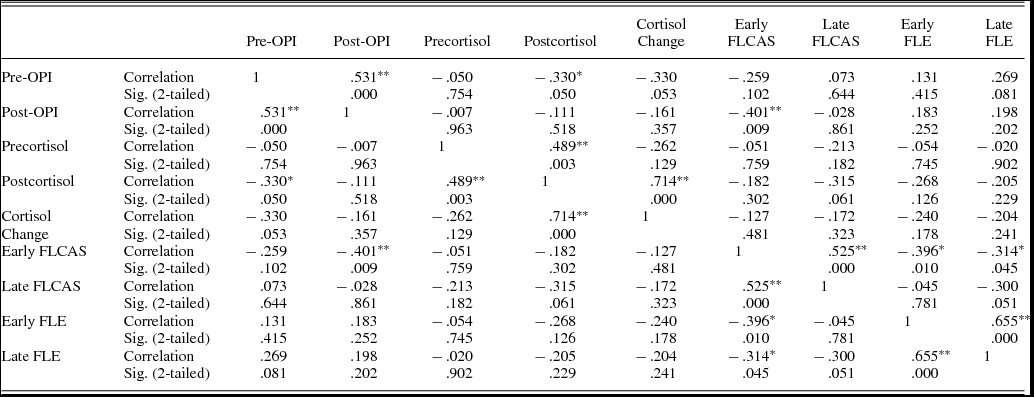
One way to determine whether two instruments measure something different is to examine correlations between the two. If correlations are low and nonsignificant, it can be assumed that they measure two different things (John & Benet-Martinez, Reference John, Benet-Martinez, Reis and Judd2000). Pearson correlations between anxiety and proficiency variables are shown in Table 1. Anxiety levels (cortisol figures) did not correlate significantly with FLCAS scores). The highest correlation between cortisol levels and FLCAS scores was between post levels (r = −.315), indicating a mild and nonsignificant relationship, with higher FLCAS scores being somewhat associated with lower cortisol levels or less overall anxiety (medium effect size/correlation by some standards [Cohen, Reference Cohen1988] and small by others [Plonsky & Oswald, Reference Plonsky and Oswald2014]. One might therefore argue that the FLCAS and cortisol measure two different things—overall anxiety and classroom anxiety show some overlap but are also distinct from each other.
Correlations Between Primary Anxiety Measures

**Correlation is significant at the 0.01 level; * correlation is significant at the 0.05 level.
Overall Anxiety Levels Over SA
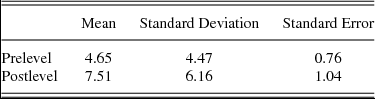
Changes in cortisol levels, measured in picograms per milligram, are depicted in the pre- and postsample results displayed in Table 2. A paired sample t test indicated significant increases in hair cortisol levels, t (34) = 3.03, p = .005, d = 0.51, suggesting that overall anxiety levels increased over the SA experience. This is a medium or typical effect size (Cohen, Reference Cohen1988) for the social sciences and small for a within-group test by SLA standards (Plonsky & Oswald, Reference Plonsky and Oswald2014).
Pre- and Postcortisol Level Descriptive Statistics in pg/mg

The Classroom: FLCA and FLE Over SA
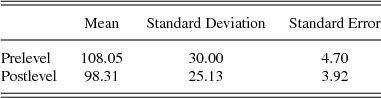
A paired samples t test for FLCAS scores (descriptive statistics in Table 3) indicated that classroom anxiety levels decreased significantly over the SA, t (40) = 2.30, p = .027, d = 0.36. This effect size is between small and medium by social science standards (Cohen, Reference Cohen1988) and considerably lower than 0.60, the size considered small in SLA research for within-group comparisons (Plonsky & Oswald, Reference Plonsky and Oswald2014).
Descriptive Statistics for FLCAS Scores

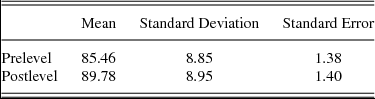
A paired samples t test for FLE scores (descriptive statistics in Table 4) indicated that classroom enjoyment levels increased significantly over SA, t (40) = −3.79, p = .001, d = 0.58. This effect size is medium by social science standards (Cohen, Reference Cohen1988) and just below 0.60, the size proposed as small in SLA research for within-group comparisons (Plonsky & Oswald, Reference Plonsky and Oswald2014).
Descriptive Statistics for FLE Scores

Initial Proficiency and Overall Anxiety Level Abroad
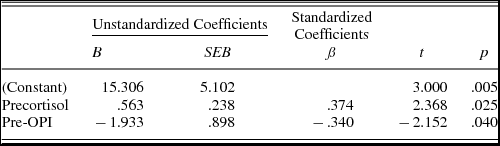
Stepwise regression was conducted to determine the best linear combination of variables predicting overall levels during SA (postcortisol). The regression model predicted slightly over 20% of the variance, adjusted R 2 = .202, F(1,30) = 5.05, p = .013. Table 5 provides the values for this model. Students with higher levels of pre-SA hair cortisol tended to have higher cortisol during SA (postcortisol)—in other words, those prone to anxiety in the United States tended to experience more overall anxiety in Jordan. Students with higher predeparture OPI scores tended to experience less overall anxiety while abroad than those with lower OPI levels.
Regression Coefficients for Model Predicting Postcortisol Level (Overall Anxiety During SA)

Anxiety-Related Variables and Proficiency Gains
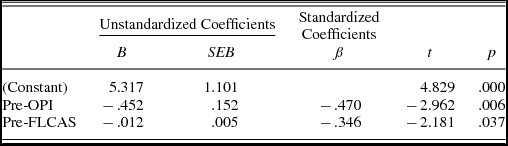
Stepwise regression was conducted to determine the best linear combination of variables predicting change in OPI score. The regression model predicted slightly over 38% of the variance, adjusted R 2 = .381, F(2,30) = 10.85, p < .000. Table 6 provides values for this model. Students with higher pre-SA OPI scores tended to receive higher post-SA OPI scores, and those with higher FLCAS levels at the beginning of the study (Pre-FLCAS) tended to receive lower Post-OPI scores. Overall anxiety level during SA (postcortisol) did not serve as a predictor, and neither did any other variable.
Regression Coefficients for Model Predicting Change in OPI Score

DISCUSSION
The first research question regarded the relationships between overall anxiety level, FLE, and classroom anxiety during SA. The nonsignificant and negative correlation between FLCAS results and cortisol level falls in line with and is similar to the r values Horwitz (Reference Horwitz1986, Reference Horwitz, Gkonou, Daubney and Dewaele2017) has used to argue that two anxiety-related measures capture different constructs (i.e., discriminant validity), so it is safe to say the data support the notion that overall anxiety level (operationalized as cortisol level) is separate from classroom anxiety for SA (operationalized as FLCAS scores—i.e., the scores representing self-assessments of cognitive and affective responses). Also, given the nonsignificant relationship between the two, it appears that factors other than FLCA must have been contributing to students’ overall anxiety levels during this SA in Amman.
Regarding the second research question, whether each of the anxiety measures changes over SA, increases in overall anxiety from pre to post were found in the data, but effect sizes were between small and medium. Compared to effect sizes seen in cortisol research, these are typical for research involving psychopathy and just below average for studies of exposure to chronic stressors (Staufenbiel et al., Reference Staufenbiel, Penninx, Spijker, Elzinga and van Rossum2013). In other words, one might consider the effects of the anxiety or stress of studying abroad comparable to those of moderate consistent stressors, but not as high as those seen in studies of extreme stressors such as those responsible for posttraumatic stress disorder (PTSD). For comparison, there was an increase during SA of approximately 3 pg/mg of hair cortisol, but PTSD victims show increases of 10 pg/mg or more (Steudte et al., Reference Steudte, Kolassa, Stalder, Pfeiffer, Kirschbaum and Elbert2011). In sum, the effects are not strong enough to be considered traumatic, but they are comparable to those seen in university students reporting having recently experienced major life stressors, such as the death of a close relative, a serious illness, or divorce or separation from a partner (e.g., Karlén, Ludvigsson, Frostell, Theodorsson, & Faresjö, Reference Karlén, Ludvigsson, Frostell, Theodorsson and Faresjö2011), where d = 0.52.
In spite of these various program interventions described previously, participants still reported stressful experiences they considered debilitating (based on analyses of hundreds of journal entries and interviews; cf. Bown et al., Reference Bown, Dewey, Belnap, Mitchell, Tracy-Ventura and McManus2015), even though overall increases in anxiety, as measured by hair cortisol, were not at a level considered traumatic. Such anxiety seems to be part and parcel of the SA experience. Sources of anxiety vary from student to student and need to be better investigated. Many students are prone to comparing themselves to others and feeling discouraged, a common phenomenon discussed by Pellegrino Aveni (Reference Pellegrino Aveni1998, Reference Pellegrino Aveni2005). Some feel anxiety about grades given in foreign classrooms appearing on their home transcripts. Others feel that they are making little progress in spite of considerable efforts. Some, especially those showing perfectionistic tendencies, report being uncomfortable with assignments that they are unable to finish to their satisfaction. In short, in spite of strong program efforts to moderate anxiety, SA clearly heightened anxiety for many, but not all. Some students' hair cortisol decreased over the course of the program. Further investigation into the precise causes is in order, as is qualitative investigation of the influence of these program interventions currently underway.
The fact that FLCAS scores decrease over SA matches previous research (Allen & Herron, Reference Allen and Herron2003; Thompson & Lee, Reference Thompson and Lee2014). However, note that the FLCAS results for this group indicate higher levels of classroom anxiety than in Allen and Herron's French learners. Average totals for the FLCAS at pre for that group were 91.08 and at post 77.56, as compared to this group, whose averages were 108.05 at pre and 98.31 at post. This group of learners reported more FLCA at the end of their SA than the Allen and Herron's French learners did at the beginning. It is possible that the difference in relative distance between U.S. culture and French and Jordanian cultures (Obeidat et al., Reference Obeidat, Shannak, Masa'deh and Al-Jarrah2012) contributed to this gap. Classroom practices and teacher behavior are bound to differ across cultures (Rajagopalan, Reference Rajagopalan and Llurda2005), which may become a source of anxiety for the students. A specific example consists of motivational strategies that can vary from one culture to another (Ruesch, Bown, & Dewey, Reference Ruesch, Bown and Dewey2011). Some students in Jordan reported being shamed for performing below teacher expectations, a practice they said they had never seen used to motivate in U.S. classrooms. However, given that in anonymous exit surveys program participants in Jordan regularly rate “encouragement from language teachers” as the most helpful aspect of the program (Belnap et al., Reference Belnap, Bown, Dewey, Belnap, Steffen, Gregersen, MacIntyre and Mercer2016), it seems unlikely that the teacher is the source of anxiety in most classrooms. Student interviews suggest that, at least for the more advanced students, a sense of competition between some students is the more likely source of stress. Far more context is needed before one could begin to understand the rating differences between these two groups of students.
Increases in FLE as language learning experience and proficiency go up are seen in the previous research in FL settings (Dewaele & Dewaele, Reference Dewaele and Dewaele2017; Dewaele & MacIntyre, Reference Dewaele and MacIntyre2014, Reference Dewaele, MacIntyre, MacIntyre, Gregersen and Mercer2016). The current results indicate the same pattern. Furthermore, FLE scores were similar to those reported by Dewaele and colleagues. This makes the higher FLCAS scores stand out even more, in particular because, as FLE went up, FLCA came down in a way similar to the pattern seen in the at-home FL studies cited earlier. In short, FLE results in this SA setting are not markedly different from FL studies, but FLCAS results are.
The next two research questions focused on predictors of overall anxiety levels and language proficiency gains over SA. Regarding the former, those with higher levels of predeparture overall anxiety tended to show more anxiety during their SA experience. Furthermore, those with lower levels of L2 proficiency also tended to experience more anxiety overall while abroad. These two variables explain only 20% of the variance in overall anxiety levels over SA (postcortisol), leaving many other variables that could potentially have an influence. Learners’ self-perceptions of their own language abilities have been key stressors during SA (Pellegrino Aveni, Reference Pellegrino Aveni2005), and various forms of anxiety have been associated with attitude and motivation (Clément et al., Reference Clément, Dörnyei and Noels1994; Ehrman & Oxford, Reference Ehrman and Oxford1995), willingness to communicate (MacIntyre et al., Reference MacIntyre, Dörnyei, Clément and Noels1998), and personality (Ehrman & Oxford, Reference Ehrman and Oxford1995), all factors that have potential to influence both L2 use and L2 proficiency development during SA. While self-perceived abilities have only been modestly correlated with actual proficiency in SA research (Dewey, Reference Dewey2004; Lapkin, Hart, & Swain, Reference Lapkin, Hart, Swain and Freed1995), it is feasible that actual L2 proficiency development works in conjunction with some of these other correlated variables to influence anxiety-related variables during SA. Further research is needed to determine both the types and aspects of anxiety that might be influenced by SA and the role proficiency might have in affecting anxiety.
In answer to the fifth research question, the one anxiety-related variable that best predicted OPI gains was FLCA. One might therefore say that learners who were less anxious in the classroom early on did better in terms of L2 development. This would follow research that has shown significant connections between FLCA and various measures of linguistic development (for an overview, see MacIntyre, Reference MacIntyre, Gkonou, Daubney and Dewaele2017). The regression model here explains a relatively high amount of variance in Post-OPI score (38.1%), which suggests that predeparture proficiency and FLCA are collectively making a meaningful contribution to proficiency development. This matches previous research showing that scores on language exams prior to SA predicted OPI gains to a greater degree than anxiety levels (Steffen, Dewey, & Belnap, Reference Steffen, Dewey and Belnap2017). However, again there are other variables that are coming into play—perhaps some of which have been seen as good predictors of linguistic development in previous SA research, such as whether students took content courses in the target language, length of their SA, living arrangements, previous coursework, gender, and so forth (for a study of these and other variables, see Vande Berg, Connor-Linton, & Paige, Reference Vande Berg, Connor-Linton and Paige2009).
In terms of future studies, researchers might explore the potential of additional innovative measures of anxiety, including perhaps saliva cortisol, which can be used on the spot to objectively evaluate anxiety or stress in reaction to specific events (e.g., immediately after service encounters, interactions with teachers, or requests made to native speakers). Further, additional comparisons of various institutional contexts, countries, and so forth to determine levels of anxiety that might be attributable to changes in these variables would be in order. They might also take ecological approaches to anxiety (Gkonou, Reference Gkonou, Gkonou, Daubney and Dewaele2017), much as we have done for other aspects of SA such as social interaction (Belnap et al., Reference Belnap, Bown, Dewey, Belnap, Steffen, Gregersen, MacIntyre and Mercer2016; Bown et al., Reference Bown, Dewey, Belnap, Mitchell, Tracy-Ventura and McManus2015).
CONCLUSION
This study has shown the potential of a physiological measure of anxiety (i.e., stress) to help understand anxiety and SA beyond classroom learning alone. As far as the classroom is concerned, this study indicates that learners can grow more comfortable and experience less anxiety and more enjoyment over the period of SA. However, this study also shows that learners studying abroad in Jordan grew more anxious or stressed despite increasing classroom comfort levels. Two key factors that may have influenced their overall anxiety levels abroad were tendency toward anxiety prior to SA and language proficiency upon departure for SA. The latter provides support for having students more proficient prior to SA, given that doing so may lead to a less stressful (i.e., more enjoyable) SA experience.
In addition to encouraging greater proficiency, educators may want to inform learners that although they might be uncomfortable early on in their SA language classrooms, they are likely to enjoy that classroom learning and be less anxious over time (see also Allen & Herron, Reference Allen and Herron2003). To make sound recommendations regarding anxiety for SA educators, students, and others, however, additional studies delving into individual stories (e.g., Jackson, Reference Jackson2002) will still be necessary. This study indicates the value of providing support for students prior to SA and in country to help them cope with the various anxiety inducers they face. Allen and Herron (Reference Allen and Herron2003) suggested that such preparation and support can reduce anxiety through “activities with an emphasis on potential linguistic or cultural conflicts, . . . advis[ing] students during SA to pursue social pursuits they enjoy at home, . . . [and] assign[ing] projects that will necessitate cross-cultural contact.” (p. 383). Although overall anxiety levels increased over SA, they were not as high as might be expected, leading us to believe that the methods for coping with the challenges associated with studying abroad in Jordan taught to the students are beneficial for moderating levels of anxiety during SA (for descriptions, see Belnap et al., Reference Belnap, Bown, Dewey, Belnap, Steffen, Gregersen, MacIntyre and Mercer2016; Bown et al., Reference Bown, Dewey, Belnap, Mitchell, Tracy-Ventura and McManus2015).