Approximately 200–250 pan-tropical spotted dolphins, Stenella attenuata (Gray, 1846), stranded on Gaddani Beach (GPS coordinates: 25°09.024′N 66°44.298′E) on the Balochistan coast of Pakistan, approximately 50 km north-west of Karachi on 6 March 2009. The species is known to occur in tropical and warm-temperate waters between about 40°N and 40°S around the world (Jefferson et al., Reference Jefferson, Webber and Pitman2008; Perrin, Reference Perrin, Perrin, Würsig and Thewissen2009) and has been recorded from the waters of countries neighbouring Pakistan and other countries in the region, i.e. Oman, India, Sri Lanka, Bangladesh and the Maldives in the Indian Ocean (Leatherwood, Reference Leatherwood1986; Gallagher, Reference Gallagher, Leatherwood and Donovan1991; Leatherwood et al., Reference Leatherwood, McDonald, Prematunga, Girton, Ilangakoon, McBrearty, Leatherwood and Donovan1991; Salm et al., Reference Salm, Jensen and Papastavrou1993; Ballance & Pitman, Reference Ballance and Pitman1998; Kumaran, Reference Kumaran2002) but there have been no previous confirmed records of this species from Pakistani waters (de Boer et al., Reference Boer, Baldwin, Burton, Eyre, Jenner, Jenner, Keith, McCabe, Parsons, Peddemors, Rosenbaum, Rudolph and Simmonds2003). Although Niazi (Reference Niazi1990) mentions that the pan-tropical spotted dolphin is among the species that gets killed in large-mesh sized (150–240 mm) surface gill-nets used for catching large pelagic fish in offshore waters of Pakistan, the information is based only on a few anecdotal records reported by fishermen. This paper presents the first confirmed record of the pan-tropical spotted dolphin from Pakistan.
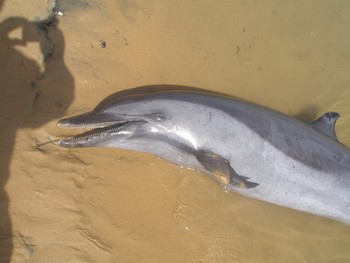
The Cetacean Conservation Pakistan (CCP) project conducted systematic surveys of the entire coastline of Pakistan between November 2005 and October 2008 and confirmed the occurrence of 12 cetacean species but did not encounter pan-tropical spotted dolphins. Species identification for the stranded animals was confirmed from photographs taken by bystanders; the typical long beak tipped with white, well-defined cape passing high over the eye and flipper stripe passing towards the gape are clearly visible.
Dead specimen of a pan-tropical spotted dolphin Stenella attenuata found on Gaddani Beach after the mass stranding event. (Photograph: Abrar-ul-Hassan, Zoological Survey Department (ZSD) Pakistan).

Animals began to beach at about 1000 hours and continued until 1400 hours. There were also reports that some animals beached on the following day (7 March 2009). The dolphins included juveniles as well as adults; lengths ranged from 1.5 to 2.3 m. No detailed information was collected on sex and size of animals. Most of the dolphins returned to the water without assistance. Attempts were made to float others out into the water and were largely successful; only two of the dolphins were reported to have died. At least 11 dolphins were recorded to have superficial injuries on different parts of their bodies. Personnel from Sindh Wildlife Department and WWF Pakistan assisted with the rescues. One carcass on the beach was retrieved on 8 March and taken to the Centre of Excellence in Marine Biology (CEMB) in Karachi for preparation as an osteological specimen. A tissue sample was collected and preserved in ethanol for DNA studies.
Only a few mass strandings of pan-tropical spotted dolphin have been previously recorded: three in Florida, of between three and 11 individuals (Walsh et al., Reference Walsh, Ewing, Odell, Bossart, Dierauf and Gulland2001) and one in Western Australia, of 13 (Mell, Reference Mell and Augee1988). No mass stranding of this species of such large-scale has ever been recorded from any of the neighbouring and regional countries of Pakistan, however, two large-scale mass strandings involving at least 152 small cetaceans were recorded along the Iranian coast in September 2007. About 79 spinner dolphins (Stenella longirostris) washed ashore near the port of Jask in southern Iran on 20 September 2007 and then approximately 73 live striped dolphins (Stenella coeruleoalba) were found in almost the same area as the previous mass stranding event on 24 October 2007 (Braulik et al., Reference Braulik, Savadkouhi, Fadakar, Mohammadi, Brownell, Reeves, Nabavi and Fernández2010a). Detailed investigation was carried out by experts from the IUCN Cetacean Specialist Group headed by G. Braulik, it was concluded that negative fishing interaction was most likely the underlying cause of the first event, while complex coastal features trapped the dolphins in the second event and caused them to live strand. However, it remained unknown what agents caused an offshore species, i.e. striped dolphins, to enter into nearshore, shallow waters. Braulik et al. (Reference Braulik, Savadkouhi, Fadakar, Mohammadi, Brownell, Reeves, Nabavi and Fernández2010a) also suggested that there was no evidence to suggest that the two mass strandings were linked because they involved different species and also exhibited different characteristics.
Limited records of pan-tropical spotted dolphins are available from Oman (Alling, Reference Alling1986; Ballance et al., Reference Ballance, Pitman, Reilly and Force1996; G. Minton & R. Baldwin, personal communication). There are only a few records of live sightings dating back to the mid-1990s made by R. Baldwin. A number of third party sightings are also available but their authenticity cannot be confirmed. Three stranding records of this species are available from Oman dating back to the 1970s and 1980s made by M. Gallagher—the former curator of the Oman Museum of Natural History (G. Minton, personal communication). The species is still to be confirmed in Iranian waters (Braulik et al., Reference Braulik, Ranjbar, Owfi, Aminrad, Dakhteh, Kamrani and Mohsenizadeh2010b). In India, pan-tropical spotted dolphin is recorded from at least five sighting records, two stranding records, and one skull that resides in the British Museum (Alling, Reference Alling1986; De Silva, Reference De Silva1987; Anon, 1999a, b; Sathasivam, Reference Sathasivam2002). It is interesting to note that one of these strandings was a live mass stranding of a mixed group of spinner dolphins and pan-tropical spotted dolphins involving a total of 12 animals that were all rescued while the second stranding involved four dead pan-tropical spotted dolphins that beached just after three days of the first event in almost the same area. It is possible that the same animals that were rescued died and beached again. The species is common along the coast of Sri Lanka but there is no stranding record available (A. Ilangakoon, personal communication). In Bangladesh it is only recorded through a live sighting (Smith et al., Reference Smith, Ahmed, Mowgli and Strindberg2008). Only one beach-worn pan-tropical spotted dolphin skull is recorded from the Maldives (Anderson et al., Reference Anderson, Shaan and Waheed1999). The Pakistan stranding is the largest reported for this species to date. The cause of the stranding is unknown. The pan-tropical dolphin typically inhabits deep pelagic waters (Jefferson et al., Reference Jefferson, Webber and Pitman2008) and is not usually seen in shallow coastal waters. The Balochistan coast is characterized by a narrow continental shelf with water over 2000 m deep within 25–35 km offshore. No harmful algal blooms (HABs) or seismic exploration were observed in the days prior to or on the day of stranding; although it is possible that these activities or events may have been occurring at the time of the stranding, and cannot be ruled out as the cause. Pollution from a local ship-breaking industry has been singled out as a possible contributor to contamination and an unhealthy habitat for cetaceans in this particular area (Gore et al., Reference Gore, Ahmad, Ali, Culloch, Hameed, Hasnain, Hussain, Kiani, Shaik, Siddiqui and Ormond2007). A multi-national naval exercise (AMAN 09) involving more than 20 warships (including vessels from the US, UK, France and Australia) was, however, being conducted in a deep water region of Pakistan between 5 March and 14 March (Geo Pakistan, 2009) and data on vessel locations and sonar use during this exercise must be analysed before a naval sonar link to the stranding can be ruled out. Naval exercises have been associated with mass strandings of a variety of species, including small cetaceans (Parsons et al., Reference Parsons, Dolman, Wright, Rose and Burns2008). In the case of the Pakistan event, nothing could be determined about the cause of this mass stranding due to lack of expertise for detailed investigation of dead animals and also due to non-availability of vessel presence and sonar use data during the AMAN 2009 naval exercises. However, if these data become available in the near future, it may lead to the solution of this riddle.
This new information regarding the occurrence of pan-tropical spotted dolphin in Pakistani waters is very significant for Pakistan, which is in the process of updating information about its marine mammal fauna, and will assist in the development of Pakistan's National Conservation Strategy for marine mammals and the Pakistan Biodiversity Action Plan.
ACKNOWLEDGEMENTS
The authors greatly acknowledge the valuable comments from William F. Perrin, Mauvis Gore and anonymous referees for the improvement of this short paper. The research grant from the Higher Education Commission Pakistan (HEC) is gratefully acknowledged. We express our gratitude to Mr Abrar-ul-Hassan of the Zoological Survey Department (ZSD) Pakistan for providing the photograph of the dead dolphin for proper identification. The authors are thankful to the management of the Centre of Excellence in Marine Biology, University of Karachi for providing the transport facility to visit the stranding area.