Introduction
Funding: Work was funded in part *******by the National Institute of Mental Health (NIMH), the National Institute of Nursing Research, and the Substance Abuse and Mental Health Services Administration (SAMHSA) (R25 MH070569) which established the Child and Family Disaster Research Training and Education Program at the Terrorism and Disaster Center (TDC) at the University of Oklahoma Health Sciences Center (Dr. B. Pfefferbaum). TDC is a partner in the National Child Traumatic Stress Network and is funded by SAMHSA (U79 SM57278). The National Center for Disaster Mental Health Research, funded by the NIMH (P60 MH082598), also provided funding for the work (Dr. Norris).
Research on the mental health of children during and following a disaster is especially challenging due to the complex child maturational processes and family and social contexts of children's lives. Research and clinical work with children and adolescents requires systematic attention to developmentally appropriate and relevant issues, as well as recognition of the vulnerabilities associated with childhood. Over time, disaster mental health research has attracted local investigators seeking to address issues that arise as part of clinical efforts or to expand knowledge about novel issues. Individuals representing a wide range of professional backgrounds may become involved in disaster work because of serendipitous circumstances requiring an immediate response to a community's need for information and services. Others, who have developed expertise through prior work, constitute a cadre of seasoned disaster researchers who respond to calls for help.
Whether the study rationale involves descriptive (eg, portraying children's disaster reactions) or informative (eg, guiding interventions) goals, researchers and clinicians should benefit from a systematic framework for approaching disaster mental health research with children and families. This article provides such a framework, and an overview of the mental health literature on children in the context of disasters and terrorist events.
Setting the Stage
Information gathering in a community grappling with the devastating effects of mass trauma is challenging due to four issues: (1) disruption and chaos; (2) damage to the infrastructure; (3) depletion of resources; and (4) limited access to potential participants—all of which may influence the feasibility of initiating a study, selection of participants, timing of assessments, and constructs chosen for investigation. Disasters present numerous practical and methodological barriers, rendering the task of conducting rigorous empirical investigations difficult. Additionally, researchers who seek to understand the reactions of children and adolescents may confront difficulties in accessing survivors who are willing and able to participate.Reference Litz and Gibson1, Reference Pfefferbaum and North2 As a result of these impediments, researchers historically have conducted studies based more on accessibility than on theory development.Reference Pfefferbaum and North2
Framework for Research on Mental Health of Children
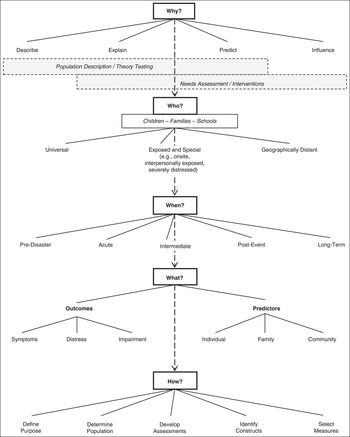
An efficient approach is presented to guide both novice and experienced researchers as they prepare to conduct disaster research. This method is derived from the foundational framework proposed by North and Norris,Reference North and Norris3 who identified specific questions researchers should consider when conducting disaster research studies. Five fundamental research questions guide the strategy: “Why?, Who?, When?, What?, and How?”
Why?
Disaster mental health assessment studies demonstrate the nature, severity, and extent of the effects disasters have on mental health and behavior,Reference North and Norris3 and assist in the development of interventions that promote recovery in groups of children who experienced various types and degrees of exposure to trauma, loss, and adversity. Spanning the entire life cycle of disaster, assessment is important in monitoring recovery, the effects of post-event circumstances, and the effectiveness of services and interventions.Reference Pynoos, Schreiber, Steinberg and Pfefferbaum4 Measurements focus on variables such as exposure, subjective reactions, loss of significant others, property destruction, and post-event adversities that increase the risks for severe and persistent distress, behavioral and developmental problems, and functional difficulties. Results can aid clinical endeavors through the creation and implementation of preparedness activities and services and interventions from the acute and early post-event period through long-term recovery.
Providers and researchers in the disaster and post-disaster environment focus attention in the midst of sometimes frenetic conditions and activity, which may be true especially for those with dual responsibilities in providing clinical services and conducting research. Historically, often these roles have been best served by combining activities through data collection in the form of screening, needs assessment, clinical evaluation, treatment outcomes and program evaluation. Thus, despite the difficult environment, child disaster mental health assessment research has flourished over the past several decades, providing a base of knowledge about the deleterious effects of disasters and terrorist events on children.
To date, most disaster studies have focused on enhancing our understanding of the link between disaster-related variables (eg, exposure) and psychiatric symptomatology. As a result, the effects of disasters and terrorist events on children's behavior and mental health have been well established through studies describing reactions without providing much in the way of explanation or prediction. More recently, assessment studies have sought to identify factors predictive of disaster outcomes or to demonstrate characteristics of effective interventions.
Investigations may be designed to elucidate the nature and course of psychopathology, through the use of comprehensive assessments, or they may be based on well-defined research questions that clarify existing knowledge and promote in-depth appreciation of disaster-related phenomena through focused assessments. As disaster research extends beyond the existing, widely-held knowledge of the impact of disasters on children, results contribute to theory building and to the development of effective services and interventions.
Hypothesis-generating research allows for the exploration of novel issues, such as the impact of the sociopolitical climate in which a disaster occurs. More work is needed to: (a) discover and test theoretical concepts; (b) explore issues related to the biology of stress reactions in children; (c) develop more comprehensive knowledge of the relationships among variables not yet substantiated (eg, whether prior trauma increases disaster vulnerability); and (d) clarify the role of family and other community and societal influences in children's disaster reactions and recovery.
Within the area of disaster mental health assessment, some findings have contributed additional knowledge regarding: (1) a diversity of outcomes including posttraumatic stress, depression, other morbidities;Reference Bolton, Hill and O'Ryan5-Reference Hoven, Duarte and Lucas7 and traumatic grief;Reference Brown and Goodman8 and (2) predictors including the role of family factorsReference Gil-Rivas, Holman and Silver9-Reference Proctor, Fauchier and Oliver12 and coping.Reference Cardeña, Dennis, Winkel and Skitka13-Reference Wadsworth, Gudmundsen and Raviv18 Additionally, a recent trend in research on positive outcomes following disaster, including resilience and posttraumatic growth,Reference Calhoun and Tedeschi19, Reference Cryder, Kilmer, Tedeschi and Calhoun20 represents a new and viable focus for study and theory development.
Who?
The “Who” of a disaster assessment study may be most straightforwardly defined by geographic distance from the impact site, with samples chosen based on physical proximity or by their residence within the community affected by the disaster or terrorist event. The nature of the incident and its unique characteristics influence the sample selected. Ideally, the selection of participants emerges from a priori theoretical considerations; often, however, it evolves from the practicality of the study and access to a sample.
Child and Adolescent Samples
Disaster research with children and adolescents is particularly challenging given the developmental and social factors that influence children's reactions and recoveries, as well as the consent process and study methodology.Reference Pfefferbaum and North2 In particular, very young children have been under-studied, though recent research has addressed preschool children.Reference Bannon, DeVoe, Klein and Miranda21-Reference Scheeringa and Zeanah23 Identifying the age group(s) under investigation advances both theoretical and methodological purposes.
Accessing Participants
Researchers face difficulties accessing survivors who are willing and able to participate.Reference Litz and Gibson1, Reference Pfefferbaum and North2 In fact, the problem of access is likely to influence the selection of a research sample. Furthermore, adult observations are needed for young children who lack the conceptual and verbal skills to participate meaningfully, and adding further complexities to the recruitment process, children require parental consent for participation. Fortunately, children can be accessed through various means and locations, as delineated by Norris, who identified five sampling approaches to disaster research: convenience, purposive, clinical, random, and census approaches.Reference Norris24
Representative and random samples of children have been rare in disaster studies. In fact, Norris found that purposive sampling was used much more often in child disaster studies than in those with adults, and that children often were accessed through their schools.Reference Norris24 Convenience sampling also has been utilized to access large groups of children in a school setting, and has been best applied following a novel event (eg, the terrorist attacks of September 11, 2001) when no other sampling approach has been possible. Often, schools have been used as the point of selection for assessing large samples of children exposed to disaster, primarily because the school either has been the site of an incident (eg, school sniper attack,Reference Pynoos, Frederick and Nader25 hostage-taking incidentReference Desivilya, Gal and Ayalon26, Reference Vila, Porche and Mouren-Simeoni27) or has been located in the general area struck by a disasterReference Russoniello, Skalko and O'Brien16, Reference Osofsky, Osofsky and Kronenberg28-Reference Shaw, Applegate and Schorr30 or human-caused incidents.Reference Hoven, Duarte and Mandell31
Accessing children through public school systems may supply researchers with children residing in the vicinity of a particular incident, but it does not provide access to children younger than school-age, children attending private schools, or those who are home-schooled. In addition, researchers may sacrifice some degree of representativeness when accessing samples of children through a school, because these children form a “cluster,” meaning that they would be similar to each other because of the common school setting. This concern may be minimized by accessing children from multiple schools in diverse neighborhoods throughout the community.
Accessing children in schools and other locations is complicated further by logistical, procedural, bureaucratic, ethical, funding, and other barriers.Reference Pfefferbaum and North2, Reference Pfefferbaum, Call and Sconzo32 Lindy and colleagues described a protective shield that envelops severely traumatized individuals making it difficult to reach survivors, even to deliver services.Reference Lindy, Grace and Green33 Conducting research with affected children can be even more problematic, as both survivors and providers may be suspicious of research efforts.Reference Pfefferbaum, Tucker and North34 To address some of the obstacles, Steinberg and colleagues recommended that researchers offer training and resources for school personnel, ongoing surveillance, and opportunities for collaboration.Reference Steinberg, Brymer, Steinberg and Pfefferbaum35
Selecting Participants
Defining exposure and delineating groups of children based on their exposure is important in identifying disaster and terrorism survivors for potential participation in research. Some researchers focus on children with intense exposure who are likely to experience the greatest adverse effects,Reference Chemtob, Nomura and Abramovitz22, Reference Yule, Bolton and Udwin36 whereas others designate a broader participant base and study a general population or community sample of children with various levels of exposure, loss, and distress.Reference Hoven, Duarte and Lucas7, Reference La Greca, Silverman, Vernberg and Prinstein14, Reference Pfefferbaum, Nixon and Krug37 Special populations, including directly-exposed children, may be the focus of study (see discussion below). Some researchers may choose to assess children whose parents or other family members were directly exposed or died as a result of the event.Reference Brown and Goodman8 Importantly, research has demonstrated the importance of exposure factors other than direct physical experience such as the perception of life threat,Reference Silverman and La Greca38 experiences with “high-intensity” disaster events,Reference Chemtob, Nomura and Abramovitz22 and/or relationship with victims.Reference Pfefferbaum, Nixon and Krug37-Reference Milgram, Toubiana and Klingman40
The use of multiple informants as collateral sources of information, such as parents, teachers, and other professionals, allows for the most comprehensive appraisal of children's reactions and functioning. While more difficult to access, siblings and other family members, classmates, and friends may provide unique perspectives of a child's situation.Reference Pfefferbaum and North2, Reference Putnam41 While practical difficulties in accessing children and those who can provide information about them typically drive decisions about who should serve as respondents, whenever possible, parental reports should accompany those of their children.Reference Balaban42 Collecting data directly from children and from their parents can identify important distinctions in the perceptions of children and their parents.Reference Koplewicz, Vogel and Solanto10, Reference Breton, Valla and Lambert43, Reference Pfefferbaum, Stuber, Galea and Fairbrother44 For example, parents of children in the World Trade Center during the 1993 bombing reported a decrease in their children's posttraumatic stress and incident-related fears at nine months following the exposure, but their children reported no decrease.Reference Koplewicz, Vogel and Solanto10 Researchers should consider obtaining parental ratings whenever possible, recognizing that parents are better at reporting externalizing symptoms, while children may provide more accurate information regarding internalizing symptoms.Reference McClellan and Werry45
When?
The specific timing of research assessments depends on the purpose (the “Why”) of the study, and must recognize temporal considerations within the disaster timeline and determine the optimal time to conduct an investigation that reflects the “Why, Who, and What.” The period for collecting data on children's disaster reactions extends from the time before a disaster-producing event strikes to the weeks, months, and years that follow. A diverse terminology for time periods exists, with no established consensus. According to North and Norris, the first two to six months following the onset of a disaster constitute the “acute period” with the “intermediate” period occurring 12 to 18 months post event, and the “long-term” phase occurring two to three years after the precipitating event.Reference North and Norris3
Assessments must be conducted early enough in the aftermath of an event to avoid recall bias,Reference Friedman46 yet not so soon that it mistakes the ubiquitous early and transient distress for psychopathology. Studies examining children relatively soon after the onset of disasters predominate to the extent that long-term effects have been under-studied.Reference Norris and Elrod47 Unfortunately, existing research has relied primarily on one-time assessments rather than longitudinal approaches.Reference Norris and Elrod47 A recent longitudinal study by McLaughlin and colleagues provided data from children and adolescents involved in Hurricane Katrina during a three-wave survey, spanning the time period from five to seven months, seven to 10 months, and 15 to 19 months post hurricane.Reference McLaughlin, Fairbank and Gruber48
Determining When to Conduct a Study
Pre-Disaster Assessment
Because of the unpredictability of disasters, prospective studies have been rare. Two methods have been applied for collecting pre-event data. First, as a result of ongoing studies, researchers may have access to pre-event data that provide a baseline for a preexisting sample.Reference Asarnow, Glynn and Pynoos49, Reference La Greca, Silverman and Wasserstein50 An alternative method involves the use of archival data from other sources on representative samples (eg, population data/rates) for comparison with data collected from a post-event sample.Reference Stuber, Galea and Pfefferbaum51 To explain or predict the true impact of a disaster on children, a baseline assessment of their functioning must be established. Therefore, while it is not necessarily practical, researchers are urged to explore avenues for utilizing existing data from ongoing studies or archival databases, or, if possible, to collect pre-event data on children at risk.
Longitudinal and Long-Term Assessment
While researchers have long recognized the benefits of a longitudinal approach, few studies of children have used longitudinal design. Rarely, studies entail long-term assessments beyond six months post event.Reference Norris and Elrod47 A few researchers have documented the course of symptomatology through repeated evaluations of children, with results underscoring the impact of initial distress on the persistence of symptoms over time.Reference La Greca, Silverman, Vernberg and Prinstein14, Reference Shaw, Applegate and Schorr30, Reference McFarlane52, Reference McLaughlin, Fairbank and Gruber53 Long-term studies that have assessed children years after exposure have elucidated factors related to disaster adjustment extending into decades post disaster.Reference Yule, Bolton and Udwin36, Reference Bolton, O'Ryan and Udwin54-Reference Udwin, Boyle and Yule57 Using both self- and collateral reports, a series of Hurricane Katrina studies indicate that while improved from baseline, children exposed to the event continued to experience disaster-related distress from five to 27 months post hurricane.Reference McLaughlin, Fairbank and Gruber48, Reference McLaughlin, Fairbank and Gruber53
What?
The number of constructs relevant to assessment of disaster reactions is virtually limitless; thus, the broadest and most complex question is likely related to “what” child disaster researchers decide to include in their investigations. Traditionally, research has focused on documenting the prevalence and severity of children's reactions to trauma, with primarily clinical applications. In more recent years, new questions have emerged, enhancing our knowledge of a variety of important factors that influence differences in the nature, course, and severity of children's disaster reactions. A brief overview of the child disaster literature provides a record of the variables investigated as disaster outcomes, and the constructs identified as predictors or correlates in the child disaster literature.
Determining What Outcomes to Study
In terms of outcomes, specific psychological problems and non-specific distress commonly are used as indicators of the severity of disaster reactions.Reference Norris, Friedman and Watson58 The extent to which children are affected depends on numerous factors, and an accurate evaluation is influenced by study design, sample, measurement tools, and importantly, the outcomes examined.
Symptoms and Diagnoses
Common outcomes examined in the child disaster literature include the presence or absence of posttraumatic stress disorder (PTSD) and/or symptoms, depressive and anxiety disorders, behavioral disturbances, grief, and functional impairmen.Reference Silverman and La Greca38, Reference Pfefferbaum, Houston, North and Regens59 Norris and colleagues identified PTSD and posttraumatic stress symptoms as the most commonly assessed mental health outcome for child and adult disaster survivors;Reference Norris, Friedman and Watson58 few child studies involve comprehensive evaluations for the presence of PTSD.Reference Silverman and La Greca38
Balaban identified several factors to consider in assessing children's mental health following disasters, highlighting the importance of moving beyond traditional evaluations for the presence of PTSD to include symptoms of multiple disorders and functioning.Reference Balaban60 Other measures assess distress, anxiety, depression, grief, somatic complaints, anger, behavioral problems, substance use, academic performance, impairment, and coping.
Degree of Distress and/or Impairment
Studies typically have been used to assess outcomes by classifying samples according to the frequency or severity of symptoms or degree of reaction (eg, in terms of distress and/or impairment). Distress and impairment indicate the extent to which a child's functioning has been disrupted, and are necessary for establishing a diagnosis. Dimensional symptom classifications (eg, mild, moderate, severe), other continuous variables (eg, number and frequency of PTSD symptoms), and discrete categories (eg, presence or absence of a mental disorder) have been used.
Resilience and Posttraumatic Growth
Disaster outcomes and the factors influencing them commonly have been cast in light of pathology, with relatively little attention to children who overcome significant trauma, or perhaps even thrive in the face of disasters. A growing body of literature contributes to our knowledge of positive outcomes of resilience and growth.Reference Cryder, Kilmer, Tedeschi and Calhoun20, Reference Malchiodi, Steele and Kuban61 Among disaster survivors, resilience describes restoration of functioning, despite the manifestation of some transient symptoms.Reference Bonanno62 Additionally, the concept of “posttraumatic growth” has emerged to explain positive changes following trauma (eg, greater appreciation for life, increased sense of personal strength), including personal, interpersonal (eg, improved relationships), and/or spiritual growth.Reference Cryder, Kilmer, Tedeschi and Calhoun20
Determining What Predictors to Study
Exposure
As indicated, exposure may be a predictor or correlate of disaster outcomes. Exposure has been measured in terms of a host of variables including physical proximity, perceived life threat, interpersonal relationships with victims, personal loss, life disruption, and/or contact with media coverage. More recent concerns, such as those associated with terrorist attacks, have focused on public health issues like the potential effects of television coverage on children with various forms and levels of exposure.Reference Pfefferbaum, Nixon and Krug37, Reference Fairbrother, Stuber and Galea63-Reference Schuster, Stein and Jaycox69
Age/Development
While a child's developmental stage will influence the expression of his/her disaster reactions, studies to date have not provided definitive evidence about the relative effects of disasters across age.Reference Norris, Friedman and Watson58, Reference La Greca and Silverman70 The commonly-used cross-sectional designs that include children and adolescents of multiple ages have demonstrated trends particular to a specific group, but typically have obscured any age or developmental differences. Longitudinal designs and methods that transcend traditional linear correlation analysis may be needed to determine any true effects by comparing both intra- and inter-individual changes over time.
Gender
Studies also have produced mixed results with respect to gender differences in children's disaster reactions. When identified as a correlate or predictor variable in disaster studies, female gender generally has been considered a risk factor for negative outcomes in terms of the development of PTSD or posttraumatic stress reactions,Reference Vernberg, La Greca, Silverman and Prinstein17, Reference Green, Grace and Vary55, Reference Lonigan, Shannon and Taylor71-Reference Weems, Watts and Marsee73 internalizing (versus externalizing) reactions,Reference Hoven, Duarte and Lucas7 and emotional (versus behavioral) symptoms.Reference Lonigan, Shannon and Taylor71, Reference Shannon, Lonigan, Finch and Taylor72 Girls also appear to rely more on emotion-focused (versus problem-focused) coping than do boys.Reference Vernberg, La Greca, Silverman and Prinstein17, Reference Wadsworth, Gudmundsen and Raviv18 Gender is an important sociodemographic variable to consider in light of these outcomes; however, La Greca and Silverman and Norris and colleagues have questioned the legitimacy of the influence of gender, noting that results may have limited explanatory potential.Reference Norris, Friedman and Watson58, Reference La Greca and Silverman70
Race/Culture
Some dated studies of young survivors have found disaster effects to be relatively equivalent across racial groups,Reference Vernberg, La Greca, Silverman and Prinstein17, Reference Weems, Watts and Marsee73 a finding that is in contrast with adult studies that have revealed more disaster-related difficulties in individuals of minority group status compared with majority-group counterparts.Reference Norris, Friedman and Watson58 Although minority racial status may exist as a risk factor for child disaster survivors,Reference La Greca and Silverman70 the relationship may be better explained by underlying causes, such as socioeconomic disparity,Reference La Greca, Silverman, Vernberg and Prinstein14 repeated exposure to trauma,Reference Silverman and La Greca38 social discrimination, and/or lack of extrafamilial support.Reference Weems, Watts and Marsee73
Disposition and Pre-Existing Conditions
Disposition and preexisting conditions may be robust predictors of disaster reactions, but they remain under-studied. Similar to the “trait” versus “state” distinction used to describe certain symptoms of psychopathology, in addition to symptom presentations, disposition and temperament have emerged as potential correlates of disaster reactions. Trait anxietyReference Lonigan, Shannon and Taylor71 and a general predisposition to perceive situations as threatening appear to be important factors contributing to children's disaster-related distress.Reference Lengua, Long and Meltzoff74 Furthermore, some evidence exists to support the risk posed by preexisting psychiatric conditions,Reference Earls, Smith, Reich and Jung75 anxiety,Reference Asarnow, Glynn and Pynoos49, Reference La Greca, Silverman and Wasserstein50, Reference Weems, Watts and Marsee73 negative affect and depression,Reference Asarnow, Glynn and Pynoos49, Reference Weems, Watts and Marsee73 and academic and attention difficulties.Reference Silverman and La Greca38
Prior Trauma
Prior exposure to trauma may be a risk factor for the development of disaster-related symptoms.Reference Hoven, Duarte and Lucas7, Reference Garrison, Weinrich and Hardin76 However, the classification of “prior trauma” varies, and at least one study has demonstrated contradictory findings.Reference Scheeringa and Zeanah23 Thus, additional study is needed on this issue.
Parental Reactions and Family Issues
Though not usually examined in post-disaster assessments of children, parental stress is among the most robust predictors of children's post-disaster adjustment.Reference Norris, Friedman and Watson58 For example, Green and colleagues found a relationship between parental symptom severity and children's PTSD symptoms following the Buffalo Creek dam collapse,Reference Green, Korol and Grace77 and that the influence of parental disaster reactions on children's symptomatology decreased as the children aged.Reference Pfefferbaum and North78, Reference Wolmer, Laor and Gershon79 The relationships between children's and parents’ trauma reactions may be modulated by various parental factors that also influence children's responses. For example, subsequent changes in parenting as well as enduring maternal distress have predicted children's persisting distress, even more than children's direct exposure to an Australian bushfire.Reference McFarlane52 In a study of adolescents and their parents geographically distant from the September 11 terrorist attacks, Gil-Rivas and colleagues found that greater adolescent-parent conflict was associated with adolescents’ distress, trauma symptoms, and functional impairment.Reference Gil-Rivas, Holman and Silver9
Certain families may be at risk for maladjustment post disaster. Family cohesion (the flexibility of emotional bonds among family members) and adaptability (the capacity to adjust the power structure, roles, and norms within the family) have been examined in the context of adverse events.Reference Laor, Wolmer and Mayes80 Child adjustment problems were associated with both too much and too little cohesion during Scud missile attacks in the 1990-1991 Persian Gulf War, suggesting that both disengaged families (which fail to help the child process the experience) and enmeshed families (which transmit unmodified negative emotions from one family member to another) may put children at risk.Reference Laor, Wolmer and Mayes80, Reference Laor, Wolmer and Cohen81 Other family characteristics or patterns of response have been linked to children's disaster reactions, including irritable, depressed, and over-protective families,Reference McFarlane11, Reference Green, Korol and Grace77 and families with parental stress and conflict.Reference Wasserstein and La Greca82
Secondary Adversities
An important factor that often has been overlooked in studies of child disaster survivors is the presence of stressful life events (particularly those involving loss and/or harm) that occur during and following the disaster. These secondary adversities may exacerbate the effects of the initial trauma and obstruct the recovery process. For example, among adolescents exposed to Hurricane Andrew, negative events that occurred after the storm were associated with posttraumatic stress symptoms, even after accounting for loss, prior trauma, fear, and decreased sense of safety.Reference Garrison, Bryant and Addy83 Unexpectedly high rates of PTSD among preschool children displaced by Hurricane Katrina raised questions about the potential effects of evacuation, sheltering experiences, or returning to view a damaged home.Reference Scheeringa and Zeanah23
Determining What Measures to Utilize
The number of variables for inclusion in disaster mental health assessments is essentially infinite, making it impossible to incorporate all important predictors and outcomes into a single study. Practical concerns also dictate the extent to which researchers can conduct comprehensive evaluations of children's temperaments, preexisting symptoms, trauma histories, functional status, parental factors, and post-disaster adversities, among other issues. Clearly, selected measures will reflect the previously determined Why, Who, and What of the study. Following their extensive review, Norris and colleagues contended that future studies need not re-establish the fact that disasters are psychologically consequential.Reference Norris, Friedman and Watson84 Thus, researchers are urged to carefully choose instruments and measurement techniques that add to existing knowledge through in-depth evaluations or that examine new areas of interest.
Comprehensive assessments inform us about the seriousness of disaster-related psychopathology, and can be used to track its course through the use of longitudinal research. In-depth measures, such as diagnostic interviews, would be appropriate for determining the clinical relevance of outcomes or the influence of risk and protective factors. Focused assessments derived from well-defined research questions that clarify existing knowledge and allow in-depth appreciation of disaster-related phenomena may contribute to enhanced understanding of emerging issues such as posttraumatic growth.
The challenge of disaster mental health research involves establishing procedures for rapid access to affected populations for early data collection without compromising the integrity of sampling and quality of measurement. Screening tools may assist with identifying children in need of services or determining the effectiveness of interventions, but they have become somewhat obsolete for the purpose of identifying key predictors, requiring researchers to employ more thorough assessments and those that zero-in on specific issues. Raphael advocated for the development of a disaster mental health research strategy,Reference Raphael85 which would include an agreed-upon set of criteria for measurement of important variables that are selected based on the demand they create on participants and researchers, ease of use across diverse disaster contexts, and ability to assess changes longitudinally.
Balaban has presented a useful guide for selecting instruments to assess children's disaster outcomes.Reference Balaban60 Although focused on clinical purposes, his recommendations address concerns about cost and time, and the need to identify a limited set of psychological and behavioral reactions assessed by both self- and parent reports.
Informants vary in the type and quality of information they can provide. In addition to collateral reports provided by parents, siblings, or peers, teachers have the advantage of being able to compare children to their peers.Reference Pfefferbaum and North2 In addition, Steinberg and colleagues have suggested that future studies should assess children's perceptions about their research participation as a means for evaluating the benefits.Reference Steinberg, Brymer, Steinberg and Pfefferbaum35
How?
Researchers who incorporate well-defined plans for the “four Ws” in their investigations of child disaster mental health will be better equipped to develop straightforward methodological plans. The procedures for data collection are driven by the purpose (Why), sample (Who), timing (When), and variables selected (What). Existing strategies facilitate “How” researchers will acquire assessment information. The methodological approach employed likely will reflect the distinguishing features of a particular disaster event. A simple illustration of the “four Ws” is depicted in Figure 1, with the “How” discussed below as a guide to determining the steps to take in a study of child disaster mental health.
The Five Fundamental Questions for Child Disaster Mental Health Research

Determine “Why”
Even in the chaotic aftermath of an event, researchers embark on investigations with certain objectives. To facilitate the data collection process and maximize the application of results, the rationale for the study—to describe, explain, predict, and/or influence—must be defined clearly. In light of the remarkable foundation of empirical knowledge establishing the effects of disasters on children, the literature would benefit from the incorporation of theory, and advancements in our abilities to explain precisely how certain variables contribute to positive and negative outcomes and to influence these outcomes through prevention and intervention efforts.
Although valuable in describing, extant findings have been generated primarily from convenience samples and provide insufficient information for the continued development of theory. To explain child disaster mental health, researchers have conducted comprehensive literature reviews to identify Who, When, and What to study. Determinations of Who and When are defined according to the potential application of findings. Researchers intentionally select variables based on their potential usefulness in explaining factors that contribute to disaster symptomatology and those associated with positive outcomes, such as resilience and posttraumatic growth.
Pre-event data are essential to predict, and disaster-related variables must be isolated to be able to draw conclusions and examine both risk and protective factors. Studies of interventions are designed to influence child disaster mental health. As illustrated in Figure 1, the reasons for conducting studies (Why?) are aligned with the various purposes for conducting research in general. Thus, population descriptions of exposure and reactions and theory testing are conducted to describe, explain, and predict; needs assessment and intervention studies are conducted to explain, predict, and influence.
Identify “Who”
Choosing the appropriate population to study depends, in part, on the issues of concern and the questions being asked, and conversely, specific populations raise distinct issues and generate distinct questions. For example, researchers may select a study population based on some specific characteristic such as demographics (eg, ethnicity of the child) or developmental status, family structure (eg, children of divorce), cultural heritage, geographic location, type and severity of disaster exposure, or source of participants (eg, schools, day care settings).Reference North and Norris3
Representativeness is an additional issue for consideration, as it enhances researchers’ abilities to draw conclusions about the nature of disaster mental health among the population.Reference Norris24 Practical barriers may limit accessibility to children and their families, which may signify the need for alternative recruiting methods. Fortunately, technological advances (eg, the Internet, mobile phones) have provided researchers with new avenues to reach participants who otherwise may have been excluded. For example, Gil-Rivas and colleagues collected data on a national sample of adolescents and their parents following the September 11 terrorist attacks through the use of a Web-based survey.Reference Gil-Rivas, Silver and Holman86
Decide “When”
Retrospective data limit the ability to produce definitive results about any preexisting factors associated with mental health outcomes. When pre-disaster information is unavailable, North and Norris have recommended researchers begin fieldwork within the first few weeks post event in order to capture data that might be lost in later retrospective accounts.Reference North and Norris3 Quick access is essential to obtaining valuable information about the immediate disaster effects and survivor needs, eliciting more accurate information in “real time.” For research purposes, early data collection allows for the discovery of early predictors of long-term reactions.Reference North and Norris3 When part of clinical screening processes, early assessments may identify those who are experiencing the most severe initial reactions, and thus, may have the greatest need for intervention.
Early data collection is not without significant obstacles and drawbacks. Entry may be complicated by safety and security concerns, the urgency of clinical needs, ethical standards, and other logistical barriers that must be addressed prior to the commencement of a study. As many exposed individuals experience transient posttraumatic reactions, assessments conducted in the immediate aftermath of an event may be misleading. In the chaos during and/or following an event, survivors typically are preoccupied with safety and other physical needs, and may be burdened by requests to participate in research.Reference North and Norris3
Resolve “What”
Results from over 30 years of child disaster studies have revealed the importance of assessing a variety of relevant outcomes and predictors. Although perhaps limitless in scope, the most important predictors and correlates identified in previous child disaster research have been summarized. Ascertaining which variables truly predict or cause children's disaster reactions requires the use of validated assessments and application of careful empirical control. Longitudinal design can provide information to enhance confidence in conclusions regarding the impact of specified factors over time. Importantly, the scope of each inquiry may be tailored to the defining features of the particular disaster event.
Clearly-defined constructs are necessary for consistency across studies, and should contribute to increased validity and reliability of results. Research on children's disaster experiences should include attention to their functioning and whether they achieve developmental milestones.Reference Weissbecker, Sephton, Martin and Simpson87 In terms of exposure, an assortment of measures should be utilized, including ones that address objective and subjective factors. Indicators of geographic proximity may help to identify certain features of the sample, but do not fully explain initial disaster reactions or those that persist. Subjective perceptions of life threat, loss, life disruption, and interpersonal relationships with victims complement determinations of geographic proximity. Further investigation of the impact of individual characteristics such as age, development, gender, and predisposition is needed, as well as assessments of parent and family factors. Longitudinal data, including reports from both parents and children, could assist with further interpretation of the associations between parent and child disaster-related symptom presentations. Assessments also should include resilience and positive growth.
Establish “How?”
The assessment modality should be selected carefully in order to obtain the desired information from children and the important others who may provide significant feedback about their functioning. For diagnostic purposes or to enhance existing knowledge about the longitudinal course of disaster reactions, comprehensive assessments should be utilized. Well-defined, briefer measurement tools may be used for clinical screening purposes or to assess novel issues and test new theories. Consideration should be given to developmental factors that influence children's abilities to participate meaningfully in disaster assessments and that affect the manifestation of symptomatology across various age groups. Parental reports, while necessary for very young children, may elicit information that contradicts that of older children and adolescents, which must be acknowledged and reconciled by researchers.
Conclusions
Research is crucial to advance knowledge in the field and to facilitate the development of services and interventions to address the novel clinical issues that arise in the context of a disaster. Five fundamental questions guide mental health researchers interested in assessing children's disaster reactions. Critical tasks of research endeavors include identifying the research questions (Why?), populations (Who?), and variables of interest (What?) and determining When to initiate and conclude data collection. By answering the “four Ws,” investigators are better equipped to determine how to proceed (How?).
The past few decades of disaster assessment research have produced a diverse portfolio of studies to guide clinical efforts focused on children. These studies have used a variety of methods from exploratory, qualitative design to those with more experimental control. The Why? of most child disaster studies is to enhance our understanding of disaster reactions with the goal of identifying and developing services and interventions for young survivors and their families. Researchers face numerous practical obstacles in the chaotic and unpredictable disaster environment. Furthermore, with post-disaster environments in particular, the diversity inherent in the populations and events studied presents challenges to the selection of research questions and limitations to the control of errors. Nonetheless, researchers rely on various sources of scientific inquiry, addressing a variety of questions in their research efforts. The purpose of an investigation may determine and be determined by the timing of the study.
The extent to which children are affected by disasters depends on numerous factors, and an accurate evaluation is influenced by study design, sample selection, measurement tools, and targeted outcomes. Researchers are urged to move beyond accepting commonly stated assumptions about the importance of limited variables and conditions (eg, physical proximity) to explore and critically analyze the myriad factors (and their relative influence) that may contribute to the differential vulnerability of children exposed to disasters. Discovering and elucidating the effects of development is a formidable challenge for researchers seeking to understand and assist children exposed to disaster.
Abbreviations
- PTSD:
posttraumatic stress disorder