INTRODUCTION
W. E. B. Du Bois argued that those who were racialized as White have long understood that there were more social and economic rewards for being poor and White than being a person of color (Allen Reference Allen2004; Fields and Fields, Reference Fields and Fields2012; Roediger Reference Roediger2007). Rather than working to undo the plantation system, poor European ethnics chose to receive the “public and psychological wages” of Whiteness from a system in which they were endowed with the opportunity to become White (Allen Reference Allen2004; Du Bois Reference Du Bois2007; Kwate and Goodman, Reference Kwate and Goodman2014). Non-Black status served as a material and public compensation for their White identity (Du Bois Reference Du Bois2007). As a result, White American racial and ethnic identity has historically (and presently) been both unconsciously and consciously mediated by Whites’ comparison to stereotypes about people of color (Lensmire Reference Lensmire2017; McDermott and Samson, Reference McDermott and Samson2005; Painter Reference Painter2010; Tanner Reference Tanner2019; Thandeka 1999).
The racialized social system situates White culture as normative, granting Whites the freedom to remain largely unaware of their racial and ethnic identity (McDermott and Samson, Reference McDermott and Samson2005; Omi and Winant, Reference Omi and Winant1994; Painter Reference Painter2010). Typically blind to the social and economic privileges related to their racial and ethnic identity, White non-Hispanic Americans (hereafter “White”) frequently consider their elevated social status as being a product of their own individual effort and merit, rather than considering how the racialized social system is simultaneously (and systematically) disadvantaging racially and ethnically marginalized groups (Bobo Reference Bobo2017b; Bonilla-Silva Reference Bonilla-Silva2018; Watson Reference Watson2013). Additionally, avoidance of direct racial language perpetuates Whites’ propensity to ignore how the racist social system provides them with advantages and privileges not afforded to racial and ethnic groups who have been minoritized (Bobo Reference Bobo2011; Bonilla-Silva Reference Bonilla-Silva2018; Efird and Lightfoot, Reference Efird and Lightfoot2020; Manning et al., Reference Manning, Hartmann and Gerteis2015; Lensmire Reference Lensmire2017).
Health researchers have extensively documented the negative health implications of racism on people of color in the United States (Bailey et al., Reference Bailey, Krieger, Agénor, Graves, Linos and Bassett2017; Daniels Reference Daniels2019; Ford et al., Reference Ford, Griffith, Bruce and Gilbert2019; Gee and Ford, Reference Gee and Ford2011; Gee et al., Reference Gee, Hing, Mohammed, Tabor and Williams2019; Krieger Reference Krieger2021; Pearson Reference Pearson2008; Wallace et al., Reference Wallace, Crear-Perry, Richardson, Tarver and Theall2017; Williams and Davis, Reference Williams, Lawrence and Davis2019). Structural racism encompasses the macro level systems, institutions, social influences, ideologies, and processes that interact with one another to foster and replicate inequities among racial and ethnic groups (Gee and Ford, Reference Gee and Ford2011; Powell Reference Powell2008). Yet, many Whites continue to believe the myth that racial inequality and health inequities are primarily the results of individual choice, rather than structural factors (Douds et al., Reference Douds, O’Connell and Bratter2019; Kwate and Goodman, Reference Kwate and Goodman2014; Malat et al., Reference Malat, Mayorga-Gallo and Williams2018). Interestingly, Whites who place high importance on their racial identity are more likely to attribute racial inequality to individual level factors rather than structural explanations (Douds et al., Reference Douds, O’Connell and Bratter2019).
Following the Civil Rights era, Whites have used individualism as a tool to refute and decontextualize the existence and implications of racial inequality (Bobo et al., Reference Bobo, Kluegel, Smith, Tuch and Martin1997; Manning et al., Reference Manning, Hartmann and Gerteis2015). Thus, an era of “Laissez-faire racism” (Bobo et al., Reference Bobo, Kluegel, Smith, Tuch and Martin1997) bolsters many Whites’ denial and blindness to the ways that racism has infiltrated structures and systems throughout history and at present (Bobo Reference Bobo2017a, Reference Bobo2017b). Regard for individual effort is deeply rooted in what many Whites equate with being American (Efird and Lightfoot, Reference Efird and Lightfoot2020; Geronimus and Thompson, Reference Geronimus and Thompson2004; Jardina Reference Jardina2019), and individual rights, personal responsibility, and opportunity compose their dominant narrative of what constitutes American values (Geronimus and Thompson, Reference Geronimus and Thompson2004; Kwate and Meyer, Reference Kwate and Meyer2010). Yet, holding fast to meritocratic ideology is not equally health promoting for all people who have been racialized as White (Geronimus et al., Reference Geronimus, Pearson, Linnenbringer, Schulz, Reyes, Epel, Lin and Blackburn2015; Malat et al., Reference Malat, Mayorga-Gallo and Williams2018; Metzl Reference Metzl2019).
Whiteness and White Americans’ Health
Whites who believe in self-sufficiency and individualism may be at increased risk for negative health effects when they experience perceived or actual social disadvantage (Geronimus et al., Reference Geronimus, Pearson, Linnenbringer, Schulz, Reyes, Epel, Lin and Blackburn2015; Kwate and Goodman, Reference Kwate and Goodman2014; Malat et al., Reference Malat, Mayorga-Gallo and Williams2018). With their beliefs that poverty and inequality are just consequences of a lack of individual effort (Bobo et al., Reference Bobo, Kluegel, Smith, Tuch and Martin1997; Geronimus and Thompson, Reference Geronimus and Thompson2004; Knowles and Lowery, Reference Knowles and Lowery2012), Whites’ health may be adversely affected when they personally experience the same hardships that they typically attribute to racially marginalized others. Socioeconomic gradients in Whites’ health may also be associated with expectations of relative or actual privilege (Pearson Reference Pearson2008), which results in negative health outcomes for Whites when their expectations of relative advantage remain unmet (Kwate and Goodman, Reference Kwate and Goodman2014; Malat et al., Reference Malat, Mayorga-Gallo and Williams2018; Siddiqi et al., Reference Siddiqi, Sod-Erdene, Hamilton, Cottom and Darity2019). For example, Erin Cooley and colleagues (Reference Cooley, Brown-Iannuzzi, Lei, Philbrook, Cipolli and McKee2021) recently found that White survey respondents who had high discrepancies in their social status—as compared to their perception of the status of all White Americans—reported few positive emotions, which in turn predicted worse mental and physical health than Whites who reported low discrepancies between their individual social status and that of White Americans in general. Said another way, White respondents who perceived that they occupied a lower social status than the collective White American racial group had worse self-reported physical and mental health. Interestingly, status comparisons between the self and one’s racial group were not significant among Black respondents, thus affirming that notion that the “White = wealthy stereotypes, although seemingly benign, may have pernicious psychological and physical consequences for White people who feel that they are not measuring up” (Cooley et al., Reference Cooley, Brown-Iannuzzi, Lei, Philbrook, Cipolli and McKee2021, p. 379).
Understanding more about how the racialized social system affects Whites’ health would shed light on the ways that the supremacy and oppression associated with structural racism affect the health of all racial and ethnic groups in the United States (Hicken et al., Reference Hicken, Lee and Hing2018; Malat et al., Reference Malat, Mayorga-Gallo and Williams2018). Jennifer Malat and colleagues (Reference Malat, Mayorga-Gallo and Williams2018) developed a theoretical framework to demonstrate how Whiteness (as a hegemonic social system) and capitalism affect White Americans’ health outcomes through three broad categories: (1) societal conditions, (2) individual characteristics and social experiences, and (3) psychosocial responses. The framework illuminates the pathways through which societal conditions, such as social policies and economic conditions, influence Whites’ individual characteristics and experiences (e.g., beliefs and narratives about inequality). These individual and community level experiences then influence Whites’ psychosocial responses, which encompass physiological responses (e.g., distress or perceived threat) and behavioral responses (e.g., health behaviors or health care utilization). In turn, these responses influence mental health, morbidity, and mortality (see Malat et al., Reference Malat, Mayorga-Gallo and Williams2018 for a visual depiction of the full framework).
As noted by Arjumand Siddiqi and colleagues (Reference Siddiqi, Sod-Erdene, Hamilton, Cottom and Darity2019), Whites’ pre-COVID-19 pandemic declines in mortality and increased deaths of despair (Case and Deaton, Reference Case and Deaton2015) are not associated with traditional indicators of population health inequalities such as economic or social disadvantage. Rather, Whites’ perceived threat to social status is negatively affecting the groups’ health at the population level in the United States (Siddiqi et al., Reference Siddiqi, Sod-Erdene, Hamilton, Cottom and Darity2019). There is no substantive evidence of Whites’ decline in relative social status compared to racially minoritized populations (Siddiqi et al., Reference Siddiqi, Sod-Erdene, Hamilton, Cottom and Darity2019), thus the perception of a decrease in status is unwarranted and incorrect. Investigating the roots of these misperceptions at the individual level could illuminate potential underlying determinants of Whites’ population-level health changes.
Given that White Americans are not a homogenous racial or ethnic group (Hughey Reference Hughey2010; Lee and Hicken, Reference Lee and Hicken2018; Omi and Winant, Reference Omi and Winant1994), I posit that researchers who study Whiteness, White identity, and health should also consider how place-based cultural factors influence Whites’ health beliefs and attitudes. In Deep Roots: How Slavery Still Shapes Southern Politics, Avidit Acharya and colleagues (Reference Acharya, Blackwell and Sen2018) illustrate how Southern Whites who live in areas where the local economy relied heavily on the labor of enslaved people—as compared to areas in the American South that did not—are more racially hostile and less amenable to policies which could engender Black American progress. The authors compare the voting patterns of Whites in a city in the Mississippi Delta (where 68% of the population was enslaved in 1860) to a city in the Appalachian Mountains in western North Carolina (where 15% of the population was enslaved in 1860) (Acharya et al., Reference Acharya, Blackwell and Sen2018). They argue that White residents of the Mississippi city (where the local economy was historically dependent upon exploitative labor and enslavement), are politically conservative today as a result of “behavioral path dependence”—meaning that ideas, norms, and behaviors were passed down from older to younger generations (Acharya et al., Reference Acharya, Blackwell and Sen2018). By contrast, the authors argue that Whites in the Appalachian city, and other Southern communities outside of the “Southern Black Belt” (where chattel slavery was perpetuated), are more politically progressive as a result of prior generations’ lack of direct dependence on the institution of slavery (Acharya et al., Reference Acharya, Blackwell and Sen2018). Their findings indicate that social scientists should explore how history and regional culture are intertwined with Whites’ current social and political beliefs.
Whiteness in Rural Appalachia
In this manuscript, I will illuminate how Whiteness historically and presently shapes beliefs about health and healthcare programs for Whites in a rural, economically distressed region of the Appalachian Mountains in western North Carolina. Building on my prior research which denotes how Whiteness shapes perceptions of health in a rural community in the American South (Efird and Lightfoot, Reference Efird and Lightfoot2020), I posit that there may be regional, cultural differences in the ways that rural Whites describe health and healthcare. Variations in White American identity and ethnicity exist (Hughey Reference Hughey2010; Kaufmann Reference Kaufmann2019; McDermott and Samson, Reference McDermott and Samson2005; Omi and Winant, Reference Omi and Winant1994), and regional diversity in Whites’ affinity for their racial identity is difficult to parse out in nationally representative survey data which do not account for the length of time that Whites have lived in a specific region or area (Jardina Reference Jardina2019). Furthermore, the qualitative data I present here offer an in-depth look at rural Appalachian Whites’ perceptions of health and healthcare in a way that has not been captured through national surveys.
Other qualitative studies with Whites in Appalachia have found that those who were socialized in rural Appalachian areas consistently note their place of residence as an explicit component of their ethnic identity (Bennett et al., Reference Bennett, Ricks and Howell2014; Grove Reference Grove2015). While indicating his race and ethnicity on a demographic form, one interviewee in this study told the interviewer, “I’m a rural White, and I think that’s different than a regular White.” Furthermore, the popular generalization of Appalachian Whites as “ignorant hillbillies” (Scott Reference Scott2009) is a stigma that does not accurately portray all Whites in a region which spans 420 counties across thirteen states (Appalachian Regional Commission 2020).
Therefore, my analysis seeks to, (1) highlight the health beliefs and attitudes associated with being a “a rural White” in Appalachian western North Carolina, and (2) document how the racialized social system shapes interviewees’ beliefs and attitudes about health and healthcare.
METHODS
Data Collection
This secondary analysis draws upon interviews (n=24) that were collected for two oral history projects in 2019, which I refer to as study A and study B for the purpose of anonymity. Both studies focused on various social determinants of health in rural, western North Carolina (NC) and were funded by the same research institution. Because of the similarities in the interview guide, time of data collection, geographic location of the study participants, and content of all interviews, it was appropriate to combine and analyze the transcripts and interviewers’ field notes for this article. The Office of Human Research Ethics at the University of North Carolina at Chapel Hill approved this secondary analysis of the anonymized oral history interviews from both studies.
For study A, an interdisciplinary research team, community partners, and healthcare providers developed a semi-structured interview guide which included questions related to life history, health history, healthcare, and community change over time. Study B utilized the same interview guide as study A, with an added emphasis on education as a determinant of health and well-being in western NC (Table 1).
Example interview questions.

A research assistant (RA) and I conducted all the interviews included in this analysis. We are both trained and experienced in oral history methods and identify as White cis gendered females who were primarily socialized in the rural American South. Although neither of us are from this particular region of western NC, we both independently documented in our private field notes that our racial, gender, and Southern identities helped us build initial rapport with many of the interviewees. Prior research affirms that White people are more likely to discuss race-related topics with White interviewers than with interviewers who are people of color (Jayakumar and Adamian, Reference Jayakumar and Adamian2017; McDermott Reference McDermott, Markus and Moya2010; Straubel Reference Straubel2020). Shared White identity does not immediately equate to interviewer-interviewee rapport (Gallagher Reference Gallagher, Twine and Warren2000), but it contributed to these participants’ openness during their interviews.
Participants
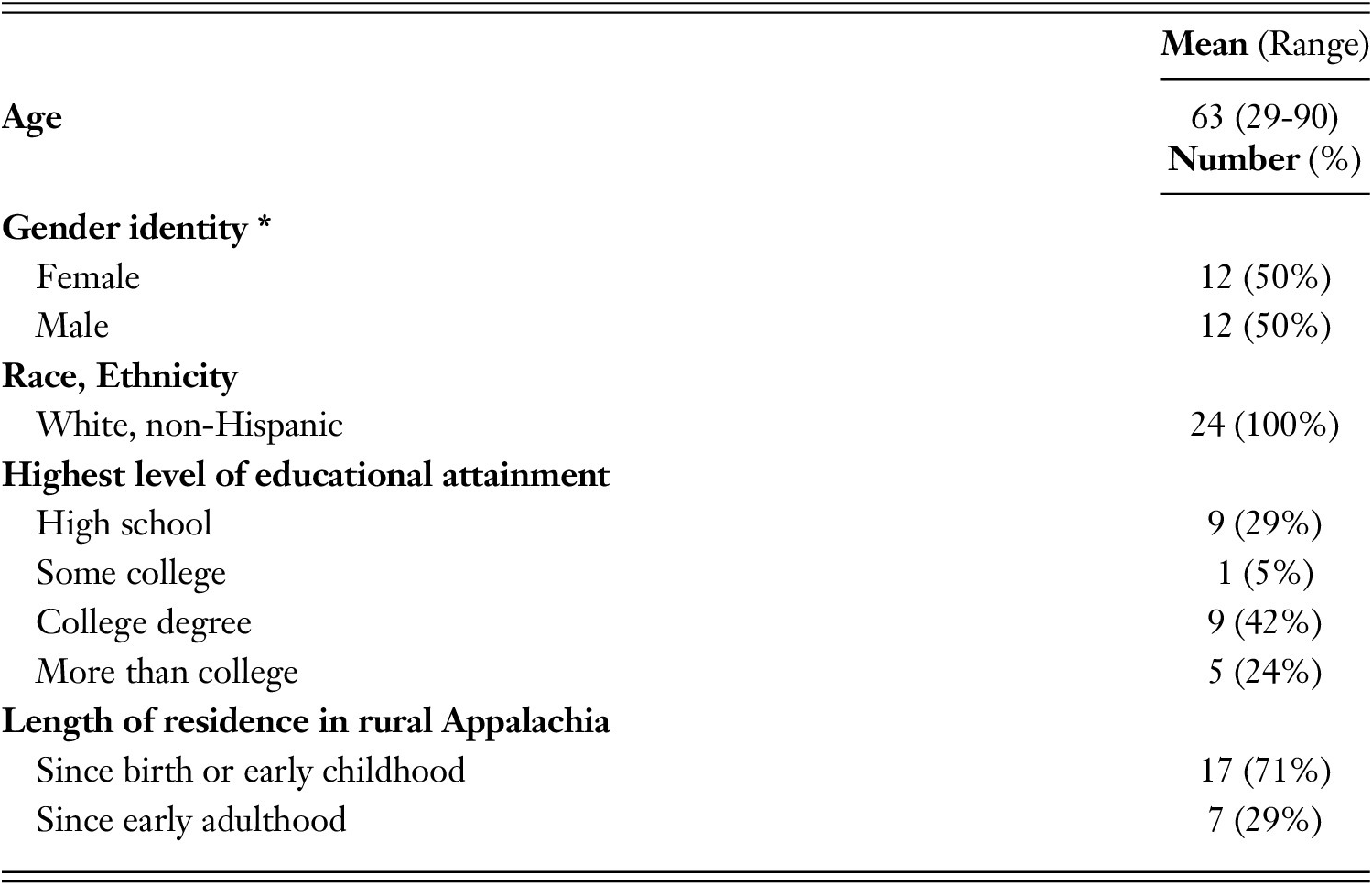
The RA and I collaborated with local healthcare providers and educators to purposively recruit healthcare providers, educators, multi-generational residents of western NC, and individuals who moved to the region in early adulthood. As presented in Table 2, half of the interviewees identified as female, and the other half identified as male. The average age of the participants was sixty-three-years-old, with a range of twenty-nine to ninety-years-old. Oral history projects frequently focus on solely interviewing adults over the age of sixty-five (Yow Reference Yow2015), but the original research studies intentionally sought to capture a wider age-range of perspectives from Appalachian residents. Because participants were invited to share their life histories during the interviews, I was able to determine the length of time that each interviewee was a resident of rural Appalachia. Seven of the twenty-four interviewees moved to western NC in early adulthood, while the others were socialized in rural Appalachia from birth or early childhood. The sample was more highly educated than the average for their respective county of residence, with five interviewees (three healthcare providers, one educator, and one engineer) completing more than college, and all interviewees completing at least high school.
Demographics of Interviewees.

* No participants identified as a gender other than female or male
Per participants’ personal preference, interviews were conducted in their home or place of employment. Following traditional oral history collection practice, interviewees were not offered incentives for participation, other than a copy of the interview audio and transcript (Thompson Reference Paul2017; Yow Reference Yow2015). Audio was professionally transcribed, and transcripts were mailed to interviewees for final approval prior to placement within a public archive at the sponsoring university. I deidentified transcripts and issued pseudonyms prior to analysis.
Thematic Analysis
Thematic analysis is a flexible qualitative research method which can be applied within a variety of research paradigms (Braun and Clarke, Reference Braun and Clarke2006). My analysis utilizes a social constructionist approach (Burr Reference Burr1995) to uncover both inductive (data-driven) and deductive (theory-driven) themes within the data (Clarke and Braun, Reference Clarke and Braun2017). Social constructionism in qualitative research attempts to theorize the sociocultural contexts and structural conditions which uphold the individual accounts that are shared by interviewees (Braun and Clarke, Reference Braun and Clarke2006). As such, I explore how the sociocultural contexts and structural conditions created by Whiteness foster the collective stories that were shared by participants. In doing so, I focus specifically on the “individual social characteristics and experiences” component of the Whiteness and health framework (Malat et al., Reference Malat, Mayorga-Gallo and Williams2018).
The initial data familiarization process involved listening to twenty-six hours and forty-two minutes of interview audio, followed by memoing (Saldaña and Omasta, Reference Saldaña and Omasta2016) interview transcripts and interviewers’ private field notes. After data familiarization, I developed codes based on interview content and theory. For example, data-driven codes such as “healthcare” and “community change” originated from interview content, while theory-driven codes such as “work ethic” and “social position” were based on the Whiteness and health framework (Malat et al., Reference Malat, Mayorga-Gallo and Williams2018). I coded and analyzed transcripts and field notes with ATLAS.ti software.
According to Michele Crossley (Reference Crossley2011), the content and complexity of personal narratives is best interpreted by considering the social reality in which the narrative is produced. Because of the life history and community focus of these oral histories, I was able to investigate how interviewees situated themselves within the social hierarchy in their community throughout their life course. To document how Whiteness did (or did not) shape their stories, I created one-page narrative summaries with a chronological interpretation of each interviewee’s life history.
Thematic analysis (Braun and Clarke, Reference Clarke and Braun2017) of the narrative summaries enabled me to determine that there were two central themes related to interviewees’ health beliefs and attitudes toward healthcare services: (1) bootstraps perspective and (2) structural perspective. I conceptualize a bootstraps perspective as the belief that individuals are responsible for their own success (Sears and Henry, Reference Sears and Henry2003). Conversely, I define a structural perspective as acknowledgement of the social arrangements that are systemically advantageous to majority populations while being simultaneously disadvantageous to minoritized populations (Pearson Reference Pearson2020; Sørensen Reference Sørensen1996).
Because the bootstraps perspective was noticeably more pervasive than the structural perspective, I used my coding results and interview summaries to produce a matrix with key demographic characteristics to determine if there were any patterns related to how demographic factors corresponded to the themes (Table 3). Location of primary socialization was the only demographic factor which consistently correlated with the bootstraps perspective or the structural perspective. Notably, neither age, education level, nor gender identity consistently corresponded with either a bootstraps or structural perspective.
Excerpt from analytic matrix.

RESULTS
Theme 1: Bootstraps Perspective of Individual Health and Healthcare Services
Bootstraps ideology was pervasive, as interviewees apprised strong work ethic as a core family and community value. Regardless of age, education level, or gender identity, the bootstraps perspective was offered solely by interviewees who were primarily socialized or born in Appalachia. Interestingly, advanced formal education did not preclude these interviewees from framing their stories with the meritocratic assumption that one’s personal contribution into the social system (e.g., talent and effort) would determine the individual rewards (e.g., economic resources and health) that one receives (Knowles and Lowery, Reference Knowles and Lowery2012). As they reflected on their own lives and the experiences of their ancestors, these interviewees suggested that people should be able to overcome difficult circumstances through “hard work,” and their narratives about community life and health contained a preponderance of stories which glorified individualism. Below, I highlight how the bootstraps perspective operated within discourses about who was responsible for (a) individual health and well-being and (b) healthcare services.
Theme 1a: Personal Responsibility for Individual Health and Well-being
Many interviewees indicated that the values of “hard work” and self-sufficiency were instilled in them from a young age by their family members. Derek (mid-thirties), a high school principal who was primarily socialized in rural Appalachia, said:
It was not uncommon for Dad to put in eighteen-hour days on a regular basis at [the factory], and Mom, even today she’s seventy-five and we can’t get her to slow down. Dad has to make her slow down. They taught me what hard work is.
Similarly, Dean (early sixties), a factory worker and lifetime western NC resident said the following:
The main thing I learned from Mom was just how to work hard and perseverance, because she was a hard worker and she had a tough life. We were very poor…even with minimum wage jobs she always provided a house and food. So other things, if you wanted them, you worked for them.
In conjunction with parents’ “hard work,” children were often expected to contribute to family finances. As they described their childhoods, interviewees of all ages who were primarily socialized in Appalachia spoke of a need to help support their families financially when they were young. They detailed the process of harvesting native mountain plants to sell to tourists, working at local general stores, and selling produce. Dean’s father died when he was a child, which prompted him to say, “I’ve worked almost a full-time job since I was about ten years old.”
Not only did interviewees who were raised in Appalachia believe that they (and their families) “worked hard,” they ascribed any current personal successes to their work ethic. Specifically, discourses about educational attainment were underscored by notions of meritocracy, in that educational attainment was always attributed to their own individual effort. Regardless of age or gender identity, all interviewees who were born or socialized in western NC who possessed a college degree were the first person in their family to attend college, and each one described how arduously they strived to achieve that goal.
For instance, Pamela (early fifties) was the child of factory workers who were multi-generational residents of rural Appalachia. With an adolescent dream of becoming a healthcare provider, she was the only child in her family to attempt secondary education. Yet, difficult circumstances resulted in Pamela becoming both a mother and a widow before her nineteenth birthday. To achieve her career goal, Pamela completed college during her forties, while simultaneously working full-time at a manufacturing company.
Fervent work ethic and tenacious perseverance characterized much of Pamela’s lived experiences, so much so that the stories she told about family and community members indicated that she expected the same high-level of effort from others. Her bootstraps ideology influenced her assessment of community members such that she disapproved of people whose lifestyles did not mirror her commitment to meritocratic ideals. As Pamela reflected on industry shifts in her community, she stated that people “aren’t willing to work hard anymore.” Pamela determined that:
People have just gotten away from what hard work is. If you work hard, you have stuff, and if you don’t work hard, you have nothing, you know? You earn your living by the sweat of your brow. People don’t want to work anymore! Everybody wants a paycheck, but nobody wants to work.
Her perception that commitment to “hard work” had diminished in her community implied a value judgement that local residents did not have jobs because they were lackadaisical and unwilling to be employed. This sentiment was common among lifetime residents of western NC, which is why I highlighted Pamela’s story as a prime example of bootstraps perspective.
Additionally, bootstraps ideology was present beyond discourses about education and employment. It also permeated interviewees’ beliefs about health behaviors. For example, interviewees consistently blamed other community members for their own poor health, because of individual level factors such as poor diet and lack of exercise. As Jeff (mid-sixties) contended:
People get overweight because they don’t feel like exercising. Nowadays people just eat junk food and sit around watching T.V. when they get home from work—if they even go to work.
Relatedly, interviewees who were raised in western NC often described mental illness and substance use disorders without offering consideration for outside factors which might contribute to mental illness, such as stress or genetic predisposition. As a healthcare provider at a local hospital, Pamela was accustomed to seeing people admitted to the emergency department for severe drug overdoses. She offered this sentiment:
Living here in this area, I love it—I don’t see drugs, but I know they’re here. This is just, like, the drug capital. I know people that do it. I don’t associate with them…but I know it’s here…I just want to smack people! What is wrong with you? [laughs] I think that to call drug addiction a disease is wrong. I don’t think it does anybody a favor. I think it just lets them have that excuse. Diabetes is a disease. Cancer is a disease. When you choose to go out and do drugs, buy drugs, give up your family, your kids, everything that means anything to you, and you wonder how could somebody do that, then it has to be a disease. No, it’s not! It’s a choice. You made a choice. And a disease, to me, is something that comes on you and you have no choice, and I think we make excuses for people to do the wrong thing, and there’s no [sighs] punishment for doing the wrong thing when you call it a disease.
Pamela’s recognition that “diabetes is a disease” is somewhat contrary to other narrators’ assumptions that lifestyle diseases like Type II diabetes were a matter of personal choice. However, an intolerance for substance use was salient across interviews with individuals who were primarily socialized in western NC. Drug addiction was commonly viewed as an immoral choice made by people who were not willing to find employment. For example, when Mallory (late twenties), another local healthcare provider, described witnessing the death of a former classmate who overdosed on drugs at the local hospital, she seemingly blamed them for “not mak[ing] the best decisions.” After this story, the interviewer asked Mallory what she thought was causing the apparent increases in drug use in the community. Mallory responded:
Poverty, is just a way to—some of them, it’s a way to make money, and some of it’s just like, “I don’t want to work, I’m lazy, and I don’t have anything to do, so I’m going to do drugs and sleep all day and play all night.” People don’t work. I just think that’s it. I think—idle hands, you don’t have anything to do, and people don’t want to work for—“Oh, I’m not going to work for $9 an hour. I’m just going to stay home and steal from other people who work and make a living.” I see that.
Thus, “idle hands” were the opposite of hard work, and essentially the antithesis of pulling oneself up by their own bootstraps. As indicated in the quote above, many interviewees who were socialized in western NC suggested that poverty was synonymous with an individual-level refusal to be gainfully employed. They often blamed individuals for their unemployment and attributed unhealthy behaviors and negative health outcomes to character deficits.
Theme 1b: Personal Responsibility for Healthcare
Similar to their belief that individuals were responsible for maintaining their own health, many interviewees perceived that individuals should procure their health insurance without governmental assistance. As such, frustration with the Affordable Care Act (ACA) was common among those who were primarily socialized in Appalachia.
Clyde (age ninety) was a retired factory worker whose family had lived in the same western NC community since the early nineteenth century. At a young age, Clyde labored on the family farm every day, even before and after school, until he began working at a manufacturing company. As a hobby, Clyde collected artifacts which reflect the culture of White settlers who moved to Appalachia in the 1800s, and several buildings on his property were full of everything from farming tools to Confederate memorabilia from the American Civil War. In concert with a long-life filled with hard work and perceived self-sufficiency, Clyde’s discourses on community life and health were suffused with bootstraps ideology.
Similar to his admiration for work ethic and self-reliance, Clyde viewed individuals as being as responsible for their own health care. He asserted that healthcare was “way better before Obamacare,” as he nostalgically described physicians making house calls during his youth and young adulthood. He also lauded the era when health insurance was primarily procured through full-time employment (pre-ACA), as if health insurance was a reward that should only be offered to those who work full-time jobs. When the interviewer asked Clyde how the ACA had impacted his community he flatly stated: “I wish healthcare was back like it was.”
Other narrators who were primarily socialized in western NC echoed the sentiment that the ACA was inappropriate because they supposed that it provided health insurance to people who were not willing to work, a direct affront to their bootstraps mentality. Marla, a healthcare provider in her mid-fifties, insisted:
I find that most [patients] do not have insurance. The ones that do are working people, and the ones that don’t, they have no intention of working, and I see a lot of entitlement, not just at [the hospital], but in general.
Again, interviewees’ meritocratic ideals bolstered their notion that individuals who were “willing to work” would have access to health insurance. Most interviewees indicated that local factory closures had diminished the availability of stable, full-time employment in their community. Yet, they did not consider the ways that a lack of local full-time employment opportunities could inhibit residents’ ability to procure health insurance through an employer.
Additionally, considerations of federal healthcare programs were replete with racialized value judgements. For example, Gene (late seventies) supposed that high healthcare costs were a result of “those people” who inappropriately utilized federal healthcare plans. When Gene said the phrase, “those people,” I interpreted this to mean Black Americans, given the following context provided to me by his adult daughter prior to his interview:
My dad is what I like to call “a big talker” and he’s a huge [Donald] Trump supporter. He’s the type who still says, “There are two types of Blacks, [racist slur] and Black people,” but I told him he can’t say the N-word while you interview him.
Following his daughter’s advice, Gene did not explicitly indicate disdain for Black Americans while the recording device was turned-on. However, his favorable sentiment toward Medicare, and his contempt for Medicaid, mirrored what many scholars have found to be racialized, stereotypical beliefs about federal healthcare programs: Medicare is associated with hard-working Whites, and Medicaid is associated with low-income Black Americans and those deemed the “undeserving poor” (Geronimus and Thompson, Reference Geronimus and Thompson2004; Gilens Reference Gilens1996; Jardina Reference Jardina2019; Metzl Reference Metzl2019; Williams et al., Reference Williams, Lawrence and Davis2019). For example, after several minutes of describing his frustration with the rising costs of medical care, Gene expressed:
There’s so many people that once they get on Medicaid, they abuse it bad. It’s those people—most of the time it’s people that won’t work that gets on it. That’s the trouble…but I think Medicare’s wonderful! We pay for that. But Medicaid, from what I hear—it’s abused bad…. I think a lot of people use [Medicaid] when they should just be out working instead.
Thus, Gene believed that Medicare, a program which he and his peers personally benefited from, was acceptable, while he simultaneously articulated discomfort with Medicaid, a federal healthcare program which supported people he believed were unwilling to work. Relatedly, Gene conveyed resentment toward people who moved into his community and did not “want” to work. He said:
I have the best place in the world to live, but those people are coming in and we don’t need no more people. We just keep to our own around here.
Gene resented when people that he perceived to be outsiders moved into his community, and he also verbalized annoyance that there were increasingly more “people who don’t speak English the right way” moving into the area. However, some of his “keep to our own” mentality extended to all people he perceived as outsiders, not simply racialized others. For example, he was also disdainful of the “tree huggers” who moved onto a nearby land trust, where the vast majority of the residents were White. Gene’s “keep to our own” attitude aligned with his thoughts on federal healthcare programs. For example, he supposed that older adults who worked hard (his peer group) deserved Medicare, while “lazy” people and outsiders had no place in his community, and they did not deserve governmental assistance for healthcare. Along with Gene, several interviewees also indicated an explicit mistrust of healthcare providers in their community who were not “from the mountains,” another example of the ways in which a distrust of “outsiders” could negatively affect healthcare attitudes and care-seeking behaviors.
Overall, the health politics of interviewees who grew up in western NC, regardless of their education level or occupation, favored health policies that predominantly benefitted people who were employed full-time. As such, they expressed frustration with Medicaid and the ACA. Because Whites typically associate needs-based programs with people of color, they often reject social policies which would ultimately benefit millions of low-income Whites (Hicken et al., Reference Hicken, Lee and Hing2018; Williams et al., Reference Williams, Lawrence and Davis2019). Therefore, these interviewees’ beliefs were consistent with the ways that white identity politics have influenced beliefs about healthcare at the national level (Jardina Reference Jardina2019).
Of the interviewees who were primarily socialized in rural Appalachia (n=17), only Robert (early eighties) and Frank (early sixties) noted the benefits of the ACA. Both Robert and Frank explicitly lauded the ACA because it provided their family members with inexpensive access to health insurance for the first time in their lives. Robert offered bootstraps ideology when he considered individual health and well-being, but he did not indicate meritocratic sentiment when he discussed healthcare programs. Frank, on the other hand, did not exhibit bootstraps ideology in any discourse during the interview, leaving him as the only lifetime resident of Appalachia who did not adhere to the bootstraps perspective. However, the beliefs of others who were socialized in rural Appalachia closely aligned with Clyde’s supposition that “everyone that’s honest and willing to work and everything gets good healthcare,” suggesting that the ACA and Medicaid were “handouts” for people who chose not to work.
Theme 2: Structural Perspective of Health and Healthcare Services
The meritocratic beliefs associated with the bootstraps perspective were contrasted by other interviewees’ structural perspective, in which participants (n=8) definitively acknowledged the ways that outside factors, systems, and structures influenced health and determinants of health for people in their community. With one exception (Frank), the structural perspective was expressed solely by interviewees who moved to Appalachia in early adulthood. Their discourses about community life and health contained a preponderance of stories which acknowledged how macro-level determinants (e.g., healthcare policies, economic shifts, access to healthy foods, available employment opportunities) affect local residents’ health and healthcare access. Below, I highlight how the structural perspective operated within narratives about the ways in which outside factors influence (a) individual health and well-being and (b) healthcare services.
Theme 2a: Outside Factors Influence Individual Health and Well-being
Elizabeth (late forties) was a provider at a local health center and had lived in western NC since her late teens. She was raised in a metropolitan part of central NC. During the interview, Elizabeth refrained from offering many details about her personal life, but she openly discussed topics related to health and healthcare in her community.
When Elizabeth asserted that many people in her county of residence were without jobs, she specified the deficit in adequate employment opportunities as a reason for widespread poverty and unemployment in the region:
There is a lot of poverty in rural communities. We don’t have a lot of big companies for folks anymore. Our huge industries have shut down left and right, and folks are having trouble putting food on the table, let alone paying for insurance and copays, and Medicaid isn’t accessible to folks who should be working but aren’t working, because of the lack of jobs.
Thus, Elizabeth attributed impoverishment, unemployment, and lack of health insurance to various social and structural factors which she saw directly affecting the health of people in the area.
At the clinic where she worked, Elizabeth often encountered patients who experienced drug addiction and mental illness. Her perspective on drug misuse offered a distinct contrast to the bootstraps perspective of drug misuse shared by other local healthcare providers who were interviewed:
There’s still quite a bit of stigma that a medication designed to treat opioid use disorder is not just perpetuating the problem…I think that we have to do a better job, or continue to do a good job, letting folks know that this is a medical issue. We know it’s a brain-based disease, it is a chronic relapsing issue, and that while they may be responsible, you know, the first several times for using, they’re not responsible for developing an addiction. I think the medications, or the drugs, are pretty profoundly responsible for that. So, not enabling people, but letting them know that we treat opioid use disorders like other chronic relapsing conditions.
In Elizabeth’s opinion, medical risk factors and circumstances outside of a person’s individual control often contributed to their unemployment or addiction to drugs. To reduce the stigma around opioid use disorder, she indicated that healthcare providers and healthcare systems should do more to educate local residents and healthcare providers about the underlying causes of addiction. Her sentiment was similar to the opinions of other interviewees who moved to western NC in adulthood. For example, John, an educator in his fifties who was primarily socialized in another rural region of NC, believed that poverty and job loss were exacerbating the need for mental health services in his community. He observed that mental illness was increasingly common among youth at the high school where he worked. He contended that decreasing the stigma associated with seeking mental healthcare services could help prevent some of the depression and suicide that he witnessed among youth and adults in the area.
Theme 2b: Collective Responsibility for Healthcare
The structural perspective was evident when interviewees determined that factors beyond an individual’s control influence one’s ability to access healthcare services. This sentiment was common among interviewees who moved to Appalachia during early adulthood. For example, Linda explicitly praised a “Medicare for All” model. As a retired farmer and healthcare provider who considered herself to be “from the mountains,” Linda (mid-seventies) believed firmly in the importance of equitable access to healthcare for all people, regardless of income level, immigration status, or employment status. She acknowledged that her family’s financial resources contributed to her ability to receive sufficient healthcare throughout her life course, but she contended that access to healthcare services should be a right instead of a privilege. Linda was a healthcare provider in rural Appalachia for over forty years, and she passionately expressed:
We have to vote in a different government that puts healthcare for everybody as a major plank of their running for office. I think we have to change the government…. It’s not ridiculous to think that changes can be made, because we know there have been other things like tax breaks and so on. Why should anybody make billions? I mean, nobody has worked so hard every day that they earned a billion dollars, that has to be paid to that person who’s head of that company before the first worker is paid, and yet we still have—many people have raised the basic pay to $15, but it’s not the law. You can still pay somebody $7.50 or whatever [the minimum wage] is in our state. And how could anybody live on that, and how can these people making this money imagine that people could live on that, even with two people in a household working?
In addition to the perceived benefits of a “Medicare for All” model, several participants were disturbed that NC’s Republican-majority legislature refused to expand Medicaid under the ACA. While these interviewees personally possessed health insurance and stable full-time employment (or retirement benefits), they lamented that many low-income residents in their community fell into a coverage gap because they earned too much income to qualify for Medicaid but did not make enough money to independently purchase a health insurance policy. For instance, Elizabeth suggested:
If we expanded Medicaid [in NC], that would benefit people. And in the long run, we know—there is evidence, there is science, there is research—that it will cost our system less and fewer dollars if people have the medical care that they needed on a regular basis and could access support from both physicians or medical providers and behavioral health providers.
While the structural perspective was not as prevalent as the bootstraps narrative within this set of oral histories, some interviewees did describe ways that members of their rural Appalachian community could benefit from federal healthcare programs which aim to provide the most vulnerable populations with equitable access to health insurance and healthcare services.
DISCUSSION
It is critical to explicate Whites’ perceptions of inequality because the prospect of reducing racial inequalities is strongly linked to public understandings about the underlying causes of inequality (Douds et al., Reference Douds, O’Connell and Bratter2019; Manza and Brooks, Reference Manza and Brooks2012). Health-related oral histories from White residents in western NC suggest that the racialized social system of Whiteness did not uniformly shape these rural Appalachian Whites’ perceptions of health, federal healthcare programs, or inequality in their community. Rather, as hypothesized in the Whiteness and health framework (Malat et al., Reference Malat, Mayorga-Gallo and Williams2018), individual experiences throughout each interviewee’s life course, societal conditions, and the hegemonic social system of Whiteness contributed to their assessments of health and healthcare. Even with a growing consideration that many rural Whites possess a “rural consciousness,” characterized by resentment toward “liberal elites” and residents of urban areas (Cramer Reference Cramer2016), these results confirm the need to move beyond the conceptualization of rural Whites in the American South, and Appalachia, as a monolithic ethnic group. While most interviewees provided a bootstraps perspective about health and healthcare, one-third of the interviewees rejected the meritocratic narratives perpetuated by Whiteness.
As scholars investigate how Whiteness and White identity politics influence Whites’ perceptions of health and well-being (Jardina Reference Jardina2019; Kwate and Goodman, Reference Kwate and Goodman2014; Malat et al., Reference Malat, Mayorga-Gallo and Williams2018; Metzl Reference Metzl2019), these findings suggest that researchers should also consider how factors such as the location of one’s primary socialization and their place of residence (rural or urban) influence Whites’ lived experiences and potentially their subsequent health behaviors and health outcomes. White mortality rates and other population health indicators are not equivalent across all areas that are classified as rural (James Reference James2014), suggesting that among Whites, the relationships between place-based factors (e.g., local culture, local economy, available healthcare services) and specific health outcomes should be probed further. For instance, interviewees shared a broad spectrum of beliefs about the causes of mental illness and drug use in their rural Appalachian region, which indicates that specifically examining rural Whites’ mental health-related beliefs and outcomes could illuminate some determinants of regional differences in the prevalence of mental illness in rural areas.
Furthermore, the location of interviewees’ primary socialization was associated with their beliefs about health and healthcare, such that those who were socialized outside of rural Appalachia did not adhere to the bootstraps perspective, even if they had lived in Appalachia for decades and considered themselves as being “from the mountains” or a “mountain person.” Along with individual social identities and socioeconomic status, I posit that researchers who study Whiteness, White identity, and health should additionally investigate how nuanced place-based social and cultural factors associated with the location of one’s primary socialization may influence Whites’ perceptions of what it means to be healthy. For example, survey data from Appalachian Ohio indicate that rural identity and Appalachian identity are not synonymous, meaning that it is necessary for researchers to consider them as unique constructs (Paskett et al., Reference Paskett, Young, Bernardo, Washington, DeGraffinreid, Fisher and Huerta2019). Since other qualitative studies find that rural Appalachian Whites frequently possess a region-specific ethic identity (Grove Reference Grove2015; Hartigan Reference Hartigan2004; Scott Reference Scott2009), future research should assess if and how Whiteness shapes Appalachian Whites’ health-related beliefs and attitudes in similar or different ways as compared to Whites in rural communities outside of Appalachia. Failing to understand the nuanced ways that White identity politics manifest regionally could result in unsuccessful community organizing efforts which aim to increase Whites’ political support for inequality reducing policies.
Interviewees’ stories also indicate that some rural Appalachian Whites’ adherence to bootstraps ideology influences their contempt for stigmatized federal healthcare programs. Similar to how other Whites in NC have used a “get over it” narrative frame to suggest that people who are marginalized should simply “get over” the discrimination and oppression that they experience (Straubel Reference Straubel2020), interviewees who framed their stories with the bootstraps perspective did not express empathy for fellow community members who were unemployed. By failing to acknowledge structural factors that affect available employment opportunities in their region, some interviewees suggested that community members make a deliberate choice to go without full-time employment, therefore blaming individuals for their lack of health insurance. Thus, the stigma these interviewees associate with Medicaid and the ACA (e.g., programs they believed were offering “hand-outs” to lazy people) precludes them from supporting other federal healthcare policies and social programs designed to improve healthcare access in their community and beyond. Interestingly, these findings contradict the aforementioned narrative that regions of the American South that are located outside of the historical “Black Belt” are more amenable to racialized social policies (Acharya et al., Reference Acharya, Blackwell and Sen2018). By that logic, White residents of western NC would be more supportive of progressive health policies (as compared to other Southern Whites) because such a relatively small percentage of the population was enslaved in western NC during the 1800s. The findings presented in this manuscript complicate the notion that conservatism among White Southerners is consistent with historic patterns of enslavement, given that only one-third of these interviewees in Appalachia exhibited progressive sentiment with regards to healthcare. Moreover, interviewees who offered a more progressive, structural perspective (apart from Linda) were primarily socialized in other regions of the South where the local economy relied much more heavily on chattel slavery than mountainous western NC.
Furthermore, in alignment with Du Bois’ assertion that the “public wage” of being White is the compensation one receives from non-Black status (Du Bois Reference Du Bois2007), interviewees whose narratives exemplified the bootstraps perspective made concerted efforts to distance themselves from health programs that they associate with Blackness. Self-reliance and work ethic ostensibly protected these interviewees from the stigma of racialized healthcare programs. However, upholding bootstraps ideology is counterproductive for impoverished Whites. At the national level, racial resentment toward Black Americans has historically bolstered White opposition to many social programs which could ultimately benefit millions of White Americans (Gilens Reference Gilens1996; Tesler Reference Tesler2012; Williams et al., Reference Williams, Lawrence and Davis2019). My findings suggest that this political resistance could be especially health-harmful for White people in economically distressed rural Appalachian communities where residents are less likely to be insured than those in urban areas (Marshall et al., Reference Marshall, Thomas, Lane, Holmes, Arcury, Randolph, Silberman, Holding, Villamil, Thomas, Lane, Latus, Rogers and Ivey2017). Similar to Jonathan M. Metzl’s (Reference Metzl2019) findings in Dying of Whiteness: How Racial Resentment is Killing America’s Heartland, I posit that pervasive bootstraps ideology could further negatively affect the health of millions of uninsured Whites who reside in Appalachia (Appalachian Regional Commission 2012), as deaths of despair and perceived social status threat worsen White mortality rates (Siddiqi et al., Reference Siddiqi, Sod-Erdene, Hamilton, Cottom and Darity2019). These interviews and previous research indicate that the association of former President Barack Obama with the ACA precludes many Whites—especially White Republicans—from supporting it (Efird and Lightfoot, Reference Efird and Lightfoot2020; Metzl Reference Metzl2019; Tesler Reference Tesler2012). Because of this, any local efforts to promote Medicaid expansion in NC should be reframed in ways that de-emphasize the term “Medicaid.” For example, there was bi-partisan support for Medicaid expansion in Republican-majority Michigan when the effort was reframed as the “Healthy Michigan Plan” (Kelley et al., Reference Kelley, Goold, Ayanian, Patel, Zhang, Beathard, Chang, Solway and Tipirneni2019).
Additionally, White Appalachian opposition to social programs could ultimately be health-harmful for Black, Indigenous, and other people of color in rural Appalachia because people of color in rural areas disproportionately experience the negative health-effects that are associated with a lack of healthcare services (Caldwell et al., Reference Caldwell, Ford, Wallace, Wang and Takahashi2016; Gee and Ford, Reference Gee and Ford2011; Richman et al., Reference Richman, Pearson, Beasley and Stanifer2019). Further investigation into the individual and social factors which prompted someone like Frank (who was primarily socialized in rural Appalachia) to acknowledge the unjust roots of inequality could support efforts to create more successful interventions which aim to teach Whites about inequality and challenge individually held ahistorical beliefs about structural inequality. This is important because increasing White Appalachian political support for health-promoting and inequality-reducing policies would benefit both people of color and impoverished Whites in the region.
Finally, some of the interviewees’ resistance to social programs which they associate with marginalized and othered groups may be connected to an in-group preference for people who they perceive to be members of their predominantly White community. Eric Kaufmann’s (Reference Kaufmann2019) analysis of ethno-traditional nationalism during Donald Trump’s presidency found that ethnic attachment is a key factor explaining White identity, which in turn influenced Whites’ decision to vote for Trump in 2016. Conversely, high-ethnic-identifying racially minoritized individuals were less likely to have voted for Trump than low-ethnic-identifying racially minoritized individuals (Kaufmann Reference Kaufmann2019). Ashley Jardina’s (Reference Jardina2019) examination of nationally representative polling data found that in-group preference and White racial solidarity are key motivators of Whites’ alignment with Trump’s divisive political rhetoric and ideologies which harm people of color (Bobo Reference Bobo2017b). It is beyond the scope of this paper to further explore the “keep to our own” sentiment conveyed by many of the interviewees who were raised in rural Appalachia, yet this perspective should be systematically investigated to determine how White Appalachian residents’ in-group preference may or may not be associated with a sense of ethnic identity that differs from White people who live in other areas. The “keep to our own” attitude of some Appalachians Whites indicates that interventions or political organizing efforts which intend to foster and increase political will for health and social programs should be designed in collaboration with White Appalachians and presented by local, trusted residents who exhibit a structural perspective. Furthermore, attempts to garner support for federal healthcare programs in this region of Appalachia should be framed in ways that show residents how these programs would directly benefit their community.
LIMITATIONS
Given that this analysis does not include the perspective of any White residents with less than a high school degree, a limitation of my findings is that they are based on a sample of individuals who are more highly educated (on average) than their county of residence. Formal education is known to influence the ways in which individuals interact with the political and social world (Kinder and Kam, Reference Kinder and Kam2010). For example, nationally representative polling data indicate that Whites’ education level is associated with their level of White racial identity, such that less educated Whites tend to exhibit more in-group preference and subsequently adopt higher affinity for their own racial group in consideration for policies and federal healthcare programs (Jardina Reference Jardina2019). Yet, individualistic and meritocratic ideology still permeated many of the highly educated interviewees’ beliefs about health and healthcare. While all interviewees who offered a structural perspective about health or healthcare programs possessed at least a college degree, advanced formal education did not preclude interviewees who were socialized in rural Appalachia from exhibiting meritocratic and individualistic ideals.
CONCLUSION
This study demonstrates that there is not one uniform type of “rural White” within an Appalachian region of western North Carolina. To gain more White American support for inequality reducing healthcare policies, it is necessary to deconstruct how Whiteness, White identity, and place-based cultural factors influence Whites’ perceptions of health and healthcare. Interviewees’ variation in acceptance of health-related White identity politics (Jardina Reference Jardina2019) was connected to various social and individual factors, such as one’s place of primary socialization. Therefore, researchers should consider how regional and cultural factors reinforce Whiteness and shape White Americans’ sense of identity and subsequent health beliefs and voting behaviors. As racism remains embedded within United States culture (Bobo Reference Bobo2017a; Bonilla-Silva Reference Bonilla-Silva2020; Williams et al., Reference Williams, Lawrence and Davis2019), documenting and naming the ways that Whiteness shapes Whites’ perceptions of health and healthcare is a critical component of efforts to dismantle the systems of oppression and supremacy which perpetuate racialized health inequities. To increase White American political will for social programs which promote health equity and reduce inequality, policies should be framed in ways that appeal to specific regional and local cultures.
ACKNOWLEDGEMENTS
I want to express my gratitude to Clare Barrington, Bria Berry, Dane Emmerling, and two anonymous reviewers for their insightful comments on earlier drafts of this manuscript. I am also grateful for the resources and training I received from Rachel F. Seidman, Sara Wood, Emma Miller, and other colleagues at the Southern Oral History Program at the Center for the Study of the American South at the University of North Carolina at Chapel Hill.