Introduction
The little-known Hkamti amber from the Sagaing Region of northern Myanmar was recently uranium-lead (U-Pb) dated to be ca. 110 Ma of age (Xing and Qiu, Reference Xing and Qiu2020). Previously, it was thought to be the same age as Kachin (or ‘Burmese’) amber from the nearby Hukawng Valley in Kachin State, Myanmar (90 km from Hkamti). The age of Kachin amber was U-Pb dated to be ca. 99 Ma (Shi et al., Reference Shi, Grimaldi, Harlow, Wang, Yang, Lei, Li and Li2012), a date considered to be supported by some fossils (Smith and Ross, Reference Smith and Ross2018). Kachin amber is well-known for its extremely diverse and rich tropical paleobiota from the Cretaceous, with nearly 1,500 species currently described (Ross et al., Reference Ross, Mellish, York, Crighton and Penney2010; Ross, Reference Ross2019, Reference Ross2020). Because amber mining began in Hkamti only recently, very few species have been reported (Jouault et al., Reference Jouault, Perrichot and Nel2020a, Reference Jouault, Rasnitsyn and Perrichotb; Olmi et al., Reference Olmi, Perkovsky, Guglielmino, Capradossi and Jouault2020; Xing and Qiu, Reference Xing and Qiu2020), and its paleobiota is yet to be described and compared with that of Kachin amber.
Prior to the current study, there were no records of mollusks from Hkamti amber, but nearby Kachin amber is known to be rich in mollusks: 19 new species of land snails have been described since 2018 and numerous other molluskan inclusions have been reported (Yu et al., Reference Yu, Wang and Pan2018; Hirano et al., Reference Hirano, Asato, Yamamoto, Takahashi and Chiba2019; Balashov, Reference Balashov2020; Balashov et al., Reference Balashov, Perkovsky and Vasilenko2020; Bullis et al., Reference Bullis, Herhold, Czekanski-Moir, Grimaldi and Rundell2020; Yu, Reference Yu2020). Kachin amber is much richer in mollusks than all other well-studied deposits of amber combined (Balashov, Reference Balashov2020). Only 11 species of land snails have been described from Eocene Baltic amber over 130 years of study (Stworzewicz and Pokryszko, Reference Stworzewicz and Pokryszko2006, Reference Stworzewicz and Pokryszko2015; Balashov and Perkovsky, Reference Balashov and Perkovsky2020), and few specimens have been reported from Miocene Dominican amber (Poinar and Roth, Reference Poinar and Roth1991; Penney, Reference Penney and Penney2010) and from Lower Cretaceous Lebanese amber (Roth et al., Reference Roth, Poinar, Acra and Acra1996) without species descriptions. The goals of this study are to describe the first mollusks from Hkamti amber, compare the species composition of this deposit to Kachin amber, and discuss the implications of the resulting comparisons.
Materials and methods
The amber was mined in Hkamti (sometimes spelled ‘Khamti’), Hkamti District, Sagaing Region, northern Myanmar. Systematics follow Bouchet et al. (Reference Bouchet, Rocroi, Hausdorf, Kaim, Kano, Nützel, Parkhaev, Schrödl and Strong2017). The terminology used in the description of Diplommatinidae follows Neubert and Bouchet (Reference Neubert and Bouchet2015) and Nurinsiyah and Hausdorf (Reference Nurinsiyah and Hausdorf2017).
Repository and institutional abbreviation
Types, figures, and other specimens examined in this study are deposited in the collection of terrestrial mollusks of the I.I. Schmalhausen Institute of Zoology NAS Ukraine, Kyiv, Ukraine (SIZK; the abbreviation IZAN is the same and also in use).
Systematic paleontology
Class Gastropoda Cuvier, Reference Cuvier1795
Subclass Caenogastropoda Cox, Reference Cox and Moore1960
Order Architaenioglossa Haller, Reference Haller1892
Superfamily Cyclophoroidea Gray, Reference Gray1847
Family Diplommatinidae Pfeiffer, Reference Pfeiffer1856
Genus Euthema Yu, Wang, and Pan, Reference Yu, Wang and Pan2018
- Reference Yu, Wang and Pan2018
Euthema Yu et al., p. 255.
- Reference Hirano, Asato, Yamamoto, Takahashi and Chiba2019
Euthema; Hirano et al., p. 7.
- Reference Balashov2020
Euthema; Balashov, p. 2.
- Reference Bullis, Herhold, Czekanski-Moir, Grimaldi and Rundell2020
Paleodiplommatina Bullis et al., p. 5.
- Reference Bullis, Herhold, Czekanski-Moir, Grimaldi and Rundell2020
Xenostoma Bullis et al., p. 6 (n. syn.).
Type species
Euthema naggsi Yu, Wang, and Pan, Reference Yu, Wang and Pan2018.
Revised diagnosis
Shell very small, dextral, nearly cylindrical, consisting of approximately six whorls. First two whorls irregularly tightly coiled. Constriction strong to almost reduced. Surface with prominent ribs. Aperture oval to circular or nearly heart-shaped. Peristome doubled. Umbilicus open, often with periumbilical keel.
Occurrence
Only known from Kachin and Hkamti ambers (northern Myanmar), eight species; Albian–Cenomanian (mid-Cretaceous), ca. 110–99 Ma.
Size
Height 1.7–3.25 mm; diameter 0.9–1.5 mm.
Remarks
This genus has been previously revised (Balashov, Reference Balashov2020), but the addition of new specimens, including one described here, provide a more complete picture and require additional clarifications and arrangements.
There are several significant characters that appear to be inherited from the ancestor of Euthema but are more or less reduced in some of the species. These characters are:
(1) In all Euthema spp., there is a constriction near the last quarter of the penultimate whorl and/or the first quarter of the last whorl, i.e., the diameter of the shell tube decreases, and the remaining part of last whorl continues with the same diameter as before the constriction. The constriction varies in Euthema spp. from strong to very weak (Table 1), but it is present in all specimens and is among the distinctive features of Diplommatinidae (Neubert and Bouchet, Reference Neubert and Bouchet2015; Nurinsiyah and Hausdorf, Reference Nurinsiyah and Hausdorf2017).
(2) Largely because of the constriction, coiling of the two last whorls is more or less irregular in Euthema, and some part of the penultimate whorl is often appressed to the last whorl. This character has been described for Euthema spp. as ‘penultimate whorl coiling tight’ (Yu et al., Reference Yu, Wang and Pan2018; Hirano et al., Reference Hirano, Asato, Yamamoto, Takahashi and Chiba2019; Balashov, Reference Balashov2020). This description means that, in abapertural view, the ‘left’ part of the penultimate whorl (last quarter) is usually irregularly lower than in the previous whorl. This is especially obvious in E. naggsi and E. annae Balashov, Reference Balashov2020 (see Yu et al., Reference Yu, Wang and Pan2018, fig. 1A; Balashov, Reference Balashov2020, fig. 1B, D). However, if the constriction is oriented in a slightly different position, or if the shell is from a juvenile or subadult, then the same part of the penultimate whorl might be regularly higher than in the previous whorl, whereas the ‘low part’ might be displaced to the end of the penultimate whorl. This condition is particularly conspicuous in E. hesoana Asato and Hirano in Hirano et al., Reference Hirano, Asato, Yamamoto, Takahashi and Chiba2019 (see Hirano et al., Reference Hirano, Asato, Yamamoto, Takahashi and Chiba2019, fig. 4a–c). In some Euthema spp., this character is very weak, and the ‘low part’ can be displaced to the beginning of the last whorl; in such a case, the penultimate whorl coils almost regularly, but the last whorl does not.
(3) The first two whorls of Euthema are irregularly tightly coiled (oblique to the axis of the remaining shell and unproportioned in size), and in most species, they are also significantly narrower than the third and following whorls. Such coiling often forms a specific, slightly blunt and rounded shape of the upper part of the shell (first three whorls), which is especially conspicuous in E. truncatellina Balashov, Perkovsky, and Vasilenko, Reference Balashov, Perkovsky and Vasilenko2020 (see Balashov et al., Reference Balashov, Perkovsky and Vasilenko2020). This irregular coiling means that juveniles of some Euthema species with approximately three whorls have a relatively low shell, with the diameter exceeding the height, and this is perhaps beneficial to Euthema in its earlier life stages. Usually in species with a cylindrical or high-conical shell of three whorls, the shell is high already (but there are exceptions). This character seems to be especially important for generic delimitation because it does not occur in most extant Diplommatinidae. However, it is similar in Notharinia Vermeulen, Phung, and Truong, Reference Vermeulen, Phung and Truong2007 from Southeast Asia (Vermeulen et al., Reference Vermeulen, Phung and Truong2007, Reference Vermeulen, Luu, Theary and Anker2019; Maassen, Reference Maassen2008; Páll-Gergely and Hunyadi, Reference Páll-Gergely and Hunyadi2018). Perhaps this means that Notharinia is distantly related to Euthema.
(4) A periumbilical keel is present only in some species of Euthema, and it largely reflects the shape of the constriction, e.g., it is probable that the keel initially formed as a result of a strong constriction. However, considering that a keel is also present in some species with a weak constriction and absent in some species with a moderate constriction (see Table 1), it appears to be an important independent character that should be especially useful for species delimitation in Euthema.
A comparison of distinguishing characters in Euthema spp.

* remeasured from the original photos
A comparison of distinguishing characters from all known Cretaceous species of Diplommatinidae (see Table 1) leads to the conclusion that members of this group are probably closely related and, therefore, should be viewed as a single genus. The implications suggest that Xenostoma should be considered a synonym of Euthema, as was previously concluded for Paleodiplommatina (see Balashov, Reference Balashov2020). Xenostoma was established for a single species from Kachin amber, X. lophopleura Bullis et al., Reference Bullis, Herhold, Czekanski-Moir, Grimaldi and Rundell2020, and is characterized by the “very small elongate conical shell with penultimate whorl wider than body whorl, narrowly umbilicate, and uniquely oblique-ovate aperture with doubly expanded peristome” (Bullis et al., Reference Bullis, Herhold, Czekanski-Moir, Grimaldi and Rundell2020, p. 6). All listed characters, except apertural shape, are common among Euthema spp. (see Table 1), and a slightly different shape of the aperture alone is not significant enough to distinguish genera. The whorls are relatively regularly coiled in E. lophopleura (see Bullis et al., Reference Bullis, Herhold, Czekanski-Moir, Grimaldi and Rundell2020), but a weak constriction is present, and the first two whorls are coiled relatively irregularly and tightly. Other characters of E. lophopleura are like those of E. naggsi.
The nomenclatural acts by Bullis et al. (Reference Bullis, Herhold, Czekanski-Moir, Grimaldi and Rundell2020) should be addressed here because the publication date of the taxa being referred to is 2019 (Ross, Reference Ross2020). The online version of the paper was first published in September 2019, but because the publication was not registered in ZooBank (Bullis et al., Reference Bullis, Herhold, Czekanski-Moir, Grimaldi and Rundell2020), the requirements of Article 8.5 of the International Code of Zoological Nomenclature (ICZN, 1999, with amendments of 2012) were not met. Thus, the date of publication of the printed version (March 2020, day not specified) should be used.
In the recent work of Yu (Reference Yu2020), three new shells of Euthema were reported from Kachin amber. Two were identified as E. naggsi, and the third was described as a new species, ‘Truncatellina dilatatus’ Yu, Reference Yu2020 of the extant genus Truncatellina Lowe, Reference Lowe1852 (Heterobranchia, Stylommatophora, Orthurethra). The latter genus belongs to a different subclass of gastropods than Euthema. There is absolutely no doubt that this shell is not a representative of pulmonate mollusks but belongs to Cyclophoroidea. The last whorl is constricted and slightly curved and irregularly coiled, which is a typical feature of Diplommatinidae (Nurinsiyah and Hausdorf, Reference Nurinsiyah and Hausdorf2017) not found in Orthurethra. Some species of Euthema are indeed very similar to Truncatellina, so much so that together with the fact that I have collected and studied several thousands of the extant European snails of this genus, it has led me to naming one of the Euthema species after this genus, E. truncatellina, to acknowledge the convergence in the two lineages of land gastropods (Balashov et al., Reference Balashov, Perkovsky and Vasilenko2020).
An irregular character of shell coiling in Euthema, especially of the last whorl and of the first two whorls, is unmistakably different than in Truncatellina. As described above for Euthema, ‘Truncatellina dilatatus’ has the first two whorls irregularly tightly coiled and significantly narrower than the third and following whorls. This condition is not found in Truncatellina, with all whorls coiling regularly. The shell coiling of ‘Truncatellina dilatatus’ is identical to that of E. naggsi, E. hesoana, E. truncatellina, etc. Apparently, ‘Truncatellina dilatatus’ is a juvenile Euthema with an incomplete aperture and a differently oriented constriction. From the main distinctive characters, ‘Truncatellina dilatatus’ does not significantly differ from E. naggsi, except in being a little smaller and having fewer whorls and a circular aperture (see Table 1), all of which are expected differences for a juvenile E. naggsi with an unfinished shell. ‘Truncatellina dilatatus’ could be conspecific with E. naggsi or could represent a separate species. Additional juvenile and subadult specimens of Euthema are required for clarification. Also problematic, the species name ‘dilatatus’ is used in the masculine form, but both Truncatellina and Euthema are feminine; therefore, the ending should be changed to ‘dilatata’ in agreement with gender.
One of the two other Euthema shells reported by Yu (Reference Yu2020, fig. 1A, B) apparently represents E. naggsi as it was identified, but the other (see Yu, Reference Yu2020, fig. 1C, D) is clearly not a representative of this species. It is probably E. hesoana considering the enormous umbilicus resulting from the extremely strong constriction of the last whorl.
Therefore, eight species should be currently placed into Euthema: (1) E. naggsi Yu, Wang, and Pan, Reference Yu, Wang and Pan2018 (additional specimen illustrated by Yu, Reference Yu2020, fig. 1A, B); (2) E. hesoana Asato and Hirano in Hirano et al., Reference Hirano, Asato, Yamamoto, Takahashi and Chiba2019 (additional specimen illustrated by Yu, Reference Yu2020, fig. 1C, D); (3) E. spelomphalos (Bullis et al., Reference Bullis, Herhold, Czekanski-Moir, Grimaldi and Rundell2020); (4) E. lophopleura (Bullis et al., Reference Bullis, Herhold, Czekanski-Moir, Grimaldi and Rundell2020); (5) E. dilatata (Yu, Reference Yu2020); (6) E. truncatellina Balashov, Perkovsky, and Vasilenko, Reference Balashov, Perkovsky and Vasilenko2020; (7) E. annae Balashov, Reference Balashov2020; and (8) E. myanmarica n. sp.
Euthema myanmarica new species
Figure 1
Holotype
SIZK GT 7178, single shell in a small piece of amber, 24 mm × 12 mm × 5 mm. No recognizable syninclusions.
Holotype of Euthema myanmarica n. sp. in Hkamti amber, SIZK GT 7178, views from opposite sides of the amber stone. Scale bar = 0.5 mm.

Diagnosis
Shell almost cylindrical; whorls moderately convex; aperture oval; constriction weak; penultimate whorl high, coiling almost regularly; umbilicus wide, with strong periumbilical keel.
Occurrence
Hkamti, Sagaing Region, northern Myanmar; Albian (mid-Cretaceous), ca. 110 Ma.
Description
Shell dextral, almost cylindrical, comprising six moderately convex whorls. Protoconch smooth. First two whorls irregularly tightly coiled, oblique, significantly narrower than third and following whorls. Penultimate whorl relatively high, coiling almost regularly. Constriction weak, mainly on first quarter of last whorl. Sculpture of relatively straight regular ribs on entire teleoconch. Apertural half of penultimate whorl with ~25 ribs. Aperture oval, with no visible structures inside. Apertural height exceeding its width (ratio 1.25). Peristome doubled; inner peristome thickened; outer peristome thin, sharp, strongly expanded, slightly reflected. Umbilicus wide. Strong periumbilical keel on entire last whorl.
Etymology
The species is named after the country of origin, Myanmar.
Size
Shell height 2 mm, diameter 0.9 mm; apertural height 0.75 mm, width 0.6 mm; height of last whorl 0.9 mm, diameter without aperture 0.75 mm; height of visible part of penultimate whorl 0.5 mm, diameter 0.75 mm; height of visible part of fourth whorl 0.35 mm, diameter 0.7 mm; height of visible part of third whorl 0.25 mm, diameter 0.5 mm; height of visible part of second whorl 0.1 mm, diameter 0.3 mm.
Remarks
This specimen clearly differs from most species of Euthema by the presence of the strong periumbilical keel (see Table 1). Euthema spelomphalos is much larger (height 3.25 mm) and has a columellar tooth and weaker periumbilical keel. The shells’ proportions also differ: in E. myanmarica n. sp., the last 3 whorls make up more than four-fifths of the shell height, whereas in E. spelomphalos, the whorls make up only approximately two-thirds of the shell height. The first two whorls are not irregularly narrower than the third whorl in E. spelomphalos. In E. hesoana, the constriction is much stronger than that of E. myanmarica n. sp., resulting in the enormous umbilicus. In E. myanmarica n. sp., the umbilicus is wide but does not form a large cavity on the wall of the last whorl as in E. hesoana.
Family Cyclophoridae Gray, Reference Gray1847
Genus Archaeocyclotus Asato and Hirano in Hirano et al., Reference Hirano, Asato, Yamamoto, Takahashi and Chiba2019
Type species
Archaeocyclotus plicatula Asato and Hirano in Hirano et al., Reference Hirano, Asato, Yamamoto, Takahashi and Chiba2019.
Archaeocyclotus cf. A. plicatula Asato and Hirano in Hirano et al., Reference Hirano, Asato, Yamamoto, Takahashi and Chiba2019
Figure 2
Occurrence
Hkamti, Sagaing Region, northern Myanmar; Albian (mid-Cretaceous), ca. 110 Ma.
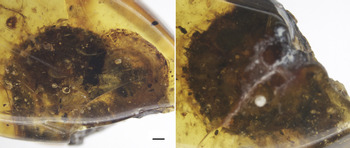
Shell of Archaeocyclotus cf. A. plicatula in Hkamti amber, SIZK GT 7179, views from opposite sides of the amber stone. Scale bar = 0.5 mm.

Description
Shell discoidal, keeled, comprising 5.5 whorls. Suture deep. Protoconch smooth, comprising 2.5 whorls. Sculpture of sparse large axial ribs. Small periostracal hairs present. Aperture large, oval, with broadly reflected margins. Umbilicus open, wide, approximately one-third of shell diameter.
Materials
SIZK GT 7179, single shell in a small piece of amber, 12 mm x 6 mm x 5 mm. No recognizable syninclusions.
Size
Shell height ~2.5–3 mm, diameter 6.8 mm.
Remarks
This shell strongly resembles that of Archaeocyclotus plicatula (see Hirano et al., Reference Hirano, Asato, Yamamoto, Takahashi and Chiba2019), but it is larger and has strongly reflected apertural margins. This could indicate that the holotype of A. plicatula is a juvenile or subadult—it measures 5.2 mm at 5 whorls, whereas this shell is 6.8 mm at 5.5 whorls. Considering that the current specimen is presumably of a significantly different age than A. plicatula, it would be speculative to conclude that they are conspecific without having more specimens from both deposits.
The protoconch of this shell is not visible in photographs because of the amber's structure, but is fully observable by eye with distortion. The piece of amber is too small and the shell is too close to the surface for further polishing.
Cyclophoridae gen. indet. sp. indet. 1
Figure 3
Occurrence
Hkamti, Sagaing Region, northern Myanmar; Albian (mid-Cretaceous), ca. 110 Ma.
Shell of Cyclophoridae gen. indet. sp. indet. 1 in Hkamti amber, SIZK GT 7180, views from opposite sides of the amber stone. Scale bar = 0.5 mm.

Description
Shell low-conical, slightly keeled, very thin-walled, comprising at least 3 whorls (protoconch unobservable). Last whorl very large, more than half of shell. Surface almost smooth, very weakly striated. Aperture very large, oval, with simple edges. Umbilicus closed or very narrow.
Materials
SIZK GT 7180, single shell in a small piece of amber, 11 mm x 9 mm x 3.5 mm. No recognizable syninclusions.
Size
Shell height ~2.5 mm, diameter 5.9 mm.
Remarks
This shell is likely from a juvenile and perhaps deformed.
Cyclophoridae gen. indet. sp. indet. 2
Figure 4
Occurrence
Hkamti, Sagaing Region, northern Myanmar; Albian (mid-Cretaceous), ca. 110 Ma.
Shell of Cyclophoridae gen. indet. sp. indet. 2 in Hkamti amber, SIZK GT 7181, views from opposite sides of the amber stone. Scale bar = 0.5 mm.

Description
Shell low-conical, comprising at least two whorls (protoconch unobservable). Suture deep. Surface almost smooth, very weakly striated. Aperture large, oval, with simple edges. Umbilicus open, wide, approximately one-quarter of shell diameter.
Materials
SIZK GT 7181, single shell in a small piece of amber, 21 mm x 17 mm x 7 mm. No recognizable syninclusions.
Size
Shell height ~0.5 mm, diameter 1.7 mm.
Remarks
This shell is from a juvenile and slightly resembles that of Perissocyclos kyrtostoma Bullis et al., Reference Bullis, Herhold, Czekanski-Moir, Grimaldi and Rundell2020 from Kachin amber, which is much larger. Perhaps this is a juvenile of Perissocyclos sp.
Cyclophoridae gen. indet. sp. indet. 3
Figure 5
Occurrence
Hkamti, Sagaing Region, northern Myanmar; Albian (mid-Cretaceous), ca. 110 Ma.
Shell of Cyclophoridae gen. indet. sp. indet. 3 and beetle (Scydmaeninae) in Hkamti amber, SIZK GT 7182, views from opposite sides of the amber stone. Scale bar = 0.5 mm.

Description
Shell discoidal, irregularly coiled, comprising two whorls. Surface smooth. Aperture large, oval, with simple edges. Umbilicus open, wide, more than one-third of shell diameter.
Materials
SIZK GT 7182, single shell in a small piece of amber, 18 mm x 8 mm x 4 mm. Syninclusions: two specimens of Scydmaeninae (Coleoptera, Staphylinidae).
Size
Shell height ~1 mm, diameter 3.1 mm.
Remarks
This shell is probably from a juvenile, notable by its specific irregular coiling.
Ichnofamily Gastrochaenolitidae Wisshak, Knaust and Bertling, Reference Wisshak, Knaust and Bertling2019
Ichnogenus Teredolites Leymerie, Reference Leymerie1842
Type ichnospecies
Teredolites clavatus Leymerie, Reference Leymerie1842.
Teredolites clavatus Leymerie, Reference Leymerie1842
Figure 6
Holoype
Unknown.
Ichnospecies Teredolites clavatus, the borings of pholadid bivalves, in Hkamti amber: (1) SIZK GT 7183; (2) SIZK GT 7184. Scale bars = 0.5 mm.

Occurrence
Hkamti, Sagaing Region, northern Myanmar; Albian (mid-Cretaceous), 110 Ma.
Description
Long, club-shaped structures with narrow distal end connected to surface of amber, more or less perpendicular to surface at point of connection. Diameter of structures gradually increases from narrow distal part to widest proximal part, continuing to rounded proximal end. Structures circular in cross section over whole length. Axis of structures more or less straight. Full length of structures approximately two or three times greater than maximum diameter.
Materials
Eight pieces of amber: (1) SIZK GT 7183, 3 borings in a stone measuring 16 x 8 x 3 mm (Fig. 6); (2) SIZK GT 7184, 5 borings in a stone measuring 23 x 17 x 7 mm; (3) SIZK GT 7185, 15 borings in a stone measuring 22 x 13 x 4 mm; (4) SIZK GT 7186, 16 borings in a stone measuring 19 x 15 x 9 mm; (5) SIZK GT 7187, 13 borings in a stone measuring 15 x 15 x 7 mm; (6) SIZK GT 7188, 6 borings in a stone measuring 17 x 14 x 4 mm; (7) SIZK GT 7189, 2 borings in a stone measuring 16 x 8 x 5 mm; (8) SIZK GT 7190, 4 borings in a stone measuring 16 x 12 x 6 mm. Syninclusions: various Diptera.
Size
Length 1.9–6.5 mm, diameter at widest place of proximal part 0.7–2.9 mm, minimum diameter at narrowest place of distal part 0.2 mm.
Remarks
Most of the structures are incomplete because significant parts have been chafed away with part of the amber, naturally or during primary treatment of the amber after mining. Often, only the proximal part of the structure remains, or even only a proximal tip.
Discussion
All five snails found in Hkamti amber are representatives of the superfamily Cyclophoroidea, which is also the case for nearly all known land snails from Kachin amber, except one rather semiaquatic species (Balashov, Reference Balashov2020). Cyclophoroidea is the second-most speciose lineage of extant land gastropods after Eupulmonata (Kobelt, Reference Kobelt1902; Wenz, Reference Wenz and Schindewolf1938–1939; Haas, Reference Haas1961; Boeters et al., Reference Boeters, Gittenberger and Subai1989; Emberton, Reference Emberton2002; Vermeulen et al., Reference Vermeulen, Phung and Truong2007, Reference Vermeulen, Luu, Theary and Anker2019; Maassen, Reference Maassen2008; Yamazaki et al., Reference Yamazaki, Yamazaki and Ueshima2013, Reference Yamazaki, Yamazaki and Ueshima2015a, Reference Yamazaki, Yamazaki, Rundell and Ueshimab; Páll-Gergely et al., Reference Páll-Gergely, Hunyadi and Maassen2014, Reference Páll-Gergely, Feher, Hunyadi and Asami2015, Reference Páll-Gergely, Hunyadi and Asami2017a, Reference Páll-Gergely, Hunyadi, Sáng, Naggs and Asamib, Reference Páll-Gergely, Nguyen and Chen2019, Reference Páll-Gergely, Sajan, Tripathy, Meng, Asami and Ablett2020; Balashov and Griffiths, Reference Balashov and Griffiths2015; Neubert and Bouchet, Reference Neubert and Bouchet2015; Budha et al., Reference Budha, Naggs and Backeljau2017; Minton et al., Reference Minton, Harris and North2017; Nurinsiyah and Hausdorf, Reference Nurinsiyah and Hausdorf2017; Páll-Gergely and Hunyadi, Reference Páll-Gergely and Hunyadi2018, and others). In the fossil record of the Palaeozoic and Mesozoic, excluding Kachin amber, a relatively small portion of land snails have been considered to belong to Cyclophoroidea (Bandel, Reference Bandel1993; Pan and Zhu, Reference Pan and Zhu2007; Raheem et al., Reference Raheem, Schneider, Böhme, Vasiliyan and Prieto2017) and most have been interpreted as representatives of the superorder Eupulmonata (Huckriede, Reference Huckriede1967; Solem, Reference Solem1978; Solem and Yochelson, Reference Solem and Yochelson1979; Roth et al., Reference Roth, Poinar, Acra and Acra1996; Roth, Reference Roth2000; Pan and Zhu, Reference Pan and Zhu2007; Stworzewicz et al., Reference Stworzewicz, Szulc and Pokryszko2009; Isaji, Reference Isaji2010; Nordsieck, Reference Nordsieck2014; Cameron, Reference Cameron2016; Cabrera and Martínez, Reference Cabrera and Martínez2017, Jochum et al., Reference Jochum, Yu and Neubauer2019, and others). The taxonomic placement of many such snails might be questionable, especially those placed in the order Stylommatophora (Bandel, Reference Bandel1993; Cameron, Reference Cameron2016; Balashov, Reference Balashov2020), as also indicated above by the erroneous description of a cyclophoroid snail in the stylommatophoran genus Truncatellina (Yu, Reference Yu2020). However, there is significant evidence that snails of the order Ellobiida, or their extinct relatives, existed much earlier than the formation of Kachin and Hkamti ambers (Huckriede, Reference Huckriede1967; Stworzewicz et al., Reference Stworzewicz, Szulc and Pokryszko2009; Isaji, Reference Isaji2010; Dayrat et al., Reference Dayrat, Conrad, Balayan, White, Albrecht, Golding, Gomes, Harasewych and de Frias Martins2011; Cameron, Reference Cameron2016; Jochum et al., Reference Jochum, Yu and Neubauer2019). Therefore, the predominance of Cyclophoroidea and the absence of Eupulmonata indicate the close similarity of the malacofauna of Hkamti and Kachin amber.
Two identified snails from Hkamti amber, Euthema myanmarica n. sp. and Archaeocyclotus cf. A. plicatula, are representatives of genera that previously were only recorded from Kachin amber. In the latter case, the snail could be conspecific with true A. plicatula from Kachin amber. Euthema myanmarica n. sp. appears to be closely related to E. hesoana. Therefore, E. myanmarica n. sp. is probably more closely related to some species from Kachin amber than some of these species are related to each other. The representatives of Archaeocyclotus and Euthema appear to be among the most common gastropods in Kachin amber (Balashov, Reference Balashov2020). The fact that both genera are represented among the first five snails reported from Hkamti amber suggests that Archaeocyclotus and Euthema are probably not rare in this deposit either. These findings indicate that the Hkamti and Kachin amber deposits have a similar taxonomic composition of mollusks, and representatives of the same two genera appear to be among the most common snails in each deposit.
The ichnospecies Teredolites clavatus, reported above from Hkamti amber, is also present in various other ambers of different ages, first appearing in Lower Cretaceous Lebanese amber (Smith and Ross, Reference Smith and Ross2018; Mayoral et al., Reference Mayoral, Santos, Vintaned, Wisshak, Neumann, Uchman and Nel2020). Teredolites clavatus is considered to result from bivalve mollusks of the genus Martesia Sowerby, Reference Sowerby1824 (Pholadidae) drilling into the amber or dry resin on the sea floor to make a crypt (Smith and Ross, Reference Smith and Ross2018; Mayoral et al., Reference Mayoral, Santos, Vintaned, Wisshak, Neumann, Uchman and Nel2020). Thus, formation of the borings could have occurred significantly later than formation of the resin, in some cases perhaps millions of years. Because some pholadid bivalves have been found in Kachin amber, both inside and outside of the borings, the borings have been considered of the same age as the amber (Smith and Ross, Reference Smith and Ross2018). This consideration supports the U-Pb dating of Kachin amber to be ca. 99 Ma because it means that the resin was often washed into the sea shortly after formation. Because rocks that bear Kachin amber were formed on the sea floor and amber is a product of trees, it is disputable whether amber could be redeposited in these rocks long after its formation. The presence of pholadids suggests that the occurrence of fresh resin on the sea floor was probably common, and no additional geological processes required for the presence of the amber there (Smith and Ross, Reference Smith and Ross2018).
Specimens of Teredolites clavatus from Hkamti amber are similar in size to those recorded from Kachin amber. All values strongly overlap, with only some slightly exceeding the known size values from Kachin amber (Smith and Ross, Reference Smith and Ross2018; Mayoral et al., Reference Mayoral, Santos, Vintaned, Wisshak, Neumann, Uchman and Nel2020). Specimens of Teredolites clavatus from Lebanese (early Barremian, Lower Cretaceous) and Mexican (Miocene–Oligocene) ambers are much longer, and their values do not overlap those presented here. The measurements here partially overlap those of specimens from Spanish and French ambers (both Albian, mid-Cretaceous; Mayoral et al., Reference Mayoral, Santos, Vintaned, Wisshak, Neumann, Uchman and Nel2020).
It appears that Teredolites clavatus is very common in Hkamti amber, which is also the case for Kachin amber (Smith and Ross, Reference Smith and Ross2018), suggesting that amber from both deposits has spent significant time on the sea floor. Most Teredolites clavatus from Hkamti amber are very incomplete and represented only by the proximal part of the structure that is naturally placed deeper in amber. This suggests that pieces of amber with these ichnofossils have spent a lot of time in the sea being polished by the other stones in the water. However, the incompleteness could also result from the primary treatment of the amber after mining. The similar size and the large numbers of Teredolites clavatus in Hkamti and Kachin ambers indicate closeness in age, but this is not significant enough for conclusions regarding precise dating.
Consequently, similarity of the malacofauna from Hkamti and Kachin ambers, as well as the presence of numerous, similar Teredolites clavatus in each, indicates that these ambers were formed in very similar paleoenvironments. Perhaps coastal forests with very similar conditions and very similar malacofauna existed for over ten million years, throughout the Albian to the early Cenomanian, or even longer. These numerous aforementioned similarities between the two ambers, especially the taxonomic composition of cyclophoroids at the generic level, raise some doubts regarding the current dating of the Hkamti and Kachin ambers. The U-Pb dating is based on zircons from the stone matrix next to the amber, not from the amber itself (Shi et al., Reference Shi, Grimaldi, Harlow, Wang, Yang, Lei, Li and Li2012; Xing and Qiu, Reference Xing and Qiu2020) and, therefore, it is possible that the amber was redeposited in these rocks long after formation. The fact that Kachin amber could be directly deposited on the sea floor does not prove that it could not be redeposited into another marine deposit later. The U-Pb dating only provides solid evidence of the minimal age of the amber deposit. Therefore, assuming that Hkamti and Kachin ambers are of similar age and that the U-Pb dating is only the minimal age, Kachin amber could be 110 Ma or even older.
Acknowledgments
I thank A.V. Martynov (National Museum of Natural History National Academy of Sciences of Ukraine, Kiev) for help with photos, E.E. Perkovsky (SIZK) for useful suggestions, S.C. Crews (California Academy of Sciences, San Francisco) for correcting the English language in the manuscript, reviewers B. Hausdorf (University of Hamburg, Germany), B. Páll-Gergely (Plant Protection Institute, Hungarian Academy of Sciences, Budapest), and Editor J. Jin (University of Western Ontario, London, Ontario, Canada) for corrections to and remarks on the manuscript.