Introduction
In contrast to the stereotypical overuse of /v/ in English by German speakers, as in ve vill vait (‘we will wait’), the reverse pattern, wisiting Wienna (‘visiting Vienna’), is the more commonly encountered feature among younger, more experienced and more proficient speakers of English. In simple terms, /w/ for /v/ usage (henceforth: w for v) can be understood as the result of overgeneralization and hypercorrection. That is, the ‘English sound’ /w/ is successfully acquired but used beyond its standard scope, replacing /v/ in syllable-initial position. Thus, the contrast in pairs such as vary/wary, vine/wine and vicar/wicker is neutralized, with both <w> and <v> realized as /w/. Instances of overgeneralization and hypercorrection are, unsurprisingly, also found in other areas of German speakers' English. Most such instances tend to be dynamic and subject to change as proficiency increases. W for v, however, is a firmly established feature that, in light of its frequency and distribution, has arguably attained ‘preferred’ sociolinguistic status, i.e. as a marker of (assumed) English competence.
Background
Children in AustriaFootnote 1 and Germany (and frequently in Switzerland and other German-speaking regions of EuropeFootnote 2 ) typically begin learning English in the first years of primary school – sometimes even earlier, e.g. through English songs and games in kindergarten. English is one of the main school subjects and usually a mandatory part of the Austrian Matura and German Abitur examinations that are compulsory for university admission and to pursue many (and increasingly more) vocational pathways. In recent decades, it has become common for students to have had at least eight years of English instruction by the time they finish school, and there is keen popular awareness of the importance of knowing the language. English is the default choice for contact with non-German speakers from afar as well as across immediate borders. Moreover, as in other parts of Western Europe, English in Austria and Germany is present in – and often indispensable for access to – many areas of personal and professional pursuit, including media & entertainment, science & technology, business & commerce, continuing education, and travel.
As part of their English schooling, learners become aware of the ‘new’ sounds, i.e. those that are not native to German, including the consonants /θ/, /ð/, /r/ ([ɹ]) and /w/. Even when little classroom instruction in pronunciation is offered, exposure to English (and English-like contentFootnote 3 ) through the media and popular culture ensures that the sounds of English are widely known, immediately recognized and often imitated. German spoken with an English accent, for example, usually with exaggerated pronunciation for humorous effect, is a familiar notion in popular culture and another vehicle for the spread of (presumed) English sound patterns.
Knowledge of the phonemic contrasts and distribution of such sounds, however, usually lags behind productive abilities. This leads to non-standard realizations, which may be conceptualized using the two poles underuse and overuse. Ve vill vait (/v/ replaces /w/) shows underuse of the English phoneme /w/ and, in turn, overuse of the native German phoneme /v/. It occurs when speakers are unaware of the relevant phonemic conventions or unable to realize them. The cause is straightforward: German does not have the phoneme /w/, so speakers substitute the sound perceived as closest in their own language, namely /v/, a common sound in German. This substitution is reinforced by German orthography (see below), in which the letter <w> corresponds to the phoneme /v/, e.g. Wein [vaɪn] ‘wine’. Ve vill vait is thus the result of two factors, the absence of /w/ in German and the (mis)identification of English <w> as corresponding to German <w>, i.e. to the sound /v/.
The reverse pattern, wisiting Wienna (/w/ replaces /v/), shows the overuse of /w/, i.e. its use in non-standard contexts. As it is an ‘English sound’, /w/, that is overused – or indeed a ‘German sound’, /v/, that is underused, this pattern is hypercorrective. That is, as a marker of perceived Englishness, /w/ is preferred and used beyond its standard scope.Footnote 4 This use of /w/ for syllable-initial <v>, as this article contends, is a common and robust feature of German speakers' English that, in certain tiers of society, is far more common than the better-known ve vill vait pattern. Indeed, relative to its current prominence, w for v seems to have received little attention.Footnote 5
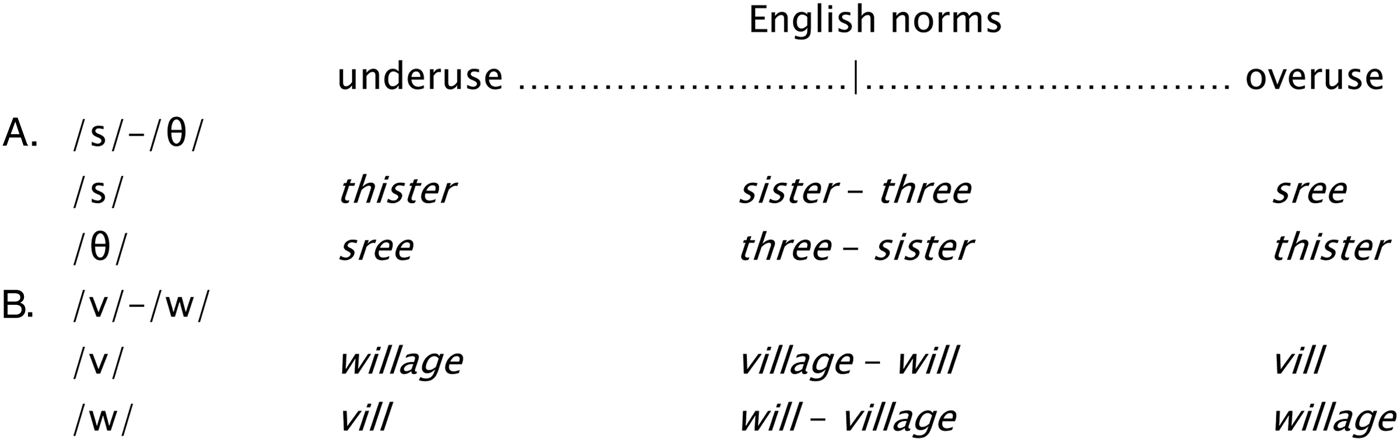
Experience also shows the overuse and underuse of other phonemes, especially /θ/ and /ð/, which are usually more difficult for German speakers to produce than /w/. As such, /θ/ and /ð/ are frequently underused, with two main substitution patterns: thing as [sɪŋ], [fɪŋ] or [tɪŋ] (/s/, /f/ or /t/ replaces /θ/) and this as [zɪs] or [dɪs] (/z/ or /d/ replaces /ð/). Like /v/ and /w/, the phonemes /s/ and /θ/ form a pair in which speakers may substitute one element for the other. Sister, for example, may be realized hypercorrectively as thister by learners, especially when th– words are grouped, thus creating alliterative patterns such as three thisters and I think tho. Underuse, as in sree for three, is common among beginning and less experienced English speakers. The underuse and overuse of the two pairs /s/–/θ/ and /v/–/w/ may be represented as follows:
The representation as a range is meant to suggest variation in phonetic quality and in the frequency and consistency of realizations. Specifically, speakers may use intermediate or related sounds, such as [β] or [ʋ] for /v/ or /w/. Variation, too, is seen in how often and in which (phonetic or situative) contexts overuse, underuse or a mixture of the two patterns occurs.
Yet a key difference between w for v (willage) and the other overuse-underuse examples in Figure 1 concerns the type of speaker typically involved. The other three examples (thister, sree and vill) tend to be limited to speakers with little experience with English or little interest in it.Footnote 6 Indeed, exposure to English and efforts toward improvement usually lead to a shift to (more) standard realizations of the corresponding phonemes, with thister, sree and vill thus becoming less common as proficiency increases. This is not the case with w for v, however: willage seems as common – perhaps even more common – among intermediate and advanced speakers as among beginners.
Underuse and overuse of English /s/–/θ/ and /v/–/w/

W for v: examples and causes
The following examples, with spelling adapted to reflect w for v, are drawn from English courses and other interactions with native German speakers at Austrian universities and other organizations:

Similarly, in spelling and in acronyms, the letter <v> is typically referred to as wee [wi:], both in widely known words such as [wi: aɪ pi:] ‘VIP’ and [εs ju wi:] ‘SUV’ and in one-off and specialized terms such as [wi: eɪ wi:] ‘VAV’ (variable air volume).
As the examples show, w for v occurs syllable-initially, especially word-initially and in stressed syllables. Elsewhere, i.e. syllable-finally, as in lover, every, never, travel and favor, /v/ is usually preserved or devoiced to /f/. In word-final position, where devoicing (or fortition) is standard in German,Footnote 7 the realization of <v> as /f/ is common, e.g. love and five as [laf] and [faɪf].
A situation in which phonotactic constraints override w for v is in words containing view, e.g. viewing and review.Footnote 8 Here, w for v would lead to the awkward cluster /w/ + /j/. Instead, this is a case – the only one I have encountered – in which syllable-initial <v> is never realized as /w/ but rather as /v/ or, often, as /f/, e.g. [fjuɪŋ] for viewing.
Before returning to the notion of the preference of /w/ as a marked English sound, it is important to consider a German-specific reason for w for v and related issues. Namely, German and English feature differing, indeed partly opposing, phonemic values for <v> and <w>. In German, <w> corresponds to /v/, as in wann [van] ‘when’; <v> has two values: /f/, the most common realization, as in viel [fi:l] ‘much’, and /v/, especially in French and Latin/Greek borrowings, such as vage [va:gə] ‘vague’. The former value, <v> as /f/, also explains the pronunciation of viewing as [fjuɪŋ]. Figure 2 summarizes the orthographic-phonemic differences between the two languages.
Orthography and pronunciation of <v> and <w> in English and German

When learning English, German speakers need to internalize that <w> is not /v/ (as in German) but rather /w/. They may thus infer that ‘w is the English v’, prompting them to habitually replace the ‘German sound’ /v/ with the ‘English sound’ /w/:
-
1. /v/→/w/
Such a ‘rule’ may indeed be useful to avoid equating English <w> (/w/) with German <w> (/v/) and producing stereotypical utterances à la ve vill vait. The potential for confusion, however, lies in the tendency to conflate phonemic (/v/, /w/) and graphemic (<v>, <w>) levels. When this occurs, learners equate /v/ and <v> – which is supported by German orthography – and draw a seemingly related conclusion:
-
2. <v>→/w/
This now yields w for v, wisit for visit. English /w/ is overgeneralized as corresponding to <w> and <v>. To the learner, this may seem consistent with 1. in that a v is changed to a w, but while 1. refers to the different phonemic values of <w> in the two languages, 2. extends the notion to apply to <v>. German orthographical conventions are therefore a predisposing factor for w for v and other uncertainties surrounding <v>, <w>, /v/ and /w/ in English.
Among some speakers, there may also be a tacit assumption of mutual exclusivity in regard to the ‘tricky sounds' in the two languages. That is, knowing some are used only in English, such as /r/ (especially [ɹ]), /θ/, /ð/ and /w/, and others only in German, such as /r/ (e.g. [ʁ] and [ʀ]) and /ç/ (including [ç] and [χ]), learners may assume that since /w/ is an English-only sound, /v/ must be a German-only sound. As above, therefore, /w/ may be viewed as simply the English counterpart to German /v/. English is indeed unusual among European languages in having both /v/ and /w/: ‘An examination of Maddieson (Reference Maddieson1985) shows that 76% of his sample languages have /w/, but only 21% have /v/, and a mere 11% percent of the languages in his sample have both /v/ and /w/.’ (Trudgill et al., Reference Trudgill, Schreier, Long and Williams2004: 34)
Unlike other typical features of the English of German speakers, w for v does not represent interference. By contrast, phenomena such as ve vill vait and [laf] ‘love’ are straightforward examples of the transfer of German conventions to English. Yet while uncertainties regarding v and w usage may be attributable to German, and especially to English-German contrasts, w for v cannot be explained in such terms, for /w/ is not a German phoneme. Instead, the ‘interference’ comes not from German but from English: English /w/ is overgeneralized at the expense of /v/.
A caveat to this point is in order for several German dialects, such as those spoken in parts of Bavaria, Franconia and (the Austrian state) Carinthia.Footnote 9 In these regions, many speakers realize /v/ such that it is close(r) to /w/, e.g. as the voiced bilabial fricative [β], the bilabial approximant [β] or the labiodental approximant [ʋ]. People from such areas may therefore have different needs when learning to distinguish between /v/ and /w/ in English. Unlike most German speakers, who need only realize that English <v> and German <w> represent the same sound (/v/), speakers of these dialects may not be able to simply import a sound from their native variety of German. Experience shows, however, that people who use such intermediary sounds are easily able to produce [v]. It is often helpful to describe it to them as ‘how /v/ (i.e. the letter <w>) is pronounced in formal German’, e.g. in Weißwein ['vaɪsˌvaɪn] ‘white wine’.
As seen above, w for v typically shows complementary distribution, with /w/ syllable-initially and /v/ (or /f/) syllable-finally. This parallels the /v/–/w/ mergers or near-mergers reported for several small varieties of contemporary English (cf. Trudgill et al. Reference Trudgill2010). Moreover, v–w alternation is a well-known historical feature of southern England (e.g. the speech of the Cockney Sam Weller in Dickens' Pickwick Papers), found from the second half of the thirteenth century onward (Wakelin, Reference Wakelin1972: 96). The phenomenon was especially prominent in southeast England, e.g. in Norfolk, up to the eighteenth century, as documented by dialectologists such as Wright and A. Ellis:
Initial and medial v has become w in m.Bck. Nrf. Suf. Ess. Ken. e.Sus., as wentə(r) venture, witlz victuals, wiksn vixen, konwē, –wai convey. (Wright Reference Wright1905: 227)
Ellis even dubs the region affected by w for v the Land of Wee:
Another peculiarity has also developed itself, but is disappearing under the influence of education. It is not, however, confined to e.Ss. and Ke., but extends along the e. of England from Ke. through Es. and Sf. to Nf. inclusive, which form what may be called the Land of Wee. This is the replacement of (v) by (w), but not conversely … I have never yet heard (v) used for (w) in good faith, though I have much wanted to do so, but (w) for (v) I have known all my life in Ke. (Ellis Reference Ellis1889: 132)
Although this feature has disappeared in England (‘it is probably safe to say that no native English speaker anywhere in England now fails to contrast /w/ and /v/’, Trudgill et al., Reference Trudgill, Schreier, Long and Williams2004: 25), it is still present in folk memory and has a ‘current high-stereotype level of awareness.’ (Trudgill, Reference Trudgill2010: 66)
In contrast thereto, awareness among German speakers that w for v deviates from English norms is strikingly rare, even among experienced, proficient speakers. The determining factor is clearly the sheer frequency of exposure to and repetition of words such as walley, wisit and willage, rendering w for v an unremarkable, indeed ‘standard’, feature of the English with which speakers are most familiar. As N. Ellis (Reference Ellis and Robinson2012: 195) says of the role of frequency in language learning:
Learning, memory and perception are all affected by frequency of usage: the more times we experience something, the stronger our memory of it, and the more fluently it is accessed. The more recently we have experienced something, the stronger our memory of it, and the more fluently it is accessed. The more times we experience conjunctions of features, the more they become associated in our minds and the more these subsequently affect perception and categorization; so a stimulus becomes associated to a context and we become more likely to perceive it in that context.
Work with native German-speaking university students consistently reveals related insights. Some students admit – others perhaps only to themselves – that, initially, they are unable to hear any difference between /v/ and /w/. Many more report that they find the distinction subtle and difficult to reproduce. Nearly all first-semester students, moreover, when asked about their previous understanding of /v/ and /w/, report that they did not learn in schoolFootnote 10 that the two were separate sounds. From this perspective, difficulties in distinguishing the phonemes are not surprising: accurate categorial perception is dependent on awareness of and experience with the categories involved. As shown by Ladefoged's (Reference Ladefoged1967: 167) experiments, ‘acoustic differences cannot be readily perceived until the corresponding articulatory gestures have been learnt.’ This also explains why students who are regularly exposed to native English speech (e.g. through television, film and other media) rarely, if ever, notice a contrast between standard (w for v-less) English and speech featuring w for v, whether their own or others'.
Nevertheless, an awareness of the contrast between /v/ and /w/ is usually not difficult to convey, starting by focusing on the differences in the place of articulation, i.e. lip rounding for /w/ versus the labiodental or, with exaggerated articulation, ‘lip biting’ position of /v/. Yet w for v is usually so ingrained that speakers struggle to produce /v/ as soon as it is part of an English word and no longer isolated. Here, most speakers automatically revert to /w/. That is, [v] is articulated perfectly in isolation, but visit becomes wisit when the whole word is articulated. A useful approach in such cases is to focus first on articulating /v/ in German lexical elements, then carrying these over to English. For example, available – instead of awailable – can be learned by substituting German wähl (imperative of wählen ‘to choose’) for the second syllable, i.e. recomposing the word as: a + wähl + able. Similarly, the /v/ in visor (instead of wisor) can be realized via the very similar sounding German word weiser (‘wiser’).
Still another matter concerns learners' perception of the necessity of differentiating between /v/ and /w/, i.e. of avoiding w for v. With the exception of university students of English, who typically attempt – and are expected to attempt (cp. Jenkins, Reference Jenkins2007; Seidlhofer, Reference Seidlhofer2011) – to approximate native articulatory patterns as closely as possible, most speakers see little reason to alter their w for v speech. The knowledge that ‘it's visit, not wisit’ may be interesting – or, as seen above, bewildering because no difference is perceived – but not practically relevant. Indeed, the functional load of the v–w opposition in English is low, with few problematic minimal pairs (Trudgill et al., Reference Trudgill, Schreier, Long and Williams2004: 25). Context will usually preclude misunderstandings resulting from contrast neutralization in pairs such as vary–wary, veal–wheel and verse–worse. W for v is thus not an obstacle to communication and seems to be noticed, if at all, primarily by native English speakers.Footnote 11 As to the connection between salience and perception, N. Ellis (Reference Ellis2006: 181) comments:
As a simple consequence of usage, without there being any contingency between the perceptual stimuli they process and any other outcomes or events, perceptual systems alter their sensitivity to stimulus features, becoming more sensitive to those which are psychologically significant dimensions of variation amongst the stimuli, and becoming less sensitive to those redundant characteristics which do not play any role in accurate classification.
Prestige modelling may well contribute to the vigor of w for v. This differs markedly from the historical English counterpart of w for v, which A. Ellis (Reference Ellis1889: 132) characterizes as ‘disappearing under the influence of education’, with one of his sources confirming: ‘In general w for v is used by rude rustics' (ibid. 270). By contrast, w for v in the English of German speakers is especially conspicuous in ‘educated’ and ‘professional’ spheres, including university students and professors, managers, engineers, researchers and journalists. W for v is commonly heard at international forums, such as conferences and lectures, and on television and radio. For instance, during the 2010 Winter Olympic Games in Vancouver, realization of the host city's name as ['wænkuvə(ɹ)]Footnote 12 was widespread in the Austrian media. The second <v> in Vancouver, as seen above for never, favor and travel, was not affected by w for v.
Similarly, Vail (Colorado), site of World Cup ski races,Footnote 13 is rarely referred to by Austrian commentators with its standard pronunciation, [veɪl], but rather as [weɪl], homophonous with wail and (non-aspirated) whale. This pronunciation is used in both German and English and is especially common (and indeed the de facto standard) when native German-speaking reporters speak English, i.e. when interviewing athletes and functionaries. Other recent, fortuitously encountered media examples include Napa Walley (ARD, August 26), Silicon Walley (Bayern 2, September 26 and December 4), Wirginia Woolf (Bayern 2, September 27), World Wisionary Award (ZDF, October 26), Wintage Trouble (Bayern 2, December 14) and Darth Wader (Ö3, December 17) – all from 2015. These instances of w for v occurred in German-speaking contexts.
The connection between w for v and prestige seems to stem from the notion that /w/ is a characteristically English sound, a marker of Englishness and English competence. In classroom discussions of the differences between /v/ and /w/, students often comment – after they have learned to distinguish between the two – that wisit sounds ‘better’, ‘more correct’ and ‘more English’ than visit. This is largely the result of the frequency of the former, but it is clearly also connected to the qualities that speakers ascribe to /w/. Indeed, the high frequency of w for v (including its role in group and social identity) and its preference as an ‘English sound’ are mutually reinforcing notions. It is as if the use of /w/ (hypercorrective or not) makes a statement about the speaker's ability to ‘do English’, to produce its signals and thus partake in the notions with which English is linked, e.g. internationality, modernity, sophistication and coolness.
Examples of prevalence
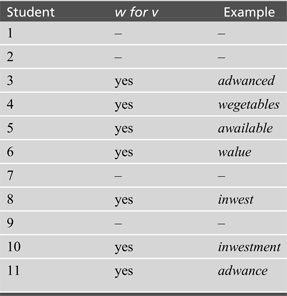
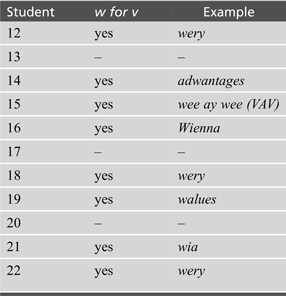
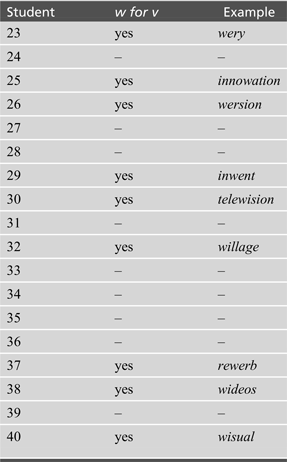
The following tables, based on three classes at two Austrian universities of applied sciences (Fachhochschulen), indicate students for whom w for v was noted – including an example – during presentations in the summer semester of 2015. The approximately 15-minute presentations, one per student, were held in English classes for bachelor's degrees in international business (Table 1) and engineering (Tables 2 and 3). All students were L1 German speakers (approx. 90% Austrian, 10% German), with English levels ranging from intermediate to advanced (B1–C1). The topics of the presentations were in accordance with the respective degree programs.
w for v during presentations by business students (2nd semester)

w for v during presentations by engineering students (2nd semester)

w for v during presentations by engineering students (4th semester)

In total, w for v was noted for 24 of 40 (60%) students. While this sample is small, the results are consistent with experiences with hundreds of university students over the past decade. In fact, w for v prevalence is often higher than the 60% indicated by this retrospective survey.
The reverse phenomenon, v for w (e.g. vest for west) was not noted for the presentations assessed above. My experience with similar classes has shown that, as noted above, this stereotypical feature is still occasionally found among university students, but it is uncommon and typically limited to older (e.g. post-professional) students and those with lower levels of proficiency and interest in English.
The results above refer to students in academic programs in which English is a supplementary subject. Among students pursuing English degrees, the prevalence of w for v is similar at first but usually recedes noticeably after several semesters. As students learn to avoid w for v, i.e. by realizing /v/, this shift is initially limited to form-focused contexts, e.g. in structured classroom activities, whereas w for v continues to be used in non-self-conscious speech, e.g. in content-focused and unstructured, spontaneous contexts. For many students, this pattern remains evident throughout their studies.
Conclusion
W for v, the non-standard use of /w/ for <v>, as in wisiting Wienna, is a widespread feature of German English, especially among younger, more educated, and more proficient speakers. Upon initial consideration, this phenomenon might seem surprising in that it means that people who use /v/ frequently in their native German suddenly have great difficulties producing it when speaking English. The causes, as discussed above, appear to be rooted in several factors.
First, /w/ is (rightly) perceived as a characteristically English sound. Its absence – and replacement by /v/, as in ve vill vait – is one of the features best known (by German and non-German speakers) as stereotypical of a German accent, one that may be mocked and associated with poor education and provincialism – and, especially to native English speakers, perhaps even reminiscent of the Nazi era and television and cinematic depictions thereof (cp. Mair, Reference Mair1995: 12). The overvaluation of the English sound /w/ is thus coupled with a devaluation of /v/, the purported German – but actually equally English – sound. In this sense, the results demonstrate the importance of a perceived – rather than actual – characteristic of English.
Second, w for v is used often because it is heard often, and vice versa, e.g. in school and university settings, in business and in the media. This circular proposition reflects the pattern of reception and production of w for v, each affirming the other. As w for v is common among highly skilled English speakers and those in positions of leadership and authority, it is not surprising that others, wittingly or unwittingly, mimic their speech. Ultimately, the frequency and prevalence of words such as wisit, willage and Wienna are stronger, at least currently, than any opposing forces, e.g. English instruction or exposure to non-w for v English. In southeast England, w for v ultimately fell into disrepute and disappeared. In the English of Austrians and Germans today, by contrast, w for v has found a welcoming host, even in loftier sociolinguistic circles.
Furthermore, the existence of v–w alternations, mergers or near-mergers in various English speech communities, both today and historically, indicates that the phonemes /v/ and /w/ may be perceived as similar or allophonic, and their distinction deemed of low salience. While this is not the cause of w for v in the English of German speakers, it is clearly a predisposing factor and one without which the emergence, spread and retention of w for v would not have been possible.
From the perspective of the widening scope, functions and identity of English, w for v may be included in discussions of the role of norms and variation and of changing attitudes toward foreign accents (cp. Jenkins, Reference Jenkins2000, Reference Jenkins2007; Seidlhofer, Reference Seidlhofer2011; Seidlhofer & Berns, Reference Seidlhofer and Berns2009; Walker, 2010; Erling, Reference Erling2002). Specifically, when English is seen as the international lingua franca, pronunciation goals shift from the attainment of native-like speech patterns, unachievable for most learners, to an emphasis on intelligibility. Regional variation and color – as in L1 English varieties – are then seen as markers of identity rather than deficiency. As such, w for v might appropriately be considered a feature of Austrian English or perhaps more broadly of German English.
In addition to their role in within-group identity, such features, e.g. accented speech, may offer added value in certain environments. Austrian and German engineering companies are highly successful in attaining projects abroad, e.g. in the Middle East, Eastern Europe and Asia, in part because of the reputation and mystique of Austrianness or Germanness and the qualities ascribed to these notions. A corresponding accent in English – the language in which business is conducted – may thus function as a carrier of the ‘brand’. Whether business associates would be able to distinguish between an Austrian accent and, say, a Danish or Dutch accent is not relevant here. The point is that accented speech may reinforce an image favorably, affecting listeners' perceptions and ultimately how speakers, in this case Austrians and Germans, view their own English and the desirability – or superfluity – of adapting it to English norms.
Nevertheless, w for v remains a feature that, while commonplace among German speakers, is non-standard. Depending on situative variables, it may be perceived as ‘peculiar’ or ‘wrong’, especially by L1 English speakers, for whom this pronunciation may conjure up the speech of cartoon characters such as Elmer Fudd, the perennially inept hunter of Bugs Bunny and other wabbits, as he famously called them. Of course, the recognition and acceptance of the legitimacy of other Englishes, especially for international communication within the Expanding Circle, need not preclude discussion of conventional norms and their implications.
 DR. EMIL CHAMSON teaches English and linguistics at the University of Innsbruck and the Management Center Innsbruck. Originally from the United States, he has lived in Austria for the past 25 years. His academic background is in German and English linguistics, and his research interests include English-German contrasts, etymology, lexicology and translation. Email: Emil.Chamson@uibk.ac.at