INTRODUCTION
Although dysfunction in the area of explicit memory has been widely reported in patients with schizophrenia (SZ; e.g., Aleman, Hijman, de Haan, & Kahn, Reference Aleman, Hijman, de Haan and Kahn1999; Cirillo & Seidman, Reference Cirillo and Seidman2003), there have been more conflicting results in studies of procedural learning (PL) in SZ. This type of learning is the ability to gradually acquire new or unfamiliar motor, cognitive, or perceptual skills through repeated exposure to a specific rule-governed activity (Cohen & Squire, Reference Cohen and Squire1980). Some studies have shown preserved PL in patients with SZ (Clare, McKenna, Mortimer, & Baddeley, Reference Clare, McKenna, Mortimer and Baddeley1993; Perry, Light, Davis, & Braff, Reference Perry, Light, Davis and Braff2000; Takano et al., Reference Takano, Ito, Kobayashi, Sonobe, Kurosu and Mori2002), while others have revealed that these patients are impaired in the acquisition of such skills (Giménez et al., Reference Giménez, Junqué, Pérez, Vendrell, Baeza and Salamero2003; Schwartz, Rosse, Veazey & Deutsch, Reference Schwartz, Rosse, Veazey and Deutsch1996).
The basal ganglia appear to play a determinant role in PL, based on lesion evidence and neuroimaging studies. Much of the evidence comes from studies of neurodegenerative disorders involving the striatum, such as Huntington’s (HD) and Parkinson’s diseases (PD) that have been associated with multiple PL deficits (Butters, Wolfe, Martine, Granholm, & Cermak, Reference Butters, Wolfe, Martine, Granholm and Cermak1985; Cohen & Pourcher, Reference Cohen and Pourcher2007; Harrington, Haaland, Yeo, & Marsden, Reference Harrington, Haaland, Yeo and Marsden1990; Joel et al., Reference Joel, Zohar, Afek, Hermesh, Lerner and Kuperman2005; Martone, Butters, Payne, Becker, & Sax, Reference Martone, Butters, Payne, Becker and Sax1984). More specifically, the involvement of the striatum in motor learning and in mirror reading tasks has been revealed in neuroimaging studies (Poldrack, Desmond, Glover, & Gabrieli, Reference Poldrack, Desmond, Glover and Gabrieli1998; Poldrack, Prabhakaran, Seger, & Gabrieli, Reference Poldrack, Prabhakaran, Seger and Gabrieli1999). Other cortical and cerebellar sites are also involved, but their contributions vary widely depending on the learning phase and on the motor and cognitive processes recruited for the task (e.g., Grafton et al., Reference Grafton, Mazziotta, Presty, Friston, Frackowiak and Phelps1992).
Considering the different affinities of D2 dopamine receptors for typical and atypical neuroleptics (NLPs), these drugs may differentially affect the functions of the striatum – a determinant brain structure involved in PL. Haloperidol, a common typical NLP, has higher D2 dopamine receptor blockade in the striatum, while atypical NLPs administered at a therapeutic dose (such as clozapine, quetiapine, risperidone or olanzapine) are associated with either transient or quantitatively less effective D2 blockade according to D2 binding displacement positron emission tomography (PET) studies (e.g., Kapur, Zipursky, Jones, Remington, & Houle, Reference Kapur, Zipursky, Jones, Remington and Houle2000). In contrast to haloperidol, risperidone is characterized by greater affinity for serotonin 5HT2A than dopamine D2 receptors and by a less powerful D2 blockade in associative and sensorimotor parts of the striatum at equivalent antipsychotic dosages. These properties have been related with a favorable extrapyramidal symptoms (EPS) profile and less striatal dysfunction (Kapur, Remington, Zipursky, Wilson, & Houle, Reference Kapur, Remington, Zipursky, Wilson and Houle1995).
The investigation of motor PL in SZ has shown that performance is differentially affected under typical or atypical NLP treatment (Bédard et al., Reference Bédard, Scherer, Stip, Cohen, Rodriguez and Richer2000; Scherer et al., Reference Schérer, Bédard, Stip, Paquet, Richer and Bériautl2004). Such effects have been revealed between olanzapine and haloperidol treatments on the proceduralization of a visuomotor skill using the Computed Visual Tracking Task; participants under olanzapine performed as well as control subjects, whereas those treated with haloperidol showed deficits in the acquisition of this skill (Paquet et al., Reference Paquet, Soucy, Stip, Lévesque, Elie and Bédard2004). The influence of three neuroleptic treatments has also been investigated using another type of visuomotor PL task, the mirror drawing task (Scherer et al., Reference Schérer, Bédard, Stip, Paquet, Richer and Bériautl2004). The authors observed that haloperidol-treated patients showed both a disturbed PL and a poor average performance, whereas risperidone-treated patients showed only poor average performance. Risperidon-treated and clozapine-treated patients showed PL profiles similar to control subjects’. The differential effect of haloperidol, risperidone, and olanzapine on cognitive aspects of PL has also been examined in SZ. Performance on the Tower of Toronto test under these drugs was maintained after six weeks, but declined after six months under risperidone and haloperidol treatments (Purdon, Woodward, & Lindborg, Reference Purdon, Woodward and Lindborg2003), suggesting that the impairment in PL seen in SZ may be a consequence of neuroleptic-induced dysfunction of the striatum (e.g., Schwartz, Rosse, Veazey, & Deutsch, Reference Schwartz, Rosse, Veazey and Deutsch1996).
To date, most of the studies investigating the effects of typical and atypical NLPs on the acquisition of a procedural skill have involved a motor component. Few studies have investigated nonmotor aspects of proceduralization in SZ, and those that have used the mirror-reading task did not take the pharmacological effects into account (e.g., Clare et al., Reference Clare, McKenna, Mortimer and Baddeley1993; Takano et al., Reference Takano, Ito, Kobayashi, Sonobe, Kurosu and Mori2002). Moreover, these investigations were cross-sectional studies or conducted over a short period of time, reporting preserved mirror-reading skill learning in patients with SZ treated with conventional NLPs (Takano et al., Reference Takano, Ito, Kobayashi, Sonobe, Kurosu and Mori2002). Such experiments do not inform about the effect of treatment over longer time periods.
Impairment in semantic memory – knowledge of the world, facts, concepts, and the meaning of words (Tulving, Reference Tulving, Tulving and Donaldson1972) – has also been frequently shown in SZ using a wide variety of semantic processing tasks (e.g., Al-Uzri, Laws & Mortimer, Reference Al-Uzri, Laws and Mortimer2004; McKay et al., Reference McKay, McKenna, Bentham, Mortimer, Holbery and Hodges1996). Degraded representations in the semantic memory store (e.g., Rossell & David Reference Rossell and David2006) or difficulty in accessing an intact semantic memory (Allen, Liddle, & Frith, Reference Allen, Liddle and Frith1993; Joyce, Collins, & Crichton, Reference Joyce, Collinson and Crichton1996) are two proposed mechanisms for this impairment in SZ. According to the network model of semantic memory, each concept is represented as a node in a network, with properties of the concept interconnected through links with related concept nodes. Thus, semantic priming is frequently used for evaluating the degree to which associations between representations stored in semantic memory are intact. There are, however, contradictory results regarding semantic priming effects within SZ. Some have reported abnormal semantic priming for patients with SZ (Gouzoulis-Mayfrank et al., Reference Gouzoulis-Mayfrank, Voss, Morth, Thelen, Spitzer and Meincke2003; Moritz, Woodward, Küppers, Lausen, & Schickel, Reference Moritz, Woodward, Küppers, Lausen and Schickel2002; Quelen, Grainger, & Raymondet, Reference Quelen, Grainger and Raymondet2005; Spitzer, Braun, Hemle, & Maier, Reference Spitzer, Braun, Hermle and Maier1993), while others have shown comparable semantic priming between patients with SZ and healthy controls (Besche-Richard, Passerieux, & Hardy-Baylé, Reference Besche-Richard, Passerieux and Hardy-Baylé2005; Blum & Freides, Reference Blum and Freides1995).
In this perspective, the objectives of the present study were to (1) determine the extent to which typical and atypical drugs affect nonmotor aspects of PL in SZ relative to the performance of a healthy control group, (2) assess whether the ability to learn a new perceptual procedural skill is differentially affected by type of treatment over time, and (3) further investigate the semantic aspects involved in mirror reading for patients with SZ.
METHODS
Participants
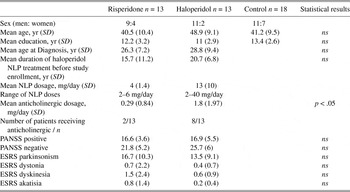
Twenty-six outpatients with SZ participated in the study. The diagnosis was made by a psychiatrist and fulfilled all the criteria of the DSM-IV for SZ. One group of 13 patients (9 men; 4 women) was treated with risperidone, while another group of 13 patients (11 men; 2 women) received haloperidol medication. Over the course of the study, three patients (two patients from the haloperidol treatment group and one patient from the risperidone group) did not complete the last assessment at 12 months because of noncompliance with their treatment. The mean age of the participants, age at diagnosis, duration of psychiatric illness on treatment, and level of education were not statistically different between the two patient groups (all p’s > .05). A group of 18 healthy volunteers were matched by age and education to the groups of patients in the study. This control group had no history of psychiatric or neurological disorder and was not under psychoactive medication. None of the participants had a history of drug or alcohol abuse. The demographic and clinical characteristics of each group are presented in Table 1. All participants gave their written informed consent prior to their inclusion in the study. The study was carried out according to the principles laid down in the Helsinki declaration and was approved by the ethics committee of the local institution.
Baseline demographic and clinical characteristics of participants

Note
NLP = neuroleptic, PANSS = Positive and Negative Syndrome Scale, ESRS = Extrapyramidal Symptom Rating Scale.
Tests and Procedure
Participants were followed over a period of 12 months, and the study included clinical and neuropsychological testing at baseline, 3, 6, and 12 months of treatment. The first assessment was conducted at baseline, when all the 26 participants with SZ were on a stable regimen of haloperidol. After the first assessment, they were randomly assigned to remain on current haloperidol treatment or to follow a switch from conventional NLP to risperidone over a 4-week washout period. In the switching group, the baseline dose of conventional drug followed a 25% decrease each week until the dose reached 0 mg and a weekly progressive titration of risperidone of 0.5 mg BID, 1 mg BID, 1.5 mg BID, 2 mg BID, with a further adjustment of 0.5 mg once or twice a day if judged clinically advantageous. The same psychiatrist consultant administered all the patients’ medications. Most of the participants reached the final dosage at 4 weeks and all were stabilized within 8 weeks. A steady state of NLP treatment was maintained over one year.
For the duration of the study, the experimenter was blind to the participants’ medication and psychopathological status, while the clinician assessing psychopathology and EPS was blind to their cognitive performance and medication status.
Procedural learning ability was assessed at each assessment session, using a computer-controlled test designed to obtain a measure of acquisition and automatization competence for novel procedures (here reading ability). This test was the same as the one used by Cohen and Pourcher (Reference Cohen and Pourcher2007) with PD patients. The PL test was preceded by practice with six pairs of words with inverted letters (not repeated in the experimental test to avoid repetition priming effects) in order to familiarize the participants with the reading task. In the experimental task, words were presented in pairs with vertically rotated letters and there were four blocks of 24 word pairs each. The words were between four and seven letters, in Arial font. Each pair was preceded by a 500-ms fixation cross at the center of a 38-cm screen. The word pairs subtended an angle of 4–5 degrees on either side of the fixation point, with subjects sitting 40 cm away from the screen. The word pairs belonged to one of four types of semantic categories: typical semantic associations from the same category (C1; e.g., table-chair), typical nonsemantic associations from different categories (C2; e.g., chair-canary), atypical semantic associations (C3; e.g., ostrich-penguin), and atypical nonsemantic associations (C4; e.g., ostrich-whaler). All items in the test were taken from Brosseau and Cohen (Reference Brosseau and Cohen1996). The four types of semantic categories were equally represented within the blocks.
Subjects were required to read as fast and as accurately as possible the word pairs with inverted letters. Time to read aloud each word pair was the time taken from the appearance of the stimulus pair on screen, immediately following presentation of the fixation point, until the last syllable of the second word in the pair was uttered. There was a 2-s interval between word pairs’ presentations. All subjects were assessed in the same manner with the same tests, 3, 6, and 12 months later. Speed of response, that is, reading aloud the word pairs, was measured. Degree of psychopathology was also assessed with the Positive and Negative Syndrome Scale (PANSS; Kay, Opler, & Lindenmayer, Reference Kay, Opler and Lindenmayer1989) and extrapyramidal symptoms with the Extrapyramidal Symptom Rating Scale (ESRS; Chouinard, Ross-Chouinard, Annable, & Jones, Reference Chouinard, Ross-Chouinard, Annable and Jones1980).
Data Analysis
An alpha level of .05 was used for all statistical tests. Three sets of analyses were conducted. First, data from the PL task were analyzed using a repeated measures analysis of variance (ANOVA) with Group (Risperidone, Haloperidol, Control) as between-subjects factor. The repeated measures variables were Time (baseline, 3, 6, 12 months) and Procedural Learning (mean average reading times for the first and last blocks of word pairs). To determine whether the semantic aspects of the task influenced performance, an ANOVA was carried out using Group (Risperidone, Haloperidol, Control) as between-subjects factor, and Time (baseline, 3, 6, 12 months) and Semantic Priming (C1, C2, C3, C4) as repeated variables. ANOVAs with Group (Risperidone, Haloperidol) and Time (baseline, endpoint), with repeated measures on the second factor, were conducted to examine the differential effects of both NLP treatments on EPS (parkinsonism, akathisia, dystonia, and dyskinesia). All analyses were performed on transformed (inverse) data.
Contrast analyses were conducted on each significant main effect of Group, in order to determine which group, if any, differed from the other groups (SZ vs. control; risperidone vs. haloperidol). Contrast analyses were also performed on every significant main effect of Time, in order to determine when an improvement occurred (baseline, 3, 6, and 12 months). The Statistical Package for Social Sciences II (SPSS II) software was used for all analyses. The Greenhouse-Geisser correction was used in the analysis of the semantic priming data as the sphericity assumption was violated.
RESULTS
Procedural Learning
As eight participants with SZ under haloperidol treatment and two under risperidone were also treated with anticholinergic medication, correlation (PPMC) analyses were first conducted to determine the extent of association between dosage of anticholinergic medication and performance measures of procedural learning in these 10 patients. All correlations were nonsignificant, indicating that there was no association between mirror-reading skill and anticholinergic medication. The correlation values are presented in Table 2.
Correlations between procedural learning measures and anticholinergic dosage

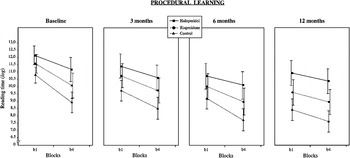
A main effect of Group was observed for the reading performance of inverted word pairs, F(2, 41) = 8.6, p = .001, Eta-Squared (η2) = 0.30. Contrast analysis was conducted to determine which group differed from the others and showed that overall performance of the patients with SZ was significantly poorer than that of control subjects, F(2, 41) = 13.95, p = .001, η2 = 0.25. Further contrasts revealed no significant difference between the reading performance of the haloperidol- and risperidone-treated groups, F(2, 41) = 3.21, p = .008, η2 = 0.07.
A main effect of Procedural Learning, F(1, 41) = 171.16, p < .0001, η2 = 0.81, was observed, indicating that all participants read words at a faster rate on the last block as they gained experience with reading the word pairs with inverted letters. A main effect of Time, F(3, 123) = 74.98, p < .0001, η2 = 0.65, was also observed, showing that the participants got significantly better at reading the word pairs over the successive assessment periods.
Two interactions were also revealed. First, a Group x Procedural Learning interaction, F(2, 41) = 5.09, p = .01, η2 = 0.20, indicated that mirror reading performance was not equivalent for the three groups. Further analyses revealed that only the patients with SZ under haloperidol treatment performed worse than controls, F(1, 29) = 8.99, p = .006, η2 = 0.24 and F(1, 29) = 2.44, p = .129, η2 = 0.08 for the comparisons with healthy controls and Risperidone group, respectively. Second, a Group × Time F(6, 123) = 2.22, p = .045, η2 = 0.10, interaction indicated that improvement between the four testing sessions was not equivalent for all groups. Contrast analyses revealed that only control subjects showed continual improvement at each assessment [from baseline to 3 months, F(1, 17) = 35.36, p < .0001, η2 = 0.68; from 3 to 6 months, F(1, 17) = 28.049, p < .0001, η2 = 0.62; and from 6 to 12 months, F(1, 17) = 13.809, p = .002, η2 = 0.45], showing off-line learning. The performance of the risperidone-treated group improved from baseline to 3 months, F(1, 12) = 6.009, p = .031, η2 = 0.33, and from 3 to 6 months, F(1, 12) = 15.133, p = .002, η2 = 0.56. No further improvement was shown between 6 and 12 months, F(1, 12) = 0.794, p = .391, η2 = 0.06. A similar outcome was also observed for the haloperidol-treated group, F(1, 12) = 14.136, p = .003, η2 = 0.54; F(1, 12) = 21.8, p = .001, η2 = 0.65; and F(1, 12) = 1.455, p = .251, η2 = 0.11.
Finally, ANOVAs on the number of errors showed no main effects [F(2, 41) = 0.961, p = 0.391, η2 = 0.05; F(3, 123) = 1.085, p = .358, η2 = 0.03; F(3, 123) = 1.89, p = .135, η2 = 0.04 for the main effect of Group, Time, and Errors, respectively] and no interactions [F(6, 123) = 1.523, p = .176, η2 = 0.07 and F(6, 123) = 0.603, p = .727, η2 = 0.03 for the Group by Time and for the Group by Errors interactions, respectively] indicating that the accuracy of response was equivalent for the three groups of subjects at all assessment periods. Figure 1 shows the reading performance of each group at each assessment period.
Mean reading times (95% confidence interval) taken by risperidone, haloperidol, and control groups to read the pairs of words with inverted letters (blocks 1 and 4) at each assessment period.

Semantic Priming
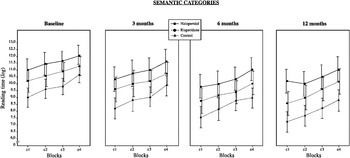
ANOVAs on the reading of word pairs belonging to categories with different semantic associations (C1, C2, C3, and C4) showed a main effect of Group, F(2, 41) = 7.82, p = .001, η2 = 0.28. Contrasts revealed no difference between the two patient groups, F(2, 41) = 2.73, p = .106, η2 = 0.06. However, their performance was poorer than that of control subjects, F(2, 41) = 12.98, p = .001, η2 = 0.24.
A strong effect of Semantic Priming, F(3, 123) = 130.61, p < .0001, η2 = 0.76, was obtained. Contrast analyses showed a significant difference in the time taken to read the word pairs made up of typical exemplars from the same category (C1) and the time to read atypical exemplars drawn from different categories (C4), indicating that the degree of semantic proximity impacts on reading time. For all subjects, pairs of words with closer semantic proximity were read faster. A main effect of Time, F(3, 123) = 101.182, p < .0001, η2 = 0.71, was also shown, indicating that the participants got significantly better from baseline to 3 months, F(1, 41) = 48.447, p < .0001, η2 = 0.54, and from 3 to 6 months, F(1, 41) = 86.907, p < .0001, η2 = 0.68. Performance remained stable until the 12-month assessment period, F(1, 41) = 1.66, p = .205, η2 –= 0.04. There was no Group by Semantic Priming interaction, F(6, 123) = 1.492, p = 0.186, η2 = 0.07, and no Group by Time interaction, F(6, 123) = 1.839, p = 0.097, η2 = 0.08, suggesting that the patient groups appeared to benefit from the semantic proximity effect just as much as the control subjects over the course of the study. Figure 2 shows the performance of the three groups of participants in reading pairs of words with varying degrees of semantic proximity.
Mean reading times (95% confidence interval) taken by risperidone, haloperidol, and control groups to read pairs of words differing in semantic proximity at each assessment period. (C1: high typicality exemplars from the same category; C2: high typicality exemplars from different semantic categories; C3: low typicality exemplars, same category; C4: low typicality exemplars, different categories).

Long-term Effects of Neuroleptic Treatment on Extrapyramidal Symptoms
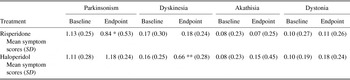
ANOVAs showed a significant effect of Group, F(1, 24) = 10.512, p = .003, η2 = 0.31, with the haloperidol-treated group showing higher dyskinesia symptom scores. A main effect of Time, F(1, 24) = 11.924, p = .002, η2 = 0.33, and a significant Group by Time interaction, F(1, 24) = 10.717, p = .003, η2 = 0.31, indicated a differential evolution of dyskinesia symptoms under these two treatments, with haloperidol showing higher symptom scores at the end of the study, F(1, 12) = 0.016, p = .903, η2 = 0.001 and F(1, 12) = 23.353, p < .0001, η2 = 0.66 for risperidone and haloperidol, respectively. An ANOVA for Parkinsonism symptoms revealed a Group by Time interaction, F(1, 24) = 7.698, p = .011, η2 = 0.24, also suggesting a treatment-dependent effect on the evolution of this EPS over time. Contrast analysis showed that risperidone was more effective, F(1, 12) = 5.743, p = .034, η2 = 0.32, than haloperidol, F(1, 12) = 2.308, p = .155, η2 = 0.16, in reducing Parkinsonism symptoms from baseline to endpoint. There was no significant effect of Group, F(1, 24) = 1.914, p = .179, η2 = 0.07, or Time, F(1, 24) = 2.962, p = .098, η2 = 0.11, for Parkinsonism EPS.
ANOVAs on dystonia and akathisia scores revealed no difference between the two groups of patients with SZ, F(1, 24) = 0.17, p = .684, η2 = 0.01 and F(1, 24) = 0.224, p = .641, η2 = 0.01 for dystonia and akathisia, respectively, no change in scores over time, F(1, 24) = 1.796, p = .193, η2 = 0.07 and F(1, 24) = 0.137, p = .714, η2 = 0.01, as well as no interaction between Group and Time, F(1, 24) = 1.128, p = .299, η2 = 0.05 and F(1, 24) = 0.189, p = .668, η2 = 0.01. This suggests that the severity and change in dystonia and akathisia symptoms over time were equivalent for the two treatment groups. Table 3 presents the evolution of EPS scores.
Mean extrapyramidal symptom scores

Note
* p < .05; ** p < .0001.
DISCUSSION
In this study, we attempted to determine the long-term effects of neuroleptic drug treatments on nonmotor procedural learning in patients with SZ treated with typical (haloperidol) or atypical (risperidone) medication. Our results showed that all participants had the capacity to acquire new procedural skills necessary for the reading of words with inverted letters, as evidenced by faster reading times by the end of each testing session. However, a significant slowing of reading time was shown in both treatment groups relative to healthy controls. Moreover, haloperidol patients performed worse on mirror-reading relative to the risperidone-treated patients and healthy controls.
The differential effects of typical haloperidol and atypical risperidone on the striatum D2 dopamine receptors may explain these observations and suggest that nonmotor PL dysfunction is, in part, reversible in the course of SZ. In contrast to healthy controls who showed steady improvement over each assessment period, both NLP-treated groups reached a plateau halfway through the study in their capacity to improve mirror-reading skill.
Our observations add weight to the evidence that the striatum is not only essential for the acquisition of a new motor procedural skill, but is also involved in the learning of nonmotor procedural skills, as is the case with mirror reading tasks. The results also indicate that patients with SZ under haloperidol medication show more pronounced learning disturbances. Treatment with risperidone showed lower incidence of EPS Parkinsonism and dyskinesia in contrast to haloperidol. Risperidone possesses mixed serotoninergic and dopaminergic antagonist properties that renders it more protective than typical NLPs in the correction of adverse motor side effects (Peuskens, Reference Peuskens1995). Lower EPS have been associated with less striatal dysfunction (Kapur et al., Reference Kapur, Remington, Zipursky, Wilson and Houle1995), which strongly suggests that the better mirror-reading performance under risperidone treatment is to some extent the result of less striatal D2 receptor occupancy. This view is in accord with results from a number of studies. For example, response speed in a PL task was facilitated with an indirect dopamine agonist (d-amphetamine) and inhibited with an antagonist (haloperidol) in healthy subjects (Kumari et al., Reference Kumari, Coor, Mulligan, Cotter, Checkley and Gray1997). One hypothesis to explain the mechanism by which haloperidol impacts on cognitive function and, in this case, in the acquisition of procedural routines is via higher striatal dopamine D2 receptor occupancy. For example, Corripio et al. (Reference Corripio, Catafau, Perez, Puigdemont, Mena and Aguilar2005) showed that D2 receptor occupancy was higher in patients treated with haloperidol (approx. 75%) than with patients treated with an atypical neuroleptic (ziprasidone; approx. 60%) at equivalent antipsychotic dosage. The atypical property linked to the coexistence of a 5HT2/D2 may provide relative protection from extrapyramidal syndromes (Kapur et al., Reference Kapur, Remington, Zipursky, Wilson and Houle1995) and mixed blockade may be less deleterious for striatal motor, as well as nonmotor functions.
The patients on haloperidol were given anticholinergic medication to correct for motor extrapyramidal side-effects. It has been reported that anticholinergic drugs may have a deleterious effect on cognitive functions (e.g., Vinogradov et al., Reference Vinogradov, Fisher, Warm, Holland, Kirshner and Pollock2009). However, the poorer learning performance observed in the haloperidol group is not explained by the use of anticholinergic medication, as there was no significant relationship between this concurrent drug treatment and procedural learning performance over the duration of the study. This adds weight to the assumption that this type of learning is more likely modulated by striatal dopaminergic systems. It should be noted that the pharmacology of procedural learning is still in its infancy and additional investigations are required before we can confidently dissect the respective involvement of dopamine and the striatum in skill acquisition in patients with SZ.
The present study also investigated the contribution of the semantic associations embedded in a procedural memory task. As was the case with the control subjects, mirror-reading speed improved with degree of semantic association for all patients in the two treatment groups. Greater semantic proximity within a word pair was associated with faster reading time. These observations provide evidence for the preservation of associative connections in the semantic network of patients with SZ and generally agree with findings reporting equivalent semantic priming effects in patients with SZ and healthy controls (e.g., Quelen et al., Reference Quelen, Grainger and Raymondet2005). However, they are at odds with studies showing abnormal heightened automatic spread of activation within semantic networks (e.g., Gouzoulis-Mayfrank et al., Reference Gouzoulis-Mayfrank, Voss, Morth, Thelen, Spitzer and Meincke2003). Factors such as diagnostic category may explain these differing observations. The patients in the present study included essentially paranoid and a few residual types of patients with SZ, while other studies showing hyperpriming effects were conducted with thought-disordered patients with SZ (e.g., Moritz et al., Reference Moritz, Woodward, Küppers, Lausen and Schickel2002; Spitzer et al., Reference Spitzer, Braun, Hermle and Maier1993). As unimpaired semantic priming with thought-disordered patients has also been observed (Besche-Richard et al., Reference Besche-Richard, Passerieux and Hardy-Baylé2005; Blum & Freides, Reference Blum and Freides1995), the variability in results across studies may also be task-specific and related to methodological issues, including direct versus indirect priming, lexical decision versus word naming tasks, as well as duration of the interstimulus interval (e.g., Kreher, Holcomb, & Kuperberg, Reference Kreher, Holcomb and Kuperberg2008).
In a previous study (Rémillard, Pourcher, & Cohen, Reference Rémillard, Pourcher and Cohen2008), impairment on a verbal declarative memory task (the California Verbal Learning Test, CVLT; Delis, Kramer, Kaplan, & Ober, Reference Delis, Kramer, Kaplan and Ober1987) had been shown with the same two groups of patients who took part in this study. The patients recalled significantly fewer items on the CVLT and used inadequate semantic clustering strategies to hold information in memory. Taken together, these observations suggest that the access to semantic memory systems under implicit processing (priming effect) is apparently intact in SZ, while more intentional processing of information, such as using a specific semantic categorization strategy to learn and recall new information, is impaired. To date, there is no consensus regarding the nature of the semantic deficits in SZ. However, our results agree with others that have shown difficulty in accessing an intact semantic memory in patients with SZ (Allen et al., Reference Allen, Liddle and Frith1993; Joyce et al., Reference Joyce, Collinson and Crichton1996), rather than a degraded semantic knowledge store (e.g. Rossell & David Reference Rossell and David2006). The generalization of our findings is, however, made with caution, and there is need for further replication with designs using both implicit and explicit measures of semantic memory within the same sample of patients.
CONCLUSION
Our earlier investigations of long-term effects of NLP drug treatment on cognitive function in patients with SZ have shown that haloperidol and risperidone do not differ in their impact on a variety of neurocognitive functions, such as executive function, attention, and verbal episodic memory (Rémillard et al., Reference Rémillard, Pourcher and Cohen2005, Reference Rémillard, Pourcher and Cohen2008). The present findings clearly show that there is, however, a specific and differentiating effect between these two drugs on the patients’ ability to proceduralize a cognitive task. These results indicate a deleterious effect of the conventional drugs on striatal function in contrast to the effect produced by atypical medication. The results also highlight the need to maintain so-called atypical drugs such as olanzapine and risperidone in the low range of posology, where D2 striatal blockade lies under a safe therapeutic range for extrapyramidal symptoms in order to preserve new habit learning in young schizophrenic patients. The findings also reveal, indirectly, the primary role of dopaminergic processes in the acquisition of procedural memory.
ACKNOWLEDGMENTS
We are indebted to the subjects who volunteered their time for the duration of the study. This study benefited from a grant from Janssen Ortho Foundation.