Benefit Finding (BF) or growth related to stress, is defined as an individual’s perception of positive change as a result of coping with an adverse life event (Lechner, Tennen, & Affleck, Reference Lechner, Tennen, Affleck, Lopez and Snyder2009; Tedeschi & Calhoun, Reference Tedeschi and Calhoun1996; Tomich & Helgeson, Reference Tomich and Helgeson2004). These changes occur mainly in the social domain (producing positive changes in interpersonal relationships), in the cognitive domain (perceiving improvements in personal strengths) and in the spiritual domain (increasing life appreciation and changing priorities Tedeschi & Calhoun, Reference Tedeschi and Calhoun1996).
Although BF as a consequence of adverse events like being attacked, being in a war, being caught up in natural disasters or looking after sick family members for a long time (Helgeson, Reynolds, & Tomich, Reference Hegelson, Reynolds and Tomich2006; Kim, Schulz, & Carver, Reference Kim, Schulz and Carver2007) has been studied, most research has been focused on BF derived from cancer (Cavell, Broadbent, Donkin, Gear, & Morton, Reference Cavell, Broadbent, Donkin, Gear and Morton2016; Jansen, Hoffmeister, Chang-Claude, Brenner, & Arndt, Reference Jansen, Hoffmeister, Chang-Claude, Brenner and Arndt2011; Kangas, Willians, & Smee, Reference Kangas, Willians and Smee2011), especially breast and prostate cancer (Carver & Antoni, Reference Carver and Antoni2004; Luszczynska, Mohamed, & Schwarzer, Reference Luszczynska, Mohamed and Schwarzer2005; Urcuyo, Boyers, Carver, & Antoni, Reference Urcuyo, Boyers, Carver and Antoni2005; Weaver, Llabre, Lechner, Panedo, & Antoni, Reference Weaver, Llabre, Lechner, Panedo and Antoni2008). BF derived from other illnesses like multiple sclerosis (Pakenham & Cox, Reference Pakenham and Cox2009; van der Wende, Reference van der Wende2000), HIV/AIDS (Littlewood, Vanable, Carey, & Blair, Reference Littlewood, Vanable, Carey and Blair2008; Milan, Reference Milam2004) or heart diseases (Affleck, Tennen, Croog, & Levine, Reference Affleck, Tennen, Croog and Levine1987; Garnefski, Kraaij, Schroevers, & Somsen Reference Garnefski, Kraaij, Schroevers and Somsen2008; Leung et al., Reference Leung, Gravely-Witte, MacPherson, Irvine, Stewart and Grace2010) has not received very much attention.
Different studies have shown BF to be positively associated with emotional well-being and positive affect whereas its relation with distress symptoms like depressive ones in samples with different pathologies (Carver & Antoni, Reference Carver and Antoni2004; Littlewood et al., Reference Littlewood, Vanable, Carey and Blair2008; Pakenham & Cox, Reference Pakenham and Cox2009; Urcuyo et al., Reference Urcuyo, Boyers, Carver and Antoni2005), including cardiac diseases (Garnefski et al., Reference Garnefski, Kraaij, Schroevers and Somsen2008; Leung et al., Reference Leung, Gravely-Witte, MacPherson, Irvine, Stewart and Grace2010) is negative. Furthermore, there is some evidence that BF may have some contribution to physical health (Bower, Kemeny, Taylor, & Fahey, Reference Bower, Kemeny, Taylor and Fahey1998; McGregor & Antoni, Reference McGregor and Antoni2009). In the particular case of cardiac illnesses, it has been found that after controlling for relevant variables like age, socioeconomic status and the severity of the illness, those patients that experienced BF seven weeks after having a myocardial infarction are less likely to have another infarction and present lower levels of morbility 8 years later (Affleck et al., Reference Affleck, Tennen, Croog and Levine1987).
The study of factors contributing to a better prognosis of cardiac patients is of paramount importance, because Coronary Heart Diseases (CHD: basically myocardial infarction and angina) are one of the main causes of death worldwide as well as one of the causes of premature incapacity. Specifically, the global deaths caused by these illnesses are estimated to be around 13% of total deaths. This represents about 7 million deaths each year (World Health Organization: WHO, 2014). In Europe alone, there are nearly 2 million deaths per year, which is 20% of the total mortality rate on the continent. Although Spain is one of the countries with the lowest mortality rate for this type of disease, there are about 70,000 new cases each year and CHD is the primary cause of death (Medrano, Boix, Cerrato, & Ramírez, Reference Medrano Albero, Boix Martínez, Cerrato Crespán and Ramírez Santa-Pau2006). Moreover, it has been found to affect men more than women (WHO, 2008).
It has been suggested that the relationships of BF with well-being and health are due to the fact that BF could be a way to counteract the psychological negative consequences derived from coping with stressful situations. In this way, some researches (Bower, Moskowitz, & Epel, Reference Bower, Moskowitz and Epel2009; Cassidy, McLaughlin, & Giles, Reference Cassidy, McLaughlin and Giles2014) propose what could be described as a resource model of stress to explain the pathways from BF to health and well-being. Specifically, they have proposed that BF would favor the improvement of certain personal resources like the perception of self-efficacy as well as psychosocial resources such as social support and the use of effective coping strategies.
To date, some studies have examined the relationships between BF and these personal and psychosocial resources among people who experienced various adverse events including severe diseases. The majority of the studies carried out have been done so on samples of cancer patients and have shown, in agreement with this proposal, that BF is associated with greater social support and an increase in the perception of self-efficacy (Luszczynska et al., Reference Luszczynska, Mohamed and Schwarzer2005) as well as the use of more effective coping strategies, which are those that focus on problem solving and the positive cognitive restructure of situations (Cavell et al., Reference Cavell, Broadbent, Donkin, Gear and Morton2016; Kinsinger et al., Reference Kinsinger, Penedo, Antoni, Dahn, Lechner and Schneiderman2006; Luszczynska et al., Reference Luszczynska, Mohamed and Schwarzer2005; Urcuyo et al., Reference Urcuyo, Boyers, Carver and Antoni2005). However, there are only a couple of studies that points to relations between BF and the use of effective coping (Garnefski et al., Reference Garnefski, Kraaij, Schroevers and Somsen2008) and social support (Leung et al., Reference Leung, Gravely-Witte, MacPherson, Irvine, Stewart and Grace2010) in cardiac patients.
Similarly the construct BF, all these resources (self-efficacy, social support and effective coping) also maintain a positive association with emotional well-being (Ben-Zur, Reference Ben-Zur2009; Scholz, Kliegel, Luszczynska, & Knoll, Reference Scholz, Kliegel, Luszczynska and Knoll2012; Yeung & Lu, Reference Yeung and Lu2014) and have beneficial effects on the prognosis of cardiac patients (Arrebola-Moreno et al., Reference Arrebola-Moreno, Garcia-Retamero, Catena, Marfil-Álvarez, Melgares-Moreno and Ramírez-Hernández2014; Barth, Schneider, & von Känel, Reference Barth, Schneider and von Känel2010; Roohafza, Talaei, Pourmoghaddas, Rajabi, & Sadeghi, Reference Roohafza, Talaei, Pourmoghaddas, Rajabi and Sadeghi2012; Sarkar, Ali, & Whooley, Reference Sarkar, Ali and Whooley2009; Stanton, Revenson, & Tennen, Reference Stanton, Revenson and Tennen2007).
In short, the studies that have been conducted so far have focused on showing that BF is positively associated with emotional well-being and with some resources, such as self-efficacy, social support and effective coping, and that these resources are also associated with emotional well-being. However, no study has analyzed how BF and these resources jointly contribute to the well-being. The study of the joint contribution of BF and resources would be necessary because we must highlight that much of positive changes collected by BF construct are precisely improvements in interpersonal relations and in the use of coping strategies as well as a positive view of oneself (Leung et al., Reference Leung, Gravely-Witte, MacPherson, Irvine, Stewart and Grace2010), which could fall under the headings of social support, coping and self-efficacy respectively. In this sense, a whole study could reveal whether all of them are equally relevant to the emotional well-being or contribute differentially to this.
Therefore, our first objective was to explore the combined contribution of BF, self-efficacy, social support and effective coping to positive affect in a sample of patients who have just suffered a first cardiac episode.
It must be borne in mind that although it has been proposed that BF is the antecedent to producing an increase in resources; reciprocal relations of causality are likely to exist in such a way that personal and psychosocial resources would favor the development of BF.
Given that up until now, there have been no studies to analyze the reciprocal relations between BF and psychosocial and personal resources, another of our objectives was to explore if BF could be a precursor to these resources or if it is the resources themselves that favor the development of BF.
Patients who have recently suffered a cardiac episode have a significant impairment in their physical functional capacity, which, in turn, has an important psychological impact (Karapolat et al., Reference Karapolat, Eyigor, Durmaz, Yagdi, Nalbartgil and Karakula2007; Sanjuán, Arranz, & Castro, Reference Sanjuán, Arranz and Castro2014). Therefore, we wanted to study all these relationships after controlling for this functional capacity, which was assessed by means of a cardiac stress test. Moreover, the elapsed time since diagnosis was also controlled, since it has a direct relationship with said functional capacity.
Method
Participants and procedure
This study took place at the Cardiac Rehabilitation Unit (CRU) of La Paz-Cantoblanco Hospital in Madrid, from June to December 2014. Patients were recruited on day one Phase II of the Cardiac Rehabilitation Program (PII-CRP). PII-CRP consists of physical exercise and relaxation, as well as information on healthy lifestyle, focusing on diet, exercise habits, and medication. The time span from hospitalization (i.e., Phase I) to the beginning of Phase II varies depending on the severity of the cardiac event, and Phase II only begins when physicians consider that exercise does not pose a risk to patients.
Of the 80 heart patients who came to the CRU in this period, 60 complied with the requirement of having suffered a first cardiac episode. These 60 patients were offered the opportunity to participate in our study. Fifty-two patients who voluntarily chose to participate were interviewed by one of the authors to collect socio-demographic data and rule out psychiatric disorders. Patients were included, only, if they had no history of psychotic symptoms nor suffered cognitive deterioration. Other serious illnesses were discarded before being referred to the CRU to begin Phase II. The hospital’s bioethics committee approved the protocol and a voluntary written informed consent was obtained from each participant after interview and before they answered the questionnaires and performed the cardiac stress test.
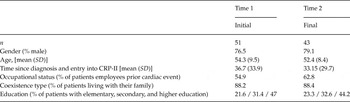
PII-CRP lasted 8 weeks, and during week 1 and week 8 (Time 1 and 2 respectively) the variables of interest were measured. Of the 52 patients, 1 was excluded for having a previous psychiatric history. Therefore, at Time 1 the sample was finally composed of 51 patients. At Time 2, 8 of the 51 patients did not do the final assessment, so that the sample consisted of 43 patients. For sample characteristics at Times 1 and 2, see Table 1.
Demographic characteristics of patients

Note: CRP-II = Cardiac Rehabilitation Program Phase II.
Measures
Both at Time 1 and at Time 2 (8 weeks later), the patients were assessed on the following instruments:
Benefit finding scale (Antoni et al., Reference Antoni, Lehman, Kilbourn, Boyers, Culver, Alferi and Carver2001; Spanish version for cardiac patients: Sanjuán & García-Zamora, Reference Sanjuán and García-Zamora2013; Sanjuán, García-Zamora et al., Reference Sanjuán, García-Zamora, Bermúdez, Ruiz, Pérez-García and Arranz2016)
The 17 items that make up the scale include the perception of benefit in different areas like coping in situations, interpersonal relations, including family relations or personal resources. The participants respond to each of the items on a 7 point Likert type scale where “0” means “not at all” and “6” means “totally” depending on the degree to which that expressed each of the items was applicable to them. Total score was calculated by averaging the scores given to each one of the items that make up the scale, where higher scores indicate greater perception of benefit. In current study alpha coefficients were .93 both at Time 1 and 2.
Social support subscale from the quality of life questionnaire (Ruiz & Baca, Reference Ruiz and Baca1993)
This subscale consists of 8 items which assess the type of relationships established with the family and friends in addition to the level of social support perceived. The participants respond to each of these items on a 7-point Likert type scale where “0” equals “not at all” and “6” equals “totally” depending on the level that best reflects their personal situation at the time of assessment. Total score was calculated by averaging the scores given to each of the items of the subscale. Higher scores indicate greater perception of social support. In the current sample, alpha coefficients were .91 at Time 1, and .96 at Time 2.
Brief COPE scale (Carver, Reference Carver1997)
In agreement with the current study proposals, we employed a short version of this questionnaire proposed by Eisenberg, Shen, Schwarz, and Mallon (Reference Eisenberg, Shen, Schwarz and Mallon2012), made up of 14 items and proposed for cardiac patients. The scale evaluates the different strategies used to cope with difficulties found on a 7- point Likert type scale where “0” is “nothing at all” and “6” equals “totally” according to the degree to which the participants employ each one of the strategies set out in the items. Since Carver himself (1997) points out that the subscales can be selected depending on the objectives of the study and in accordance with the results obtained through an exploratory factor analysis conducted with current data, we only used a subscale, derived from the first factor obtained in this analysis, which we have denominated "effective coping". This subscale includes 3 items to assess active coping strategies, planning and positive re-evaluation of situations. The subscale score was calculated by averaging the scores given to each of the items of the subscale. Higher scores indicated greater use of this type of strategies. In this sample, alpha coefficients were .82 at Time 1 and .78 at Time 2.
General self-efficacy scale (Baessler & Schwarzer, Reference Baessler and Schwarzer1996; Spanish version: Sanjuán, Pérez-García, & Bermúdez, Reference Sanjuán, Pérez-García and Bermúdez2000)
This scale has 10 items to assess people´s stable self-perception on their capacity to adequately manage a wide range of stressors in their daily lives. The ítems listed are responded to on a 7- point Likert type scale where “0” is “disagree totally” and and “6” is “agree totally” according to the extent of agreement with each of the items. Total score was calculated by averaging the scores given to each of the items of the scale. Higher scores indicated greater perception of self-efficacy. In the current study alpha coefficients were .91 at Time 1 and .95 at Time 2.
Positive and negative affect scales (PANAS; Watson, Clark, & Tellegen, Reference Watson, Clark and Tellegen1988; Spanish version by Sandin et al., Reference Sandin, Chorot, Lostao, Joiner, Santed and Valiente1999)
This is a 20-item instrument that assesses 2 dimensions: positive affect (10 items) and negative affect (10 items). The response scale was a 7-point Likert-type. Participants were asked to report how they had felt in the previous week. Only the positive affect subscale was used for this study. Subscale score was calculated by averaging the scores given to each of the items of the subscale. The highest score on the subscale indicated greater experience of positive emotions. In this sample alpha coefficients were .81 at Time 1 and .88 at Time 2.
Functional capacity
It was assessed through cardiac stress tests, on a treadmill. The unit to measure this capacity is the standard metabolic equivalent or MET. One MET is equivalent to the energy (oxygen) used by the body at rest, while sitting quietly or reading a book, for example. Through the cardiac stress test, the maximum number of METs reached by a patient is recorded, allowing the prediction of the activities the patient may successfully carry out. Participation in CRP has been associated with significant improvements in METs (Balady, Jette, Scheer, & Downing, Reference Balady, Jette, Scheer and Downing1996; McKee, Kerins, Fitzgerald, Spain, & Morrison, Reference McKee, Kerins, Fitzgerald, Spain and Morrison2013; Sanjuán et al., Reference Sanjuán, Arranz and Castro2014).
Results
Preliminary analyses
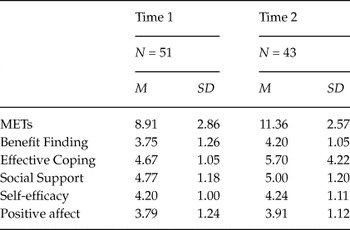
Table 2 shows the descriptive statistics of the variables analyzed depending on the phase of the study.
Descriptive statistics of variables analysed

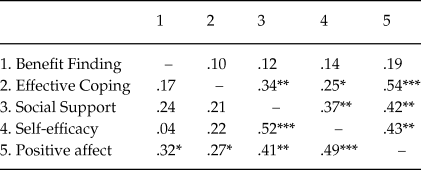
In Table 3 can be seen the intercorrelations among all psychological variables of the study both at Time 1 and 2.
Pearson correlations among variables at Time 1 (n = 51) and at Time 2 (n = 43)

Note: Correlations above the diagonal are those of Time 1, and below the diagonal are those of Time 2.
*p < .05; **p < .01; ***p < .001.
To study the possible associations that clinical (time since diagnosis and METs), and socio-demographic (age, gender, educational level, occupational status, and coexistence type) variables had with psychological variables (positive affect, BF, social support, self-efficacy, and effective coping), Pearson correlations between all the variables were calculated. Given the size of the current sample and in order to control all those socio-demographic and clinical factors that might have an effect on psychological variables, only in these analyses, marginal statistical significances (.09 ≥ p ≥ .05) were also considered. We found that at Time 1, positive affect significantly correlated with occupational status (r = –.34, p < .02) and METs (r = .35, p < .01), and marginally correlated with time since diagnosis (r = .26, p < .08), which means that those who were active, or reached more METs or with more time since their diagnosis, reported more positive affect. At Time 2, METs significantly correlated with effective coping (r = .35, p < .02) and self-efficacy r = .30, p < .05), and marginally correlated with positive affect (r = .28, p < .07). This pattern of correlations means that the more METs reached the more effective coping, self-efficacy, and positive affect reported. Sex showed a significant correlation with self-efficacy (r = –.37, p < .01), which means that women reported less self-efficacy. Coexistence type significantly correlated with social support (r = .38, p < .01) and effective coping (r = .32, p < .04), which implies that those living accompanied report having more social support and employ more effective coping strategies. Finally, occupational status significantly correlated with self-efficacy (r = –.49, p < .001) and positive affect (r = –.48, p < .001), and marginally correlated with social support (r = –.26, p < .09) and effective coping (r = –.28, p < .07), which means that those who were active reported more self-efficacy, social support, effective coping and positive affect.
According to these results, sex, time since diagnosis, coexistence type, occupational status, and METs at Time 1 and 2 were included in the following analyses to control their effect, when each of the variables, with which maintained significant correlations, were studied.
As part of the preliminary analysis, and to evaluate possible changes in the variables of interest between Time 1 and 2, one-way repeated measures analyses of variance (Time 1 vs. Time 2) were conducted with METs, positive affect, BF, social support, self-efficacy, and effective coping as dependent variables. Results showed that METs [F(1, 42) = 54.98, p < .001, η2 p = .57], BF [F(1, 42) = 6.46, p < .01, η2 p = .13], and effective coping [F(1, 42) = 4.27, p < .04, η2 p = .10] were significantly increased at Time 2, compared to Time 1. However, social support, self-efficacy and positive affect did not change over this period.
Cross-sectional analyses on combined contribution of BF, self-efficacy, social support and effective coping to positive affect
In order to study the combined contribution of BF, self-efficacy, social support and effective coping to positive affect two regression analyses (with the variables of Times 1 and 2 respectively) were conducted including both BF and personal and psychosocial resources in the equation as predictor variables.
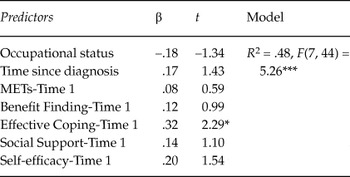
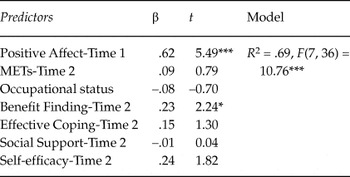
As we can see in Table 4, the results of the regression analyses performed with variables at Time 1 showed that, after controlling for the effect of sociodemographic (occupational status) and clinical (METs and time since diagnosis) variables, only effective coping could predict positive affect.
Regression analysis to predict Positive Affect at Time 1 (n = 51)

*p < .05; ***p < .001.
Occupational Status (1 = employees, 2 = not employees)
As can be seen in Table 5, at Time 2, after controlling for positive affect at Time 1, METs reached, and occupational status, only BF significantly predicted positive affect.
Regression analysis to predict Positive Affect at Time 2 (n = 43)

*p < .05; ***p < .001.
Occupational Status (1 = employees, 2 = not employees)
Longitudinal analyses on the direction of relationships between Benefit Finding and Social Support, Self-efficacy, and Effective Coping
To check whether BF at Time 1 could predict each of considered resources at Time 2, or resources at Time 1 were the predictors of BF at Time 2, several regression analyses were carried out with BF, self-efficacy, social support or effective coping at Time 1 as predictor variable. Given that the different variables at Time 2 (BF, self-efficacy, social support, and effective coping) were the criterion variables in each of these regression analyses, the corresponding variable at Time 1 was introduced as the first predictor to control its effect.
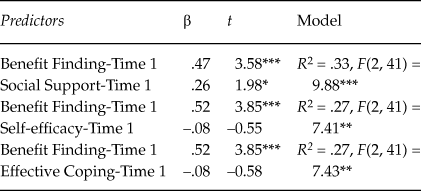
In Table 6, the results of the three different regression analyses carried out to predict BF at Time 2 can be seen, where, social support, self-efficacy or coping at Time 1, respectively, were introduced as second predictor. After controlling for possible effect of BF at Time 1, only social support at Time 1 predicted BF at Time 2.
Different regression analyses to predict Benefit Finding at Time 2 (n = 43)

*p < .05; **p < .01; ***p < .001.
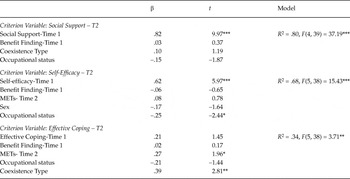
Table 7 shows the results of the three regression analyses carried out to predict social support, self-efficacy or coping at Time 2, respectively, by introducing BF at Time 1 as predictor. As can be seen, BF at Time 1 was not a significant predictor in any of the variables analysed at Time 2.
Different regression analyses to predict Social Support, Self-efficacy or Effective Coping at Time 2 (n = 43)

*p < .05; **p < .01; ***p < .001.
Coexistence Type (1 = alone, 2 = accompanied); Occupational Status (1 = employees, 2 = not employees); Sex (1 = male, 2 = female)
Discussion
The main objective of this longitudinal 8 week study was to explore, in a sample of patients who had just suffered a first cardiac episode, the combined contribution of BF and certain resources, such as self-efficacy, social support, and effective coping, to positive affect. Moreover, we wanted to check whether these resources were derived from BF or, on the contrary, these resources were antecedents of BF.
We have found that, after controlling for the effect that certain variables have on the emotional state of patients such as functional capacity and occupational status, and taking into account all the variables jointly (BF, self-efficacy, social support and effective coping), at the Time 1, only the use of an effective coping to deal with the disease significantly contributed to positive affect. At Time 2, and also controlling positive affect at Time 1, only the EB provided a significant contribution to positive affect.
These results suggest that when the cardiac event is recent, what is more relevant to the emotional well-being of patients is the use of coping strategies based on both the solution of problems and the positive cognitive re-evaluation of the situation. When the cardiac event is already far, what has more impact on their well-being is the capacity to extract benefit from disease, which not only includes the ability to face difficult situations and perceive their positive side, but also the appreciation of personal relationships, the increase of empathy and a sense of transcendence beyond oneself. In addition, we want to note that the BF was a significant predictor of emotional well-being only at Time 2, which was the time when BF had increased compared to that shown at Time 1. This fact could be suggesting that a certain level of BF would be necessary for it may have an effect on the emotional well-being, as some authors have suggested (Lechner et al., Reference Lechner, Tennen, Affleck, Lopez and Snyder2009).
As previously cited, reduced functional capacity, due to a very recent cardiac episode, has a direct impact on emotional state (Karapolat et al., Reference Karapolat, Eyigor, Durmaz, Yagdi, Nalbartgil and Karakula2007; Sanjuán et al., Reference Sanjuán, Arranz and Castro2014). In this way, when functional capacity improves, so does emotional state. For that reason we want to highlight that the association between BF and positive affect, continued to be significant also after controlling the effect of the patient´s functional capacity. This means that said association is not due to the improvement in functional capacity.
As in other studies (Balady et al., Reference Balady, Jette, Scheer and Downing1996; McKee et al., Reference McKee, Kerins, Fitzgerald, Spain and Morrison2013; Sanjuán et al., Reference Sanjuán, Arranz and Castro2014), CRP achieved what it set out to do because when the patients completed the programme, their functional capacity had improved considerably in comparison to when they began. BF and effective coping were also increased, even though this programme had no specific modules for these purposes. As regards coping, our results suggest that the increase in functional capacity plays an important role, since the METs reached were a predictor of the use of this type of coping strategies at Time 2 (see table 7) even annulling the effect that the previous strategies at Time 1 had on these strategies at Time 2. However no association between BF and functional capacity was seen at either of these assessment times, in fact the BF shown had absolutely nothing to do with the improvement of the patients in this sample. For this reason, its increase at Time 2 in comparison to Time 1 may be due to the fact that the process required to produce benefit, beginning immediately after the event takes place, needs some time for its complete evolvement as some authors have suggested (Hegelson et al., Reference Hegelson, Reynolds and Tomich2006). Further studies would be required to follow up on patients at different periods of time to check if this proposal is plausible and find out how much time is needed to culminate the process of benefit finding.
Although the EB has been usually treated as a unitary construct, some studies have distinguished various components in the EB (Kim et al., Reference Kim, Schulz and Carver2007; Luszczynska et al., Reference Luszczynska, Mohamed and Schwarzer2005), such as improving the capacity for empathy, the interpersonal relationships and the personal resources, or the appreciation and acceptance of life. Therefore, future studies should investigate not only whether these components have different ability to predict well-being, but also whether they require different times to develop.
Regarding the question whether BF precedes the increase in personal and psychosocial resources, or if, on the other hand, it is a consequence of these changes, results indicate that social support precedes the development of BF and not the other way round. Although these results must be taken cautiously because they are based on a very reduced sample of cardiac patients (43), they do allow us to suggest that the fact that the patients had people to help them at one of the most difficult times in their lives seems to be key to developing the perception of nearness to others and the deep sense of purpose in life that BF implies. Further studies should confirm these suggestions through larger samples with different characteristics.
Social support not only favours the development of emotional well-being (Scholz et al., Reference Scholz, Kliegel, Luszczynska and Knoll2012) as well as better prognosis for the illness (Barth et al., Reference Barth, Schneider and von Känel2010; Stanton et al., Reference Stanton, Revenson and Tennen2007), as previous studies had shown, but here it manifests itself as a crucial antecedent for the development of other beneficial processes for emotional well-being and health, like BF. However, future studies should also clearly distinguish between perceived and provided social support, which could have different impacts on development of BF, since some findings have shown that it is fundamentally the perceived support which has beneficial effects for people (Haber, Cohen, Lucas, & Baltes, Reference Haber, Cohen, Lucas and Baltes2007).
Some of the positive changes that are reflected in the construct of BF, like improvements in interpersonal relationships and in the use of effective ways of dealing with situations as well as a positive view of oneself (Leung et al., Reference Leung, Gravely-Witte, MacPherson, Irvine, Stewart and Grace2010), could have some degree of overlap with the resources evaluated in this study (social support, effective coping and self-efficacy respectively). While it is true that in this sample, we have not found correlations between different constructs tested, we cannot rule out that the absence of associations may be due to sample size. Therefore, future studies with larger samples should explore this possible overlap.
As a whole, the results obtained indicate that the analysed processes have an impact on positive emotions which, in turn, play an important role in the cardiac patient´s prognosis (Boehm & Kubzansky, Reference Boehm and Kubzansky2012; Chida & Steptoe, Reference Chida and Steptoe2008; Davidson, Mostofsky, & Whang, Reference Davidson, Mostofsky and Whang2010; Diener & Chan, Reference Diener and Chan2011). Thus, specific module programmes to promote the development of these processes should be considered in order to speed up recovery and avoid relapse.
We propose that some limitations of the study like the small size of the sample or the fact that it was impossible to study for prolonged periods of time, should be taken into account and overcome in further studies. Since all psychological variables have been exclusively evaluated through questionnaires, which can lead to less-accurate findings, this is also a limitation of the study. These biases would be more likely in some of the measures, since certain scales have recently been adapted (such as BF) and others have been translated for the purposes of this study (like the shortened version of Brief-COPE), so there are still few studies on their psychometric properties. Although more studies with different samples are needed, however, the analyses conducted to date with both questionnaires showed high internal consistency coefficients, good temporal stability, and acceptable predictive validity (Sanjuán & García-Zamora, Reference Sanjuán and García-Zamora2013; Sanjuán, García-Zamora et al., Reference Sanjuán, García-Zamora, Bermúdez, Ruiz, Pérez-García and Arranz2016; Sanjuán, Magallares, Ávila, & Arranz, Reference Sanjuán, García-Zamora, Bermúdez, Ruiz, Pérez-García and Arranz2016).
In spite of these limitations, this study indicates that regardless of the initial deterioration and posterior improvement in patient functional capacity, processes like ability to find benefit while suffering from an illness are key to patients ‘emotional well-being.
This work was supported by the Spanish Ministerio de Economía y Competitividad under Grant [Reference number: PSI2012–33708].