Introduction
Humans have evolved to consume omega-6 fatty acids and omega-3 fatty acids in a ratio of between 1:1 to 2:1.Reference Simopoulos1 However, current data indicate that people eating a typical western diet consume a fatty acid ratio of approximately 20–30:1, signifying a relative deficiency in omega-3 fatty acids.Reference Young and Conquer2 As a result of this omega-3 fatty acid deficiency and dietary fat imbalance, governmental health authorities have published guidelines stipulating the recommended daily intake of these dietary lipids. In 2004, the Scientific Advisory Committee on Nutrition (SACN) and the Committee on Toxicity (COT) recommended that adults should consume at least two portions of fish per week, one of which needed to be oil-rich (equalling approximately 0.45 g/day of omega-3). Alternative sources such as supplements and food enriched with omega-3 fatty acids are available, but the continued imbalance of these fatty acids in western diets has led to serious concerns over the impact this will have on public health.Reference Lunn and Theobald3
This review will take a detailed look at studies that have examined the links between omega-3 fatty acids and physical and cognitive health, particularly in elderly individuals with cognitive disorders. Relevant publications were found through a search of PubMed, as well as e-journal library facilities, and from other academic colleagues. Further details of these search methods can be obtained from the corresponding author.
Mechanistic reasons behind why low intake of omega-3 fatty acids may affect physical health as well as cognitive function
Mechanistic theories have been put forward, which attempt to explain why fatty acids, specifically omega-3 fatty acids, may be beneficial to physical and cognitive health. One mechanistic theory indicates that diets high in omega-3 fatty acids benefit cardiovascular health. It is therefore possible that this type of diet in turn may indirectly reduce the risk of developing cognitive deficits and Alzheimer's disease (AD).
Diets rich in omega-3 fatty acids have the capacity to reduce blood pressure in individuals with hypertension, reduce the risk of arrhythmias,Reference Morris, Sacks and Rosner4–Reference Leaf, Kang, Xiao and Billman6 lower the risk of stroke,Reference Gillum, Mussolino and Madans7, Reference Iso, Rexrode, Stampfer, Manson, Colditz, Speizer, Hennekens and Willett8 lower the risk of subclinical infarcts and white matter abnormalities,Reference Virtanen, Siscovick, Longstreth, Kuller and Mozaffarian9 decrease platelet aggregationReference Hornstra10 and decrease atherosclerosis.Reference Von Schacky and Harris11 It is argued that by replacing saturated fatty acids with unsaturated fatty acids, low-density lipoprotein (LDL), the ‘bad’ cholesterol, is reduced and raises high-density lipoprotein (HDL). This HDL, the ‘good’ cholesterol, removes triacylglycerols from the bloodstream.Reference Mensink and Katan12–Reference Howell, McNamara, Tosca, Smith and Gaines14 Moreover, eicosahexanoic acid (EPA) is a precursor for prostaglandin-3 (which inhibits platelet aggregation), thromboxane-3 and leukotriene-5 groups (all eicosanoids, which are anti-atherogenic and anti-thrombogenic).Reference Simopoulos1, Reference Simopoulos15 EPA also has a wide range of pharmacological actions including anti-hyperlipidemic, anti-inflammatory and anti-arrhythmic properties.Reference Tanaka, Ishikawa, Yokoyama, Origasa, Matsuzaki, Saito, Matsuzawa, Sasaki, Oikawa, Hishida, Itakura, Kita, Kitabatake, Nakaya, Sakata, Shimada and Shirato16
In addition to the physical effects of poor cardiovascular health, there is also mounting evidence to show that there is a strong association between cognitive functioning, cardiovascular disease and atherosclerotic indices.Reference Breteler, Claus, Grobbee and Hofman17, Reference Muller, Grobbee, Aleman, Bots and van der Schouw18 Cardiovascular wellbeing is intimately connected to the wellbeing of the central nervous system (CNS).Reference Lim, Alexander, LaFleche, Schnyer and Verfaellie19, Reference Verhaeghen, Borchelt and Smith20 It is therefore expected that vascular disease could lead to a number of structural changes within cortical and subcortical areas of the brain, including the basal ganglia and the hippocampus (structures known to deal with memory).Reference Murray21 Of particular interest in this review was evidence linking vascular health with the increased risk of Alzheimer's disease (AD).
Increasing evidence argues that vascular disorders are a major risk factor for AD,Reference de la Torre22 including hypertension and atherosclerosis.Reference Hooijmans and Kiliaan23 With hypertension present in approximately 50% of over-70-year-olds, it is possible to predict AD 20 years before its onset.Reference Hooijmans and Kiliaan23 As a result of hypertension, vessel wall changes may occur, leading to impaired cerebral perfusion and eventual cerebral hypoperfusion, ischaemia and hypoxia, which may play a significant role in the onset of AD.Reference Skoog and Gustafson24 In addition, elevated midlife systolic blood pressure (160 mmHg or more) is associated with white matter lesions and greater numbers of plaques in the hippocampus and neocortex,Reference Skoog and Gustafson24, Reference Virtanen, Siscovick, Longstreth, Kuller and Mozaffarian9 which are particular hallmarks of AD.Reference Scahill, Schott, Stevens, Rossor and Fox25–Reference Henry-Feugeas27 Similarly, atherosclerosis has been associated with the blockage of carotid arteries, which can lead to cognitive difficulties that precede AD by decades.Reference Hooijmans and Kiliaan23 Therefore it is feasible to postulate that atherosclerosis could increase a person's risk of AD.Reference Skoog and Gustafson24
When taking all this evidence into consideration, omega-3 fatty acids might reduce the risk of AD by benefiting vascular health.Reference Tully, Roche, Doyle, Fallon, Bruce, Lawlor, Coakley and Gibney28–Reference Merino and Hachinski31 Specifically, Virtanen et al.Reference Virtanen, Siscovick, Longstreth, Kuller and Mozaffarian9 argue that prevention of subclinical infarcts and white matter abnormalities may be one route by which EPA and docosahexaenoic acid (DHA) consumption may reduce the risk of AD. Further evidence suggests that by lowering serum triglyceride levels it is possible to lower blood pressure and improve endothelial function.Reference Din, Newby and Flapan32 Again, it is possible to surmise that improving endothelial function and thus reducing the risk of atherosclerosis will reduce the risk of structural changes to the brain, resulting in a reduced risk of cognitive deficits characteristically seen in AD. Akiyama et al.Reference Akiyama, Barger, Barnum, Bradt, Bauer, Cole, Cooper, Eikelenboom, Emmerling, Fiebich, Finch, Frautschy, Griffin, Hampel, Hull, Landreth, Lue, Mrak, Mackenzie, McGeer, O'Banion, Pachter, Pasinetti, Plata-Salaman, Rogers, Rydel, Shen, Streit, Strohmeyer, Tooyoma, Van Muiswinkel, Veerhuis, Walker, Webster, Wegrzyniak, Wenk and Wyss-Coray33 suggest that omega-3 fatty acids can also lower the risk of dementia by reducing the synthesis of pro-inflammatory cytokines and thus attenuate the pro-inflammatory features of the disease process in dementia.
Omega-3 fatty acids and the CNS
Other mechanistic theories put forward are concerned with cell membranes, neurotransmitter function and beta amyloid production. Just like other organs of the body, the brain can be affected by what we eat and drink. The brain's physical structure and functioning is highly dependent on receiving sufficient amounts of vital macronutrients and micronutrients, including amino acids and essential fatty acids such as linoleic acid and alpha-linolenic acid. Without adequate nutrition the brain will be unable to function at its optimum and this may lead to premature ageing,Reference Bourre34 neurological conditions or mental health difficulties.Reference Van de Weyer35 More specifically, current deficiencies in omega-3 fatty acids in our diet have also been linked to an increased risk of neuropsychiatric illnesses,Reference Logan36 cognitive impairment,Reference Catalan, Toru, Slotnick, Murthy, Greiner and Salem37 neurological disordersReference Salem and Niebylski38 and ischaemic damage.Reference Maclean, Issa, Newberry, Mojica, Morton, Garland, Hilton, Traina and Shekelle39
Effects of omega-3 fatty acids on cell membranes and neurotransmitter function
The brain itself is made up of mostly water and amongst other nutrients, 60% of its dry weight is fat.Reference Lauritzen, Hansen, Jorgensen and Michaelsen40 Most of this fat (35%) is polyunsaturated fatty acids (PUFAs).Reference Lauritzen, Hansen, Jorgensen and Michaelsen40 This PUFA content is particularly found in the grey matterReference Becker, Kyle, Mostofsky, Yehuda and Salem41 and the myelin sheaths.Reference Yehuda, Simopoulos and Cleland42 Yehuda et al.Reference Yehuda, Rabinovitz, Carasso and Mostofsky43 suggested that the effects of PUFA on brain function could be divided into five categories: (1) modification of neuronal membrane fluidity (i.e. adapting the viscosity of the lipid bilayer of the cell membrane); (2) modification of membrane activity-bound enzymes, thus affecting reactions taking place during neurotransmitter synthesis (modification of these enzymes enables neurotransmitters to be loaded into synaptic vesicles by transport proteins (receptors) found in the vesicular membrane); (3) modification of the number and affinity of membrane receptors; (4) modification of the function of neuronal membrane ionic channels (which help to establish and maintain signalling across membranes), their receptors (which regulate the membrane potential and the activity of the ion channels involved in the nerve impulse) and ATPases which drive other important chemical reactions within the membranesReference Maclean, Issa, Newberry, Mojica, Morton, Garland, Hilton, Traina and Shekelle39 and (5) modification of the production of neurotransmitters and brain peptides.
EPA and DHA in particular are crucial in the development and maintenance of a normal CNS.Reference Maclean, Issa, Newberry, Mojica, Morton, Garland, Hilton, Traina and Shekelle39 DHA makes up 20% of the brain's dry weight, making it a major constituent of neuronal membranes.Reference Yehuda, Rabinovitz and Mostofsky44 DHA is crucial for human brain development as it plays a role in nerve growth.Reference Jones, Arai and Rapoport45 Evidence suggests that DHA levels do vary between structures of the brain. Therefore, a deficiency in DHA may not affect all brain areas to the same extent, so could be regarded as being ‘region specific’.Reference Bourre34, Reference Carrie, Clement, de Javel, Francis and Bourre46, Reference Carrie, Clement, de Javel, Francis and Bourre47 In turn, certain cognitive abilities might be more vulnerable to DHA deficiency than others.
Most of the current information on the consequences of omega-3 fatty acid deficiencies comes from studies on omega-3-deficient animals.Reference Logan36 Hashimoto et al.Reference Hashimoto, Hossain, Shimada, Sugioka, Yamasaki, Fujii, Ishibashi, Oka and Shido48 conducted a study investigating the effects of PUFA deficiency on learning in animal models. They found that rats that were DHA deficient had an inferior learning capacity and postulated that DHA prevents cortical hippocampal neuronal structures from deteriorating. Similar findings relating to learning behaviour in mice were also reported by Hung et al.,Reference Hung, Shibasaki, Yoshida, Sato and Imaizumi49 Moriguchi et al.Reference Moriguchi, Greiner and Salem50 and Umezawa et al.Reference Umezawa, Ohta, Tojo, Yagi, Hosokawa and Takeda51
Several hypotheses have been put forward that try to explain why such learning deficits might occur. Omega-3 deficiencies may cause the reduction of neuron size in brain areas responsible for learning such as the hippocampus and the cortex.Reference Ahmad, Murthy, Greiner, Moriguchi and Salem52 Secondly, omega-3 deficiencies might cause significant reductions in cerebral catecholamines (e.g. epinephrine (adrenaline), norepinephrine (noradrenaline) and dopamine), or reductions in glucose transport and utilization within the brain,Reference Ximenes da Silva, Lavialle, Gendrot, Guesnet, Alessandri and Lavialle53 all of which could become detrimental to the brain's ability to function optimally. Omega-3 deficiency has also been found to induce a reduction in the second messenger cyclic AMP level in the hippocampus,Reference Nanjo, Kanazawa, Sato, Banno and Fujimoto54 and leads to a decrease in phospholipid synthesis in the brain, particularly in the hypothalamus.Reference Gazzah, Gharib, Croset, Bobillier, Lagarde and Sarda55, Reference Murthy, Hamilton, Greiner, Morigushi, Salem and Kim56 These brain changes may be exaggerated in older adults due to poorer fatty acid transfer through the BBB. This may be particularly true in AD where the permeability and structure of the BBB is compromised.Reference De Vries, Kuiper, De Boer, Van Berkel and Breimer57
Omega-3 fatty acids, beta amyloid and neuronal function in AD
Low omega-3 fatty acid status could also be implicated in the aetiology of dementia.Reference Lim, Gammack, van Niekerk and Dangour58 Studies of lipid biochemistry suggest that AD is associated with brain lipid defects.Reference Söderburg, Edlund, Kristensson and Dallner59–Reference Mulder, Ravid, Swaab, de Kloet, Haasdijk, Julk, Van Der Boom and Havekes62 DHA is a primary component of membrane phospholipids in the brain. Therefore, as already mentioned, diets rich in omega-3 fatty acids may maintain membrane integrity and neuronal function.Reference Lim, Gammack, van Niekerk and Dangour58 Animal studies undertaken by Morris et al.Reference Morris, Evans, Bienias, Tangney, Bennett, Aggarwal, Schneider and Wilson63 discovered that a diet involving DHA enhancement resulted in increased neuronal membrane excitability, increased neurotransmitter levels and reduced damage to neurons. Furthermore, omega-3 fatty acids also suppress the production of beta amyloid from the amyloid precursor protein (APP) that is argued to be the cause of the plaque pathology in AD. By reducing beta amyloid production this may also increase its clearance.Reference Friedland64 Administration of DHA in beta amyloid-infused rats protected against neuronal apoptosis and ameliorated the decline in learning ability.Reference Hashimoto, Hossain, Shimada, Sugioka, Yamasaki, Fujii, Ishibashi, Oka and Shido48 Following on from this, Lim et al.Reference Lim, Calon, Yang, Morihara, Ubeda and Ashe65 undertook a study on transgenic mice models to evaluate the impact of DHA on APP processing and amyloid burden. Results indicated that DHA could be protective against AD by lowering beta amyloid production, accumulation, and potential downstream toxicity. Green et al.Reference Green, Martinez-Coria, Khashwji, Hall, Yurko-Mauro, Ellis and LaFerla66 also found evidence to suggest that DHA influenced the reduction of beta amyloid and tau. Moreover, in AD mouse models, DHA protects against dendritic pathologyReference Calon, Lim, Yang, Morihara, Teter, Ubeda, Rostaing, Triller, Salem, Ashe, Frautschy and Cole67 and increases cerebral blood flow.Reference Hooijmans and Kiliaan23 Omega-3 deficiency also (1) raised tau in soluble and insoluble protein fractions in the cortex of 3XTg-AD mice, and (2) caused the selective decrease of the post-synaptic membrane protein drebrin.Reference Green, Martinez-Coria, Khashwji, Hall, Yurko-Mauro, Ellis and LaFerla66 However, little if any direct research in these areas has focused on the possibility of these effects occurring in humans.
Omega-3 fatty acids and neurotransmitter function in AD
Like other neurotransmitters, acetylcholine (ACh) is modulated by dietary n-3 fatty acids and has been linked with the aetiology of AD.Reference Young and Conquer2 Jones et al.Reference Jones, Arai and Rapoport45 argue that DHA plays a role in cholinergic synaptic transmission and that dietary DHA increases basal levels of brain ACh.Reference Favreliere, Perault, Huguet, De Javel, Bertrand, Piriou and Durand68 DHA increases levels of hippocampal and cortical ACh in spontaneously hypertensive rats, which results in improvements in avoidance performance.Reference Minami, Kimura, Endo, Hamaue, Hirafuji, Togashi, Matsumoto, Yoshioka, Saito, Watanabe, Kobayashi and Okuyama69 Both these studies support the assumption that DHA plays a significant role in cholinergic function.Reference Hashimoto, Hossain, Shimada, Sugioka, Yamasaki, Fujii, Ishibashi, Oka and Shido48 Therefore, altered cholinergic function may well contribute to improvements in humans (e.g. in memory) as seen in AD animal models. Once again, whether these effects do occur in humans has yet to be tested directly.
Dietary omega-3 fatty acids and their potential benefits to cognitive function
Evidence over the last two decades suggests that chronic administration of DHA improves long-term memory in both youngReference Gamoh, Hashimoto, Sugioka, Hossain, Hata, Misawa and Masumura70 and old rats.Reference Gamoh, Hashimoto, Hossain and Masumura71 Therefore, it could be argued that the supplementation of DHA could be considered as neuroprotective.Reference Cole, Lim, Yang, Teter, Begum, Ma, Harris-White and Frautschy72, Reference Bourre34 Along with the plausibility of the mechanistic theories mentioned above, there is also epidemiological evidence to suggest that diets rich in omega-3 fatty acids are positively correlated with cognition in humans.
A review of the current research indicates that omega-3 fatty acids may benefit all age groups, but these possible benefits need to be considered alongside possible side-effects to individuals. For example, research has reported gastrointestinal upset, excessive bleeding,Reference Kris-Etherton, Harris and Appel73 halitosis, belching and diarrhoea.Reference Belluzzi, Boschi, Brignola, Munarini, Cariani and Miglio74
Of particular interest is research exploring links between dietary fats and brain maintenance. Few research investigations focus on dietary links with cognitive functioning in mid- to old age. Evidence is emerging, however, which indicates that a preclinical or subclinical phase of cognitive decline precedes by decades the clinical appearance of dementia such as AD.Reference Geschwind, Robidoux, Alarcon, Miller, Wilhelmsen, Cummings and Nasreddine75 Therefore there is a need to examine risk factors for cognitive decline and AD. In addition, research needs to focus on factors which alleviate these risks and reduce the likelihood of individuals in mid-life from developing cognitive problems in the future.
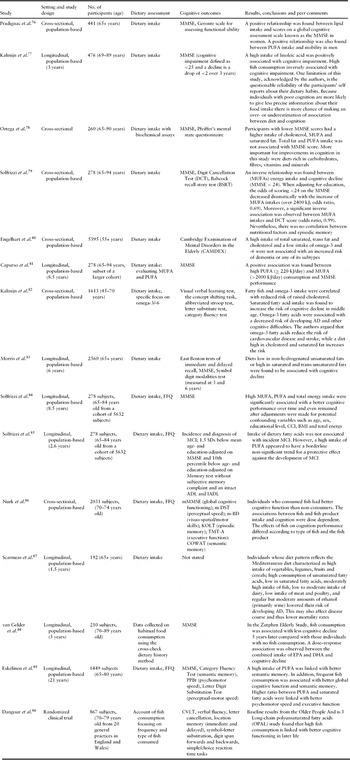
Table 1 outlines a chronological list of observational studies investigating associations between dietary fatty acid intake and cognitive function in mid- to old age. From the results found in the studies outlined in Table 1, there is definitely a growing body of evidence supporting the assumption that omega-3 fatty acids benefit physical health and cognition in mid- to old age. Individuals with diets high in omega-3 fatty acids perform better in cognitive tasks than individuals who consume less omega-3 fatty acids. In addition, diets high in saturated and trans-unsaturated fats were found to be associated with cognitive decline. Furthermore, this association may be dose dependent. However, the evidence remains unclear about whether consuming high levels of oily fish reduces the risk of cognitive disorders such as AD. What is noticeable is evidence demonstrating that a good balanced diet, consisting of a variety of foods and including at least five portions of fruit and vegetables a day, may be the best way to reduce the risk of cognitive decline. Therefore, it remains a possibility that positive associations between omega-3 fatty acid status and cognitive health are generated by a general healthy lifestyle rather than a specific effect of fatty acids on cognition.
Chronological list of observational studies examining relationships between dietary fatty acid intake and cognition in mid- to old age

PUFA, polyunsaturated fatty acids; MMSE, mini-mental state examination; MUFA, monounsaturated fatty acids; AD, Alzheimer's disease; ADL, activities of daily living; IADL, instrumental activities of daily living (IADL); MCI, mild cognitive impairment; CCI, Charlson co-morbity index; BMI, body mass index; mMMSE, modified mini-mental state examination; m-DST, modified digit symbol test; m-BD, modified block design; KOLT, Kendrick object learning test; TMT-A, trail making test, part A; COWAT, controlled oral word association test; CVLT, Californian verbal learning test; PPBt, Purdue peg board task; EPA, eicosapentaenoic acid; DHA, docosahexaenoic acid.
Omega-3 depletion in cognitive impairment and AD
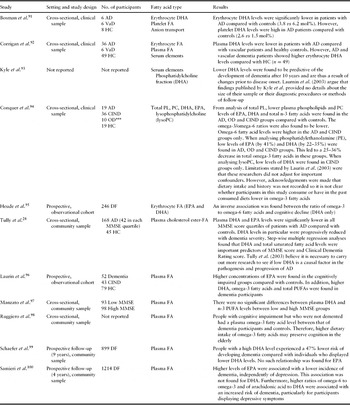
Observational studies over the last decade have attempted to determine whether individuals with cognitive impairment and dementia display differing bodily levels of fatty acids compared with normal age-matched individuals and whether this is a risk factor for their cognitive difficulties. Table 2 outlines, in chronological order, research results examining this question. The evidence shown here seems to indicate overall differences in fatty acid status in individuals with cognitive impairment but who are not demented (CIND) and in AD patients compared with age-matched controls. At this time it is difficult to determine whether this decrease occurs before or after disease onset, though evidence does indicate that the drop-off does occur early in the course of AD.Reference Conquer, Tierney, Zecevic, Bettger and Fisher94
Chronological list of observational studies examining relationships between fatty acid status and cognitive impairment and/or dementia in older adults

VaD, vascular dementia; HC, healthy control; OD, other dementias; PL, phospholipids; PC, phosphatidylcholine; lysoPC, lysophosphatidylcholine; CIND, cognitive impairment, no dementia; DF, dementia free; FA, fatty acids.
What remains debatable is whether the degree of fatty acid depletion is associated with disease severity. More research in this area needs to be carried out. In addition, it is important to consider the origin of the fatty acids measured. It is clear from the review that plasma samples, erythrocyte DHA and platelet fatty acids have presented with differing results. It is important therefore to disclose the source of the fatty acids. The failure to do so will inevitably prevent comparability to previous work. What also remains unclear is the causal factor for the differences in fatty acid composition between healthy older adults and those with cognitive impairment. It is possible that cognitive impairment may lead to a poor diet, which in turn leads to a low fatty acid status (reverse causality). It could also be that a poor diet could lead to cognitive impairment, as well as poor fatty acid status (confounding), which would support dietary observational studies discussed in Table 1. Depletions could also be caused by the deterioration in diet as a result of ageing, with both factors contributing to cognitive impairment.
Overall, evidence from both observational studies looking at associations between omega-3 fatty acid intake and cognitive performance and clinical studies of depleted fatty acids status in those with cognitive disorders have indicated that supplementation studies may prove fruitful, both in terms of preventing cognitive disorders as well as alleviating cognitive decline.
Omega-3 intervention studies involving healthy elderly people and those with cognitive impairment and dementia
There are currently only two published studies looking into the benefits of omega-3 fatty acids in healthy older adults. The first, by Rest et al.,Reference van de Rest, Geleijnse, Kok, van Staveren, Dullemeijer, OldeRikkert, Beekman and de Groot101 was a double-blind, placebo-controlled trial of 302 cognitively healthy individuals (MMSE score >21) aged 65 years and older. Results found that neither a dose of 1.8 g/day EPA-DHA nor a dose of 0.4 g/day EPA-DHA for 26 weeks benefited their cognitive performance (e.g. attention, sensorimotor speed, memory and executive function). The second was a multi-centre study of 485 individuals with age-related cognitive decline (ARCD) by Yurko-Mauro et al.Reference Yurko-Mauro, McCarthy, Bailey-Hall, Nelson and Blackwell102 This study found that after 6 months of DHA (900 mg/day) supplementation, there were improvements in CANTAB Paired Associate Learning (PAL) scores (a visuospatial episodic memory test) and a decrease in heart rate. There are other studies investigating the cognitively healthy elderly population which are nearing completion (http://clinicaltrials.gov).
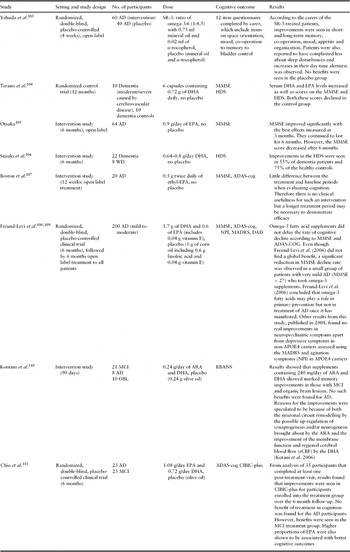
Of particular importance to this review is this assumption that differences in fatty acid status do exist between individuals with cognitive impairment and dementia compared with healthy older adults. Research focusing on elevating fatty acid levels through supplementation to improve nutritional status and thus affect cognition in the cognitively impaired is in its infancy. However, Table 3 outlines the studies carried out in this area to date. The majority of the studies indicate that supplementing cognitively impaired or demented individuals with omega-3 fatty acids may be beneficial for alleviating their cognitive deficits. However, many of these studies are pilots, with no placebo group and with relatively small sample sizes, and only a few of the larger scale studies have reported positive results. The findings of Freud-Levi et al.Reference Freund-Levi, Eriksdotter-Jönhagen, Cederholm, Basun, Faxén-Irving, Garlind, Vedin, Vessby, Wahlund and Palmblad108 in particular highlight the need for larger scale studies to be carried out with individuals with mild AD and also CIND to see if omega-3 fatty acids may help to halt or slow the progression of dementia. Even with this largest study, concerns need to be raised with regard to whether patients who were scoring 27 or higher on the MMSE were truly demented rather than just cognitively impaired.
Chronological list of omega-3 fatty acid intervention studies involving people with cognitive impairment and dementia

HDS, Hasegawa's dementia scale; SR-3, essential fatty acids preparation; WD, without dementia; ADAS-cog, Alzheimer's disease assessment scale – cognitive items; NPI, neuropsychiatric inventory; MADRS, Montgomery Asberg depression scale; DAD, disability assessment for dementia; MCI, mild cognitive impairment; OBL, organic brain lesion; RBANS, repeatable battery for assessment of neuropsychological status; CIBIC-plus, clinician's interview-based impression of change scale which included caregiver-supplied information.
Determining whether an individual has very early AD or mild cognitive impairment is subject to debate. It is sometimes the case that some highly intelligent individuals with dementia do have a good social façade particularly for orientation of time and space that could lead to a high MMSE score. This explanation relates to an individual's level of cognitive reserve. SternReference Stern112 and Roe et al.Reference Roe, Xiong, Miller and Morris113 state that it is possible that individuals with a high IQ or education level are better able to compensate for AD brain pathology without a lot of observable cognitive deficits. If participants with MMSE scores >27 in the study by Freund-Levi et al.Reference Freund-Levi, Eriksdotter-Jönhagen, Cederholm, Basun, Faxén-Irving, Garlind, Vedin, Vessby, Wahlund and Palmblad108 were still experiencing an impaired capacity to undertake their everyday life, then maybe the correct diagnosis has been given. This would be particularly true if the MMSE is supported by more detailed neuropsychological assessment where multiple cognitive impairments are apparent. In addition, Freund-Levi et al.Reference Freund-Levi, Eriksdotter-Jönhagen, Cederholm, Basun, Faxén-Irving, Garlind, Vedin, Vessby, Wahlund and Palmblad108 did find that omega-3 supplements reduced the decline seen in MMSE score in the subgroup scoring >27. However, this could be a spurious finding as subgroup analyses carry the risk of Type 1 errors. Furthermore, Freund-Levi et al.Reference Freund-Levi, Eriksdotter-Jönhagen, Cederholm, Basun, Faxén-Irving, Garlind, Vedin, Vessby, Wahlund and Palmblad108 indicated that the improvements in cognition over the latter 6 months of the study could be a result of practice effects or other factors unrelated to the omega-3 supplements. Thankfully, more large scale clinical trials are currently underway (see http://clinicaltrials.gov). It is therefore hoped that over the next 5 years results from these trials will provide a better understanding about the possibility of omega-3 fatty acid supplementation helping individuals with cognitive disorders.
Conclusion
There is a sound body of evidence from both mechanistic research and epidemiological studies that suggests that omega-3 fatty acids could be beneficial to physical and cognitive health. There is evidence that omega-3 fatty acids help to reduce the risk of poor vascular health, with some indication that this may then go on to alleviate the possible effects of vascular damage on cognitive function. This may be particularly true for individuals with cognitive disorders such as AD. Furthermore, omega-3 fatty acids also seem to play a role in cell membranes, neurotransmitter function and beta amyloid production, with again particular attention being paid to AD. Epidemiological studies are abundant and their results commonly indicate that there are strong associations linking diets high in omega-3 fatty acids with better cognitive performance. However, what is also clear from these studies is the possibility that what is more important to cognitive status is a well-balanced diet and not omega-3 fatty acids specifically. It is possible therefore that those results are confounded due to studies not fully accounting for lifestyle factors. Evidence examined here also supports the assumption that those with manifest cognitive impairment show depletions in omega-3 fatty acid status. However, explanations for this remain debatable. Finally, if the mechanistic theories along with evidence from epidemiology and clinical studies on omega-3 fatty acid depletions are to be believed, it would seem fruitful that supplementation studies would be beneficial to older people, particularly those with AD. However, few studies have been carried out. Of those that have, most are too small in scale. More clinical trials are in progress. However, it seems from the present published findings that supplementing omega-3 fatty acids in the elderly population, cognitively impaired or not, has a negligible, unsustainable effect on cognition.