The wave of labor unrest that accompanied the Belarusian post-election protests had no precedents in the country's independent history. It overshadowed any previous labor protests in Belarus since 1991 by its geographic spread, the number of workers and companies/organizations involved, and the number of economic sectors affected. Moreover, labor participation in these protests is exceptional in the regional context, given that it never played a significant role in the so called “color revolutions” or electoral protests in Russia. This goes against the pessimistic expectations prevalent in the existing literature on the sociology and anthropology of the post-Soviet working class that stress its weakness in terms of organization, structural and material resources. This paper addresses the puzzle of an unexpected activation of the seemingly passive Belarusian working class.
Since August 10 and until the last day of the author's monitoring of the labor unrest (September 31), protest activity has been recorded on eighty-eight industrial, trade, and service enterprises, as well as educational, medical, and other organizations, almost all of them state-owned or budget-financed. The revenue of the thirty largest enterprises affected by the protests amounts to almost a third of Belarusian GDP.Footnote 1 Although protesters as well as the media often describe these events as “strikes,” I prefer using the term “labor unrest,” referring to an expression of workers’ discontent in a wider range of forms, including spontaneous or organized demonstrations, walkouts, absenteeism, slowdown, riots, and work disruption.Footnote 2
Although strikes proper are a small share of the workers’ repertoire of contention, as demonstrated below, the emergence of these large-scale labor-related protests constitutes a puzzle given that the scholarship on postsocialist labor stresses primarily workers’ patience and the weakness of their resistance capacities.Footnote 3 In the Belarusian case specifically, researchers note bureaucratic control at workplaces, workers’ atomization, and the suppression of their voice.Footnote 4 Moreover, some scholars stipulate that employees of state enterprises “negatively adapted” to the stifled growth of incomes by combining “exit” and “loyalty” strategies.Footnote 5 What forced Belarusian workers to lose their patience and enabled them to mount resistance at such a scale?
Addressing this puzzle, I follow the literature that uncovers the signs of relative strength of postsocialist workers by analyzing “moments of struggle” and the agency of labor organizations in overcoming the challenges of mobilization, confrontation, and political alignments.Footnote 6 The task of this article is to suggest hypotheses about the factors behind the unusual level of labor unrest within the broad protest movement in Belarus.
Methodologically I rely on data-gathering techniques applied in empirical studies of other post-Soviet countries.Footnote 7 I have compiled a database of labor-related protest events (August 10–September 31) and performed a content analysis of a selection of statements, interviews, and social media discussions among participants of the protests. The structure of the database is adopted from the Ukrainian Protest and Coercion Data project.Footnote 8 The unit of analysis is a protest event with the actors identified or self-identified as workers; the repertoire of collective actions is expanded to reflect Belarusian realities (gatherings and petitions added as types of action; economic unit added as a variable). The data have been gathered manually from online media and telegram channels.
The rest of the article is structured as follows: The first section analyzes the dynamics of labor-related protests, their repertoire of contention, and the response of the state. The second section explores hypotheses about the factors behind this protest wave. By way of conclusion, I offer reflections on the future of the labor movement in Belarus.
Rise and Fall of Workers’ Militancy
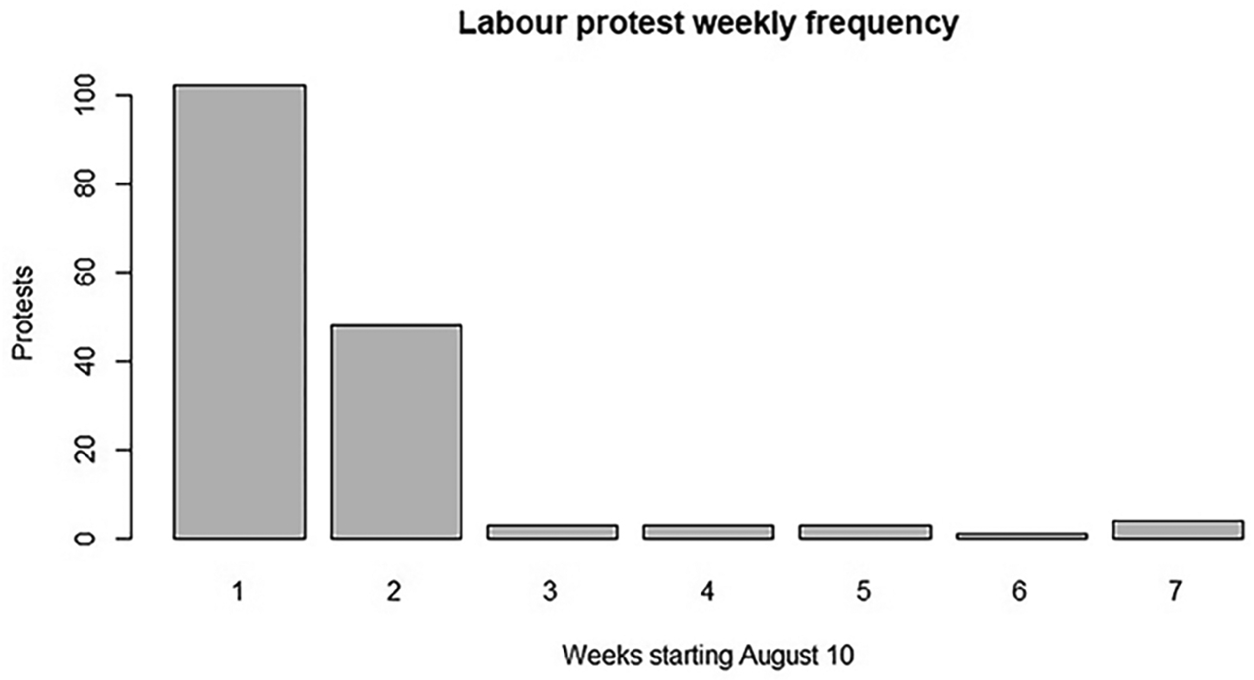
After seven years of relative quiescence at workplaces that followed an uptick of labor militancy in the post-crisis years of 2011–13, this summer Belarus saw a dramatic outbreak of labor unrest: within a brief period between August 10 and September 31, 2020, the author's monitoring registered 168 labor-related protest events at eighty-eight economic units (See Figure 1).
Labor protest weekly frequency

This protest wave peaked on the second and third week of August: almost half of all the reported protest events (eighty-two occurrences or 49%) happened on August 13–14 and the second peak was on August 17–18 with twenty-six events or 15% of all protests. The last large mass protest, a march of workers from six Minsk enterprises to the city center (“March of the new Belarus”) on August 23, closed the active phase and inaugurated a period of declining intensity. In the last week of August and throughout September, the intensity of labor-related protests fell drastically (fifteen instances) and repressions escalated (twenty-one instances, mostly arrests). Individual rather than collective expressions of discontent prevailed in the next three months except for the last week of October, when labor activists in six large industrial enterprises tried to stage a strike.
At the height of the unrest, in mid-August, both enterprise management and state authorities seemed disoriented and occasionally cooperative. In an informal arrangement, the management sometimes supported workers, often met with them in their enterprises, and allowed them to “go for a walk” and take a leave of absence in exchange for not showing up on their enterprise's premises. September, in contrast, was dominated by reprisals: dismissals of active workers for absenteeism, harassment by management, detentions (sometimes on the shop floor) and arrests of labor activists. All the tools of bureaucratic despotism at workplaces were put into use: non-renewal of fixed-term contracts, job flexibility, withholding of bonuses, and harassment by deputy directors for ideology.Footnote 9
Workers were also initially predisposed to dialogue. According to my calculations, a relative majority of protest events (seventy out of 143) between August 10–20 were limited to spontaneous and later organized short-term gatherings in groups of dozens to hundreds of workers inside their factory gates. These meetings would happen once or twice a day, involve factory management, trade union representatives, and local officials; they would most often occur once or twice a week. Such meetings would often happen outside of working time and not lead to a shutdown of a plant or its departments. Their outcomes were the gathering of signatures for strike warning statements, collective petitions, including those signed by the so-called yellow trade unions, creation of strike committees, and the withdrawal from “yellow” (employer-dominated) trade unions.
Strikes proper, involving a partial shutdown of plant divisions, happened rarely (twelve occasions): at two departments of the Hrodna Azot chemical plant on August 13, at most mines of the Belaruskali potash company in Salihorsk on August 17–19; several reported work stoppages at the Belarusian Metallurgical Plant and the Hrodna Construction Company among a few others. The crucial shift in the repertoire of contention happened on August 26, when the leader of the Belarusian Congress of Democratic Trade Unions (BCDTU) announced that the workers’ movement would switch to a “work-to-rule” tactic (reportedly first employed at the Minsk Tractor Plant, Belaruskali, and the Minsk Automobile Plant). It is not clear yet how widespread this tactic has been, given the ample arsenal of punitive tools at management's disposal—from withholding bonuses to threatening financial and criminal charges—and workers’ dependency on plant-mediated welfare provisions (including subsidized housing and loans). This phase was accompanied by symbolic actions on the shop floor (banners, flags) and three episodes of individual workers refusing to leave the mines in Salihorsk.
Workers organized to protest in an extremely adverse institutional environment. Belarusian labor organizations are segregated into the state-controlled Federation of Trade Unions (FTU) that covers almost every employee, and four BCDTU unions counting less than 10,000 members in total.Footnote 10 In the first protest week, the state-controlled unions, surprisingly, responded to pressure from their rank-and-file members: in several cases local trade union organizations signed letters condemning fraudulent elections and police brutality; the central body of the FTU, however, disciplined them swiftly. The alternative trade unions were not visibly active until the second week of the protests, and strike committees appeared as active organizers during the second week of the labor unrest.
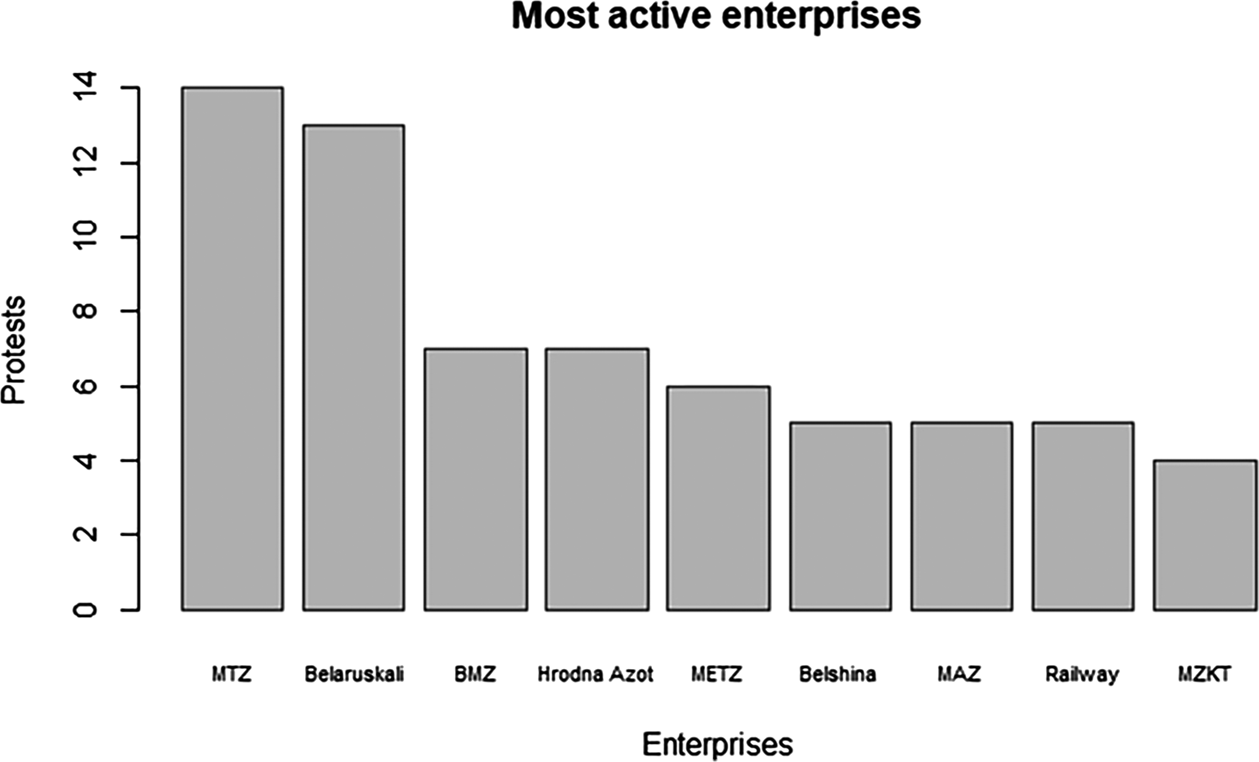
Spontaneous protests preceded local organizations in most cases. Strike committees at the Belaruskali potash company started forming on August 17 and merged into an enterprise-wide committee on August 18, a week after the first protest events. The Hrodna city strike committee was formed on the same day, reportedly uniting workers at twenty-one companies. In parallel, the BCDTU announced the formation of a national strike committee. Within the next days, strike committees were established at the Minsk Tractor Plant, the Minsk Automobile Plant (August 20), and several other enterprises. Workers’ representatives entered the opposition Coordination Council, constituting twelve out of fifty-two members. Strike committees have actively worked with trade unions, the most notable case being Belaruskali, where the Independent Miners’ Union was at the frontline of struggle (Belaruskali workers account for the second largest share—12%—of all protest events, second only to the Minsk Tractor Plant with 14%: see Figure 2).
Most active enterprises

Other alternative unions also participated and reported a significant growth in membership. After the shift toward work-to-rule tactics, the Coordination Council in cooperation with the alternative trade unions and strike committees established an “Online Trade Union” initiative that would enable secret application for membership in a trade union not affiliated with the FTU.
Thus, the Belarusian labor unrest of August–September 2020 was the most numerous, the most spatially diverse and the longest labor protest wave in the country since the strikes of April 1991.Footnote 11 After 1991 labor protests had been localized, like the Salihorsk miners’ protests in 1992, 1996, 1998, and 1999; short-lived, like the transportation workers’ strike in 1995 and trade union-organized protests in 1998–2001; or both, like the wild cat strikes in 2011–13.Footnote 12 Moreover, similar labor mobilizations never emerged as a significant part of the last decade's political protests in other post-Soviet countries (in the Russian Federation, Armenia, Ukraine or Kyrgyzstan).Footnote 13 And yet, it happened in the unfavorable environment of increasing work precarity, mounting state repression, and weak labor organizations. What could account for the resources that enabled workers to rebel?
Creating Cleavage, Overcoming Atomization
During the protests, Belarusian workers had to overcome the challenges of their suppressed voice, bureaucratic despotism, and atomization. I hypothesize that it was the vagueness of the Belarusian opposition's ideology and workers’ participation in the broader protest movement that made this wave of labor unrest possible.
The prevalence of vague populist anti-authoritarian rhetoric as opposed to substantial “thick” ideologies in the general protest helped workers overcome the suppression of their voice in the workplaces.Footnote 14 Virtually all demands voiced during the labor unrest had been “political”: from mild appeals to prosecute cases of police violence to calls for Lukashenka's resignation. In second place, however, in several cases there have been economic demands related to low wages and poor working conditions. This populist ideological framing, which stems from the “non-parasites protests” of 2017 and was picked up by the opposition presidential campaign, has encouraged workers to formulate their demands, bypassing the apathy instilled in them by previous futile efforts to appeal to the official unions with purely economic claims.Footnote 15
This “thin” political articulation of workers’ demands helped bypass traditional institutional forms of channeling labor-related grievances that have been blocked by the state. A conventional strike over work-related grievances deemed “legitimate” by Belarusian Labor Law is next to impossible since it involves a lengthy procedure which requires consent from two-thirds of a representative workers’ congress with a two-week warning; it may be prohibited for reasons of national security or public order. Additionally, strikes legally initiated by trade unions cannot include “political demands,” as the Belarusian Law on Trade Unions states without further clarification.
The anti-authoritarian appropriation of the populist “thin ideology” created a situation of cleavage between “us” (the “working people”) and “them” (the “corrupt bosses”).Footnote 16 This proved essential in overcoming the factory regime of bureaucratic despotism, since in the state capitalist country that is Belarus, class conflict is blurred: the immediate exploiter coincides with the state bureaucracy, and social demands cannot be disconnected from political demands. In popular perception economic bureaucrats do not appear as the managers of state-owned capital that they are. They are seen instead as part of a “feudal” order; their social control function is abstracted and fetishized by the workers, and their exploitative function is left aside. Thus, workers’ protest proved most successful not as a struggle against exploiters but as a rebellion against both company and state bureaucracy.
The initial success in forcing the management and the local authorities into a dialogue in the first week of labor unrest encouraged workers to continue pressing their demands and start uniting in organized ways. Disaffected by the state-controlled trade unions and lacking knowledge about other labor organizations, however, workers did not know how to protest in their capacity as workers. As evidenced by the Minsk Tractor Factory Telegram channel, workers did not know what a strike means precisely, they could not agree on the time and date of a gathering or on how to proceed afterwards. Similarly to how the word “strike” was idiosyncratically used to refer to any protest action, the word “strike committee” (stachkom) was initially used to denote one person (in the case of the Minsk Tractor Factory, Siarhei Dyleuski).Footnote 17
Therefore, Belarusian workers had to rely on other means to overcome atomization. As we talk about this labor unrest as a part of the larger protest, the Belarusian working class protested as citizens rather than as workers. This is proven by the fact that the labor protest wave immediately followed the post-electoral general mobilization with its outrage against police violence and that the spikes of labor militancy have been related to the broader weekly protest schedule. Additionally, BCDTU-affiliated trade unions have a long-standing tradition of participating in opposition protests, which they brought to the newly-organizing strike committees. This is, however, an ambivalent process: the very experience of uniting and standing up to the bosses is vitally necessary for the workers to overcome atomization and gain organizational experience, but at the same time workers have not learned to articulate political demands with a broader social agenda.Footnote 18 At the moment, the form of the workers’ protest ideology proved more important than the content.
As I was finishing this article, the opposition Coordination Council announced a general strike for October 25. The events of the following days put to test the above hypotheses about the factors behind the protest activity of Belarusian workers. On October 26 and 27, disturbances occurred on six large industrial enterprises with significant work disruption at the Hrodna Azot plant and Minsk Electrotechnical Plant. Although this number was comparable to that of the ten active enterprises in the first two days of the August protest wave, only the core of 30–60 organized workers per enterprise actively participated in gatherings; up to two hundred protesters mobilized only in Hrodna. The police and the enterprise management, on the contrary, have been better prepared, intimidating workers with police posts at the gates or, as on Hrodna Azot, detaining dozens of them right at the plant. In contrast to the first protest week of August, the October wave subsided immediately: numerous activists were detained and dismissed in the following days, which led to sporadic solidarity demonstrations. Subsequent labor protests in November and December took the form of individual declarations of joining the strike, which were met with targeted repressions in the form of dismissals for absenteeism.Footnote 19
This episode points to the limits of the mobilizing factors discussed in the second section of this paper. The immediate politicization of the labor movement and workers’ self-identification as citizens, which accounted for the August wave of militancy at Belarusian enterprises, was both a blessing and a curse. Although these factors helped workers overcome the lack of organizational resources, they made the labor movement dependent on external circumstances. As opposed to the April 1991 strike, when the labor movement had a political representation in parliament, now, despite having reached a comparable scale, it lacks such political representation that would both offer a positive program to broaden the support base and structure the claim making to ensure rationale for protest activity. The workers’ economic interests are not articulated in the general opposition platform, which makes it difficult to reach a sustained broad participation in workplace-based actions beyond a core of activists. My analysis of Telegram-based discussions among active workers at the Minsk Tractor Plant shows increasing confusion among them concerning the long-term economic consequences of the opposition struggle and their possible victory; the cost/benefit analysis seems to be restraining workers’ participation in the view of inevitable repressions.
Nevertheless, the resurgence of labor militancy in Belarus may be possible in the long run rather than in conjunction with the ongoing opposition movement. Comparison with the 1991 strikes and subsequent protests suggests that the politicization of workers in street protests, their experience of confrontation with the management, of solidarity and self-organization will probably survive for several years. Moreover, newly emerging organizational structures seem to be paying more attention to work safety-related and economic issues, which could benefit the expansion of their support base. These subjective factors may lead to further mobilizations given the deteriorating economic conjuncture.
Although the chances for the victory of the political protests are waning, the contradictions of Belarusian state capitalism will only become more acute. The deepening global recession and the pressure from the Russian capital in the oil processing, chemical, and energy sectors will affect the Belarusian working class under any political scenario. Depending on the political situation, which would only influence the pace of changes, the workers’ precarity will increase with wage decline, privatizations, and the optimization or closing of large employers. At the same time, the “legacy” trade unions will not be able to direct workers’ discontent. This combination of workers’ politicization and organization experience added to the deteriorating economic situation may lead to new waves of labor unrest, maybe more autonomous from larger political protests. Sustained and autonomous labor organizations capable of articulating workers’ class interests become crucial in this respect; otherwise, Belarusian labor risks repeating the sorry fate of many other pro-democracy mobilizations.Footnote 20