Much of how we think about the modern, powerful American presidency and independent, adversarial news media of today is defined by how these institutions break from the past. Nineteenth-century presidents, particularly Republicans, are often considered reluctant leaders of public opinion who avoided interpreting events for the American people. Scholars reviewing the history of the news in the United States depict the nineteenth century as an era of a predominantly partisan press, with some outlets making forays into nonpartisan journalism in the late 1800s.
Based on this understanding of the development of the presidency and press, it becomes harder to account for Ulysses S. Grant's vigorous defense of his conduct during the Whiskey Ring scandal of his second term. Even orthodox Republican newspapers offered mixed defenses of his administration, defying the standard view that a partisan press reliably stood behind presidents of their party. Additionally, news of the scandal included content supposedly distinctive to the contemporary media. The Grant experience suggests that some of the familiar dynamics of the modern presidency/media relationship can be witnessed earlier in American political history than we typically assume.
I argue that the Whiskey Ring case provides evidence of important developments in the institutions of the presidency and the news media, taking place at a pivotal, tumultuous moment in American politics when party divisions, battles over civil service reform, and shifting journalistic standards all collided. The case suggests presidents may have always had significant capacity to frame their actions for the public, requiring more research of early, comparable cases to provide a fuller picture of these abilities. A “premodern” president by nearly every conventional measure, Grant still mounted a concerted effort to mitigate the damage of the Whiskey Ring scandal, and news coverage of the events defied common assumptions about the press of that era.
Literature Review: Why the Whiskey Ring Matters Now
Most scholarly accounts of the presidency in Grant's time lead us to presume he would be unlikely to publicly appeal for redemption in the face of scandal, in contrast to presidents today. Numerous works identify the emergence of a modern presidency in the twentieth century involved in leading and molding public opinion, aided by enhanced institutional and technological resources (Greenstein Reference Greenstein and King1979; Jacobs and Shapiro Reference Jacobs and Shapiro2000; Kumar Reference Kumar2007; Lowi Reference Lowi1985; Neustadt Reference Neustadt1990; Pfiffner Reference Pfiffner1994; Tulis Reference Tulis1987). This characterizes most nineteenth-century presidents as clerk-like figures carrying out the will of Congress, and shunning “improper” appeals to the people. Tulis (Reference Tulis1987) argues the Constitution and nineteenth-century norms forbid presidential popular rhetorical leadership, for fear it would endanger republican government.
Others have challenged the notion we can identify certain presidential behaviors as arising only after this twentieth-century transformation of the office. Nichols (Reference Nichols1994) calls the modern presidency a “powerful myth,” arguing so-called modern attributes of the office can be found earlier and in the constitutional structure. Klinghard (Reference Klinghard2010) traces the rhetorical presidential candidacy back to the 1880s, as the nationalization of political parties empowered presidents to shape campaign issues. Summers (Reference Summers1994) depicts politicians of the 1870s bullying and socializing with reporters and using patronage to manage the news. Bimes and Mulroy (Reference Bimes and Mulroy2004) identify a robust tradition of populist leadership amongst specifically nineteenth-century Democratic presidents, to undermine the legitimacy of policies and institutions they opposed. Laracey (Reference Laracey and Medhurst2008) argues nineteenth-century presidents used presidential newspapers to disseminate their policy views. Gamm and Smith (Reference Gamm, Smith and Ellis1998) point to presidents since Theodore Roosevelt routinely making direct appeals to the public on issues. Azari (Reference Azari2013) points to examples of presidential mandate rhetoric that reveal premodern presidents shoring up the legitimacy of the office and building political support independent from parties or Congress. Hoffman (Reference Hoffman2010) urges us to adopt a broader definition of presidential rhetoric that encompasses forms of persuasive communication beyond the policy speech, establishing that even our earliest presidents were thus popular leaders.
The preceding contrasting views of the presidency make it difficult to anticipate how a late-nineteenth-century scandal involving the White House would unfold. If nineteenth-century presidents were indeed circumspect in appealing to the people, we would expect a president not to visibly involve himself in the matter, nor engage in public testimonials to minimize the damage. Conversely, from the revisionist perspective that sees nineteenth-century presidents actively promoting their agenda, we would look for a president to defend himself vigorously and publicly. Rather than focusing on presidential policy appeals, we might also identify, as Skowronek (Reference Skowronek2001) does, how presidents’ authority rests on their ability to control the meaning of their actions and sustain legitimacy for what they do. Here, I expand the exploration of presidential popular rhetorical leadership to major scandals, which threaten presidential power and authority and jeopardize public trust in government (Basinger and Rottinghaus Reference Basinger and Rottinghaus2012; Miller Reference Miller1999; Sabato Reference Sabato1991). If a nineteenth-century president could limit the damage of a significant scandal through his public statements, we have evidence of powerful popular leadership well before we assume such a White House reaction to scandal.
The news media, another key institution in this story, also transformed over this period. Schudson (Reference Schudson1978) identifies a transition from media outlets subsidized and directed by political parties to some “penny press” newspapers claiming political independence and more interested in building mass audiences. However, Kaplan (Reference Kaplan2002) argues that Schudson's narrative about the emergence of neutral news content is flawed, as partisan newspapers endured until the turn of the century. McGerr (Reference McGerr1986) finds after the Civil War, even as newspapers became more independent from party control, editors still drew no clear distinction between fact and opinion. Further, a party's affiliated newspapers did not necessarily speak with one voice, instead reflecting and fostering disagreements within the party (Summers Reference Summers1994). Occurring at a time of intraparty turmoil for the Republicans, newspaper coverage of the Whiskey Ring scandal could be particularly informative in explaining how these party fractures might play out in the partisan press. Grant's party faced an internal revolt by a Liberal Republican faction rejecting patronage and corruption, and the scandal's charges of official malfeasance directly related to this larger controversy over civil service reform.
The motivations of media actors and journalistic norms were also evolving in this era. Both McGerr (Reference McGerr1986) and Smythe (Reference Smythe2003) identify the rise in some outlets of “independent journalism” in the 1870s and 1880s, a less devoutly partisan and more factual style of reporting, though partisanship reasserted itself in presidential election years. Hamilton (Reference Hamilton2004: 39) demonstrates that in 1870, a vast majority of newspapers were still defined by a partisan attachment, but that for the largest newspapers, “the growth in independent affiliation was most pronounced from 1870 to 1880.” This marks 1876, the year the Whiskey Ring scandal unfolded (as well as a presidential election year) as a critical moment in this era of change. Many trace the rise of nonpartisan content to market forces, as newspapers gained more revenue from advertising and sought to increase their circulation numbers (Baldasty Reference Baldasty1992; Hamilton Reference Hamilton2004; McGerr Reference McGerr1986; Mindich Reference Mindich1998). Newspapers were no longer receiving substantial printing subsidies from the government; the end of official presidential newspapers and patronage for favored outlets occurred over 1860–61 with the creation of the Government Printing Office (Rubin Reference Rubin1981; Smith Reference Smith1977). Tebbel and Watts (Reference Tebbel and Watts1985) argue that during Grant's administration, an increasingly investigative, competitive press would expose political scandals, regardless of their party leanings. At the same time, Smythe (Reference Smythe2003) notes that several of the Republican newspapers that backed the Liberal Republican bolt from Grant's candidacy in 1872 suffered a loss in circulation and revenue, demonstrating the financial perils of bucking the party line in the 1870s.
The literature leaves unclear how prominent news outlets of 1876 would react to a presidential scandal. If party affiliation remained a significant part of a newspaper's identity, it would likely react to trouble in the White House by intensifying its partisan leanings—either rallying to the president's side or pursuing an opportunity to bring down his administration. Catering to an audience of reliable partisans, papers might not want to risk alienating their readership by striking an independent course in such a controversy, particularly in a presidential election year. Alternatively, we would assume a more independent press interested in appealing to the widest possible audience would pursue nonpartisan journalism exposing official corruption. The circumstances of this case allow us to examine how press outlets balanced fostering the public interest in exposing corruption, navigating prominent calls for civil service reform, and rallying behind their party as a major election loomed.
Finally, media observers have identified developments in news coverage norms that have purportedly emerged over just the past few decades. One is coverage of the president and presidential candidates wherein journalists take up the role of amateur psychologists, heavily scrutinizing politicians’ character (Jamieson and Waldman Reference Jamieson and Waldman2003; Stanyer and Wring Reference Stanyer and Wring2004). A second is the press increasingly focusing on the underlying motivations behind the actions of politicians, making strategy and the game-like aspects of politics the primary focus of their coverage (Cappella and Jamieson Reference Cappella and Jamieson1997; Farnsworth and Lichter Reference Farnsworth and Robert Lichter2011; Jacobs and Shapiro Reference Jacobs and Shapiro2000; Patterson Reference Patterson1993, Reference Patterson2003). Unexpectedly, the Whiskey Ring scandal coverage shows newspapers placed great emphasis on such content, allowing us to question how recently this style of reporting proliferated.
Research Design
To understand how President Grant sought to minimize the damage of the Whiskey Ring scandal, I make use of the concept of framing. Previous works have analyzed presidential scandals by exploring the president's use of frames and rhetoric to shape media coverage and public understanding of such controversies (Busby Reference Busby2001; Denton and Holloway Reference Denton and Holloway2003; Entman Reference Entman2012; Farnsworth and Lichter Reference Farnsworth and Robert Lichter2006; Hopper Reference Hopper2013; Stuckey Reference Stuckey1997). Framing entails highlighting certain aspects of a story and deemphasizing others, stressing particular central organizing themes, and giving coherence and meaning to an issue or event (Altheide Reference Altheide1976; Bennett Reference Bennett2005; Callaghan and Schnell Reference Callaghan and Schnell2005; Entman Reference Entman2004; Lakoff Reference Lakoff2004). The framing process works to set the terms of debate, making some facets of reality more visible than others (Kuypers Reference Kuypers2009; Reese et al. Reference Reese, Gandy and Grant2001). Kuypers and D'Angelo (Reference Kuypers and D'Angelo2010) have championed the value of framing studies for understanding how political actors seek to advance a cause, as well as how news outlets seek to package content and relay information to audiences. Political actors use framing to situate events within selected narratives designed to foster support for their political goals, and work to ensure such interpretations are echoed in the news to reach a large number of citizens.
To explore presidential framing in shaping news coverage in the Whiskey Ring case, I engage in a comparative framing analysis of the president's public statements on the scandal and news coverage of the events. The goal of this comparison is to ascertain similarities and differences in how the president and the press framed the scandal. The study first looks at February 9–25, 1876, spanning the length of the criminal trial of the president's personal secretary, with Grant's voluntary, supportive deposition given in the middle, allowing for review of the coverage before and after the president weighed in. In line with Cappella and Jamieson (Reference Cappella, Jamieson, Graber, McQuall and Norris1998), Entman (Reference Entman1991, Reference Entman1993), Kuypers (Reference Kuypers2006, Reference Kuypers2009), and Kuypers et al. (Reference Kuypers, Cooper, Althouse and Denton2012), I identify major themes in Grant's public statements on the scandal through qualitative inductive analysis, and then analyze the president's words for “framing devices,” or phrases, references, and concepts, that consistently showed up in the narrative. Such framing devices demonstrate how the administration intended those preliminary themes to be framed, or interpreted and understood by audiences.
I then engage in a close interpretive analysis of important urban news media outlets of the period including the Republican newspapers the New York Times and Chicago Tribune, the Democratic-leaning New York Herald and New York Sun, and the quasiindependent New York Tribune. These papers were selected according to three criteria to best permit conclusions about the tenor of news coverage that reached audiences regarding Grant and the Whiskey Ring scandal: circulation rates, different partisan leanings, and inclusion of an outlet from another urban area with a thriving newspaper industry. First, regarding circulation, by 1880, New York City alone published 22.8 percent of the country's daily sheets (Baldasty Reference Baldasty1992: 49). Of New York City's 100 daily newspapers, the most of any state, I analyzed the papers with the four largest circulation numbers (American Newspaper Directory 1875). There are admitted limitations to this focus: The nineteenth-century metropolitan press produced news content markedly different from small towns (where a paper might lean toward political independence, as typically the only outlet in the area) and some small cities/larger towns (which tended toward greater partisanship because of the prominence of patronage in their localities) (Baldasty Reference Baldasty1992: 130). But the mix of partisan and independent outlets in the New York City press allows for keeping the region constant while analyzing how newspapers of different political identities covered the same story. Additionally, by 1870, 34.5 percent of the US population resided in urban areas and literacy rates were highest there (ibid.: 49), and major New York City papers reached many readers outside of that locality (Summers Reference Summers1994: 19). Second, the scope of the newspapers selected includes orthodox Democratic and Republican papers, Liberal Republican–sympathizing outlets, and Independent newspapers, allowing us to explore the impact of factionalized political parties and media outlets with diverse political identities on coverage of this particular case.Footnote 1 Third, the Chicago Tribune was included as Chicago was also a major media center of the time, and its editor, Joseph Medill, a major Republican leader, made the paper a leading voice of the official party organization (Novotny Reference Novotny2014: 37; Smythe Reference Smythe2003: 22). Lastly, complete microfilm/microfiche archives were available for all five newspapers for the selected periods; not all outlets of the time were preserved in their entirety.
This diachronic study incorporates a second period, to evaluate whether presidential frames successfully shaped news content over time, particularly when Grant's critics circulated their alternate readings of the scandal. Numerous scholars have traced the trajectory of “framing contests,” or the battle amongst political actors to interpret high-stakes issues for the press and the public (Chong and Druckman Reference Chong and Druckman2007a, Reference Chong and Druckman2007b; Entman Reference Entman2004; Jamieson and Waldman Reference Jamieson and Waldman2003; Wolfsfeld 1997). The House of Representatives was well positioned to present a formidable challenge to President Grant's ability to frame the scandal, given the institutional power of Congress vis-à-vis the presidency in this era and that Democrats controlled the chamber in 1876. In March of that year, the House launched a six-month investigation into the Whiskey Ring frauds. After reviewing the entirety of the committee's published proceedings, I selected the month of July for analysis as a best test case for assessing how Grant's framing of the scandal would fare when contested by his opponents. July encompassed the most detrimental testimony for the president's frames and generated extensive news coverage, and Grant's actions brought the administration back into the center of the scandal. Were Grant's frames to persevere in the press even at the height of this challenge, the president's ability to shape news narratives would be clear.
A single case limits our ability to make sweeping assumptions based on its findings about the nature of the presidency, the news media, or popular presidential leadership at the time. Further research will be needed to clarify how “typical” Grant's actions and subsequent media coverage were for this era. Still, President Grant presents a solid test case for nineteenth-century popular presidential leadership. Known for his reticence, Grant was also a Republican (less associated with popular appeals than Democrats of his era) and not a career politician more accustomed to exercising “the little arts of popularity.” If Grant was willing to engage in public appeals, it stands to reason that other presidents of this era, bettered suited to embark on such a path, would do so as well. While the centerpiece of the scandal was a legal trial, perhaps enhancing the likelihood newspapers of the day would cover events in a two-sided, neutral way, other cases of this period, including the trials of preacher Henry Ward Beecher for adultery in 1875 and the Haymarket bombing perpetrators in 1886, received largely one-sided, biased coverage in the news (Evensen Reference Evensen2001–2; Junger Reference Junger2010).
Grant and the Whiskey Ring Scandal
In 1876, President Grant's private secretary, General Orville Babcock, was indicted and criminally tried for involvement in the St. Louis “whiskey ring” exposed in 1875 by Grant's Secretary of the Treasury Benjamin Bristow (Hesseltine Reference Hesseltine1935: 378). Whiskey rings were uncovered in cities throughout the country, and involved underreporting whiskey production so fewer taxes were paid to the federal government, which lost millions in revenue. The excess money was illicitly divided amongst the whiskey producers and corrupt government officials charged with collecting the taxes in an intricate system of bribery. The most incriminating pieces of evidence against Babcock were mysteriously worded dispatches he sent to some of the main organizers of the ring and construed as warnings to his coconspirators as to when federal agents were going to strike. Babcock was regarded as extremely close to Grant, one of the most powerful and influential people in the White House (Rives Reference Rives2000).
Grant was constrained in defending his conduct in comparison to presidents engulfed in scandal in the contemporary era, who might give high-profile, televised speeches in which they cast their actions in the most favorable light possible. Grant, voluntarily testifying to Babcock's innocence, not only sought to vindicate his secretary, but also to set the record straight about his own lack of involvement in wrongdoing. As a vehicle for framing a scandal, a president's deposition differs sharply from a major speech: The president in the former case cannot entirely control the format and limits of the questions posed to him, and is vulnerable to a hostile cross-examination. Despite these limitations, in the course of his statements, Grant's efforts to highlight elements of the case and deemphasize others, just as his modern scandal-plagued counterparts would do, become clear. Additionally, a willingness to be confronted by questions of the opposition enhances the appearance of transparency. Finally, the rarity of presidential depositions in criminal cases could draw great public and press attention to Grant's preferred take on the situation.
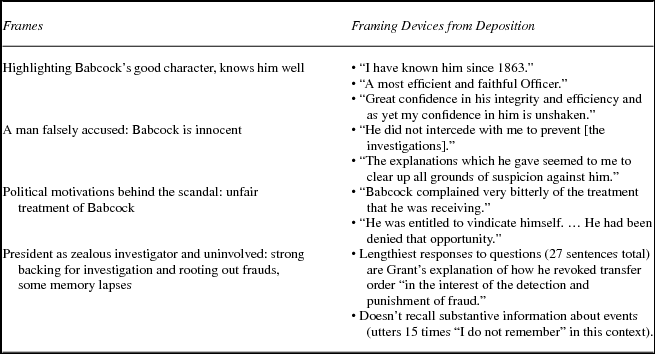
In the following text, I identify the main ways President Grant framed the scandal in his deposition and how these frames fared in subsequent newspaper coverage. Table 1 offers a brief summation of the substance of those frames. I find that though Grant framed events to absolve himself and Babcock of any wrongdoing, the nature of the nineteenth-century newspaper limited his ability to shape coverage effectively. Much of the editorial content in the analyzed Republican-leaning papers did privilege the president's position, and that of the Democratic papers challenged Grant's frames, demonstrating the persistence of one-sided news in 1876. However, a great deal of the news content consisted of detailed recounting of events in chronological order, such as trial proceedings, which resulted in a fair amount of favorable and unfavorable content for the president in all the selected print outlets, regardless of their partisan affiliation. Further, the five newspapers offered a surprising amount of commentary on the motivations and character of the president, and connected his personal traits to mistakes made in office, counter to assumptions such content is a firmly modern development.
Grant's framing of the Whiskey Ring scandal

The first frame employed by Grant in his deposition was highlighting Babcock's good character, enhanced by assertions that he had known him intimately for an extended period. Rather than distancing himself from his secretary, Grant instead emphasized what an “efficient and faithful” member of the administration Babcock had been. The president declared that he “always had great confidence in his integrity and efficiency, and as yet my confidence in him is unshaken; I have never learned anything that would shake that confidence; of course I know of this trial that is progressing.” The president sought to restore public faith both in Babcock and the integrity of his administration.
Grant's close firsthand knowledge of Babcock also served to bolster the second frame employed in his testimony, that Babcock was innocent of the charges against him. The president frequently reiterated that, to his knowledge and recollection, Babcock never interfered with the investigation of the ring, never asked for Grant to take particular action in the case except to make sure “men of high character” were doing the investigating, and was not involved in the ring's illegal activities. At some points in the deposition, Grant stated his “memory doesn't go back to that time” regarding being shown particular dispatches or spoken to about certain officials now convicted of being involved in the ring, not unlike President Ronald Reagan's public claims he could not recall some elements of Iran-Contra. However, Grant stressed that had Babcock tried to use his influence with the president to cover up his involvement, Grant would certainly remember these efforts, and he did not.
A third (but less emphasized) frame throughout Grant's statements was the depiction of Babcock as not merely innocent, but treated unfairly. When asked whether Babcock ever interfered with the investigation, Grant responded: “To my knowledge he has not; General Babcock has complained very bitterly of his treatment; after the speech of Mr. Henderson in the Avery trial was delivered.” The statement by John B. Henderson, a Whiskey Ring prosecutor, was the accusation Grant and Babcock had wrongly interfered with the Treasury Department's efforts to root out the whiskey frauds (Hesseltine Reference Hesseltine1935: 386). This was widely criticized by Grant supporters as evidence that the investigation was little more than a partisan attack on the president (Rives Reference Rives2000: 5). Grant's defenders felt he not only faced persecution from Democrats, but from within his own administration, and accused Secretary Bristow of positioning himself for an 1876 Republican presidential run at Grant's expense (Nevins Reference Nevins1967: 793). When Grant was questioned as to why he made a prior request for a military Court of Inquiry for Babcock, he answered, “It was made because he applied for it, and I thought he was clearly entitled to vindicate himself if he was innocent. He had been denied that opportunity before the Grand Jury.” The president raised the possibility of misconduct in the criminal investigation, violating norms of fairness, and turned the tables on administration critics, a common feature of image-restoration strategies (Benoit Reference Benoit1995). This was a tactic President Bill Clinton would also employ during the Lewinsky scandal more than a century later, in declaring that the special prosecutor scrutinizing his actions had shamefully moved into his private life, and noting, “now the investigation itself is under investigation” (Miller Center Reference Center2017).
Finally, Grant emphasized that he was not involved in the scandal, and that throughout the investigation his intentions were always to expose the guilty and root out corruption, casting himself as a zealous investigator. Grant might have wanted to maintain his secretary was innocent but simultaneously needed to illustrate his own distance from the corruption, with an eye toward the public nature of his remarks. The president highlighted his desire to find and punish those guilty of participation in the ring, and contradicted the notion he had not been cooperative or proactive in the investigation. One of Grant's actions that undermined this narrative was his revoking an order to transfer revenue supervisors between cities to disrupt the ring and reveal the guilty parties, but he explained in the deposition that he became convinced (though not by Babcock) this would prevent the corrupt from being caught, giving them too much notice and time to cover up their misdeeds.
Urban Press Coverage of the Grant Deposition
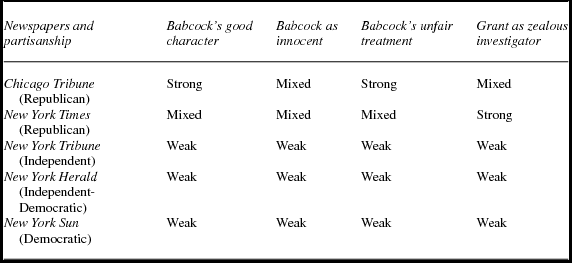
During the February period, the Babcock trial was the single most dominant story in all five analyzed newspapers.Footnote 2 When Grant's deposition was officially entered into the court's records, its text appeared in its entirety or in lengthy excerpts in all the outlets, and any commentary on the deposition's content was placed in separate articles nowhere near as lengthy as the president's own words. It seems Grant, through this public statement of support for Babcock, could get the full scope of his views out to the newspaper-reading public, often without being directly undermined (at least initially) by the newspaper in which they appeared. However, the openly hostile New York Sun provided its own subheadings to the full text of the deposition that criticized the president's statements, such as “A Bad Memory” and “Points Grant Doesn't Remember” (New York Sun 1876, February 18a). The Herald asserted it was a “remarkable failure” on Grant's part to recollect Babcock's explanation of the meaning of his suspicious dispatches, particularly given that the president was somehow able to recall that these explanations were to his satisfaction (New York Herald 1876, February 15b). Taking a different perspective, the Times offered greater credibility to Grant's deposition overall by including in the headline of a February 14 article that much of the testimony was “fortified by papers and telegrams,” and never questioning the president's memory lapses. Table 2 identifies the level of support for each of Grant's frames as strong, weak, or mixed in each paper; a more detailed discussion follows.
Level of support for frames in analyzed newspapers, February 9–25, 1876

Babcock's Good Character
Of all the newspapers, the Chicago Tribune offered the most clearly positive coverage for the president. It was the only paper to independently make some reference to Babcock's good character, bolstering the frame offered by Grant. Testimony at the trial, the paper claimed, had given the country a “glimpse at the real dignity of Babcock as a public functionary,” and it lamented that there were unfortunately so many “little things” emerging in the case against him it would be hard for “the good and honorable Babcock” to explain them all away (Chicago Tribune 1876, February 12).
The other newspapers directly contradicted Grant's assertions of Babcock's good character. When Babcock was acquitted, a February 25 Herald editorial claimed that though the jury knew best, “We question if he [Babcock] should return to the White House . . . the man who is pliable enough to allow thieves and conspirators to draw him into this most unfortunate position is not the man to enjoy the confidence of the President.” Even if Grant was successful in portraying Babcock as a man of integrity, this only led to the criticism that the president chose a naïve, easily manipulated individual as one of his closest advisers. The New York Tribune contended that all the focus on Babcock's character, his army service, and his work in the White House was like showing “in the trial of Aaron Burr for treason that the defendant was a good lawyer” (New York Tribune 1876, February 19a). This undermined Grant's claims that Babcock's commendable service as his private secretary went a long way toward explaining his innocence.
Babcock as Innocent
All the newspapers provided considerable information that both supported and contradicted Grant's framing Babcock as innocent. This was largely due to the nature of the coverage: In providing the actual text of the courtroom arguments and lengthy quotes from attorneys, readers were exposed to evidence and explanations from both the prosecution and the defense. On days in the courtroom when the defense was most dominant in making its case, immediate media coverage reflected defense themes; the opposite was true when the prosecution held sway.
Yet a more opinion-based take was also evident in the news. Five editorials in the Herald (New York Herald 1876, February 9, 10, 15a, 24a, 24b) and six editorials in the Tribune (New York Tribune 1876, February 9, 12, 17, 21a, 22, 23a) in this period depicted Babcock as guilty, directly undermining Grant's portrayal of his secretary as falsely accused. During the trial, the defense presented a key witness who claimed he had removed letters with money in them that the conspirators sent to Babcock from a mailbox, information that was intended to exonerate Babcock from charges of bribery. The Sun's coverage described the witness as highly coached and clearly engaging in perjury. His words were labeled, “Testimony That No One Believes” (New York Sun 1876, February 18b). In describing the defense's contention that Hoge, another witness who worked for the government, was really the one warning the Whiskey Ring criminals about the investigations, a Sun headline rang out, “Hoge to Be Made the Real Informer” (New York Sun 1876, February 17a) implying the evidence was constructed rather than reality based. Appearing in the same day's paper, however, was a lengthy recounting of Babcock's lawyers’ arguments, and commentary undermining those arguments appeared only on the editorial page and not within the article (New York Sun 1876, February 17b). Even in a partisan paper clearly hostile to the administration, then, we can identify articles that gave the opposition a fair hearing, though those views might be torn apart in editorial commentary.
Meanwhile, the Times vacillated between statements professing Babcock's guilt and innocence. On February 9, its coverage asserted some of the evidence would be nearly impossible to explain away, but in a February 15 editorial proclaimed the dispatches provided by the prosecution were unreliable evidence. When the prosecution closed its case, the Times on February 16 portrayed a public surprised that Babcock's accusers did not have as much direct evidence as expected. The Times, with a pro–Republican Party bent, was thus more likely to provide a version of events in line with Grant's. The paper's highly critical coverage shedding light on financial malfeasance by Tammany Boss William Marcy Tweed and the city's Democratic party machine just a few years earlier (Berger Reference Berger1951: 36) suggests the Times’ anticorruption crusades might be selective based on partisanship.
Interestingly for a Republican-leaning newspaper, the Chicago Tribune’s coverage at the start of the trial was more one-sided in casting Babcock as guilty. The articles reflected the prosecution's domination of the trial's beginning. The paper pointed to the defense's propensity to object to every piece of evidence submitted by the prosecution and reliance upon technicalities as creating the impression that “Babcock has, in fact, no defense” (Chicago Tribune 1876, February 9a). This gloomy portrayal of Babcock, however, did not extend to the president. On three occasions, the paper urged Grant to distance himself from and temper his support for Babcock, assuming his secretary would be convicted (Chicago Tribune 1876, February 9b, 10a, 10b). As the trial progressed and the defense became its primary focus, the paper's coverage abruptly shifted toward support of the frame of Babcock as innocent. This was also the point in the trial when the substance of Grant's deposition became public. Though the Chicago Tribune admitted on February 18 there was enough evidence “to warrant the indictment found against” Babcock, there still was “not enough to warrant his conviction.” The trial's events were now filtered through the frame of Babcock's likely innocence. On February 16, the paper had described the defense's argument that Hoge was the real informer as a “scheme to offer this choice creature vicariously,” but then on February 18 claimed that Hoge's letters showed he was indeed the guilty party. This kind of strong support for the Babcock-as-innocent frame, though belated, was not found in the other newspapers analyzed. Given the paper's steadfast Republican support, perhaps if Grant had indicated to the paper earlier on that he would stand by Babcock, the Chicago Tribune’s early coverage of the trial would not have been as damaging. Such a move may have been at odds with Grant's relationship with the press; he was known for telling newspapers as little as possible about what he intended to do (Pollard Reference Pollard1947: 435–39; Tebbel and Watts Reference Tebbel and Watts1985: 218). We might note, however, that Grant's deposition still altered the paper's coverage of the trial, thus producing a similar, if delayed, effect as would have resulted from the president or his surrogates directly contacting the editor or reporters.
Babcock Subject to Unfair Treatment
The Chicago Tribune also echoed Grant that Babcock was subject to unfair treatment by occasionally casting the trial as a partisan witch-hunt on the part of the prosecution. The paper hypothesized that one of the prosecutors was an “inveterate Democrat” who in cross-examining Grant would seek to “get in on the president a number of artfully contrived questions” that might entrap him (Chicago Tribune 1876, February 8a). Grant's unfair treatment frame did not provide a full, explicit explanation of why Babcock was being treated as such, and the Chicago Tribune filled in the gaps, portraying the trial as a Democratic effort to embarrass the Republican administration. By contrast, the Sun and the New York Tribune countered that Babcock was the beneficiary of a systematic effort by the president to get him preferential treatment. The New York Tribune claimed, “[I]f the fairness and justice of the proceedings are to be questioned at all upon the ground of interference or undue influence, the president himself, as Gen. Babcock's friend, is much more exposed to criticism than anyone else” (New York Tribune 1876, February 12). The Sun on February 9 scrutinized the jury and declared that none were rebels against the Union and at least seven were known Republicans. While Grant did not explicitly claim the trial had been infiltrated by rebel influences out to get Babcock, he was perhaps aware that some strongly Republican newspapers were “waving the bloody shirt,” and therefore was free to allude to general unfairness that might suggest such accusations without engendering great controversy. This could then constitute a premodern president employing a framing strategy that capitalized on the media environment of his time.
Further, the Sun and the New York Tribune attempted to make the framing tactics of Grant's side transparent, a supposedly modern media convention, by claiming that accusations the trial was a Democratic conspiracy aimed at the president were merely “intended to manufacture a public sentiment” for Grant to pardon Babcock if convicted (New York Sun 1876, February 10; New York Tribune 1876, February 11a). They explicitly noted that the White House knew it needed public opinion to support its actions in the case, and the administration was using the rhetoric of an unfair trial to that end. This cast the president's deposition as an act of political persuasion instead of an accounting of facts by a responsible official, lessening its perceived veracity and authority.
Grant as Zealous Investigator
Finally, as far as Grant's efforts to frame his involvement as eager to find and punish the guilty, several of the papers frequently called these assertions into question. Eight Herald and six New York Tribune editorials over this span took the position of outright praise for Secretary Bristow in bringing those involved to justice and/or criticism of Grant for hindering the prosecution of his “friends” (New York Herald 1876, February 15b, 16, 17, 18, 19, 21, 22, 24c; New York Tribune 1876, February 9, 12, 19b, 19c, 21b, 23b). Several times the Herald asserted Grant protected Whiskey Ring criminals to protect his party, a transgression the paper connected to its wider calls for civil service reform (New York Herald 1876, 15b, 19). The Sun argued on February 16 that the president's claim in his deposition that he revoked a transfer of supervisors to better detect the whiskey frauds was “an insult to public intelligence, besides being wholly destitute of truth.”
Meanwhile, after the prosecution's closing arguments, the Times described lawyer James Broadhead's speech in a way that attributed partisan motivations to the attorney: “As was expected, he indulged in an indirect but severe criticism of the administration of President Grant, of whom he has long been a conspicuous opponent” (New York Times 1876, February 20a). Grant was far less likely to be framed in the Times as an obstacle to the investigation, and the paper argued that, unfairly, his political opponents “have labored to create the impression that the Administration itself was on trial” (New York Times 1876, February 20b).
The Chicago Tribune detailed the president's attitude toward the Whiskey Ring prosecutions as at first zealous support, and then gradually more willingness to obstruct the investigation, particularly as Babcock became a target. However, at the height of the Babcock trial, the Chicago Tribune emphasized Grant's desire to root out the whiskey frauds, claiming the president was “the authority for the statement that there is to be no faltering . . . no matter whose ox is gored” (Chicago Tribune 1876, February 11a) and on February 17 noted he had issued a “special charge” to bring to justice those who claimed they had influence to protect themselves. Thus, Grant was more likely to be framed as he had portrayed himself—a zealous investigator—in the Chicago Tribune compared to the other papers.
Even in this friendly outlet, however, Grant was subject to a schizophrenic storyline that also drew attention to the ways he impeded the investigation. Still, that behavior was always explained as resulting from his susceptibility to the influence of bad advice and unscrupulous characters. Over the course of the trial, four articles referred to sinister individuals that had “poisoned Grant's mind” against the prosecutions and Secretary Bristow (Chicago Tribune 1876, February 8b, 11b, 23, 24). Grant's undermining of the investigation, then, was not attributed to his own corruption or complicity with the ring, but rather the character flaw of being easily influenced by the wrong people. The newspaper's editorials frequently took on the tone of trying to warn President Grant against taking particular actions, while asserting it had the president's best interests in mind. After February 20, however, the paper clearly positioned itself on the side of Bristow against Grant. In considering firing Bristow, the paper declared on February 20 that Grant was “playing with fire. To do it will be to risk the forfeiture of much of the fair reputation he has earned, and perhaps darken the remainder of his public career . . . and to court the censure of history.” Whereas Grant received fairly favorable coverage from the Tribune when set against his critics or a Democratic-tinged prosecution, when he placed himself in conflict with a rising and popular figure in his own party like Bristow, the paper was more likely to treat the president as a liability for Republicans. Surprisingly, even in a reliably Republican paper, Grant was not always guaranteed favorable coverage toward his rehabilitation project, and despite being president, he might not be perceived or portrayed as the best leader of the party by copartisan outlets, mirroring divisions in the party. Further, even a committed Republican newspaper was not entirely immune to the journalistic trends toward independence and rooting out corruption.
Overall, the zealous investigator frame employed by Grant was the frame most likely to be directly undermined by the coverage, which at least in part resulted from Grant weakening his rhetorical claims of support for the investigation by taking contradictory actions that clearly inhibited the effort, such as ordering a military trial for Babcock and enacting policies discouraging witnesses from coming forward.
Grant's Character
Grant's character was questioned, particularly by the more hostile papers. One Herald editorial termed Grant “a plain, blunt soldier, who is so inexperienced in the detection of rogues that the revenue service is filled with them” (New York Herald 1876, February 16). A February 16 Sun editorial argued the view that Grant was really the one on trial was “a notion put in his mind” and he “believes, or pretends to believe, these absurdities.” The New York Tribune claimed Grant was susceptible to terrible and manipulative advice from various “Iagos” that surrounded him (New York Tribune 1876, February 11b). The editors of the paper declared on February 25: “Keeping bad company is the besetting sin of Gen. Grant's administration.”
Even the New York Times, though to a lesser extent, raised similar questions about the nature of Grant's personality, maintaining, “While stubborn fidelity to one's friends, through good and bad report, may be a fault which leans toward virtue's side, there is a point beyond which it may become a grave blunder in one occupying the position of President of the United States” (New York Times 1876, February 20b). However, the Times never neared the sustained assault on Grant's character found in the other New York newspapers, and certainly the critique that the president was too loyal was far more benign than the criticisms that appeared elsewhere.
Overall, though, there was a benefit to the character questions raised by the opposition newspapers for Grant's efforts to minimize the scandal's damage. In placing so much emphasis on Grant's ill-advised sources of counsel, Grant's personal honesty remained intact. Despite the public perception that Grant surrounded himself with schemers and criminals, this was a step short of believing Grant to be corrupt. Grant's persistent personal favorability was apparent even a few years later: Returning from a postpresidency world tour in 1879, he was “arguably the most popular political figure in the country” and a viable candidate for the 1880 Republican nomination (DiSalvo Reference DiSalvo2012: 67–68).
At the same time, in attesting to Babcock's character in the midst of a criminal trial largely assailing it, Grant appeared to open himself up to a debate about his own character, and speculation as to what his chief flaws might be. The Sun questioned his loyalty on February 19, claiming that before the investigation implicated Babcock, the president was untroubled by the convictions of other associates, because “[h]e was willing to sacrifice a few friends for the glory of being called a reformer.” The New York Tribune noted that, with all the ways Grant obstructed justice, “he is better fitted to rule an Asiatic kingdom than a free American republic” (New York Tribune 1876, February 23b). The coverage did not shy away from scrutinizing Grant's personality, hypothesizing about his motives, and connecting both to his performance in office.
Mixed Results for Grant's Frames
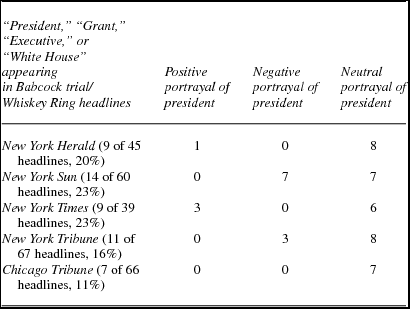
In the trial coverage, Grant was treated as a far more credible witness by the press than many others testifying, and may thus have aided Babcock's acquittal. At the same time, he was not immune to criticism in the news, most notably for his faulty memory and for actions that appeared to impede the investigation. Due to Babcock's proximity to the president for so long, it is doubtful that Grant could have plausibly distanced himself from the accused. However, in choosing to provide the deposition, Grant inserted himself into the coverage of the trial to a much larger extent, a strategy fraught with risks. As seen in table 3, a sizeable portion of the papers’ headlines on the trial referred to the president, and only a small number of those references reflected positively on his role in events. The prosecution in the Babcock case closed its arguments by maintaining that even the president would be unable to protect the guilty defendant, a claim that the newspapers covered extensively, along with the reported “sensation” that this caused in the courtroom.
President's presence and portrayal in Whiskey Ring scandal headlines, February 9–25, 1876

In all the newspapers analyzed here, the editorial page was separate from the news pages, yet this did not prevent political commentary and interpretation from seeping into the news articles. The exception was the inclusion of “general press dispatches” from organizations like the Associated Press focused on the day's court proceedings. These articles tended to limit their coverage to recounting events and directly quoting prominent figures in the case, adhering to a factual account of the trial, and thus making their product commercially viable to a wide spectrum of partisan papers. Even these Associated Press articles, however, did not take “balanced” coverage into account, failing to provide opposing viewpoints to those cited in their stories. They were merely a depiction of the arguments or personalities that dominated the events making news on a particular day.
Herein lies another problem for a president in Grant's position, trying to cast a major scandal in a more positive light. Press coverage largely composed of a detailed, strict recounting of events like a criminal trial or congressional committee hearing may not leave a great deal of room for framing. The style of many news articles was to cover events in chronological order of how things occurred (Polakoff Reference Polakoff1973: 7; Smythe Reference Smythe2003: 8). Often stories featured no overarching consistent narrative, which made it more difficult to have the president's preferred storyline adopted. If these fact-oriented articles focused on Grant's opponents, solely because they had been more active players in events on that particular day, the president might find his interpretations of events undermined even in a Republican newspaper that carried this “objective” news content.
Coverage of the House Select Committee Concerning the Whiskey Frauds
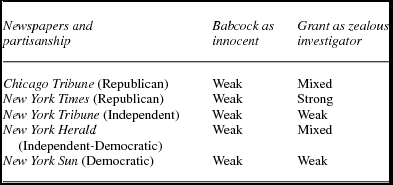
In July 1876 the House of Representatives’ investigation into the whiskey frauds called some of its most high-profile witnesses, and two well-known government employees, Homer T. Yaryan and Marshall Jewell, were ousted by Grant, leading a third to resign in protest. All three were strong supporters of Bristow and the Whiskey Ring prosecutions. Bristow (who left the administration in June), Yaryan, and Bluford Wilson, Bristow's investigative partner and solicitor of the treasury, testified before the committee in July and provided accounts of the investigation that undermined Grant's framing of events. Two of those frames remained relevant at this juncture: the assertion of Babcock's innocence and the portrayal of Grant as a zealous investigator. Table 4 summarizes how the newspapers treated these two frames over the month of July.
Level of support for frames in analyzed newspapers, July 1876

Babcock as Guilty
Grant's effort to cast Babcock as innocent was completely absent from the coverage at this point in the scandal, replaced by a dominant frame of Babcock as guilty. After the testimony of Wilson became public, the Herald emphasized the ways his account verified Babcock's guilt, and claimed it was a disgrace Babcock still held public office (New York Herald 1876, July 28a, 30). On July 31, the Sun claimed that any actions Grant and his friends took to help Babcock had been motivated by the fear that if taken down, Babcock would implicate them. While this might be expected in those outlets, even in a Republican paper like the Chicago Tribune, the presumption by July was Babcock was in fact guilty of the charges he had been acquitted of in February. The paper on July 29 prefaced part of Wilson's testimony with the subheadline “Babcock's Potency to Shelter Himself and Brother Ringsters.”
Grant as Zealous Investigator
The Herald deemed Grant's removal of Yaryan at the beginning of July as indicative of his desire to punish all those who were zealous investigators of the Whiskey Ring. The paper on July 1 and 3 ascribed hatred on Grant's part toward these officials, and pointed out how much worse the president had treated the investigators compared to those accused of being a part of the ring. However, over time, the Herald backtracked significantly from this initial portrayal. Wilson's testimony before the House Select Committee, held up by some as quite damaging to Grant, was interpreted by the Herald as actually “exonerating” the president, showing that he honestly wanted to break up the ring. The Times also took this approach on July 28, contending that Wilson's account proved that Grant wrote a “let no guilty man escape” order of his own volition and with no reluctance, contrary to what his critics argued. The Herald read Wilson's version of events as showing that at first the president was a zealous investigator, but then bad influences turned him against Bristow, Wilson, and the prosecution; yet when these false friends were shown to be wrong, Grant's interest in combatting the ring returned (New York Herald 1876, July 28b). Here, Grant's backing for the investigation was inconsistent, but at times clear, and never dropped off completely. Wilson's testimony, generously quoted in all the outlets, meant a slightly rosier picture of Grant's support for the investigation emerged even in the more hostile papers.
The Times identified Grant's “official decapitation, one after another” of officers who faithfully brought criminals to justice, alongside vague references to negative influences on the president that caused these actions (New York Times 1876, July 6, 29). The dismissed officers were praised for their honesty and integrity (New York Times 1876, July 1, 12, 18), creating a narrative in the paper of wrongdoing without clear blame attributed to Grant. Similarly, when Wilson's testimony became public, rather than emphasizing a multitude of sins of the president as the more hostile papers did, the Chicago Tribune explained away many of Grant's shortcomings through the “bad influences” narrative. Though the president had “honesty of purpose,” he was “made the dupe of men who had abused his confidence, and he was persuaded to do things to protect innocent men, as he was led to believe, which materially interfered with the plan of reaching all of the men who had been guiltily connected with the Ring” (Chicago Tribune 1876, July 30).
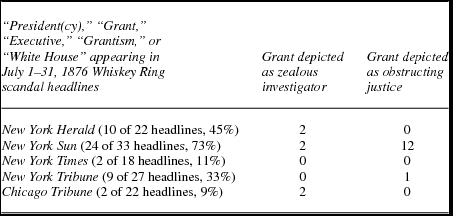
As table 5 indicates, the president was mentioned in a greater percentage of Whiskey Ring headlines in the more hostile outlets of the Sun, Herald, and New York Tribune in comparison to February, and appeared in a majority of such headlines in the Sun. However, he was referred to in a small percentage of such headlines in the friendlier Times and Chicago Tribune, thus minimizing his direct role in events.
President's presence and depiction in July 1876 Whiskey Ring scandal headlines

Note: Headlines in which a reference to the president appeared but did not clearly portray him as either a zealous investigator or obstructing justice were not included in the second and third columns.
Conclusion: Grant's Framing Project—Many Challenges, Few Advantages
In the case of the Whiskey Ring scandal, President Ulysses S. Grant framed events to cast the scandal in the least damaging light possible, actions we typically associate with similarly situated modern presidents. This framing project was hampered by the limitations of the nineteenth-century presidential office, divisions amongst Republicans, and a news media undergoing substantial transition. Even the friendly partisan papers looked at here were not always reliable defenders of the president or his interpretations of events. In more neutral press content, without the norm of journalistic “balance,” the president's preferred perspective might dominate the news or be absent entirely. Despite these challenges, Grant could affect news content by constructing favorable narratives of the scandal in his February deposition. The president's version of events was evident in these prominent urban newspapers, at times even those of Democratic persuasion.
These preliminary findings suggest aspects of the presidency/news media system we tend to identify as distinctively “modern” existed in 1876, indicating a need for further research of nontraditional forms of persuasive presidential communication in the nineteenth century, to shed light on how presidents sought to reach the public through a press no longer blindly and unfailingly partisan. Further, even the most hostile newspapers here did not accuse Grant of dangerous demagoguery, raising questions about the extent to which popular presidential leadership was considered inappropriate.
The scandal also offers a useful case study to illuminate the changing press norms of the mid-to-late 1800s in urban newspapers. A growing commitment to getting the public information meant a detailed recounting of events with less concern for fostering the goals of a party organization or politician. Still, lingering yet splintered partisan identities meant scandal coverage varied greatly from outlet to outlet. This wide-ranging content suggests a formidable fragmented news environment in major metropolitan areas like New York City in some ways comparable to the present-day, post-Internet media (albeit on a much smaller scale), which likewise offers uncertain prospects for presidential framing (Cohen Reference Cohen2008; Edwards Reference Edwards III2012; Heith Reference Heith2013). While President Grant could help frame events for the media, he could not rely on the same loyal devotion of partisan papers his predecessors enjoyed, nor did he have the robust institutional resources for managing the news of his modern successors.
Grant could affect news about the scandal through his public statements on the controversy, at a price—as evidenced by much of the coverage, his reputation was damaged. One factor that complicates the question of how effective Grant was at framing events is the scandal's timing. The heart of the controversy took place over the last year of Grant's presidency and just prior to an election in which he made clear he would not be a candidate. Grant was on his way out of office, and many were looking ahead. This meant traditionally Republican papers might be willing to criticize the administration's shortcomings or promote Bristow in the interest of winning in 1876. Simultaneously, Grant's pending departure made very harsh attacks or calls for impeachment seem less urgent.
At the scandal's height, President Grant did not admit wrongdoing or mistakes to the public, in contrast to some of his scandal-beset successors, though he did express regret for some of his personnel decisions just before leaving office (Pollard Reference Pollard1947: 450). Perhaps Grant could have sought to rehabilitate his image by openly conceding that, as both friendly and opposition press accounts at times insisted, he had been the victim of bad influences and taken advantage of by nefarious characters. We might liken such strategic use of presidential character flaws in the face of scandal to Reagan's propensity for delegation making his claims of ignorance in Iran-Contra more plausible, or Clinton's history of public accusations of infidelity making the Lewinsky affair appear less shocking and hypocritical. Grant's own public acknowledgment of this shortcoming would go further in redeeming his administration than the news coverage alone by indicating he was aware of the problem, a key first step toward not allowing it to occur in the future. Though not a positive portrayal, it would demonstrate less agency by the president when it came to official misconduct and the scandal than his critics claimed. Certainly, Grant's era was a far less confessional culture than that of today, but the unexpected news coverage of his character and psychology suggests such baring of his soul might not be completely out of step with the times. Absent an admission by Grant of this flaw, the press's portrayal of that facet of his character is rendered predominantly negative. Grant emerges instead as a leader subject to blindness and gullibility he is unable to overcome, rather than being made to work in the interest of helping him rebound from perceived transgressions. President Grant's deposition indicates he sought to frame the Whiskey Ring scandal to his benefit, but perhaps not that he framed events in the most effective way possible.