1. Introduction
The agricultural negotiations at the WTO Doha Round have signaled the rise of a new India in global economic governance. Scholars and commentators of international trade have variously commented as India being a ‘leader’ (Efstathopoulos, Reference Efstathopoulos2012), ‘emerging power’ (Conceição-Heldt, Reference da Conceição-Heldt2013), or a ‘great power’ (Narlikar, Reference Narlikar2011), based on their analysis of India's role in global agricultural trade negotiations. There is near scholarly consensus that India has played an active role in shaping the agriculture negotiations at the WTO by submitting detailed proposals, building and leading coalitions with other developing nations, and adopting tough unilateral positions (or veto) to pursue its strategic interests. However, this aggressive posturing in international negotiations seems to be at odds with the domestic agricultural policy focus. Most scholars depict India's domestic agriculture situation as one of crisis and deep distress, characterized by an alarming rate of farmer suicides across the country (Reddy and Mishra, Reference Reddy, Mishra, Narasimha Reddy and Mishra2009; Deshpande and Arora, Reference Deshpande, Arora, Deshpande and Arora2010). While there have been studies that argue that India's domestic factors influence international agricultural policy (Priyadarshi, Reference Priyadarshi2004; Purohit, Reference Purohit2015; Conceição-Heldt, Reference da Conceição-Heldt2013; Narlikar, Reference Narlikar2006), they often remain inadequate in explaining this apparent contradiction between India's international negotiating positions and the domestic policy. This paper attempts to fill this gap and locate the convergence and contradictions between India's domestic and international agricultural policies.
The vast multi-disciplinary literature on the situation of agriculture in India has been highlighting an inadequate policy focus on the sector, culminating in a protracted crisis and agrarian distress. For instance, the economics literature has highlighted how the decline in public investments and capital formation along with a lack of agricultural reforms has led to abysmal farm productivity and unsustainable debt portfolios of the farming households (Walker, Reference Walker2008; Siddiqui, Reference Siddiqui2015; Hoda and Terway, Reference Hoda and Terway2015; Bisaliah et al., Reference Bisaliah, Mahendra Dev, Saifullah and Sarkar2014; World Bank Group, 2014; Fan et al., Reference Fan, Gulati and Thorat2008). On the other hand, the political economy literature has highlighted that the influence of agriculture on the domestic political economy has become quite limited (Mendelsohn, Reference Mendelsohn1993; D. Gupta, Reference Gupta2005; Parry, Reference Parry2003; Chatterjee, Reference Chatterjee2008). The sociological literature presents irrefutable evidence of an overwhelming desire to quit farming among Indian farmers who treat agriculture merely as a ‘waiting room’ for the despairing (D. Gupta, Reference Gupta2005, Reference Gupta2015; Himanshu and Rodgers, Reference Himanshu and Rodgers2016; Mines and Yazgi, Reference Mines and Yazgi2010; Parry, Reference Parry, Osella and Gardner2004). The extensive literature on agrarian distress has explored reasons behind the alarming rate of farmer suicides (one in every thirty minutes) and distress migrations (S. Mishra, Reference Mishra2007; Reddy and Mishra, Reference Reddy, Mishra, Narasimha Reddy and Mishra2009; Deshpande and Arora, Reference Deshpande, Arora, Deshpande and Arora2010), indicating that the severity of the crisis makes the situation an ‘agrarian dystopia’ (Harriss-White, Reference Harriss-White2008). At least since the early 2000s, even the official policy literature has begun to recognize the failure of policy action in addressing the problems of agriculture. The various government reports diagnose the problem as either a consequence of insufficient investments (National Commission on Farmers, 2004) or a lack of exit of productive labor resources from the sector (Ministry of Finance, 2016).
Given the seeming neglect of agriculture in the domestic policy space, it is worthwhile to ask what is driving India's aggressive outlook to international agricultural trade negotiations? Further, is the negotiating approach in sync with domestic policy priorities? This paper brings together diverse strands of literature to discern domestic policy priorities. It also attempts to make a nuanced analysis of India's negotiating positions on agriculture to identify their congruence or divergence with these policy priorities. Our analysis indicates that given the constraints of the non-agricultural sector to absorb a rapid migration of agricultural workers (Harriss-White, Reference Harriss-White2008; Dorin et al., Reference Dorin, Hourcade and Benoit-Cattin2013) and limits on domestic demand, policy solutions to India's agrarian crisis may need to explore an export-led rapid growth strategy along with active protection of smallholder farming. However, neither domestic policy framework nor international posturing, seem to be in tune with these approaches, leaving the international and domestic policies in a bundle of contradictions. The largely protectionist nature of India's trade negotiating position and the domestic policy practices seems to be at variance with the goal of rapid output and productivity growth in the domestic agriculture sector that requires large-scale investment, a rebalancing of crop-portfolio, and possibly export-led growth for its revival. India's aggressive negotiating positions in the international arena, thus, seem to be more ‘status quo’ in approach and hence inconsistent with the domestic needs and priorities of a large-scale revival of Indian agriculture from the current dystopia.
This paper analyzes the apparent reasons behind the above-mentioned contradictions, locating them to the domestic political economy. Extant literature on international trade acknowledges that domestic compulsions are driving India's negotiating stance. It recognizes the importance of India's 600 million agriculture-dependent population, along with concerns around food security for a large impoverished population, as being central to India's political dynamics and its democratic legitimacy (Narlikar, Reference Narlikar2006; Conceição-Heldt, Reference da Conceição-Heldt2013; Clapp, Reference Clapp2015). However, we argue that with a decline in the influence of farmers or rural agrarian elite in the domestic political economy, there is a limited political constituency for serving and extending the interests of India's agricultural producers. As a result, the domestic agricultural policy seems to emphasize consumer interests and price stability concerns rather than producer interests of increased agricultural incomes and reduced vulnerabilities. In turn, such a policy focus arises from two important constituents of the domestic political economy – an inflation-wary rising middle class population that sets the mainstream policy discourse, and a burgeoning population of vulnerable sections of the society who have failed to benefit from India's rising growth and now require extensive need-based consumption subsidies to ensure survival. As a result, India's domestic and international policy stance prioritizes maintenance and expansion of the public stockholding program to cater to these two constituencies, thereby ensuring the democratic legitimacy and political stability of the Indian state. We thus argue that India's interests in agriculture do not prima facie originate from the concerns of its producers, but from its need to maintain status quo in domestic markets through the food security program. This overwhelming importance of India's food security program has remained under-emphasized in the extant literature. This analysis has several important implications for India's agricultural policy, as well as agriculture negotiations at the WTO. The paper identifies a divergence of India's interests with those of other developing nations, raising several questions concerning India's continued role in global agriculture trade negotiations, its potential for assuming leadership of the G-20 and G-33 coalition groups, and its legitimacy to play its traditional role as one of the leading voices of the developing world.
The rest of the paper is organized as follows. In Section 2, we review the state of agriculture in India and discern the domestic policy priorities. In Section 3, we analyze India's negotiating position and approach by reviewing the negotiating proposals and postures at key moments in the WTO agriculture negotiations. In Section 4, we analyze the international policy in the context of domestic policy compulsions and attempt to explore seeming contradictions between the two arenas. In Section 5, we offer an analysis of the reasons behind these apparent contradictions, arguing that the domestic political-economic compulsions can potentially explain the divergence between India's international negotiating positions and the domestic policy priorities. In Section 6, we offer concluding remarks and discuss implications for India's domestic policy as well as its future role in global agricultural trade negotiations.
2. Domestic drivers of Indian agriculture policy
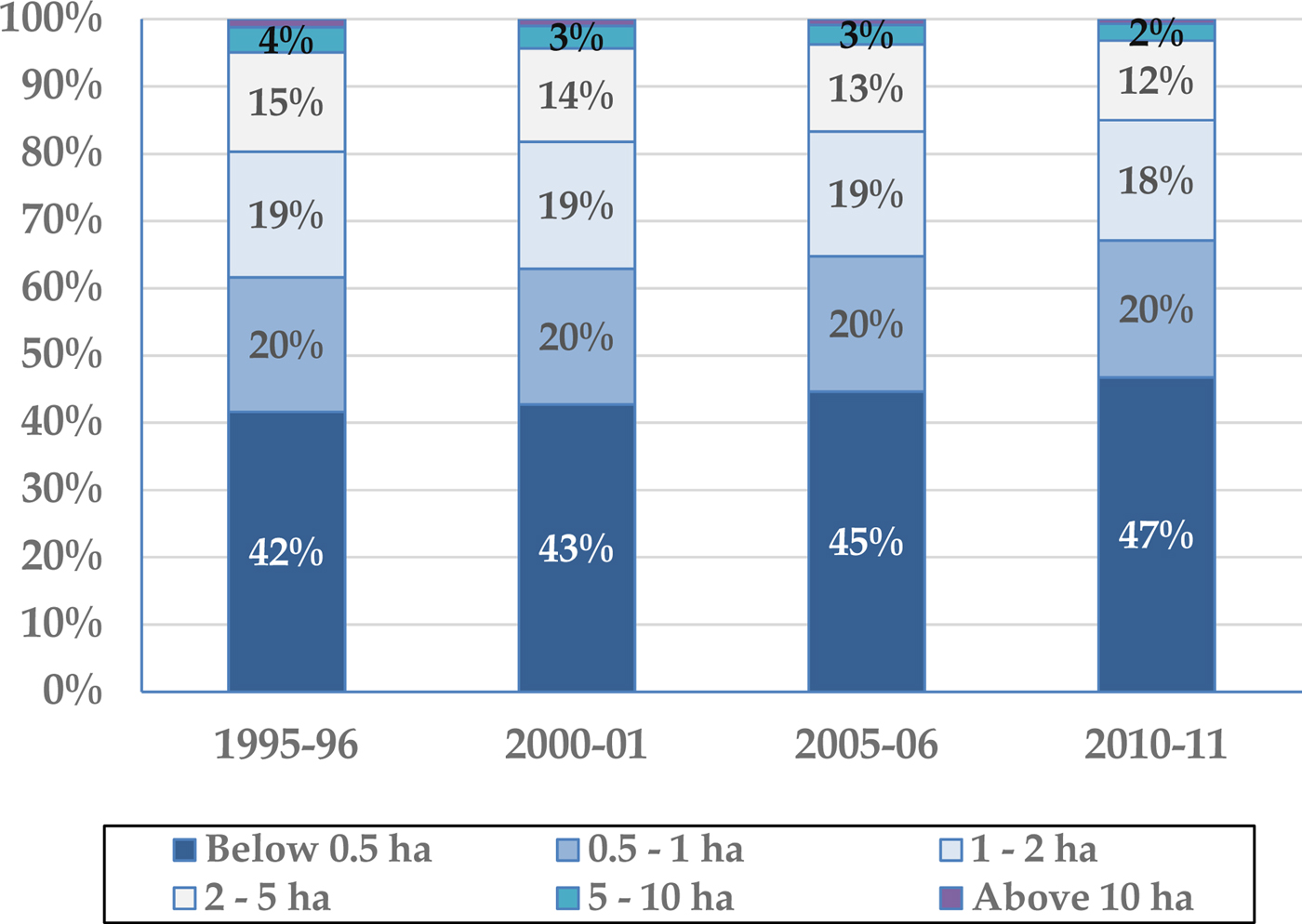
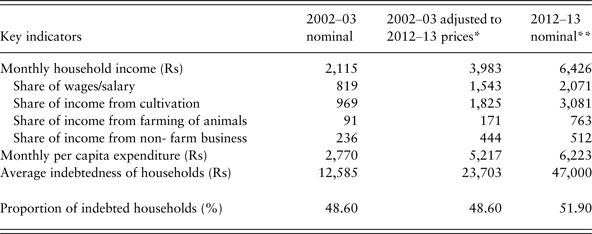
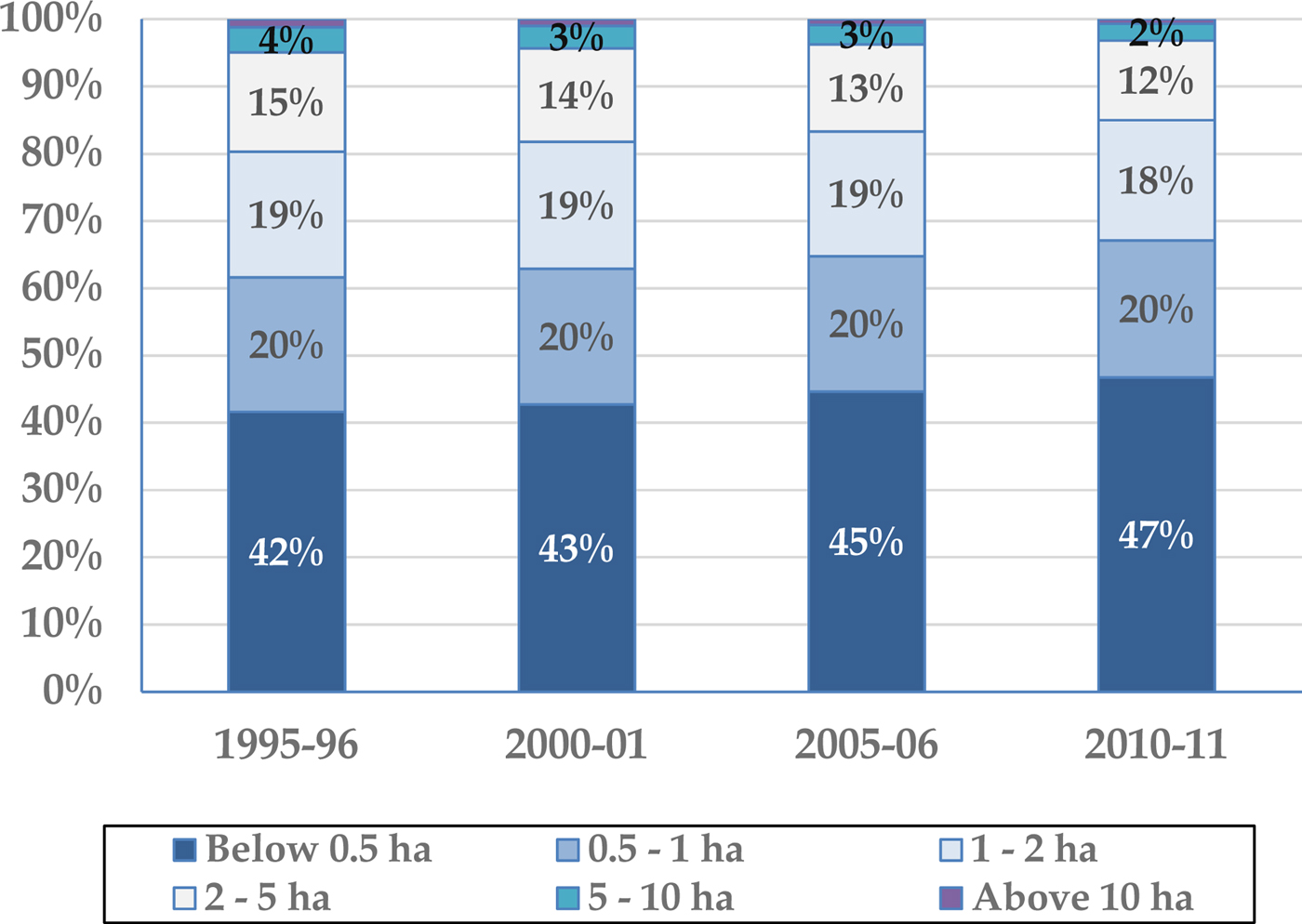
Given that the agriculture sector employs over 50% of the total workforce (ILO, 2016), one would expect that the imperatives of democracy would make agricultural producers’ interests a prime concern for the Indian government and for state policy. However, even a cursory review of the state of Indian agriculture highlights an alarming crisis, which can only be explained as a consequence of a seeming policy neglect. The sector remains saddled with low productivity, high output, and price volatility, and a sharply rising cost structure. Further, over 55% of farmland remains rain-fed and thus vulnerable to vagaries of monsoon (World Bank Group, 2014). These problems are confounded by the small size of many farms that lead to unsustainable production for a majority of Indian farmers (World Bank Group, 2014). Despite the evident vulnerabilities of Indian agriculture, little has been done to address the core problems afflicting the sector, and the situation has continued to worsen over time. Over the last two decades, the proportion of marginal farmersFootnote 1 has continued to increase to now comprise over two-thirds of total farming households, pushing an ever-increasing proportion of farmers to the brink of crisis (see Figure 1). A national level situation assessment survey of farming households indicates how over the last decade, incomes and profitability levels have remained extremely low, leaving a large percentage of the farming households indebted, and with wafer-thin margins to meet their monthly consumption expenditure (see Table 1).
Distribution of number of agricultural landholdings by size class (ha)
Key Indicators for income, expenditure and indebtedness levels of farming households in India

Notes: *Approximation done using the GDP deflator method adjusted for changes in price base in intermediate years.
** Data across 2002–03 and 2012–13 are not strictly comparable owing to changes in coverage and classification of farming households across the two surveys.
Policy response to rescue the agricultural producers from this crisis has been rather inadequate, implying limited concern for the worsening situation. Contrary to the need to extend government support to address the vulnerabilities, there has been a steady decline in overall public investments over the years (World Bank Group, 2014), with limited resource allocation towards research and extension services (P. K. Joshi et al., Reference Joshi, Kumar and Parappurathu2015). This manifests in the rapidly declining share of agriculture in gross capital formation that has fallen from around 30% in the early 1990s to less than 10% by 2014 (World Bank Group, 2014). Further, the advent of liberalization reforms since 1991 has led to a steady reduction in production subsidies related to fertilizer, power, water, and credit (Reddy and Mishra, Reference Reddy, Mishra and Radhakrishna2008, Reference Reddy, Mishra, Narasimha Reddy and Mishra2009). As a result, farmers have had to rely increasingly on privatized solutions that have escalated their indebtedness levels. The thin profitability and high indebtedness levels have meant that farmers remain extremely vulnerable and unprepared to handle any income shocks, which are only too frequent. While previously, the income shocks were prominent only during times of drought, in recent times the farmers’ incomes have fallen even during bumper harvests owing to low prices resultant from a glut (Mehta and Kumar, Reference Mehta and Kumar2017). These shocks have often manifested in an unabated spate of farmer suicides, occurring at a staggering rate of one farmer suicide every 30 minutes since the mid-1990s (Basu et al., Reference Basu, Misra and Das2016). It is worthwhile to ask what explains the nature of, or rather the lack of an appropriate, policy response to the situation of agrarian distress in India.
2.1 Locating the problem: a Lewis trap?
The extensive scholarship on solutions for India's agrarian crisis tends to suggest two broad policy approaches. The first approach entails rapid output growth through consolidation of unviable smallholder farms, technological investments, and expansion of requisite supply chain infrastructure to support the consequent productivity increases. The second approach tends to emphasize a large scale shift of agricultural producers out of farming providing labor to the industrial and non-farm sectors (Harriss-White, Reference Harriss-White2008). While both approaches locate the core problem to the low productivity and presence of surplus labor in the sector, their policy propositions are vastly different. The first one emphasizes a more expansionary strategy focused on the revival of agricultural growth; the second one takes a more defensive outlook to protect existing producers as the non-agricultural sector readies itself to absorb the vast labor force exiting the sector. India has tended to adopt the more defensive policy approach even while failing to adequately protect the interests of its producers, as we shall see over the next two sub-sections. Let us now examine the possible origins of this strategy and its prospects, given the current structure of the economy.
Scholars have since long noted an apparent ‘urban bias’ in India's policy (Lipton, Reference Lipton1977, Reference Lipton2006), potentially arising out of the famous ‘Lewis Model’ of structural transformation of the economy (Lewis, Reference Lewis1954). This theory argues for labor mobility from the ‘traditional’ (agriculture) sector to the ‘modern’ (non-agriculture) sectors, which would result in rising agricultural productivity, rising wages, and consequent elimination of poverty. In India, there seems to be a continued policy focus on migration of workers outside of agriculture, with even recent policy statements arguing that resources from the agriculture sector need to be ‘forced or enticed away from inefficient and unsustainable uses’ (Ministry of Finance, 2016: 37, 68). In recent times, the most significant government policies for rural areas have been towards extending employment guarantees and enhancing skills for better absorption in non-farm sectors, with rural non-farm employment being one of the key focus areas (IDFC Rural Development Network, 2014).
However, the low rate of employment creation in the industrial sector has meant that such a strategy has had limited success, and the agriculture sector remains saddled with surplus labor (Deshpande and Prabhu, Reference Deshpande and Prabhu2005; Deshpande and Arora, Reference Deshpande, Arora, Deshpande and Arora2010). Further, the deteriorating quality of low-paid casual employment in the non-farm sector has meant that it is merely an incremental livelihood option in the work portfolio of marginal farm households, rather than being an alternative employment strategy for workers leaving agriculture (Himanshu, Reference Himanshu2014). Recent analyses indicate that agriculture may have reached its limit as an absorber of labor and any further growth can only be distress inducing (Harriss-White, Reference Harriss-White2008; Vakulabharanam, Reference Vakulabharanam2005). Dorin et al. (Reference Dorin, Hourcade and Benoit-Cattin2013) have characterized this situation as a ‘Lewis Trap’ as a polar opposite to the virtuous structural transformation envisaged under the Lewis model.
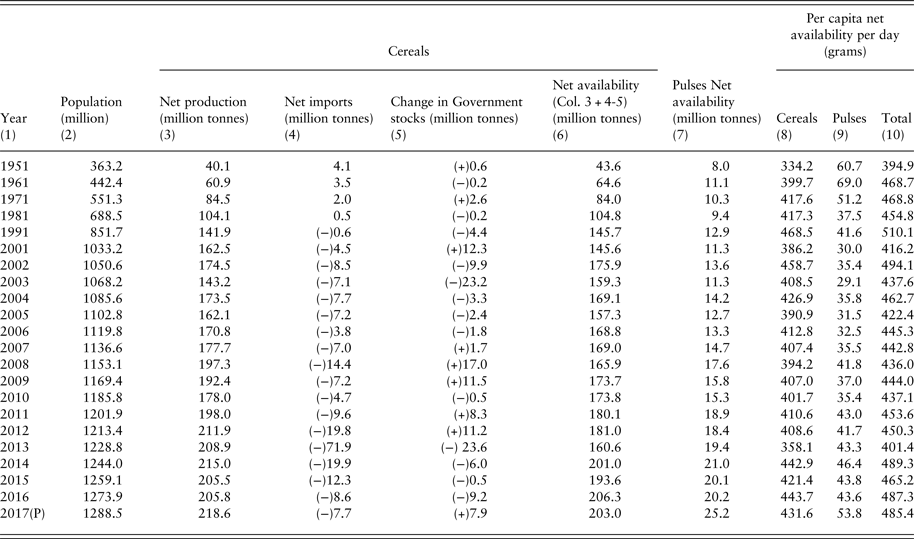
The challenges in engineering a rapid shift of a large portion of agricultural producers to other sectors could have necessitated a potential shift to the other approach of stimulating a large-scale revival of agricultural growth itself to improve the condition of producers. However, as India attained self-sufficiency in foodgrain productionFootnote 2 since as early as the mid-1980s, there are constraints to a rapid growth in domestic demand for agricultural produce (Ministry of Finance, 2016). It is evident from Table 2 which indicates that India has registered net negative imports in cereals since the 1980s even as the per capita net availability of foodgrains has remained largely stable over the last three decades (see Table 2). With such constraints on domestic demand, strategies to increase output and productivity growth could potentially explore either an export-led growth model or stimulation of domestic demand for non-food grain crops. Both would, however, require a rebalancing of crop portfolio together with a large-scale public investment in developing the requisite supply chain infrastructure. As the shift in domestic demand is predicated on consumption dynamics and behavioral change, let us examine the potential and prospects for an export-led growth strategy.

2.2 Unrealized potential for an export-led growth strategy
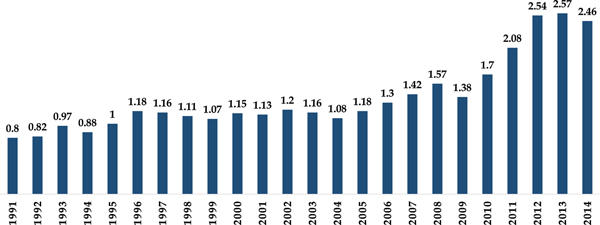
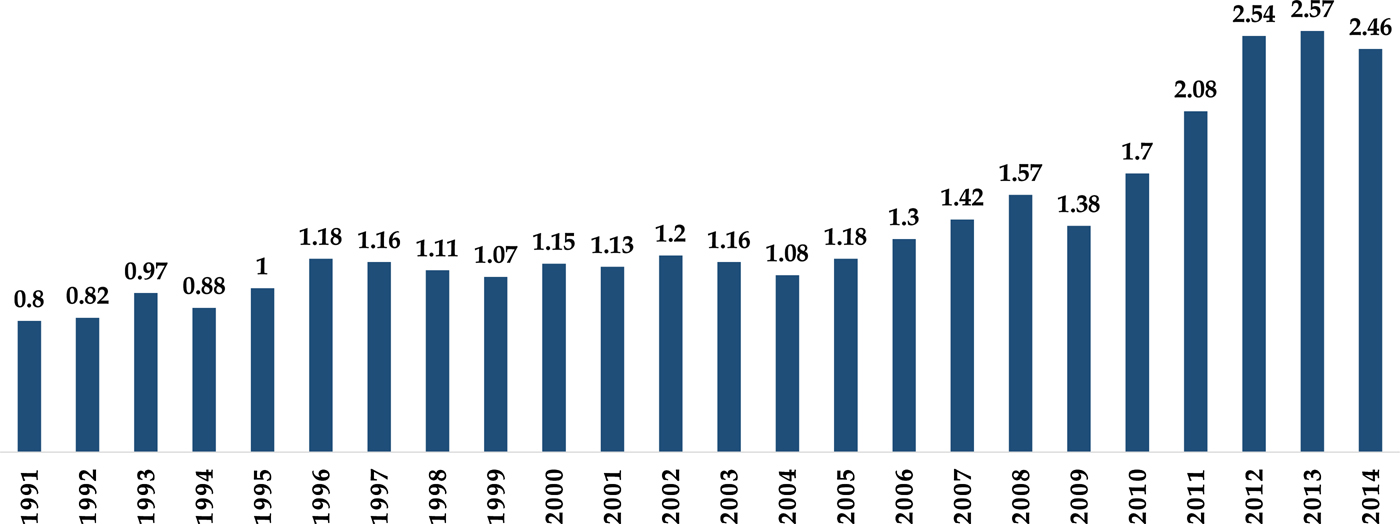
Has there been an adequate policy response towards stimulating an export-led agricultural growth model to improve the condition of Indian producers? Such an analysis would entail assessing whether an export opportunity exists for Indian agricultural produce, and analyzing the policy initiatives towards exploiting such an opportunity. The first question can be addressed by recognizing India's revealed comparative advantage in agricultural products throughout the period between 1960 and 2014 (Anderson, Reference Anderson2016: 64–72; Chand, Reference Chand, Barua and Stern2010; Mahajan and Nanda, Reference Mahajan and Nanda2011). This comparative advantage is also evident from India's ability to improve its market share by value, in global agricultural trade from around 0.9–1% in the pre-WTO period of the early 1990s to around 2.5% currently (Figure 2). Commodity wise analysis also confirms the applicability of this trend to nearly all of India's key agricultural export commodities, barring tea. Most significant improvements in India's share have come from spices, fruits and vegetables, and meat products. Such improvements have come despite the high sanitary and phytosanitary barriers (SPS) faced by such exports (Arora, Reference Arora2013). This only indicates Indian agriculture can command a competitive position in global markets, and thus there is potential to enhance exports significantly.
Share of India's agriculture exports in world agricultural trade (percentage)
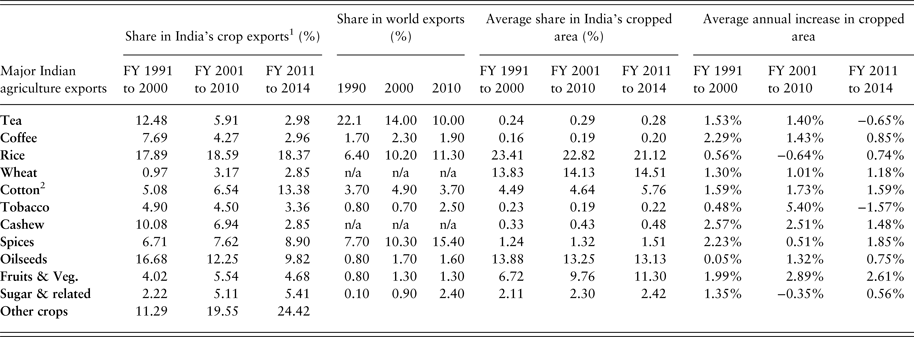
Despite such an advantage, India's agrarian production structure primarily emphasizes domestic use rather than exports, with a primacy of cereals and pulses in both the total cropped area and output value. Cereals and pulses comprise nearly 67% of the total cropped area and 30% of the total output value while contributing to less than 20% of the total agriculture exports (Table 3). After the opening up of global markets post-WTO, there has not been any major rebalancing of India's crop portfolio towards crops where India has demonstrated good export potential. While there have been minor increases in the cropped area for fruits and vegetables, a major part of this stems from domestic demand. Surprisingly, the area under cultivation for rice, wheat, and sugar continues to increase, despite not being the most profitable use of land and inputs, as compared to other export commodities.
Major agricultural exports (by value) and share in cropped area (hectares)

1 excludes marine, fisheries and processed food
2 Global trade share reflects share in woven cotton fabrics
Source: Economic Survey (various issues), RBI (2016), EPWRF India Time Series (2017).
Prima facie, it may seem that this continued emphasis on low-value cereals is on account of domestic demand, and paranoia regarding food security (Priyadarshi, Reference Priyadarshi2004). However, foodgrain self-sufficiency over the last three decades as seen above (Table 2), not only obviates the rationale for such fears but also implies that further productivity enhancements and an increase in cropped area can only imply production surpluses. The rising exports of rice, largely, on account of the release of surplus stock from the public stockholding, bear testimony to our conclusion.
From the above discussion, it is clear that India has largely failed to tap the export opportunity that seems to exist in global agricultural trade. As a result, the share of agriculture and food exports in India's total merchandise exports has steadily fallen from around 25% in 1995 to around 13% in recent years (Brink et al., Reference Brink, Orden and Datz2013). The largely domestic-oriented structure of land use allocation and production implies that India's interests in global agricultural trade continue to remain predominantly domestic-oriented and defensive. Let us now analyze whether such defensive interests have manifested in farmer support and protection policies.
2.3 Farmer protection and support policies: producer or consumer centric?
We have seen how the Indian smallholder cultivation remains vulnerable to any demand or supply shocks. One of the prime sources of vulnerability is seasonal weather patterns, especially, high variability in monsoon rainfall that explains much of the trend in agricultural productivity in India. Yet, only 45% of the total cropped area remains irrigated, and the recent decline in the growth of irrigated area indicates a waning policy impetus towards the extension of irrigation infrastructure (World Bank Group, 2014). Further, the adoption of crop insurance products that mitigate weather risks remains low, possibly driven by the farmers’ concerns regarding the substantial delays in the settlement of claims in times of crop loss as well as the low settlement rates (Mukherjee and Pal, Reference Mukherjee and Pal2017).
There are some attempts to insulate the domestic agricultural markets from global shocks through application of tariffs, and imports and export restrictions. The most significant tariffs apply to food-grains where India has renegotiated bound rates and set them at fairly high levels of 80% (broken) and 100% for rice and wheat respectively (Narayanan, Reference Narayanan2015). However, it is less clear whether such policies aim to protect the producers’ interests or the consumer concerns around price stability. Scholars have highlighted a counter-cyclical administration of price policies in India. At times of high world prices, India tends to lower tariffs and imposes export restrictions in a bid to regulate domestic prices (Brink et al., Reference Brink, Orden and Datz2013). There is limited attempt to allow the producers to realize the best prices, even though some efforts are made to insulate them from large demand shocks, but largely limited to select food-grain crops.
Let us now analyze the domestic support given to Indian producers. Given the domestic orientation of India's agriculture policy, it is unsurprising that India offers no substantial export subsidies (Hoda and Terway, Reference Hoda and Terway2015). India's ‘Green Box’ and ‘Blue Box’ supportFootnote 3 is also marginal (Brink et al., Reference Brink, Orden and Datz2013; Hoda and Gulati, Reference Hoda and Gulati2013). Even though India offers non-product specific ‘Amber Box’ subsidies on agricultural inputs such as fertilizer, electricity, and irrigation, these have largely remained in the vicinity of 10% of the total value of agricultural output, although they had peaked at 15% in 2008–2009 (Hoda and Gulati, Reference Hoda and Gulati2013). However, most of these subsidies are a legacy of India's ‘Green Revolution’ during the 1960s–1970s when the expansion of agricultural produce was firmly the national priority. Even as there has been limited introduction of new subsidies to take care of the current agrarian crisis, scholars have noted a declining focus on the importance of such production subsidies post the liberalization reforms in the 1990s (Deshpande and Arora, Reference Deshpande, Arora, Deshpande and Arora2010). India's ‘Amber Box’ de minimis allowance level of 10% of aggregate measurement of support, coupled with the exemption of over 95% of ‘low-income’ or ‘resource-poor’ farmers from applicability of such commitments under Article 6.2 provisions of Special and Differential (S&D) provisions of the Agreement on Agriculture (AoA), leaves significant untapped potential for expansion of such subsidies within the current WTO AoA framework (Narayanan, Reference Narayanan2015).
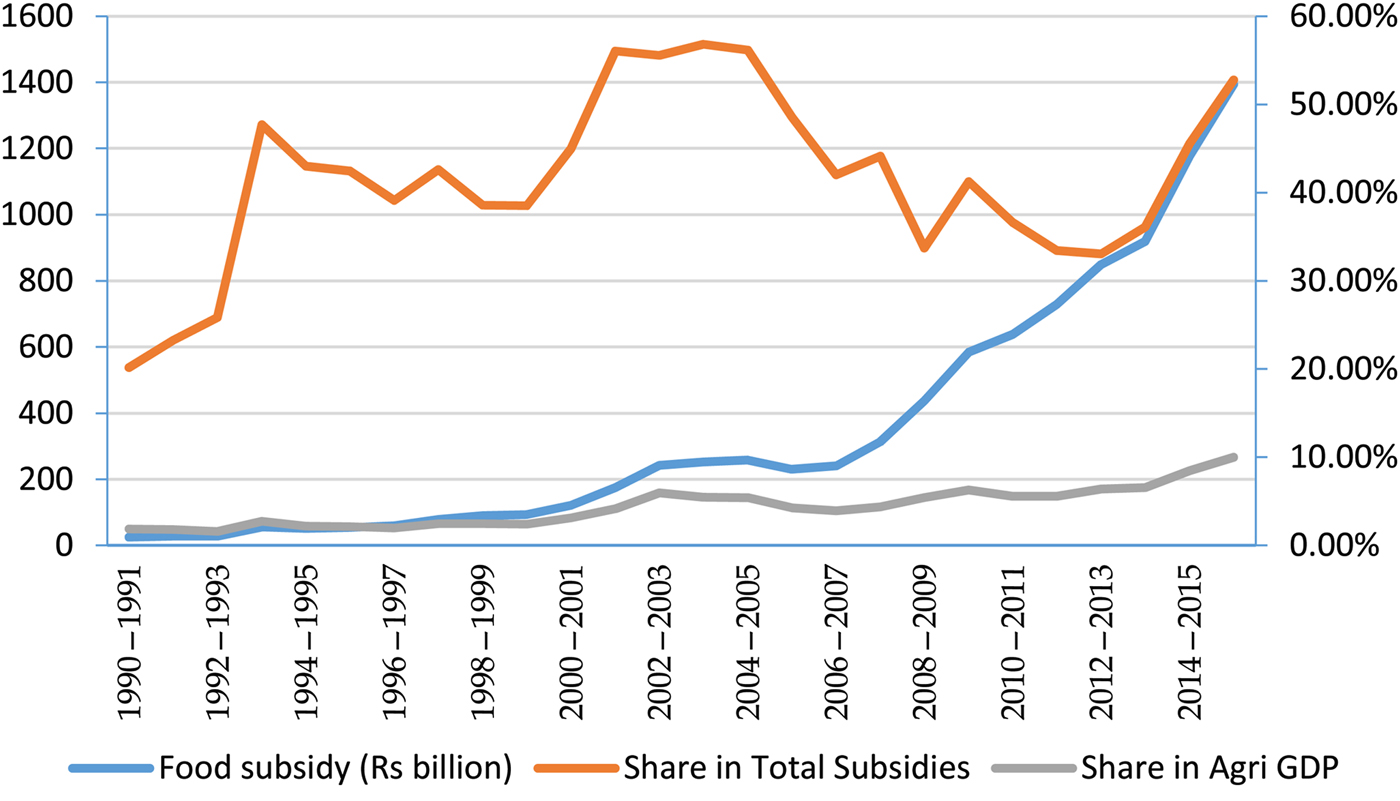
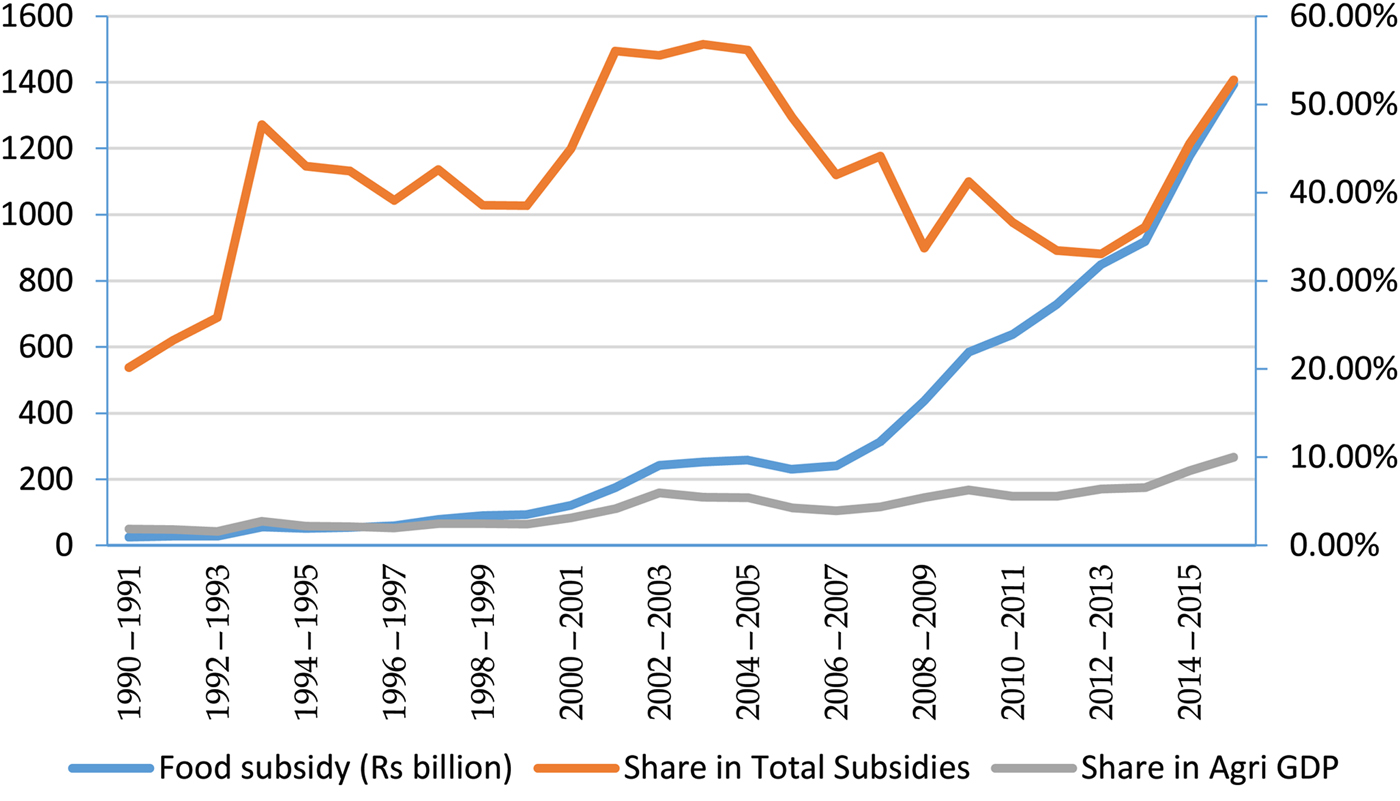
The most significant support for agriculture provided by the Indian government is through its public stockholding program. However, given the dual objectives of the program encompassing both farmers and consumers, prioritization outcomes of government support across these groups remain difficult to ascertain. The program involves procurement of food-grains through a scheme of administered prices (Minimum Support Prices or the MSP), followed by distribution through a public distribution system (PDS) to low-income consumers. This program has emerged as the principal bone of contention in the WTO negotiations (Roy and Doerr, Reference Roy and Doerr2013; Diaz-Bonilla, Reference Diaz-Bonilla2014; Schnepf, Reference Schnepf2014). The current WTO rules recognize the difference between the administered prices and the external reference prices (indexed to 1986–1987 rates) as the domestic support provided by the government to its producers, leading to large gaps in India's support to MSP and PDS policies. Over the last two decades, India's food subsidy bill has sharply increased by over 25 times, reaching close to 10% of agriculture GDP in recent years, thereby threatening to breach the de minimis commitments under the current rules of the WTO (Figure 3). Further, the implementation of the National Food Security Act in 2013 has aggravated the pressure on food subsidies.
Food Subsidies in India (INR billion): 1990–1991 to 2014–2015
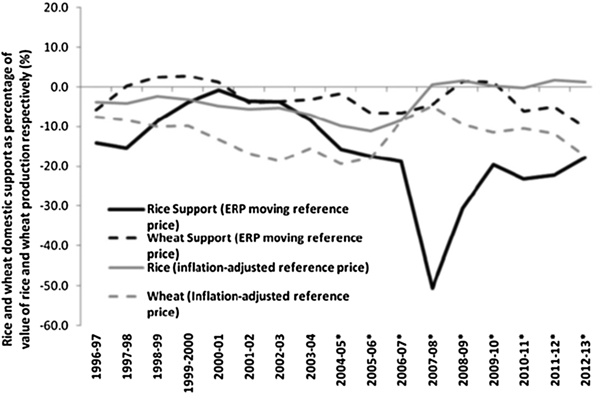
Scholars have noted that India's public stockholding program follows multiple objectives, with the salience of each objective varying substantially through the course of its history – (i) to cope with emergency situations like droughts, (ii) distribute essential products to vulnerable people, and (iii) guaranteeing remunerative prices to producers (Mooij, Reference Mooij1998, Reference Mooij1999). In recent times, the analysis of the structure and pricing policies of the program seems to indicate a primary focus towards the domestic consumers rather than a privileging of the agricultural producers. Firstly, the administered price mechanism covers only a few crops – cereals, pulses, oilseeds, sugar, and cotton – which are more important from a domestic consumption standpoint instead of export-oriented crops. Secondly, the available evidence indicates that the MSP scheme is not designed to incentivize higher production as it barely meet the costs of cultivation in many Indian states. The study by Narayanan (Reference Narayanan2015) shows that the average MSP in recent times has been at the lower end of the range of costs across states for both wheat and paddy, and in many states MSP is even lower than the cost of production. Thirdly, a comparison of procurement prices (MSP) with respect to moving external reference prices, or even the inflation-adjusted fixed external reference prices (based on India's notifications to WTO) indicates that India provides negative support to its producers under the MSP regime (Narayanan, Reference Narayanan2014, Reference Narayanan2015) (Figure 4). In other words, the procurement policy tends to undermine the benefits that Indian producers could gain from benchmarking with international prices, thereby implying an implicit subsidization of consumers at the expense of the producers.
Price Support to rice and wheat (based on moving reference price and inflation-adjusted reference price)

From the above analysis of India's domestic agricultural policies, it is evident that there is a limited impetus in domestic policy on the revival of agricultural growth based on an expansionary export-led growth model. The policy seems to focus on preserving the status quo in domestic food markets. Although the food security program offers some protection to its vulnerable producers by preventing any large-scale disruptions that could jeopardize long-term foodgrain production, its primary emphasis seems to be on the regulation of the consumer price index and ensuring adequate supply for distribution through its public distribution system (PDS). This limited focus on preserving and extending the interests of Indian producers, however, seems to be at substantial variance with India's proactive role in international trade negotiations on agriculture.
3. India's posture at the WTO agriculture negotiations
India has maintained an active interest in the agriculture negotiations at the WTO since as early as the pre-Seattle round (WTO, 1998b, 1998a). Together with active participation in the privileged ‘Green Room’ for developing pre-ministerial consensus (Efstathopoulos and Kelly, Reference Efstathopoulos and Kelly2014; Hopewell, Reference Hopewell2015), India's submissions on agriculture have often exceeded those on other aspects of trade negotiations (Chakraborty, Reference Chakraborty, Barua and Stern2010). Its comprehensive submission in 2001 covering all aspects of agriculture negotiations, remains one of the longest and most elaborate proposals made by any member (WTO, 2001). Even at the last Ministerial Conference at Buenos Aires, India's Minister for Commerce and Industry Mr. Suresh Prabhu laid special emphasis on India's position on agricultural issues, as compared to other aspects of international trade and WTO governance (WTO, 2017a). Is this high level of interest merely on account of India's position as an important global power, or does it imply a pursuit of a strategic interest? Moreover, if it is indeed arising out of a conscious self-interest, what are the issues that India tends to prioritize? To answer these questions, let us examine the revealed policy stance, tone, and the negotiating approach of India in agricultural trade negotiations at the WTO.
3.1 Passive coalition member or active pursuit of strategic self-interest?
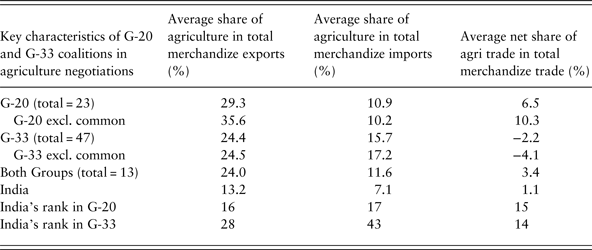
India's overall negotiating approach has been to forge broad-based coalitions with other developing country members. Given its economically dominant position and a willingness to provide ‘club goods’ to coalition members such as maintaining coalition unity and offering technical support (Narlikar, Reference Narlikar2011: 1616), India has often joined forces with many diverse groups of developing country coalitions such as the Like-Minded Group (LMG), South Asian Association for Regional Co-operation (SAARC), the G-77 as a key leader and even engaged with the Asian Developing Members, African Group, G-90 and the LDCs to raise specific issues (Efstathopoulos and Kelly, Reference Efstathopoulos and Kelly2014). Prior to the 11th Ministerial Conference at Buenos Aires, India joined China to submit a detailed proposal on a wide range of issues aimed at reducing distortions in global agricultural trade (WTO, 2017b). As part of such coalitions, India has not shied away from raising diverse issues that may not be in-line with its domestic policy stance. In fact, it has remained an active leader of coalitions with often divergent interests, as exemplified by its role in the G-20 and the G-33. The interests of the G-20Footnote 4 group in agricultural negotiations are primarily expansionary, focussed on increasing their exports, driven by the higher importance of agriculture in their total exports and their position as net agricultural exporters (Table 4). The group's primary interest lies in reversing protectionism in the developed world, while retaining some flexibility for developing countries in opening up their markets (Conceição-Heldt, Reference da Conceição-Heldt2013; Aggarwal, Reference Aggarwal2005). On the other hand, the G-33 groupFootnote 5 is comprised of countries that largely have defensive positions in the negotiations, driven by a higher importance of agriculture in their total imports and a low to negative agricultural trade balance (Table 4). The group's primary interest lies in protecting their vulnerable domestic producers from the volatilities in international trade (Matthews, Reference Matthews2014; Farsund et al., Reference Farsund, Daugbjerg and Langhelle2015; Polaski, Reference Polaski2005). India's core interests seem to diverge from both those of the G-20 and the G-33, with much lower importance given to both total agricultural exports and imports. India also maintains a largely neutral trade balance.
Importance of agriculture in total trade for G-20 and G-33 members, 2015

Note: (1) The data for Cuba, which is part of both groups is not available and has not been considered
Source: World Trade Statistical Review 2016 (WTO, 2016a).
Despite following an over-arching coalition-building approach, India has not shied away from taking aggressive postures, or feared global isolation, in pursuing its negotiating agenda. India's ‘hard-line approach’ was set since the pre-Doha negotiations when it tried to resist the launch of the Doha Round negotiations before ensuring adequate progress on the AoA from the previous Uruguay round, a stance that nearly isolated India on the global stage (Efstathopoulos and Kelly, Reference Efstathopoulos and Kelly2014). That India was prepared to go alone and stand firm on its negotiating position became evident from its key role in the collapse of the Doha Round of negotiations in July 2008 (Narlikar, Reference Narlikar2011; Wolfe, Reference Wolfe2009; Hawkes and Plahe, Reference Hawkes and Plahe2013). It is exemplified by the statement of India's Minister for Commerce, at the WTO that ‘I made it very clear in these talks that I am willing to negotiate commerce. I am not willing to negotiate livelihood security’ (Pritchard, Reference Pritchard2009: 304). While a portion of the blame for stalling the Doha Round in 2008 was also attributed to the US and its inflexible positions on the special safeguards mechanism (SSM) (Wolfe, Reference Wolfe2009; Hopewell, Reference Hopewell2015), India almost became completely isolated at the Bali Ministerial Conference in 2013. India adopted a unilateral stance solely to ensure its food security interests (subsidy program) and blocked the Trade Facilitation Agreement, which was the first multilateral trade deal in two decades (Wilkinson et al., Reference Wilkinson, Hannah and Scott2014; Diaz-Bonilla, Reference Diaz-Bonilla2014; Tangermann, Reference Tangermann, Bhagwati, Krishna and Panagariya2016; Schnepf, Reference Schnepf2014). India's veto met with considerable criticism, with even the G-33 partners reluctant to support India's position, which found support only from South Africa, Bolivia, Cuba, and Venezuela (Babu, Reference Babu2014).
From the above discussion, it is clear that India is not merely content being a passive coalition member, or even merely representing the interests of its partners as a coalition leader. It has not hesitated from taking positions that threatened to derail the entire global trade negotiations regime, which indicates pursuit of a strategic self-interest, despite an overall coalition-building approach. While in the initial Ministerials such as Doha and Cancun, India largely sought to speak together with coalition members, in recent times it has tended to adopt a more unilateral position. Even though it still maintains a polemical rhetoric that addresses its allies among developing countries and helps it lead different coalitions, India has increasingly been willing to strike bilateral deals. For instance, India struck a bilateral arrangement with the US post-Bali that signaled India's support of US interests in other areas of trade negotiations, as long as its food security concerns were recognized (Wilkinson, Reference Wilkinson2015). With a recognition that India has indeed sought to pursue its strategic self-interests, often in divergence with coalition partners’ views, it is important to discern the negotiating stance and key issues of interest to India.
3.2 Protectionist stance
Although India has often submitted detailed proposals covering all aspects of agriculture negotiations (WTO, 2001), its hard-line positions at critical junctures reveal a protectionist stance to global agricultural trade. In the pre-Seattle submissions in 1999, India advocated strengthening of S&D treatment for developing members in the form of a continued government support program to manage issues of price volatility, food security, and self-reliance in production (WTO, 1999a, 1999b, 1998a, 1998b). Even though India argued for trade liberalization as part of the G-20, it reconciled its interest by having the G-20 incorporate the demand for strengthening S&D treatment under Article 6 of the AoA, and for fine-tuning the green box measures to suit developing country needs (Conceição-Heldt, Reference da Conceição-Heldt2013; Aggarwal, Reference Aggarwal2005). India also championed the concept of the ‘development box’ or ‘livelihood security box’Footnote 6 in successive ministerial negotiations (Wolfe, Reference Wolfe2009; Priyadarshi, Reference Priyadarshi2004). Later, as part of the G-33 coalition, India championed the cause of ‘special safeguards mechanism’ (SSM), meant to protect a developing nation against a sudden surge in imports, making it the central point of the collapse at Doha in 2008. Most recently, it has strongly argued for finding a solution that would ensure its public stockholding program for food security purposes does not fall foul of its WTO commitments. Its unilateral stance on food security was at that time a significant departure from the collective view of the G-33 members, many of who do not even have major public stockholding programs. It is only later that some of the other developing countries, such as China, Indonesia, Nigeria, and Turkey also increased their domestic support for farmers, although none of these has made it a focal point of its negotiating strategy as yet (Scott, Reference Scott2017). Overall, it can be concluded that India has largely adopted a protectionist stance in the agricultural negotiations (Narlikar, Reference Narlikar2006, Reference Narlikar2013), trying to preserve a status quo in its domestic agricultural production base and food markets.
From the above discussion, it is quite evident that India has played an aggressive role in pursuing its protectionist agenda on agriculture and has not hesitated from taking positions that threatened to derail the entire global trade negotiations regime. Its aggressive role has however been couched with the legitimacy arising out of its coalition approach, carefully cultivated by aligning with nations with interests divergent from its domestic policy priorities. As such, India has striven to maintain a tight balance between championing group interests and pushing its individual interests. However, under pressure, India seems to behave as a big power rather than as a coalition leader.
4. A bundle of contradictions?
From the standalone analysis of India's domestic agricultural policy orientation in Section 2 and a review of its international negotiation positions in Section 3, one could perceive several contradictions. Further, these policies often deviate from the domestic imperative of alleviating agrarian distress that could potentially be pursued through a combination of output growth driven by enhancement of export competitiveness, and reduction of the multitude of vulnerabilities faced by the Indian farmers. It may be noted here that while one of the key domestic agricultural policy objectives is indeed to maintain price stability and ensure food at an affordable cost for the consuming population, the core of policy interventions must address the agrarian crisis through a focus on productivity growth, thereby protecting the livelihood of those who are directly or indirectly involved in agriculture, which in India is staggeringly high. India's policy seems to exhibit contradictions and falters in attaining these objectives. The above analysis reveals the following facts.
First, India has maintained an unusual amount of interest in agriculture when it comes to international negotiations, despite its limited importance to overall trade prospects and its limited and steadily declining influence in the domestic policy arena. This by itself may not be abnormal as the scenario may be true for most of the developed and developing countries. However, it is notable that India's aggressive posture on agriculture at the trade negotiations has threatened even to block the overall global trade liberalization process, despite India having a considerable stake in the services sector negotiations (Conceição-Heldt, Reference da Conceição-Heldt2013) which is of far greater significance to India's international trade.
Second, despite India's comparative advantage in agricultural products and the potential to enhance exports that could improve livelihood and productivities of its large farm-dependent population, India has largely followed a defensive and protectionist approach in both domestic and international policy arenas. While the WTO regime offers India significant latitude for a more expansionary strategy for an export-led growth model, it has largely maintained a domestic orientation of crop mix, with limited investments going towards enhancing its international trade competitiveness. In the absence of such a strategy, the agricultural sector remains in deep distress, merely hoping for the non-agricultural sectors to take away surplus labor, hope that is belied by experience.
Third, despite the limited export orientation and lack of focus on enhancing its exports, India remains an integral part and a key leader of the G-20 that comprises nations with primarily expansionary export interests in the negotiations. As part of the alliance, India has also submitted detailed proposals meant for liberalizing agricultural trade, even though its domestic policy orientation has been rather defensive and protectionist. As a result, there seems to be limited follow-up planning to take advantage of India's proposed liberalization plan at the WTO.
Fourth, while the protectionist thrust to negotiations makes India a natural partner in the G-33 group, its policy priorities are different. The G-33 group remains largely concerned about the livelihood security of their vulnerable farmers and seeks to protect them from international price volatility. However, India's domestic support (MSP regime) and tariff policies seem to be more oriented towards maintaining stability in prices of agriculture products with the consuming public in focus, rather than focussing on the creation of a viable agriculture production cycle for the producers. In other words, though India has assumed leadership of the G-33 coalition, which emphasizes protection of their domestic producers, its domestic policy prioritizes the consumer interest rather than the producer interest. India maintains an elaborate food subsidy program, which most G-33 coalition partners cannot afford.
Fifth, India despite its divergence of core interests from both G-20 and G-33 groups, has chosen to go with a largely coalition-building approach to agriculture negotiations. While negotiation strategy may justify such an approach, one fails to understand India's unilateral positions, like the ones seen at Geneva in 2008 and Bali in 2013, which to a large extent go against the collective stand taken by the coalition partners. To pursue its individual interests, India chose to distance itself from the coalition partners, and even went back from its promised positions to its own detriment. Such actions, despite limited pressures of agriculture from the domestic political economy standpoint, are indeed quite unexpected.
Finally, India's domestic agriculture policy seems to focus on maintaining ‘status quo’ as highlighted in Section 2. In the absence of any major thrust to either realign crop mix or to stimulate growth and productivity enhancements through adequate public investments, the policy focus lies in only mitigating any major adverse impact from the opening up of global markets. Yet, India has been at the forefront of developing country coalitions that argue for substantial changes in the international agricultural trade regime in favor of developing nations. On the other hand, it is mostly the developed nations like EU, US, and Japan that have attempted to retain status quo in the global agricultural trade order in a bid to protect their domestic interests.
5. An explanation for the contradictions
From the above discussion, it is evident that India's international negotiating positions seem to be at variance with both its domestic policy needs and its current focus on maintaining a protectionist policy stance that emphasizes the status quo in domestic production base. Previous literature on India's international negotiating positions on agriculture seems to emphasize a kind of convergence with the domestic political economy. For instance, Conceição-Heldt (Reference da Conceição-Heldt2013) argues that the food and livelihood security of 700 million farmers is behind India's protectionist stance. Other scholars have also noted that India's international policy remains driven by the need to protect the vulnerable agriculture sector, even as India promotes liberalization of other sectors like services (Efstathopoulos and Kelly, Reference Efstathopoulos and Kelly2014; Narlikar, Reference Narlikar2006). Others have located India's approach as one of a ‘colonial mindset’ and argue that influential domestic interests resist globalization through the WTO, being unaware and hence wary of the full implications of the new trade regime (Hurrell and Narlikar, Reference Hurrell and Narlikar2006). However, most of these studies also note that when it comes to finalization of the negotiating strategy, Indian producers are hardly represented, unlike the organized business interests that influence policy in other aspects of trade and commerce. India's weak and unrepresentative farmer unions, and ill-equipped NGOs fail to contribute to policy formulation which remains the purview of government officials (Priyadarshi, Reference Priyadarshi2004; Narlikar, Reference Narlikar2006; Conceição-Heldt, Reference da Conceição-Heldt2013). This limited representation of farmers’ interests during international policy formulation assumes special importance, given that some leaders of farmer movements in India, like Sharad Joshi of the Shetkari Sangathan (S. S. Joshi, Reference Joshi2010), as well as scholars of farmer movements (Sharma, Reference Sharma2004), have periodically argued for a more aggressive approach to the opening up of global markets for Indian agricultural produce. Thus, this line of argument fails to establish whether it is indeed the producers’ interests or simply official bureaucratic and policy resistance to any large-scale changes or the ‘status quo’ approach to agriculture policy that is behind India's negotiating stance. Further, the food security and livelihood security concerns are often confounded as ‘producer concerns’ with limited recognition that food security concerns may arise out of the interests of Indian consumers rather than the producers. In any case, the multitude of contradictions between the international position and domestic imperatives for agricultural revival, as highlighted in Sections 2 and 4 above, remain unaddressed in the extant literature that links international policy positions to the domestic political economy.
Another line of international relations scholarship sees India's activist position in the Doha agricultural trade negotiations as merely an attempt to emerge as a significant player in global economic governance (Hopewell, Reference Hopewell2015; Hurrell and Narlikar, Reference Hurrell and Narlikar2006; Efstathopoulos, Reference Efstathopoulos2012; Flemes, Reference Flemes2009). From this vantage point, despite limited policy focus on agriculture, India could simply be using the agricultural agreement as a bargaining chip for addressing Non-Agricultural Market Access (NAMA) issues. Some other international relations scholars have attributed India's role to its historical legacy of being a non-aligned power or its pursuit of an equitable and just global trade architecture (Efstathopoulos and Kelly, Reference Efstathopoulos and Kelly2014; Hurrell and Narlikar, Reference Hurrell and Narlikar2006). However, such explanations fail to account for the fact that, despite ‘Green Room’ access, India's role in the international system is merely seen as one of a ‘veto-player’ rather than an ‘agenda setter’, with very few instances where India has successfully managed to influence outcomes in its favour (Narlikar, Reference Narlikar2011, Reference Narlikar2013). Further, like most other nations, India has only accepted its position in the ‘Green Room’ to the exclusion of its coalition partners, while doing little to advocate changes to the core negotiations process. An aggressive approach, like the one at Bali, has not only threatened to hamper India's stature in the international arena but often isolated it as an ‘irresponsible power’ (Efstathopoulos and Kelly, Reference Efstathopoulos and Kelly2014; Narlikar, Reference Narlikar2011). It may also have repercussions on India's coalition strategy and its ability to continue assuming the leadership role for different developing country coalitions, like the G-20 and G-33, in the future. As such, the rationale for India's international policy stance as being merely a bid to gain power in the global trade order fails to completely explain the contradictions between domestic and international policies, providing a limited explanation for India's unilateral (veto) positions on some aspects of the agricultural trade. It points towards a strong rationale for India's pursuit of particular positions, especially on protecting the food security program, at the WTO agricultural negotiations.
Based on the above discussion, we see that the literature analyzing India's international policy positions with regard to agriculture fails to adequately explain the seeming contradictions between the domestic and international policy stance and the domestic policy priorities for protecting and stimulating the agricultural sector in India. It is clear that India does have strong strategic self-interests with regard to agricultural negotiations, independent of its international relations’ priorities. However, the driver for this interest in agriculture remains unclear. While the producer concerns have remained over-emphasized, the rationale for India's food security program has remained under-acknowledged. We offer an alternate explanation by focusing on the recent trends in the domestic political economy that has seen a declining influence of farming interests along with the emergence of newer interest groups and imperatives for maintaining its public stockholding program for food security.
5.1 Declining political influence of agricultural producers
Given the numerical advantage of the agricultural workforce, one would expect it to exert significant influence in the domestic political economy. Indeed, the extant political economy literature from the 1980s till early 2000s points towards the strong and growing influence of ‘rural agrarian elite’, whose interests arose from land and the rural agrarian economy (Bardhan, Reference Bardhan1999; Rudolph and Rudolph, Reference Rudolph and Rudolph1987). Variously categorized as ‘agrarian bourgeoisie’ (Vanaik, Reference Vanaik1990), ‘kulaks’ (Omvedt, Reference Omvedt1981), or ‘bullock capitalists’ (Rudolph and Rudolph, Reference Rudolph and Rudolph1987), this agrarian class seemed to enforce some sort of a relative power equilibrium with their urban counterparts – industrial capitalists and professionals (Bardhan, Reference Bardhan1999). It manifested in large-scale farmer movements that often pitted the ‘town versus countryside’, articulating that the state policy was marginalizing the interests of the agrarian population in favor of urban population (Varshney, Reference Varshney1998). Often, these movements were successful in ensuring higher procurement prices, and greater subsidies for fertilizers, power, and other agricultural inputs (Frankel, Reference Frankel2006).
However, there is near consensus in the recent political economy literature that the agricultural sector no longer commands the importance and influence it did in the 1970s and 1980s, even though scholars offer varying explanations for this phenomenon. Often, scholars trace this decline in policy focus around agriculture to the advent of liberalization reforms that empowered the non-agricultural sectors (Bhattacharya, Reference Bhattacharya and Bhattacharya2014; R. Singh and Singh, Reference Singh, Singh, Singh and Ratna Reddy2009). Atul Kohli (Reference Kohli2007, Reference Kohli2009) has written extensively about a definitive shift from left-leaning, anti-capitalist rhetoric and policies that looked at agriculture as one of the critical sectors, towards a ‘rightward shift’ and ‘pro-business’ growth orientation that firmly focused on the corporate and industrial sectors. Even, Pranab Bardhan who had earlier presented a three-class dominant coalition model of India's political economy that firmly placed the ‘rural agrarian elite’ at the centre-stage of policy focus (Bardhan, Reference Bardhan1999), admitted that the liberalization reforms carried out by India in the 1990s have subordinated the position of agrarian elites and placed industrial bourgeoisie firmly in the position to set the policy agenda of the government (Bardhan, Reference Bardhan2009). Partha Chatterjee (Reference Chatterjee2008) and Kalyan Sanyal (Reference Sanyal2007), on the other hand, see this as a gradual process, described as the ‘passive revolution’ of capital that marginalized the position of the landed agrarian economy.
However, these would only be a partial explanation for the waning influence of farmers, as it does not address why the state lost its interest in cultivating a rural agricultural constituency that could have yielded rich political dividends. Ashutosh Varshney (Reference Varshney1993) attributes this to the cross-cutting nature of rural identities (caste, ethnic, and religious) that divided the rural farm movements, thereby, enabling the state to ignore agrarian interests while embarking on reforms that saw the industrial sector as the primary engine of growth post the 1990s (ibid.). Further, the extensive sociological literature has established that the constraints on agricultural growth failed to support the rising aspirations of the rural farming elite, who began to see their futures outside of agriculture. It led to an overall cultural decline of the idea of farming and the discursive construction of the village (Nandy, Reference Nandy2001; Parry, Reference Parry, Osella and Gardner2004; D. Gupta, Reference Gupta2005; Mines and Yazgi, Reference Mines and Yazgi2010). As a result, the sources of power and authority in rural areas underwent a dramatic shift with a de-linking of agricultural land as the primary source of power and a move towards more fluid sources of authority like liaising with political and administrative officials for access to state welfare schemes (P. Gupta and Thakur, Reference Gupta and Thakur2017).
The waning influence of agricultural producers in the domestic political economy has meant that farmer movements that articulated the producers’ interests have declined since the 1990s, and the issues of increasing MSPs for farm produce or increasing input subsidies have taken a backseat (Varshney, Reference Varshney2014). While the issue of farmer suicides manages to attract political attention, there are limited popular demands for ensuring a large-scale revival of agricultural productivity and growth. As a result, the Indian state continues to remain worried about any sudden large-scale disruptions that could cause sudden unrest, even while continuing to let the sector suffer from gradual neglect. This analysis helps explain why Indian domestic policy has failed to adequately address the core interests or problems of its producers, and why India has adopted a defensive stance in agricultural negotiations at the WTO, despite significant latitude for a more expansionary strategy. However, the impetus of rising food subsidies remains to be explained.
5.2 Political imperative for food subsidies
While the agricultural producers’ in India find it increasingly difficult to exert influence on shaping agricultural policies, two new political constituencies now constrain policy choices against any large-scale disruption in domestic food markets and in favor of expanding the food subsidies. These include (i) an inflation-wary middle-class population that sets the mainstream policy discourse, and (ii) a burgeoning population of vulnerable sections of society who have failed to benefit from India's economic growth and increasingly require needs-based subsidies to ensure subsistence. Firstly, food inflation has become an important political issue in recent times given the volatility in prices, and the large contribution of food in India's overall inflation basket. Since the increase in global food prices, markedly felt post-2007–2008, India like some other emerging powers such as China, Indonesia, Nigeria, and Turkey among others, has felt the need to tame food inflation (Scott, Reference Scott2017). Scholars have written extensively about how the Public Distribution System (PDS) policy tries to address the concerns of food inflation in recent times, by maintaining large buffer stocks to be released for managing food prices. They have also noted how managing food inflation has become an important political issue (Bandara, Reference Bandara2013; Kotwal et al., Reference Kotwal, Murugukar and Ramaswami2011). As food inflation also impacts the ‘middle classes’ that remain the most influential stakeholder in media debates and policy discourse in India, it has received disproportionate attention compared to other social issues. For instance, Sinha et al. (Reference Sinha, Patnaik, Raaj, Bhattacharya and Joshi2014) note that the discourse around food inflation has often overwhelmed the movement for producer support mechanisms and even the National Food Security Act. They quote an activist as saying ‘Media never gave fertilizer space, but they gave price rise space’ (Sinha et al., Reference Sinha, Patnaik, Raaj, Bhattacharya and Joshi2014). This concern for rising food prices leads to expansion of the PDS scheme in a bid to maintain adequate buffer stocks to mitigate unforeseen inflationary pressures. While the issue of food inflation often assumes center-stage in policy debates, the role of India's PDS policies in managing the same remains ideologically colored. Mainstream media debates blame the rising food subsidies for causing inflationary pressures in line with middle-class sensibilities (Chatterjee, Reference Chatterjee2008), even though several scholars continue to emphasize the key role of MSP and PDS policies in price stabilization (Sinha et al., Reference Sinha, Patnaik, Raaj, Bhattacharya and Joshi2014). Secondly, despite continued fiscal pressures along with the distaste of the dominant ‘corporate capitalist’ and ‘middle classes’ towards any subsidies, the food subsidies remain an important element of populist politics in India creating strong incentives for the expansion rather than curtailment of the food security program (Mooij, Reference Mooij1998, Reference Mooij1999). The food subsidy has emerged as an important driver for decentralized politics in India, influencing choices of elected politicians (Schneider and Sircar, Reference Schneider and Sircar2014). Mody (Reference Mody2016) has also analyzed the importance of distributive politics of PDS on central elections, arguing that this program selectively benefits federal units that are deemed important for electoral strategies like the ‘swing states’ or those with larger representation in national parliament.
Why has food policy emerged as an important political tool in India's political economy when other concerns, like those of producers, have waned in influence since the 1990s? The answer perhaps lies in the nature of the domestic political economy. Most scholars agree that post the 1990s, while the industrial capitalist class in India is now the dominant class and in a position to set the terms to which other political formations can only respond, they still lack the political legitimacy to exercise their hegemony over other classes (Chatterjee, Reference Chatterjee2008; Bardhan, Reference Bardhan2009). There is an increased realization that capital is unlikely to be able to absorb losers from agriculture, and the process of structural transformation of the economy is likely to remain incomplete. As a result, several sections of the population have failed to reap benefits from India's rapid economic growth since the 1990s and are likely to remain impoverished and economically vulnerable (Drèze and Sen, Reference Drèze and Sen2013). It has almost created two parallel economies in India – one characterized by the progressive and modern ‘corporate capital’ or the ‘formal sector’, and the second by the large section of the population engaged in a largely inefficient need-driven economy comprising the ‘informal sector’ (Sanyal, Reference Sanyal2007; Chatterjee, Reference Chatterjee2008). The large informal sector, comprising of both farm and non-farm dependent households, operates at low-income levels that are ill-equipped to sustain income or consumption shocks. In such circumstances, the political legitimacy of the Indian state is dependent on the ‘welfare governmentality’Footnote 7 premised on the idea of the state providing entitlements and capabilities to the citizens, in the form of subsidies (Sanyal, Reference Sanyal2007). At the same time, their marginalized position in the domestic political economy has meant that instead of a sustained commitment to long-term policies to reduce vulnerabilities, the political response is largely short-term, ad hoc and populist in nature. As a result, the food subsidy policies also tend to prioritize the bare minimum food-grain security and handling crises like droughts and famines, rather than looking at longer-term initiatives of nutrition security (Banik, Reference Banik2016).
Thus, we can see that despite the limited influence of agriculture in the policy space, the government is faced with the reality of an ever-burgeoning need to provide consumption subsidies to the mostly poor and vulnerable ‘consumers’. While doing so, it largely ignores that a large portion of them might also be ‘producers’ and can benefit from a revival of the agricultural sector. It may also be noted here that the government realizes that any large-scale disruption to agricultural production processes could lead to further aggravation of the problem by increasing the welfare dependence of the population. Therefore, agriculture continues to play an important role as a sink for ‘surplus labor’ in the economy. In this context, the imperative to provide a substantial quantum of food-based consumption subsidies to its large proportion of the low-income population, and the demands of an assured price and supply protection to its middle-class consumers emerge as the vital policy concern for the Indian agricultural sector. This imperative accounts for India's aggressive posture in agricultural trade negotiations focused on protecting its food security policies.
With this insight, India's core interests seem to be divergent from most of its developing country coalition partners in the G-20, who are looking at agriculture negotiations from the perspective of enhanced and equitable market access and thus argue for across the board reduction in subsidies and tariff barriers. India's interests are also divergent from the G-33 nations who can ill-afford the elaborate food subsidies provided by India. They are merely looking at protecting and advancing the interests of their vulnerable farm population, through special and differential (S&D) treatment that provides them enhanced market access but allows them the flexibility of maintaining adequate safeguard mechanisms. Given that India lacks power and influence in the global trade architecture, it has been compelled to forge coalitions with other developing countries to pursue its strategic national interests couched in the legitimacy of broader developing country positions. This explanation lends some credence to the argument that India seems to be the ‘elephant hiding behind the mice’ (Schwab, Reference Schwab2011).
6. Concluding remarks and future implications
In this article, we have argued how India's core policy focus has been on merely preserving the status quo in domestic agricultural markets with regard to managing food price inflation and prevention of any sudden shocks to the production process. Further, the need to provide a large quantum of food-based consumption subsidies for a large poor and vulnerable population remains an important driver for populist politics. As such, India's key concern to agricultural negotiations does not seem to arise from agriculture per se but from the need to maintain its food security program. Our discussion has significant implications for India's negotiating behavior once it finds an acceptable solution to its problem of preserving its food security program within the ambit of WTO AoA. With the recent shift towards direct cash transfers of subsidy benefits (GOI, 2017), such a solution may be on the anvil. It partly explains why after the US–India bilateral understanding/informal arrangement that provided India with hopes of a permanent peace clause and assurance on being able to pursue its food security objectives (Wilkinson, Reference Wilkinson2015), India has backed down from its aggressive negotiating positions on agriculture with limited other gains. It raises questions about the sustainability of India's aggressive role in agricultural negotiations and the nature of coalitions going forward.
We may have already seen the start of a new Indian negotiating approach at the Nairobi Ministerial in 2016. At Nairobi, India agreed to endorse the agreement on export competition in agriculture de-linking it from other aspects of the agriculture negotiations which have now been relegated to the status of continued negotiations under the ‘best endeavor’ basis. These include vital aspects like SSM safeguards, permanent solution for livelihood protection programs of developing countries, distortionary cotton subsidies, or preferential treatment for the LDCs (WTO, 2015b). This position was not only a major negotiating strategy for the developing countries to ensure developed countries did not pick and choose the agenda items that suited them, but also was painstakingly followed by India to ensure its interests remained protected. It also seems to be a reversal of the nature of Doha Development Agenda as a single undertaking that sought to link all the key aspects of the trade negotiations and is a significant setback to the prospects of establishing a more equitable agricultural trade architecture (Scott, Reference Scott2017; Wilkinson et al., Reference Wilkinson, Hannah and Scott2016). The de-linking of trade agreements and even the export competition in agriculture from other aspects of agricultural negotiations thus marks a significant compromise on India's and its coalition partners’ negotiating positions, without any commensurate gains (Kanth, Reference Kanth2016). Further, the statement of India's Minister of Commerce and Industry at the Nairobi Ministerial highlights India's new-found casual approach to agriculture negotiations. At Nairobi, she merely expressed her surprise and displeasure at crucial changes that were missed or ‘slipped through’ in the adopted declaration, despite India having been a privileged participant to the ‘Green Room’ drafting and negotiating process (WTO, 2016b). The fact that India did not even attend the meeting convened to discuss the SSM aspects at Nairobi further reflects India's waning interest (Kanth, Reference Kanth2016). In the run-up to the Buenos Aires Ministerial as well, the new Indian commerce minister Mr Suresh Prabhu also indicated that India was unlikely to aggressively push further on agricultural issues if it had sufficient reassurance regarding preserving its food security program and would, instead, focus on other trade issues like services, e-commerce, and others (Seetha, Reference Seetha2017; Kanth, Reference Kanth2017; A. R. Mishra, Reference Mishra2017). However, the deadlock at Buenos Aires between US and India over the issue of a permanent solution for public stockholding for food security purposes, makes it amply clear that India is unlikely to compromise its position on food security, especially when it sees no major gains in other areas (Scroll Staff, 2017).
While the above analysis has implications for the role of India in the global trade negotiations going forward, it also helps distill the substantial policy gaps that remain unaddressed on the domestic policy front. Given that agriculture is likely to continue as the mainstay of a large proportion of the Indian population in the near future and the rising subsidy bill can rapidly become unmanageable, there is an urgent need to push for a revival of the domestic agricultural economy for inclusive growth. It calls for substantial policy focus and sustained interventions in addressing the growing problem of agrarian distress. Through greater investments in improving infrastructure support to its farmers in terms of supply chain infrastructure creation, research and extension services, volatility protection policies, and other mechanisms, there is significant potential to improve India's export competitiveness and to enhance and exploit its existing comparative advantage. Many of these requisite policy interventions can very well remain compliant with the existing WTO AoA framework. It would also require a reorientation in the negotiating strategy from defensive focus to proactive effort for exploring market access opportunities. While this would be more consistent with the domestic policy needs of export-led agricultural growth, it would also resemble the negotiating orientation of most developing countries.