In bioethical argument we can make a distinction between constructive
argument—argument trying to build up some coherent position with
regard to a specific ethical question—and critical
argument—argument trying to show that some position that the
author does not agree with is incoherent in some way or leads to
conclusions that make it unsustainable. In critical argument many
different strategies can be adopted, but one of the most common in
bioethics is to show that the position one wishes to argue against not
only leads to the conclusions that its proponents argue for but also to
other conclusions that they might not like.
This kind of “If you have said A, you must also say B”
argument is technically known as a parity of reasoning argument (PRA).
In this article I briefly consider under what conditions a person can
say A without being committed to saying B.
Complete and Incomplete Parity of Reasoning
Arguments
The simplest form a PRA may take is the following:
- X puts forward an argument A leading to conclusion B.
- The argument A will (perhaps with the addition of some further
premises that X accepts) also support conclusion C.
- X is therefore by parity of reasoning committed to accept
conclusion C.
An example could be someone who claims that abortion is wrong because
it involves the killing of innocent human beings. She would also commit
herself to the conclusion that the destruction of embryos in connection
with in vitro fertilization is wrong, because it also involves the
killing of innocent human beings.
The only way the simple PRA may fail is if additional premises are
needed in step 2 and if the additional premises introduced are not
premises that X is willing to accept.
A slightly more complex situation arises if the argument A that X
puts forward is not complete—that is, if it has hidden premises.
This situation often occurs in real life because even arguments in
academic papers are often not complete. The precise meaning of central
concepts like “sanctity of life,” “respect for
persons,” “reproductive liberty,” or “justice
in healthcare allocation” is often not completely specified, and
their underlying justification often not spelled out in full. In this
case we must therefore introduce one further step in our PRA:
- X puts forward an incomplete argument A leading to conclusion B.
- A can be made complete by the addition of premises
P1–Pn.
- The complete argument A will (perhaps with the addition of some
further premises that X accepts) also support conclusion C.
- X is therefore by parity of reasoning committed to accept
conclusion C.
An example could be someone who claims that respect for persons
requires us to allow people to access genetic information about
themselves (i.e., that paternalism in the context of access to genetic
testing is wrong). If we then explicate “respect for
persons” as “respect for personal autonomy and
self-determination,” we can argue that he thereby also commits
himself to allowing people to remain in ignorance about their genetics
if that is their decision.
This version of the PRA may fail for the same reasons as the simple
PRA, but it may also fail if X rejects the way in which A is made
complete. In many cases, a valid complete argument can be produced from
an incomplete argument in a number of different ways, and unless X
himself has completed the argument—and thereby brought us back to
the simple PRA—he is not necessarily bound to accept the
completion. He may simply say something like “That was not what I
meant when I used the term ‘respect for persons.’ I meant
respect for a person's rational decisions, and it cannot be
rational to limit one's access to information.”
In some situations we may be able to find support for the specific
completion of the argument in X's other writings or statements,
but if that is not the case our PRA is severely weakened. These
considerations entail that a PRA based on an incomplete argument is
often much weaker than a PRA based on a complete argument, because we
cannot conclusively show that X is (or should be) committed by our
completion of his argument.
Regulation, Legislation, and Parity of
Reasoning Arguments
A final form of the PRA is the one proceeding from official
regulation or legislation. This type of PRA occurs in two subtypes. The
first subtype is:
- Authority X promulgates regulation R.
- X puts forward an incomplete argument A supporting R.
- A can be made complete by the addition of premises
P1–Pn.
- The complete argument will (perhaps with the addition of some
further premises that X accepts) also support regulation C.
- X is therefore by parity of reasoning committed to accept
regulation C.
The second subtype is:
- Authority X promulgates regulation R.
- The justification for R can be reconstructed as argument A*.
- The argument A* will (perhaps with the addition of some further
premises that X accepts) also support regulation C.
- X is therefore by parity of reasoning committed to accept
regulation C.
These “official policy” based PRAs may fail for the
reasons already discussed, but a further possible mode of failure
occurs if the regulation is a result of a compromise, either because X
has openly engaged in a compromise with some other group, or because X
has already taken the views of some other group into account when
drafting the regulation (for instance, to ensure a smooth passage
through the political process). If a regulation is based on a political
compromise, it may well be the case that no one wants to defend or
justify the position reached in the regulation, except as a legitimate
result of a legitimate political process. This means that there is no
argument to reconstruct, and no one saying A that we can also commit to
say B.
An example could be the abortion legislation in countries allowing
abortion on demand until a certain gestational age. It is unlikely that
many people would actually claim to have an argument that can justify
the exact limit legislated in a specific country, but many more might
be willing to accept it as a legitimate political compromise between
those wanting a higher limit and those wanting a lower limit. Such
laws, therefore, do not necessarily imply that something radical is
thought to happen to the moral status of the fetus or the
moral rights of the mother when the gestational age in
question is reached.
A PRA based on official policy also needs to take into account that
there are limits to the preciseness with which one can draft regulation
and that ethically extraneous factors play a role. As Tom Beauchamp and
James Childress write:
Public policy is often formulated in contexts that are marked
by profound social disagreements, uncertainties, and different
interpretations of history. No body of abstract moral principles and
rules can determine policy in such circumstances, because it cannot
contain enough specific information or provide direct and discerning
guidance. The specification and implementation of moral principles and
rules must take account of problems of feasibility, efficiency,
cultural pluralism, political procedures, uncertainty about risk,
noncompliance by patients, and the like. (pp. 8–9)1
Beauchamp TL, Childress JF. Principles of
Biomedical Ethics, 5th ed. New York: Oxford University Press;
2001.
Parity of Reasoning and the Use of Examples
A close relative of the PRA often employed in bioethics is the use of
a hypothetical example, followed by recourse to the PRA or a more
general injunction of consistency when the interlocutor has responded
to the example. A classical example of this kind of argumentative
strategy can be found in James Rachels' famous article
“Active and Passive Euthanasia,” where he presents us with
the case of two uncles, Smith and Jones, to convince us that there is
no morally relevant difference between killing and letting die. Rachels writes:
So, let us consider this pair of cases:
In the first, Smith stands to gain a large inheritance if anything
should happen to his six-year-old cousin. One evening while the child
is taking his bath, Smith sneaks into the bathroom and drowns the
child, and then arranges things so that it will look like an
accident.
In the second, Jones also stands to gain if anything should happen
to his six-year-old cousin. Like Smith, Jones sneaks in planning to drown
the child in his bath. However, just as he enters the bathroom Jones
sees the child slip and hit his head, and fall face down in the water.
Jones is delighted; he stands by, ready to push the child's head
back under if it is necessary, but it is not necessary. With only a
little thrashing about, the child drowns all by himself,
“accidentally,” as Jones watches and does nothing.
Now Smith killed the child, whereas Jones “merely”
left the child to die. That is the only difference between them. Did either
man behave better, from a moral point of view? If the difference between
killing and letting die were in itself a morally important matter, one
should say that Jones's behavior was less reprehensible than
Smith's. But does one really want to say that? I think not. (p.
32)2
Rachels J. Active and passive
euthanasia. In: Singer P, ed. Applied Ethics. New York: Oxford
University Press; 1986:29–35.
As soon as we assent to Rachels' “I think not,” we
are—at least as far as Rachels is concerned—on the parity
of reasoning hook and can be forced to admit that there is no
difference between killing and letting die in a range of other
circumstances, including the case that Rachels is really interested
in—that is, the case of euthanasia by medical doctor.
Rachels' hypothetical case and his interpretation of it are
problematic in a number of ways, as has been pointed out by many
critics over the years.3
Oderberg DS.
Moral Theory: A Non-consequentialist Approach. Oxford:
Blackwell Publishers; 2000.
There is a certain amount of
overdetermination at play, and there is an unargued elision of the
moral evaluation of an act and the moral evaluation of the agent
performing the act. It could be the case that, although Smith's
and Jones's acts are not morally equivalent, the two men are
equally reprehensible.
However, in the current context, the possible deficiencies of
Rachels' case are not as important as the light it can shed on the
use of the PRA based on hypothetical examples.
What Rachels wants to argue is something like the following:
- In this pair of cases, “killing” and “letting
die” are morally equivalent because both cases involve the death
of the cousin as a result of an action by the uncle.
- Anyone who accepts (1) must accept that, in other situations where
cases differ only in being either “killing” or
“letting die,” there is by parity of reasoning no moral
difference between the cases.
If we are unconvinced of the moral equivalence at this stage, it
would be possible to devise other hypothetical examples to deal with
the objections raised, and we would get a chain of examples leading
inexorably to the conclusion that there is no difference between
“killing” and “letting die.” Such examples can
be found in many papers and books on euthanasia, and the conclusion
argued for is almost invariably that what matters is not the nature or
description of the act but its consequences.
It is, however, important to see that we could just as well have
moved through a quite different chain of hypothetical examples to a
quite different conclusion. This chain would start with an only
slightly different PRA:
- In this pair of cases, “killing” and “letting
die” are morally equivalent because both cases involve the
intended and directly aimed at death of the cousin.
- Anyone who accepts (1) must accept that, in other situations where
cases differ only in being either “killing” or
“letting die,” there is by parity of reasoning no moral
difference between the cases.
The endpoint of this chain of hypotheticals would be that what
matters is not the description of the act but its underlying
(objective?) intention.
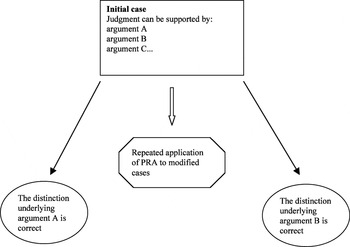
The more general point is that most hypothetical cases are not
self-interpreting or straightforwardly interpretable in only one way.
When a person concurs with a judgment about a specific case, there are
often a number of different possible justifications for that judgment,
and we cannot necessarily decide from the judgment which of the
justifying arguments the person will assent to (it may even be the case
that he or she will assent to more than one). The situation can be
illustrated by Figure 1.
As the author of an article using the strategy for argumentation it
is up to me to decide which of the possible underlying distinctions to
emphasize in my choice of further positive or negative hypothetical
examples, and by choosing wisely I can try to lead my reader to believe
in the relevance or truth of any of the distinctions and arguments that
are a possible justification for his initial judgment.
The Principle of Charity—A Forgotten
Principle in Bioethics?
As I have shown, most applications of the PRA and the use of
hypothetical examples combined with the PRA involve the analysis and
interpretation of arguments put forward by others and their completion
or reconstruction.
It is generally accepted in the field of logic and the analysis of
informal arguments that in this process one should apply the Principle
of Charity, even in those cases where one disagrees with one's
interlocutors.
The principle can be stated in the following way:
This principle requires that we try to make the best possible
interpretation of the discourse being evaluated, whether we are trying
to decide if an argument occurs in a passage, looking for the main
point of an argument, attempting to clarify the meaning of questionable
words or phrases, or formulating missing premises. The aim is to give
the benefit of the doubt to the speaker or author. Rather than
ridiculing someone for a remark that doesn't follow from what was
said earlier or that isn't strictly true, it is more reasonable
and responsible to try to reinterpret the passage so that it will make
more sense….
The Principle of Charity is a reminder to attend to the main
thrust of an argument and deal with it fairly.
The Principle of Charity also offers sound practical advice by
telling us to avoid setting up a “straw man”—a weak
imitation of the argument we are considering. It may be easy to break down a
“straw man,” but it will also be easy for an adversary to
rebut an attack by reformulating the argument slightly to meet your
objections. The arguer will simply claim, correctly, that you have
misinterpreted the argument by making it seem weaker than it really is.
(p. 58)4
Churchil RP. Becoming
Logical: An Introduction to Logic. New York: St. Martin's
Press; 1986.
If the Principle of Charity was always applied in the development of
a PRA, many of the problems I have identified would not occur, because
the completions and reconstructions of our opponents' arguments
would always be done to give them the best and strongest possible form.
Only if that is done can we really claim that, if they have said A,
they must also say B!