I. INTRODUCTION
In recent years, thermo-mechanical control process (TMCP) was more and more widely used in the fabrication of high strength steels, which can improve the mechanical properties of steels by optimizing microstructures during rolling and cooling.Reference Zhao, Yang and Shan1–Reference Qi, Zhang, Du, Liu and Wang3 TMCP technology can control phase transformations and precipitations of carbide of carbonitride particles in steels by adjusting parameters like austenitizing temperature, deformation temperature, degree of deformation, deformation rate, cooling rate after rolling, etc. For TMCP technology, to control the rolling in the nonrecrystallization austenite temperature region is important during which a large amount of crystal defects can be generated through the accumulation of deformation. These crystal defects, especially dislocations, can serve as potential nucleation sites for subsequent transformations and favor microstructure refinement. However, TMCP technology is difficult to be applied in the production of ultra-high strength steels because extremely high load is required for these steels to be rolled in the nonrecrystallization austenite region due to the relatively high content of carbon and alloying elements. Thus, TMCP is presently used only in the production of high strength steels of general grade.Reference Xu, Bai, Liu and Yuan4−6
It should be noted that small deformation in the nonrecrystallization austenite region by rolling could be a candidate solution to the above challenge for ultra-high strength steels. Therefore, it is necessary to understand clearly how small deformation in the nonrecrystallization austenite region influences the phase transformation behaviors in ultra-high strength steels. Considering bainitic transformation is essential to the strengthening of Cr–Ni–Mo ultra-high strength steels, this study mainly focused on the bainitic transformation behavior in 30CrNi3MoV ultra-high strength steel. This work is prospect to provide useful theoretical basis for developing specific TMCP technology suitable for ultra-high strength steels.
Khlestov et al.Reference Khlestov, Komopleva and McQueen7 have studied the isothermal bainitic transformation from deformed austenite using 30 steels with different compositions and suggest that deformation of austenite can promote or impede bainitic transformation according to the isothermal temperature at which undercooled austenite is hold. In this work, investigation is mainly focused on the bainitic transformation in the continuous cooling process since continuous cooling is more similar to the practical rolling condition of steels.
II. EXPERIMENTAL MATERIALS AND PROCEDURES
The chemical composition of the investigated 30CrNi3MoV steel is as follows (in wt%): 0.3 C, 0.26 Si, 0.45 Mn, 3.1 Ni, 0.47 Mo, 0.94 Cr, 0.003 S, and 0.009 P. The austenite starting (Ac1) and finishing temperatures (Ac3) of this steel are 720 and 790 °C respectively. And the recrystallization temperature is estimated to be 934 °C according to the following empirical equationReference Boratto, Barbosa, Yue and Jonas8:
 $${T_{\rm{r}}} =\,\, 887 + 464{\rm{C}} + (6445{\rm{Nb}} - 644\sqrt {{\rm{Nb}}} ) + (732{\rm{V}} - 230\sqrt {\rm{V}} ) + 890{\rm{Ti}} + 363{\rm{Al}} - {\rm{357Si}}\quad {\rm{,}}$$
where C, Nb, V, Ti, Al, and Si represent, respectively, the content of alloying element in weight percentage.
According to the above, to investigate the influence of small deformation in the nonrecrystallization austenite region, the temperature for austenite deformation was selected as 850 °C, a temperature between the austenite finish temperature and the recrystallization temperature.
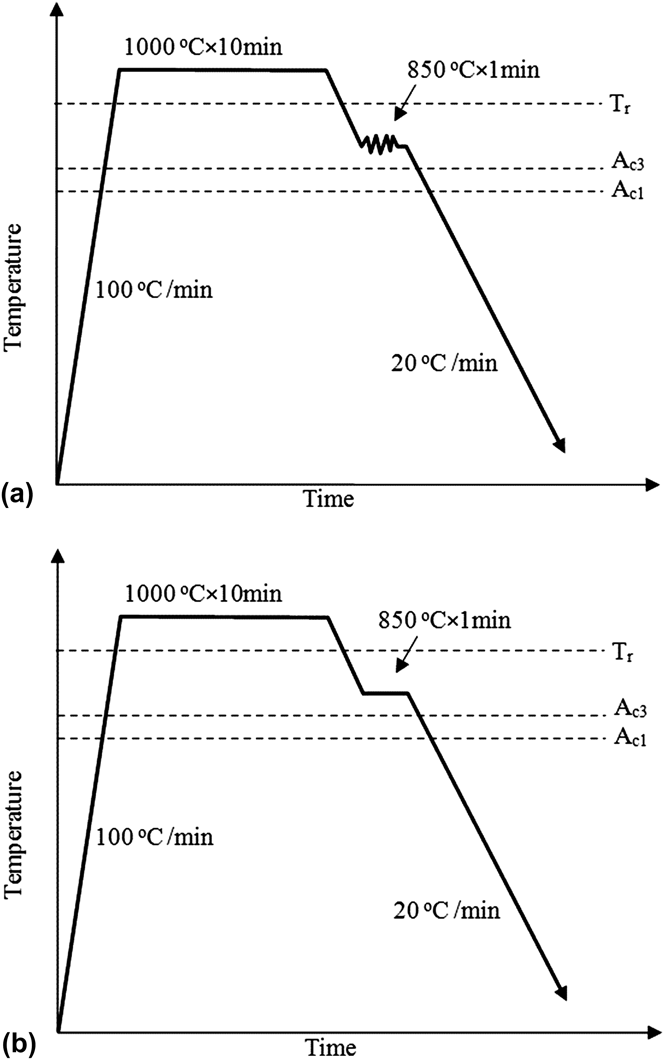
A high-resolution differential dilatometer was used to conduct the experiment. Dilatometry samples with a dimension of ϕ6 × 10 mm were spark cut from a 30-mm-thick hot-rolled steel plate, having been uniformly heat treated. The samples were austenitized at 1000 °C for 10 min and then cooled down to 850 °C for 1 min at a cooling rate of 20 °C/min. At 850 °C, samples were subjected to a small compression deformation or not as shown in Fig. 1. In the case with small deformation at 850 °C, a uniaxial compression stress of 140 MPa was applied to the dilatometry sample to ensure the small austenite deformation. Subsequently, samples were cooled down to room temperature from 850 °C at the same cooling rate of 20 °C/min during which bainitic transformation occurred. The detailed heat treatment parameters applied on the samples are presented in Fig. 1 in which Fig. 1(a) is for the investigated sample with a small austenite deformation at 850 °C (named 850-1) and Fig. 1(b) is for the comparison sample without austenite deformation at 850 °C (named 850-0). The two samples (850-1 and 850-0) were heat treated with almost the same parameters except for the application of a small deformation at 850 °C or not. During heat treatment processes, the dilatometric curves between length changes and temperatures of the samples were obtained. The starting and finishing transformation temperatures were determined from the dilatometric curves using the tangent rule.Reference Lin and Fu9
Schematic illustrations for 30CrNi3MoV steel with different heat treatments: (a) 850-1, subjected to small deformation in the nonrecrystallization austenite region; (b) 850-0, without small deformation in the nonrecrystallization austenite region as a comparison sample.

BX51M optical microscope (Olympus Corporation, Japan) and JEM-100CX II transmission electron microscope (JEOL, Japan) were applied for microstructural observations. Specimens for optical microscopy were cut from dilatometric samples subjected to different heat treatment processes, perpendicular to the axis of the samples. To reveal prior austenite grain boundaries, metallographic specimens were etched with a saturated picric acid solution after mechanical polishing. Foils for transmission electron microscopy (TEM) were prepared by cutting thin wafers from dilatometric samples and grinding them to about 100 μm in thickness. Discs of 3 mm in diameter were punched from the wafers and electropolished using an electrolyte of 10% perchloric acid and 90% ethanol.
III. RESULTS
A. Kinetics of bainitic transformation
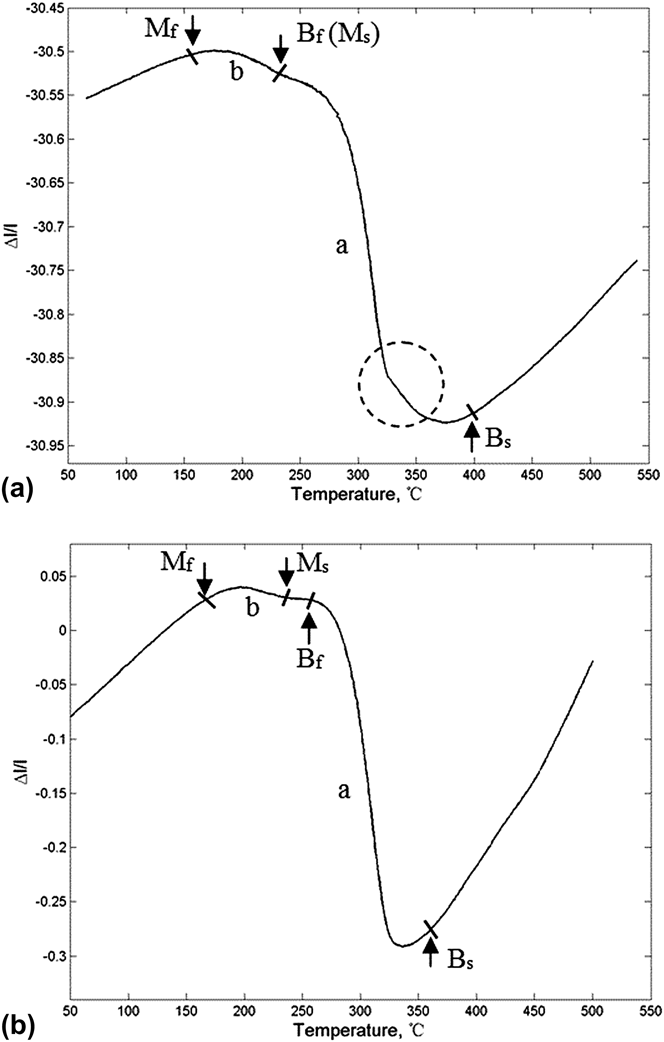
Figure 2 shows the cooling dilatometric curves of the samples subjected to different heat treatment processes, with deformation (850-1) and without deformation (850-0). For the deformed sample 850-1, there is a 30% reduction in length under the uniaxial compression stress of 140 MPa at 850 °C for 1 min. It should be noted that the dilatometric curves for deformed and nondeformed samples display a similar shape, both which include two stages (indicated by “a” and “b” in Fig. 2). Such a particular shape of dilatometric curves results from the incomplete bainitic transformation in 30CrNi3MoV steel. In stage “a,” a majority of undercooled austenite is transformed to bainite, whereas in stage “b,” only a small amount of martensite is formed from the retained austenite after bainite transformation.Reference Qiao, Liu, Yua and Gao10
Measured length changes as a function of temperature during cooling of 30CrNi3MoV steel samples: (a) 850-1, deformed; (b) 850-0, nondeformed. The arrows indicate the starting and finishing temperatures of phase transformation.
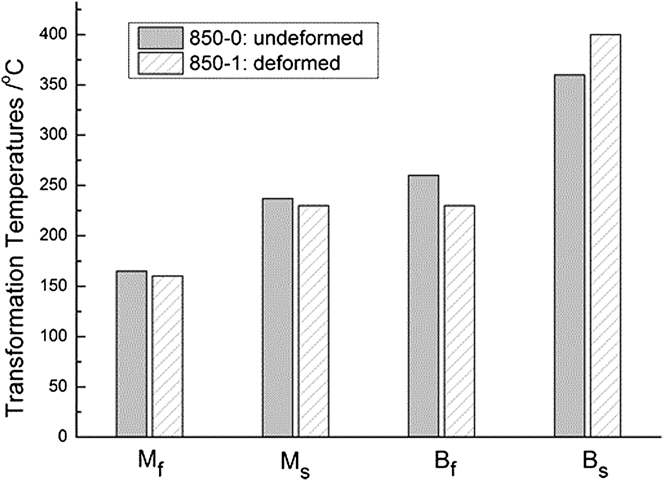
The phase transformation temperatures, including starting and finishing bainite temperatures (Bs and Bf) and starting and finishing martensite temperatures (Ms and Mf), can be determined from the points at which the cooling dilatometric curves deviate from the linearity, as indicated by the arrows in Fig. 2, and the results are plotted in the histogram in Fig. 3.
Transformation temperatures (Bs, Bf, Ms, Mf) for the 30CrNi3MoV steel samples (deformed and nondeformed).
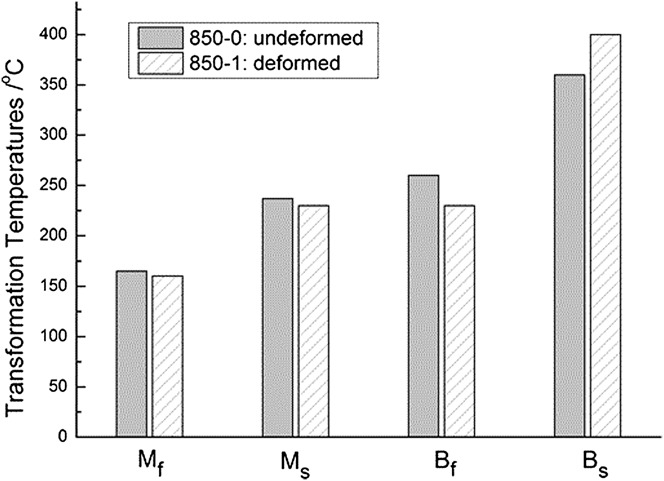
By comparing the Bs between the deformed and nondeformed samples at 850 °C, the Bs (400 °C) of the deformed sample (850-1) is obviously higher than that (360 °C) of the nondeformed sample (850-0). This indicates that the small deformation applied in the nonrecrystallization austenite region could decrease the minimum chemical driving force for the start of bainitic transformation in 30CrNi3MoV steel and thus promotes the occurrence of bainitic transformation.
In Fig. 2(a), it should be noted that there is an obvious inflection (at about 325 °C) on the dilatometric curve of the deformed sample (850-1), as indicated by the circle, shortly after the bainitic transformation begins. It is reasonable to suppose that the bainite transformations at temperatures below and above 325 °C perform in different ways, which may be related to the evident increase of Bs in this sample. Based on the microstructure examination in the following section, it is found that granular bainite forms at temperatures above 325 °C, yet lower bainite forms at temperatures below 325 °C.
Contrary to the variation in Bs temperatures, the Bf temperature (230 °C) of the deformed sample (850-1) is lower than that (260 °C) of the nondeformed sample (850-0). This indicates that the small deformation in the nonrecrystallization austenite region postpones the finish of bainitic transformation to a lower temperature than that of the nondeformed, and meanwhile resulting in a wider temperature range of bainite transformation. However, there is no considerable difference between the deformed and nondeformed samples either in martensite starting temperature (Ms) or in martensite finishing temperature (Mf).
The results above suggest that the small deformation in the nonrecrystallization austenite region has different effects on the kinetics of bainitic transformation at the early and late stage, respectively. Undercooled austenite at the late stage of bainitic transformation is more stable than that at the early stage.
B. Microstructural observations
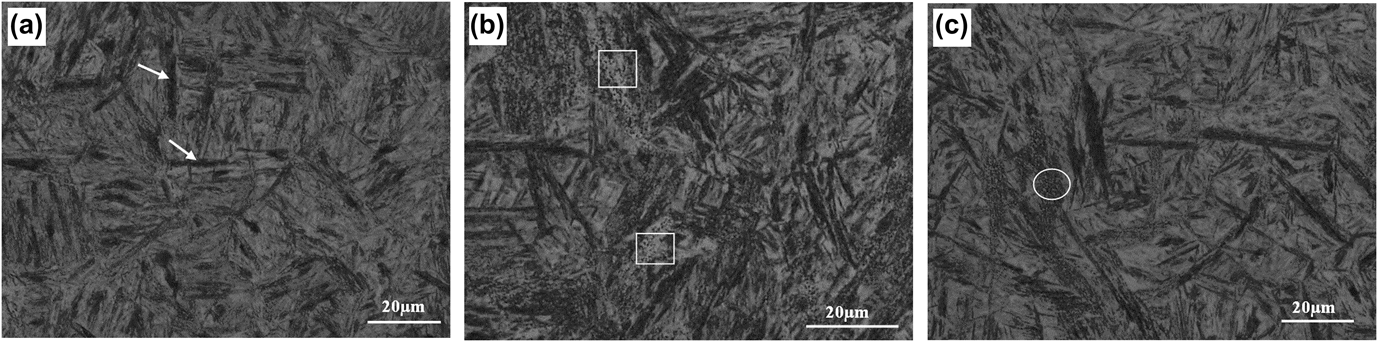
Figure 4 shows the optical microstructures of the samples with and without deformation at 850 °C. For the nondeformed sample (850-0), as shown in Fig. 4(a), the microstructure is composed of lower bainite and limited amount of martensite. The lower bainite is the dominant phase in the sample, consisting of groups of parallel laths with a common orientation. The martensite [indicated by arrows in Fig. 4(a)] is formed from the retained austenite after primary previous bainitic transformation, which associates with the incomplete bainitic transformation in 30CrNi3MoV steel. However, with regard to the specimen with deformation (850-1), in addition to lower bainite and martensite, granular bainite is observed in the microstructure as indicated by the rectangles and circles in Figs. 4(b) and 4(c). The granular bainite exhibits two different morphologies as shown in Figs. 4(b) and 4(c). In Fig. 4(b), fine particles are sparsely distributed on a large scale, existing together with lower bainite laths. But in Fig. 4(c), granular bainite is composed of closely distributed particles, with a fusiform outlined shape. It is known that granular bainite is usually formed at high temperatures in comparison with upper bainite and lower bainite, thus the granular bainite structures in the deformed sample should be ascribed to the inflection (at 325 °C) shown in Fig. 2(a). It can be concluded that small deformation at 850 °C would stimulate the formation of granular bainite in 30CrNi3MoV steel.
Optical microstructures of the 30CrNi3MoV steel samples subjected to different heat treatment processes: (a) 850-0, the arrows indicating martensite plates; (b) and (c) 850-1, the circles and rectangles indicating granular bainite with different morphologies.
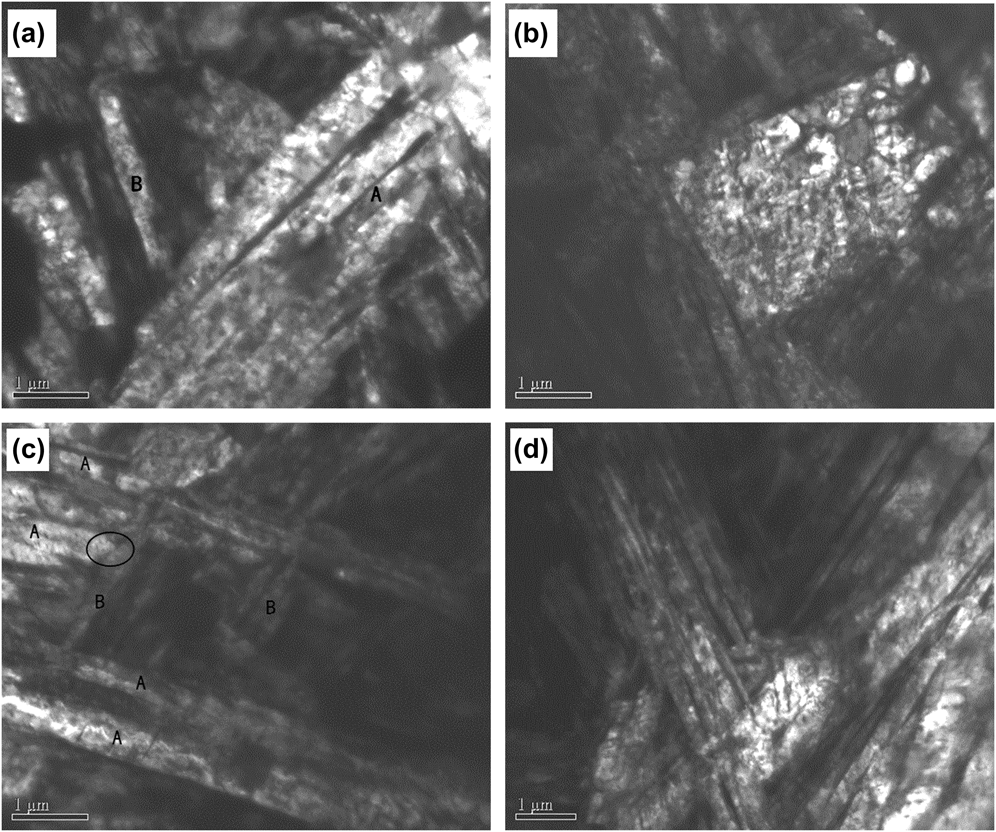
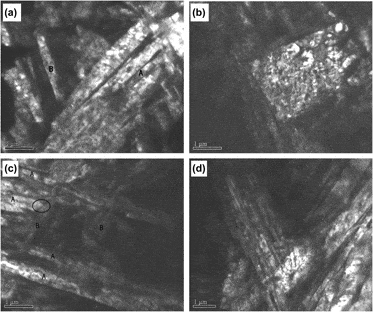
TEM observations were carried out on the deformed sample 850-1 and the typical bainite morphologies are shown in Fig. 5. Figure 5(a) shows some bainite groups with different orientations. Each bainite group is composed of parallel lower bainite laths oriented in a common direction. It can be detected that carbide particles are distributed within the bainite laths. It can be seen from Fig. 5(a) that within a certain prior austenite grain, there are many lower bainite groups oriented in different directions. Since each bainite group usually develops from a certain nucleus, it is known that considerable nucleating sites for bainite have been generated after the small deformation in the nonrecrystallization austenite region. This can be attributed to the accumulation of considerable dislocations during the deformation process, favoring the nucleation of bainite.
TEM images of the deformed 30CrNi3MoV sample (850-1), with different morphologies of bainite: (a) lower bainite laths with different orientations; (b) granular bainite enclosed by lower bainite laths; (c) and (d) intersecting lower bainite laths, some of which crossed through each other.
Except for lower bainite groups with different orientations, there exists some granular bainites in the deformed sample as shown in Fig. 5(b). Detailed observation on the granular bainite reveals the carbide particles randomly distributed in the matrix of polygonal ferrite and the high density of dislocation in ferrite, which is typical of granular bainite. The TEM observation is consistent with the optical observation and dilatometric analysis discussed above.
In Fig. 5(a), it is noted that a lower bainite group stops growing when it impinges another group with different orientations. However, the bainite morphology presented in Fig. 5(c) is different from the case in Fig. 5(a). Figure 5(c) shows two intersecting lower bainite groups that are designated as A and B, respectively. Some bainite laths in group A stopped growing as they encountered the laths of group B (as indicated by the circle), whereas the others continue to grow in previous directions even after the impingement with the laths of group B. This means that some laths in group A can overcome the resistance from group B and crossed through them. Such morphology where bainite laths with different orientations cross through each other is fairly common in the deformed sample (850-1). Figure 5(d) shows another microstructure similar to Fig. 5(c), displaying another pair of bainite groups that crossed through each other. The growth of intersecting bainite laths in previous directions shows that the impingement of bainite laths does not have a considerable effect on the subsequent bainite growth. For the crossed bainite laths, the driving force obtained may be large enough to overcome resistance and grow in previous directions.
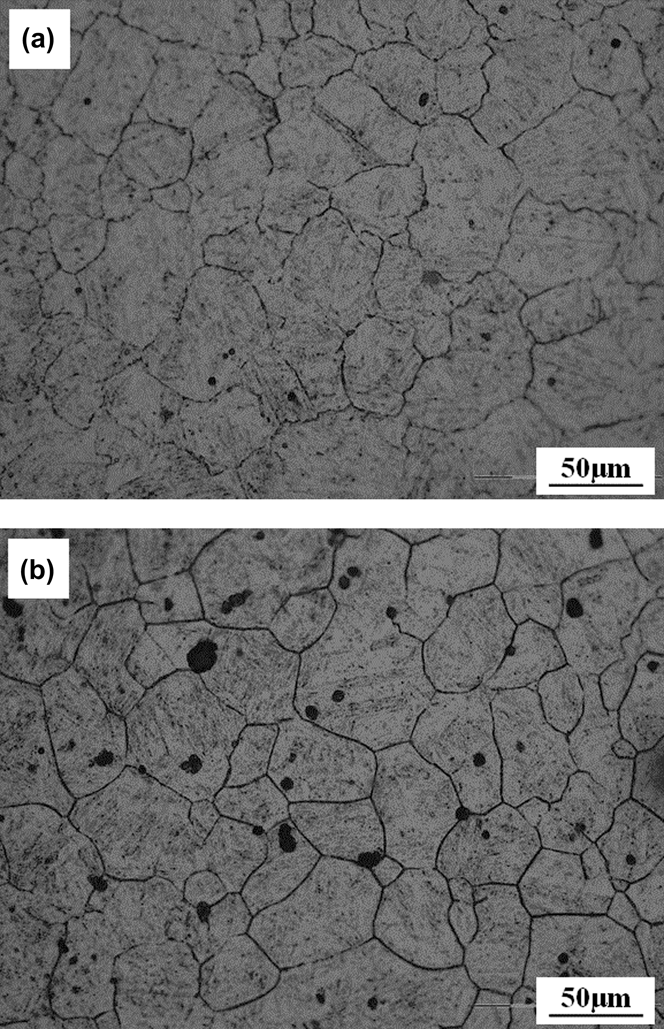
Figure 6 displays the prior austenite grains in samples 850-0 and 850-1. There is no significant difference between the deformed and nondeformed samples in average size of austenite grains. But the morphology of austenite grains in sample 850-0 is obviously different from that in sample 850-1. The austenite grain boundaries in the nondeformed sample are much straighter, whereas the grain boundaries in sample 850-1 are distorted. It is known that straight grain boundary is the most stable condition for prior austenite, which exhibits the minimum area and thus minimum interfacial energy. During the deformation at 850 °C, the austenite grains were compressed and rotated, resulting in distorted grain boundaries. These distorted grain boundaries cannot be eliminated by austenite recrystallization since the deformation was carried out in the nonrecrystallization region. Therefore, the distorted grain boundaries in sample 850-1 can store high deformation energy and provide extra energy for subsequent bainite transformation.
Optical micrographs showing prior austenite grains in the 30CrNi3MoV steel samples: (a) deformed, 850-1; (b) nondeformed, 850-0.
IV. DISCUSSIONS
A. Bainite transformation temperatures (Bs and Bf)
From Figs. 2 and 3, the Bs increases and the Bf decreases after the small deformation in the nonrecrystallization austenite region. This suggests that small deformation in the nonrecrystallization austenite region adjusts the kinetics of bainitic transformation differently at the early and late stage, respectively. Undercooled austenite at the late stage of bainitic transformation is more stable than that at the early stage.
According to the classical theory on phase transformations, when bainite is formed from austenite, the change in free energy ΔG γ→α′ is composed of three parts: the difference of chemical free energy between austenite and bainite ferrite (ΔG chem), the strain energy (ΔG strain), and the interfacial energy (ΔG interfacial), just as followsReference Bhadeshia11:
 $${\rm{\Delta }}{G^{{\rm{\gamma }} \to {\rm{\alpha }}\prime }} = {\rm{\Delta }}{G_{{\rm{chem}}}} + {\rm{\Delta }}{G_{{\rm{strain}}}} + {\rm{\Delta }}{G_{{\rm{interfacial}}}}\quad .$$
Hence, the critical chemical driving force needed to stimulate bainite is
 $$- \Delta {G_{{\rm{chem}}({{\rm{B}}_{\rm{s}}})}} = \Delta {G_{{\rm{strain}}}} + \Delta {G_{{\rm{interfacial}}}}\quad .$$
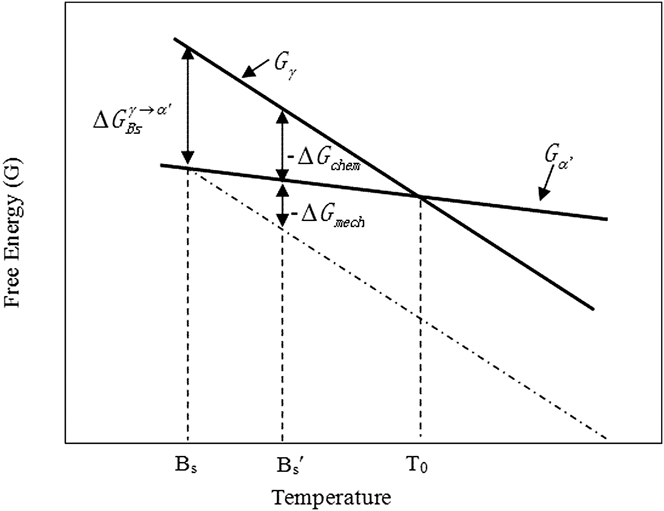
Therefore, there is a constant minimum value of chemical driving force for bainite transformation to be triggered to overcome the increased stain energy and interfacial energy during transformation. And thus, sufficient undercooling is necessary to reach the minimum chemical driving force as shown in Fig. 7. The Bs, corresponding to the critical chemical driving force, should be lower enough than the T 0 temperature at which the Gibbs energy of austenite is equal to that of bainite as illustrated in Fig. 7.Reference Bhadeshia12
Schematic diagram illustrating the increase of Bs in the 30CrNi3MoV steel sample subjected to small deformation in the nonrecrystallization austenite region with regard to thermodynamics theory.
It is known from Fig. 6 that the 30CrNi3MoV steel deformed in the nonrecrystallization austenite region stored increased energy in distorted austenite grain boundaries. Such energy can serve as an extra mechanical driving force to trigger bainitic transformation. Assuming that the critical value of driving force to stimulate bainite is constant, such mechanical driving force can replace part of the required chemical driving force (as indicated by −∆G mech in Fig. 7), and thus the critical chemical driving force for bainite activation decreased, resulting in the decrease of necessary undercooling and the raise of bainite starting temperature (from Bs to  ${\rm{B}}_{\rm{s}}^\prime$).
Austenite grain boundaries are the main nucleation sites of bainite. For the steel deformed in the nonrecrystallization austenite region, austenite grain boundaries are distorted and a larger grain boundary area is obtained, thus resulting in increased nucleation rate. Bs is directly related to the nucleation rate of bainite; therefore, the Bs of the deformed sample increased to some extent. In addition, the dislocations and other defects introduced during the small deformation in the austenite region can also serve as nucleation sites and assist the nucleation of bainite ferrite, and thus promote bainite transformation, resulting in increased Bs.
As for the slight decrease of Bf in the deformed sample, it is associated closely with the more universal intersection of differently oriented bainite laths. The intersection morphology would decelerate the growth rate of bainite laths and postpone the finish of bainite transformation to lower temperatures.
B. Bainite morphology
As shown in Fig. 4, granular bainite are presented in the microstructure and replace part of lower bainite after the small deformation in the nonrecrystallization austenite region. This indicates that small deformation in the nonrecrystallization austenite region can promote the formation of granular bainite in steels. This change in bainite morphology can be attributed to two factors:
(1) Increase of Bs
Granular bainite is considered to form at relatively high temperatures above upper bainite and lower bainite.Reference Qiao, Liu, Yu and Gao13 With Bs increased to some extent in the deformed steel, the formation of some granular bainite is possible.
(2) Acceleration of carbon diffusion
To form granular bainite, a long-range carbon diffusion is required so that carbon atoms can diffuse over one or more bainite grains to form martensite/austenite constituents (M/A).Reference Xu and Liu14 The increased density of dislocations produced from deformation in parent austenite can accelerate the diffusion of carbon atoms and favor the formation of granular bainite.
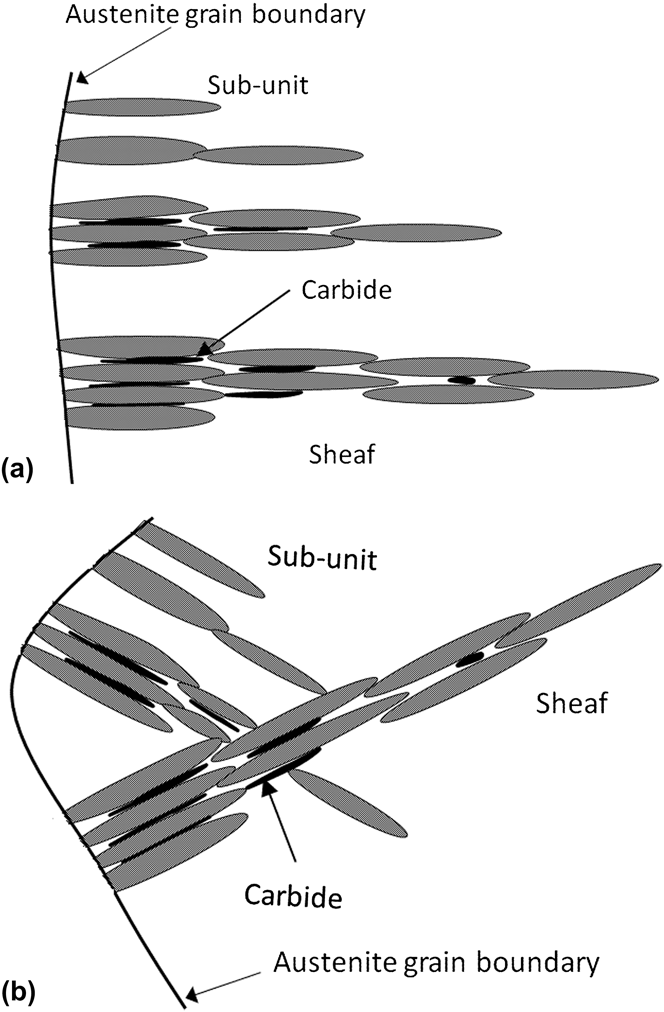
In addition to granular bainite, intersection of differentially oriented lower bainite laths is another typical feature presented in the microstructure of the deformed steel (Fig. 5). Some intersected lower bainite laths cross through each other. According to Bhadeshia, the evolution of bainite is a cyclical process containing the following three events as shown in Fig. 8(a): (i) nucleation of a subunit at an austenite grain boundary, (ii) lengthening of the subunit until its growth is arrested by plastic deformation within the austenite, and (iii) nucleation of new subunits at the tips of the old subunits.Reference Bhadeshia15 Normally, adjacent bainite sheaves are less liable to intersect because the subunits grow usually perpendicular to the straight austenite grain boundaries. However, for the steel deformed in the nonrecrystallization austenite region, austenite grain boundaries are distorted, which would cause the increase of intersection opportunity of neighboring bainite sheaves too, as shown in Fig. 8(b). Therefore, such intersection morphology of bainite laths is fairly common in the deformed sample. The lengthening of a subunit has to stop when it encounters subunits of different orientations. Afterward a new subunit may nucleate on the other side of the intersecting subunits and grow in its own previous direction. In this way, two intersecting bainite lath groups with different orientations can successfully cross through each other as shown in Figs. 5(c) and 5(d). Also, this is indirect evidence for the bainite evolution model of Bhadeshia.
Schematic diagrams illustrating nucleation and growth of bainite: (a) with straight austenite boundaryReference Bhadeshia15 and (b) with distorted austenite boundary.
In addition, more frequent intersection of differently oriented bainite is certain to decelerate the growth of bainite because the delay between successive subunits increases. As a result, the finish of bainite transformation is postponed to lower temperatures and the Bf decreased. Accordingly, the small deformation in the nonrecrystallization austenite region plays a role of retarding bainite transformation at the late stage.
V. CONCLUSIONS
For continuously cooled 30CrNi3MoV ultra-high strength steel, small deformation in the nonrecrystallization austenite region has different effects on the bainitic transformation at the early and late stage, respectively. The increase of Bs is owing to the stored energy in distorted austenite grain boundaries, which serves as an extra mechanical driving force for baintic transformation during continual cooling. Formation of granular bainite was promoted due to the increase of Bs. The decrease of Bf is attributed to the more universal intersections of differently oriented bainite laths, which decelerate the overall growth rate of bainite by increasing the delay between successive subunits.
ACKNOWLEDGMENTS
The authors are grateful to the National Natural Science Foundation of China (Grant Nos. 50834011, 51204121, and 51104107) and the China Postdoctoral Science Foundation (Grant No. 20110490774) for grant and financial support.