To Wagner’s characterisation of Italian opera as a courtesan and French opera as a coquette, Émile Zola would add that operetta and its performers are outright whores. Zola’s novel Nana (1880) establishes its tone of disgust for Second Empire folly and decadence through the grimy, gaudy setting of a fictionalised Théâtre des Variétés, whose impresario Bordenave repeatedly instructs visitors to ‘Call it my brothel!’ (‘Dites mon bordel!’).Footnote 1 The fictional operetta La Blonde Vénus (a thinly disguised imitation of Offenbach’s Orphée aux enfers and La Belle Hélène) consists of inane, suggestive songs accompanied by sneering instruments, and as for Nana, the much-touted star, she sings ‘like a corncrake’; her stage movements consist of hair tossing, hip thrusts and a high kick.Footnote 2 At first it seems her performance will fail, as the audience responds with derision, but artistic standards give way to pornographic ones as Nana dominates the audience with her sexual charisma.
The fictional Nana, in and out of her role as the ‘Blonde Venus’, joins a gallery of operatic variations on the theme of ‘love for a prostitute’, to borrow Freud’s 1910 category of a pathological type of love.Footnote 3 La traviata presents the neurosis in its most sentimental form, as the ‘fallen woman’ reveals her courtesan persona and behaviour to be a mask over a monogamous heart. Freud adds that the love-object need not be a literal prostitute, but only ‘a woman … whose fidelity and reliability are open to some doubt’, and Manon presents this type in a more intractable form, so that the devotion of Des Grieux appears increasingly self-deluding, even masochistic. Finally Nana appears as the most overtly misogynistic incarnation, a commodified urban Circe who reduces men of all social classes to beasts. Since its inception in the 1850s, and especially after the 1870s, the operetta as personified in Nana has carried the stigma of a subhuman and socially destructive force. On the production side, this urban popular genre appears as feigning, manipulation, counterfeit art, achieving its effects through cheap, obvious and repetitive strategies. The audience-consumer in turn appears credulous and deluded, endowing something valueless with value.
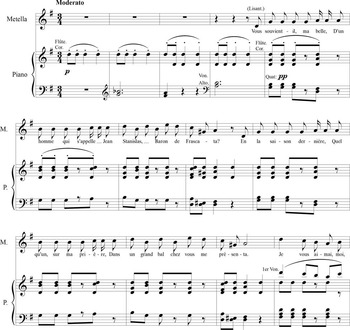
The ‘Rondeau de la lettre’, in Act II of La Vie parisienne (Ex. 1), in which the demi-mondaine Métella reads aloud a letter from a former lover recommending a new lover for her consideration, presents a different, more optimistic perspective on the meretricious enjoyments offered by popular commodity culture.Footnote 4 This aria undoes the presumed antagonism between the repetitive, commodified nature of the courtesan’s ‘love’ and the possibility of an authentic impact on her lover.Footnote 5 It celebrates the apparently self-deluding act of loving an object that is explicitly engineered to be loved by everyone.
The opening of ‘Rondeau de la lettre’ from Act II of La Vie parisienne.

Near its beginning, the letter calls into question the trustworthiness of passionate speech, as the lover-writer Frascata recalls:
Métella’s opacity, both in the past and in the present moment of reading, is characteristic of the commodity, which cares little what it means to you personally, so long as you buy it and recommend it to others. The meaning that their encounter held for Frascata is economically superfluous, except insofar as it generates new buyers: his appreciation is best expressed through a recommendation, not through possessiveness. Yet the letter’s discourse upholds the older, ‘courtly’ image of the demimonde, as the writer respects the courtesan’s dignity and boundaries, her privilege as a hostess: he asks for her favour, rather than demanding her services.Footnote 6 Nor, most importantly, does the transactional context exclude personal motivations of memory, affection and gratitude. Along with the most valued gift of a referral, personal emotions may nonetheless be smuggled.
Even in this context of exchange, where pleasures are contrived to please many and to circulate widely, the ‘artificial’ experience of a liaison with a courtesan has produced a ‘real’ emotional and personal impact. Frascata’s contrast between his bleak grey homeland and Métella’s ‘boudoir bleu de ciel!’ anticipates Adorno’s diagnosis of the artificial sweetness and brightness that operetta, movies and sentimental novels will bring to the grey lives of the working class – but does not yet disdain that consolation as fraudulent.Footnote 7
The aria’s interrelated effects of melancholy and monotony both arise from its high tolerance for repetition. Its rondeau musical form includes four complete statements of a refrain, which itself consists of two concise repeated phrases (AABB’).
The rhythmic figure ‘1-and, 2, 3’ persists in the accompaniment, only broken for one bar at the climax of the first episode and not fully abandoned until the rhapsodic second episode. The A melody (which, being heard a total of eight times, alone comprises a sixth of the song) is simply an ascending scale submitted to a monotonous ‘chugging uphill’ rhythm. Unlike some of Offenbach’s other famous rondeaux (e.g., ‘Au mont Ida’ in La Belle Hélène), the refrain comes back each time intact, without variation. These small- and large-scale devices of strict repetition create a tone of self-disciplined, measured expression, which in turn provides a background for the passionate outbursts of the two episodes. Indeed, although the number is labelled ‘rondeau’, we could equally well hear AABB’ as a verse rather than a refrain, and the piece as a strophic song disrupted by two digressions. The overall form emulates that of ‘Gretchen am Spinnrade’, as the writer gets increasingly caught up in what he is saying and the music grows higher, more expansive and further from the tonic – then breaks off at a high point until the well-established accompaniment figure comes in to gather up the thread and re-focus.
If the drama of the song resides in this tension between the cool gallantry of the refrain and the passionate lapses of rhetorical control in the episodes – transgressions marked in the text with the formulas ‘but never mind … but I digress … but back to my main point’ – then the double-voiced situation becomes interesting. Métella, reading aloud this letter from the never-seen Frascata, envoices his reminiscence of her, as she had formerly facilitated the experiences being recalled. Furthermore, although a scene of letter-reading would typically focus on the recipient’s reactions to the letter’s content (Violetta’s desolate ‘E tardi!’), this scene does not specify how Métella feels about these reminiscences of herself, these compliments to herself, these insinuations. Though technically a scene of reading, it has more in common with scenes of writing, where the act of writing leads to the very thoughts that cannot or should not be said. By having Métella read the words, digressions, insinuations and outbursts of ‘Frascata’, the aria contrives to participate in a topos of gendered voyeurism, in which a female character discloses her thoughts and emotions fully to the audience while producing an edited version of them for the letter’s intended recipient. Although the writer of Métella’s letter is male, it is given to the female performer/character to enact ‘his’ progress of self-discovery, self-expression and self-censorship.
Unlike a conventional letter-writing scene, however, this letter to Métella is already finished, and the writer has ‘composed’ his digressions and self-interruptions into the text so that the momentary lapses of rhetorical control become the rhetorical highlights. The paradox of what we might call ‘skillfully crafted spontaneity’ marks operetta as a genre and light music as a commodity. These same moments in Frascata’s letter (i.e., in Métella’s song) demonstrate the libertine tendency of operetta: to combine an elegant surface with insinuations, as it repeatedly approaches and retreats from the line between what can be said and what sophisticated people do not need to say. The moments where he/she crosses from gallantry into apparently spontaneous feeling are also (not coincidentally) the moments of erotic implication. Indeed, reminiscence emerges as the writer’s primary erotic mode, as the lonely pleasure of recalling his time with Métella appears more durable and more real than the six weeks during which she had professed her love ‘with such a smile’. Even more perversely, his goal in writing this letter is to enrich his own future reminiscences with new stories from his friend. The rhapsodic climax of the song is not, as we might expect in a more respectable art form, an anticipation of seeing Métella again, but of savouring memories of her with another enthusiast. Frascata’s letter acknowledges that beyond the enjoyment of a thing itself, commodified pleasures offer the communal enjoyment of fandom, discussion, shared reminiscences and shared appreciation. The pleasures of the popular are shareable pleasures, and should the spell of its melancholy charm be broken, this truth becomes scandalous.