Introduction
Students report a mixture of reasons for subject selection, including liking the subject, having an interest in the subject, being able to do well in the subject and requiring it for further education/training (Lamont & Maton, Reference LAMONT and MATON2008, Reference LAMONT, MATON and Wright2010; Symth & Calvert, Reference SMYTH and CALVERT2011). However, various school subjects carry with them a hierarchy or classification, which depending on the school context might affect students’ perception of the subject. For example, the high status of subjects such as math and science may be influenced by the fact that they are a prerequisite for entry to many third-level university courses in the Republic of Ireland (McGarr & Lynch, Reference MCGARR and LYNCH2017), and mathematics education is increasingly lauded as essential to a nation’s economy (Jablonka, Reference JABLONKA, Bishop, Clements, Keitel and Leung2003; Reyna & Brainerd, Reference REYNA and BRAINERD2007).
Prior research has shown that school music is enjoyed by students (Lamont et al., Reference LAMONT, HARGREAVES, MARSHALL and TARRANT2003; Lamont & Maton, Reference LAMONT and MATON2008, Reference LAMONT, MATON and Wright2010), with others advocating that music should be ‘for all’ (Welch, Reference WELCH2001). However, commentators have noted ‘a host of negative beliefs and behaviours towards music in formal schooling, among both learners and teachers, which pose serious challenges for music education’ (Lamont & Maton, Reference LAMONT, MATON and Wright2010, p. 63). It is important, therefore, to consider the perceptions which exist around the value of the study of music as a school subject and in what way this may affect student attitudes. This is particularly relevant as discussion centres on what we are doing ‘to provide a musical education that will be relevant and deemed desirable to our young people so as to not have our subject end up in a pupil “vox pop” as the subject they consider the most boring and least relevant as many surveys indicate?’ (Burgess, Reference BURGESS2001, p. 3).
The focus of this paper is to gain an insight into student attitudes towards the subject of music in second-level education in the Republic of Ireland. For the purposes of the present study, second-level music education refers to music education (all aspects) that occurs within the formal school curriculum. This research considered two questions: What are the attitudes of students towards the subject of music? What factors affect student subject choice of music? The paper outlines some pertinent information regarding the particular research context in the Republic of Ireland. Second-level music education is introduced and discussed. Thereafter, the methodology used to frame the study is described. Findings are presented in terms of the major themes emerging from data collection. Finally, some interpretations of these findings are explored.
Some relevant Irish context
In order to explore student attitudes towards the subject of music in second-level education, some relevant national context is now established. Education in the Republic of Ireland is compulsory from the ages of 6 to 16 or until students have completed 3 years of second-level education (DES, 2004). The second-level sector builds on primary education and offers a 3-year junior cycle for students aged 12–15 and a 2-year senior cycle for students aged 15–18 (DES, 2004). The aim of the senior cycle is to encourage students to continue full-time education after the compulsory period by providing ‘a stimulating range of programmes suited to their abilities, aptitudes and interests’ (GOI, 1998, p. 38). The senior cycle programme culminates with a final examination, known as the Leaving Certificate (LC). Students can choose from syllabi available in up to 40 subjects; however, the ‘number of subjects made available to students and the degree of choice afforded them have been found to vary across schools’ (Smyth & Calvert, Reference SMYTH and CALVERT2011, p. 101). Students generally select six subjects for examination. This is a high-stakes exam, with almost 90% of the age cohort sitting for the exam every year (Corcoran & O’Flaherty, Reference CORCORAN and O’FLAHERTY2017). Upon completion of the LC, points are awarded depending on the grade achieved in each of the six examination subjects. Students hoping to apply to further education must meet certain requirements for entry, and if the demand exceeds the number of places available at a particular institution, students are ranked according to their achievement on the points scale (Hyland, Reference HYLAND2011). There has been widespread criticism of the points system in terms of promoting consumerist values, where education is viewed as a market and the achievement of high grades as a commodity. Hyland (Reference HYLAND2011) discusses the impact of the points system on teaching and learning and on the overall student experience, particularly during the senior cycle. She highlights the way in which this system affects students’ attitudes to subject choice at senior cycle.
The points system influences an individual student’s subject choice … Some students base their subject choice for leaving cert on the perceived likelihood of getting a high grade, rather than on their aptitude for the subject or its relevance to their higher education course of choice (Hyland, Reference HYLAND2011, p. 4).
The Irish education system is influenced by competitive individualistic values (Lynch, Reference LYNCH1987; O’Flaherty & Gleeson, Reference O’FLAHERTY and GLEESON2014, Reference O’FLAHERTY and GLEESON2017), an ideology which is reflected in the assessment-driven nature of the LC and the points system. Waters, McPherson, and Schubert (Reference WATERS, MCPHERSON and SCHUBERT2014) argue that there is limited research regarding the factors that influence subject choice during second-level education, which is surprising considering the profound effect of subject selection on the future careers of adolescents.
Second-level music education
When attempting to examine student attitudes towards music as a school subject, it is important to understand the role of music socially and culturally. Theories of the psychology of music education (Elliott & Silvermann, Reference ELLIOTT and SILVERMAN2015; Reimer, Reference REIMER2003) are useful in understanding the way in which music primarily functions as a human activity, including research linking music education with social group membership and schooling (Welch et al., Reference WELCH, HALLAM, LAMONT, SWANWICK, GREEN, HENNESSY, COX, O’NEILL and FARRELL2004). Furthermore, music can function as a tool for social cohesion (Eerola & Eerola, Reference EEROLA and EEROLA2013), which is highly relevant in terms of the surge in multinationalism of 21st century Ireland (O’Flaherty et al., Reference O’FLAHERTY, MCCORMACK, GLEESON, O’REILLY, O’GRADY and KENNY2018). Within the Irish context, there appears to be an understanding of the value of the arts (Drury, Reference DRURY2006) (a general term under which music can be considered) in creating an awareness of other cultures. In a survey commissioned by the Arts Council of Ireland, 9 out of 10 people believed that the arts from different cultures give an insight into the lives of people from other cultures (Drury, Reference DRURY2006, p. 56). With regard to education, four out of five people believed that an arts education is as important as science for young people (Drudy, Reference DRURY2006).
The benefit of music education in the lives of young people has been widely acknowledged, with Campbell (Reference CAMPBELL2010) suggesting benefits to both adolescent developments as individuals and as members of social groups. She further suggests that music is a tool ‘too powerful to be excluded from children’s lives, whether in school or out’ (Campbell, Reference CAMPBELL2010 p. 3), and argues for the inclusion of music as a core subject of schools’ curricula. Hallam (Reference HALLAM2010) identifies the benefits of music education to include physical, social and intellectual benefits. She provides a strong case for the wider benefits of engagement with music making from childhood through to adult life (Hallam, Reference HALLAM2010, p. 12). Pitts (Reference PITTS2012) however adds the caveat that ‘opening doors to musical participation requires that the route beyond is not a dead end’ (p. 171). A number of studies have proven that music can act as a catalyst for positive youth development – including increased self-regulation, teamwork and confidence through complex, goal-orientated and challenging activities (Barrett & Bond, Reference BARRETT and BOND2015) and enhanced coexistence across cultures (Cabedo-Mas & Díaz-Gómez, Reference CABEDO-MAS and DÍAZ-GÓMEZ2013). Despite a widespread awareness of the role of music in the lives of young people, music education advocates continue to fight for its existence and survival as a subject in schools (Stunell, Reference STUNELL2011), a sentiment echoed by second-level students who ‘identified gaps in the development of skills for their future lives, including ICT skills, reading for pleasure, an appreciation of art and music, and involvement in sports’ (Smyth, Banks, & Calvert, Reference SMYTH, BANKS and CALVERT2011, p. 232).
Previous research evidences a number of factors that influence students’ subject selection as they move through the second-level education system. Smyth, McCoy and Darmody (Reference SMYTH, MCCOY and DARMODY2006) report that students were more positive towards subjects they had an intrinsic interest in, being good at the subject was a characteristic to a ‘very helpful lesson’ (p. 123) and that liking the subject impacted their perception. Students also had a more favourable attitude towards practical subjects, ‘students were most positive about the subjects with a more practical orientation while many found the more “academic” subjects difficult’ (Smyth et al., p. 165). Kokotsaki (Reference KOKOTSAKI2017) echoes the results of Symth et al. (Reference SMYTH, MCCOY and DARMODY2006) and suggests that students most enjoyed lessons in which they were ‘actively involved musically by doing practical work … as opposed to “sitting and writing” and carrying out assessment which they felt was often the case with other subjects’ (p. 12). Fifth year students in Smyth and Calvert’s (Reference SMYTH and CALVERT2011) study identified the following factors as ‘important’ to ‘very important’ in terms of subject selection for LC: find the subject interesting, liked the subject, to get good marks, because the subject is easier and because they liked the teacher. Equally, students identified that if they had not taken the subject in lower second level, they were less likely to select it for LC. Further research suggests that future education or career aspirations are a factor which affects student attitudes towards subject selection (Millar, Kelly, & NCCA, Reference MILLAR and KELLY1999; Waters et al., Reference WATERS, MCPHERSON and SCHUBERT2014). Lamont and Maton (Reference LAMONT and MATON2008) consider a combination of factors which ‘may shape pupils’ decisions about music: ‘how difficult they think the subject is, how good they think they may be at it, and how important it is are all potentially powerful influences’ (p. 269). The optional status of music education within the formal education system can also impact selection, with Bell (Reference BELL2001) reporting that few students choose to study music when it becomes an option. Lamont et al. (2003) suggest that while students enjoy music education, uptake of the subject at GCSE level remain relatively low (Bray, Reference BRAY2000; Lamont & Maton, Reference LAMONT and MATON2008). Finally, McCoy et al. (Reference MCCOY, SMYTH, DARMODY and DUNNE2006) report that students prefer to seek advice on subject selection on a one-to-one basis with the guidance counsellor, and while this finding was echoed by Smyth and Calvert (Reference SMYTH and CALVERT2011), they also report that a number of students in their cohort felt ill-informed and expressed dissatisfaction with the timing and information offered to them regarding subject choice.
Second-level music education provision in the Irish context
From a historical perspective, the new primary school curriculum of 1971 expanded the role of music in the classroom (McCarthy, Reference MCCARTHY1999) and music educators welcomed the enhanced status of arts education. Whilst music education has been available in a number of second-level schools since the emergence of the state, in 1966 a new Intermediate Certificate (age 12–15 years) syllabus was introduced consisting of three courses – music, general musicianship and practical musicianship. In the 1990s, new music syllabi for both Junior Certificate (age 12–15 years) and LC (age 15–18 years) were developed, focusing on performance in a wider range of genres, to encourage greater access and participation in the subject. With the introduction of these new syllabi, students were permitted ‘to present school-based musical activities such as choirs, orchestras, and other groups/ensembles, as the performing element for assessment purposes’ (Beausang, Reference BEAUSANG2002, p. 3), underpinned by the assumption that the teacher would support all students to be competent performers (Moore, Reference MOORE2014). The current senior cycle music syllabus introduced in 1997 comprises three core elements: listening, performing and composing. Senior cycle music is offered at two levels – Higher and Ordinary level – and each aspect of the syllabus is examinable through the following modes of assessment: a practical examination, a composing examination and a listening examination. Each prescribed activity is allocated a 25% weighting. A further 25% elective is chosen by the higher level student, enabling students ‘to gain up to 50 per cent of the total marks in the musical activity that best suits their talent’ (performance, listening, composing) (DES, 1996, p. 4). Footnote 1 The syllabus is designed so that its objectives (knowledge and understanding, skills and attitudes) can ‘be realised through two years (180 hours) of classroom study as a continuation of the Junior Certificate music syllabus or similar programme’ (DES, 1996, p. 3).
Methodology
The present study set out to explore student attitudes towards the subject of music in second-level education, and focuses specifically on students who choose to study senior cycle music. The research was framed by the following research questions: What are the attitudes of students towards the subject of music? What factors affect student subject choice of music?
Design
This research is embedded within the interpretivist paradigm, an epistemological stance, which views reality as a social construction (Cohen, Manion, & Morrison, Reference COHEN, MANION and MORRISON2011), and allows for thick descriptions and complex nuanced findings (Dumas & Anderson, Reference DUMAS and ANDERSON2014). As this research was aimed to identify the attitudes of a particular group of people, a qualitative methodological design was selected. Ethical approval was sought and granted from the relevant University Research Ethics Committee and is in compliance with ethical protection for human subjects research. Informed consent was obtained from all parties involved and pseudonyms were used to maintain confidentiality.
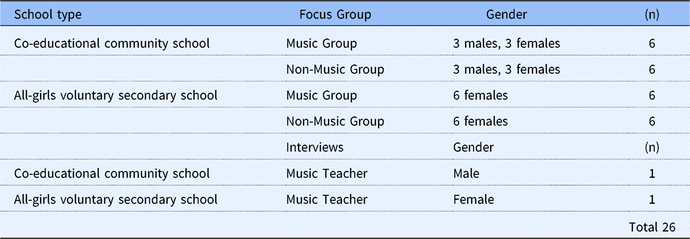
Participants : This research was conducted in the Republic of Ireland and the research sample was selected from two second-level schools. Students aged between 16 and 17 were invited to volunteer to participate in the research. In order to ascertain student attitudes towards the subject of music, particularly selection of the subject for LC, a music and non-music focus group was carried out in each school. The music group consisted of students currently studying senior cycle music and the non-music group included students who had not selected the subject for senior cycle. Each of the focus groups comprised six students. The sample included an all-girls school and a co-educational school; therefore, the focus group composition reflected this (see Table 1). The researcher invited second-level music teachers to participate in the study using an information letter which was distributed to six schools across the north-west of the country. From this population, two teachers consented to take part in the interviews. The interviewees included one male and one female and had 8 and 22 years’ experience, respectively, teaching music at second level.
Details of the focus group and interview participants

Methods
The qualitative research design informed the choice of research methods employed in the present study. Four focus groups were completed with students and two semi-structured interviews with music teachers. Focus groups are useful for gaining a large amount of data within a short time frame. The groups are ‘focused’, in the sense that they share a common experience (Yin, Reference YIN2011, p. 141). This was apparent in the context of the present study where participants from two of the focus groups were studying music for senior cycle and participants from two of the groups were not. Aside from gaining the views of the students, focus groups allow the participants to challenge each other’s reasons for holding a certain view, which can be more interesting than the traditional question and answer approach of interviews (Bryman, Reference BRYMAN2012). Open-ended questions included asking students’ to discuss their understanding and experiences of studying music and music-related activities at second level; particular aspects of these activities that they enjoyed/did not enjoy; factors that affected their decision to choose (or not) music as a subject for senior cycle; musical experiences outside school; and information provided regarding the option to study music. The aim of the interviews was to obtain an in-depth exploration of the music teachers’ opinions’ of student attitudes towards the subject of music. Semi-structured interviews were chosen as the most appropriate interview method as they increase systematic direction for participants, yet the interview remains mainly conversational (Cohen et al., Reference COHEN, MANION and MORRISON2011). Bell (Reference BELL2010) suggests that questions need to be carefully planned to mitigate the inclusion of leading questions, which may lead to interview bias. The authors devised an interview framework that not only included questions regarding students’ attitudes towards the subject of music, but also provided enough scope for exploration of individual perspectives (Bryman, Reference BRYMAN2012).
Data analysis
The present study utilised an inductive approach of thematic analysis where themes and sub-themes were identified through engagement with the transcripts from the focus groups and interviews. The authors engaged in complete coding, a technique outlined by Braun and Clarke (Reference BRAUN and CLARKE2013), where the researchers initially code all the data before becoming more selective with this content at a later stage in the analytic process. The inductive thematic approach to data analysis was guided by the seven-step model as outlined by Braun and Clarke (Reference BRAUN and CLARKE2013), which included transcription, reading and familiarisation, complete coding, searching for themes, producing an index of themes and sub-themes, defining and naming themes and writing up and finalising analysis. The authors acknowledge the limitations of the present study and that it is not possible to generalise the results as school cultures differ. However, to improve the robustness of this small-scale study, purposive sampling ensured a wider range of participation in the present study with the inclusion of four focus groups and two interviews, which generated data from single-sex, co-educational schools and male and female music teachers.
Findings
The following section presents a synthesis of the findings from the focus group and interview data and is presented in three sections: interest in the subject; third-level requirements; and music curriculum, assessment modes and teacher disposition. These findings reflect the major themes which emerged as a result of thematic data analysis.
Interest in the subject
The most prevalent theme which emerged from the focus group discussions was the idea that those students who had an innate or natural interest in the subject of music were most likely to choose it at senior cycle. Students in the non-music focus groups stated that one of the reasons they did not choose music was because they had ‘no interest’ in the subject. In addition to impacting subject choice, students in the music focus groups felt that having an interest in music made it ‘easier’ and was a motivating factor in trying their best to succeed in the subject.
You need an interest in music like. (Lucy, Music Focus Group A)
It’s easier if you have an interest in it. (Tara, Non-Music Focus Group C)
Some participants felt that having an interest or passion for music affected subject choice in a way that did not compare to choosing other subjects such as science. One student suggested that you need to have an interest in music specifically, due to the practical performance element of the course.
It’s not like doing science or that where you might not have a huge interest in it but you’re doing it anyway, like you do need to have an interest … (Grainne, Music Focus Group A)
I think you need to have more of an interest in music [than other subjects] just so that you can put all your work into your practical … you can practice it. (Sophia, Music Focus Group B)
Discussions emerged from focus group data supporting a belief that an intrinsic interest in the subject extended to the ability to sing or play a musical instrument. Some students felt that having the ability to play an instrument was essential to partaking in the subject, with some ruling out their participation in the subject on this sole premise.
I wouldn’t do it if I couldn’t sing or play an instrument. (Tara, Music Focus Group B)
I think that you have to be able to sing or play an instrument to sort of be part of it. (Niamh, Non-Music Focus Group C)
Didn’t play an instrument like so couldn’t really do it. (Andrew, Non-Music Focus Group C)
Students identified that having an existing instrumental ability provides an advantage and would make the course ‘a lot easier’ in terms of understanding the content and with regard to the practical examination.
…if you’re playing an instrument you’re more likely to do it because you hear that there is a practical and you think well I can already do that. (Ruairi, Music Focus Group A)
I think if you’re playing [an instrument], it’ll come a lot easier. (Rachel, Music Focus Group A)
Students who did not study music at senior cycle believed that their peers who chose the subject had a musical talent or a skill. Students who deemed themselves to have ‘no musical talent’ promptly removed themselves from partaking in the subject. One student felt that a lack of musical talent would cause feelings of exclusion in the classroom.
I thought that you had to be talented so it didn’t affect me at all… I think people with no musical talent, they would be just sat there. (Tara, Non-Music Focus Group C)
The ability to play a musical instrument or have some level of musical skill in terms of choosing the subject frequently emerged during the focus group discussions. This led participants to discuss whether students needed to have a certain level of musical skill or competency prior to taking the subject at second level. Both music teachers indicated that no prior musical training was required to take the subject from first year (aged 12–13 years), as they cover basic music theory from the beginning of the course.
Anyone that comes into first year, they can come in with no previous knowledge; you’re just working from there… (Music Teacher A)
No they absolutely do not [need prior musical training], we start from scratch and it’s very easy for them to pick up. (Music Teacher B)
The majority of participants in the music focus groups agreed with the sentiments of the teachers and felt that no prior musical training was needed to take the subject in school. One student described how she had ‘no musical background at all coming into first year’ (Zowie, Music Focus Group B). Others believed that extra tuition would always help but was not a prerequisite for the course.
No you don’t, cos they teach you. (Jennifer, Music Focus Group B)
Like anyone can learn it really if they just try. (Lucy, Music Focus Group A)
Participants in the music group felt that regardless of the students’ existing musical ability, there is time to develop a level of musical skill over the course of the 3 years of the junior cycle. They also believed that the course is quite flexible in terms of students reaching a level of musicality over the duration of the senior cycle syllabus.
I don’t think you need a high ability going into it cos’ that’s what you’re doing in class, you’re gonna learn how to do all the stuff. Maybe though if you had an instrument it might help, but if you don’t you still have three years to learn one. (Roisin, Music Focus Group A)
Some of the participants disagreed, however, and believed that a certain level of musical ability was needed for the practical element of the course at senior cycle.
Yeah for the practical I think you need to have some ability… (Darragh, Music Focus Group A)
The significance of having an existing musical skill or ability appeared to affect students’ perception and selection of the subject of music. In some cases, it appeared to be a barrier for entry to the subject for those who deemed themselves lacking a musical skill, and for those with previous music experience it was an encouraging factor in the selection of the subject.
Third-level requirements
The majority of focus group participants agreed that the requirements for entry into third-level education were a considerable factor in influencing subject choice at senior cycle. Students considered the subject choice of music in terms of what subjects would be most useful to them once they completed second-level education, particularly with regard to their professional careers or in further education.
Some people need it and some people don’t. (Lucy, Music Focus Group A)
I didn’t really know that I wanted to do music as a subject until I found out that this is pretty much what I wanna do for the rest of my life so I had to kind of get the qualification, had to have it on the CV, so that’s pretty much the only reason. (Ruairi, Music Focus Group A)
Some students ruled out the subject on the grounds that it would not be useful to them once they had completed second-level education.
I just wouldn’t have any interest in it after school. (John, Non-Music Focus Group C)
One of the music teachers discussed the issue of timetabling music directly opposite science subjects or languages which are often minimum entry requirements for further education and training programmes.
It all depends on the way it’s lined up with other subjects. Music can often be a subject where people are good at it and they do it but they might not necessarily be pursuing music in college… they’re just doing it maybe because they know they’ll get on well with it and they know they’ll get the points. They might need a science subject or […] a language and straight away that lowers their choices for other things. (Music Teacher A)
One student shared the view of the teacher and describes how science subjects are often prioritised in terms of subject selection due to the requirements for entry into higher education institutions.
Usually the people choose the sciences cos they need it…for college and stuff. (Charlotte, Music Focus Group B)
The issue of timetabling music alongside other subjects appears to remove the subject of music as a choice for students, on the premise that other subjects such as science and languages are required for entry into further education.
Assessment modes, music curriculum and teacher disposition
The practical component of senior cycle music was an appealing aspect of the subject for students and it proved a key factor in selecting the subject for LC. Music students discussed their enjoyment of practical music making, and the equal focus on theory and practical eased the pressure of ‘theory-laden’ learning that they attributed to other subject areas. LC music students complete an examination in composing, performing and listening and they also undertake an elective study. The vast majority of LC students opt to take their elective in performing (SEC, 2012), which results in a 50% allocation of marks for the practical exam and a 50% allocation for the listening and composing exam. All the students in the music focus groups had chosen performance as their elective and they felt that this considerably eased the pressure on them in terms of the exam workload.
Yeah the practical’s done before you walk into the exam so it’s handy. (Oisin, Music Focus Group A)
Yeah it’s less stress because you only have 50% to do in the written exam. (Sophia, Music Focus Group B)
For exams and stuff, it takes off so much of the pressure… to have the practical. (Roisin, Music Focus Group A)
Students felt that the nature of the practical examination was an attractive method of assessment as it veered away from the traditional assessment method of a written examination worth 100%. The practical nature of the subject of music and the performance assessment led to a perception from some of the students in the non-music focus groups that music was an easy option if students had a musical skill as they would perform well in the practical assessment.
I think they find it easier than doing the big theory stuff like biology and that … well if they can sing or that, that’s most of their exam, just doing practical. (James, Non-Music Focus Group C)
Students in the music focus group suggested there is a misconception that the subject is an easy option due to the performance aspect, with one of the music teachers stating that there is a misunderstanding that the subject is solely based on ‘singing’.
People think you just go in and play a few songs, they don’t realise it’s so technical. (Lucy, Music Focus Group A)
The misconception is it’s just choir, it’s just singing so that’s a big one that you always have to counter and fight. (Music Teacher B)
Other students believed that there was a perception that music is not as useful as other subjects such as math, again influenced by the performance element of the subject.
Yeah when you think of maths, it’s all numbers and learning… whereas music, people don’t really think of it as like learning notes and all that kind of thing… I think people don’t see music as necessary, yeah because it’s music like it’s not a serious subject. (Grainne, Music Focus Group A)
Overall, students expressed the opinion that the practical element of the course was appealing in terms of assessment. However, there appeared to be a preconception that ‘singing’ or ‘choir’ was all that the subject involved and if a student had a musical skill they were bound to succeed based on the practical assessment method in the LC exam.
The issue of the relevance of the music curriculum was also raised by participants, with some students suggesting the subject material to be far removed from their own contemporary musical interests.
I was under the impression you’re not learning like modern music, that it’s all just like Mozart and all that. (James, Non-Music Focus Group D)
Music Teacher A echoed this feeling and described how he felt students’ perceptions of curriculum content may affect subject choice. He calls for a more contemporary approach to the music curriculum, in order to make the learning more relevant for students.
I’d say they probably think there’s an awful lot more current stuff going on… I had a girl who transferred from music to technology after the first three weeks and I asked her why; she just said that ‘it wasn’t what I thought it was going to be’ so she had a different idea of what music was going to be… I think there needs to be a lot more stuff that they’re listening to everyday. (Music Teacher A)
Students also identified the teaching style and disposition of the individual subject teacher as a factor which affected subject choice. Focus group participants studying music felt that the teacher positively influenced and cultivated their interest in the subject and the general atmosphere of learning in the classroom.
Yeah cos most people that do it here, they like it because Mr. Y is a good teacher and his teaching style is good, it’s not as stressed as other teachers. (Grainne, Music Focus Group A)
I think if the teacher enjoys it, it helps you enjoy it more. (Lucy, Music Focus Group A)
…we get on really well with Ms. Z… and it’s good to have her from the start as well, that helps a lot. (Jennifer, Music Focus Group B)
Students described how the teachers’ disposition affected their attitudes towards the subject and emotions experienced when entering the classroom.
I think it’s nearly just the teacher because when we had Ms. X in first year… you would stress going in. (Roisin, Music Focus Group A)
I like the class that we had and it was never a class that I was worried going in to … it wasn’t easy but it wasn’t stressful learning. (Grainne, Music Focus Group A)
Discussion
The present study set out to explore student attitudes towards the subject of music in second-level education. Contrary to the findings reported by Bray (Reference BRAY2000) and Harland et al. (Reference HARLAND, KINDER, LORD, STOTT, SCHAGEN, HAYNES, CUSWORTH, WHITE and PAOLA2000), findings from the current study evidence students’ positive disposition towards the subject. Results indicate that a number of factors potentially impact students’ attitudes towards music, including level of interest, musical ability, the teacher’s disposition and the curriculum. Some ways on interpreting these findings will be discussed in two sections: what motivates a student to study music and students’ perceived utility value of the subject.
What motivates a student to study music?
Echoing the findings of Bray (Reference BRAY2000), the most prevalent theme emerging from focus groups data was the view that students needed to have an intrinsic or innate interest in the subject in order to pursue it in second-level school. This interest was strengthened by the ability to sing or play a musical instrument and weakened by a perceived lack of musical ability. Sanz and Orbea (Reference SANZ and ORBEA2014) believe that this is a ‘mistaken social belief’ regarding the ‘need to have a special innate gift to learn music’ (p. 375), a belief which affects students’ willingness to engage with the subject. Equally, Waters et al. (Reference WATERS, MCPHERSON and SCHUBERT2014, p. 3) suggest that a ‘decline in value beliefs during adolescence’ may support a perception that certain academic activities are not valued or viewed as important, and therefore students’ motivation to engage with the subject diminishes. Waters elaborates by suggesting that the literature on music education signifies that this decline in motivation is related to a belief that ability is innate and fixed and that effort cannot change a person’s innate ability. He concludes suggesting that students’ beliefs about their level of musical competency determine their commitment to learning and consequently their value for the subject. Echoing these findings, Lamont and Maton (Reference LAMONT and MATON2008) report that ‘children’s attitudes towards music decline to a larger extent than in other curriculum subjects as they start to perceive musical ability as a fixed entity that not everyone possesses’ (p. 2) or as ‘an elite option requiring both natural ability and special skills’ (Lamont & Maton, Reference LAMONT, MATON and Wright2010, p. 70). In the current study, this ‘fixed mindset’ regarding music ability mindset was evidenced (Dweck, Reference DWECK2007). It is therefore incumbent upon all stakeholders to address these preconceived assumptions as well as work to challenge them throughout the second-level experience – perhaps, by offering all students a taster of the subject of music upon entry to second-level education.
The participants in the music and non-music focus groups along with one of the music teachers commented on the content of the syllabus and how this may affect students’ perceptions of the subject. This finding is interesting in light of the research conducted by Swanwick (Reference SWANWICK1999), who discussed formal and informal music education and who at one point suggested no requirement of a formal curriculum, rationale or list of objectives – aside from ‘the formal systems [which] may be crucial points of access’ (p. 127). Green (Reference GREEN2008, p. 150) considers ‘drawing pupils away from what they already know and into the wider world of music’. Participants in the current study called for a more modern approach with content that is relevant to them. These findings echo results from consultation with young people on junior cycle reform: ‘Those studying music would like to study modern as well as classical music’ (NCCA, 2011, p. 21). Reflective of the arguments leveraged by Swanwick (Reference SWANWICK1968) some 50 years ago and contemporary authors, including Green (Reference GREEN2002a, Reference GREEN and Spruce2002b, Reference GREEN, Clayton, Herbert and Middleton2003), music listed under ‘popular music’ in the current junior cycle syllabus include artists such as ‘The Beatles’ and ‘Ralph McTell’, reflecting perhaps that formal education tends to prioritise ‘serious’ music while largely ignoring ‘popular’ music which may engage students more. Downey (Reference DOWNEY2009, p. 47) suggests that ‘it can be argued that for young people, “their culture” is frequently construed as the popular music culture of their time’. However, it is heartening that in response to these concerns, the new junior cycle music specification (syllabus) allows more flexibility in its approach. The learning outcomes can be met using music material chosen by the teacher, not material specifically listed in the syllabus, which allows teachers to make learning relatable for students. Although this is a way forward in terms of curriculum reform, there has yet to be consultation regarding the Senior Cycle syllabus. Equally of importance is the need for appropriate pre-service and in-service education for music teachers focused on pedagogy that can support a teacher’s experience and learning in the area of popular music (Green, Reference GREEN2002c).
Another factor affecting student attitudes towards the subject of music was the disposition of the subject teacher. The teacher proved to foster a positive or negative view of the subject, in turn affecting students’ subject selection. The importance of the student-teacher relationship has been acknowledged in the education community (Smyth et al., Reference SMYTH, MCCOY and DARMODY2006; Swanwick, Reference SWANWICK2008). Kokotsaki (Reference KOKOTSAKI2017) found that the teacher played an important role in ‘determining the extent to which pupils reported higher or lower levels of satisfaction with school music’ (p. 16).
Assessment modalities
While Bray (Reference BRAY2000) argues that music may be inappropriate to be studied and assessed as an examined subject, perhaps due to the inauthenticity of music and music making in school as compared with out of school (Green, Reference GREEN2006), participants in the music focus groups in the present study expressed a sense of importance regarding the practical exam. Reflective of the national context (where only a small minority of candidates, 0.3% of the total Higher Level candidature, select the option of ‘presenting a Higher Level non-elective performance’ (SEC, 2012, p. 17)), the majority of music focus group students opted to take their elective in performing also. Despite an awareness of the high stakes of the practical exam similar to Kokotsaki (Reference KOKOTSAKI2017), students favoured this assessment mode over the traditional once-off written examination, suggesting that the music practical assessment eased the stress and overall management of their workload during the LC. Swanwick and Franca (Reference SWANWICK and FRANCA1999) offer some caution, however, suggesting that ‘performance can be problematic within the music curriculum unless students are able to work at a technical level where they are able to exercise interpretative judgement and make musical decisions’ (p. 5). Rather, they advocate an integrated music curriculum comprising all three activities. The impetus on assessment was clear from the outset of the current study. When students were asked about their understanding of studying music at second level, one participant’s response was: ‘it’s 50% practical’. The assessment-driven nature of the LC examination is reflected in the attitudes of students towards the subject of music. The State Examinations Commission (assume responsibility for the operation of the State Examinations from the Department of Education and Skills) recognised the lack of coherence between the learning goals of senior cycle and the assessment modes used in the LC examination (GOI, 1999). Petty (Reference PETTY2009), however, iterates the importance of aligning the learning aims and assessment methods for effective teaching and learning. In a consultation with young people on reform of lower second-level education, students shared the desire for a variety of assessment methods and argued that ‘the Junior Certificate exam [at lower second level] is a “memory test” which depends on the cramming of information and is not an accurate account of students’ capabilities’ (Roe, Reference ROE2011, p. 23). This reflects the ‘model of reproduction’ outlined by Lynch (Reference LYNCH1989, p. 29) where schools transmit knowledge for the purpose of assessment. This traditional ideology needs to be challenged. A more flexible approach to assessment would encourage a culture in which learning is assessed formatively as opposed to students ‘cramming’ information within a short time frame for a once-off written assessment. Some solace can be taken from recent developments at lower second level, with the introduction of two classroom-based assessments in the form of a composition portfolio and a programme. The practical performance assessment has increased from 25% to 30%, whilst the allocation of the written examination has been reduced from 75% to 70% (NCCA, 2017). Lund and Fortman Kirk (Reference LUND and FORTMAN KIRK2010) argue that students find performance-based assessments more engaging, as they usually involve real-world tasks and also give students a sense of ownership over their learning which is a powerful motivator. Whilst there remains on-going review of senior cycle provision, the authors recommend that a similar approach to assessment be adopted in senior cycle.
Students’ perceived utility value of the subject
Findings from the current study indicate that student attitudes towards the subject of music are affected by the perceived utility value of the subject. This can be further compounded by parents who view music as unimportant because it lacks vocational value (Bray, Reference BRAY2000) – a perception which can be transmitted to their children. The utilitarian value is ‘determined by future goals, career aspirations, capacity to earn a good income, and acceptance into tertiary education’ (Renwick & Reeve, Reference RENWICK, REEVE, McPherson and Welch2012). Lynch (Reference LYNCH1989) discusses how subject choice at second level can be restricted depending on aspirations for further education and training, suggesting that ‘subject choice is much more limited than it might first appear’ (p. 39). Entrance to further or higher education often carries with it a set of subject requirements such as English, mathematics, Irish, a foreign language and a science-based or business subject which in effect, limits students in their subject choice ‘if they are to have any real occupational choices after school’ (p. 39). Smyth and Calvert (Reference SMYTH and CALVERT2011) note how schools prepare ‘subject packages’ in response to student preferences for subject selection in upper second level, resulting in students making one selection cross a package of subjects, for example, one of History, Geography and French. Using this approach, some students may not get the choices they wanted as certain classes may be over-subscribed; options may clash (Smyth & Calvert, Reference SMYTH and CALVERT2011). Equally, if too few students express an interest in a particular subject that subject may not be provided in that academic year, resulting in some students pursuing the subject outside school. This option, however, is not available for all students.
Although the provision of music education has developed over the last few decades, it remains a subject whose survival relies on communities of music teaching advocates. However, the prevalence and influence of tertiary education entry requirements on subject choice at senior cycle and the preoccupation students have regarding assessment (NCCA, 2015) – both of which are reflected in the present study – can further subjugate the existence and survival of music as a subject in schools. Sanz and Orbea (Reference SANZ and ORBEA2014) illustrate that interest and value in the arts subjects appears to decrease at second level and students invest more time in other subjects. Perhaps, at second level, there is an attitudinal shift towards subjects with a higher perceived cultural capital (Bourdieu & Passeron, Reference BOURDIEU and PASSERON1990) such as math and science, subjects that have the potential to promote social mobility through access to further education. The authors, however, echo the sentiments of Plato advocating the importance of music education, ‘for the patterns in music and all the arts are the keys to learning’.