Introduction
Search strategies and parasitism success involve a series of stimuli that can be chemical, physical or morphological (Vinson, Reference Vinson, Cardé and Bell1984; Vet et al., Reference Vet, Lewis, Cardé, Cardé and Bell1995; Afsheen et al., Reference Afsheen, Wang, Li, Zhu and Lou2008; Conti & Colazza, Reference Conti and Colazza2012). Parasitoids are known to use semiochemicals and they have evolved strategies in the use of those chemicals to increase the efficiency to find their hosts (Vinson, Reference Vinson, Kerkut and Gilbert1985, Reference Vinson1998; Vet & Dicke, Reference Vet and Dicke1992; Steidle & van Loon, Reference Steidle, van Loon, Hilker and Meiners2002; Fatouros et al., Reference Fatouros, Dicke, Mumm, Meiners and Hilker2008). A variety of egg parasitoids species use host pheromones as long-range kairomones to find their hosts and thereby find their eggs (Fatouros et al., Reference Fatouros, Dicke, Mumm, Meiners and Hilker2008; Colazza et al., Reference Colazza, Peri, Salerno, Conti, Cônsoli, Parra and Zucchi2010). For example, exposure to the sex pheromone of Euschistus heros (Fabricius) (Hemiptera: Pentatomidae) unleashes a sequence of motor responses in the parasitoid Telenomus podisi Ashmead [Hymenoptera: Platygastridae (=Scelionidae)] that leads it to the host (Silva et al., Reference Silva, Moraes, Laumann and Borges2006). Similar responses to defensive compounds from metathoracic scent gland secretions of the stink bugs Nezara viridula (L.) (Hemiptera: Pentatomidae) and E. heros were found in the parasitoids Trissolcus basalis (Wollaston) (Hymenoptera: Platygastridae) and T. podisi (Laumann et al., Reference Laumann, Aquino, Moraes, Pareja and Borges2009).
Chemical compounds in the eggs and the chorion may also act as short-range kairomones (Bin et al., Reference Bin, Vinson, Strand, Colazza and Jones1993; Vet et al., Reference Vet, Lewis, Cardé, Cardé and Bell1995). Semiochemicals of Ostrinia nubilalis Hubner (Lepidoptera: Crambidae) and Mamestra brassicae (L.) (Lepidoptera: Noctuidae) eggs are a potential cue for the parasitoid Trichogramma brassicae Bezd. (Hymenoptera: Trichogrammatidae) (Renou et al., Reference Renou, Nagnan, Berthier and Durier1992). The interaction between egg volatiles and chemotaxy of parasitoids has been mainly found in the following pairs hosts and parasitoids: N. viridula/T. basalis (Bin et al., Reference Bin, Vinson, Strand, Colazza and Jones1993), Spodoptera frugiperda (J.E. Smith) (Lepidoptera: Noctuidae)/Telenomus remus Nixon (Hymenoptera: Platygastridae) (Gazit et al., Reference Gazit, Lewis and Tumlinson1996), E. heros/T. podisi (Borges et al., Reference Borges, Costa, Sujii, Cavalcanti, Redígolo, Resck and Vilela1999), Murgantia histrionica (Hahn) (Hemiptera: Pentatomidae)/Trissolcus brochymenae (Ashmead) (Hymenoptera: Platygastridae) (Conti et al., Reference Conti, Salerno, Bin, Williams and Vinson2003) and Sesamia nonagrioides Lefebvre (Lepidoptera: Noctuidae)/Telenomus busseolae Gahan (Hymenoptera: Platygastridae) (Santis et al., Reference Santis, Conti, Romani, Salerno, Parillo and Bin2008).
Most of the active compounds identified are hydrocarbons, but other eggs derived compounds were also found to be active (Colazza et al., Reference Colazza, Peri, Salerno, Conti, Cônsoli, Parra and Zucchi2010). Females of T. brassicae responded in a linear olfactometer to O. nubilalis eggs and to chemical extracts from eggs of O. nubilalis and M. brassicae. The insect responded most readily to a mixture of five synthetic saturated hydrocarbons (heneicosane, tricosane, pentacosane, heptacosane and nonacosane), also to palmitic acid and ethyl palmitate, indicating that different compounds on the host egg may be used for host location (Renou et al., Reference Renou, Nagnan, Berthier and Durier1992). However, in the heteropteran host, the chemical nature of the egg compounds was defined as mucoplysaccharide–protein conjugates (Bin et al., Reference Bin, Vinson, Strand, Colazza and Jones1993), but the chemical identity of this conjugate still needs to be elucidated (Conti & Colazza, Reference Conti and Colazza2012).
Also, the chemical environment of immature stages in the life of the parasitoid may carry over to the adult stage through the Chemical Legacy Hypothesis, which suggests that larval chemical environment will also be found in the hemolymph or the external layer of that host egg (Corbet, Reference Corbet1985). If so, then after emerging from its host, the new adult may recognize the scent of the host. This hypothesis was confirmed upon demonstration of the influence of chemicals in the exoskeleton of the original host on the adult parasitoid choice (Vet & Dicke, Reference Vet and Dicke1992; Van Emden et al., Reference Van Emden, Sponagl, Wagner, Baker, Ganguly and Douloumpaka1996; Storeck et al., Reference Storeck, Poppy, Van Emden and Powell2000). This was related in the chemotaxy of two allopatric populations of Telenomus euproctidis Wilcox (Hymenoptera: Platygastridae) that responded to the sex pheromone of the species in which they developed (Arakaki et al., Reference Arakaki, Wakamura and Yasuda1997). For T. podisi, the presence of lemongrass [Cymbopogon citratus (DC.) Stapf. (Poales: Poaceae)] throughout the immature developmental stage altered the parasitoid chemotaxic orientation and prompted learning in this organism that lasted for up to 72 h (Tognon et al., Reference Tognon, Sant'Ana and Jahnke2013).
The egg parasitoid T. podisi, is an important natural enemy of stink bugs (Pentatomidae) and, as such, regulates populations in a variety of species (Medeiros et al., Reference Medeiros, Schimidt, Loiácono, Carvalho and Borges1997; Pacheco & Corrêa-Ferreira, Reference Pacheco and Corrêa-Ferreira2000; Maciel et al., Reference Maciel, Lemos, Souza, Costa, Barrigossi and Chagas2007; Riffel et al., Reference Riffel, Prando and Boff2010; Tillman, Reference Tillman2010, Reference Tillman2011).
In Brazil, T. podisi is the most abundant natural enemy of E. heros in soybean (Medeiros et al., Reference Medeiros, Schimidt, Loiácono, Carvalho and Borges1997; Godoy et al., Reference Godoy, Galli and Ávila2005) and was observed above 80% parasitism in field (Pacheco & Corrêa-Ferreira, Reference Pacheco and Corrêa-Ferreira2000). In rice crop, the parasitoid is also the most frequent in Tibraca limbativentris Stål (Hemiptera: Pentatomidae) eggs (Maciel et al., Reference Maciel, Lemos, Souza, Costa, Barrigossi and Chagas2007; Farias et al., Reference Farias, Klein, Sant'Ana, Redaelli and Grazia2012; Idalgo et al., Reference Idalgo, Sant´Ana, Redaelli and Pires2013) with parasitism of up to 75% (Riffel et al., Reference Riffel, Prando and Boff2010). Therefore, it is potentially useful for use in biological control of insect pests (Pacheco & Corrêa-Ferreira, Reference Pacheco and Corrêa-Ferreira1998).
The use of parasitoids in biological control of insect pests requires understanding of the mechanisms and factors by which parasitism is mediated, such as how parasitoids find their hosts.
Here, we investigated the possible influence of original host on the chemotaxic behaviour of T. podisi that emerged from T. limbativentris and E. heros eggs. We tested how volatile chemicals from eggs of both hosts and the synthetic sex pheromone (zingiberenol) of T. limbativentris influenced the parasitoid host choice, as well as determined the impact of the original host on parasitism success of T. podisi on these two pentatomids.
Material and methods
We reared insects and carried out bioassays in a controlled condition chamber (26±1 °C, 65±10% relative humidity, 14 h photoperiod), in the Ethology and Insect Chemical Ecology Laboratory, at the Federal University of Rio Grande do Sul (UFRGS).
Acquisition and rearing of the insects
Telenomus podisi
We collected parasitized eggs of T. limbativentris from irrigated rice fields in Eldorado do Sul (30°1′23″S, 51°20′50″W), Rio Grande do Sul, and were then kept in controlled condition chamber until emergence, being the generation used in bioassays. Parasitoids from the host E. heros were obtained from Genetic Resources and Biotechnology Laboratory (EMBRAPA/Cenargen) in Brasilia, DF, Brazil. We continued to rear the parasitoid in this host in the laboratory. Parasitoids were kept in glass tubes (7.5×1.3 cm) sealed with a parafilm and fed with a drop of honey. In our experiments, only females, previously paired with males for 24 h, were used (females approximately 48 h old). Each female was used only once in the experiment.
Tibraca limbativentris
Adults were collected from irrigated rice fields in Eldorado do Sul, kept in wooden cages (27×16×19 cm) and maintained on rice stalks (IRGA 417) that were used for feeding and oviposition. Eggs for bioassays were removed daily.
Euschistus heros
It was reared from eggs supplied from EMBRAPA/Cenargen. Stink bugs were reared and fed following Borges et al. (Reference Borges, Laumann, Silva, Moraes, Santos and Ribeiro2006). Some eggs were used to maintain the colony of T. podisi and some for use in experiments.
Bioassays
Kairomonal action of the sex pheromone of T. limbativentris in T. podisi females
Olfactometry
Behaviour of female T. podisi reared from the eggs of T. limbativentris or E. heros was observed in a double-choice test in a glass, Y-tube olfactometer of 1.4 cm diameter, beginning arena of 16 cm, bifurcated with each branch of 19 cm, under fluorescent (60 W, luminance=290 lux) light. Air flow, after activation with charcoal filtration, was 0.8 l min−1 through a vacuum pump connected to a flow meter and a humidifier. Before the experiment, each female was placed individually in a glass tube (5 ml), fed on a drop of honey and acclimated for 30 min in the test room. Each female was then placed in the arena with a number 0 paint brush.
A female was given either the synthetic sex pheromone of T. limbativentris (1RS, 4RS, 1′RS)-4-(1′,5′-Dimethylhex-4′-enyl)-1-methylcyclohex-2-en-1-ol (supplied and prepared by Miguel Borges, from Genetic Resources and Biotechnology Laboratory (EMBRAPA/Cenargen) in Brasilia, DF, Brazil) or hexane (control). We placed filter paper (4×15 cm/80 g m−2) treated with 5 μl of zingiberenol solution (0.001 μg μl−1) at one end of a branch of the olfactometer, and a filter paper with the same volume of hexane at the other end. Responses were considered positive when parasitoids reached the odour source or entered at least 4 cm within a branch and remained for at least 1 min. Unresponsive females were those that did not move during the first 5 min or did not reach either of the two arms of the olfactometer in 10 min; these were excluded from statistical analysis. The olfactometer was rotated 180° after every three trials, and after six trials, was and washed with a neutral detergent, dried and sterilized at 150 °C. After this procedure, the test substances were changed. Each test was performed at least 40 times.
Semi-field tests
These experiments were carried out in a cage (90×90×200 cm) in an open area (27±2 °C, 72±20% relative humidity) of the Agronomy School (30°05′27″S, 51°40′18″W) of the UFRGS, Porto Alegre, Rio Grande do Sul. The cage contained four rice plants, approximately 30 cm tall, grown on Plantmax® commercial substrate, fertilized with NPK 5-20-20, in plastic pots of 500 ml and watered daily. They were placed in the corner of the cage 1.30 cm apart from each other.
Euschistus heros eggs (n=20, at most 24 h old) were glued on paper with double-sided tape (Scotch®) to a wooden support 30 cm inside the pots, near a plant. Additionally, we placed a piece of filter paper (4×15 cm) adjacent to eggs. To two of the rice plants in the cage we added 10 μl of zingiberenol (0.001 μg μl−1) and to the other two, hexane (control).
We then released into the cage 30 mated female T. podisi whose original host was E. heros, and left the eggs exposed to parasitism for 24 h, after which we removed the eggs and placed them in glass tubes as above. Adult parasitoids emergence was checked daily. There were 15 replicates.
Chemotaxic response of T. podisi to pentatomid egg volatiles
Parasitoids from the eggs of both the stink bug hosts were also tested in the Y-tube olfactometer to choose between the egg volatiles from each species. Eggs at most 24 h old were used. Selected eggs were cleaned of volatiles by submersion in hexane for 5 min, and then dried at ambient temperature. Washed and unwashed eggs of each species (n=20 eggs in each combination) were used as follows. Three pairs of experimental treatments were: (a) unwashed eggs of both T. limbativentris and E. heros, (b) washed and unwashed eggs of T. limbativentris and (c) washed and unwashed eggs of E. heros. Each treatment was repeated at least 40 times.
Parasitism of T. podisi on eggs of T. limbativentris and E. heros
We compared the parasitism success of T. podisi between those whose original host was T. limbativentris and E. heros choosing between both subsequent hosts, through a choice test on eggs with a maximum age of 24 h. A single female parasitoid was reared on a specific host was placed in a glass rearing tube (7.5×1.3 cm), with honey for food. In this tube was also placed a piece of cardboard (1×1.5 cm) with a double-sided tape on which were placed ten eggs each of E. heros and T. limbativentris, and the tube was sealed with parafilm. An identical test was carried out with parasitoids that had been reared from the eggs of T. limbativentris but followed by one generation of E. heros as the original host. After 3 h, each female was removed from the tube and the number of eggs of each species that was parasitized was counted. Each test included, at least, 30 replicates.
Statistical analysis
All comparisons of the treatments were carried out with chi-square (χ2) tests (P<0.05), with BioEstat® 5.0 (Ayres et al., Reference Ayres, Ayres, Ayres and Santos2007).
Results
Kairomonal action of sex pheromones of T. limbativentris in T. podisi females
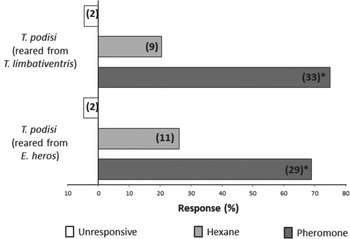
Female T. podisi from E. heros hosts moved more (69.04%) in the direction of zingiberenol rather than to the control (26.19%) (χ2=16.2, df=1, P=0.0001). The same occurred with the parasitoids from eggs of T. limbativentris that chose the sex pheromone (75%) more rather than the control (20.45%) (χ2=27.429, df=1, P=0.0001) (fig. 1).
Comparisons of chemotaxic responses of T. podisi females (reared from T. limbativentris and E. heros) tested in Y-tube olfactometer to sex pheromone of T. limbativentris (zingiberenol) (0.001 μg μl−1) and hexane (control). Numbers in parentheses represent the number of insects responsive or not to treatment. Values followed by an asterisk differ significantly (χ2, P<0.05) from control in each host.

In the semi-field bioassay, the proportion of eggs of E. heros that were parasitized was greater in plants with zingiberenol (68.16%) than with the control (44.5%) (χ2=59.657, df=1, P=0.0001).
Chemotaxic response of the parasitoid to the two host-egg volatiles
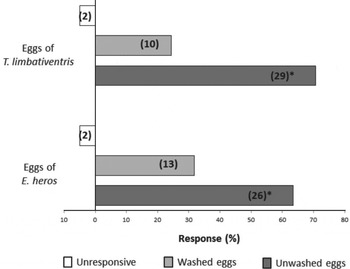
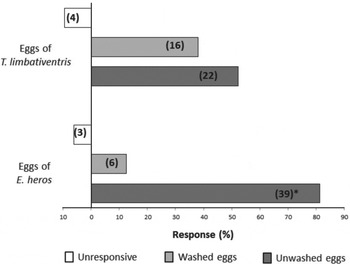
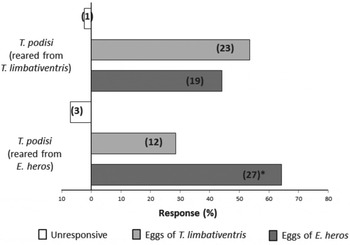
Females that emerged from T. limbativentris chose the branch with unwashed eggs of T. limbativentris and E. heros more often than washed eggs (χ2=18.513, df=1, P=0.0001; χ2=8.667, df=1, P=0.0066, respectively) (fig. 2). Parasitoids that emerged from E. heros eggs chose more unwashed eggs of the same original host (P=0.0001, fig. 3). Parasitoids that emerged from T. limbativentris eggs when exposed to volatiles of unwashed eggs from both hosts did not show preference (χ2=0.762, df=1, P=0.5127). However, parasitoids that emerged from E. heros eggs preferred volatiles from unwashed eggs of their original host (64.28%) compared with volatiles emitted from unwashed T. limbativentris eggs (28.57%) (χ2=11.538, df=1, P=0.0015) (fig. 4).
Comparisons of chemotaxic responses of T. podisi females (reared from T. limbativentris) tested in Y-tube olfactometer to volatiles from eggs washed and unwashed of E. heros and T. limbativentris. Numbers in parentheses represent the number of insects responsive or not to treatment. Values followed by an asterisk differ significantly (χ2, P<0.05) from control in each host.

Comparisons of chemotaxic responses of T. podisi females (reared from E. heros) tested in Y-tube olfactometer to volatiles from eggs washed and unwashed of E. heros and T. limbativentris. Numbers in parentheses represent the number of insects responsive or not to treatment. Value followed by an asterisk differ significantly (χ2, P<0.05) than control to females reared from eggs of E. heros.

Comparisons of chemotaxic responses of T. podisi females(reared from T. limbativentris and E. heros) tested in Y-tube olfactometer to volatiles of unwashed eggs of E. heros and T. limbativentris. Numbers in parentheses represent the number of insects responsive or not to treatment. Value followed by an asterisk differ (χ2, P<0.05) from the control to females reared from eggs of E. heros.

Parasitism of T. podisi on T. limbativentris and E. heros
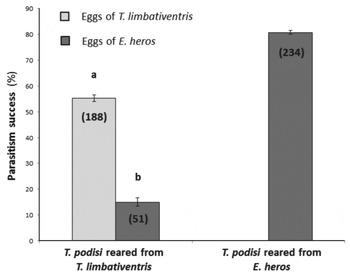
The success of parasitism in the choice tests, of females of T. podisi emerged T. limbativentris, was 15% in eggs of E. heros and 55.29% in eggs of T. limbativentris (χ2=46.2, gl=1, P=0.0001) (fig. 5). In females of T. podisi reared from E. heros eggs the observed parasitism was 82.75%, only in this species (fig. 5). When female T. podisi reared from the eggs of T. limbativentris but followed by one generation of E. heros as the original host, 10.62% of T. limbativentris and 40.62% of E. heros eggs were parasitized (χ2=35.129, df=1, P=0.0001).
Percentage of success parasitism of T. podisi females (from T. limbativentris and E. heros) in choice test to eggs of both hosts. Numbers in parentheses represent the number of emerged insects. Bars followed by different letters within each treatment indicate a significant difference (χ2, P<0.05).

Discussion
Regardless of original host species T. podisi chose more zingiberenol, indicating that T. podisi may use pheromones of different stink bugs as the kairomone. This pattern was also found for T. podisi in relation to pentatomid hosts E. heros (Borges et al., Reference Borges, Schmidt, Sujii, Medeiros, Mori, Zarbin and Ferreira1998, Reference Borges, Costa, Sujii, Cavalcanti, Redígolo, Resck and Vilela1999; Silva et al., Reference Silva, Moraes, Laumann and Borges2006), N. viridula (Laumann et al., Reference Laumann, Aquino, Moraes, Pareja and Borges2009), Podisus maculiventris (Say) and Euschistus obscurus (Palisot) (Bruni et al., Reference Bruni, Sant'Ana, Aldrich and Bin2000). There was no influence of the original host in the chemotaxic response of this parasitoid to the sex pheromone of T. limbativentris, similar results were observed with other parasitoids, such as Hilker et al. (Reference Hilker, Blaske, Kobs and Dippel2000) with Chrysonotomyia ruforum Krausse (Hymenoptera: Eulophidae) that were reared on eggs of Diprion pini L. (Hymenoptera: Diprionidae) to the sex pheromone of Neodiprion sertifer Geoffroy (Hymenoptera: Diprionidae). Indeed, parasitoids can react to kairomones of species of hosts to which they have never come into prior contact (Vinson, Reference Vinson1998; Steidle & Van Loon, Reference Steidle, van Loon, Hilker and Meiners2002). Thus, apparently the response of the parasitoid T. podisi that emerged from E. heros to the sex pheromone of T. limbativentris is an innate response. On the other hand, some parasitoids strongly prefer the pheromones of the original host, such as T. euproctidis that develop in two species of caterpillars (Arakaki et al., Reference Arakaki, Wakamura and Yasuda1997). Thus, the olfactory perception that initiates the chemotaxic response to host pheromones can vary among species.
This two-trophic-level interaction mediated by kairomones is an evolutionary response of the parasitoids. The interception of intraspecific chemical messages (pheromones) associated with the presence of the host, led to greater reproductive success because it improved the efficiency by which the host was found and parasitized (Vinson, Reference Vinson, Cardé and Bell1984). One of the factors that probably mediates chemical communication between herbivores and their parasitoids is the degree of specialization of this interaction. For example, generalist parasitoids tend to use chemical cues from a variety of hosts, while specialist or foretic parasitoids use chemical cues exclusive to their target species (Vet & Dicke, Reference Vet and Dicke1992; Bruni et al., Reference Bruni, Sant'Ana, Aldrich and Bin2000; Meiners et al., Reference Meiners, Westerhaus and Hilker2000; Steidle & Van Loon, Reference Steidle, van Loon, Hilker and Meiners2002; Fatouros et al., Reference Fatouros, Dicke, Mumm, Meiners and Hilker2008). Telenomus podisi is a generalist that parasites eggs of a variety of species of agricultural pest stink bugs, including Euschistus spp. (Medeiros et al., Reference Medeiros, Schimidt, Loiácono, Carvalho and Borges1997; Pacheco & Corrêa-Ferreira, Reference Pacheco and Corrêa-Ferreira2000; Tillman, Reference Tillman2010), N. viridula, Piezodorus guildinii (Westwood) (Hemiptera: Pentatomidae) (Pacheco & Corrêa-Ferreira, Reference Pacheco and Corrêa-Ferreira2000; Tillman, Reference Tillman2011), Oebalus pugnax pugnax (Fabricius) (Hemiptera: Pentatomidae) (Tillman, Reference Tillman2010) and T. limbativentris (Maciel et al., Reference Maciel, Lemos, Souza, Costa, Barrigossi and Chagas2007; Riffel et al., Reference Riffel, Prando and Boff2010).
Although it was not found in the relation chemotactic between the original host and the pheromone, we found that parasitoids that emerged from E. heros were less attracted to egg volatiles of T. limbativentris than those of E. heros. Thus, the parasitoids orientation may have a close relationship with volatile cues associated with the original host, acquired through learning during the development of the immature stage, which remain with olfactory memory into the adult stage (Vet & Dicke, Reference Vet and Dicke1992; Vinson, Reference Vinson1998; Tognon et al., Reference Tognon, Sant'Ana and Jahnke2013). As a consequence, over many generations in the laboratory, parasitoids reared on only one host may become specialists, and thereby decrease or lose their ability to accept other hosts (Salmanova et al., Reference Salmanova, Chernyshev, Olifer, Grinberg and Afonina1993). The same parasitoid species in the field, however, and which were exposed to a variety of hosts probably remains generalist, with the flexibility to parasitize a variety of hosts.
Our results of the kairomonal activity of parasitoids to eggs support the Chemical Legacy Hypothesis (Corbet, Reference Corbet1985). Egg odours associated with the adhesive substances used to glue the eggs together and on the substrate are also the odours used by parasitoids to find their host (Bin et al., Reference Bin, Vinson, Strand, Colazza and Jones1993; Borges et al., Reference Borges, Costa, Sujii, Cavalcanti, Redígolo, Resck and Vilela1999). These adhesives are secretions of proteins and lipids produced in the reproductive system of the female (Gillot, Reference Gillot, Hilker and Meiners2002). This was demonstrated by kairomones found in the eggs of N. viridula that play an important role in the recognition of eggs by the parasitoid T. basalis at short distances, and which can be easily removed by chemical solvents (Bin et al., Reference Bin, Vinson, Strand, Colazza and Jones1993). Female T. podisi find eggs of E. heros and can discriminate between fertile and infertile eggs (suggesting additional chemical cues that identify fertility), demonstrating an important step in the host-recognition process (Borges et al., Reference Borges, Costa, Sujii, Cavalcanti, Redígolo, Resck and Vilela1999).
Similarly, parasitoids that were reared in T. limbativentris prefer to parasitize the same host rather than E. heros, as found in other studies with other species. Similar results have been found with Trichogramma pretiosum Riley (Hymenoptera: Trichogrammatidae) parasitising eggs of different species but which preferred its original host, Anagasta kuehniella Zeller (Lepidoptera: Pyralidae) (Goulart et al., Reference Goulart, Bueno, Bueno and Diniz2011). Also, T. pretiosum reared for several generations in eggs of A. kuehniella, followed by one generation in either S. frugiperda or Anticarsia gemmatalis Hübner (Lepidoptera: Noctuidae), then preferred the new and last original host, S. frugiperda or A. gemmatalis (Goulart et al., Reference Goulart, Bueno, Bueno and Diniz2011).
The lack of parasitism in T. limbativentris by females that emerged from E. heros indicates that a preimaginal conditioning (during the larval state) is associated with that preference (Matthews & Matthews, Reference Matthews and Matthews2010). This occurred in T. pretiosum (a generalist parasitoid) when it did not parasitize eggs of Spodoptera albula (Walker), Spodoptera eridania (Cramer) and Spodoptera cosmioides (Walker) (all Lepidoptera: Noctuiidae) after being reared for several generations in eggs of A. kuehniella (Siqueira et al., Reference Siqueira, Bueno, Bueno and Vieira2012). Another example is the absence of parasitism by T. podisi and Trissolcus urichi Crawford (Hymenoptera: Platygastridae) on N. viridula when the parasitoids were reared in E. heros (Sujii et al., Reference Sujii, Costa, Pires, Colazza and Borges2002).
Importantly, the parasitism success is not only a consequence of semiochemicals, but volume, shape, thickness, colour, hardness of the chorion and nutritional content of the host are also important, as in different herbivore–parasitoid interactions (Hoffmann et al., Reference Hoffmann, Ode, Walker, Gardner, Nouhuys and Shelton2001; Roriz et al., Reference Roriz, Oliveira and Garcia2006; Rukmowati-Brotodjojo & Walter, Reference Rukmowati-Brotodjojo and Walter2006). These factors, however, were not evaluated in this work. Thus, one or more variables could be related to preimaginal conditioning resulting in an increase parasitism of T. podisi, reared from T. limbativentris in eggs of E. heros after a single generation in the latter host.
Laboratory rearing of T. podisi on only one host, for several generations, can make this parasitoid, that in nature, innately, has a generalist behaviour, become in specialist, may prevent the use of the insect in management practices in agroecosystems. Thus, knowledge of the interference of factors that mediate host–parasitoid communication may assist in control biological programmes, allowing greater adequacy and reliability in the use of this tool.
Acknowledgements
This work received financial support from the Brazilian Council for Scientific and Technological Development (CNPq). We thank Maria Carolina Blassioli Moraes, Miguel Borges and Raul Alberto Laumann from Genetic Resources and Biotechnology Laboratory (EMBRAPA/Cenargen, Brasilia, DF, Brazil) for helpful comments and technical support.