Socioeconomic status (SES) is a global concept reflecting individuals’ access to resources based on their income, occupation, and education. Among children and adolescents, growing up in a low-SES family is a risk factor for maladjustment, because the association between low SES and psychopathology crosses generations. Parents experiencing mental health issues as a result of their precarious condition have a harder time providing good parenting to their offspring (Conger et al., Reference Conger, Wallace, Sun, Simons, McLoyd and Brody2002). Children and adolescents from low-SES families present more internalizing, externalizing, thought, and attention problems than do their peers from middle- or high-SES background (Ashford, Smit, van Lier, Cuijpers, & Koot, Reference Ashford, Smit, van Lier, Cuijpers and Koot2008; van Oort, van der Ende, Wadsworth, Verhulst, & Achenbach, Reference van Oort, van der Ende, Wadsworth, Verhulst and Achenbach2011). In addition, the adverse health consequences of low SES in childhood can still be measured years later in adulthood (Cohen, Janicki-Deverts, Chen, & Matthews, Reference Cohen, Janicki-Deverts, Chen and Matthews2010). Among adults, low SES affects individuals’ mental health, as revealed by higher levels of internalizing symptoms and depression, lower levels of happiness and well-being, and higher incidence of dementia (Almeida, Neupert, Banks, & Serido, Reference Almeida, Neupert, Banks and Serido2005; Menec, Shooshtari, Nowicki, & Fournier, Reference Menec, Shooshtari, Nowicki and Fournier2010; Murphy et al., Reference Murphy, Olivier, Monson, Sobol, Federman and Leighton1991; Pinquart & Sörensen, Reference Pinquart and Sörensen2000; Yang, Reference Yang2008). In spite of the tendency for SES to be relatively stable across generations, some children from low-SES backgrounds find their way out of poverty. Child characteristics that contribute to (dis)continuity in SES from one generation to the next were the focus of this study.
A life span perspective on SES requires that various components of this construct (education, income, and occupational prestige) be studied separately rather than be aggregated in a single index of adult adjustment. As a general rule, education is a precursor of occupational status later in adulthood, which itself predicts lifetime income (Dubow, Boxer, & Huesmann, Reference Dubow, Boxer and Huesmann2009; Grubb, Reference Grubb1993; Johnson, Brett, & Deary, Reference Johnson, Brett and Deary2010; Judge, Klinger, & Simon, Reference Judge, Klinger and Simon2010; Schoon, Reference Schoon2008). In this context, educational attainment in early adulthood can be conceptualized as a mediator of the association between early life influences and other SES components that can be reliably measured only at around midadulthood (income, occupation, and neighborhood [dis]advantage). In line with this idea, children's success in school is largely accounted for by a combination of child psychological disposition, competence, and mental health (Beal & Crockett, Reference Beal and Crockett2010; Dubow et al., Reference Dubow, Boxer and Huesmann2009; McLeod & Kaiser, Reference McLeod and Kaiser2004).
The Intergenerational Transmission of SES
Conger and Donnellan (Reference Conger and Donnellan2007) have proposed three developmental theories to account for differences in SES levels in the adult population and for the continuity of SES across generations within families. The social causation model suggests that financial strain creates parental stress and suboptimal parenting practices, whereas financially secure parents are able to build a supportive environment for their children by using the material, social, and educational resources they have access to. It is easier for socioeconomically privileged parents to maintain good psychological health, which has a positive impact on their interactions with their children (see also McLoyd, Reference McLoyd1998). In contrast, the social selection model proposed by Conger and Donnellan (Reference Conger and Donnellan2007) suggests that parents’ financial resources (or lack thereof) have only a spurious association with children's future SES. Instead, parental characteristics that contribute to a higher SES level in the family (e.g., intelligence and skills that open the door to better jobs) are passed on to their children through genes or social learning processes, and individuals who have inherited such characteristics from their parents will be able to secure higher SES levels when they become adults. A third model proposed by Conger and Donnellan (Reference Conger and Donnellan2007), the interactionist perspective, combines elements from the other two models. More important, it is the only model that acknowledges that parenting practices and the contexts created by parents for their children can be influenced by children themselves, thus suggesting that children play an active role in determining the SES level they will reach in adulthood. The interactionist model incorporates the principle of transactional processes as a central element of human development. It also focuses on interaction (i.e., moderation) effects between child characteristics and their social environment. These two aspects of the interactionist model will be discussed in turn.
Transactional processes are mutual and reciprocal exchanges involving individuals and their environment that bring about an interrelated series of changes observable in both the individuals and their context (Bronfenbrenner & Morris, Reference Bronfenbrenner, Morris, Lerner and Damon2006; Cicchetti, Reference Cicchetti1993; Sameroff, Reference Sameroff1975). Transactional models are a subtype of mediation model in which the variables are not simply predictors, mediators, or outcomes; rather, the variables play all these roles in sequence during a certain period of time (Véronneau & Vitaro, Reference Véronneau and Vitaro2007). One example would be the reciprocal influences between parents who engage in stimulating activities with their young children, who enthusiastically participate in those activities. As a response, parents bring up the level of cognitive stimulation they provide to their children, who develop greater cognitive aptitudes, thus requiring the parents to continuously adjust to their child's ability.
Even though transactional processes can be captured only by repeated measures, a transactional model can also be used as an underlying theoretical framework that guides research questions about global and long-term development. According to Conger and Donnellan (Reference Conger and Donnellan2007), the interactionist perspective suggests that a more advantaged family context provides more resources to children, which enables them to develop skills and behaviors that support their academic success. These skills may include emotion regulation, prenumeracy and preliteracy, and the ability to use certain tools (pencils, books, and computers). Later on, children can influence their parents, teachers, and peers to support them in academic activities because they have learned how to control inappropriate social behaviors (e.g., excessive aggression or withdrawal), how to be friendly, and how to focus and learn in structured contexts.
An important complement to the interactionist perspective was later added by Donnellan, Conger, McAdams, and Neppl (Reference Donnellan, Conger, McAdams and Neppl2009), who pointed out that children's individual characteristics can also play a moderating role in the intergenerational transmission of SES. In contrast with transactional effects, which represent the mechanisms through which certain variables influence each other over time, moderation effects represent the contexts in which certain variables exert their influence. To illustrate, children's academic competence is a mediator of parents’ SES if the family resources (e.g., access to better schools and private tutors) enable the child to develop the academic skills needed to attend college and subsequently obtain a prestigious and well-paid job. Conversely, a child's academic competence is a moderator of parents’ SES if it is a necessary condition for parents’ SES to be transferred to their child. If children of high-SES families reach high SES themselves as adults only if they have sufficient academic competence to benefit from the educational opportunities provided by their parents, then the child's academic competence is a moderator of parents’ SES. In terms of intergenerational continuity, children's academic competence may be involved in mediational and moderational processes simultaneously.
Only a few studies have evaluated children's own influence on their future SES level (Conger, Conger, & Martin, Reference Conger, Conger and Martin2010). Extant research tends to support the hypothesis that children's characteristics (e.g., academic achievement, mental health, antisocial behavior, and personality characteristics) play a mediating role in the relation between parents’ SES and children's future SES (Haas & Fosse, Reference Haas and Fosse2008; Martin et al., Reference Martin, Conger, Schofield, Dogan, Widaman and Donnellan2010; Schofield et al., Reference Schofield, Martin, Conger, Neppl, Donnellan and Conger2011; Schoon et al., Reference Schoon, Bynner, Joshi, Parsons, Wiggins and Sacker2002; Trentacosta et al., Reference Trentacosta, Neppl, Donnellan, Scaramella, Shaw and Conger2010; Wickrama, Conger, Lorenz, & Jung, Reference Wickrama, Conger, Lorenz and Jung2008). Past studies have focused mostly on a single aspect of child adjustment at a time, which raises the question whether distinct aspects of child adjustment (i.e., both in the social and academic domains) could contribute independently to the prediction of their future SES. In addition, the possibility that children's characteristics could act not only as mediators but also as moderators has been raised, but has received little empirical attention (Bradley & Corwyn, Reference Bradley and Corwyn2002). On the one hand, children's adaptive characteristics, like their academic competence or social skills that promote their social integration, could protect them from negative outcomes usually associated with growing up in a socially and economically disadvantaged family. On the other hand, emerging psychopathology (e.g., internalizing and externalizing symptoms) could prevent children from benefiting from the advantages of growing up in a middle- or high-SES family. In both cases, children's characteristics could help account for the discontinuity in SES across generations.
Because of the close association between education and employment opportunities, students’ academic competence and educational attainment represent important variables that may lead to higher SES levels in adulthood and that could lead to a brighter future for some children who grew up in poverty. Academic engagement and achievement are known predictors of educational attainment (Hardy et al., Reference Hardy, Shapiro, Mellits, Skinner, Astone and Ensminger1997; Marjoribanks, Reference Marjoribanks2005; Melby, Conger, Fang, Wickrama, & Conger, Reference Melby, Conger, Fang, Wickrama and Conger2008). In addition, positive social adjustment may contribute to social mobility through its impact on educational success: having good social skills and low levels of aggressive behaviors improves children's chances of reaching high academic achievement and decreases their risk for grade retention and school dropout (Agostin & Bain, Reference Agostin and Bain1997; Jimerson, Ferguson, Whipple, Anderson, & Dalton, Reference Jimerson, Ferguson, Whipple, Anderson and Dalton2002). In contrast, externalizing disorders may negatively affect educational attainment and subsequently compromise SES because they increase risks of problem drinking, unemployment, early parenthood, and instability in one's career path (Caspi, Elder, & Bem, Reference Caspi, Elder and Bem1987; Kokko & Pulkkinen, Reference Kokko and Pulkkinen2000; Kokko, Pulkkinen, Mesiäinen, & Lyyra, Reference Kokko, Pulkkinen, Mesiäinen and Lyyra2008; Miech, Caspi, Moffit, Wright, & Silva, Reference Miech, Caspi, Moffitt, Wright and Silva1999; Serbin et al., Reference Serbin, Temcheff, Cooperman, Stack, Ledingham and Schwartzman2011). Internalizing symptoms (e.g., social withdrawal) may also contribute to lower educational attainment, although mixed findings have emerged (Parker & Asher, Reference Parker and Asher1987; Rapport, Denney, Chung, & Hustace, Reference Rapport, Denney, Chung and Hustace2001; Risi, Gerhardstein, & Kistner, Reference Risi, Gerhardstein and Kistner2003). Lack of attention to possible gender differences may generate inconsistent results. Caspi, Elder, and Bem (Reference Caspi, Elder and Bem1988) found that shy boys were less successful in reaching major adult milestones in their family life and career, whereas shy girls were just as adjusted as their outgoing peers. In sum, various individual child characteristics have been identified that can help predict and understand their course toward high or low SES in adulthood. Nevertheless, many factors in their global environment can also play a role, as discussed below.
Sociohistorical Factors Facilitating Upward Mobility in SES From Parents to Offspring
The intergenerational continuity of SES is largely associated with familial factors, but sociohistorical factors can also influence the extent to which individuals can change their position within the hierarchy of their social group, relative to their origins (Beller & Hout, Reference Beller and Hout2006). This idea is consistent with the bioecological model (Bronfenbrenner & Morris, Reference Bronfenbrenner, Morris, Lerner and Damon2006) that suggests that macrosystems influence individual development, as shown in several studies. For example, Schoon et al. (Reference Schoon, Bynner, Joshi, Parsons, Wiggins and Sacker2002) observed that in spite of an overall improvement in material conditions for individuals born in the United Kingdom in 1970 beyond conditions of a cohort born in 1958, socioeconomic inequalities between children raised in low- versus high-SES families were more pronounced in the 1970 cohort. Thus, social mobility decreased over time, making it harder for the 1970 cohort to move up the social scale than it had been for the 1958 cohort. However, global interventions have also proven to benefit those who have the greatest needs. For example, the Child–Parent Center Education Program offered to inner-city Chicago families targeted low-SES families to help break the cycle of poverty and had enduring positive consequences for the children, as shown by higher levels of SES once they became adults and up to 25 years after receiving the program (Reynolds, Temple, Ou, Arteaga, & White, Reference Reynolds, Temple, Ou, Arteaga and White2011).
When education is made more accessible to an entire population through significant changes in governmental policies, some individuals may be in a better position than others to take advantage of these new opportunities and thus increase their status within their society, whereas others have a hard time increasing or even maintaining their position. Historical periods when social policies and the job market undergo radical changes and restructuring can represent “natural experiments” that facilitate the study of individual factors that play a role in the (dis)continuity of SES across generations. The historical period following the Quiet Revolution in the Canadian province of Québec therefore presents an interesting opportunity to investigate those questions.
In the mid-1950s through the mid-1960s, the Canadian province of Québec witnessed political events and social movements that worked together to open up new educational and economic opportunities for Québécois children who were born around this time (Lacoursière, Provencher, & Vaugeois, Reference Lacoursière, Provencher and Vaugeois2011). Until then, people living in the only predominantly French-speaking province in Canada had been occupying mainly low-status, agricultural, and working-class occupations. In the 1960s the Québécois people experienced the Quiet Revolution (Langlois, Reference Langlois1992). A new government put in place social policies that led to expanded opportunities for secondary schooling and the creation of a new system of colleges and public universities that facilitated the population's access to higher education. As a consequence, children born in the 1960s and 1970s were able to get the education required to access positions that provided better income than those of their parents. Because of technological innovations that decreased the demand for manual labor, jobs in industry and trade became increasingly common. As a result, the increase in SES across the Québec population narrowed the gap between Québec and other Canadian provinces.
The possibility for greater variation in SES outcomes for Québécois children growing up in the 1960s and 1970s than for those who grew up earlier or later on makes this historical period particularly well suited for identifying personal characteristics that help individuals improve their own social condition versus those that precipitate the deterioration of their situation relative to that of their age cohort, and also relative to their family background. These issues are quite relevant today, considering global changes in the structure of job markets. The increasing demand for a well-trained and educated workforce is not restricted to developed countries, such as Canada, the United States, and Western European countries, because the number of qualified workers in developing economies also does not meet employers’ needs (Sondergaard, Murthi, Abu-Ghaida, Bodewig, & Rutkowski, Reference Sondergaard, Murthi, Abu-Ghaida, Bodewig and Rutkowski2012).
This Study
Following the interactionist model (Conger & Donnellan, Reference Conger and Donnellan2007), we examined whether children's characteristics played mediating and moderating roles in the (dis)continuity of SES from one generation to the next, by studying 503 families followed during a 30-year period and including two generations. The second generation (G2) in this sample attended school in the 1970s and 1980s, following the educational reforms introduced in the 1960s and early 1970s. Our first hypothesis was that SES indicators measured from G2 participants are significantly higher than those measured from their parents, Generation 1 (G1). Our second hypothesis was that emerging psychopathology from middle childhood to early adolescence, taking the form of high levels of aggression and social withdrawal as reported by peers, mediates the association between G1 SES and G2 educational attainment. In turn, G2 educational attainment was hypothesized to predict G2 adult SES. Adaptive child characteristics (academic competence and likeability) were also included as mediators. Our third and most important hypothesis relevant to this Special Section about “the influential child” was that intergenerational transmission of SES from G1 to G2 is moderated by child characteristics. We tested interactions between each component of G1 SES (occupational prestige, educational attainment, and neighborhood risk) with children's aggression, social withdrawal, likeability, and academic competence in the prediction of G2 participants’ educational attainment. Based on the work by Caspi et al. (Reference Caspi, Elder and Bem1988), we also hypothesized that the moderating effect of social withdrawal would have different effects on boys than on girls, such that it would accentuate the risk of reaching low educational attainment among boys but not among girls.
Method
Overview of the design and procedures
Participating families were originally screened and selected between 1976 and 1978, when the G2 participants (then age 7–13 years) were attending French-language public schools serving lower income, inner-city neighborhoods of Montreal. Records of standardized educational testing were obtained from official records at the end of the academic year in which the child participated in the screening procedure. Phone and home interviews were conducted with the child's family to obtain demographic information (e.g., G1 participants’ educational attainment and occupation). This information was updated by periodic phone interviews with the G1 during G2 participant's childhood and with the G2 participants themselves in adulthood. Educational attainment and SES measures for the G2 participants were taken from interviews conducted in the mid-2000s, when the participants were in their middle to late 30s.
Participants
Initiation of the Concordia Project and identification of the original sample
In school years 1976–1977 and 1977–1978, the Concordia Longitudinal Risk Project began with the screening of 4,109 francophone school children (excluding special education classes) in Grade 1 (born in 1969–1970), Grade 4 (born in 1966–1967), and Grade 7 (born in 1963–1964). These children lived in lower socioeconomic, inner-city areas of Montreal, Québec, Canada. Participation in the screening was voluntary, and more than 95% of the students consented to participate. Following screening, 1,770 children were selected for inclusion in an intensive longitudinal study, including approximately equal numbers of boys (n = 861) and girls (n = 909) across all grade levels (see Schwartzman, Ledingham, & Serbin, Reference Schwartzman, Ledingham and Serbin1985, for detailed descriptions of the original selection procedures).
Description of the participating subsample for this study
The subsample for this study comprised 503 (220 males, 283 females) ongoing G2 participants in the Concordia Project whose complete information regarding G1 and G2 educational attainment and SES was available. In this subsample, 171 G2 participants came from the original Grade 1 cohort (M age = 7.10, SD = 0.41), 154 participants were in Grade 4 (M age = 10.23, SD = 0.58), and 178 participants were in Grade 7 (M age = 13.22, SD = 0.61). The mean age of the total sample at the time of recruitment was 10.23, SD = 2.61. At the time of the midadulthood data collection (2002–2005), the participating G2 sample had a mean age of 37.06 years (SD = 2.62). Although there was a relatively wide age range among G2 participants at the first assessment, we chose to combine them into a single sample for our analyses considering that we used age-normed measures for those characteristics, such that children's ratings were in relation to same-age peers. Furthermore, a comparison of correlations among study variables before and after partialling out the effect of age revealed that these associations were not influenced by participants’ age.
To evaluate the representativeness of the current subsample of 503, the participants were compared and found not to differ significantly from the original Concordia longitudinal G2 sample of 1,770 in terms of childhood behavioral characteristics (i.e., aggression, social withdrawal, likeability, or academic achievement scores; see below). They also did not differ from the original sample in terms of educational attainment and SES or in regard to age/sex distribution.
Measures
G1 SES
Three components of SES were assessed for G1 participants at the time of original recruitment (1976–1978): occupational prestige, neighborhood risk, and educational attainment. To examine intergenerational continuity in education specifically, we kept educational attainment separate from the two economic indicators. In turn, the two remaining indicators were insufficient to generate a global economic–occupational factor for the G1 participants, so the three measures were kept separate in the analyses.
Occupational prestige was computed based on the highest of the paternal and maternal occupational prestige scores. Scores for G1 occupational prestige ranged from 18.2 (laundry or dry-cleaning operative) to 81.2 (physician; Nock & Rossi, Reference Nock and Rossi1979). For neighborhood risk, block-enumerated census tract data (Statistics Canada, 2001) provided the following sociodemographic information: percentage of households within the immediate neighborhood of the G1 family residence in 1976 (a) headed by a single parent, (b) with total household income below the poverty line, (c) whose head of household had less than a Grade 10 level of education, and (d) whose head of household was unemployed (Roos, Magoon, Gupta, Chateau, & Veugelers, Reference Roos, Magoon, Gupta, Chateau and Veugelers2004). These scales were combined into a neighborhood risk factor. Factor loadings for those components were 0.870 (single parenthood), 0.922 (low income), 0.647 (low education), and 0.912 (unemployment), together explaining 71.4% of the variance. Sampling adequacy was 0.742. This sample was disadvantaged compared with the rest of the population on all components except the last one (i.e., head of household being unemployed). In addition, both parents reported about their total years of schooling, and the data from the most highly educated parent were used for G1 educational attainment.
G2 childhood aggression, social withdrawal, and likeability
The children were rated on the dimensions of aggression and social withdrawal by means of a French translation of the Pupil Evaluation Inventory (PEI; Pekarik, Prinz, Liebert, Weintraub, & Neale, Reference Pekarik, Prinz, Liebert, Weintraub and Neale1976), which is a peer nomination instrument. The PEI consists of 34 items that load onto three factors: aggression (20 items), withdrawal (9 items), and likeability (5 items). Scale scores on the PEI have been shown to be highly reliable, that is, typically greater than 0.90, including internal consistency coefficients, split half comparisons, and test–retest measures (Pekarik et al., Reference Pekarik, Prinz, Liebert, Weintraub and Neale1976; Schwartzman et al., Reference Schwartzman, Ledingham and Serbin1985). Items within each scale are very highly intercorrelated. Alpha coefficients for the study sample were 0.975, 0.920, and 0.900 for aggression, withdrawal, and likeability, respectively. Sample items for the aggression factor include “those who are mean and cruel toward other children” and “those who fight all the time and get into trouble.” Items in the withdrawal factor include “those who are too shy to make friends easily” and “those who usually don't want to play with others.” Likeability items include “those who are liked by everyone” and “those who are especially nice.”
The number of nominations received by each child within a class was summed to compute the aggression, withdrawal, and likeability scores, based on the above-mentioned factors. Scores were standardized within sex and class to control for gender differences and class size in base rates of each factor. This procedure enabled appropriate comparisons of each child against relevant norms for gender and age, enabling us to combine participants of different ages at the study onset into a single group for our primary analyses. For a more extensive description of the original methodology and characteristics of the sample, see Schwartzman et al. (Reference Schwartzman, Ledingham and Serbin1985, Reference Schwartzman, Bukowski, Hastings, Serbin, Stack and Ledingham2015) and Serbin et al. (Reference Serbin, Cooperman, Peters, Lehoux, Stack and Schwartzman1998). The aggression and social withdrawal scales of the PEI were validated by Lardon and Jason (Reference Lardon and Jason1992) in relation to teacher reports of externalizing and internalizing dimensions (Achenbach & Edelbrock, Reference Achenbach and Edelbrock1983). Serbin, Lyons, Marchessault, Schwartzman, and Ledingham (Reference Serbin, Lyons, Marchessault, Schwartzman and Ledingham1987) also validated these scales in relation to quantitative observational measures of children's behavior.
G2 academic achievement
Standardized tests of children's ability in mathematics and language arts (French first-language reading and writing) were obtained from the results of standardized testing by the school board in the year of their identification for the project (i.e., 1976–1977 or 1977–1978). Scores are reported in stanines with a population mean of 5 and a standard deviation of 1.
G2 SES
For G2 participants, three economic–occupational indicators of SES were available: occupational prestige, family income, and neighborhood risk. This number of indicators was sufficient to test for the factorial structure of a global SES index, which was deemed satisfactory: factor loadings for each of the components are 0.813, 0.811, and −0.630 for income, occupational prestige, and neighborhood risk, respectively, with a sampling adequacy of 0.603 (Kaiser–Myer–Olkin) and 57.1% of the variance explained. The global SES economic index was therefore retained for analyses. G2 educational attainment was kept separate from this economic–occupational index.
To measure G2 occupational prestige, we used the same scale as that used for G1 participants (Nock & Rossi, Reference Nock and Rossi1979). The G2 occupational prestige scores (ages 34–40) ranged from 18.4 (cleaners and charwomen) to 78.3 (university/college teacher). G2 participants reported on their family income, taking into account both their own and their partner's income. For neighborhood risk, block-enumerated census tract data (Statistics Canada, 2007) provided the same sociodemographic information as that for G1 neighborhoods. Again, the four scales were combined into a neighborhood risk factor. The educational attainment variable was measured using G2 participants’ self-report of the total number of years of schooling completed.
Procedures
At its initiation, the study was approved by the research committee of the participating school board and by the administration and the teachers’ and parents’ committees of each participating school. Subsequently, Concordia University's institutional review board's approval was obtained each time data collection was carried out.
Initiation of the study (between 1976 and 1978)
Within each classroom, boys and girls were rated on the PEI (Pekarik et al., Reference Pekarik, Prinz, Liebert, Weintraub and Neale1976) in separate administrations. Children were asked to nominate as many as four boys and four girls in their class (from class lists) who best matched each item on the PEI. At the end of the school year in which the PEI was administered, the standardized achievement scores were obtained from the school board.
Procedures for obtaining education and SES information
Participating families were contacted and interviewed by phone during the year following their original selection (i.e., in 1976–1978) to obtain G1 educational and occupational information as part of a broad assessment of family functioning. The data used for adult G2 educational attainment and SES outcomes in our study were drawn from interviews with the G2s in the mid-2000s, when the sample ranged in age from 34 to 40.
Analytic strategy
Our hypothesis about the increase in SES from G1 to G2 was tested using paired-sample t tests on measures of educational attainment and occupational prestige, using the SPSS software version 21. Our hypothesis that G2 psychopathology and adjustment in childhood would mediate the relationship between G1 SES and G2 adult SES was tested using structural equation modeling (SEM) with EQS software version 6.1. Hypotheses about G2's childhood characteristics as moderators of the impacts of G1 SES on G2 adult SES were tested using interaction terms in regression analyses conducted with the SPSS software version 21, and subsequently confirmed by adding these interactions in the SEM model.
Results
Preliminary observations on the sample composition
This sample is of particular interest when studying the factors contributing to the continuity and discontinuity of SES from one generation to the next, because of the relatively disadvantaged socioeconomic conditions of the families in which G2 children were raised and their potential for substantial change in those conditions by the time they reached adulthood. Preliminary results will be presented to describe the socioeconomic conditions of this sample relative to Québec provincial averages.
When comparing G1 participants’ schooling reported in 1976 with education reported by a representative cohort of Québécois ages 55–64 years in 1996 (Institut de la Statistique du Québec, 2001), we find that the number of individuals who had not completed their Grade 9 education in our G1 sample (51.0%) is significantly higher than what was common in the general population among this generation (37.2%), according to a nonparametric binomial test (p < .001). This finding held for men (52.6% in our sample, compared with 36.0% in the population, p < .001) and for women (49.2% in our sample, compared with 38.3% in the population, p < .001). This confirms that our sample was generally disadvantaged. Data from our G2 sample revealed that these participants were still significantly less educated than the Québec average for their generation, with 27.5% of G2 participants having no secondary school diploma, compared with 19.4% in the overall population (p < .001). This finding held for men (31.1% in our sample, compared with 21.3% in the population, p < .001) and for women (24.8% in our sample, compared with 17.3% in the population, p < .001). This suggests that there is some continuity in the relative disadvantage of these families, even if a comparison between G1 and G2 participants suggests that the situation of the new generation was significantly better than that of their parents.
Descriptive statistics for G2 participants
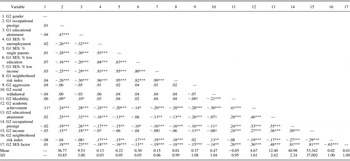
We conducted t tests on all variables, and these revealed only one small but significant gender difference: girls’ academic achievement (M = 4.83, SD = 1.59) was higher than boys’ (M = 4.47, SD = 1.49), t (201) = –2.52, p = .01, d = –0.36 (a small effect size). Means and standard deviations for all variables were computed on the full sample and are presented in Table 1, along with correlations among variables. They show that G1 variables are correlated in the expected direction and are also correlated with G2 childhood academic achievement and with G2 educational attainment and SES in adulthood. G2 academic achievement is also correlated with every other childhood characteristic in the expected direction (positively related to likeability but negatively related to aggression and social withdrawal). Children presenting higher aggression scores were rated as marginally less likeable than their peers, but aggression was not significantly correlated with withdrawal issues. Social withdrawal was negatively related to likeability. G2 educational attainment was related to all G2 childhood characteristics, but withdrawal was only marginally related to lower educational attainment. G2 SES was related to all childhood characteristics in the expected directions. It is noteworthy that educational attainment and occupational prestige among G2 males and females were not significantly different within this generally low-SES sample.
Descriptive statistics and correlations

Note: G2, Generation 2; G1, Generation 1; SES, socioeconomic status.
†p < .10. *p < .05. **p < .01. ***p < .001.
For comparison purposes, we also explored gender differences in schooling and occupation status for G1 males and females. No significant gender differences emerged in mothers’ and fathers’ years of education, with an average of 8.52 years for mothers (SD = 2.80) and 8.61 years for fathers (SD = 3.42). However, there existed a significant difference in the prestige of the occupations held by G1 men and women, t (839) = 6.30, p < .001, d = 0.44 (a small to medium effect size), in that mothers more often occupied lower level positions (M = 30.00, SD = 9.07) than did fathers (M = 34.60, SD = 11.71). Note that the numbers presented here for G1 men and G1 women educational attainment and occupational prestige are lower than the mean scores presented in Table 1 because in our main analyses, we used measures taken from the one parent who had reached the highest education and the highest occupational prestige levels.
Change in SES from G1 to G2
The correlations presented in Table 1 reveal a modest but highly significant level of intergenerational continuity in SES indicators from G1 to G2. Occupational prestige and neighborhood risk measured for G1 participants correlated with the G2 measures at r = .19 and .18 (p < .001), respectively. These correlations reflect small effect sizes; however, a medium-sized effect emerged for the intergenerational continuity in educational attainment, r = .32 (p < .001). It is noteworthy that these G1 indicators of SES are all significantly associated with the same indicators as measured in G2 participants, except for G1 occupational prestige and educational attainment, which do not predict G2 neighborhood risk.
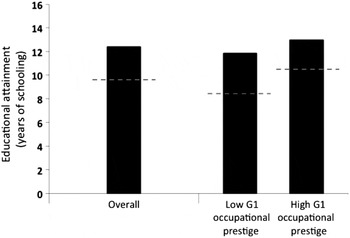
Beyond these findings regarding observed continuity in SES within families, a more interesting question is whether global changes in SES indicators occurred from one generation to the next. In line with our first hypothesis, paired-sample t tests showed that the average occupational prestige score for G1 participants (M = 36.77, SD = 10.85) was significantly lower than for G2 participants (M = 40.98, SD = 12.24), t (502) = 6.41, p < .001, d = 0.29 (a small effect size). Similarly, significantly fewer years of education were completed by G1 participants (M = 9.53 years, SD = 3.00) than by G2 participants (M = 12.40 years, SD = 2.62), t (502) = 19.62, p < .001, d = 0.88, an increase of nearly 3 years between generations (a large effect size). These results are even stronger when considering that occupational prestige and educational attainment in G1 were coded as the maximum level reached by either of the parents. Figure 1 shows G1 and G2 educational attainment in the overall sample and as a function of G1 occupational prestige. In this graph as in the following, the bars represent G2 participants’ educational attainment, whereas the dotted horizontal lines represent G1 educational attainment, thus showing the difference in educational attainment not only across subgroups of G2 participants but also between participants from each of these subgroups and their parents.
Child educational attainment (bars) and parental educational attainment (dotted lines) for the overall sample and for families in which parents have low versus high occupational prestige.

Modeling the intergenerational continuity of SES within families
We modeled the intergenerational continuity of SES using SEM. We evaluated model fit using Hu and Bentler's (Reference Hu and Bentler1999) guidelines, according to which good model fit is reached when the chi-square value is nonsignificant, comparative fit index (CFI) values are at 0.95 or more, root mean square error of approximation (RMSEA) values are at 0.06 or less, and standardized root mean square residual (SRMR) values are at 0.08 or less.
Building the initial model
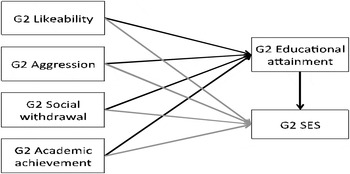
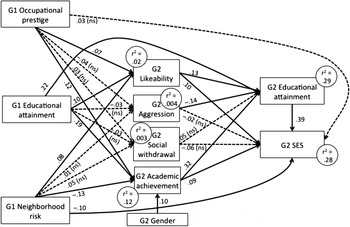
Because of the longitudinal nature of the model that involves several key transition points at which specific mediators are expected to play a role either in the transmission of SES or in a process of shifting familial predispositions, we built the initial model in two steps. Step 1 (Figure 2) involved a preliminary test of G2 childhood characteristics as predictors of G2 adult outcomes (educational attainment and SES). From past studies, it was not clear whether we should have expected the relationship between childhood characteristics and adult SES to be entirely mediated by educational attainment, or if we could expect childhood characteristics to predict SES independently of educational attainment. Therefore, these two possibilities were statistically contrasted. In both models, there was a direct path from G2 educational attainment to G2 SES. A first model was tested that included only paths from G2 childhood characteristics to educational attainment (black arrows in Figure 2) and that represented the influence of childhood characteristics on adult SES, which is fully mediated by educational attainment. In a second model representing a partial mediation of the association between G2 childhood variables and G2 SES, we also included all paths representing the direct influence of G2 childhood characteristics on future SES and educational attainment (black arrows and gray arrows in Figure 2). The fit of these two models was statistically compared to help us decide which one would be included in the broader model to be tested in Step 2. The chi-square difference test revealed that the partial mediation model (with direct paths from childhood characteristics to SES and to educational attainment) had a better fit than did the full mediation model, χ2 (4) = 21.61, p < .001. Therefore, the partial mediation model was used as a basis to develop a broader model in Step 2.
Building the initial model: Step 1. Two models were compared: the full-mediation model, including only the paths that are depicted in black arrows, and the partial mediation model, including the paths that are depicted in black and gray arrows. In both models, autocorrelations among childhood characteristics are also included.

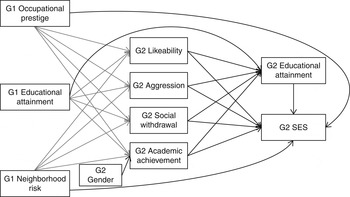
In Step 2 (Figure 3), we started with the best fitting model from Step 1 and added G1 predictors. On the basis of past studies showing significant continuity between years of education and SES across generations, we ran a “direct effect” model, which included three direct paths from G1 characteristics and their corresponding variable in G2 (see the three black arrows from G1 variables to G2 educational attainment and G2 SES). Then, we tested the “mediated effect” model, which also included the 12 paths from G1 characteristics to G2 childhood characteristics (depicted by gray arrows in Figure 3). This model represents the partial mediation of G1 influences to G2 educational attainment and SES through the characteristics displayed by G2 participants in childhood. The fit of these two models was statistically compared, and the chi-square difference test revealed that the mediated effect model (with direct paths from G1 variables to G2 childhood characteristics) had a better fit than did the direct effect model, χ2 (12) = 73.04, p < .001. Therefore, all the paths presented in Figure 3 were used in the initial model.
Building the initial model: Step 2. Two models were compared: the direct effect model, including only the paths that are depicted in black arrows, and the mediated effect model, including paths that are depicted in black and gray arrows. Autocorrelations among childhood characteristics and among parental characteristics are also included in both models.

Building the final model
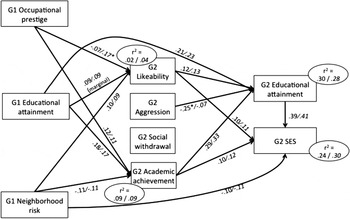
Fit indices indicate that the initial model provided an adequate fit to the data, χ2 (11) = 8.47, p = .67, CFI = 1.00, RMSEA = 0.00, and SRMR = 0.02 (see Figure 4). Although model fit was adequate, we inspected modification indices to see whether a more parsimonious model could still offer an adequate fit to the data. Lagrange multiplier tests revealed that many paths included in the initial model were not significant, so they were removed one by one to yield a more parsimonious model with possibly better fit. Fit indices for the trimmed model appeared to be just as good as those for the initial model, χ2 (22) = 18.06, p = .70, CFI = 1.00, RMSEA = 0.00, SRMR = 0.03. The chi-square difference test confirmed that the final, more parsimonious model did not lead to any significant loss in model fit, compared with the initial model, Δχ2 (11) = 9.59, p = .57.
Standardized path coefficients and explained variance for the structural equation model prior to trimming nonsignificant paths to achieve a more parsimonious, final model. Dotted lines represent nonsignificant (ns) path coefficients. Mean age of child participants at the child assessment (1976–1978) was 10.23 years (SD = 1.61, range = 6.52–15.18 years), and mean age at the adult assessment (2002–2005) was 37.06 years (SD = 2.62, range = 34–40 years).

Gender differences
To explore differences between boys and girls with respect to the pattern of relationships among the variables in the final model, we ran a multiple-group “constrained” model in which both genders were assumed to have equivalent path coefficients (regressions and correlations). Modification indices suggested that the constraint placed on the path from G1 occupational prestige to G2 likeability should be lifted across genders, and this coefficient turned out to be significant only for girls. The same strategy led to the discovery that the path from G2 aggression to G2 educational attainment was significant only for boys. Our final model is presented in Figure 5, with distinct standardized coefficients for boys and for girls. Only the two paths reported above can be assumed to be significantly different across genders. All other paths were constrained to equality, such that their unstandardized values (not reported in the figure) are identical, even if their standardized values presented in the figure may differ slightly. The final model explained 30% and 28% of the variance in G2 educational attainment for boys and for girls, respectively, as well as 24% and 30% of their respective variance in G2 SES, when considering the sum effect of all of their predictors.
Final model with standardized path coefficients and explained variance for (left) boys and (right, italicized) girls. Corresponding unstandardized coefficients are constrained to equality across genders, except for the coefficients marked by an asterisk; these coefficients are only significant for the designated gender.

Summary of direct effects
With regard to direct paths from G1 SES or educational attainment to similar variables in G2, we found significant continuity for educational attainment. G1 neighborhood risk (i.e., the characteristics of the neighborhoods in which the G2 participants were raised) predicted G2 SES, but G1 occupational prestige did not. With respect to the relations between G1 predictors and G2 childhood characteristics, we found that G1 educational attainment, occupational prestige, and neighborhood risk all predicted G2 academic achievement, but none of the G1 variables predicted G2 aggression and social withdrawal. G2 likeability is a special case because it appears to be more highly influenced by G1 characteristics among girls than among boys. Occupational prestige predicted likeability only among the girls. In addition, a marginally significant path emerged between G1 educational attainment and G2 likeability, which led us to look at specific values for girls and for boys. We found that this path was significant among girls but not among boys. Because there was no modification index suggesting a significant gender difference, this result must be interpreted with caution. Unexpectedly, we found that living in a higher risk neighborhood with one's parents is related to higher peer ratings of likeability. Finally, the two childhood characteristics that could be reliably predicted from G1 variables (likeability and academic achievement) were direct predictors of both educational attainment and G2 SES in adulthood. G2 childhood aggression predicted boys’ but not girls’ educational attainment.
G2 childhood characteristics as mediators of G1 predictors
Specific indirect effects were tested to understand the developmental chain accounting for participants’ SES attainment in adulthood. Unless otherwise indicated, the following results apply to boys and to girls.
Several indirect paths led from G1 occupational prestige to G2 SES. The indirect path from G1 occupational prestige to G2 SES through academic achievement and educational attainment was significant (β = 0.02, p < .05). The shorter indirect path involving only academic achievement (not educational attainment) was only marginally significant (β = 0.02, p = .08). Because the path from G1 occupational prestige to G2 likeability was significant only among girls, indirect effects from G1 occupational prestige to G2 SES through G2 likeability and educational attainment were tested on the girls subsample only and turned out to be nonsignificant.
Other indirect paths leading to G2 SES started from G1 educational attainment. The indirect path from G1 educational attainment to G2 SES through G2 academic achievement and educational attainment was significant (β = 0.02, p < .001), as was the shorter indirect path involving only academic achievement, not educational attainment (β = 0.02, p < .05), and the one involving only educational attainment (β = 0.08, p < .001).
G1 neighborhood risk also predicted G2 SES through various indirect paths. The indirect path from G1 neighborhood risk to G2 SES through the G2 academic achievement and educational attainment was significant (β = −0.01, p < .05), and the one involving only academic achievement (not educational attainment) was marginally significant (β = −0.01, p = .07).
G2 aggression was not related to any G1 predictor. Because the path from G2 aggression to educational attainment was significant only among boys, the indirect effect from aggression to G2 SES through educational attainment were tested on the boys subsample only and turned out to be significant (β = −0.08, p < .01).
Summary of mediation effects
Of all three G1 predictors, only G1 neighborhood risk (where G2 participants grew up) was a direct predictor of G2 SES in adulthood. Nevertheless, all three G1 SES predictors had an indirect relation with G2 SES. Part of this indirect relation was mediated only through academic achievement, and another part was mediated through G2 educational attainment as well. Contrary to hypotheses, emerging psychopathology did not play a role in the continuity of SES across generations.
Modeling the intergenerational discontinuity of SES within families
G2 childhood characteristics as moderators of G1 predictors
On the basis of the hypothesized developmental sequence in which G2 educational attainment is a proximal predictor of G2 SES, we focused our analysis of moderation effects to probe interactions between each of the G1 variables and each of the G2 childhood characteristics in predicting G2 educational attainment. In other words, we verified whether the influence of the sociofamilial context in which G2 participants grew up on their future educational attainment might differ depending on G2 individual characteristics in childhood.
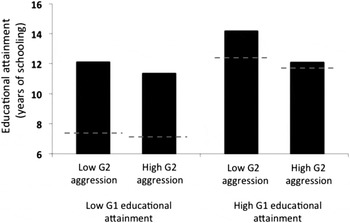
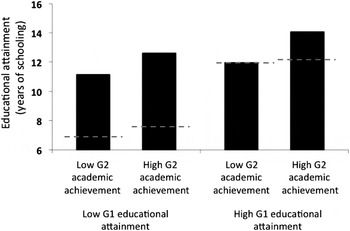
For heuristic purposes, interactions were created and entered separately (nonsimultaneously) in a regression model, as a way to identify the specific interactions that would subsequently be confirmed by entering them in the above-described final SEM model. Another benefit of testing interactions in regression models is the possibility of testing for regions of significance (Johnson–Neyman tests). Figures representing significant interactions were created using the following strategy. We split the sample at the median value of the G2 childhood variable that served as a moderator. Then, we split each subgroup again at the median value of the G1 variable whose association with the dependent variable was being moderated. Figures 5 through 8 depict the average level of educational attainment for each subgroup of G2 participants using the bars, and the horizontal dotted lines represent educational attainment for the parents of participants included in each subgroup of G2 participants.
Two significant interactions involving G1 educational attainment emerged: one with G2 aggression (β = −0.11, p < .001) and one with G2 academic achievement (β = 0.09, p < .001). As shown in Figure 6, we found that the positive relation between G1 educational attainment and the same variable in G2 participants years later was moderated by G2 participants’ aggression in childhood. We used the Johnson–Neyman technique to compute the region of significance for interaction effects (Hayes & Matthes, Reference Hayes and Matthes2009). This analysis revealed that for participants at 0.74 SD above the mean on aggression or higher, there was no significant association between G1 and G2 educational attainment. Based on Figure 6, it appears that aggressive children who were raised by highly educated parents were unable to benefit from this positive aspect of their familial situation and reached levels of education that were similar to that of participants raised by parents who had low levels of education. In a similar way, Figure 7 shows that G2 participants’ academic achievement moderated the association between G1 and G2 educational attainment. More specifically, there was no significant association between parents’ and children's educational attainment for participants at 1.07 SD below the mean on academic achievement or lower. Figure 7 suggests that low-achieving children who were raised by highly educated parents were unable to benefit from this familial situation and reached levels of education that were similar to that of participants raised by parents who had low levels of education.
Interaction between Generation 1 (G1) parent educational attainment and Generation 2 (G2) child aggression predicting G2 educational attainment. Dotted lines represent G1 educational attainment as a function of the various subgroups of G2 participants.

Interaction between Generation 1 (G1) parent educational attainment and Generation 2 (G2) child academic achievement predicting G2 educational attainment. Dotted lines represent G1 educational attainment as a function of the various subgroups of G2 participants.

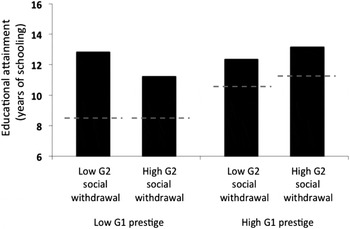
On the basis of past research showing that internalizing problems may be a risk factor that affects educational attainment and adult SES for boys but not for girls (Caspi et al., Reference Caspi, Elder and Bem1988), we split the sample based on gender and tested for interaction effects involving G1 SES (occupational prestige and neighborhood risk) and G2 social withdrawal. Again, interactions were used as predictors of G2 educational attainment. A significant interaction emerged between G1 occupational prestige and G2 social withdrawal for boys (β = 0.12, p < .01). We found that there was a significant association between G1 occupational prestige and G2 educational attainment for male participants only when they scored at 1.26 SD above the mean on the social withdrawal scale or higher. Figure 8 suggests that a familial context in which parents had low-level occupations negatively affected boys’ ability to reach high levels of educational attainment only if these children were highly withdrawn. In contrast, boys from low-SES families who tended to be outgoing reached higher levels of educational attainment, and so did boys whose parents had high-level occupations (regardless of their tendency to be withdrawn).
Interaction between Generation 1 (G1) parent occupational prestige and Generation 2 (G2) child social withdrawal predicting G2 educational attainment for male G2 participants. Dotted lines represent G1 educational attainment as a function of the various subgroups of G2 participants.

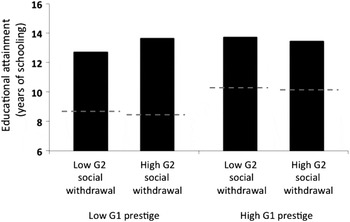
We also found a significant G1 Occupational Prestige × G2 Social Withdrawal interaction for girls (β = –0.11, p < .001), but the sign of the interaction effect was opposite to that we found for boys. We found that the association between G1 occupational prestige and G2 girls’ educational attainment was only significant for those who were at 0.35 SD below the mean on the social withdrawal scale or lower (i.e., girls who were relatively outgoing). That is, parents’ occupational prestige influenced their daughter's future educational attainment only when the child was relatively outgoing. Figure 9 suggests that girls’ ability to reach high levels of educational attainment was negatively affected by their parents’ low occupational prestige only if they were outgoing. In contrast, withdrawn girls whose parents had low-level occupations were relatively protected and reached higher levels of education, and so did girls raised by parents who had high-level occupations. Overall, our results thus suggest that social withdrawal played opposite roles for relatively low-SES boys and girls. We expected that boys presenting withdrawal issues and living in low-SES families would be at risk for low educational attainment, but the fact that low-SES, outgoing girls were also at risk was a new and unexpected finding.
Interaction between Generation 1 (G1) parent occupational prestige and Generation 2 (G2) child social withdrawal predicting G2 educational attainment for female G2 participants. Dotted lines represent G1 educational attainment as a function of the various subgroups of G2 participants.

To verify whether some of the interactions were relatively stronger than others, we also ran another regression model and included all three interactions simultaneously (G1 Educational Attainment × G2 Aggression; G1 Educational Attainment × G2 Academic Achievement; and G1 Occupational Prestige × G2 Social Withdrawal). G1 Educational Attainment × G2 Aggression remained significant in the combined gender model, whereas G1 Occupational Prestige × G2 Social Withdrawal remained significant in the girls’ model.
Summary of moderation effects
In summary, several childhood characteristics of G2 participants moderated the relation between family (G1) background and G2 participants’ educational attainment in adulthood. High parental education would normally help children attain high levels of schooling themselves. However, high levels of aggression and low academic achievement prevented children from benefiting from their parents’ education. Gender differences emerged for the moderating role of G2 childhood social withdrawal. Among the children of parents with low occupational prestige, boys with a tendency to be withdrawn were at risk for reaching low levels of educational attainment, whereas outgoing boys were protected. In contrast, still among low-SES children, girls who were more outgoing during childhood were at risk for reaching low levels of educational attainment, whereas girls who were more socially withdrawn were protected.
Discussion
The main goal of this study was to test for the role of emerging child characteristics in moderating the continuity of SES conditions within families from one generation to the next, under conditions in which extrafamilial, sociopolitical factors could facilitate upward social mobility. The concerns that drove the initiation of social policies increasing access to secondary and postsecondary education 50 years ago in Québec are still relevant today in communities that are making concerted efforts to promote higher education levels in their population. Our study may be particularly relevant to emerging economies and geographic regions where labor skills have not yet adapted to recent changes in demand from global economic markets (Sondergaard et al., Reference Sondergaard, Murthi, Abu-Ghaida, Bodewig and Rutkowski2012). Our multigenerational study represents a rare chance to test the hypothesis that for some children, emerging psychopathology can play a moderating role and thereby negatively affect their ability to take advantage of educational opportunities that could contribute to their long-term socioeconomic well-being. However, for other children, special strengths boost their ability to benefit from extrafamilial resources, with positive impacts on their social mobility.
The Quiet Revolution provided a “natural experiment” in which the influence of children's emerging psychopathology and psychosocial adjustment on upward social mobility could be examined. The Quiet Revolution had a particular impact on relatively disadvantaged families, effectively and rapidly raising educational levels and SES from one generation to the next. This generational shift was clearly visible in Figure 1. However, child aggression, social withdrawal, and academic achievement played a role as moderators of intergenerational change. The results illuminate how child characteristics, in particular child problems related to disruptive behavior, social and emotional problems, and individual academic skills, were influential in determining the outcome of this large social and educational transformation. This study also investigated gender differences in the mediation and moderation of change through psychopathology and other child characteristics.
Discontinuity in SES driven by sociopolitical change
As expected, based on historical accounts of the Quiet Revolution in Québec (Lacoursière et al., Reference Lacoursière, Provencher and Vaugeois2011; Langlois, Reference Langlois1992), children growing up during the 1960s and 1970s in traditionally disadvantaged families had the opportunity to improve their socioeconomic condition considerably because of a facilitated access to newly created and expanded secondary programs, public colleges, and universities. Other social changes that were more or less closely related to the Quiet Revolution likely contributed further to improving G2 participants’ SES relative to that of their parents, including easier access to contraception that reduced the size of families and their financial burden and an evolution of social norms that enabled more women to occupy jobs instead of being homemakers.
The effects of social changes on educational attainment of our study's G2 participants compared with that of their parents were rapid and quite noticeable, with an overall increase of almost 3 years of school attendance. This increase in education was accompanied by a commensurate improvement in SES from G1 to G2, with the new generation being better able to access more prestigious jobs than were their parents. Although this outcome might seem obvious, improvement in employment does not always follow from an increase in the population's education. For example, at the turn of the 21st century, about half of college graduates in the Republic of Ireland were unemployed or underemployed, and many part-time young workers occupied precarious jobs because they were unable to find full-time employment (United Nations Department of Economic and Social Affairs, 2003). The disconnection between education and occupational opportunities can have financial consequences (e.g., difficulty reimbursing student loans) and human costs (e.g., decreased life satisfaction and delayed family formation). In the Québécois population, however, increased education led to the intended improvement in occupational status, as seen in the G2 cohort.
Child characteristics influencing the continuity of SES
Before we investigated children's characteristics as variables that moderate their ability to benefit from external opportunities offered to them, we studied how children may contribute to some level of consistency in family SES from one generation to the next, by testing for mediation effects. The first step of this mediation process shows significant relations between G1 SES (educational attainment, neighborhood risk, and occupational prestige) and G2 academic achievement in childhood, thus supporting both the social causation and the social selection theories of intergenerational continuity in SES (Conger & Donnellan, Reference Conger and Donnellan2007). The social causation theory suggests that parents’ access to resources (money, services, and human capital) facilitates children's access to higher SES levels later on. The fact that children's academic achievement is predicted by their family's occupational prestige and by lower neighborhood risk, independently from parental educational attainment, suggests that family resources help children reach the first step toward educational attainment and higher SES in adulthood. Conversely, the fact that parents’ educational attainment predicts their child's academic achievement independently from the additional resources that are generally associated with education also suggests that genetically determined academic talent and effective preparation for schooling (e.g., reading to young children) by more educated parents may play a role in the continuity of SES from G1 to G2, thus supporting the social selection model as well.
Because a child's academic achievement is the only G2 childhood predictor that had an approximate equivalent that had been measured in the previous generation (i.e., G1 educational attainment), it is difficult to interpret our study results in light of the social selection model for other aspects of a child's adjustment. Inferences about genetic transmission of other child characteristics (aggression, social withdrawal, and likeability) would require close equivalents measured in G1 participants, which are not available. Nevertheless, we can relate our study results to the social causation theory. Specifically, it appears that resources available to G1 participants contributed to their child's likeability among their classmates. This suggests that above and beyond their own positive or negative individual characteristics, children whose parents have relatively more wealth and occupational prestige were better liked by their classmates. It could be that disadvantaged G2 participants could not afford to participate in extracurricular activities that would have contributed to their visibility in their peer group and that would have provided opportunities to develop social skills and opportunities to form friendship bonds with more classmates.
This hypothetical developmental sequence is supported by results from Conger et al. (Reference Conger, Martin, Reeb, Little, Craine, Shebloski, Maholmes and King2012), who found that parents’ economic hardship has a negative impact both on children's affiliation with conventional peers and on their involvement in extracurricular activities, which ultimately affect their educational attainment and SES in adulthood. Because childhood likeability contributes to various components of G2 SES (educational attainment and economic–occupational indicators), further investigation might be valuable in terms of understanding the processes whereby early SES conditions influence social competence and other aspects of likeability and peer relations. Such studies should also control for parents’ own likeability as a predictor.
The social causation theory suggests that as family SES increases, so does parents’ ability to afford services that will help their children when they show signs of emerging psychopathology. This theory would therefore suggest a negative association between G1 SES and G2 psychopathology symptoms. However, in the study sample, G1 SES indicators were unrelated to aggression or social withdrawal among G2 children. When such associations do not exist, it is impossible for child psychopathology to be a mediator of the association between G1 SES and G2 SES. In other words, child emerging psychopathology does not appear to be one of the mechanisms through which the lack of parental resources affected G2 participants’ future SES level. Yet, the relatively low SES of participating families may account for this nonsignificant result. It is possible that mental health services were unaffordable even for families that had the highest SES in our sample. Perhaps emerging psychopathology would mediate the association between G1 and G2 SES in a sample that would include the full range of SES represented in the Québec population at the time, because families at the high end of the SES scale could afford to pay for mental health services.
We also found that G2 boys’ aggressive behavior was not a mediator of G1 SES, but instead, it had an independent influence on their future SES. This finding is consistent with the notion that aggressive behavior can be detrimental to students’ relations with peers and teachers at school, which in turn can have negative consequences on school adjustment and persistence (Mercer & DeRosier, Reference Mercer and DeRosier2008). More important, the impact of early aggression on G2 educational attainment among males was not simply tied to the continuity of dysfunction over time from one context to another: a child's aggression also had a moderating role in the relation between G1 SES and G2 educational attainment, as described below.
Child characteristics influencing the discontinuity of SES
The most important contribution of this study with regard to the theme of this Special Section was to show that children influence their own developmental paths toward SES in adulthood, as suggested by the interactionist model of SES transmission across generations (Conger & Donnellan, Reference Conger and Donnellan2007). In some cases, children have strengths that enable them to gain more from their environmental resources than expected and thereby surpass what could be expected for them in terms of educational attainment. In contrast, other children influence their future in a harmful way, such that some of their individual challenges (e.g., emerging psychopathology) get in the way of healthy development in spite of supportive environmental conditions.
When examining interaction effects, we found that children exhibiting more aggression were less likely to benefit from having educated parents when it comes to reaching high levels of educational attainment. There are several possible explanations for this result. Perhaps parents of aggressive children spend more time and energy managing their inappropriate behaviors than helping them with schoolwork, even if these parents have the necessary knowledge and skills to provide academic support. It is also possible that over time, parents of aggressive children have learned to avoid interactions that may trigger anger and aggressive reactions from their son or daughter, which parents experience as particularly aversive. In particular, children who encounter academic difficulties may find that working through them is a frustrating experience, and their lack of ability to manage their negative feelings about schoolwork could make parents’ involvement in their child's schoolwork a punishing experience that they try to avoid as much as possible. This pattern would unfortunately result in detrimental consequences for the child's ability to do well in school over the long term.
Consistent with the interactionist prespective, we found that children with low academic competence were generally unable to benefit from having educated parents. This finding suggests that children influence their own educational attainment years later: depending on their natural academic abilities, some children are in a better position to take advantage of a rich intellectual environment at home than are others, which is another way in which children's characteristics influence their own life trajectory. It is noteworthy that this effect was less robust than the G1 Educational Attainment × G2 Aggression interaction, because we were unable to establish its significance after controlling for this other interaction. This finding thus warrants replication in future studies.
Our results may indirectly point to other aspects of emerging psychopathology that negatively affect G2 social mobility, considering that low academic achievement may hide disorders such as attention deficits or learning disabilities. That being said, the increase in educational attainment observed from G1 to G2 in families where parents had low levels of education was not limited to high-achieving children. On average, as shown in Figure 7, both low- and high-achieving children surpassed their parents’ education by many years, whereas this intergenerational increase in education was subtler in children raised by the most educated parents in the sample. It is encouraging to see that positive societal changes that are meant to break the cycle of poverty in families did not translate into a “Matthew effect,” wherein individuals who benefit from more favorable familial conditions in the first place show more improvement than their disadvantaged counterparts when they have access to similar extrafamilial resources (cf. Bakermans-Kranenburg, van IJzendoorn, & Bradley, Reference Bakermans-Kranenburg, van IJzendoorn and Bradley2005). Even if high-achieving children from high-SES backgrounds reached the highest levels of schooling in absolute numbers, those who benefited the most from the new social policies to improve their condition relative to that of their parents were G2 participants raised in low-SES G1 families.
Finally, children's social withdrawal had a significant influence on their future life trajectories, and this finding was most robust in the female subsample because it was maintained after controlling for the other two above-mentioned interactions. Figure 8 suggests that being outgoing enabled boys to take better advantage of the new social policies than withdrawn boys; the former showed greater improvements in educational attainment relative to their parents’ education. Because withdrawal only had negative educational consequences for boys who were raised by parents who had low levels of occupational prestige, we can relate these findings to those of a diathesis–stress model, wherein vulnerable individuals (withdrawn boys) only encounter negative consequences (low educational attainment) when they happen to be in a stressful situation (low-SES background). Nevertheless, it is important to keep in mind that even if withdrawn boys from low-SES families were the ones who reached the lowest levels of educational attainment, their level of education still improved by many years as compared to that of their parents, thus suggesting that the new social policies had a high efficacy overall.
In contrast, coming from a family in which parents had low occupational prestige was a risk factor for girls who were more outgoing than average. This finding points to the importance of considering cultural norms about gender roles as moderators of the impact of specific individual characteristics on one's development not only in childhood but most likely throughout one's life (Schwartzman, Verlaan, Peters, & Serbin, Reference Schwartzman, Verlaan, Peters, Serbin and McCord1995). Even if gender stereotypes may have changed somewhat since the study was initiated in the 1970s, males from this sample (who were educated during the 1970s and 1980s) were probably expected to be more socially outgoing and dominant, whereas females raised at this period were certainly expected to be more reserved behaviorally and more compliant than boys during middle childhood and adolescence (Serbin, Powishta, & Gulko, Reference Serbin, Powlishta and Gulko1993). Our data showed that boys displaying high levels of social withdrawal engaged in low levels of aggression (r = –.16, p < .05), thus suggesting that they may be perceived as lacking in conformity to expected male behavior. Engaging in behaviors that were sharply inconsistent with traditional gender roles was an obstacle to boys’ and girls’ educational attainment if they were raised in low-SES families. This could be explained by nontraditional children's dislike for traditional institutions such as school, or by negative reactions from the social milieu, especially at school, which would not provide as much support for the educational success of individuals who failed to fit in the group and to conform to cultural expectations. Negative developmental consequences observed in low-SES, withdrawn boys parallel results obtained by Caspi et al. (Reference Caspi, Elder and Bem1988), who studied a cohort of children born in the late 1920s. They found that shy boys who presented delays in the attainment of major life milestones (marriage, career, and fatherhood) reached lower occupational attainment, whereas shy girls followed a typical life course.
However, our study suggests that developmental risks associated with a low-SES background were more pronounced among outgoing girls. These girls’ greater movement toward the peer group might explain such findings. Low-SES parents are often forced to live in unsafe neighborhoods, and they also face stressful life events that can decrease their ability to monitor their children's activities and friendships. This combination of factors constitutes a particularly risky situation for girls, whose involvement in problem behavior is highly dependent on their access to deviant peers who are easy to find in an unsafe neighborhood (Caspi, Lynam, Moffitt, & Silva, Reference Caspi, Lynam, Moffitt and Silva1993). Contacts with deviant peers can precipitate early pregnancy (Dishion, Ha, & Véronneau, Reference Dishion, Ha and Véronneau2012), with deleterious consequences for girls’ educational opportunities (Serbin, Peters, McAffer, & Schwartzman, Reference Serbin, Peters, McAffer and Schwartzman1991). In contrast, more introverted girls would be less likely to join a group of deviant peers and to run the risk of early drug use and pregnancy, thus protecting them from early school dropout and its negative consequences for the level of SES they can reach in adulthood.
Our findings about the impact of social withdrawal on a child's development are particularly interesting because they suggest not only that children's individual characteristics affect their receptiveness to environmental influences but also that children's characteristics might interact among themselves (i.e., child's emerging psychopathology interacting with gender). Although we did not explicitly test for three-way interactions in this study, our results open the door to much more complex research questions, because any individual factor, such as social withdrawal, can represent either a protective or a risk factor, depending on other personal characteristics and probably depending on developmental environment and context.
Strengths and limitations
This multigenerational prospective study that spanned more than 3 decades presents a rare opportunity to examine the influence of children's emerging psychopathology on their own life path, and in particular on their future SES level, while taking into account the socioeconomic conditions in which they grew up. Further, the sociohistorical context in which this study took place in the aftermath of the Quiet Revolution in Québec provided a “natural experiment” that made it possible to verify whether children's emerging psychopathology or academic problems would negatively affect their ability to take advantage of the newly established, affordable education institutions available to them. The many sources of information used to measure this study's variables (self-reports, peer nominations, and school board and government records) also strengthen the validity of our results.
In spite of these strengths, this study also had some limitations. First, the variables under study prevented us from using an experimental design; therefore, we had to use a correlational design that made it impossible to draw true causal inferences from current results. Second, it was not possible to administer clinical diagnostic interviews to such a large sample of participants in childhood; consequently, peer-nominated aggression and social withdrawal measured in this study can be considered only as early signs of potential psychopathology rather than clinical diagnoses of externalizing and internalizing issues. Third, it would have been interesting to test for the presence of sensitive developmental periods. For example, individuals who experienced the societal changes of the Quiet Revolution at a particular age may have benefited more than younger or older individuals. However, changes in the school system that improved access to higher education occurred several years before G2 participants reached that point in their studies. Questions about sensitive developmental periods could only be answered if our sample had included slightly older participants who attended school just before and during the period of the Quiet Revolution, but this was not the case. Fourth, although the sociohistorical context in which this study was conducted is similar in some ways to the current situation in other regions of the world, the specific context in which the Quiet Revolution developed many decades ago in Québec is unique. Different cultural traditions and the new reality of a global economy make it necessary to examine the impact of facilitated access to higher education on the (dis)continuity of SES across generations in different geocultural and economic contexts.
Future directions for translating research on the influential child into preventive interventions
Our study underscores the need to take into account many systemic levels when planning interventions aimed at improving children's psychological health and their progression toward a standard of living that will contribute to maintaining their physical and psychological well-being. The most common interventions with respect to child psychopathology still primarily target the child's behavior. Our findings that individual child characteristics moderate the influence of family background in predicting future education and employment support this current practice, but other findings from this study reveal that the practice is too limited in scope.
Considering the embedded systems structure put forward by the bioecological model (Bronfenbrenner & Morris, Reference Bronfenbrenner, Morris, Lerner and Damon2006), the macrosystem often appears to be least accessible to direct intervention, even if it has an impact on all other lower level systems. However, this study shows how a well-planned, large-scale governmental policy affecting the macrosystem can have a real impact on the improvement of socioeconomic conditions for families that had traditionally suffered poverty. Large-scale social programs, such as the creation of new and affordable secondary and higher education institutions during the Quiet Revolution in Québec, permeate lower level systems and enhance individuals’ ability to improve their own conditions. Those changes benefited not only children who surpassed their parents’ SES but also the society as a whole, in that it had better qualified workers for the evolving job market, such that we can expect lower rates of social, health, and psychological problems that are more common among low-SES individuals (Ashford et al., Reference Ashford, Smit, van Lier, Cuijpers and Koot2008; Cohen, et al. Reference Cohen, Janicki-Deverts, Chen and Matthews2010; van Oort et al., Reference van Oort, van der Ende, Wadsworth, Verhulst and Achenbach2011). Results of this study are thus particularly relevant today for all countries where improving the population's education is a goal for economic and social progress. In particular, Patron and Vaillant (Reference Patron and Vaillant2012) have pointed out that many developing countries still run behind in rates of elementary, secondary, and tertiary education completion and suffer negative consequences, such as reduced competitiveness in the world's globalized economy. Many strategies have been put forward to make schooling more accessible and affordable, with positive results on rates of school enrollment, attendance, and educational attainment in various countries, including Mexico, Malawi, and Kenya (Kremer, Brannen, & Glennerster, Reference Kremer, Brannen and Glennerster2013).
In conclusion, results of our study also suggest that large-scale social policies are essential to break the cycle of poverty in disadvantaged families, but they are not sufficient to address the needs of at-risk children. Such policies must be supplemented by more specific interventions that target the microsystem (particularly the parents, but also teachers and the peer group) and at-risk children themselves to have a real impact on their development and long-term well-being. In particular, interventions that help aggressive children to learn how to manage their impulses and how to solve problems in a peaceful manner, as well as early cognitive stimulation programs that can enhance academic achievement (e.g., Perry Preschool and Abecedarian programs; see review by Barnett, Reference Barnett2011), would be good complementary interventions for children showing early behavioral or learning difficulties.