Introduction
Prior to the passage of the Patient Protection and Affordable Care Act (ACA) by the United States (US) Congress, Adam Nagourney for The New York Times discusses the role of older adults in the health-care reform debate ‘as the population ages and the nation faces intense battles over rapidly rising healthcare and retirement costs' (2009: para. 2). During this time, many older adults actively protested the legislation with the repeated sentiment: ‘Keep government hands off my Medicare’ (Campbell Reference Campbell2011). While the extensive work of Robert H. Binstock shows very little scholarly evidence that the current cohort of older adults votes as a bloc or solely based on senior-related issues (Binstock Reference Binstock1992, Reference Binstock1997, Reference Binstock2000, Reference Binstock2010; Nagourney Reference Nagourney2009), the issue of health care may be different. Just one year later, in the 2010 US Congressional election, Binstock showed that older adults voted as a bloc based on ‘senior issues’ for the ‘first time during the many years that Medicare and Social Security have been staple foundations of American life’ (2012: 408).Footnote 1
Binstock's (Reference Binstock2012) recent findings do not seem unexpected if considering earlier research providing evidence for an aged effect on political attitudes and actions. Following the work of Arthur Rose and Warren A. Peterson (Reference Rose and Peterson1965) on the sub-culture of ageing, Weaver (Reference Weaver1976) sets out to examine systematically the elderly as a political community. Similar to Binstock's research, Weaver's study shows very little evidence for bloc political behaviour among older adults – except for issues related to health. Weaver (Reference Weaver1976: 618) explains the findings by describing health policy as a ‘natural focus of elderly's emerging collective concern because their rising morbidity and approaching mortality direct their attention to their bodies and those designated to maintain and repair them’. Weaver (Reference Weaver1976) predicted that as the baby-boom generation headed towards retirement age, they would increasingly demand fair and quality care and express those concerns to their government. Binstock (Reference Binstock2012) makes similar predictions 35 years later, saying that ‘senior power’ will emerge over the next few national elections as both major political parties consider cuts to Medicare.
Understanding the attitudes and actions of all Americans surrounding health-care legislation is especially important for the next few decades with the implementation of the ACA and as politicians consider revisions to the law and/or further reforms. Older adults will most likely continue to be a vocal and active part of this process. But, will party affiliation or age more closely shape their attitudes on health policy? To gain some leverage on this question, I consider the social context of older adults with particular attention to the aged community context.
Social scientists have a strong tradition of not only studying individual factors influencing political attitudes and behaviours but also contextual factors (Books and Prysby Reference Books and Prysby1991; Huckfeldt Reference Huckfeldt1986; Huckfeldt and Sprague Reference Huckfeldt and Sprague1995; Key Reference Key1949). The aged context is a place or locale with a significant older adult population. Bramlett (Reference Bramlett2015) argues that the aged community context fosters increased political knowledge among senior residents. Additionally, older residents in these locations show surprisingly supportive attitudes towards health-care reform. For these reasons, the aged context may be especially helpful for understanding the complexity of health-care attitudes among a growing population of older adults.
In this paper, I set out to examine the aged community context effect for residents' recent health reform attitudes in the United States of America (USA) from 2009 to 2012. I find that older residents, in particular, living amongst relatively large numbers of their peers are associated with more supportive attitudes towards the recent health-care reforms than older adults without a similar context. These findings hold for 2010 and 2012, but there were no statistically significant effects in 2009 and 2011. These positive results seem counterintuitive given reports of opposition among older adults in the USA. Yet, when viewing them in light of what we know about aged communities and access to information, the aged context effects make sense and provide a more complete picture of ACA attitudes among older Americans.
Understanding and measuring health-care reform attitudes
Social programmes that Americans mostly embrace work out and gain support over time. The political struggle over recent health-care reforms did not end with the legislation's passage – it started a new one (Jacobs and Skocpol Reference Jacobs and Skocpol2012). The ACA continues to divide Americans, and understanding public opinion of the legislation is complicated. First, public opinion of the law is highly correlated with party identification. Democrats support it. Republicans oppose it. While this may come as no surprise, elite Republican Party messaging also successfully contributed to the partisan opposition by linking support for the law with being un-American (Knoll and Shewmaker Reference Knoll and Shewmaker2015).
Second, public opinion reports also indicate that while most Americans oppose the extensive changes to health care, many people support specific pieces of the ACA legislation (Brodie et al. Reference Brodie, Altman, Deane, Buscho and Hamel2010). Third, accurately measuring support for health-care reform is challenging. People of lower socio-economic status are often associated with support for health-care reform, but because they lack knowledge of the specific aspects of the law, they tend to respond that they ‘don't know’ if they support it when surveyed (Berinsky and Margolis Reference Berinsky and Margolis2011). Support for the ACA is probably being underestimated.
Complications persist when trying to understand how senior citizens feel about reform. Information from notable older adult interest groupsFootnote 2 leans towards messaging supportive of the ACA. Groups with relevant, supportive information on the organisation website include, but are not limited to: AARP, the National Council on Aging, the Alliance for Retired Americans, the American Geriatrics Society, the National Association of Area Agencies on Aging, and the American Society on Aging.
For one example, the Alliance for Retired Americans (2015) website states ‘seniors and retirees are set to gain tremendous benefits from the new health care law’. Also, as part of a letter responding to congressional attempts to defund the act, representatives from the National Association of Area Agencies on Aging (2015) write: ‘Supporting evidence-based prevention and wellness programs for older adults is imperative, given the nation's aging population and growing rates of chronic disease’.
A more reserved message from the American Society on Aging (2015) acknowledges that the ACA is no panacea but does ‘provide an opportunity to bolster a broken mental health system that disproportionately ignores the needs of older adults'.
Despite widespread supportive messaging from older interests, Brady and Kessler (Reference Brady and Kessler2010) find that older adults are more likely to oppose reform than younger adults. However, they also show that opposition among older respondents may be rooted in a distaste for major policy changes, rather than reform in itself (Brady and Kessler Reference Brady and Kessler2010). An understanding of health-care reform attitudes among older adults must also consider the role of misinformation during the national debate of the law as it moved through Congress. Polarisation among elite partisans reinforced the partisan divide in factual beliefs, and false beliefs became difficult to correct (Nyhan Reference Nyhan2010). This may be especially true for the older adult population, as with the ‘Death Panel’ myth.
Policy design also has an impact on public opinion. Campbell (Reference Campbell2011) identifies three aspects of policy design that matter for public opinion: (a) the magnitude of the benefits, (b) the way (positive or negative) the benefits are administered, and (c) perceptions of whether the benefit is earned. The third aspect is most important for understanding why many older adults opposed the ACA, despite the widespread expressed support among senior affiliated interest groups. Campbell (Reference Campbell2011) argues that this opposition resulted from the way safety net programmes like Social Security and Medicare were packaged in the USA. Seniors believed that they were being robbed of Medicare benefits they had earned and paid for. This intentional policy design and framing prevents many people from understanding the ‘insurance function of Medicare, such as its redistribution from healthy to sick, from the short-lived, from workers to retired’ (Campbell Reference Campbell2011: 966).
Even with the complicated political climate and nature of the law, there is a sense today (Nagourney Reference Nagourney2009) and in the recent past that the present generation of older adults must care deeply about the nation's health institutions and services because of the ‘changing age structure of the American population’ (Rice and Feldman Reference Rice and Feldman1983: 362). Also, this is not just an American scenario. Age is a significant predictor of people's attitudes for social safety-net issues in the USA as well as for other nations facing similar challenges (Busemeyer, Goerres and Weschle Reference Busemeyer, Goerres and Weschle2009; Cattaneo and Wolter Reference Cattaneo and Wolter2009; Tepe and Vanhuysse Reference Tepe and Vanhuysse2010). If we expect a nation's demographic structure to have political ramifications, it seems even more likely that these contextual factors make an impact at the local level, on political attitudes and behaviours of community residents.
The social context and political attitudes
There is a plethora of research on the link between contextual factors and individual political attitudes and behaviours. We know that contextual factors like the demographic structure of a community constrain and influence the social interactions of local residents (Baybeck and McClurg Reference Baybeck and McClurg2005; Books and Prysby Reference Books and Prysby1991; Burbank Reference Burbank1995; Huckfeldt Reference Huckfeldt1986; Huckfeldt and Sprague Reference Huckfeldt and Sprague1995; Key Reference Key1949). Books and Prysby (1991: 2–3) define context as a ‘geographically bounded social unit’. This is a person's local environment, their community or neighbourhood – and the resulting mix of people being social within the defined geographical unit.
Even though some still question whether context should be considered in political research (King Reference King1996), there is a growing body of research dedicated to making the link between a person's community and their attitudes (detailed below). In a world where we are increasingly connected by the internet, Schwanen and Kwan (Reference Schwanen and Kwan2008) discuss the limits of mobile phone and internet usage for enhancing spatial flexibility. Their research supports the notion that place and personal interaction continue to be important for communication. By constraining opportunities for personal contact and information flow within a defined space, a person's social context influences individuals' attitudes (albeit, indirectly).
So how does it work, if indirectly? Community social composition can influence our political opinions and activities by (a) constraining our social interactions with people in the community, and (b) fostering the available cognitive content within the community. First, opportunities for direct contact and meaningful discussion with those in our communities depend on our context (Huckfeldt and Sprague Reference Huckfeldt and Sprague1995). Second, the social context affects individual political cognition through ‘routine exposure to a biased social setting’ influencing the accessibility of cognitive content (Huckfeldt and Sprague Reference Huckfeldt and Sprague1995: 623). The available cognitive content includes the ‘entire array of knowledge stored in cognitive constructs’, but ‘exposure to biased social surroundings’ in homogeneous communities ‘may alter which content is most likely to be used’ (Burbank Reference Burbank1995: 623). For instance, living in a place with lots of older adults may produce greater access to age-based cognitive content. So, while the first mechanism requires direct social interaction, the second is casual, subtle and available even for the relatively uninformed (Burbank Reference Burbank1995).
Social scientists examine many types of social compositions and resulting attitudes and behaviours. Early research links the social class context with partisan politics (Langton and Rapoport Reference Langton and Rapoport1975) and the religious context with political attitudes (Huckfeldt, Plutzer and Sprague Reference Huckfeldt, Plutzer and Sprague1993). Many others have considered and linked the racial composition of an individual's community to their group consciousness, political participation, views towards other racial groups and political racial attitudes (Bledsoe et al. Reference Bledsoe, Welch, Sigelman and Combs1995; Ellison and Powers Reference Ellison and Powers1994; Glaser Reference Glaser1994; Jackman and Crane Reference Jackman and Crane1986; Kohfeld and Sprague Reference Kohfeld and Sprague1995; Marschall and Stolle Reference Marschall and Stolle2004; Sigelman and Welch Reference Sigelman and Welch1993; Stein, Post and Rinden Reference Stein, Post and Rinden2000). A community's LGBT population is also associated with warmer attitudes towards gay and lesbian individuals and support for gay rights legislation (Barth, Overby and Huffmon Reference Barth, Overby and Huffmon2009; Overby and Barth Reference Overby and Barth2002). Even relative educational attainment, rather than absolute education, of community members is linked with voter turnout (Tenn Reference Tenn2005). Also, higher average education levels in a community help to maintain the cognitive function of older residents (Wight et al. Reference Wight, Aneshensel, Miller-Martinez, Botticello, Cummings, Karlamangla and Seeman2006).
The age composition of a community has also been found to be important for political attitudes and behaviours of residents of all ages. On the younger side of the age spectrum, researchers have studied places, sometimes nations, with youth bulges, populations with high proportions of young adults. These studies find that places with overwhelming numbers of young adults, relative to the rest of the population, are prone to either unrest and political violence or more traditional civic participation, depending on the economic context (Fuller and Pitts Reference Fuller and Pitts1990; Hart et al. Reference Hart, Atkins, Markey and Youniss2004; Urdal Reference Urdal2006, Reference Urdal2008). The older side of the aged spectrum is the focus for the present study.
The aged context and expectations
For this paper, I am concerned with the aged context, the other end of the age demographic spectrum, and whether places with sizeable older adult populations differ from places without a significant older adult presence. I will show how the aged context has been a useful factor for understanding the different attitudes and behaviours of older adults (and people of other ages). Do older adults who have regular, personal contact with people their age and who are more likely to receive aged-biased information behave differently than their peers without the same experiences? The answer has often been, yes. For this reason, the aged context is a useful and relevant social context to consider when thinking about health reform attitudes.
Not only is the proportion of older adults in the population increasing but so are the number of aged communities (Frey Reference Frey2011). The residential patterns of older adults are not scattered evenly across the USA. Some places attract older adults (retirement communities with lots of amenities), and other places, usually rural locations, haemorrhage young people, thus leaving the population more aged. Also, many senior citizens of today choose to age in place, which means that we find aged communities all over the USA – not just Florida and Arizona (Frey Reference Frey2011; Wolf Reference Wolf2001). This increasing unevenness in the age of our communities is ripe for the study of social context effects. Cagney (Reference Cagney2006) writes that because age structure varies for neighbouring communities, researchers should consider potential contextual or compositional effects, especially when it comes to seniors’ health.
While most of the relevant research is actually quite recent, Sherman, Ward and Lagory (Reference Sherman, Ward and Lagory1985) were talking about the effect of neighbourhood age concentration 20 years earlier. They find that older adults have greater knowledge of services when living among their peers. However, age-concentrated communities were not associated with a higher likelihood of taking political action among older residents. More recently aged-concentrated neighbourhoods have been linked to older adults' self-reports of health. When older adults live around their peers and in stable places, they are less likely to rate their health as poor, but the opposite is true when they live in poverty (Subramanian et al. Reference Subramanian, Kubzansky, Berkman, Fay and Kawachi2006).
Others consider a person's aged context when looking at memory and cognition later in life. Hess (Reference Hess2005) makes the argument that there is more to memory loss than biology, and we cannot ignore the broader array of factors, like environment, that surround the ageing process. When older adults live among their peers and have regular contact with them, the community setting acts as a cognitive reserve, maintaining levels of cognitive function (Clarke et al. Reference Clarke, Ailshire, House, Morenoff, King, Melendez and Langa2012). Bramlett (Reference Bramlett2013) finds evidence for the same relationship but for political cognition. Older adults residing in aged locales have more political knowledge – especially for senior-related issues – than their peers without the same social context. Bramlett (Reference Bramlett2015) also finds some evidence from analysis of the 2000 and 2008 National Annenberg Election Surveys that older adults (and younger adults) residing in aged places were more likely to support the idea of government health insurance and/or say that governments should spend more on health programmes than their peers living in non-aged places.
The aged context effect is not limited to the USA and its growing senior citizen population. Older people concentrate in locations all over the world with consequences for intergenerational conflict and discussions of social welfare policy. Comparative research asks how much should be allocated for spending on the elderly versus the young (Tepe and Vanhuysse Reference Tepe and Vanhuysse2010). Special attention is paid to the older adult populations and their influence on education spending. While Plutzer and Berkman (Reference Plutzer and Berkman2005) find that support for education spending increases as each age cohort ages, Cattaneo and Wolter (Reference Cattaneo and Wolter2009) show the opposite with a sample of Swiss voters. This research indicates that some elderly populations, controlling for political conservatism, may be less supportive of educational spending compared with other age groups, and prefer government spending on health and social security-related programmes.
Age remains a strong predictor of social policy attitudes in the USA and more broadly. Thus, it is reasonable to suggest that the aged structure of a community may be linked with unique attitudes and behaviours when it comes to health reform attitudes. Recent health-care reforms in the USA provide a useful case for better understanding these relationships and mechanisms. We know that older Americans as individuals were more likely to oppose the ACA, so are elderly communities also more opposed to the reforms? The previous research on the aged context suggests otherwise.
What is missing from studies examining opinions on the ACA is an examination of aged communities. Given the past research on the influence of social contexts and aged contexts in particular, I propose that older adults living in places with a significant senior population may not have been as opposed to the ACA as expected. Why should elderly communities be more open to the ACA?
First, older adults living amongst their peers likely had unparalleled access to information, and information is key for understanding social networks. Opportunities for information are context dependent (Huckfeldt and Sprague Reference Huckfeldt and Sprague1995) and, thus, older adults living amongst their peers are simply more likely to have contact with people of their own age. They cannot ignore the information flow coming from the community's numerically dominant group. Additionally, residents of communities with information bias become even more sensitive to pertinent cues (Burbank Reference Burbank1995), so direct contact is not even necessary for taking in senior-related cognitive content.
Second, past work indicates that the aged context fosters more knowledge of elder-specific services, greater knowledge of senior-related political issues and a greater likelihood of support for government's role in health care (Bramlett Reference Bramlett2013, Reference Bramlett2015; Sherman, Ward and Lagory Reference Sherman, Ward and Lagory1985). Older adults living in communities surrounded by their peers may have had access to information regarding the age-specific benefits of the legislation. Additionally, leading elderly organisations, like those mentioned above, provide many services for these communities. It makes sense that the older residents of aged communities, already more knowledgeable of senior issues compared with older adults without the same context (Bramlett Reference Bramlett2013), would take notice of these organisations’ vocal support for the law's senior benefits.
Finally, Campbell (Reference Campbell2011: 966) describes the widely publicised opposition of older Americans to the ACA as ‘yet another exasperating example of public ignorance’. Given what we know about aged communities and the supportive messaging from well-known older interest groups, we have reason to believe that older residents of these aged locations might think differently about the legislation. They understand how the system works and believe that the law benefits them and others.
In sum, I maintain that the aged context provides an environment where the cognitive content is biased towards the aged population. Older adults in these places probably had more opportunities for meaningful discussion of reform and more knowledge of health-related issues, including supportive messaging about the ACA. Even for the less connected and/or knowledgeable, the cognitive content is likely biased in favour of these issues related to the health of older adults. We need to understand attitudes towards recent health-care reforms because the legislation is still being implemented and more reforms and/or cuts are likely. A careful study of the increasing population of older adults and their aged communities will move us towards a better understanding of these attitudes.
Data and methods
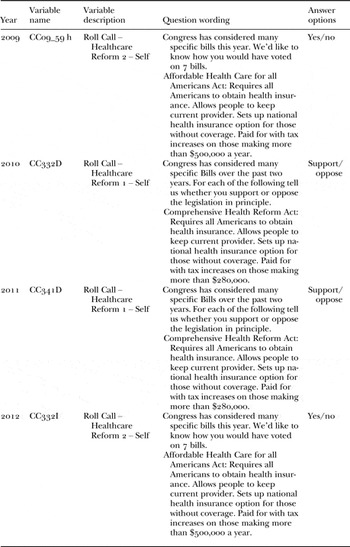
The Cooperative Congressional Election Study (CCES) data from 2009, 2010, 2011 and 2012 provide responses to questions assessing people's health-care reform attitudes, specifically focusing on the Affordable Care Act of 2010. Thanks to this massive data collection effort, we can examine attitudes prior to, during the high period of debate over and after the passage of the legislation (see Table A1 in the Appendix for question wording). The large number of respondents to the CCES surveys allow for hierarchical linear modelling, analysis that considers attitudes of individual respondents within and across particular contexts, or locations. US Census population data from 2010 are used for the contextual measures. Although Books and Prysby (Reference Books and Prysby1991: 2–3) define context as a ‘geographically bounded social unit’, choosing that unit of analysis should be done carefully. Even so, there may be no perfect unit for measuring community context (Taylor, Gorard and Fitz Reference Taylor, Gorard and Fitz2003; Williams Reference Williams1999) due to the modifiable areal unit problem, meaning that results may differ depending on the size of the geographic measure used.
I measure the community context as the county for this paper. Counties are useful political jurisdictions and geographical boundaries that others have used in contextual research (Williams Reference Williams1999). Zip codes are also useful measures used in the recent past by Bramlett (Reference Bramlett2013, Reference Bramlett2015) in addition to counties. Census tracts, states, regions and countries are also commonly used contextual containers. However, Brodie, Deane and Cho (Reference Brodie, Deane and Cho2011) explore geographical variation in public opinion on the ACA but find no context effect when considering the proportion of people aged 65 and over in the region. The county is a much smaller context container where we can examine the contextual effects of the local aged community.
The main explanatory factor for this paper measures the aged population within the community context. I follow the past work on age contexts by dividing the local population of people of a particular age by the total local population (Bramlett Reference Bramlett2013, Reference Bramlett2015; Hart et al. Reference Hart, Atkins, Markey and Youniss2004). The resulting measure is the proportion of aged people living in a county. For example, I divide the county population of people aged 65 and over by the total population in the county.Footnote 3 The resulting county-level aged context measure ranges from about 2 to 29 per cent. This means that older adults (ages 65 and over) make up 29 per cent of the population in the county with the highest proportion of older adults and only 2 per cent in the county with the lowest proportion in the sample. Counties contain more land and diversity than zip codes. If using a zip code contextual measure, we would tap into zip codes containing age-restricted communities like The Villages in Florida, almost entirely made up of people over the age of 65. The county is useful for examining more diverse populations.
I use hierarchical generalised linear modelling to understand the relationship between the aged context of a county and individual residents' health-care reform attitudes. The dependent variables are measured dichotomously (support/oppose or yes/no), so a logit link is used. Questions from the CCES surveys asked about health-care reform in a fairly consistent way across the four years of analysis, with only slight differences in question wording (see Table A1). However, the sample size of respondents varies from year to year with much larger samples in election years 2012 and 2010.Footnote 4
In addition to the attitudinal variables and the aged context measure, I consider several factors at both levels of analysis that tend to influence political opinions. It is important to control for these, so we can isolate the aged context effect if there is one. The models account for respondents' individual party identification (Republican dummy), education (four-year degree and post-graduate study dummy) and age (older adult dummy). At the county level, I also control for population density and median household income. Senior citizens may differ greatly when it comes to finances and, thus, retirement destinations. Many older adults have the means to move to retirement havens with lots of senior amenities (this is what people typically think about when considering aged communities). Others have small or modest incomes and must stay put. Places with distinct aged populations will differ by population density and economic wellbeing, so we control for these variations in community size and/or wealth. I do not want to mistakenly assign an aged effect when differences in attitudes may be related to population density or income levels.
Results
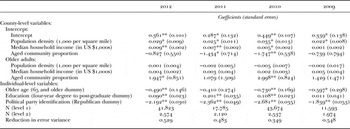
Table 1 provides the results from the multi-level models for 2009–2012. First, I will consider the relationships between the individual control factors and health-care reform attitudes. Not surprisingly, self-identifying as a Republican is strongly associated with negative attitudes towards health-care reform, as it pertains to the ACA, from 2009 to 2012. However, respondents identifying as having at least a four-year college degree are more likely to approve of the legislation. These supportive relationships do not seem to be as strong as the political party effect, but they are statistically significant for three of the years examined (no significant positive relationship for 2009). As for older adults at the individual level, those 65 and over are consistently associated with opposition towards the reform. However, this relationship is not statistically significant for 2011. Given what we know about individual characteristics that predict health-reform attitudes, these results are not surprising.
Multi-level models predicting health reform attitudes

Significance levels: * p < 0.05, ** p < 0.01.
Sources: Cooperative Congressional Election Study, 2009, 2010, 2011, 2012; US Census population data, 2010.
What about the aged context effects? First, how do the health-care reform attitudes of residents living in the least aged places compare to those living in the most aged places? The coefficients that represent the relationship between the aged context of the county and individuals of all ages are located under the intercept section of Table 1. In 2010 and 2011, the relationship is negative and statistically significant (coefficients −1.747 (standard error (SE) = 0.538) and −1.434 (SE = 0.714), respectively), looking at the aged context modelled on the intercept. Residents of all ages in the aged communities were less likely to support recent health-care reforms in 2010 and 2011 compared with residents of places without the same context and controlling for the relevant individual and county-level factors. In 2009 and 2012, the coefficients are also negative but do not reach statistical significance.
For this paper's expectations, I am primarily concerned with the aged context effect for older adults in particular. To estimate these relationships, I model the contextual variables for the older adults in the sample. These are cross-level interactions ‘defined as interactions between variables measured at different levels in hierarchically structured data‘ (Kreft and Leeuw Reference Kreft and de Leeuw1998: 12).
For this multi-level model, the coefficients under ‘older adults’ represent the interactive relationship between the individual characteristic of older adulthood and various community measures like population density, median household income and aged community proportion. In this case, the coefficient for aged community proportion is of primary interest. I ask: How do the health-care reform attitudes of older residents living in the least aged places compare to those living in the most aged places, with a significant aged population and aged cognitive content? We want to know how the large presence of older adults in a community influences the attitudes of individual older residents, controlling for numerous other relevant individual and contextual factors.
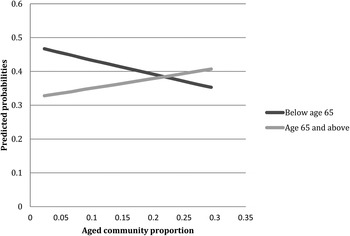
In each year examined, the aged context effect for older adults is positive. This is opposite from what we see when examining the effect of individual age. This means that older residents of aged communities are more likely to support the recent health-care reforms than their peers living in places without the same context. These relationships reach statistical significance in 2010 and 2012 (coefficients 2.998 (SE = 0.824) and 1.947 (SE = 0.851), respectively), but not in 2009 and 2011. I provide predicted probabilities for these more significant relationships to understand substantive significance better.
Figure 1 illustrates the positive relationship for older adults, compared with non-older adults, in 2010. Senior residents of the most aged communities (with a significant aged context) were 8 percentage points more likely to support recent health-care reforms than their peers living in the least aged communities.
Predicted probabilities for health-care reform attitudes across the aged context spectrum for 2010.

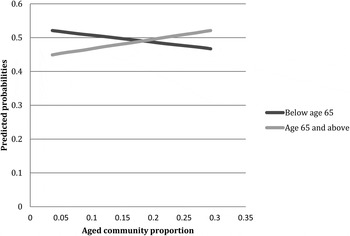
In 2012, probabilities of support for all respondents were higher than in 2010. The relationship between the aged context and support for health-care reforms among the older respondents remains positive and statistically significant in 2012. Older adults living amongst a higher proportion of their peers were 7 percentage points more likely to support the reforms than older adults living in places without the same aged context or access to aged cognitive content.
Predicted probabilities for health-care reform attitudes across the aged context spectrum for 2012.

The relationships between the aged context and recent health-care reform attitudes among older adults of 2009 and 2011 resemble the relationships in 2010 and 2012, however, we cannot be as confident in these results because they do not come close to the common threshold for statistical significance. These are also the years with the smaller sample sizes. Still, older residents of the aged communities consistently show a higher likelihood for supporting the ACA reforms than older people living without the aged context, with 2010 and 2012 perhaps being crucial years for these attitudes. Given what we know about older individuals and public opinion on health-care reforms, I argue that these findings are counterintuitive until considering the relevant community factor, the aged context.
Discussion
This paper considers the role of the social context, specifically an environment inundated with older adults and information biased towards them, for older residents' health-care reform attitudes. There are aged communities, rural and densely populated, developing all over the USA, where the older adult population within a particular geographic boundary is significant, relative to the population of other age groups. We know that older adults have tended to support modest changes for health care but have been largely opposed to reforms tied to the ACA and the Obama Administration. Yet, we see a different trend when we consider places with a critical mass of older adults.
Consistent with past reports of public opinion on the ACA, individual older adults from the CCES surveys were consistently more likely to oppose the recent reforms. But when considering the aged context, older residents of aged communities were more likely to support the ACA in 2010 and 2012. These relationships did not approach statistical significance in 2009 and 2011, but they remained positive for all four years. Even though the supportive relationships are modest, they are present and consistent after controlling for a host of relevant individual and contextual factors. In addition, they are counter to what we would expect if we were not considering social context and the biased information flow of more homogenous places.
So, what is going on? We cannot say for sure, but past contextual studies are helpful. It is possible that the older adults moving to aged communities and/or left in aged communities are just more likely to be supportive of the ACA or move to places where the surrounding population is supportive. However, that does not seem likely for a few reasons. First, we noted earlier that older adults are increasingly ageing in place, so it is probably not just a selection effect. Second, even if selection partially explains resulting attitudes, the past research on social contexts gives us reason to think that the interactions and cognitive content in such places may create unique political information environments that produce unique attitudes. In addition, we know that older adults living in aged contexts have more political knowledge than older people living elsewhere, particularly when it comes to senior-related issues (Bramlett Reference Bramlett2013). It makes sense that older adults in aged communities also know more about the ACA than their peers elsewhere, and this is something to consider given the power of misinformation during the time of the law's passage (Nyhan Reference Nyhan2010; Nyhan, Reifler and Ubel Reference Nyhan, Reifler and Ubel2013).
Older residents of aged communities were more likely to be associated with supportive health-care reform attitudes in 2010 and 2012. Why weren't these positive relationships significant in 2009 and 2011? The debate surrounding the health-care reforms were only just beginning in 2009. It may be that older adults in aged communities reported more supportive attitudes in 2010 upon receiving an influx of information on the legislation. These more supportive relationships were most evident again in 2012. Fluctuations in significance may be due to the salience of the health-care reforms and the available aged cognitive content in particular years over others. The aged context mechanisms may have especially primed older residents for these supportive attitudes with the passage of the ACA in 2010 and the US Supreme Court's decision to uphold the law in 2012. It is also possible that differences in statistical significance across years are simply due to the differences in sample sizes for those same years.
Finally, Bradley and Chen's (Reference Bradley and Chen2013) explanation of why Democratic legislators voted for the ACA when they knew their senior citizen constituents opposed it is potentially helpful for understanding the informational mechanisms of the aged context effect. Bradley and Chen (Reference Bradley and Chen2013) suggest that Democrats were operating under anticipatory representation (Mansbridge Reference Mansbridge2003), meaning that they fully understood their constituents' opinions but attempted to also educate them as to how the ACA served their policy interests (Bradley and Chen Reference Bradley and Chen2013). Based on the findings for this paper, I suggest that older residents living within an aged context already thought that the ACA would serve their policy interests because of their unique community information environment and consistent messaging from older interest groups with which they would be familiar. They probably knew and believed these things because of their enhanced knowledge on the issue due to their homogeneous social and informational environment, the aged context.
This examination is limited in a number of ways. We cannot know for certain that the aged context is working in these ways without asking aged community residents about their knowledge of the ACA or about how they receive and process information. We also do not have details on the various information environments at the time of the ACA's debate and passage. However, past work on the importance of social context (and the aged context) gives us confidence that something similar is going on with regard to health-care reform attitudes and aged communities.
What we do know from this paper is that older people of aged communities have a greater likelihood of supporting the ACA's reforms than people living in places without a significant older adult population; and that runs counter to our expectations if we are not considering social context. Understanding public opinion for recent health-care reforms and senior-related policies in the future may require additional consideration of neighbourhood factors, like the aged context. The aged context may become especially important for public opinion research as the baby-boomer generation moves fully into older adulthood and as the number of aged communities continues to rise.
Appendix
Health-care reform attitude measures