Monogamy is a strongly endorsed norm for intimate relationships (Treas & Giesen, Reference Treas and Giesen2000), and cross-culturally, the majority of people consider infidelity to be unacceptable (Boekhout, Hendrick, & Hendrick, Reference Boekhout, Hendrick and Hendrick2003; Schmitt & Buss, Reference Schmitt and Buss2001). Even so, infidelity is quite common in romantic relationships, with prevalence rates ranging from 24% to 75% (Shackelford, LeBlanc, & Drass, Reference Shackelford, LeBlanc and Drass2000; Tafoya & Spitzberg, Reference Tafoya, Spitzberg, Spitzberg and Cupach2007). Mate poaching occurs when a person attracts another, whom he or she knows is already in an exclusive relationship, into a sexual or romantic relationship (Davies, Shackelford, & Hass, Reference Davies, Shackelford and Hass2007). In terms of poaching status (i.e., whether one is a poacher, poached, or co-poached), the poacher is the individual who disrupts the existing relationship, the poached is the person who is targeted by the poacher (Schmitt & Buss, Reference Schmitt and Buss2001), and the co-poached is an individual in a new relationship where both partners poached each other from an existing relationship to start the new one together (Schmitt & ISDP, Reference Schmitt2004). A comprehensive survey of poaching among North American adults found that the majority had attempted to poach for short-term (85%) and long-term (78%) relationships. Similarly, the majority had experienced at least one mate poaching attempt by a poacher (75% for long-term and 73% for short-term relationships). Approximately half of both groups (52–63% of men and 42–47% of women) reported that the poaching attempts were successful at least once (Schmitt & ISDP, Reference Schmitt2004). Although these are lifetime values, mate poaching appears to be involved in the evolution of many relationships.
Poachers and poached appear to have a range of personal characteristics, sexual attitudes and experiences that may not be conducive for establishing quality, long-term monogamous relationships, as other researchers have argued (Foster et al., Reference Foster, Jonason, Shrira, Campbell, Shiverdecker and Varner2014). For both men and women, poachers report having more lifetime sex partners, more lifetime casual sex partners, and more lifetime dating partners (Arnocky, Sunderani, & Vaillancourt, Reference Arnocky, Sunderani and Vaillancourt2013). Those who are poached tend to report uninhibited sexual attitudes and behaviour (Foster et al., Reference Foster, Jonason, Shrira, Campbell, Shiverdecker and Varner2014). Yet little is known about the nature of relationships that are established as a result of mate poaching.
Quality of Relationships Resulting from Poaching
Foster et al. (Reference Foster, Jonason, Shrira, Campbell, Shiverdecker and Varner2014) conducted the only study to our knowledge of the quality of relationships formed from mate poaching from the perspective of poached individuals. They assessed relationship quality over a 10-week period among 138 heterosexual young adults (M age = 20.29 years, SD = 2.91). In particular, they assessed relationship commitment, which is the attachment to, and intention to remain in, a relationship (Rusbult, Reference Rusbult1980, Reference Rusbult1983), as well as satisfaction, which is the evaluation of the extent to which a relationship meets one's positive expectations (Rusbult, Reference Rusbult1980, Reference Rusbult1983). Individuals who were poached were less committed and less satisfied as compared to individuals in relationships formed serially (i.e., non-poached relationships). Individuals who were poached also perceived potential relationship alternatives to be of higher quality and had higher rates of infidelity in their current relationship. This study provided first insights into how relationships formed from poaching appear to be characterised by relatively lower levels of quality, from the perspective of someone who has been poached.
We extended the work of Foster and colleagues (Reference Foster, Jonason, Shrira, Campbell, Shiverdecker and Varner2014) by examining relationship quality of poached relationships among adults in their mid-twenties and beyond. Foster studied those who were 25 or under. Adults typically report greater relationship commitment, less relationship turnover, and greater relationship stability compared to younger ages (Arnett, Reference Arnett2000; Cherlin, Reference Cherlin2009; Rauer, Pettit, Lansford, Bates & Dodge, Reference Rauer, Pettit, Lansford, Bates and Dodge2013). There may be key differences in the mate poaching experiences of adults as reflected with relationship quality, although no study to date has examined adults. Despite originating from infidelity, relationships formed by poaching occasionally result in long-term relationships (Schmitt & ISDP, Reference Schmitt2004), suggesting that the quality for many poachers, poached, and co-poached is sufficiently high for longevity.
Poaching Status and Perceived Relationship Quality
Foster and colleagues (Reference Foster, Jonason, Shrira, Campbell, Shiverdecker and Varner2014) found that poached individuals reported lower levels of commitment and satisfaction than did those who were not poached into their current relationship. Lower commitment predicted willingness to engage in various forms of infidelity and deception, even after controlling for sociosexual orientation (Mattingly et al., Reference Mattingly, Clark, Weidler, Bullock, Hackathorn and Blankmeyer2011). Poached individuals also demonstrated higher rates of infidelity (Foster et al., Reference Foster, Jonason, Shrira, Campbell, Shiverdecker and Varner2014). We expected to find differences in reports between poachers and those who were poached in regard to relationship quality because of known biological (e.g., hormonal), psychological (e.g., sociosexual orientation, personality characteristics), and social factors (e.g., history of infidelity, experience of poaching) that differ among poachers and poached individuals (Kardum, Hudek-Knezevic, Schmitt & Grundler, Reference Kardum, Hudek-Knezevic, Schmitt and Grundler2015; Schmitt & Buss, Reference Schmitt and Buss2001; Sunderani, Arnocky & Vaillancourt, Reference Sunderani, Arnocky and Vaillancourt2013).
Because past infidelity predicts future infidelity (Allen et al., Reference Allen, Rhoades, Stanley, Markman, Williams, Melton and Clements2008; Maddox Shaw, Rhoades, Allen, Stanley, & Markman, Reference Maddox Shaw, Rhoades, Allen, Stanley and Markman2013), those who were poached from their relationships may have lower commitment and satisfaction in their relationships generally, sufficient to be attracted to a new relationship by a poacher and to leave their previous relationship. The repercussion of poaching a partner away from another is recognising that one's partner willingly betrayed his or her former partner via infidelity to establish a relationship with you, the poacher. This knowledge ultimately may spur feelings of jealousy regarding potential rivals and less confidence in a partner's trustworthiness to remain committed to the current relationship. A romantic partner's interest in other partners constitutes a significant relationship threat (Lydon, Menzies-Toman, Burton, & Bell, Reference Lydon, Menzies-Toman, Burton and Bell2008). A diary study found that perceptions of a partner's temptation for infidelity predicted vigilance and threat-sensitivity, which manifested in jealousy and efforts to guard against potential rivals (Neal & Lemay Jr, Reference Neal and Lemay2014).
Conceptual Framework
Similar to Foster and colleagues (Reference Foster, Jonason, Shrira, Campbell, Shiverdecker and Varner2014), we assessed key indices of relationship quality identified in the romantic relationship literature, drawing particularly from the investment model (Rusbult, Reference Rusbult1980) and evolutionary theory. These variables include commitment, relationship satisfaction, infidelity, and jealousy. However, we also examined other key indices supported by the literature, including sexual satisfaction and trust, which have received far less research attention in this context.
First, we drew upon the investment model (Rusbult, Reference Rusbult1980), as its constructs have been demonstrated to predict relationship commitment and the outcomes of romantic relationships (Drigotas, Safstrom, & Gentilia, Reference Drigotas, Safstrom and Gentilia1999; Johnson & Rusbult, Reference Johnson and Rusbult1989; Miller, Reference Miller1997; Rusbult, Reference Rusbult1980, Reference Rusbult1983; Rusbult, Martz, & Agnew, Reference Rusbult, Martz and Agnew1998). In particular, satisfaction has been linked closely to commitment because it reflects the extent to which one's positive expectations are truly being met in that relationship context, making one less likely to leave for another partner, as in the case of poaching (Rusbult, Agnew, & Arriaga, Reference Rusbult, Agnew, Arriaga, Van Lange, Kruglanski and Higgins2012). But it is commitment, especially, that is consistently associated with willingness to sacrifice for one's partner and relationship, relationship adjustment, and relationship persistence — making commitment a key index of relationship quality with regard to poaching, as it requires forsaking all others to remain in a relationship.
We also drew upon evolutionary theory (Buss & Shackelford, Reference Buss and Shackelford1997; Ein-dor, Perry-Paldi, Hirschberger, Birnbaum, & Deutsch, Reference Ein-Dor, Perry-Paldi, Hirschberger, Birnbaum and Deutsch2015; Kardum, Hudek-Knezevic, & Gracanin, Reference Kardum, Hudek-Knezevic and Gracanin2006) and its large body of related work on mate retention, from which the study of poaching evolved (Buss, Reference Buss1988, Reference Buss1990). Evolutionary theory posits that jealousy is a response to the threat of infidelity or to the perceived or potential loss of the relationship (Buss, Larsen, Westen, & Semmelroth, Reference Buss, Larsen, Westen and Semmelroth1992; Sharpsteen & Kirkpatrick, Reference Sharpsteen and Kirkpatrick1997). Thus, jealousy is an emotion that evolved to ward off potential poachers and prevent a partner's infidelity, but it can also be highly destructive to a relationship (Buss, Reference Buss2013). It is evoked in situations where trust (i.e., believing that partners can depend on each other) is low and subsequently indicates poorer relationship quality (Buss, Reference Buss2000; Holmes & Rempel, Reference Holmes, Rempel and Hendrick1989; Rodriguez, Dibello, Øverup, & Neighbors, Reference Rodriguez, Dibello, Øverup and Neighbors2015). Trust is an essential component in the maintenance of healthy relationships (Holmes & Rempel, Reference Holmes, Rempel and Hendrick1989; Simpson, Reference Simpson2007). Infidelity is another important indicator of relationship quality because of the links that it has to betrayal, secrecy, guilt, shame, transgression (Allen et al., Reference Allen, Rhoades, Stanley, Markman, Williams, Melton and Clements2008; Baucom, Snyder, & Gordon, Reference Baucom, Snyder and Gordon2009; Previti & Amato, Reference Previti and Amato2004), and the violation of expectations of exclusivity (Amato & Previti, Reference Amato and Previti2003; Lampard, Reference Lampard2014; Mattingly, Wilson, Clark, Bequette, & Weidler, Reference Mattingly, Wilson, Clark, Bequette and Weidler2010; Treas & Giesen, Reference Treas and Giesen2000). Infidelity also is linked to significant discord and distress in relationships (Hall & Fincham, Reference Hall and Fincham2009; Previti & Amato, Reference Previti and Amato2004), which deplete relationship quality even further.
The Current Study
The purpose of the current study was to examine the quality of adult relationships that evolve from mate poaching. It focuses specifically on the key indices of relationship quality as noted above. Co-poached individuals have not been studied as their own group to date, therefore specific predictions could not be made about how they may vary in terms of relationship quality compared to poachers and poached individuals. However, in line with previous research, we predicted the following:
H1: Individuals in a relationship formed by poaching would report lower levels of relationship quality compared to those in relationships formed serially.
H2: Individuals who were poached would report lower levels of commitment, relationship and sexual satisfaction, and higher rates of infidelity, than would poachers.
H3: Poachers would report lower trust and higher levels of jealousy compared to those who were poached.
Method
Participants and Procedure
Six hundred and seventy-five heterosexual participants (55% women, M age = 31.3, SD = 4.23) were recruited with a human intelligence task from Mechanical Turk® (MTurk ®), a crowdsourcing website that allows workers to select small online tasks for pay. Eligibility requirements were age (25–40 years), residence in the United States, and currently involved in a romantic relationship. Response to one or both of two screening questions (‘Are you currently in a relationship that started while you were already in a relationship with someone else?’ or ‘Was your current partner in a romantic relationship with someone else when your relationship with them started?’) were used to obtain a sufficient minimum number of participants from poached relationships. The sample reported the following ethnic diversity: White (72.2%), Black (7.4%), Hispanic (5.7%), South Asian (5.7%), Indigenous (2.2%), and Other (6.8%).
Measures
Relationship history
Participants provided information pertaining to their current relationship, including their relationship status (e.g., dating one person exclusively; dating more than one person; in a committed relationship with one person exclusively — i.e., living together, engaged, married; in a committed relationship but also in a relationship with someone else; open relationship), duration of relationship (in months), and partner gender (e.g., male, female, transgender male, transgender female). They also indicated whether they had an agreement of romantic and/or sexual exclusivity with their partner.
Infidelity
Participant extradyadic involvement was assessed by asking: ‘I have been romantically/sexually involved with at least one other person (other than my romantic partner) during my relationship with my current primary partner’ (from Thompson & O'Sullivan, Reference Thompson and O'Sullivan2016). Only those who also indicated that they had an agreement to be exclusive (see above), but reported engaging in romantic and/or sexual activity with someone other than their partner were classified as having engaged in infidelity.
Mate poaching
The poaching measure used in the study was adapted from the previous literature (Davies et al., Reference Davies, Shackelford and Hass2007; Foster et al., Reference Foster, Jonason, Shrira, Campbell, Shiverdecker and Varner2014; Schmitt & Buss, Reference Schmitt and Buss2001). Participants were given the definition of poaching: ‘Mate poaching occurs when someone forms (or attempts to form) a romantic and/or sexual relationship with someone who they know is already in an exclusive relationship.’ Participants then were informed that: ‘An exclusive relationship is one in which the couple has an understanding that their relationship is monogamous, so romantic or sexual relationships with people outside of their relationship is contrary to that understanding.’ An example of a poaching incident (Davies et al., Reference Davies, Shackelford and Hass2007) was then provided: ‘Suppose that Sarah is in an exclusive relationship with Tom. If David tries to attract Sarah away from Tom, then David is mate poaching because he is attempting to form a romantic and/or sexual relationship with someone (Sarah) who is already in an exclusive relationship (with Tom). If Sarah leaves Tom for David, then Sarah is said to have been mate poached.’ Participants responded to the following questions: ‘Based on the definitions above, were you mate poached by your current romantic partner?’ (yes/no) and ‘Did you mate poach your current partner?’ (yes/no). Responses to this question resulted in four groups: poachers, poached, co-poached, and non-poached individuals.
Relationship commitment
The commitment subscale of the Investment Model Scale (Rusbult et al., Reference Rusbult, Martz and Agnew1998) measures the long-term orientation that an individual has to his or her relationship. It consists of seven items, such as ‘I want our relationship to last a very long time’ and ‘It is likely that I will date someone other than my partner within the next year’ (reverse scored). Participants responded to each item on a 9-point Likert scale ranging from 0 (do not agree at all) to 8 (agree completely). Higher averaged scores indicate higher commitment.
Relationship satisfaction
The Global Measure of Relationship Satisfaction (GMREL; Lawrance & Byers, Reference Lawrance and Byers1992) is a self-report assessment requiring individuals to evaluate positive and negative aspects of their romantic relationship. Participants responded to an item, ‘In general, how would you describe your overall relationship with your romantic partner’, by rating their relationship on five 7-point dimensions: Good-Bad, Pleasant-Unpleasant, Positive-Negative, Valuable-Worthless and Satisfying-Unsatisfying. Higher scores indicate greater relationship satisfaction. The GMREL has strong psychometric properties (Byers, Reference Byers2005; Byers & Demmons, Reference Byers and Demmons1999).
Sexual satisfaction
The Global Measure of Sexual Satisfaction (GMSEX; Lawrance & Byers, Reference Lawrance and Byers1995) assesses self-reported evaluations of the positive and negative aspects of respondents’ sexual relationships. Participants responded to an item, ‘In general, how would you describe your overall sexual relationship with your romantic partner’, then rated it on five 7-point dimensions: Good-Bad, Pleasant-Unpleasant, Positive-Negative, Valuable-Worthless and Satisfying-Unsatisfying. Higher scores indicate higher sexual satisfaction. The GMSEX is psychometrically sound (Byers, Reference Byers2005; Lawrance & Byers, Reference Lawrance and Byers1995).
Trust
The Dyadic Trust Scale (Larzelere & Huston, Reference Larzelere and Huston1980) measures the amount of honesty that an individual feels his or her partner expresses toward the respondent in his or her romantic relationship. The scale consists of eight items such as ‘I feel that I can trust my partner completely’ and ‘I feel that my partner can be counted on to help me’. Participants responses fell on a 7-point Likert scale, ranging from 1 (very strongly disagree) to 7 (very strongly agree), resulting in an averaged score, higher scores indicate greater levels of trust.
Jealousy
The Multidimensional Jealousy Scale (Pfeiffer & Wong, Reference Pfeiffer and Wong1989) measures participants’ thoughts, feelings and behaviours of jealousy, or responses to perceived threats within their current relationship. Possible responses range from 1 (not at all upset/all of the time) to 7 (very upset/never). The total scale consists of 24 items such as ‘My partner is flirting with someone’ and ‘I suspect that my partner may be attracted to someone else’. Scores were averaged, with higher scores indicating higher levels jealousy (Dandurand & Lafontaine, Reference Dandurand and Lafontaine2014; Elphinston & Noller, Reference Elphinston and Noller2011). Although there are three subscales to this measure (i.e., cognitive, emotional, and behavioural jealousy), consistent with previous literature examining similar constructs (Maner, Gailliot, Rouby, & Miller, Reference Maner, Gailliot, Rouby and Miller2007; Miller & Maner, Reference Miller and Maner2009), a total jealousy score was used.
Results
Data Conditioning
We used mean substitution to replace missing values as less than 1% of the data was missing (Tabachnick & Fidell, Reference Tabachnick and Fidell2013). We conducted preliminary assumption testing to check for normality, linearity, univariate and multivariate outliers, and homogeneity of variance. We conducted power analyses using G*Power based on relevant effect sizes found in the literature (Erdfelder, Faul, & Buchner, Reference Erdfelder, Faul and Buchner1996). A power analysis for a one-way analysis of variance (ANOVA) with four groups was conducted in G*Power to determine a sufficient sample size using an alpha of 0.05, power of 0.95, and a medium effect size (f = 0.20; Faul, Erdfelder, Buchner, & Lang, Reference Faul, Erdfelder, Buchner and Lang2013; Foster et al., Reference Foster, Jonason, Shrira, Campbell, Shiverdecker and Varner2014). Based on these assumptions, the desired sample size was 436 participants. In addition, based on our sample size (N = 660), univariate analyses were robust to modest violations of normality not due to outliers (Tabachnick & Fidell, Reference Tabachnick and Fidell2013). We deleted 15 multivariate outliers from the original sample, resulting in a final sample of 315 male and 345 female participants. Inspection of the zero-order correlations did not identify any problems with multicollinearity.
Sample Characteristics
Eighty-seven participants (13.2%; 49.4% male) identified themselves as poachers, 151 participants (22.9%; 45.7% male) identified themselves as poached, 43 participants (6.5%; 53.5% male) identified themselves as co-poached, and 379 participants (57.4%; 47.4% male) indicated they were neither poached nor a poacher. Sixty-four percent of participants reported being in a committed relationship with one person exclusively, and 27% reported they were dating one person exclusively. A minority of participants were dating more than one person (5%), or in a committed relationship but also in a relationship with someone else (4%). Average relationship length was 65 months (SD = 59.14, Md = 12, Mdn = 48, range = 1–298). Overall, 27% of our participants reported having engaged in romantic and/or sexual infidelity in their current relationship. Table 1 displays the correlation matrix for all predictor variables as well as their means, standard deviations, and Cronbach alphas for the corresponding scales.
Descriptive Statistics and Correlations Between Predictor Variables

Note: N = 660. *p < .01.
A chi-square analysis revealed no differences for poaching status (i.e., poacher, poached, co-poached, non-poached) by gender, χ2(3, n = 659) = .942, p = .815. There were no infidelity differences by gender, χ2(1, n = 651) = 2.57, p = .11. An ANOVA revealed no effect for age by poaching status, F(3, 656) = 2.85, p = .04, η2 = .01. However, poaching status was associated with relationship duration, Welch's F(3, 150.29) = 12.67, p < .001, η2 = .05. Due to a violation of the homogeneity of variance, Welch's F was conducted next (Tabachnick & Fidell, Reference Tabachnick and Fidell2013). Follow-up contrasts revealed that poachers (M = 88.21, SD = 61.72), poached (M = 48.73, SD = 44.21), and co-poached (M = 45.21, SD = 51.05), as a group, did not have relationships that differed in duration from non-poached individuals (M = 68.68, SD = 60.76), t(320.73) = -1.67, p = .10. However, co-poached individuals had significantly shorter relationships than did poachers/poached, t(62.97) = 2.69, p < .01, and poached individuals had significantly shorter relationships than poachers, t(138.06) = 5.23, p < .001.
Comparisons of Relationship Quality for Poached and Non-Poached Relationships
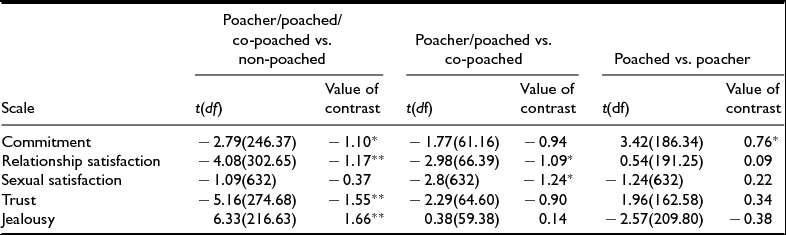
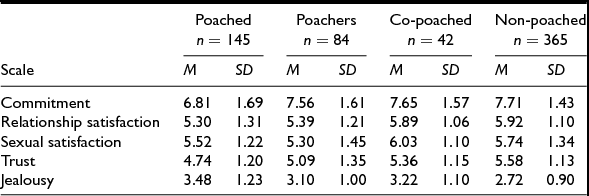
A series of ANOVAs revealed that poaching status was related to relationship quality. Given that we had specific hypotheses to test and we wanted to control for inflated familywise error (Fields, Reference Fields2013; Tabachnick & Fidell, Reference Tabachnick and Fidell2013), we planned three orthogonal contrasts: (1) poachers/poached/co-poached versus non-poached (H1); (2) poachers/poached versus co-poached (exploratory); and (3) poachers versus poached (H2 and H3). See Table 2 for the planned contrasts of each relationship quality indicator. Table 3 presents the means and standard deviations of each of the groups. To protect against type I error of running multiple ANOVAs, we adjusted our p value of significance to .01.
Planned Contrasts Comparing Poachers, Poached, and Non-Poached Individuals in Ratings of Relationship Quality

Note: Poached n = 145, poacher n = 84, co-poached n = 42, non-poached n = 365. *p < .01. **p < .001.
Group Means Across Relationship Quality Indices

We found differences in commitment scores by poaching status, Welch’s F(3, 143.28) = 11.12, p < .001, η2 = .06. Consistent with H1, planned contrasts revealed that those participants who were poachers, poached, and co-poached reported lower levels of commitment, as a group, than did those who were in relationships not formed by poaching. We also found significant differences between groups on relationship satisfaction, Welch's F(3, 146.03) = 11.62, p < .001, η2 = 06, sexual satisfaction, F(3, 632) = 4.23, p < .01, η2 = .02, and trust, Welch's F(3, 144.45) = 19.16, p < .001, η2 = 08. Planned contrasts revealed that as a group, poachers, poached, and co-poached individuals reported lower relationship satisfaction and trust than did those in relationships not formed by poaching, in line with our hypothesis (H1). However, we did not find significant differences between poached individuals as a group and non-poached individuals on reported levels of sexual satisfaction. Poaching status was also linked to jealousy, Welch's F(3, 140.95) = 18.77, p < .001, η2 = .09. Planned contrasts indicated that individuals who were in the poached group had higher levels of overall jealousy in their relationship than did those in the non-poached group, supporting H1.
Those classified as having engaged in infidelity were only those who reported being in an exclusive current relationship, but also having engaged in a romantic and/or sexual interaction with an extradyadic partner. Chi-square analysis revealed significant differences in rates of infidelity based on poaching status, χ2(3, n = 582) = 66.67, p < .001. For follow-up, we examined the adjusted standardised scores and calculated Bonferroni adjusted p values (Beasley & Schumacker, Reference Beasley and Schumacker1995; Garcia-Perez & Nunez-Anton, Reference Garcia-Perez and Nunez-Anton2003). Of those who reported engaging in infidelity in their current relationship, poachers, poachers and poached individuals, as a group, accounted for 66% of the total sample proportion. This is significantly higher than their non-poaching counterparts (34%), as predicted by H1, χ2(1, n = 582) = 52.43, p < .001. Only 16% of non-poached individuals reported engaging in infidelity in their current relationship. Thus, in almost all respects, those in relationships formed by poaching reported lower ratings of relationship quality than did those in relationships formed serially.
Comparisons of Relationship Quality for Co-Poached to Poachers/Poached
Aligning with our second contrast, we conducted exploratory analyses of co-poached individuals in comparison to poachers and poached individuals combined. Co-poached individuals did not report significantly different levels of commitment, trust or jealousy from poachers and poached individuals as a group. However, when compared to poachers and poached combined, co-poached individuals reported significantly higher levels of both relationship and sexual satisfaction. Regarding infidelity, 29% percent of co-poached individuals reported engaging in infidelity in their current relationship. This proportion was not significantly different from the combined poacher/poached group (44.7%), χ2(1, N = 232) = 3.62, p > .05.
Comparison of Relationship Quality for Poachers to Poached
Consistent with H2, poached individuals reported lower levels of commitment than did poachers, but did not differ on relationship satisfaction or sexual satisfaction. However, in contrast to our third prediction (H3), poached individuals did not report significantly different levels of trust or jealousy than did poachers. A significantly higher proportion of poached individuals (53%) reported engaging in infidelity during their current relationship compared to poachers (32%), χ2(1, N = 208) = 8.54, p < .01.
Discussion
In this study, we compared indices of relationship quality among adults in romantic relationships formed from mate poaching to those among adults in romantic relationships not formed from poaching. This study also explored whether relationship quality in poached relationships differed depending on whether the ratings of relationship quality came from the perspective of an individual who was a poacher, poached, or co-poached. We found that individuals in relationships formed by poaching rated their relationships as poorer in quality in almost every dimension that we measured than did those who were in relationships that were not formed by poaching. Those in relationships formed by poaching reported lower commitment to their relationship, lower relationship satisfaction, lower levels of trust in their relationship, and higher levels of jealousy. Furthermore, we found that to some extent, one's relationship status mattered in terms of perspective on relationship quality, as those who were poached out of an existing relationship into their current one reported lower levels of commitment than did those who poached their current partner away from an existing relationship.
Consistent with previous research with emerging adults (Foster et al., Reference Foster, Jonason, Shrira, Campbell, Shiverdecker and Varner2014) and our predictions, our study supports the premise that poachers, poached and co-poached individuals report lower relationship quality for their current relationships than do those who formed relationships serially. These differences may reflect traits that characterise individuals in poached relationships (e.g., unrestricted sociosexual orientation, low agreeableness, and low conscientiousness; Schmitt & Buss, Reference Schmitt and Buss2000; Vater & Schröder-Abé, Reference Vater and Schröder‐Abé2015) and that may be linked to lower quality romantic relationships (Foster et al., Reference Foster, Jonason, Shrira, Campbell, Shiverdecker and Varner2014). Although we did not measure these traits in the current study, this consistent pattern of findings of lower relationship quality are notable and suggest that there are traits common to those who form new relationships via poaching, or problems characteristic of such relationships, perhaps relating to their formation via infidelity.
Those in poached relationships were also more likely to report having engaged in infidelity in their current relationships than were those in non-poached relationships. Just over one half of individuals in poached relationships (53%) and one third of poachers (32%) reported engaging in romantic and/or sexual infidelity, which is two to three times higher than those in non-poached relationships (16%). This is consistent with previous research that found that those in poached relationships engaged in higher levels of infidelity than did those who were not in relationships that evolved from poaching (Foster et al., Reference Foster, Jonason, Shrira, Campbell, Shiverdecker and Varner2014). It is possible that this pattern reflects the poorer quality of these relationships in general, making them more vulnerable to infidelity. However, given that we know that poachers as a collective tend to embody personality traits negatively associated with relationship quality (Foster et al., Reference Foster, Jonason, Shrira, Campbell, Shiverdecker and Varner2014; Kardum et al., Reference Kardum, Hudek-Knezevic, Schmitt and Grundler2015; Schmitt & Buss, Reference Schmitt and Buss2000; Vater & Schröder-Abé, Reference Vater and Schröder‐Abé2015), these higher rates of infidelity may indicate a propensity toward infidelity or tolerance of infidelity among relationship partners in poached relationships.
When specifically examining relationship quality based on poaching status, we found that being in a poached relationship influenced one's ratings of quality negatively. We wanted to determine whether the role one played in the formation of the relationship influenced those ratings. To that end, we examined whether one's status as a poacher, poached, or co-poached individual influenced perceptions of one's current (mate poached) relationship. In partial support of our hypotheses, poached individuals reported lower levels of commitment to their relationship than did poachers, consistent with Foster et al. (Reference Foster, Jonason, Shrira, Campbell, Shiverdecker and Varner2014). Our primary conceptual framework, the investment model, views commitment as the hallmark feature of quality — lower levels are typically related to the relationship stress and strain (Le & Agnew, Reference Le and Agnew2003). Given that commitment is one of the best predictors of relationship longevity (Impett, Beals, & Peplau, Reference Impett, Beals and Peplau2001; Le & Agnew, Reference Le and Agnew2003), it is likely that lower relationship commitment was a factor that allowed these individuals to be poached away from their previous relationship, and perhaps this tendency toward lower commitment extends across relationships. This argument may explain in part why poached individuals had relationships that were significantly shorter in duration than did poachers. Lower commitment to a relationship is also associated with higher rates of sexual and emotional infidelity (Drigotas et al., Reference Drigotas, Safstrom and Gentilia1999; Le, Dove, Agnew, Korn, & Mutso, Reference Le, Dove, Agnew, Korn and Mutso2010). In the current study, poached individuals reported lower levels of commitment in their current relationship and were more likely to have engaged in infidelity compared to poachers. No differences were found in their ratings of relationship and sexual satisfaction, jealousy, or trust. However, when poachers, poached, and co-poached were separated into their own groups, sample sizes were unequal, which limited the power of these analyses. It is unclear whether we did not find differences in these domains because of a true lack of differences or because of insufficient power to detect them.
Interestingly, co-poached individuals had significantly higher levels of relationship and sexual satisfaction in their current relationship than did their poaching and poached counterparts, suggesting that there might be a cumulative effect operating in some way. Examination of the means reveals that co-poached individuals provide responses closer to their non-poached peers with regard to relationship satisfaction. Co-poached individuals also reported the highest levels of sexual satisfaction of all groups. Our data suggest that there may be something unique about these individuals and their relationship experiences that differentiates them from their poacher and poached counterparts. Perhaps co-poached individuals found themselves in serendipitous conditions of mutual attraction that resulted in formation of a better relationship for both parties, possibly better able to endorse ‘it was meant to be’ destiny romantic scripts (Vannier & O'Sullivan, Reference Vannier and O'Sullivan2017). However, it is important to note that they did not differ in rates of infidelity from their poaching counterparts, although replication with higher numbers in this group is warranted.
Study Limitations and Future Directions
The current study extends research on the quality of relationships formed from poaching by examining a sample that has not been used previously in the literature. Our sample included participants ranging from 25–40 years of age, whereas the one known study of this topic (Foster et al., Reference Foster, Jonason, Shrira, Campbell, Shiverdecker and Varner2014) used a sample of participants under the age of 25. We know that there are key developmental differences in approaches to relationships (Arnett, Reference Arnett2000; Cherlin, Reference Cherlin2009; Rauer et al., Reference Rauer, Pettit, Lansford, Bates and Dodge2013). These likely play a role to some extent, but both samples showed marked poorer quality in relationships formed from poaching compared to those formed serially. Our study was limited by the cross-sectional nature of the data and therefore cannot inform causal relationships. Longitudinal data are needed to track relationship quality over time, including infidelity and changes in relationship quality. A more comprehensive longitudinal study would include personality assessments of individuals in couples to assess whether there are traits that have greater predictive utility for relationship quality. Individual traits can interact within a couple dynamic, which may lead to later changes in quality, such as relationship dissolution and formation of subsequent relationships. Information from both partners’ perspectives would be invaluable, as the changes in relationship quality might not be shared by both partners and could be attributed to a partner's personal characteristics (e.g., attachment style, jealousy levels, neuroticism) or participation in infidelity. Although we have perspectives from both poachers and poached here, they were not in relationships with each other.
Participants were recruited from a crowdsourcing site that allows for greater representation than is possible from most standard sources, such as college and community samples (Behrend, Sharek, Meade, & Wiebe, Reference Behrend, Sharek, Meade and Wiebe2011). Samples recruited from MTurk tend to be more heterogeneous than community or college student samples (Goodman, Cryder, & Cheema, Reference Goodman, Cryder and Cheema2013). Research has revealed that MTurk workers are more attentive to survey instructions than are college students (Hauser & Schwarz, Reference Hauser and Schwarz2016). However, the current sample was relatively homogenous in terms of race/ethnicity (mostly White) and orientation. Research is needed using more diverse samples. For example, gay male couples report lower rates of jealousy in their relationships compared to heterosexual couples (Dijkstra, Barelds, & Groothof, Reference Dijkstra, Barelds and Groothof2013), and sexual satisfaction becomes a poor indicator of relationship quality in older couples (Chao et al., Reference Chao, Lin, Ma, Lai, Ku, Kuo and Chao2011). Studies of mate poaching have found that prevalence varies across many cultures (Schmitt & ISDP, Reference Schmitt2004). Mate poaching and its association with relationship quality may differ in groups where there is a higher perceived scarcity of partners (e.g., sexual minority groups, older populations). Perceived scarcity of partner availability increases competition among same-sex ‘rivals’ in humans (Arnocky, Ribout, Mirza, & Knack, Reference Arnocky, Ribout, Mirza and Knack2014). Arnocky and colleagues (Reference Arnocky, Ribout, Mirza and Knack2014) demonstrated that jealousy is increased in situations where there are fewer partners available, and there is a threat of infidelity to the current relationship.
Conclusion
This research extends previous research on mate poaching and relationship quality. Although overall most relationships were quite high in quality, we found poorer relationship quality in relationships formed via poaching as compared to serially formed relationships. This finding suggests that how relationships are formed is a central component for understanding relationship dynamics and that there may be something unique about these relationships or those in relationships formed from poaching, which warrants additional research attention. This study also indicates that one's role in the mate-poached relationship has differential associations with relationship quality and provides first insights regarding relationship quality for those who identify as co-poached. Although relationships formed by mate poaching appear common and endure, more research is needed to examine the process by which this lower relationship quality occurs.
Acknowledgments
We would like to thank Dr Pablo Santos Iglesias for his consultation regarding this manuscript. We gratefully acknowledge research support from a Canada Research Chair held by Lucia F. O'Sullivan.