

Introduction
Long-term care has customarily been undertaken by relatives and volunteers on an informal basis, or by residential care and professional home-care services. Since the 1990s, new ways of organising care have been introduced in many European countries. Governments and organisations for disabled people have increasingly embraced ‘cash-for-care schemes’ or ‘payments for care’ that are ‘systems in which care users are given the means to employ care-givers directly in an employer–employee relationship’ (Ungerson Reference Ungerson1997: 369).Footnote 1 Despite considerable national differences in policy and administrative arrangements, cash-for-care schemes share one basic feature: they provide people who have been assessed on the basis of their care needs as eligible with an allowance that can be used to compensate care-giving relatives or friends and/or to buy care supplied by profit or non-profit organisations or self-employed care workers (Evers, Pijl and Ungerson Reference Evers, Pijl and Ungerson1994; Ungerson and Yeandle Reference Ungerson and Yeandle2007).
The first assumption underlying this policy shift is that that personal care budgets empower care receivers (Glendinning Reference Glendinning2008; Ungerson Reference Ungerson2004), as they have greater control over whom they employ and under what terms. Secondly, governments regard cash-for-care benefits as a cost-containment measure that will make long-term, non-medical or social care more affordable in the long run (Gilbert Reference Gilbert2004). It is assumed that competition will lead to both reduced prices in the care market and improvements in the quality and responsiveness of the services (LeGrand and Barlett Reference LeGrand and Barlett1993), and that the ability to pay relatives provides women with an incentive to keep doing the care work, possibly in addition to or instead of a paid job. This is again seen as a way of containing costs and encouraging flexible care arrangements. Personal budgets are also seen as having ‘moral worth’ because they value, support and promote the affective dimensions of family care (Linsk et al. Reference Linsk, Keigher, Simon-Rusinowitz and England1992), which it is believed provide a high quality of psycho-social care through the family members' ‘personal knowledge and their ability and opportunity to understand the specifics of each situation where help is required’ (Waerness Reference Waerness, Glendinning and Kemp2006: 27). All in all, personal budgets are proclaimed as an ‘everyone wins’ reform: care recipients are empowered, care is more individualised and humanised, costs decrease, and women's informal care work is valued.
Of course, what is good for care receivers (and governments) is not necessarily good for care-givers (Kremer Reference Kremer2006). The implications of payments for family care-givers have been theorised often but rarely researched empirically. This article reports a qualitative study in The Netherlands of a small sample of women who take care of their relatives as ‘employees’. The main research questions addressed are: how do paid family care-givers envision being paid for caring for their dependent relatives, and how do they experience their contractual care relationship? The paper begins by describing the Dutch policy context, after which we review relevant previous literature, present the study and discuss the findings.
Payments for care in The Netherlands
Payments for care in The Netherlands are embedded in a long-lasting and highly inclusive social protection scheme for people in need of long-term care. Since 1968, with the introduction of a long-term care insurance scheme, Algemene Wet Bijzondere Ziektekosten (AWBZ), the Dutch welfare state has taken major responsibilities in this field, predominantly for part-funding not-for-profit residential and home-care providers (Knijn and Verhagen Reference Knijn and Verhagen2007). The costs of this scheme have been increasing in recent decades through population ageing and because the scheme created a universal, needs-based entitlement. In an attempt to curtail the rising costs, to shorten the waiting lists for professional (home) care, and to give dependent people more choices, since the early 1990s successive Dutch governments have experimented with payments-for-care, and in 1996 long-term care recipients acquired the ‘right’ to receive a Persoonsgebonden Budget [personal budget] (PGB).
People in need of support with daily activities can access the services and benefits of long-term care insurance following a positive assessment by an independent body, the Centrum Indicatiestelling Zorg [Care Assessment Office] (CIZ). If a needs-assessment finds that the person is eligible, she or he may choose between receiving formal services (either in their own home or in residential care), or having a personal budget (for domiciliary care), and combinations of the two are permitted. Given the growing demand for home care, the demand for personal budgets is increasing even more than that for formal services, and by 2007, of those in need of social care, 80,885 (10% of the total) received a personal budget. It has been projected that there will be 190,000 budget holders in 2011 (Dutch Ministry of Health, Welfare and Sport 2007). According to a representative survey (Ramakers et al. Reference Ramakers, Schellingerhout, Wijngaart and Miedema2008), the most numerous category of budget holders are adults with chronic health problems (35% in 2007), but the number of adolescents with psychiatric disorders is increasing faster (from 22% of the total in 2004 to 28% in 2007). For the latter group, the main reason for purchasing care privately is the shortage of adequate professional care (52%), but for other client groups (including frail older people), the main reason for requesting a PGB is the opportunity to pay their informal care-givers, including relatives (39%). This is especially the case among new clients, for 43 per cent intend to contract informal care-givers.
The budget may be used to buy care from either informal carers or care organisations. Forty-three per cent of budget holders purchase a combination, one-third (36%) purchase exclusively professional care, and one-fifth (21%) employ solely informal care-givers, including relatives (Ramakers et al. Reference Ramakers, Schellingerhout, Wijngaart and Miedema2008). Unlike in other countries, in The Netherlands all family members can be contracted and payments are treated as income (as for tax purposes) (Pijl and Ramakers Reference Pijl, Ramakers, Ungerson and Yeandle2007).Footnote 2 As a result, the Dutch PGB enables care-givers to become care workers (Ungerson Reference Ungerson2004), but not all relatives are employed under the same conditions. To be eligible for the payments, partners and household members have to show that the caring duties ‘overstrain’ them, in which case they can be paid carers on a contractual basis but do not gain subsidiary employment rights (such as sickness and holiday pay) from the agreement. In contrast, non co-resident relatives are considered as regular workers but gain very limited subsidiary rights either in law or de facto. In fact, paid care-givers with a contract for less than four days per week have only partial rights, such as holidays, short sick leave and the minimum wage. Full employment rights – including pensions, unemployment benefits and long-term sickness benefits – are gained only by paid care-givers who work for more than three days per week, on condition that the tax authority recognises the ‘formal’ nature of the employment relationship. As this is seldom the case, most contractual relationships are not recognised by the Dutch social security and tax systems as establishing full employer–employee relationships. As a result, most family members contracted under the PBG do not build up a pension entitlement and do not benefit from other work-related social-security rights (Social Insurance Bank 2008).
A person in need of care who receives the PGB, the budget holder, is responsible for making the formal contract(s) with the care-giver(s) and for justifying the expenditure.Footnote 3 The value of the PGB depends on the care need and an income-related (or means-tested) co-payment. Relatives may be contracted to provide personal care, nursing, support assistance (i.e. structuring daily activities), and activity assistance (i.e. stimulating psycho-social development). While until 2006 the AWBZ also covered help with household tasks, this function has recently been devolved to the municipalities but can still be performed by relatives paid with a ‘personal budget’.Footnote 4 The hourly wage paid to a care-giver varies considerably and is negotiated between the budget holder (the ‘employer’) and the care-giver (the ‘employee’). Furthermore, the budget holder can stipulate the working days and hours and the specific tasks performed.
Literature review
When informal care is paid, it acquires market value. Ungerson (Reference Ungerson1997) used the concept of ‘commodification’ to characterise this effect, whereby informal care is priced and hence can be exchanged in the market like any commodity. As care is a very intimate exchange, many dependants rely on family members and use the budget to pay (usually female) kin who previously provided the care without payment (Kunkel, Applebaum and Nelson Reference Kunkel, Applebaum and Nelson2004). Payments therefore value care-giving, typically performed by women, and legitimise care receiving (Finch Reference Finch1989; Folbre Reference Folbre2006; Knijn and Kremer Reference Knijn and Kremer1997). By giving recognition to previously unpaid care work, so long as the remuneration is adequate, payments for care raise the status of care-giving in general and more specifically of women's caring role (Lewis Reference Lewis, Glendinning and Kemp2006). Nonetheless, the care-giving literature raises several doubts and concerns about the consequences of payments to family care-givers.
Family care is normatively provided on the basis of existing relationship ties that are not chosen. Moral obligations towards kin are more complex than pure affection, and caring for family members may either strengthen existing bonds or undermine positive feelings (Komter and Vollebergh Reference Komter and Vollebergh2002; Knijn Reference Knijn, Knijn and Komter2004b; Qureshi and Walker Reference Qureshi and Walker1989; Walker and Maltby Reference Walker and Maltby1997). Family members may enjoy providing daily care, but they can also be constrained by the morality of ‘prescribed altruism’ (Finch Reference Finch1989: 132). When ‘love declines and duty takes over’ (Wilson Reference Wilson, Becker and Hermkens1993: 639), the moral obligation to uphold care-giving creates personal sacrifice (Finch Reference Finch1989; Komter Reference Komter, Knijn and Komter2004). An intensive and long-term care relationship can therefore be bolstered by payments for care, which may restore a perception of reciprocity in a structured care situation.
A ‘businesslike’ agreement between relatives may have unintended and unforeseen outcomes for their relationship. It has been found that the logic of altruism and reciprocity in the family setting does not always prosper in contracted relationships (Knijn Reference Knijn2004a). Breaking down the barrier between paid and unpaid care can influence the nature of the interactions between relatives. Firstly, payments for care may result in a longer duration of the burden of family obligations (Kremer Reference Kremer2006). If family care-giving becomes (partly or wholly) a formal activity, the contract can uphold and maybe even extend a dependent relative's claim to be cared for. Secondly, according to Hochschild (Reference Hochschild, Alexander, Marx and Williams2004), a barrier may be created between ‘emotions’ and ‘work’, even if the two are intertwined. Care-givers, especially relatives, may experience internal conflicts when they have to balance their emotional involvement with their responsibilities as employees. Finally, as Groger (Reference Groger, Kunkel and Wellin2006) emphasised, there are concerns about the implications of the cash nexus on the attitude of the paid relatives, who may withdraw from caring ‘for free’ and may profit from their position by providing (inadequate) care ‘only’ for money. Few studies have tackled empirically the implications of payments on family care relationships, particularly from the perspective of paid care-givers.
The published research tends to highlight the problems that paid care-giving relatives experience with payments. In the United Kingdom, studies of payments for caring for frail older people show that neither the care-givers nor the care receivers are very satisfied with the arrangement, partly because care is no longer a matter of free will but obligated (Qureshi Reference Qureshi and Walker1996; Qureshi and Walker Reference Qureshi and Walker1989; Ungerson Reference Ungerson2000, Reference Ungerson2003). Ungerson (Reference Ungerson2004) also found that higher demands are placed on the informal care worker who receives payments, and that these carers are disinclined to refuse requests from the ‘empowered client’. Research in the United States of America has shown that paid family carers, despite being satisfied with their working conditions, report higher levels of emotional strain compared to unrelated workers (Benjamin and Matthias Reference Benjamin and Matthias2004; Dale et al. Reference Dale, Brown, Philips and Carlson2005). From a quantitative study of 229 Flemish Personal Assistance Budgets (which closely resemble the Dutch scheme), it appeared that strained relationships were especially prevalent among co-resident paid care-givers (Breda et al. Reference Breda, Schoenmaekers, Landeghem, Claessems, Geerts, Glendinning and Kemp2006).
Finally, many studies have indicated that the subsidiary employment rights of paid family care-givers are not guaranteed, and where they are granted, many paid care-givers are reluctant to use them, e.g. to take holidays (Breda et al. Reference Breda, Schoenmaekers, Landeghem, Claessems, Geerts, Glendinning and Kemp2006; Kremer Reference Kremer2006; Pijl and Ramakers Reference Pijl, Ramakers, Ungerson and Yeandle2007). A study in 2007 of 14 Dutch informal paid care-givers (six were relatives), contradicted these findings, however, in finding that budgets had only positive effects on the relationship between carers and care receivers (Pijl and Ramakers Reference Pijl, Ramakers, Ungerson and Yeandle2007). For most of the 14, the payments had enabled the continuation of an existing care relationship. The care-givers were explicit that the contract had no negative impact on the family relationship, and none of the paid care-givers identified completely with the role of employee. Moreover, Ramakers and Wijngaart (Reference Ramakers and Wijngaart2005) showed that among 274 budget holders, 192 (70%) supposed that their paid informal care-givers would care for them without the payment. Overall, the available empirical evidence is sparse and contradictory; it provides limited and inconsistent insights into the ways in which payments for care influence family solidarity.
Aims of the study
Many family members exchange material ‘gifts’ and expressions of love and regard in unstructured and informal ways that have symbolic meaning (Komter Reference Komter2005; Ungerson Reference Ungerson1997), while personal budgets require a negotiation using commercial principles to resolve the need for care with the carer's ability and willingness to provide the care (Knijn and Verhagen Reference Knijn and Verhagen2007). When family care is contracted and waged, the nature of the relationship might change. It is therefore crucial to understand whether the principles that apply in the realm of the family, such as affection, reciprocity and internalised, normative ‘gendered’ obligations, are consistent with or adulterated by market principles, such as instrumental, rational choice and efficiency considerations. Accordingly, this study set out to explore how the cash nexus is experienced and evaluated by paid care-givers who are female relatives. Do paid family care-givers regard payments for care as appropriate recognition of their work or as a condition or prerequisite for care-giving, and how do they interpret, experience and cope with the rights and obligations that result from contracted family care-giving?
Research design and methodology
A qualitative research design was adopted to gather in-depth evidence of the personal characteristics of paid care-givers, of the care needs of their dependent relatives, and of both groups' experiences with personal budgets. We investigated the motivation to provide care, the importance of and meaning attributed to the payments, the flexibility of the paid care tasks, the experiences of care-giving and the feedback received on that care, and the perceived quality of the care relationship. As our main objective was to study the normative attitudes of the paid home care-givers towards the contract and payments, we used vignettes or ‘short stories about hypothetical characters in specified circumstances, to whose situation the interviewee is invited to respond’ (Finch Reference Finch1987: 105).
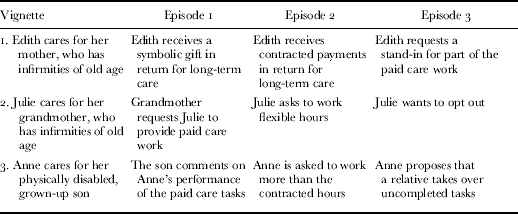
We designed three fictional vignettes of commodified care relationships, each with three episodes (see Table 1). The first describes Edith, a daughter who cares for her mother with age-related disabilities. In the first episode, Edith helps with household and other daily assistance tasks and receives a symbolic payment. Later on, the care relationship is formalised by payments for care. In the third episode, there are increasing demands on Edith's time and she is in a dilemma about her role as a paid care-giver. The second vignette describes Julie, a granddaughter who takes care of her grandmother, provides personal care and is paid through a PGB. In first episode, the grandmother wants to contract Julie as a paid carer. In the second episode, Julie asks her grandmother if she can work flexible hours, because she needs to balance the care duties with her regular job. The third episode is when Julie explains that she has decided to opt out of the care role. The third vignette describes the mother of a physically disabled son. In the first episode, he comments on her domestic care work; in the second, he asks her to work overtime unpaid; and in the third, he rejects the idea of a stand-in or replacement carer.
The fictional vignettes of commodified care
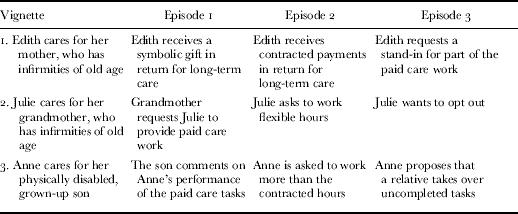
The vignettes were designed to elicit the participants' normative views about caring in a contractual situation, and to prompt questions, reactions and opinions about what ‘ought’ to happen. One drawback of the vignette technique is that it is hard to establish a link between beliefs and actions. Although many respondents related the fictive cases to their own care-giving, we also asked them explicitly about their personal experiences and compared the two sets of findings. Despite the limitations of a qualitative approach in terms of representativeness, we believe that the vignettes yielded valuable insights into the participants' views about the sensitive subject of the commodification of family care.
Inclusion criteria and data collection
We included only women in the study because they are by far the most numerous non-spousal care-givers. Each was caring for a relative in the ascendant or descendant line and remunerated through a personal budget. Outside the spousal relationship, intergenerational kin are the most prevalent providers of long-term family care (Knijn and Liefbroer Reference Knijn, Liefbroer, Dykstra, Kalmijn, Knijn, Komter, Liefbroer and Mulder2006), and feelings of obligation are strong in vertical family relations (Bengtson Reference Bengtson2001; Rossi and Rossi Reference Rossi and Rossi1990). To investigate structured care relationships, we selected only respondents who had been engaged in a paid care-giving relationship for at least six months, on the assumption that this period was sufficient for the participants to become accustomed to the arrangement. We excluded women caring for children under the age of 12 years or caring for relatives with mental disabilities or dementia. For confidentiality reasons, we were not able to select respondents from the PGB database, so instead gathered addresses of paid care-givers from the respondents to a previous study of payments for care,Footnote 5 through meetings with budget holders, and through website invitations. From the 42 collected addresses, 17 people met the selection criteria, were willing to participate and gave informed consent. The interviews were held between April and June 2007.
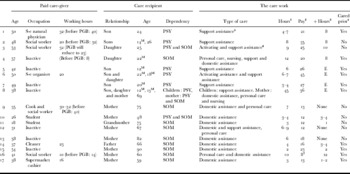
The final sample of 17 paid home care-givers included seven mothers who cared for their child(ren), eight daughters caring for a parent, one granddaughter caring for her grandmother, and one woman caring for both her children and her mother (Table 2). Most of the respondents had low or intermediate levels of education and held part-time, middle-income or low-income jobs in the care sector, catering or cleaning industries. Others were housewives, and there were two entrepreneurs and two students. They lived in various rural and urban areas, all near to the care receivers (at most one hour's travel away). Ten care-givers had provided care to the relative prior to the payment, three had replaced professional carers, and four who did not provide care prior to the PGB were hired as soon as the budget was available. The women had followed different routes into paid care-giving: for some, the payment upheld an existing care relationship, while for others it enabled it to begin by substituting for the loss or absence of income. The care tasks performed by the interviewees varied greatly, partly in relation to the needs of the relative(s). In the case of dependent children, the interviewees mainly provided help with structuring daily activities and psycho-social development. In the case of dependent older people, the core tasks were home help and personal care. The hourly wage for paid care varied from €12 to €45. In five cases, the budget holder contracted professional carers in addition to the family carer.
The paid carers' care relationships and care work

Notes: S-e: self-employed. PGB: Persoonsgebonden Budget [personal budget]. M: member of the care-giver's household. PSY: psychiatric and psycho-social problems, e.g. autism. SOM: somatic problems, e.g. physical disability. 1. Hours per week. E: extensive. 2. Gross euros per hour. 3. Additional hours of informal care per week. 4. Cared for the relative(s) prior to payment (independent of amount of hours). 5. Support assistance: structuring and helping with daily activities. 6. Activating assistance: stimulating psycho-social development. 7. Temporarily below the agreed wage through an administrative error by the budget holder (and to be corrected).
The analysis
The tape-recorded accounts of the paid care-givers were transcribed and analysed with the help of the MAXQDA 2007 software package, which enables the researcher to build an extensive framework of (sub-)categories of answers given by the respondents (see http://www.maxqda.com/). Based on the purposeful thematic steps of the vignettes, two key themes were formulated prior to the analysis of the data: the role of payments for care in the care relationship, as represented in the first episode of the first vignette (symbolic payment), and in the first episode of the second vignette (contracted payment); and the nature and the implications of the ‘employment’ relationship, as represented in the third episodes of the first vignette 1 (requesting a stand-in), the second vignette (flexibility of work conditions) and the third (quality of work tasks). Another key theme, managing emotions in paid care-giving emerged from the data: direct emotional accounts from the paid care-givers were not anticipated.
All the (sub-)categories emerged directly from the data. From a comparative case analysis of seven interviews, a preliminary framework of (sub-)categories was created. For example, throughout the interviews, to avoid biased answers the interviewer had deliberately avoided the term ‘employer–employee relationship’, but many paid care-givers used this term themselves to define their new paid care-giver status. A category was therefore added to denote ‘identification with the role of employee’. In addition to the vignettes, the open-ended questions were examined to see how the moral accounts of the paid care-givers matched their personal situations. In responding to the vignettes, however, many paid care-givers related the fictional storylines to their personal experiences.
After the first seven interviews had been analysed and categorised, the other ten interviews were similarly coded. When necessary the categories were re-categorised and/or elaborated upon, for example that of ‘social status and self-esteem’. This topic was raised by some women when they reported a sense of shame for being a paid care-giver. Overall the initial framework applied well to the 17 interviews and the categories were saturated. The quality of the categories and the interpretation of the data were peer-reviewed and validated. We now turn to the most revealing findings from both the vignette and the open-ended interview data, which are grouped under the key themes: (a) the role of payments for care in the care relationship; (b) the nature and implications of the ‘employment’ relationship; and (c) managing emotions in paid care-giving.
The findings
Being paid for caring
As mentioned, the routes to contracted care work varied. More than one-half of the respondents provided care unpaid prior to the contract, and the remainder started caring after the PGB became available. In both groups, some women reduced their working hours to provide more paid care-giving, marking a clear if partial shift from the mainstream labour market to the ‘grey area’ of paid family care. For the majority, however, the paid care was the respondent's first ‘job’ in years or, by contrast, was done in addition to a regular (part-time) job with the payments increasing their overall income. Those who reduced their paid hours in their other job maintained the same overall income. Even though payments for care are said to facilitate care-giving, no one reported having initiated or extended the caring because of the payment.
We asked the respondents how they believed intensive care is best compensated or rewarded. Responding to the episode in the first vignette where Edith received symbolic payments (gift vouchers) from her frail mother in return for her help with daily tasks (see Table 1), the interviewees described such gifts as ‘nice gestures’ and important in maintaining the care relationship, but not enough to compensate in a long-lasting care situation. A mother (Respondent 1 (R1) in Table 2) who cared for her autistic son said: ‘In society nothing comes for free. The mother (in the vignette) should reciprocate according to her ability’. When in the vignette the care recipient decided to provide her daughter with payments through the PGB, most of the respondents thought that this was an improvement. Interestingly, the care-givers distinguished between ‘incidental caring’, which they presumed would be unpaid, and ‘structured, long-term care’ that has many characteristics of a real job. Especially in relationships with a heavy care burden, they thought that payments restore a balance in the give-and-take. As the same mother (R1) said:
Why would you commit yourself to a lot of care work without being paid for it? That does not mean that you can never do something for each other, for your parent or child, but I do think that it should be seen as a job if it is one. It would also ease things up if the mother [the budget holder] sees it like that, as she is now in debt, emotionally speaking.
The care-givers believed that the budget enhanced the ability of the care recipients to reciprocate, as it allowed them to provide monetary rewards for long-term care. The ‘balancing’ effect of the cash was especially valued by the interviewees who were making personal sacrifices in order to provide care. In such cases, a payment was considered crucial for the material wellbeing of the care-giver. Responding to the first vignette, a woman (R8) who cared for three dependent relatives explained, ‘I think that it [the care-giving] will be easier for her [the care-giver] because she can now look at it as her job. She is paid for it, so it is work: previously she did it out of charity’.
The care-givers for ascendant relatives also reported that when cared-for older relatives, who generally had little ability to reciprocate, were in the position to give a payment in return for care, she or he experienced less guilt. They recognised that the PGB can create balance in a long-term care situation, which bolsters the family relationship. In such cases, the PGB was seen as ‘repairing’ an unjustified moral pressure on the relative. Although the paid care-givers saw symbolic gifts as having a valuable bonding effect, they noted that they are less frequently given in a contracted care relationship. As a daughter (R9) who cared for her frail mother noticed:
When you receive money for it, then ‘thank you’ becomes rarer. This is logical, because you no longer dwell on it every time. It is your work, so you are supposed to be there. Without a contract it is freer, and now it is not.
The perceived change in the gift exchange was reported most often by the women who cared for an older relative, but whatever the kin relationship the care-givers expected few symbolic gifts to accompany paid care. Even though they thought it was ‘logical’ for gratitude to be expressed less frequently in a contractual relationship, many said that being valued is the most rewarding element of the care relationship. The care-givers found that the contentment of the care receiver is central to their mutual engagement, so the loss of symbolic expressions could lead to doubt about whether they were appreciated. In the situations where the care receiver's disabilities meant that they could hardly express gratitude or contentment, and in those cases where the care recipient's condition did not improve, payments for care were especially valued by the care-giver. One mother (R3) educated and structured the daily activities of her autistic, adult daughter because there was insufficient professional support. She reasoned that:
After I've been working with her [the daughter] for some hours and see no result for my efforts, then I can say, ‘hey, at least I earned some money’. And then I can do something with it to reward myself.
In this way, payments for care can substitute for symbolic gifts or even compensate for expressions of dissatisfaction by the care receiver in strained care relations. The payments confound care-givers' motivations to care, however, and in some cases encourage contradictory motivations. For women who provided unpaid care to the dependant relative prior to a PGB, the payment was of secondary importance and regarded by many as ‘lubricating oil’, but for women who started caring only with the payments, the money was more important. As a daughter (R9) who cared for her frail mother said:
Financial compensation is so necessary now. I used to work 40 hours-a-week. Because of the PGB, I now earn enough for a living. If the money wasn't there, I would need to look for another job, because I provide the care on a voluntary basis. I could maybe visit her [mother] sometimes, but not in the way I can now. So, the money is important.
Some interviewees recognised that when the money earned by the care-giver was an important component of their income, the dependent relationship between the relatives might reverse. As a mother (R3) who cared for her autistic daughter reasoned:
I do not want to give up part of my job, because then it [care-giving] would become a [financial] necessity … and I want to keep it free [unpaid], as it should be about the person who receives the care, not about my income.
Two care-givers said that they would stop providing care without the PGB, while many others said they would provide less care without the payments. This can be understood as an indicator of the time and energy they invest in the care, but also reflected their occupational status – inactive or employed in low-skilled, part-time jobs. They simply needed the care payments to continue the care relationship at the same level of intensity.
The ‘employment’ relationship
The PGB contract provides a formal basis for care-giving. In responding to the moral dilemmas presented in the vignettes, the interviewees repeatedly referred to the paid care relationship as a ‘regular job’ characterised by employer–employee relationships. They understood that the PGB transforms the familial care relationship into a contracted market relationship. Many of the paid family care-givers identified themselves with the role of ‘employee’. As a daughter (R16) who worked for her frail mother reasoned, ‘I think that when you provide paid home-care, you work, and so you are a working woman. Otherwise, you are a daughter helping out … and that's a crucial difference’. The meaning of this change in role is twofold. On the one hand, the care-givers considered the private contract as a valuable recognition of their care-giver role, and tried to attain professional standards. A mother caring for her daughter characterised her situation as ‘a one-woman home-care organisation’. On the other hand, despite being aware of the changed foundation underlying their care, the paid care-givers argued that the ‘formal aspect’ should not get in the way of the affective relationship. As a mother (R7) who cared for her autistic son put it:
How can I put it? Well, you should definitely not let it [the contract] come between you and your relative. You have a special bond with someone, and indeed you do act differently because you are also employer and employee.
In response to the dilemmas exposed in the vignettes, many paid care-givers felt that the obligation to care is more intense in a contracted care relationship. They considered it legitimate that care receivers making payments had a clearer right to (or stronger ‘claim’ for) care, but emphasised that the contract also limits the care-giver's freedom to refuse requests or to ‘wheel and deal’ on the care that they provide. In the second vignette, because granddaughter Julie took a job that demanded more time, she had less time to be a carer and so requested flexible hours. The respondents saw Julie's request to change the care arrangement as unacceptable, because she was paid to care and, note well, because she should fulfil her moral obligation. They agreed that flexible arrangements were possible in some cases, but entailed the risk of the care becoming lax. As a daughter (R9) who cared for her frail mother explained:
It would be easy to fall down on the care agreement, because at one point you might think, like, oh, I can do this, that and the other before I go to grandma … to the point that necessary care is not provided. … No, I think you should stick to the contracted hours.
The care-givers believed that the flexibility of the personal relationship that the private contract supports should not be exploited. They thought that by entering into a paid care contract, one's obligations increase and it becomes more difficult to opt out. Moreover, whereas caring obligations towards relatives were considered equal for multiple potential carers, like siblings, this did not apply in a contractual situation (see Table 1, vignette 1). By putting one carer to the fore as ‘employee’ of the care receiver, other family members are (partly) released from caring obligations. As a mother (R6) who cared for her two children with psychiatric disorders reasoned:
Well, if Edith is the one to get paid for it, then she can only divide the tasks among herself. She is then always the one who is responsible … and, in fact, you can see it as a job. When you want to arrange something in a job, you also need to find a replacement … and then you also do not ask a family member to do it for you.
While some paid care-givers thought it impossible to transfer caring duties to other relatives, others thought it feasible. In such cases, the payment is very important: a replacement is possible on the condition that the relative who steps in is compensated. A daughter who cared for her frail mother reacted to the vignette as follows:
Well, I think it [the vignette scenario] is a bit narrow-minded, because Maria is also a daughter, and when Edith asks her to stand in once then she should consider doing so. Of course, Edith could offer Maria to pay her for the travelling costs out of the part of the budget that can be spent freely … that's why it's so good that that part of the budget is there.
The PGB contract empowers care recipients, and warrants that the employed family members will be ‘at their service’. Opting out becomes a difficult matter in a contracted care relationship. Reacting to Julie's wish to end the contract because of time constraints (vignette 2), the care-givers were firm, as in a comment from a mother (R1) who cared for her autistic son: ‘Can she really not find time for it? I mean, when you commit yourself to something, you are in for a penny, in for a pound. I think that she [Julie] has a major responsibility, as she accepted the contract because it suited her well’. That entering a private contract entails obligations follows from the fact that many paid care-givers felt that payments for care are meant to strengthen reciprocity, and imply increased interdependency. As a result, one should be ‘extra professional’ in meeting the needs of the budget holder, even after the contract has ended. A daughter (R9) who cared for her frail mother expressed this well:
I do think it is possible for Julie [care-giver] to quit, but not right away. Even after she quits, Julie should still come once in a while. … That is the difficulty of it [entering a PGB contract]: because you'd rather keep your family together than be paid by them.
The increased obligations induced by the payments were experienced by the interviewees, particularly in cases where the budget holder and the care-giver were not members of the same household. A daughter (R9) who cared for her frail mother noted that, ‘then [when paid] it becomes more of a duty-to-care, and you can no longer say to your mother, “I am busy this week, I'll come but stay a bit shorter”. That is harder then, it is more committing and less free’. Household members are less likely to be aware of the increased obligations, as in most cases the commitment was already high. For the relatives who encountered each other more frequently because of the contract, the monetary aspect could change both the relationship and the care-giving, by increasing constraints and obligations. A daughter (R13) who cared for her frail mother said: ‘When you do not receive money for it, you would maybe go for three hours instead of six. Because then you think, like, I will just help a little bit, in between other errands; but when you receive the payments, you will clean the house tiptop each time … because of the money it becomes professional’. Some care-givers who cared for their parents or grandparents also said that their relative felt less guilty when asking for help, and moreover felt that they had the right to depend more on the help and rely on its continuity. As a granddaughter (R11) who cared for her frail grandmother explained:
I do not think it is a choice without commitment; you choose it or you don't, even though it is family which makes it easy to turn the matter over in your mind. I will face this problem next year. I will have to plan my time in such a way that I can continue doing this [domestic aid for grandmother].
The interviewees made clear that the usual limits to providing and sustaining care were extended by the PGB, most often among those who cared for ascendant kin, which might be because care for children takes precedence over or is less discretionary than care for parents or grandparents (Finch Reference Finch1989). The formal contract appears to be a powerful means of strengthening care-giving norms in less duty-bound family relations. Some care-givers thought that a contract implied that they provide a better quality of care, and empowered the care recipient to voice their needs. Even though this might put pressure on them, some care-givers saw the change as positive and motivating, particularly when performing tasks that can be easily evaluated, such as household tasks. As a daughter (R17) who cared for her frail mother reasoned:
Now [with a contract] you are extra motivated to provide help, because you receive a payment. Now you do it much better – once you did it 100 per cent and now you do it 150 per cent. It is no longer out of charity what you do, and now you are obliged to perform.
When contracted to do more specialised tasks, some care-givers said they felt a strong pressure to perform better (than formal carers), and that this was reinforced by the care receiver's right – as empowered by the PGB – to feedback on the carer's performance. Moreover, although no care-giver said they ‘did it for the money’, being dependent on payments could complicate the motivation to sustain the care relationship. When care-givers depended on the income provided by the budget holder, they did not want to disappoint the care recipient and risk being ‘dismissed’.
Paid care-giving and ‘detached attachment’
Most of the respondent care-givers had an intimate affective bond with the cared-for person, though not invariably only positive feelings. Most typified their family relationship as loving or friendly but also sometimes ‘tense’ – especially when a long care history preceded the contract. All felt responsible for safeguarding the relationship, and a common strategy was to define a boundary between the two spheres. This was most readily achieved when the care work did not require physical contact, as with domestic tasks or support with activities in or outside the home – then the practical tasks and the emotional relationship could be kept separate. A daughter (R15) who cared for her frail mother explained this well: ‘You just have to finish the tasks as they need to be done. And then it is better to meet another time, to have some coffee together and chit-chat. Because when I work, I am there only to perform the domestic tasks … and then my mother gives specific orders: then, I just focus on the tasks’. The need to create a barrier between labour and emotion, between the employment relationship and the family bond, was apparent from the personal experiences of a care-giver (R1) who provided paid care to her disabled adult son:
Well, before, I was caught up emotionally, like ooh what's happening now, again? And that it can still be my first reaction, but then I think, wait a minute it is my job, he is a boy with a disorder, and I think, how would I resolve this with a regular client? Then I can distance myself from the situation. So because of the payments, I have a different stance: I am still the mother, but primarily the care worker.
Distancing oneself from motherly feelings here was framed as a prerequisite for delivering good quality long-term care for a handicapped adult child. Emotional detachment from care work may therefore ameliorate strained family relations. The interviewees who felt bound to provide long-term care asserted that, by defining boundaries, heavy caring duties no longer undermined or strained the family relationship as before the PGB. This view was clearly expressed by a daughter (R9) who cared for her frail mother: ‘Before, I did it on basis of charity because someone had to take care of her … and then emotional feelings are also at stake. But now it is just work, so it is easier to distinguish between the two’.
Sometimes the paid care-givers had taken up tasks that were partly invisible to the care receivers, as with co-ordinating therapeutic trajectories or coaching children with social and behavioural dysfunctions, where the contracted parent acted as the child's ‘care manager’. These forms of indirect care can create a gap in understanding between the care-giver and the care receiver about what the care-giver actually does, with the result that background care tasks are not valued as much as direct personal care. In one case, a mother (R1) who structured her adult autistic son's daily activities, by undertaking administrative chores and making appointments, was perceived as a ‘money digger’:
He used to talk to me in a way, like, ‘well, you get paid for it’. I was seen as a bad person, as I used the PGB money for myself. He said to me that I was abusing his budget, and that it was meant for a ‘real’ care worker. Then I said to him, ‘don't you see what I am doing for you?’ He was just attacking me emotionally … and I felt bad about that for quite some time.
It was not always the case, therefore, that a paid care-giver received more recognition because of the payments, and apparent that they could even be chastised as one might a paid care-giver. In fact, a few care-givers did not talk about their PGB earnings with relatives or acquaintances. They argued that caring ‘out of love’ conflicts with payments, and they were ‘ashamed’ of being paid to care for their relative. As a daughter (R14) who cared for her physically-disabled father put it, ‘well, in fact, nobody really knows that I work for him. I rather want to keep it quiet. I think it's kind of shameful, because you're not supposed to let relatives pay for you’. The ambivalent position of paid family care-givers challenges the personal relationship on which the paid care-giving is founded. While the frequency of contact can increase through the payments, this does not necessarily create a more intimate bond. Many of the paid care-givers distinguished between providing ‘professional care’ and sustaining the ‘affective relationship’. Indeed, many refrained from emotional exchanges and support during the contracted hours.
Discussion and conclusions
The Dutch Persoonsgebonden Budget [Personal Budgets] (PGB) financially values family care work that would otherwise be provided unpaid or by professional services. The PGB therefore recognises women's care work, while transforming aspects of family relationships into contracted employment relationships. This ‘commodified care system’ gives monetary values to both the hours of care and to the type of care performed. Our respondents consistently acknowledged the commodified nature of the care provided through a personal budget. Several interviewees said that they dealt with the situation by clearly distinguishing work and care: the PGB allows (and induces) a distinction between motherly or daughterly feelings and ‘doing one's job’. The contracted care work is thus not merely an extension of informal care (Breda et al. Reference Breda, Schoenmaekers, Landeghem, Claessems, Geerts, Glendinning and Kemp2006), but rather creates a formal obligation in the private domain. Many care-givers try to hide the business aspects as ‘not fitting the familial logic of care’ (Knijn Reference Knijn2004a). Others use the contract instrumentally and distinguish between love and labour to manage emotional strain. If this is applauded as limiting a person's emotional involvement in care, it also draws attention to the difficulty and sensitivity of family care-givers' ‘emotional work’ (Hochschild Reference Hochschild1989). This is most apparent when mothers have cared for their dependent children for a long period, and when the care work takes such a prominent place in a woman's life that limits must be set to avoid excessive emotional burden.
On the one hand, the care-givers regarded the payments for care as beneficial both to the carer and to the chronically-ill or disabled family member. Payments for care help to create a situation of balanced give-and-take, particularly in very demanding and intense long-term care relationships. In this way, the PGB compensates for onerous aspects of family obligations (Komter Reference Komter, Knijn and Komter2004). On the other hand, the introduction of an employment relationship between relatives alters care-givers' perceptions of their duties: the contract creates a stronger commitment and an increased duty to perform. The combination of the contractual relationship with affective bonds and moral obligations leads paid carers to make higher demands on themselves, not least by comparison with what is required of professional carers: they feel they should anticipate the care recipients' wishes and needs, provide better quality services and be reliable long term, even when there are competing demands on their time. Hence the PGB may increase the pressure on a principal carer to sustain a long-term care relationship. Moreover, unlike professional carers, the paid family carer is obliged to carry out their work without training, guidance, supervision or certain back-up.
Future social policy and payments for care arrangements should take into account the pros and cons of the quasi-employment relation in which family care-givers are placed. Two aspects of paid family care-giving provide insight into the downsides of the commodification of care. Firstly, paid care-givers experience the paid home care-giving situation as a ‘businesslike’ arrangement; the care-giving is formalised. This can be interpreted positively, as the care-giver is more focused on the care tasks and more likely to apply professional standards, but on the other hand it might lead to less emotional involvement in the caring – a component that makes family care so valuable (Waerness Reference Waerness, Glendinning and Kemp2006). Secondly, though payments for care valorise the extensive care work of relatives, they do not create a coherent framework of subsidiary employment benefits or pension rights. Paid care-givers perceive themselves as employees, but in fact employment and tax regulations deny them basic social-security rights and put them in a hybrid and ambivalent position. Moreover, their exceptional position as family care-givers and their commitment to provide continuous care, even to higher than professional standards, makes it very difficult for them to benefit from the limited subsidiary rights that are recognised, such as days off and holidays. Our findings support the idea that women who become paid family care-givers are led into a cul-de-sac of reduced labour-market value and limited employment rights. Giving long-term dependants the ability to exercise consumer choice in their care package is much praised, but it can have detrimental effects on close kin: welfare consumerism may create social inequities (Glendinning Reference Glendinning2008; Wellin Reference Wellin, Kunkel and Wellin2006).
Thus far, social policy makers seem disinclined to pass legislation for improved employment rights for paid family care-givers. State officials reason that commodifying family-care relations might endanger the voluntary efforts of family care-givers. If care-giving relatives come to know their true or market ‘value’, they feel exploited when not compensated accordingly (Dale et al. Reference Dale, Brown, Philips and Carlson2005; Gilbert Reference Gilbert2004). If the commodification of family care is further elaborated, the relationship of paid care-giving relatives to the conventional labour market requires close attention. Though payments for care might enhance the socio-economic status of women in the short term, they do not improve their position in the long run. Payments to relatives who care do not raise the rewards of women in the labour market or their social status and esteem. In order to achieve equality between the care receiver and giver, more professional guidance and employment rights for paid family care-givers should be realised.