INTRODUCTION
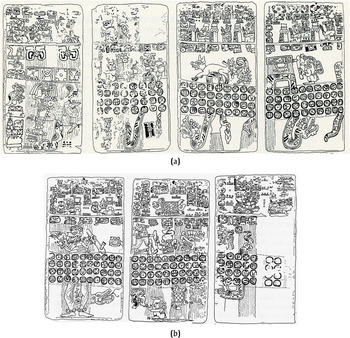
This article explores an intriguing 260-day almanac with symbols of eclipses, skybands, and Venus imagery in the Madrid Codex, a Maya screen-fold book from Yucatan that most likely dates to the second half of the fifteenth century (Bricker and Bricker Reference Bricker and Bricker2011:25; Vail Reference Vail2013:13; Vail and Aveni Reference Vail, Aveni, Vail and Aveni2004:12). Madrid pages 12b–18b depict a series of astronomical events in the context a 260-day almanac that is formatted in extenso, being laid out in full rather than in the truncated format found elsewhere in the codex (Figure 1). Here, I argue that the almanac records solar eclipses visible in Yucatan that are coordinated with the Venus cycle and important seasonal markers, such as the solstices and transitional points in the agricultural cycle. This study demonstrates that Maya priest-astronomers were watching multiple astronomical events and recording these observations in an effort to find patterning that was significant in the agricultural cycle. This study also has important implications for our understanding of ancient Mesoamerica because Maya sky watching was not merely an esoteric science; it was integrated with vital agricultural activities. This form of skywatching represents “agro-astronomy” because it focuses on astronomical observations specifically linked to the agricultural cycle.
Madrid Codex, pp. 12b–18b (after Milbrath Reference Milbrath1999:Figure 7.3).

Here, for the first time, I develop a detailed analysis of solar eclipses visible in Yucatan, plotting eclipse distribution in relation to the layout of the almanac's trecenas (13-day periods in the 260-day Maya calendar commonly called the Tzolkin). I also present evidence that the 260-day almanac period was linked to an agricultural cycle that still survives today. This work extends the scope of a previously published article focusing on paired eclipse events (Milbrath Reference Milbrath2016), in which I argued that the layout of the 260-day almanac was determined by a series of paired eclipses dated to the fifteenth century, the period when the codex was painted. In an earlier publication describing the fixed 260-day agricultural calendar on Madrid pages 12b–18b in relation to certain astronomical cycles, I did not attempt to position eclipses in the sequence (Milbrath Reference Milbrath1999:61). I noted only that the intervals represented on the pages would be appropriate for eclipses, if the number of day signs on each page are counted as a total, rather than in their natural sequence. Using day signs in this non-sequential fashion is certainly controversial, and my 2016 publication refined the analysis by coordinating Tzolkin dates with eclipse glyphs and actual eclipse events.
The Madrid almanac had been interpreted as a tenth century eclipse warning table (Bricker and Bricker Reference Bricker and Bricker2011:588), but my 2016 article dates the eclipse sequence to the Late Postclassic, noting it represents a “real-time” record of solar eclipses visible in Yucatan during the fifteenth century. Many scholars working with the codices have found that real-time events are important in their analyses (Aveni Reference Aveni1999; Bricker Reference Bricker2001; Bricker and Bricker Reference Bricker and Bricker1986, Reference Bricker and Bricker2011; Knowlton Reference Knowlton2003; Vail Reference Vail, Vail and Aveni2004; Vail and Bricker Reference Vail, Bricker, Vail and Aveni2004). I embarked along a similar path of research by studying the placement of the dates in the Venus Table in the Dresden Codex and continue to explore this line of investigation in my study of the codices (Milbrath Reference Milbrath1999:171–177, 2013, 2016).
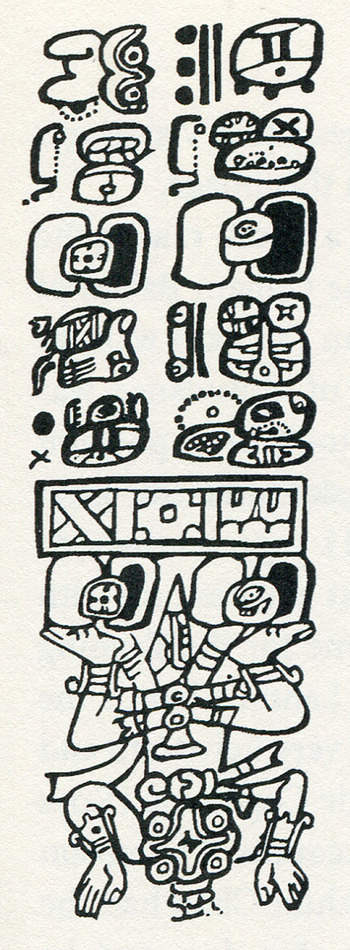
The link between Venus and eclipses in the Madrid Codex finds a parallel in Venus imagery in the eclipse table of the Dresden Codex, which features a diving god on page 58b, considered to be a representation of the Evening Star (Figure 2; Davoust Reference Davoust1994:66; Milbrath Reference Milbrath1999:162, Figure 5.1). The Madrid Codex also shares specific parallels with the Codex Borgia, a central Mexican codex dating to the Late Postclassic (a.d. 1300–1520), which includes Venus events in the context of eclipse imagery (Milbrath Reference Milbrath2013:43–45, Figure 3.4).
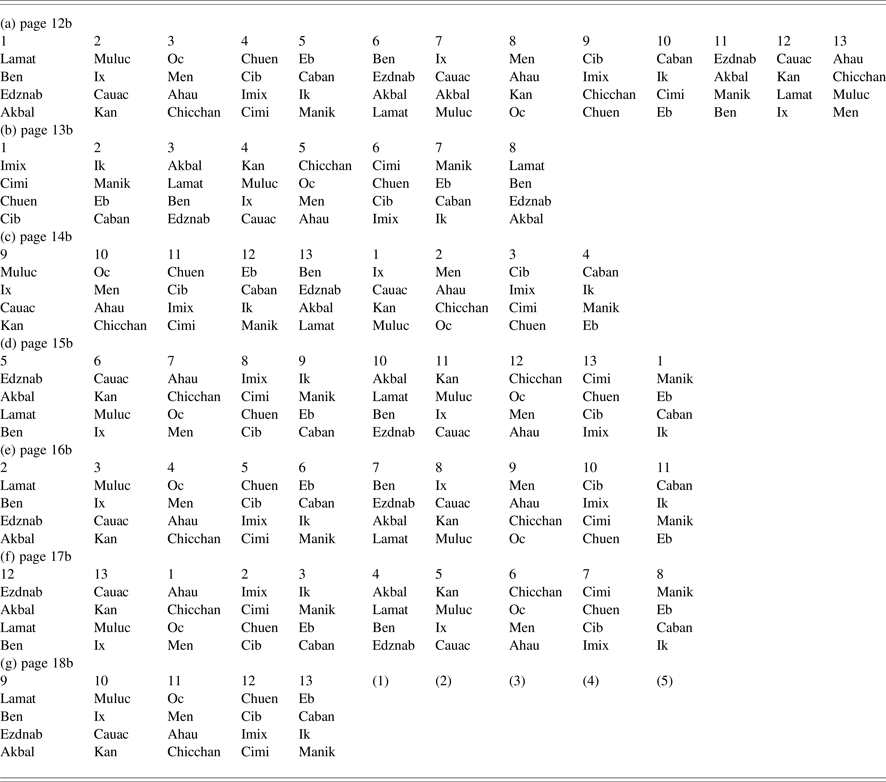
An in extenso almanac on Borgia 1–8, displaying all the individual day signs in the 260-day calendar (called the Tonalpohualli in Central Mexico), is similar to the layout of the Madrid Tzolkin almanac (Table 1; Bricker and Bricker Reference Bricker, Bricker and Aveni2015:172; Just Reference Just, Vail and Aveni2004). In both the Borgia and Madrid, the placement of the day signs implies that each column would have the same numerical coefficient and the numbers in each row would run in ascending order (one to 13). In the Madrid Codex, however, the first column of day signs actually bears the number one (Bricker and Bricker Reference Bricker and Bricker2011:566). The two in extenso almanacs exhibit other important differences. Whereas the entire 260-day Tonalpohualli is arranged in five rows of 52 days in the Borgia, the Madrid almanac shows the 260-day Tzolkin in four rows of 65 days, and the last page (18b) has the appearance of being unfinished, with most of the day sign cartouches left blank.
The layout suggests that the almanac begins on Madrid page 13b with 1 Imix, the beginning of the Tzolkin recorded by Friar Diego de Landa (Tozzer Reference Tozzer1941:149), but Bricker and Bricker (Reference Bricker and Bricker2011:568–569, Table 11-16) demonstrate that the introductory calendrics indicate that 1 Imix is actually the fourteenth day of a trecena count beginning on 1 Lamat, with a black number 13 on page 12b marking the interval of the first trecena for all four rows (Table 1). Vail (Reference Vail2013:59) concurs when noting that the 13 days needed to end each of the four rows in the 260-day almanac were left unfinished on page 18b, being added instead at the beginning on page 12b. This compelling aspect of the Brickers’ model, incorporated here and in my 2016 study, shows that the 13-day interval refers to all the trecenas in the same column (1 Lamat, 1 Ben, 1 Edznab, and 1 Akbal; Table 1). The 1 Lamat trecena is a key starting point, and it is noteworthy that visible eclipses plotted in Table 2 show that two solar eclipses took place on the day 1 Lamat itself.
Madrid Codex, pp. 12b–18b: Tzolkin arranged in four rows with first trecenas in each row referenced by a 13-day interval on page 12b. (a) Page 12b with two eclipse signs. (b) Page 13b with one eclipse sign. (c) Page 14b. (d) Page 15b. (e) Page 16b. (f) Page 17b with two eclipse signs. (g) Page 18b.

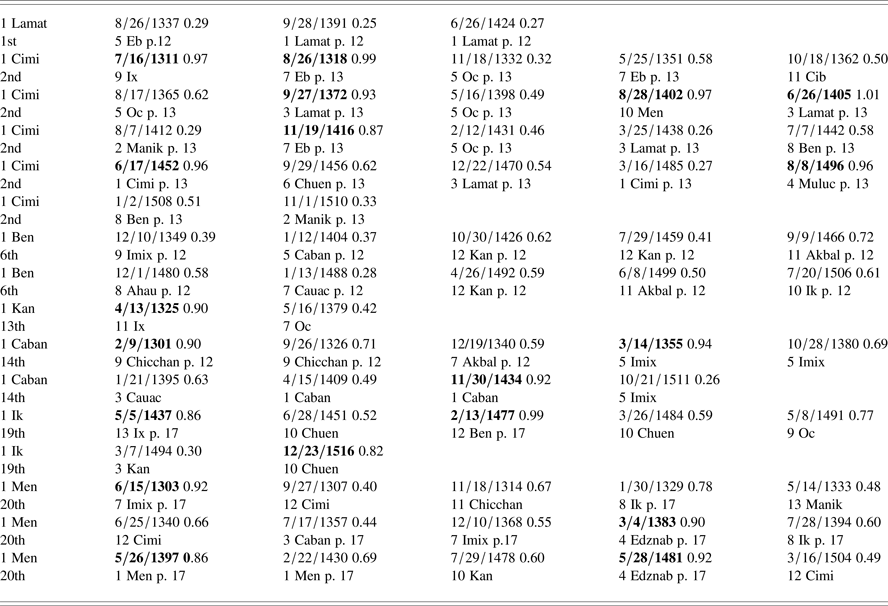
Trecena distribution of all Late Postclassic solar eclipses visible in Yucatan of a magnitude > 0.25. Only trecenas with two or more eclipses are listed and the trecenas are numbered in their order in the almanac. Local magnitude based on Verbelen's (Reference Verbelen2003) calculations for Uxmal. Eclipses of > 0.80 are in bold. Adding trecenas with single eclipses or lower magnitude eclipses (< 0.25) does not substantively change the patterning. The tzolkin date of an eclipse is followed by the corresponding Madrid page number only when that page has an eclipse symbol. All dates in Julian calendar.

ANALYSIS PUBLISHED BY BRICKER AND BRICKER IN 2011
Before exploring the pattering of visible eclipses it is important to discuss how my model for the Madrid almanac (12b–18b) differs from the one proposed by the Brickers (Reference Bricker and Bricker2011:564–590). Although I find many points of agreement and am inspired by their work, we differ on the dating of the almanac.
The Brickers note specific links with almanacs on Madrid pages 10b–11b and 10c–11c, which they date to the tenth century on the basis of strong parallels with imagery pictured in a seasonal table on Dresden Codex pages 61–69 (Bricker and Bricker Reference Bricker and Bricker2011:550–565, Figures 11-1–11-2, 11-36–11-40). The Madrid almanacs lack long count dates, but tenth century dates are reconstructed based on these parallels and a “cross-dating” technique developed by the Brickers. The Dresden almanac is dated using introductory calendric units on Dresden 61–63, including serpent numbers and ring numbers (long round dates in Thompson [Reference Thompson1972:80]), which allow reconstruction of historical long count dates ranging from a.d. 266 to 1052, spanning the Early Classic to Early Postclassic (Bricker and Bricker Reference Bricker and Bricker2011:Figure 11-1, Tables 11-4 and 11-8). The Dresden seasonal tables are placed more specifically in the tenth century, using a number of lines of evidence that will not be discussed here (see Bricker and Bricker Reference Bricker and Bricker2011:514–550), but it should be noted that the seasonal cycle repeats not only annually but also in relation to other astronomical events so these same events recur on the same date some years in the future (for example, the 8-year Venus almanac, the Metonic lunar cycle, and the Saros eclipse cycle [Milbrath Reference Milbrath1999:310–311]). Working with a Madrid almanac on pages 10a–13a, Aveni (Reference Aveni, Vail and Aveni2004:167) points out that the Metonic cycle (6,939.6 days or about 19 years) returns a given phase of the moon to the same date in the tropical year, and he ties Madrid 10a–13a to a solar eclipse on a.d. April 30, 906 that is one Metonic cycle before dates that Bricker et al. (Reference Bricker, Bricker and Wulfing1997:Table 5) proposed for 12b (eclipse number 2). The Saros cycle with 223 lunations (18.03 years) also links a series of eclipses to similar dates in the tropical year.
Therefore, accepting the Brickers’ dates for the Dresden seasonal tables does not preclude a later date for the Madrid almanacs on pages 10–11 and 12b–18b. Recognizing this, the Brickers also tested Late Postclassic dates for the Madrid in extenso almanac, but found that only a sequence of five eclipses running from a.d. November 924 to a.d. September 926 is consistent with the “constraints composed by the tzolkin, the haab, and the eclipse cycle” (Bricker and Bricker Reference Bricker and Bricker2011:589, Table 11-17). These eclipses were visible somewhere in the world during the early tenth century, but none were actually visible in Yucatan (Espenak and Meeus Reference Espenak and Meeus2006; Verbelen Reference Verbelen2003).
The Brickers (Reference Bricker and Bricker2011:588, Table 11-17) identify Madrid pages 12b–18b as a solar eclipse warning table, noting “the first eclipse in the series of five must be signaled by the eclipse glyph on M.13b, and the next four iconographic/epigraphic references must be those on pages M.12b, M.17b, M.12b again, and M.17b again.” Multiple runs through the 260-day almanac are necessary to account for the positioning of imagery related to eclipses and the seasonal cycle, but apparently the eclipse symbol on Madrid page 13b is “used” only once.
With the calendar round, a 52-year cycle linking the Tzolkin with the Haab (260 × 73 = 52 × 365 days), the Brickers propose multiple dates by pairing Tzolkin dates on individual pages with dates in the Haab (the 365-day year). The reconstructed calendar round dates are coordinated with Venus events, seasonal imagery, and solar eclipses. In order to facilitate calculations involving solstices, equinoxes, and other solar events, the Brickers use our Gregorian calendar, rather than the Julian calendar generally employed in studies of ancient astronomy (also used here in Tables 2–4). Their cycle begins with the a.d. November 4, 924 eclipse on 9 Muluc (16 Pax), a tzolkin date represented on page 14b (but the eclipse glyph actually appears on 13b). With the exception of the interval in black that represents a complete trecena on page 12b, all the trecenas on Madrid pages 12b–18b span across more than one page (Table 1). Using the Brickers’ model allows the Tzolkin dates for eclipses to fall anywhere in a trecena period that begins on a page with an eclipse glyph. The a.d. November 964 eclipse on 9 Muluc is actually a tzolkin date that falls on page 14b but is considered to be a correlation because it pertains to the 1 Imix trecena beginning on page 13b (with an eclipse glyph). Four of the five eclipses in the Brickers’ sequence coordinate with Tzolkin dates that appear on the same page with an eclipse symbol, but my more restrictive model would list only these four as correlates.
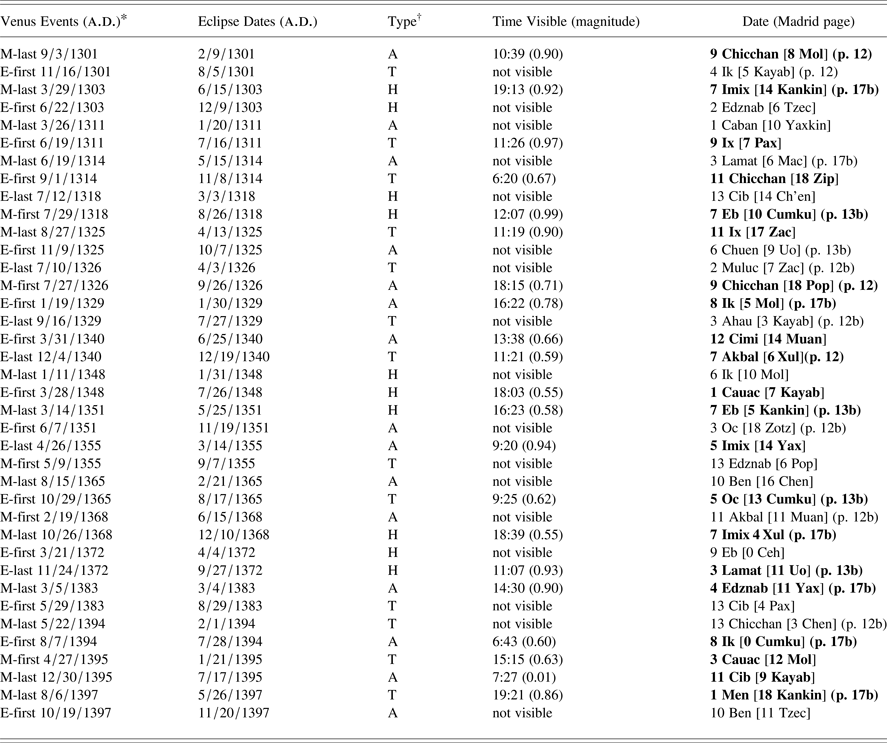
Fourteenth century Venus cycle in relation to solar eclipse pairs that include least one with a magnitude of > 0.50 visible in Yucatan. Dates for visibility of Venus based on Lange and Swerdlow (Reference Lange and Swerdlow2006) in the area of Merida with a 3° horizon. Eclipse visibility and magnitude calculated for area of Uxmal in local time (UT -5:59 hours; Verbelen Reference Verbelen2003). All dates are in the Julian calendar using the GMT-2 correlation (584,283). Maya dates in bold correspond to eclipses visible in Yucatan. Bracketed Haab dates in the calendar round are reconstructed and follow the Classic Maya system. For the modified Mayapan calendar used in the Late Postclassic period, decrease the Haab coefficient by one day (see Bricker and Bricker Reference Bricker and Bricker2011:Table 4-3). The Tzolkin date of an eclipse is followed by the corresponding Madrid page number only when that page has an eclipse symbol. All dates in the Julian calendar.

* M, morning star; E, evening star; first, Venus first visible after conjunction with the Sun; last, Venus last visible before conjunction.
† Types of eclipses: A, Annular; T, Total; H, Hybrid; P, Partial are based on Espenak and Meeus (Reference Espenak and Meeus2006).
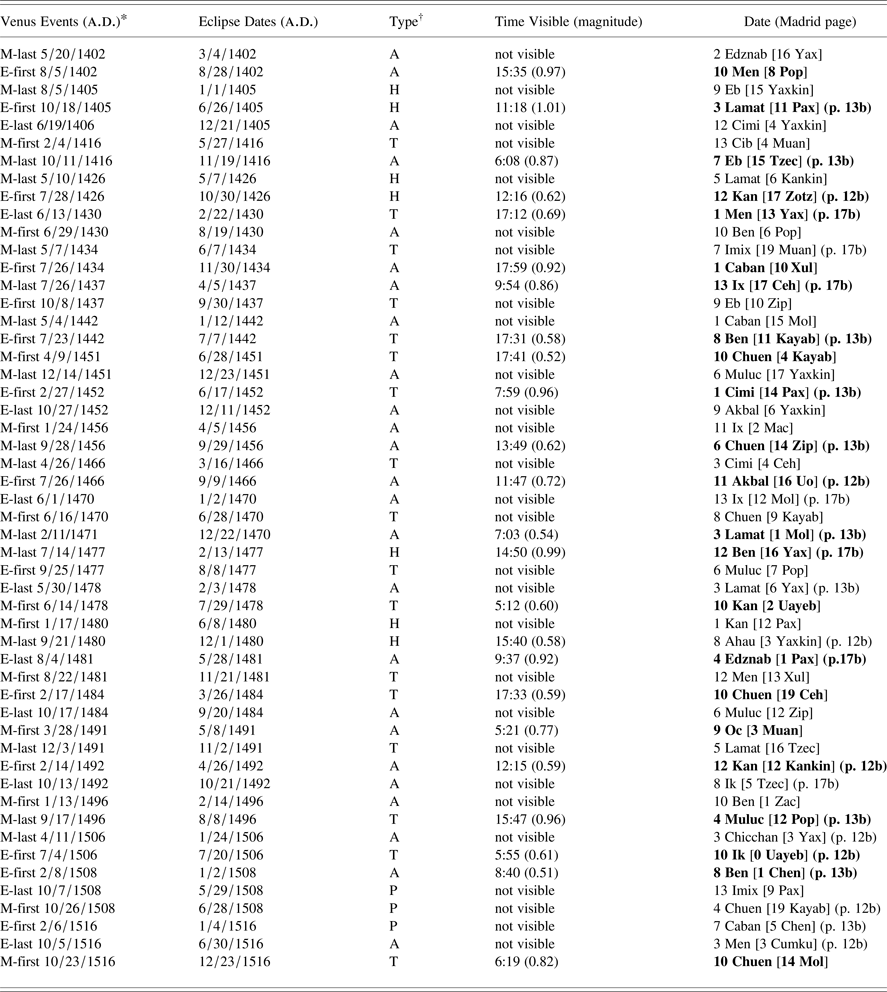
Fifteenth and early sixteenth century Venus cycle in relation to solar eclipse pairs that include least one with a magnitude of > 0.50 visible in Yucatan, with the last pair actually being a triad (a.d. 1516). See Table 3 for sources and parameters. The Tzolkin date of an eclipse is followed by the corresponding Madrid page number only when that page has an eclipse symbol.
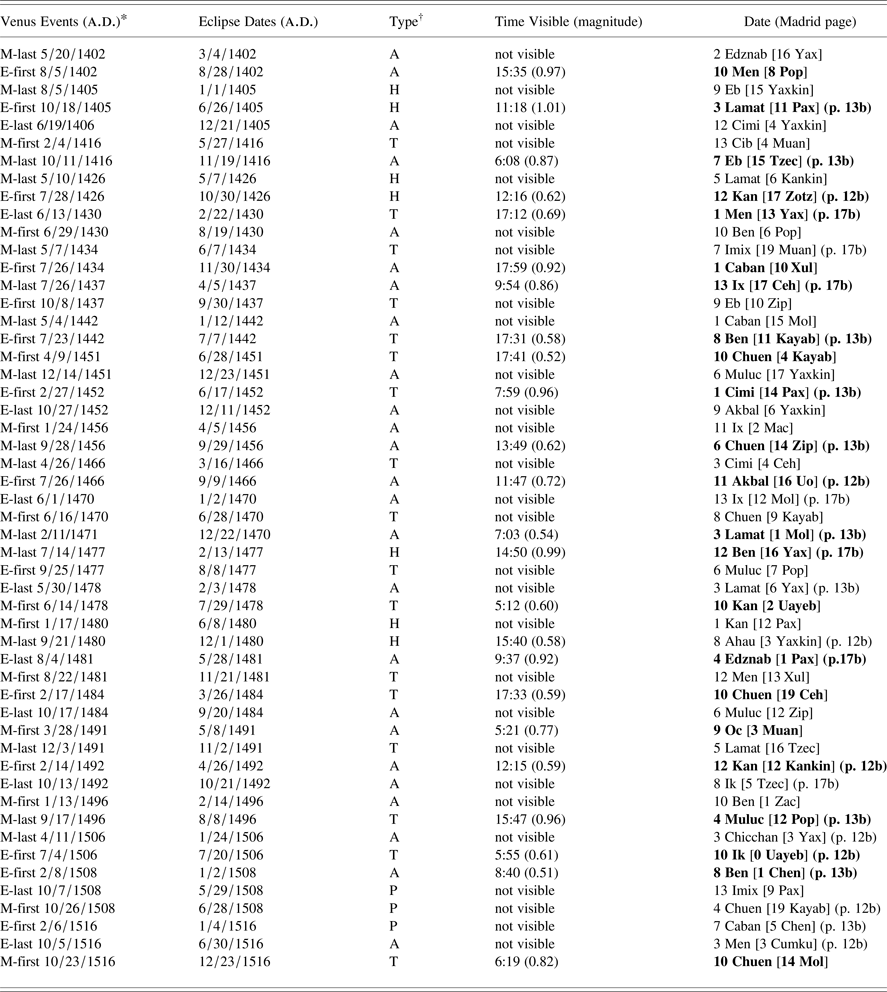
* M, morning star; E, evening star; first, Venus first visible after conjunction with the Sun; last, Venus last visible before conjunction.
† Types of eclipses: A, Annular; T, Total; H, Hybrid; P, Partial are based on Espenak and Meeus (Reference Espenak and Meeus2006).
Nine Muluc is followed 177 days later by an a.d. April 30, 925 eclipse on 4 Cimi (8 Yaxkin), falling in the 13-day interval on page 12b, which displays a pair of eclipse glyphs. Then, 178 days later, an a.d. October 25, 925 eclipse falls on 13 Kan (6 Pax), correlating with a Tzolkin date and an eclipse glyph on page 17b, and then 147 days later, an a.d. March 21, 926 eclipse falls on 4 Chuen (8 Tzec), coinciding with the 13-day interval represented on Madrid page 12b. The last eclipse of the series (177 days later) dates to a.d. September 14, 926, coordinating with 12 Lamat (5 Kankin), a Tzolkin date also found on Madrid page 17b with an eclipse glyph (Bricker and Bricker Reference Bricker and Bricker2011:Table 11-17). In the Brickers’ reconstructed sequence, the reading moves from Row 1 of the Tzolkin (a.d. November 924) to Row 4 (a.d. April 925), and then enters a new 260-day cycle when the next eclipse date appears in Row 2 (a.d. October 925), and moves along to a new 260-cycle in Row 1 (a.d. March 926) and then on to Row 3 (a.d. September 926), reusing the Tzolkin three times.
The Brickers (Reference Bricker and Bricker2011:Table 11-18) introduce evidence related to seasonality in the augural band on pages 14b–15b, proposing the possible notation of month glyphs in the Haab (365-day calendar). They identify two month glyphs (Uo and Cumku), pairing them with different Tzolkin dates to produce readings that differ from the ones published by Vail and Bricker (Reference Vail, Vail and Aveni2004:Table 7.1), but still clustering in the early tenth century. In the larger set of calendar round dates published by Vail and Bricker (Reference Vail, Bricker, Vail and Aveni2004), all the Madrid Codex dates fall between a.d. 1451 and 1488, with the exception of two dates on 14b–15b and one other date (Madrid 10b). It is difficult to accept that only these few Haab dates refer to the early tenth century when all others date to the fifteenth century, especially given the fact that calendar round dates repeat every 52 years and there are no long counts to anchor the calendar round in the Madrid Codex. Furthermore, it seems odd to find an eclipse “warning” table for the tenth century embedded in a codex with almanacs that generally refer to the second half of the fifteenth century. Even though the Dresden Codex does have historical records that go back for many centuries, the entry point is clearly dated by long count and long round inscriptions, as in the tables for Venus and Mars, the eclipse table, and the seasonal tables (Dresden 24, 43, 51a, 61–63). Without the aid of long count dates to give an entry point for the almanac, how would the priest using the Madrid almanac know that he must drop back more than 500 years to have the calendrics work in the manner outlined by the Brickers? Why would an outdated eclipse predictor be included with no “correction factors” to make it useable when the codex was painted in the fifteenth century?
Whether there are actually calendar round dates in this Madrid almanac also remains open to question. The Brickers (Reference Bricker and Bricker2011:578, Figure 11-52, Table 11-18) argue that augural band on pages 14b–15b may record a variant for Uo and a phonetic spelling for Cumku may appear on 15b. These presumed month glyphs lack numbers, so different coefficients are assigned to the months to form pairs with tzolkin dates on the same page, resulting in calendar round dates such as 1 Cauac 1 Uo, equivalent to a.d. January 13, 925 in our Gregorian calendar, and 1 Kan 6 Cumku (a.d. December 4, 925) and 1 Caban 20 Cumku (a.d. December 17, 925). Needless to say, the placement of Cumku and Uo would shift dramatically if the almanac were dated closer to the time of the conquest. Around a.d. 1566, Landa recorded dates for Cumku corresponding to July in the Julian calendar (add 10 days for the Gregorian calendar), and Cumku immediately preceded the five-day Uayeb and the New Year, which began on July 16, the first day of Pop (Tozzer Reference Tozzer1941:150–153, 166). The month Uo directly follows Pop, but the glyph compound for Uo in the augural band spanning 14b to 15b actually appears before the glyphic inscription presumed to be Cumku on 15b (Bricker and Bricker Reference Bricker and Bricker2011:Figure 11-52). Furthermore, the proposed Cumku compound does not resemble any known examples of this month from the Dresden Codex, nor other examples cited from the Madrid Codex, such as those found on Madrid pages 65–72 and 73b (Vail and Bricker Reference Vail, Bricker, Vail and Aveni2004:Figures 7.2–7.3, 7.7–7.8). At this point, the month glyphs in the augural band are by no means secure, and my model places greater weight on other factors, such as the Tzolkin dates associated with eclipses.
Despite these critiques, the Brickers’ model has clearly influenced the direction of my research. As noted above, we agree that the interval with the number 13 written in black on 12b refers to a set of four trecenas immediately preceding the ones on 13b. I also agree that the number 13 in red on 12b refers to a Tzolkin date that represents one immediately preceding the first date in the column of dates that follow on 13b (Milbrath Reference Milbrath2016). They are surely correct in assuming that the augural band refers to events depicted on the corresponding page, and at least part of the sequence shows the rainy season represented by the background of rainfall on all of the pages. Because five eclipse glyphs are represented, we are in accord that the imagery must represent multiple eclipse events and the Tzolkin dates implied by the in extenso almanac should coordinate with actual eclipse dates, but unlike the Brickers’ model, I emphasize eclipses that were visible in Yucatan.
We generally agree that the almanac overlaps with the agricultural season, a line of research that I have been working on for many decades (Milbrath Reference Milbrath and Williamson1981, Reference Milbrath1999), but we disagree on certain details relating to seasonality. For example, following Vail (Reference Vail, Bricker and Vail1997:96–97), the Brickers (Reference Bricker and Bricker2011:587) interpret the male deer without antlers on page 14b as a sign of “an early spring date, between the beginning of February and the last week of May.” A more restricted period of time seems likely, based on biological data specifying that March is when deer lose their antlers in Yucatan (Leopold Reference Leopold1959; Milbrath Reference Milbrath and Williamson1981:280–281, Reference Milbrath1999:61).
AN ALTERNATE MODEL
Inspired by the work of the Brickers (Reference Bricker and Bricker2011), my 2016 publication proposed a new model, arguing that the almanac on Madrid pages 12b–18b records visible eclipse events in the fifteenth century and these were combined with observations of Venus, an association also seen in the narrative sequence on Codex Borgia 29–46 (Milbrath Reference Milbrath2013). Here I expand on this model and introduce a new analysis in Table 2, showing the distribution of eclipse events in specific trecenas during the late Postclassic period. I also plotted eclipse events in the tenth century dates for a comparison, using the Brickers’ sequence of five eclipses on Madrid pages 10c–11c and 12b–18b (Bricker and Bricker Reference Bricker and Bricker2011:Table 11-18). These eclipse events were not visible in Yucatan, but they do show a specific patterning, all falling in certain trecenas: 1 Imix, 1 Akbal, 1 Eb, 1 Lamat, and 1 Caban, and only the 1 Lamat and 1 Caban trecenas overlap with the series of eclipses visible in the Late Postclassic (Table 2). The Brickers (Reference Bricker and Bricker2011:Table 11-20) note another set of five sequential eclipses dating in the tenth and eleventh century corresponds to the 1 Imix trecena (examples 1–6, Tzolkin Number 1). These Early Postclassic eclipse sequences follow a pattern similar to the set in the Brickers’ (Reference Bricker and Bricker2011) Table 11-18, but Table 11-20 also includes a set in the fourteenth and fifteenth centuries. These Late Postclassic eclipses overlap with one of the sets of trecenas listed here in Table 2, as would be expected. This later group all begin with the 1 Cimi trecena (examples 7–11, Tzolkin Number 6), the trecena most commonly associated with eclipses in my Table 2, but only some of the 1 Cimi eclipses were eclipses visible in Yucatan (Table 2; a.d. 1301, 1326, and 1340). As will be seen in the more detailed analysis to follow, the in extenso almanac shows that the eclipse glyphs are more clearly related to Tzolkin dates for eclipses visible in Yucatan during the Late Postclassic (a.d. 1300–1520).
Since the Chicchan Serpent is central to my interpretation of Venus imagery, it is also necessary to discuss the position taken by the Brickers (Reference Bricker and Bricker2011:576–577) in reference to this creature. They identify the six Chicchan serpents as a device for dividing the calendar into trecenas, based on work by Just (Reference Just, Vail and Aveni2004:262, 274, Note 7, Figure 9.2c), who noted that the serpents extend up to trecena boundaries but never cross them. Nonetheless, these serpents are too prominent in the imagery to be explained as merely markers for the trecenas. Furthermore, comparing Figure 1 with the layout in Table 1 shows that there are more serpents than there are trecenas (five serpents and four trecenas on 12b–18b). The Chicchan serpents actually play a more important role as plumed serpents, comparable to the Maya god Kukulcan in Yucatan and Quetzalcoatl in central Mexico (Taube Reference Taube1992:136–140). Scholars working with data related to cultural astronomy agree that both Kukulcan and Quetzalcoatl are closely related Venus gods (Aveni Reference Aveni2001:186; Bricker and Bricker Reference Bricker and Bricker2011:315; Milbrath Reference Milbrath1999:186, 261; Šprajc Reference Šprajc1996, Reference Šprajc1998). The name Kukulcan (“feathered serpent”) can be traced back to the Classic period (Houston Reference Houston1984; Milbrath Reference Milbrath1999:181), and in the Postclassic Madrid Codex, Kukulcan appears as the Chicchan Serpent, so named because it can be linked with imagery of the day sign called Chicchan (“celestial serpent” in Thompson [Reference Thompson1960:75]). Furthermore, Closs and colleagues (Reference Closs, Aveni and Crowley1984:226) have noted a relationship between the planet Venus and a Classic period ophidian image on Copan Structure 22, identified by them as the Chicchan serpent.
The role God H plays as a Venus god also has been overlooked in the Brickers’ analysis of the Madrid almanac. The link with Venus in this almanac may be indirect, for God H is also known as Nik, the god of flowers (Bricker and Bricker Reference Bricker and Bricker2011:113, 579; Vail Reference Vail2013:57). Perhaps God H represents a seasonal aspect of Venus, for he appears in a seasonal almanac with a caption that includes a Venus glyph on Madrid page 59c (Bricker and Bricker Reference Bricker and Bricker2011:632, Figure 11-78). A more direct reference to Venus appears on Madrid pages 12b and 15b in the skybands with quincunx signs (resembling a Kan Cross), which are generally linked with Venus imagery (Bricker and Bricker Reference Bricker and Bricker2011:577; Vail Reference Vail2013:47). This quincunx symbol is the counterpart for a Venus symbol prominent in the Borgia Group codices (Milbrath Reference Milbrath2013:74). It actually bears some similarly to the Venus glyph forming the head of the diving Venus god on Dresden page 58b (Figure 2). Although some have argued this is a generalized star symbol that can be used even to reference meteors (Aldana Reference Aldana2005), in the context of skybands and the Venus Table it certainly represents Venus.
Dresden Codex, p. 58b, showing Venus god in the Eclipse Table (after Milbrath Reference Milbrath1999:Plate 3).

Quetzalcoatl, the central Mexican manifestation of Venus, has an aspect as a wind god that may be linked with the Maya God H of the codices (Milbrath Reference Milbrath1999:178; Taube Reference Taube1992:60–63). God H appears as seated figure on pages 13b and 17b, pages that both have eclipse glyphs, and on Madrid page 17b he seems to touch the eclipse symbol, suggesting the role Venus gods play in eclipse cycles. Indeed, in both the Maya area and central Mexico, Venus is an eclipse agent, being seen as the cause of eclipses (Closs Reference Closs and Aveni1989:396–398; Davoust Reference Davoust1994:75; Milbrath Reference Milbrath1999:111, 162, Reference Milbrath2013:44).
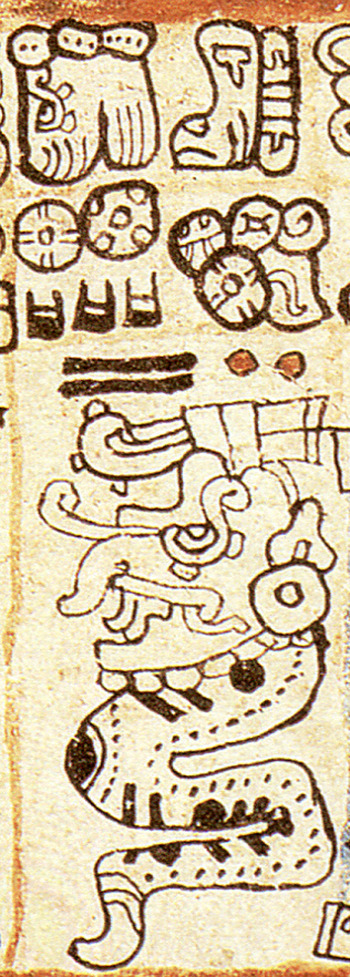
Different roles for the Venus gods in the Madrid almanac seem apparent. Whereas God H is linked with eclipse iconography, the Chicchan serpent is more generally associated with rainfall, because it is the counterpart of the Chicchan serpent bringing rainfall in ethnographic accounts recorded among the Maya (Milbrath Reference Milbrath1999:36). This concept seems to be evident in imagery of the Chicchan serpent with the rain god's head (God B), appearing on Madrid page 10b with a glyph compound interpreted as the name for Kukulcan (Figure 3; Kelley Reference Kelley1976:63–64; Macri and Vail Reference Macri and Vail2009). Among the Chorti, the Chicchan is identified as a feathered serpent linked to rainfall (Wisdom Reference Wisdom1940:395–397, 410–411, 445). In the Madrid Codex, the Chicchan serpent represents the role Venus plays in bringing rainfall, suggesting parallels with the Venus god controlling rainfall in traditional communities such as the Lacandon Maya (Aveni Reference Aveni2001:258). Venus is still observed to predict rainfall in the area of the Chorti Maya, where one of the workers at Copan noted that, on the Day of the Cross (at the beginning of May), the farmers look at Venus to determine how much rain will fall during the rainy season; if Venus appears to be cloudy there will be good rains, but if it is very bright “será una mala temporada de lluvias” (Alfonso Morales, personal communication 2013), a practice also noted among the Chorti by Girard (Reference Girard1962) decades earlier. The fact that two traditional communities that have always lived far apart share beliefs suggests there was an ancient belief that Venus controls rainfall in the Maya area.
Madrid Codex, p. 10b, showing the Chicchan serpent with Chac's head and a possible Kukulcan title (after Vail Reference Vail2013).

As I have noted in previous studies, the Madrid in extenso almanac clearly depicts Venus imagery in the context of a 260-day calendar linked with the agricultural cycle (Milbrath Reference Milbrath1999:261, Reference Milbrath2016). In light of the seasonal imagery in the Madrid almanac, discussed in greater detail below, it is important to understand the basics of the Maya agricultural cycle and how the 260-day Tzolkin coordinates with agricultural activities.
MAYA SEASONAL CYCLES AND THE TZOLKIN
In the Maya area, a number of Maya communities visualize the period spanning from the preparations for planting to the harvest as a period of approximately 260 days, running from February to October. Needless to say, this fixed 260-day count can be easily integrated with the Tzolkin, because any specific day in the 260-day sacred calendar that marks the beginning of the agricultural cycle will also name the day it ends. There is considerable variety in practices among the Maya, depending on the ecological zone and altitude, but generally the onset of rainfall determines when the main crop is planted. Planting most often coincides with the rainy season in May, around the time of the first solar zenith (Milbrath Reference Milbrath1999:13, Plate 1), but preparations take several months because the fields must be made ready for planting.
Some farmers in Yucatan risk an early planting during April, tikin muk or ticin muc known as “siembra en seco” or “maíz chico,” in hopes of early rainfall during that month, but the main crop, “maíz grande,” the maize known as xnuk nal, is planted to coincide with the onset of the rainy season in May, and there is a second planting in June through August to take care of any shortcomings in the crop due to dry weather or pests (Bricker and Milbrath Reference Bricker and Milbrath2011:528, Note 3; Terán and Rasmussen Reference Terán and Rasmussen1994:205–207). Harvesting green maize begins in August and the main harvest takes place with the crop matures in October.
In other Maya areas, it is also possible to plant a second crop during the dry season, but more generally the second planting takes place in the midst of the rainy season, as is the practice in Yucatan and among the Chorti (Estrada-Belli Reference Estrada-Belli2011:79; Girard Reference Girard1962; Milbrath Reference Milbrath1999:13–14). The pattern along the coast of Belize seems to be the same, but here there is enough rain for a second crop to be planted in the alluvial soils beginning in November, and this extra crop is harvested during the dry period that spans from January through April (Iwaniszewski Reference Iwaniszewski2002:506).
Studies of the milpa in the area of the Yucatan peninsula indicate that the burn generally takes place in April but can begin as early as March and end as late as May (Pérez Toro Reference Pérez Toro and Torres1946:203; Terán and Rasmussen Reference Terán and Rasmussen1994:198). Research conducted in the region of Calakmul in Campeche records the driest months are November through April, which have an average of less than 2 mm of daily rainfall, and the burn generally takes place from April 16 to May 15 (Monzón-Alvarado et al. Reference Monzón-Alvarado, Waylen and Keys2014:13–14). In Peten, the dry season runs roughly January to May, and April is usually the hottest, driest month of the year when it would be optimal to burn the fields in preparation for the main crop, known as the “milpas de fuego,” which is planted near the end of April (Schwartz and Rolando Corzo Reference Schwartz and Rolando Corzo M2015:75). Researchers note that Peteneros allow maize stubble and certain weeds from this first crop to decompose in the field, providing mulch for the second maize crop, called the “segunda,” a crop cycle that may extend well into the dry season. These practices may be closely related to those in Yucatan because Schwartz and Rolando Corzo (Reference Schwartz and Rolando Corzo M2015) point out that even Peteneros who no longer speak a Mayan language refer to soil types and many plants using Yucatec Maya or Itza Mayan names.
At San Pedro Chenalho in Chiapas, the Tzotzil 260-day ritual calendar is used almost exclusively for agriculture and maintains a fixed relationship to the annual cycle through 20-day “months” that are frozen in a specific relation to the tropical year (Guiteras Holmes Reference Guiteras Holmes1961:32–33). This fixed cycle of the agricultural year, equivalent to 13 Maya months, begins with a month called Sisak and ends with Pom (February 5–October 28 in 1955).
The Quiche Maya preserve a fixed agricultural cycle for mountain maize, beginning in March with planting and ending in December with the harvest, which ideally takes place on the same day and number in the 260-day cycle as when the crop was planted (Tedlock Reference Tedlock1992:204). At lower altitudes, the agricultural cycle more commonly spans from February through October (also about 260 days).
It is noteworthy that the agricultural cycle begins in early February among the Tzotzil in southern Mexico and the Chorti of Guatemala and in both areas the cycle is said to be exactly 260 days (Milbrath Reference Milbrath1999:14–15). Girard (Reference Girard1962:3–5, 339–342, Table facing page 328) describes a fixed 260-day cycle in the Chorti agricultural calendar beginning on February 8, but there seems to be some flexibility because the Chorti seasonal calendar is said to begin with the first visible crescent moon, which is generally a day or two after the astronomical new moon. As among the Tzotzil, the Chorti fixed 260-day count has been integrated with a “frozen” 365-day calendar.
The Chorti 260-day agricultural count recorded by Girard (Reference Girard1962:3–4, 55, 76, 339–342) is subdivided in two parts (80 and 180 days), using multiples of nine, 13, and 20 days. Girard (Reference Girard1962:Table facing page 328) notes that the first 80-day period of agricultural preparation ends with the first solar zenith on April 30 or May 1, coinciding with the onset of the rainy season when the planting period begins. The remainder of the agricultural period of 260 days involves planting a second crop shortly after doubling over the ears of the first crop, which prevents rainfall rotting the maize and birds eating the kernels. The second crop is planted in August around the solar zenith (August 12–13) and cultivated during a period that includes the heaviest rainfall around the fall equinox (September 21), but doubling the ears of this second crop is not necessary because the rainy season has come to an end by the time the maize is ready to harvest (Girard Reference Girard1962:265–268, Table facing page 328). The harvest begins in October and the fixed 260-day agricultural count ends with a midnight ceremony on October 25. The remaining 105 days form a period of rest, with a five-day period at year-end comparable to the Postclassic Maya Uayeb, but positioned in February rather than July. The division of the year into two segments with intervals of 105 and 260 days is documented in solar orientations at a number of early Maya sites, and also seems to be quite ancient at Teotihuacan (Iwaniszewski Reference Iwaniszewski, Wiesheu and Founier2005:105, Table 2; Milbrath Reference Milbrath2017; Šprajc Reference Šprajc2000, Šprajc and Sánchez Nava Reference Šprajc, Sánchez Nava, Arroyo, Paiz and Mejía2012).
The fixed 260-day agricultural calendar still in use today suggests comparison with seasonal aspects of the 260-day almanac in the Madrid Codex (Milbrath Reference Milbrath1999:15, 61). On Madrid page 14b, a male deer without antlers symbolizes events in March, the month when deer lose their antlers, as noted above. The span for burning in Yucatan, lasting from March through May, is probably associated with the fire glyphs in the augural band in the first pages of the sequence (Madrid 13b–16b; Figure 1). The flaming bundle or tree on Madrid page 13b and the torch on page 14b also seem to be linked with the burning fields in March and April (Bricker and Bricker Reference Bricker and Bricker2011:577; Milbrath Reference Milbrath1999:61–62). Rainfall is shown on all the almanac pages, and images of the Chicchan serpent and the rain god, Chac, appear on Madrid pages 13b–14b with containers pouring out water, seeming to represent them as “rain-makers.”
Many of these seasonal images in the Madrid almanac can also be related to Landa's festival calendar. By insisting that the New Year fell on a fixed day (July 16; Tozzer Reference Tozzer1941:150–151, Note 748), Landa implied a frozen or fixed seasonal cycle of months was in place by the Conquest period. If a fixed or “frozen” Haab existed, it could be the result of calendar changes introduced in the Late Postclassic with the Ahau Katun calendar (Bolles Reference Bolles1990). In any case, I am arguing for a late date for the almanac so the months in Landa's account can be coordinated with the visual imagery in roughly the same seasonal position they had in Landa's time (Milbrath Reference Milbrath1999:61–62, Reference Milbrath2016). The image of Chac on page 13b pouring rain from a jar may relate to the festival honoring the Chacs in Chen or Yax, and the incense burner on the same page could be related to rituals conducted in Yax (January 12–31 in Landa's Julian calendar) when the braziers were renewed (Tozzer Reference Tozzer1941:161). The Death God holding a torch up to the deer on 14b may refer to a fire ceremony (Tupp Kak) performed in Mac (March 13–April 1 in Landa's calendar), when the Maya hunted wild animals and burned them in a fire ritual (Tozzer Reference Tozzer1941:161–162). As I have noted previously (Milbrath Reference Milbrath1999:62), this ritual seems to symbolize the fires set to clear the fields for planting, and the burning fields in Mac would certainly flush out wild animals for the hunt. Another seasonal ceremony appears on page 15b, which shows a merchant god with his pack, representing the merchant god honored in Muan, celebrated in May in Yucatan around the time of the conquest (Milbrath Reference Milbrath1999:62; 1941:164). These images all help set the narrative sequence in the context of the seasonal cycle.
ECLIPSE DISTRIBUTION IN THE TRECENA CYCLE
Having summarized the seasonal cycle in the Maya area and its relationship to specific images on Madrid page 12b–18b, I now turn to a new analysis focusing on the Late Postclassic patterning of visible eclipses in relation to the Tzolkin and the seasonal cycle. To adjust the eclipse dates in Table 2 to our Gregorian calendar, add ten days to Julian dates in the sixteenth century, nine days in the fifteenth century, and eight days in the fourteenth century. Table 2 includes a wide range of eclipse events, featuring all eclipses visible in Yucatan with a magnitude greater than 25 percent (> 0.25). Describing what can be seen during an eclipse, Aveni (Anthony Aveni, personal communication 2016) notes “perceivable effects range from indirect crescent imagery at less than 50 percent and sharp shadows at greater than 50 percent to shadow bands and Baily's beads and the diamond ring at greater than 90 percent.” He also comments that we tend to emphasize the more dramatic total eclipses, but that need not be the case for the Maya. The eclipse warning table in the Dresden Codex focuses on eclipse intervals rather than magnitude, featuring eclipse windows that predict when an eclipse might occur. Astronomer-priests using such tables would be especially vigilant on those days, allowing them to detect subtle changes and compile a record of observed eclipses that included even those of lower magnitudes. In fact, many of the eclipses recorded in Aztec sources were not of high magnitude, yet they are clearly documented in written records (Aveni and Calnek Reference Aveni and Calnek1999:Table 4).
Although all the eclipses in Table 2 were visible throughout Yucatan at sites like Tulum, Chichen Itza, and Uxmal, the magnitude noted is based on a specific site selected from the data published by Verbelen (Reference Verbelen2003). Uxmal was chosen as the observation point, for it is closest to Mayapan, a site that may be the origin point of the Madrid Codex (Milbrath and Peraza Lope Reference Milbrath and Peraza Lope2003; Paxton Reference Paxton, Vail and Aveni2004:114). Table 2 shows that sets of eclipses with a magnitude of greater than 25 percent appear primarily in the following trecenas: 1 Lamat, 1 Cimi, 1 Ben, 1 Kan, 1 Caban, 1 Ik, and 1 Men, representing less than a third of the total number of trecenas (20).
Studies of Maya eclipse events in the Dresden Codex (51–58) have been shown to cluster in certain “zones” of the 260-day calendar because a double count of 260 days (520 days) is nearly equivalent to the time it takes to pass from one node of the eclipse cycle to the third and subsequent node (519.93 days; Bricker and Bricker Reference Bricker and Bricker2011:266, Reference Bricker, Bricker and Aveni2015:286). The Maya recognized eclipse danger windows, representing eclipse warning periods during which an eclipse was likely to occur somewhere on earth, categorized in terms of the movement of individual Tzolkin days into and out of those windows over time (Aveni Reference Aveni2001:182; Bricker and Bricker Reference Bricker and Bricker2011:271, 284–287, Table 9-4). Since the eclipse windows are defined in terms of a double Tzolkin of 520 days, the trecenas are drawn from more than one Tzolkin (Bricker and Bricker Reference Bricker and Bricker2011:Table 9-5). Each eclipse danger window of about 31 days contains at least two complete trecenas, which means that as many as 12 of the 20 trecenas can fall within the windows (Victoria Bricker, personal communication 2016). Eclipse tables like one in the Dresden Codex allowed the Maya to use the Tzolkin to make predictions about when an eclipse would occur somewhere, but they did not help them to predict whether an eclipse would actually be seen in their area.
The Maya must have used observational records to document eclipses in relation to specific trecenas in the Tzolkin. The Madrid Codex almanac on pages 12b–18b seems to be such a record. The idea that this almanac could be a historical eclipse record was first proposed by Bricker et al. (Reference Bricker, Bricker and Wulfing1997), who placed the almanac in the early tenth century but did not link the almanac to records of observed eclipses. As will be seen, the layout of the almanac corresponds to eclipses that were visible in Yucatan during the fifteenth century, overlapping with the estimated date of the codex. The predominant pattern emphasizes eclipses in the fifteenth century that fall in the trecenas 1 Cimi, 1 Ben, and 1 Men, all corresponding to pages with eclipse glyphs (Table 2).
The following patterns clearly emerged in studying the distribution of solar eclipses visible in the fourteenth century to the early sixteenth century (a.d. 1300–1520). The trecena beginning 1 Cimi was most likely to have an observed eclipse event (22 examples), and it was also the most likely trecena to have a high magnitude eclipse (eight of the 22). Furthermore, most of the Tzolkin dates for those eclipse events are ones that fall on page 13b, a page with an eclipse glyph. In the 1 Cimi trecena group, only the eclipses in a.d. 1311, 1362, and 1402 fail to correlate with Tzolkin dates on page 13b, but from the fifteenth century on through the early sixteenth century all the dates for visible eclipses in the 1 Cimi trecena correspond to the Tzolkin dates associated with the eclipse glyph on page 13b. There is a very definitive link between the eclipse sign and the trecena 1 Cimi on this page and visible eclipse events.
Next in order of eclipse frequency is the 1 Men trecena with 15 visible eclipses, four of these being high magnitude eclipses, and nine of the eclipses correspond to Tzolkin dates on page 17b, which also has an eclipse glyph (Figure 1, Table 2). Here the best correlation with dates on 17b is seen in eclipses that fall in the span from a.d. 1357 to 1481, and only one eclipse in this period fails to correlate with a Tzolkin date on 17b (10 Kan in a.d. 1478; Table 2).
The 1 Ben trecena is next in order of frequency, with 10 visible eclipses, all falling in the period represented by the black interval on page 12b, which has two eclipse glyphs. In my 1999 publication (Milbrath Reference Milbrath1999), I assigned page 12b to the winter solstice and 13b to an interval of 32 days beginning on February 8, leaving a gap between the two, but now that the Brickers have demonstrated that page 12b references the trecenas just before those on page 13b, it is clear that two pages represent a closely linked period of time. The eclipses in a.d. 1301, 1304, and 1488 all relate to dates on 12b, and any one of these could be an entry point for the almanac, but the eclipse date in a.d. 1488 is an especially good fit with the beginning of the agricultural cycle (a.d. January 22, 1488 in the Gregorian calendar).
Next in the order of frequency is the 1 Caban trecena with nine eclipses, but only two correspond to Tzolkin dates with eclipse signs (page 12b), and both fall in the first half of the fourteenth century. The 1 Ik trecena has seven eclipses, but only two relate to dates on a page with an eclipse sign (in this case 17b), indicating poor correlation between these eclipse events and the Tzolkin dates on pages with eclipse glyphs. This is also the case with the 1 Kan trecena with only two eclipses, and none relating to Tzolkin dates on pages with eclipse glyphs. Not listed in Table 2 are the trecenas with only a single visible eclipse, such as an eclipse in the 1 Cauac (a.d. July 28, 1348) trecena and an eclipse in the 1 Edznab trecena (a.d. December 9, 1340). The a.d. 1340 eclipse was paired with another visible eclipse on a.d. June 25, 1340, a very rare instance of a pair of eclipses that were both visible around the solstices. The only other trecena associated with observed eclipses in the Late Postclassic is 1 Lamat with three eclipses, all of which relate to eclipse glyphs on page 12b. These 1 Lamat eclipses could be another entry point to the almanac for 1 Lamat is the first trecena (Table 1). Although up to 12 trecenas can be related to eclipse danger windows, as noted above, in the Madrid almanac, only four are regularly associated with visible eclipses in the Postclassic, and these are the same ones that show a good correspondence between an eclipse event, and eclipse sign, and a Tzolkin date (Table 2).
Since the focus here is on astronomical events observed in relation to the agricultural cycle, and seasonal imagery appears in the almanac, we should note that Table 2 shows patterning of eclipse events in terms of the solstices and solar zeniths, and the span of the agricultural cycle itself. Table 2 shows that a number of eclipses correspond to the new moon directly following the summer solstice in the following years: a.d. 1303, 1342, 1405, 1424, 1451, and 1452, or just before the June solstice (a.d. 1368 and 1499). A small set corresponds to the first new moon after the winter solstice in December (a.d. 1340, 1470, and 1516) or just before the December solstice (a.d. 1349 and 1368). Vail (Reference Vail, Dowd and Milbrath2015:178) notes that solar eclipses occurred on days bracketing the winter solstice throughout the fifteenth and early sixteenth centuries, and some of these eclipse dates were surely of interest in the Madrid almanac, but the patterning may be more varied as a large set of eclipses falls around the first solar zenith (May 25 Gregorian for the Mayapan area) in a.d. 1311, 1325, 1333, 1394, 1397, 1398, 1437, 1481, and 1499, or the second solar zenith (July 20 Gregorian for the Mayapan area) in a.d. 1357, 1394, 1442, and 1478, with the most common correlation being the first new moon after the zenith event (adjusting the dates in Table 2 for the Gregorian calendar).
Another large set of eclipse dates falls in January or early February at the beginning of the agricultural cycle. Eclipse dates at the beginning of the agricultural cycle occurred in the following years: a.d. 1301, 1395, 1404, 1430, 1431, 1477, 1488, and 1508. Knowlton (Reference Knowlton2003:295, 301) points out that the Dresden Codex seasonal table (61–69) indicates a greater concern with eclipses that occur in the rainy season, as evidenced from the historical placement of the tables and the frequency of rainy season iconography with eclipse glyphs. The Madrid Codex almanac, however, seems to focus on eclipses falling during the agricultural season. This could be because a solar eclipse pinpoints the new moon event and helps calculate other lunar phases commonly observed to time the agricultural cycle, even today (Milbrath Reference Milbrath1999:30–31). With the first visible crescent as the starting point of the agricultural cycle among the Chorti, the cycle could begin anywhere between mid-January and mid-February in our Gregorian calendar.
The plotting exercise in Table 2 clearly points out that the Tzolkin dates in the almanac show a series of eclipses that coordinate with the solstices, solar zeniths, and the beginning of the agricultural cycle during the Late Postclassic. Furthermore, the trecenas 1 Ben, 1 Cimi, and 1 Men in the fifteenth century are most often associated with visible eclipses, and these are also the trecenas that appear on pages with eclipse glyphs in the Madrid almanac. This alone may be enough evidence to support my contention that the Madrid Codex 12b–18b is a Late Postclassic almanac recording a pattern of visible eclipses, but the model can be expanded further to account for Venus imagery and seasonality if one focuses on eclipse pairs using the model I proposed recently (Milbrath Reference Milbrath2016).
ECLIPSE PAIRS AND THE MADRID CODEX
Like Table 2, Tables 3 and 4 correlate the eclipse glyphs on page 12b with Tzolkin dates for eclipses that fall in one of the four trecenas immediately preceding the first column day signs on page 13b. On other pages with eclipse glyphs (13b, 17b), my model requires that the eclipse glyph relates to an actual eclipse date that appears among the tzolkin dates on that page.
The model that seems to work best in relation to the seasonal cycle is one that emphasizes eclipse pairs (Milbrath Reference Milbrath2016). Eclipse pairs are of special interest because multiple eclipses are represented by solar eclipse glyphs in the almanac. As can be seen in Tables 3 and 4, the eclipse pairs are separated by five or six months, like those recorded in the Dresden Codex eclipse table (Figure 2). This table has eclipse intervals of either 148 days or 177/178 days, clearly demonstrating that paired eclipses at five or six month intervals were important to the Maya (Milbrath Reference Milbrath1999:Plate 3). Although the Dresden table does not emphasize visible eclipses, the most significant eclipse pairs in the Madrid almanac seem to be ones that include a relatively high magnitude (>0.50) eclipse that was visible in Yucatan. The magnitude in any given location depends on the type of eclipse and the latitude and longitude of the observer's location in relation to the path of centrality for the eclipse. Espenak and Meeus (Reference Espenak and Meeus2006:4) note “eclipse magnitude is always less than 1.0 for partial and annular eclipses, but equal to or greater than 1.0 for total and hybrid eclipses.” In the fourteenth century, eight high magnitude eclipses visible that were in Yucatan form part of an eclipse pair (a.d. 1301, 1303, 1311, 1318, 1325, 1355, 1372, and 1383 in Table 3) and seven in the fifteenth and early sixteenth century (a.d. 1402, 1405, 1434, 1452, 1477, 1481 and 1496 in Table 4). Only the eclipses of a.d. 1311, 1452 and 1496 were total eclipses that had a path of centrality over Yucatan, making them high magnitude eclipses in that area (Espenak and Meeus Reference Espenak and Meeus2006). Annular eclipses of relatively high magnitude in the region of Yucatan were seen in the years a.d. 1301, 1355, 1383, 1402, 1434, and 1481 (Tables 3 and 4), but with annular eclipses the magnitude is always < 1.0 and the viewer sees a dark circle over the sun, with a wider ring of sunlight surrounding the moon than in a total eclipse. The paired solar eclipse glyphs on page 12b were interpreted as repeated eclipse events spaced over a multi-year interval by Bricker and his colleagues (Bricker et al. Reference Bricker, Bricker and Wulfing1997:Table 5; Bricker and Bricker Reference Bricker and Bricker2011:Table 11-17), but I proposed, instead, that the solar eclipse glyphs may represent a pair of eclipses occurring in a single year with a repetition of this pattern over regular intervals in subsequent years (Milbrath Reference Milbrath2016).
It is extremely rare to have two visible eclipses seen in the same year in a specific area (a.d. 1340 being the only Late Postclassic example in Yucatan; Table 3). The a.d. 1340 eclipse is notable because it was part of an eclipse pair in which both eclipses were visible in Yucatan. This pair of eclipses has added interest because both eclipses took place around the solstices. We will return to this eclipse pair in discussing Venus events, below. Generally only one eclipse in the pair was visible in Yucatan, but the augural band on page 12b showing a pair of solar eclipses might signal the almanac focuses on eclipse pairs. Paired eclipse signs in other contexts more commonly show a solar eclipse sign followed by a lunar eclipse, as on Dresden Codex page 58b (Figure 2) and Paris Codex page 10b, where the pair are related to the eclipse season, representing a period approximating five weeks in which a solar eclipse is followed by a lunar eclipse or vice versa (Bricker and Bricker Reference Bricker and Bricker2011:362, 858, Figure 9-56c).
Tables 3 and 4 were previously published (Milbrath Reference Milbrath2016:Tables 1 and 2), but appear here with some minor revisions and changes in format to clarify the data. Solar eclipses visible at a relatively high magnitude (> 0.50) in Yucatan are paired with another eclipse in the same year during a period running from a.d. 1300–1520. Certainly the almanac would not cover such a long period, but this span of dates allows us to investigate the best fit with observed eclipses in the Late Postclassic, as in Table 2. In this table, the fifteenth century eclipses show a good correlation with the Tzolkin dates of visible eclipses and dates on pages with eclipse glyphs. It would be expected that the fifteenth century would work best for the eclipse pairs as well, and this does seem to be the case but only during a more restricted period of time.
In Table 3, 38 eclipse dates in the fourteenth century are listed, and the number of visible eclipses corresponding to a Tzolkin date on a page with an eclipse glyph is 13 (those pages in bold), or a total of 34 percent. In Table 4, with 52 eclipse listed, 16 are visible eclipses corresponding to an eclipse symbol associated with a Tzolkin date on that page, or around 30 percent. If, however, we narrow the focus to a briefer span of time the ratio goes up depending on what set of years are chosen. For example between a.d. 1416 and 1477, there are 25 eclipse events with 10 being visible eclipses corresponding to dates on pages with eclipse signs, or roughly 40 percent.
The red number 13 featured so prominently on page 12b may coordinate with the tzolkin date of an eclipse, as was suggested by the Brickers (Reference Bricker and Bricker2011). Presuming that the day numbered 13 on page 12b directly precedes one of the trecena dates on page 13b, only four tzolkin dates could be candidates: 13 Ahau preceding 1 Imix, 13 Chicchan preceding 1 Cimi, 13 Oc preceding 1 Chuen, and 13 Men preceding 1 Cib (Table 1). In Tables 3 and 4, only one eclipse took place on a date with a coefficient of 13, but this eclipse on a.d. February 1, 1394 was not visible in Yucatan.
As I noted in my 2016 publication, there is another way to link a visible eclipse to the tzolkin date with the number 13 on page 12b, if we consider that the tzolkin day may have started at noon, rather than at dawn or midnight. Thompson (Reference Thompson1960:102) favors sunrise as the start of the day in Classic Maya times, but he notes this is by no means conclusive and points out that Chan Kom provides evidence of the day running from noon to noon. If the Tzolkin day shifted by six hours, this would have little effect on the patterning noted in Table 2. A few dates that fall at the beginning of the trecenas in Table 2 would shift to the previous trecena, but only if they were morning eclipses. If the eclipse took place before noon, it would actually fall on the day before in terms of the Tzolkin. Only a few visible eclipses in Tables 3 and 4 have Tzolkin dates with the number one, and only a single example is a morning eclipse. The 1 Cimi date for the a.d. 1452 eclipse would actually be 13 Chicchan if the tzolkin “day” began before noon. The a.d. June 1452 eclipse is of great interest because was a total eclipse with a path of centrality over Yucatan. If page 12b represents a visible eclipse seen in the morning on a.d. June 17, 1452 on 13 Chicchan, it would commemorate a total eclipse observed just after the summer solstice (June 11/12 Julian or June 20/21 Gregorian), followed by a second eclipse six months later on the winter solstice (December 21/22 Gregorian). The sequence could begin with a total eclipse seen on a.d. June 17, 1452 (Julian, June 26 Gregorian), and the red number 13 beside the Chicchan serpent's head on page 12b would literally represent 13 Chicchan as the date of the total eclipse.
To summarize, there is a very strong relationship between the Tzolkin dates on pages displaying eclipse glyphs and the Tzolkin dates of actual eclipses seen in Late Postclassic Yucatan (Table 2), and the best correlation is in the fifteenth century, which also seems to be the case when we consider eclipse pairs in a more limited span of time (Table 4). Page 12b serves as an introduction to the in extenso almanac by recording the first 13 days of the almanac, and possibly the paired eclipse signs on that page could announce that the almanac deals with a series of paired solar eclipses, like those documented in Tables 3 and 4.
PAIRED ECLIPSES AND VENUS EVENTS
Studying how the paired eclipses can be integrated with the Venus cycle is another facet in decoding the imagery on Madrid pages 12b–18b. Davoust (Reference Davoust1994) has shown that temporal units generated by the movements of Venus could be integrated with the cycles of the sun and moon in the codices. Aveni (Reference Aveni and Aveni1992:91, 98) notes that the Dresden Codex Venus Table commensurates with lunar cycles, and the Maya were especially interested in lunar eclipses that occurred close to heliacal rise events. The Madrid Codex shows the Maya were also interested in solar eclipses in relation to the Venus cycle. Looking at Tables 3 and 4, Venus heliacal rise and set events (first and last visibility of Venus as the morning or evening star) and the proximity of these Venus events to the eclipses may have been significant. Venus heliacal rise and set events falling in the same trecena as visible eclipses may have been especially significant, as seen in the years a.d. 1303 (E-first), 1340 (M-first), 1351 (E-first), 1365 (M-last), 1394 (E-first), and 1404 (M-last), but in the fifteenth century the pattern of interest seems to be the correlation between eclipse events and the period when Venus is the evening star during the agricultural cycle.
With the backdrop of rainfall, the almanac sequence certainly correlates in some way with the rainy season and the Tzolkin used to calculate the agricultural cycle. Venus events were observed in relation to the 260-day count because this period is very close to the observed period for visibility of the planet in the morning or evening sky (average 263 days; Aveni Reference Aveni2001:Table 6). The fact that the almanac shows the Chicchan serpent throughout the 260-day sequence suggests that Venus was visible for that length of time. This could be as the morning star, or as the evening star, or possibly as the evening star transitioning to morning star, for the planet would be visible most of the time, except for a brief period of transition during inferior conjunction (averaging 8 days; Aveni Reference Aveni2001:Table 6).
A scene on Madrid page 16b shows the Death God covering the Chicchan serpent, which could reference the brief underworld sojourn when Venus was in inferior conjunction. Perhaps the best fit in this scenario would be with the eclipse pair on a.d. February 3, 1478 and a.d. July 29, 1478, with Venus disappearing as the evening star about midway between, on a.d. May 30, 1478, at a time that the Pleaides were also invisible in conjunction (Milbrath Reference Milbrath1999:259, 261, Figure 7.3). The first eclipse was not visible but it does coordinate with a Tzolkin date on 13b, near the beginning of the almanac. And the second eclipse in July could coordinate with page 17b and its eclipse sign, although the Tzolkin date of the eclipse (10 Kan) is actually found on page 18b. This remains a possibility, but there is a more interesting pattern that repeats when the evening star was visible for the entire agricultural cycle (February to October). This would coordinate the sequence of Chicchan serpents embodying the planet Venus with the evening star bringing rain, supporting a link between the evening star and agricultural fertility first noted by Šprajc (Reference Šprajc1996).
During the total eclipse in a.d. 1452, Venus was visible as the evening star from February through October, overlapping precisely with the agricultural cycle. A total eclipse in a.d. 1496 provides another possible correlation, for Venus was the morning star from early January through the middle of September, but the patterning is not ideal because the planet disappeared before the agricultural cycle was completed. The path of centrality for the a.d. 1496 total eclipse is an interesting because went across both Yucatan and central Mexico, and this eclipse is also recorded in the Codex Borgia and in Aztec annals that incorporate eclipse records spanning several hundred years (Aveni and Calnek Reference Aveni and Calnek1999; Milbrath Reference Milbrath2013). The almanac correlates with the transition to the morning star according to the Brickers (Reference Bricker and Bricker2011), who note that the glyph representing a seated figure on page 18b also names the turtle victim killed by the rising morning star on Dresden page 49 in the Venus Table. This leads them to argue that this glyph in the augural band on Madrid page 18b corresponds to the rise of the morning star (Bricker and Bricker Reference Bricker and Bricker2011:585). Vail (Reference Vail2013:59) reads the same glyph (T227b) as na'ak, meaning “to rise,” and notes that it is paired with the name of the rain god in the augural band on Madrid page 18b, suggesting the phrase “Cháak ascendente,” which shifts the emphasis from a Venus event to the seasonal pattern of rainfall.
Significantly, in a.d. 1452, the paired eclipses occurred around the solstices, as in a.d. 1340 (Tables 3–4). In a.d. 1340, Venus first appeared around the spring equinox, and it disappeared around the winter solstice, just 15 days before the second visible solar eclipse. Counting forward to the more dramatic eclipse in a.d. 1452 indicates an integrated cycle of Venus events and paired eclipses that recurred 112 years later, a multiple of Venus almanacs like that in the Dresden Codex (5 × 584 × 13 = 104 years), but with an added almanac of five synodic Venus cycles equivalent to eight years (5 × 584 = 8 × 365 days). And, as occurs in the Dresden Venus Table, over the course of more than a century, Venus events shifted forward in time, so Venus appeared as the evening star about a month earlier in a.d. 1452 when compared with a.d. 1340, which actually put Venus in the perfect position to coordinate with an agricultural cycle spanning from February through October (E-first on a.d. February 27, 1452 to E-last on a.d. October 27, 1452).
It is noteworthy that Venus was visible as the evening star throughout the agricultural season in a.d. 1452, and this pattern would be repeated eight years later in a.d. 1460, and at similar intervals thereafter. In a.d. 1452, the first eclipse in the pair was a total eclipse (on 1 Cimi or 13 Chicchan if the day began at noon) visible after the summer solstice. If a total eclipse is referenced on Madrid page 12b, the in extenso almanac may have been used to track the patterning of eclipse pairs in relation to Venus as the evening star during that year and in subsequent years at intervals of eight years (a.d. 1452, 1460, 1468, 1476, 1484, 1492, 1500, and 1508). In each of these years, the first appearance of the evening star (E-first) took place in February at the beginning of the agricultural season, a starting point for the agricultural cycle in a number of Maya communities today. All of these years also had eclipse pairs visible somewhere on earth, but only half (a.d. 1452, 1484, 1492, and 1508) were years in which one of the eclipses was visible in Yucatan at a magnitude of > 0.50. Three of the four eclipse dates (a.d. 1452, 1492, and 1508) also coincided with Tzolkin dates found on pages with eclipse glyphs, probably representing the idealized link they may have been tracking. The first eclipse was seen a few days after the June solstice in a.d. 1452, the beginning of the heavy rains, whereas 40 years later the first in the eclipse pair was a visible on a.d. May 5, 1492, correlating with the beginning of planting, and in a.d. 1508 the first eclipse was visible in mid-January (a.d. January 12, 1508), near the beginning of the agricultural cycle.
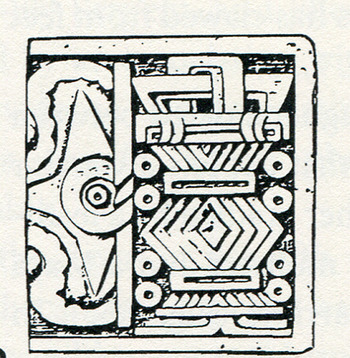
A pattern developed in the Late Postclassic, wherein Venus was visible as the evening star throughout the agricultural cycle. This pattern developed gradually, for the heliacal rise of the evening star took place around five days earlier every century (hence the corrections to the Dresden Codex Venus tables; Milbrath Reference Milbrath1999:167). In a.d. 1340, the year that paired eclipses were visible following the solstices, the evening star first appeared around the equinox in March and disappeared around the December solstice in a.d. 1340. By a.d. 1452, 112 years later (104 years plus 8), another eclipse pair was linked with the solstices. Although these eclipse pairs around the solstices were certainly noteworthy, the almanac with its emphasis on the Venus serpent displayed over a 260-day period seems to reflect a greater interest in the patterning of Venus as the evening star when its period of visibility coordinated with the agricultural cycle. This pattern had emerged by a.d. 1452, when the planet first appeared in February and last was visible in October, at the end of the agricultural cycle. Thereafter, the same pattern repeated at eight-year intervals, and observations were apparently coordinated with eclipse pairs that marked significant points in the agricultural cycle. Although there is no calendric unit to reference eight years in the almanac, the image of Chac wearing a headdress with a modified form of “A-O” symbol could signal an interest in this eight-year cycle. This variant of the trapeze-and-ray design sign used to designate years in the Codex Borgia appears in a different context in the Maya area, where it clearly shows the Venus almanac is equated with eight solar years (Figure 4; Milbrath Reference Milbrath1999:183, 201, Figure 5.5a, Reference Milbrath, Barnhart and Aldana2014:112–114).
VENUS AND SIDEREAL CYCLES
Now I turn to another line of evidence to support a correlation between the Madrid almanac and the paired eclipses observed in relation to Venus positioned as the evening star. Venus was observed in different horizon positions (never higher than 45 degrees) when it was visible as either morning or evening star, but it also could be observed in relation to the background of stars, a sidereal period of 224.7 days (Aveni Reference Aveni2001:Table 6). Sidereal observations of Venus are not widely documented, but some recent studies suggest that a Postclassic record noting the position of Venus in the background of stars is represented by a repeated sequence of 20 gods listed in the Dresden Codex Venus table (Faulseit Reference Faulseit2006). Furthermore, Aveni et al. (Reference Aveni, Bricker and Bricker2003:149–151) studied empirical sidereal intervals of Venus during the sixth through the tenth centuries and concluded that it was likely that the Maya observed the sidereal position of Venus. As we will see, the sidereal position of Venus may play a role in the notion that Venus controls rainfall.
My previous research on the Madrid almanac highlighted the changing attributes of Chicchan serpents, which are laid out sequentially to indicate the passage of time (Milbrath Reference Milbrath1999:259, 261). Two of the Chicchan serpents wear rattles as a reference to the Pleiades, called the tzab (“rattlesnake's rattle”) in Yucatan today, as it was in Friar Landa's time (Milbrath Reference Milbrath1999:261; Tozzer Reference Tozzer1941:133, 220). In my initial study of the Madrid almanac on pages 12b–18b, I focused exclusively on the position of the Pleiades relative to the agricultural cycle, noting that this star group could be considered to be part of a larger serpent constellation (Milbrath Reference Milbrath and Williamson1981). The nearby star group in Perseus presents a looped serpentine form that may have been combined with the Pleiades to form a rattlesnake constellation. This still could be a secondary reference for the serpent image, but given the great importance of the Chicchan serpent in the almanac and its survival in modern accounts as a rain-maker, it seems more likely that the primary reference of the rattlesnake is to Venus as Kukulcan, as I noted in subsequent publications (Milbrath Reference Milbrath1999, Reference Milbrath2016).
Venus Platform, Chichen Itza (after Milbrath Reference Milbrath1999:Figure 5.7a).

Landa says the Maya watched Venus and the Pleiades to tell time at night, so it is clear the two were watched together. The serpent's rattles representing the Pleiades disappear in the last four pages of the sequence because this portion of the almanac corresponds to a time when this star group was invisible at dusk during the latter part of the agricultural season (Milbrath Reference Milbrath1999:Figure 7.3). The Pleiades are still observed in relation to the agricultural cycle, and their disappearance in conjunction with the sun during May is seen as a sign to plant among the Maya today (Milbrath Reference Milbrath1999:38). In the fifteenth century, the Pleiades disappeared on the western horizon at the end of April, moving in conjunction with the sun, being invisible for about a month, and reappearing at dawn at the end of May (ca. a.d. 1500, last visible at dusk on April 26, and first visible at dawn on May 29; Aveni Reference Aveni2001:113, Table 10).
Images showing the Chicchan serpent wearing rattles may represent the positioning of Venus near the Pleiades during March and April, when this star group was seen in the western sky after dusk. Venus invariably passes by the Pleiades somewhere between March and June, a pattern that has repeated for more than 1000 years, as can be seen by studying the sidereal position of Venus relative to the Pleiades (Milbrath Reference Milbrath and Aveni1988:74, Table 1, Reference Milbrath1999:210). In the Late Postclassic, whenever Venus passed by the Pleiades in March or April, it would be seen as the evening star, and when the Pleiades reappeared in the east after conjunction in June, if Venus was visible nearby it was invariably the morning star.
Imagery of the Venus serpent with the Pleiades-rattles implies that observations of Venus occurred at dusk when the planet was the evening star. Studying the seasonal position associated with the evening star seems especially appropriate because the imagery of rainfall in the agricultural almanac evokes the widespread link between fertility and the evening star in Mesoamerica (Šprajc Reference Šprajc1993, Reference Šprajc1996, Reference Šprajc1998).
Focusing on the patterning of eclipses, Venus aspects, and the sidereal cycle of the Pleiades in relation to the agricultural cycle has led me to conclude that the almanac may have been inspired by observations beginning in a.d. 1340 when a pair of visible solar eclipse correlated with the solstices. In this year, a winter solstice eclipse coincided with the period represented on Madrid page 12b (Table 2) and Venus first appeared as the evening star around the spring equinox, remaining visible for the entire agricultural season. More than a century later, the paired eclipses again correlated with the solstices and Venus was once again the evening star, but this time it first appeared in February of a.d. 1452 and was visible for the entire agricultural cycle. During the second half of the fifteenth century, at eight-year intervals the evening star was first visible in February and was last seen in late October, correlating with the agricultural season.
CONCLUDING REMARKS
There are some definitive findings in this study that should be considered in any subsequent research on Madrid pages 12b–18b. The most important finding, presented here for the first time, is that the Postclassic eclipses visible in Yucatan clearly correlate with the tzolkin dates found with eclipse glyphs in the almanac, and the best fit is the second half of the fifteenth century, correlating with the majority of calendar round dates in the Madrid Codex analyzed by Vail and Bricker (Reference Vail, Bricker, Vail and Aveni2004). Another definitive finding is that the Chicchan serpent represents Venus, most probably the evening star aspect of the planet. The third definitive conclusion from my research is that this almanac is related to a 260-day agricultural cycle spanning from February to October. This cycle was timed by lunar phases, which may be why there is such an interest in solar eclipses in the almanac. Finally, the pattern of the evening star visible through the entire agricultural cycle became especially important in the Late Postclassic, probably inspiring the image of the Chicchan as a “rain-maker” in the Madrid Codex.
The almanac clearly deals with eclipse pairs spaced at intervals of 148 or 177/178 days, the same pattern found in the Dresden Codex eclipse table. The in extenso almanac may track paired eclipses around the solstices that can be traced back to a.d. 1340, when visible eclipses were seen in June and December, but the year a.d. 1452 seems more directly related to the almanac for it was the year of a total eclipse visible in Yucatan around the summer solstice, followed by a second eclipse on the winter solstice. The June a.d. 1452 eclipse initiated observations of a series of paired eclipses that overlapped with a time when Venus was visible as the evening star from February to October, a period of 260 days covering the agricultural season in Yucatan. If the almanac references an eclipse pair in a.d. 1452, it may have been structured to track a repeating pattern of paired eclipses that occurred when Venus was visible as the evening star during the agricultural season. Given our understanding of Maya astronomy, it seems unlikely that they could have predicted in advance whether the eclipses would actually be visible, but the astronomers could certainly calculate when an eclipse might occur, and the Maya would be well aware of the repetition of Venus as the evening star visible through the entire agricultural season at eight-year intervals. This is totally in accord with Maya interests in expressing celestial harmony. As Aveni (Reference Aveni and Aveni1992:87) notes: “[i]t was typical of the Maya to impress cycles of as many celestial bodies as possible into a given time-reckoning scheme.”
My model suggests that the almanac encodes a repeating pattern involving Venus, eclipses, and the agricultural cycle, one that could cover just over 52 years, spanning from a.d. 1452 to 1508, when Venus was repeatedly seen as the evening star during the entire agricultural cycle. The years a.d. 1452, 1492 and 1508 have an especially good relationship to the visual imagery, for not only was Venus the evening star during the entire agricultural cycle, but also the first eclipse in the pair was a visible eclipse seen at an important point in the agricultural cycle, and all three of these visible eclipses coordinate with Tzolkin dates that appear with eclipse glyphs at the beginning of the almanac.
To summarize my interpretation in a more specific context, I argue that page 12b introduces an in extenso almanac devoted to records (and possibly predictions) of eclipse pairs. Tracking visible eclipses associated with eclipse glyphs and their Tzolkin dates indicates the almanac records a pattern that became predominant in the Late Postclassic, with eclipses clustering in 1 Cimi, 1 Ben, and 1 Men, trecenas that correlate with almanac pages with eclipse glyphs on pages 12b, 13b, and 17b. This is certainly an important finding for it helps place the almanac firmly in the Late Postclassic. There is much more information in this almanac's rich array of narrative imagery. The sequence of events seems to record the trajectory of Venus as the evening star combined with observations of the Pleiades and eclipse events. This patterning may have been observed for more than a century before it was codified in the almanac during the second half of the fifteenth century.
Keying the almanac to the cycle of Venus as the evening star would also incorporate the period when it could be seen passing by the Pleiades, an event that occurred in a period ranging from March through April in the second half of the fifteenth century. This in turn can explain why the rattlesnake is wearing rattles only at the beginning of the agricultural season, when Venus as the evening star was visualized as fertilizing the fields and summoning the rains, just as the Chicchan serpent is still associated with rainfall. The focus on a repeating pattern of solar eclipses linking Venus as the evening star to the planting cycle is clearly a form of agro-astronomy that we are only beginning to investigate. It is a line of research that holds great promise, especially in light of our new understanding of real-time events in the Mesoamerican codices.
RESUMEN
La investigación presentada aquí demuestra que un almanaque poco común en el Códice de Madrid (páginas 12–18) integra observaciones del ciclo de Venus con eclipses en el contexto del ciclo agrícola. Las imágenes de eclipse en el almanaque de 260 días representan glifos relacionado con fechas en el tzolkin que se coordinan con los eclipses visibles en Yucatan durante el siglo XVI, indicando las fechas de almanaque hasta finales del período posclásico. El almanaque también representa los eventos de temporada en el contexto de un modelo de repetición los eclipses solares en pares asociados con las observaciones de Venus como el lucero vespertino. La contraparte de Quetzalcoatl-Kukulcan en el almanaque Madrid es la serpiente Chicchan, que juega el papel de Venus en una secuencia que muestra un aspecto fértil del planeta relacionado con el ciclo agrícola de 260 días y las Pléyades. Es evidente que las posiciones de Venus y eventos de eclipses fueron observados en relación con el ciclo de siembra, lo que refleja una forma de “agro-astronomía” que sólo ahora estamos empezando a comprender.
ACKNOWLEDGMENTS
My thanks to Gaby Vail, and Harvey and Victoria Bricker for reading an earlier draft of this paper, and Laura Elena Sotelo and Alfonso Morales for providing helpful comments after my presentation of a Spanish version at a Maya symposium in Merida in 2013. This paper was originally presented at the SAA Fryxell symposium in honor of Anthony F. Aveni, which Anne S. Dowd organized and chaired in 2012, and it has undergone considerable revision in response to helpful comments from two anonymous reviewers.