Introduction
Approximately 40 million residents of the coastal regions of Bangladesh (Bangladesh Bureau of Statistics, 2011) experience threats of frequent natural calamities, climate change impacts and limited socio-economic development (Islam and Ahmad, Reference Islam and Ahmad2004; MoWR, 2005). In this area, agriculture is the principal livelihood activity and plays a key role in tackling the challenges of the growing population, alleviating poverty (Azad et al., Reference Azad, Jensen and Lin2009), maintaining food security (Khan and Awal, Reference Khan and Awal2009), achieving coastal development goals and adapting to climate change (Abedin and Shaw, Reference Abedin, Shaw, Shaw, Mallick and Islam2013). In the past four decades, traditional agricultural practices of the area have been transformed due to the construction of coastal embankments and related agricultural extension work (Ali, Reference Ali2002). Instead of focusing on rice as a single crop, some farmers are now involved in small- or large-scale shrimp cultivation, sometimes along with fish, and rice-based cultivation that incorporates vegetables and/or domestic animals into existing farming practices. In a limited number of instances, farmers have adopted an integrated system, including shrimp or prawn and fish with rice and vegetables. Different studies have revealed that, due to these changes in the natural resource base, there have been positive impacts in terms of enhanced and diverse food production, but at the same time there has been serious actual and potential damage to the natural and societal environment (Haque, Reference Haque2004; DoE, 2005). The growing concern about the effects of new agricultural practices on food security and social development have led to the question, ‘What are the sustainability features of the different agricultural systems that are practiced for pursuing livelihoods in the coastal zone?’
This calls for a comprehensive examination of the factors defining sustainability of the various agricultural practices in the area in order to ensure the long-term profitability of farming and survival of the population in this part of country. This is important not only for the people directly impacted, but also for the country as a whole. Although sustainability of agriculture has become an important development issue, few studies in Bangladesh have addressed the issue in a broad-based way. In the policy sphere, there have been strong statements about the need for sustainable development by ensuring sound environmental management, implementation of diverse economic activities and provision for social needs (GoB, 2006). With this growing emphasis, the study described here aims to evaluate sustainability features of five different agricultural systems of the coastal zone of Bangladesh to assist farm families and policy makers in making choices that support food security and provide benefits for society as a whole.
The specific objectives of the research are: (1) to develop new methodology, involving aggregation of indicator data, for evaluating sustainability of agricultural systems; and (2) to apply the methodology in a comparison of sustainability of five commonly followed agricultural systems in the coastal zone of Bangladesh.
Material and Methods
Study areas and agricultural systems
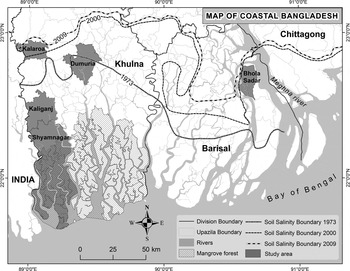
Within the southwest coastal region of Bangladesh, the upazilas (counties) of Shyamnagar (22.3306°N 89.1028°E), Kaliganj (22.4500°N 89.0417°E), Kalaroa (22.8750°N 89.0417°E), Dumuria (22.8083°N 89.4250°E) and Bhola Sadar (22.6903°N 90.6525°E) were selected as study areas (Fig. 1). After careful literature review and consultation with local experts, the individual sites were chosen on the basis of accessibility and as representative examples of the varieties of agriculture and/or aquaculture that are being followed throughout this region.
Location of the study areas and gradients of soil salinity (1973–2009) in the coastal zone of Bangladesh. The soil salinity contours represent the northern boundary of areas where soils may have salinity values of 2 dS m−1 or more (SRDI, 2012).

All the study areas are characterized by flat land and smooth relief created by the deposition of sediment from the Ganges–Brahmaputra–Meghna River tributaries (Rashid, Reference Rashid1991). The climate throughout is classified as tropical monsoon climate (Koppen, A m), characterized by a hot and rainy summer and a pronounced dry season in the cooler months (Kottek et al., Reference Kottek, Grieser, Beck, Rudolf and Rubel2006). Although all five study sites are in the same climatic region, farmers in Kalaroa, Dumuria and Bhola Sadar noted more frequent dry days during critical periods of rice production than did those in Shyamnagar and Kaliganj. In Bhola Sadar, however, farmers reported that they sometimes got excessive water during the critical rice transplanting and flowering stages. Among study areas Bhola Sadar is located on an evolving depositional island and is accessible from the mainland only by boat. Being isolated and unconnected to local physical and social infrastructure, agricultural practices remain more traditional and rely solely on the monsoon climate.
The salinity level is high in the soil and water in Shyamnagar. This is why conventional agriculture is difficult and why much of the area is devoted to the cultivation of shrimp. Farmers with large holdings began storing saline water in ghers for intensive shrimp (bagda) cultivation in agricultural land during the 1980s. The good economic return influenced other farmers to start shrimp farming in their lands and this became a widespread practice, now occupying 89% of the land available to the surveyed farmers. It is well known that shrimp cultivation affects the adjacent land's crops by leaching salinity, which diminishes crop production. Recently, however, farmers have begun cultivating some rice during and after the rainy season in upland areas and some vegetables and fruits in the homestead areas. The effect of salinity is less severe further inland in Kaliganj which is also an area of intensive bagda production. In that region, water salinity (5–10 dS m−1) is in the high category, but for the most part soil salinity is acceptable (SRDI, 2001). This is because in Kaliganj, farmers make use of fresh water from canals or ponds or from groundwater to supplement the rainwater so that any residual salts seeping into paddy fields from the surrounding ghers are diluted, thus reducing the brackishness of the water that supports the growing rice. As a result, the area is somewhat more suitable for rice, giving yields almost twice those in Shyamnagar, while the abundant marine water supply enables shrimp cultivation to be a continuing activity. With further seawater incursion around Kaliganj, however, the ability of the soil to resist salt accumulation is in question. In the rabi season, the homestead area is often used for growing rice as well as vegetables and varieties of fruits, both for personal consumption and for commercial purposes. Still further inland in Kalaroa, there is no bagda cultivation and rice is widely cultivated along with other crops such as jute, sugarcane and sesame, etc. In contrast to Shyamnagar and Kaliganj, farming in Kalaroa is in a position to follow a more diverse farming pattern. Dumuria has elevated salinity in its surface water, but its fields are enclosed by embankments to protect the land from tidal saline water, flood water and storm surges and so the soil is only moderately saline. By storing rainwater in the gher, thus diluting the surface water, an integrated agricultural system, including prawn, rice and a wide variety of vegetables has been developed. Like Kalaroa, in Bhola Sadar there is no bagda cultivation and rice is cultivated in sequence throughout the year. Pulses such as beans, lentils, groundnuts and mustard are other important components of the agricultural system.
Conceptual framework of the sustainability assessment
This sustainability research is based on the conceptual framework of vanLoon et al. (Reference vanLoon, Patil and Hugar2005). Recognizing that agriculture is a process of food and fiber production as well as a way of life, the framework divides agricultural sustainability into six categories: productivity, stability, efficiency, durability, compatibility and equity (vanLoon et al., Reference vanLoon, Patil and Hugar2005), which together reflect various dimensions of sustainability.
Productivity
Productivity of an agricultural system is related to yields measured in various ways. It is an essential component of agricultural sustainability in order to provide for individual farmers’ livelihood and to ensure food security for the wider population (vanLoon et al., Reference vanLoon, Patil and Hugar2005).
Stability
In crop production, it refers to the ability to maintain a good level of productivity over an extended period of time (vanLoon et al., Reference vanLoon, Patil and Hugar2005). It is generally not possible to measure stability directly in a predictive sense, but it can be estimated indirectly by examining the quality of the resources on which productivity depends. For example, to ensure stability, it is essential that the basic soil and water resources remain available in ample quantity and of good quality and temperature patterns remain undisturbed.
Efficiency
The processes of crop production require a range of inputs. Efficiency is the measure of the extent to which those inputs enhance crop production (vanLoon et al., Reference vanLoon, Patil and Hugar2005). Efficiency of agriculture can be measured by a variety of indicators. Indicators that are based on energy consumption during production provide a comprehensive picture of how effectively resources are used when producing crops. Likewise, efficiency can also be expressed in financial terms.
Durability
Durability can be defined as the ability of the agricultural system to resist or recover from stress, including biogeophysical and financial stress, and therefore maintain a good level of productivity over an annual cropping cycle (vanLoon et al., Reference vanLoon, Patil and Hugar2005).
Compatibility
In a broad sense, compatibility refers to the ability of an agricultural system to fit in with the biogeophysical, human and socio-cultural surroundings in which the system is placed (vanLoon et al., Reference vanLoon, Patil and Hugar2005). For the well-being of humans, agricultural activities are carried out in natural settings but at the same time, these activities can be a cause of environmental problems such as water contamination, loss of biodiversity, soil erosion or other types of destruction of a healthy ecosystem. Therefore, in a sustainable agricultural system it is expected that agricultural activities will cause no or minimal harm, providing widespread benefits for the well-being of both the human and the natural environment.
Equity
Agriculture should promote a good quality of life among the various individuals involved in farming activities and within families. All aspects of agricultural activities must come together to support farmers for an adequate and comfortable standard of living. And in addition, social welfare of the community within an agro-ecosystem is extremely important for the sustainability of agriculture itself (vanLoon et al., Reference vanLoon, Patil and Hugar2005). In this paper, social welfare is measured as ‘equity,’ using the term equity to signify a balanced distribution of the benefits of agriculture to all members of the community.
Selection of indicators
Having set out categories to be assessed, indicators were chosen. To assess agricultural sustainability various sets of indicators have been suggested (for example, OECD, 2001; Van Cauwenbergh et al., Reference Van Cauwenbergh, Biala, Bielders, Brouckaert, Franchois, Garcia Cidad and Peeters2007; Hayati et al., Reference Hayati, Ranjbar, Karami and Lichtfouse2011; FAO, 2012) but there is still scope to incorporate other sustainability indicators. Furthermore, particular indicators may not be applicable for all situations. In the coastal zone of Bangladesh, specific issues that must be addressed are the need for a variety of crops and aquaculture to provide adequate income and nutrition to individuals and the community. This must be done in the context of the setting with its unique geographical merits and stresses. Keeping this in mind, sets of indicators within the sustainability categories were identified, modified or sometimes developed afresh in order to achieve the desired goals of the investigation. The indicators list for each sustainability category can be found in Tables 1–6. Justifications for the selection of indicators are discussed below.
Keeping in mind the importance of rice as the principal agricultural crop throughout the area, two indicators that focus on rice were considered essential in productivity—the average yield (t ha−1) and the net income (US$/ha) for rice production. Clearly, there is overlap in the information embodied in these indicators, but in addition to yield, the second indicator also takes into account the important economic issue of cost in achieving a certain level of production. Three other productivity indicators were included to account for the variety of other agricultural and marine products produced within the total area available to farmers: net income (US$/ha), protein yield (kg ha−1) and energy yield (J ha−1), considering all products from the entire agro-ecosystem.
A number of soil and water chemical and physical properties were considered as part of the stability indicator. To assign a value for each indicator, the measured values (for land types on the basis of elevation, soil salinity and soil micronutrients) were converted into values based on semi-quantitative scales developed by the Soil Resource Development Institute of Bangladesh (SRDI; the semi-quantitative scales are described in Bangla, the local language, in documents available through the following website: http://www.srdi.gov.bd/). Among these properties, as stability indicators, soil and water salinity are of greatest importance in the coastal region as they play an essential role in determining agricultural practices over a period of time.
In the case of efficiency indicators every physical component of agricultural production, both inputs and outputs, can be expressed in energy terms. The available data concerning the caloric content of crops and aquatic resources were used for calculating the output energy of the total harvest of rice and other products. For inputs, the energy values of seeds, fertilizers, pesticides, fish food, diesel, bullock labor, power tiller and human labor were calculated by multiplying the quantity of input times the energy equivalent of each input. The energy efficiencies of rice and agro-ecosystems were then determined as the ratio of energy produced to energy required for production. In analogous fashion, efficiency was calculated in monetary terms.
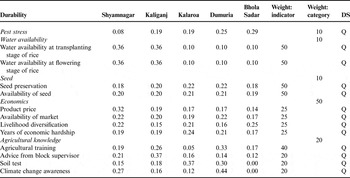
To measure durability, indicators that examine the ability of agricultural management to cope with pests, water and economic stresses were selected. In cultivating rice, water requirements are key factors, and having water available is especially important during the transplanting and flower stages. On the economic front, market accessibility, both in terms of procuring of inputs and in selling products at a good price, was an important durability issue.
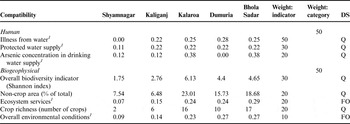
Of the many issues that could be considered as compatibility indicators, our data have provided information on two subjects: biodiversity of cropping and of the surroundings, and water quality. Biodiversity was measured by standard indices (including crop richness and the Shannon index) and the water quality was assessed by measured arsenic concentrations and through indirect measures of the impact of water on human health.
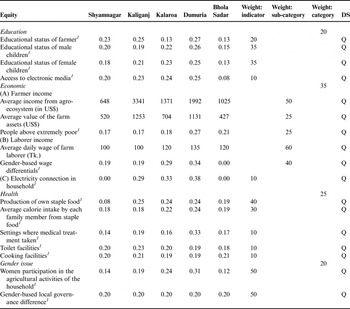
There are many issues to assess in examining equity in an agro-ecosystem. To provide a comprehensive overview, four sets of simple equity indicators were considered under the general headings of education, economic conditions, health and decision-making. Within each of these headings, several standard indicators were assessed.
Methods of indicator data collection
Data were collected in 2011–2012 from both primary and secondary sources to develop values of indicators. To collect primary data, a questionnaire was designed, a small team was selected and trained for data collection, and the questionnaire was pretested and modified appropriately. The questionnaire sought information about the farmer (education, family members and health), crop production (input and output, production costs and value), source and availability of resources, and social issues related to the family and community. The farmers were the source of primary data. Landless (<0.004 ha), marginal (0.004–0.20 ha), small (0.20–1.0 ha), medium (1.0–2.0 ha) and large farm (>2.0 ha) farmers (Bangladesh Bureau of Statistics, 2008) were chosen for primary data collection. Ensuring at least four farmers from each size class, a total of 45, 60, 29, 22 and 26 households were surveyed from Shyamnagar, Kaliganj, Kalaroa, Dumuria and Bhola Sadar, respectively. Stratified purposeful sampling was applied during the household questionnaire survey since all the farmers are practicing almost the same type of agricultural systems. In addition, survey data were checked via informal discussions with 20 key informants (15 government officials of agricultural extension, fisheries and livestock, and five experienced farmers). Key informants were selected based on agricultural knowledge and experience. Five focus group discussions (FGDs) were also carried out, one at each site. The household questionnaire was used as a checklist in conducting the FGDs but different issues were also discussed. The FGDs took place over 1.5–2 h at farm sites, at farmers’ homesteads and in community settings. In totality, approximately 120 participants attended five FGDs. Audio recordings of the FGDs were made. During FGDs, the participants were encouraged to discuss and even argue among themselves in order to reach a consensus on an issue. The main limitation of FGDs was dominance by one individual which may have influenced other participants and this required some care to see that all opinions were heard; taking this into account, we found no serious discrepancies between information obtained in the survey and that expressed in the group discussions. Various documents of the local and national governments and Non-Governmental Organizations (NGOs) were consulted as sources of secondary data.
In the tables of results, indications of data sources are given as follows: Q – from farmers’ questionnaire and GD – from government documents (source will be noted). The data collected through questionnaire survey and government documents were validated by information collected through field observation, key informants, FGDs and government officials.
Aggregation of data to assess sustainability
In order to assess the level of sustainability, the indicator values from the five areas were aggregated using Multi-Criteria Decision Analysis (MCDA). MCDA is a set of procedures by which multiple criteria can be formally incorporated into a management planning process (Mustajoki et al., Reference Mustajoki, Hämäläinen and Marttunen2004; Peng and Shi, Reference Peng and Shi2012). MCDA is relatively new to the analysis and measurement of agricultural sustainability, and only a few studies have applied this technique to measure the level of sustainability of agriculture at the local level (Blanquart, Reference Blanquart2009).
The MCDA was carried out using web-based Web-HIPRE (Hierarchical PREference Analysis) software (Hämäläinen and Lauri, Reference Hämäläinen and Lauri1992) which is capable of considering a large collection of criteria and producing comparisons for different situations. The Multi-Attribute Value Theory (MAVT) approach of Web-HIPRE was used to analyze and compute an overall score for each category. In MAVT the alternatives are evaluated with respect to each attribute and the attributes are weighted according to their relative importance (Mustajoki et al., Reference Mustajoki, Hämäläinen and Marttunen2004).
The indicator values were determined and then normalized in the following way: the values were summed and each individual site value was divided by the sum, giving results on a 0–1 scale which are reported in the tables.
In MCDA there is a scope to assign weighting to the indicators or attributes. This is to take into account the relative importance of each of the measured attributes of sustainability. In Web-HIPRE, weight attributes can be elicited by different procedures; in the present study, the direct weighting procedure was used. To assign weighting values, multiple judgment methods were employed based on information from experts, key informants and farmers who were asked to give their opinions regarding the relative importance of the categories and indicators. The average opinion was taken into account in assigning the weighting.
The weightings were set using a 0–100 scale. It is important that the weighting values be documented as they play an important part in determining the overall sustainability value.
To generate a cardinal value for the selected categories, the effects (indicator values and weighting) of all attributes are aggregated. This is done under the standard additive aggregation rule for which attributes were assumed to exhibit mutually preferential independence. An additive value function can be used to aggregate the component values, assuming mutually preferentially independent attributes (Mustajoki et al., Reference Mustajoki, Hämäläinen and Marttunen2004). The overall value of the alternative ‘x’ is given by
 $$\matrix{ {v\left( x \right) = \sum\limits_{i = 1}^n {w_i v_i \left( x \right)}} & \cr} $$
where n = the number of attributes; wi = the weight of attribute i ; and vi (x) = the rating of an alternative x with respect to an attribute i .
The sum of the weights is normalized to one, and the component value function v i (·) attains a value between 0 and 1. The weight w i indicates the relative importance of a particular attribute i changing from its worst level to its best level (Mustajoki et al., Reference Mustajoki, Hämäläinen and Marttunen2004). The relative spacing between the levels of the attribute reflects the strength of preference of one level compared with another (Hostmann et al., Reference Hostmann, Bernauer, Mosler, Reichert and Truffer2005). The normalized results were then weighted. Incorporating the indicator data and assigned weightings into the MCDA, it was possible to determine the relative sustainability level within each of the categories. After MCDA analysis, scores of the categories were compared among study areas and finally an overall level of sustainability for each study area was generated.
Result: Sustainability within Categories
Productivity
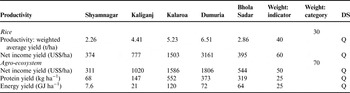
Among the five study areas, yields of rice were best during the winter (Boro) season. The weighted average yield, considering land used in all seasons, was found to be highest in the integrated agricultural system in Dumuria at 6.51 t ha−1 (Table 1). This high yield is considerably above the Bangladesh average (2.8 t ha−1) and can be attributed in part to the abundant supply of low-salinity water during the rice cultivation period. The water brought in by the tributaries of the Ganga carries with it large quantities of nutrient-rich sediment, some of which is deposited in the area. This sediment-rich soil is supplemented by rainwater stored in ghers that are protected from the surrounding salt water in the dry season by embankments which were built during the 1970s. Waste, associated with galda prawn (Macrobrachium rosenbergii) cultivation in the ghers prior to planting rice or other field crops, further provides a significant amount of organic matter and soil nutrients (Barmon et al., Reference Barmon, Kondo and Osanami2007).
Productivity indicators.

Note: There is overlap in what is measured in each of these indicators since all of them depend on the yield of various commodities, but no single indicator is able to account for the diverse contributions of the various products. Assigning a weight to each indicator was then done in a way that considers the connections. For example, because rice yield influences all five indicators in this category, the yield of rice was assigned a lower weighting than if it had been the single indicator used to describe productivity alone.
DS, Data source; Q, Questionnaire.
In contrast to the situation in Dumuria, the rice yield (2.28 t ha−1) is lowest in the bagda shrimp (Penauus monodon)-dominated agricultural system of Shyamnagar. In this area, ghers for salt-water shrimp cultivation are separated from paddy fields, but prolonged shrimp farming increases the salinity of the adjacent field as noted above (Ali, Reference Ali2006). According to the local respondents, the low yield of rice in Shyamnagar is also due to lingering impacts of Aila, a Category 1 cyclone that devastated the southwestern coastal region of Bangladesh on May 25, 2009 (Kumar et al., Reference Kumar, Baten, Masud, Osman and Rahman2010). Farmers stated that the tidal surge associated with the cyclone caused massive water logging by salt water, and had a major impact on the soil and its associated agro-ecosystem, affecting rice cultivation up to the present time. The yield of rice at 2.86 t ha−1 in Bhola Sadar was also relatively low, but about the same as the 2.8 t ha−1 national average of Bangladesh in the same year. While this is an area of yearly deposition of fresh sediment, the farming systems are basically subsistence in nature. Without a readily available source of fertilizers, the rice is cultivated under input-starved conditions. Kalaroa (5.25 t ha−1) and Kaliganj (4.41 t ha−1) experience a good yield of rice every year because of improved farming methods and irrigation facilities.
A number of factors affect the income generated from rice production. In most of the study areas, at the time of data collection, the price per kg varied between US$0.25 and 0.30. The marketing chain is very fragmented in Bhola Sadar and for this reason the farmers get a lower price (US$0.18 kg−1) for their rice compared with the other three areas. The net income from rice is very high in Dumuria, however, because wholesalers purchase there and send the rice to commission agents in the very accessible urban wholesale markets of major centers such as Khulna and Dhaka. The majority of the rice is sold to the processing industry (e.g., rice mills) in that area, and the remainder is traded in the local market at a higher price. Rice millers are a major market player with strong influence on paddy purchasing and rice processing. Some rice is sold to processors, including to the rice mill in that area, and the rest is traded in the local market at a higher price. In the rice marketing system, the rice millers are the most significant members and they play a vital role in paddy purchasing and processing.
Combining the crops and aquatic (shrimp/prawn and other fish) production, the highest net income from the entire agro-ecosystem was found in Dumuria because of good paddy production as well as a variety of vegetables. On the other hand, in terms of protein and energy yield the performance of Kalaroa with its diversified cropping system (including other grains, pulses, vegetables and fruits in addition to highly productive rice) is the highest of all study areas. The general productivity of all crops and aquatic products is low in Kaliganj and especially in Shyamnagar, and this is reflected in the economic, protein and energy indicators as well. The production of shrimp (bagda) was 150 kg ha−1 and 393 kg ha−1 in Shyamnagar and Kaligani, whereas prawn (galda) production was 245 kg ha−1 in Dumuria. Additional production of fish and other seafood, however, increases the income in the study areas. Compared with farmers in Shyamanagar and Kaliganj, those in Dumuria get a better price for their aquatic resources because of its location near the divisional city as well as an efficient and available transportation and marketing system.
Stability
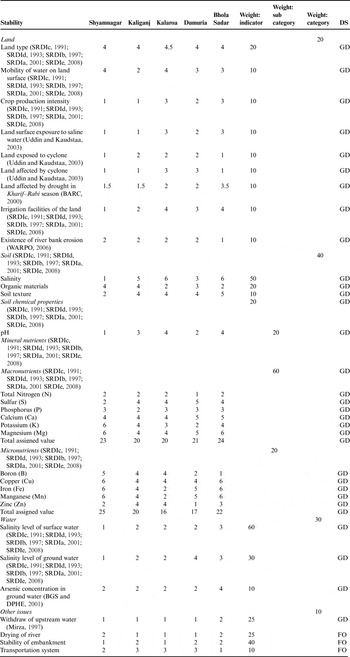
Because salinity is a key factor in limiting production of many crops, it was given a relatively large weighting in the assessment. Salinity in both soil and water is high in Shyamnagar (Table 2) throughout the year, but water salinity was very high (30–38 dS m−1) especially during the dry season, making it difficult to raise shrimp. In all the other areas, values were lower. The salinity level of the soil was also reported to be very high (30 dS m−1) in Shyamnagar compared with values in the other sites (SRDI, 2009). In terms of stability as a measure of future productivity, changing salinity is a key factor. Trends over the past 36 years show that the soil salinity is expanding from the area adjacent to the open sea in the south to include areas further to the north (Fig. 1). The Bangladesh Salinity Research Institute estimated that there were 750,380 ha of salinity-affected land in 1973 and this had increased to 950,780 ha in 2009 (SRDI, 2009).
Stability indicators.

Note: For each parameter, the measured values were converted into the values shown based on semi-quantitative scales developed by Soil Resource Development Institute (SRDI) of Bangladesh.
DS, Data source; FO, Field observation; GD, Government documents.
The stability of agriculture in the study areas depends not only on levels of salinity but also on other factors, in large part outside the ability of other farmers to control, including withdrawal of upstream water, stability of embankments, changing climate and the transportation system. Salinity levels are regularly checked by government extension workers, and farmers are aware of the rising levels in Shyamnagar and Kaliganj. Among other factors, the large withdrawals of water at the Farakka Barrage in India in the past several decades have meant that there is insufficient freshwater to dilute the effects of saline water from the tides during the dry season (November–March). Due to their greater distance from the sea, Kalaroa and Dumuria are less affected by this problem. In Bhola Sadar, the effects of withdrawal of upstream water are minimal due to being located where there are heavy yearly flows from the Jamuna/Padma/Meghna system. Another important stability indicator is the extent and quality of embankments. These structures protect agriculture from the effects of frequent cyclones and the resulting storm surges. Field observation revealed that embankments are poorly managed in Shyamnagar, moderately well managed in Kaligonj and Kalaroa, and well managed in Dumuria and Bhola Sadar.
Among the study areas, Shyamnagar, Kaliganj and Bhola Sadar are exposed to the sea and are most susceptible to cyclone events. As a result, these three areas are occasionally affected by extreme wind and rain, storm surges and tidal salt water. Kalaroa and Dumuria are less exposed to open water, protected as they are by adjacent lands; still, due to their location in the coastal area, they too can be affected by storm activity. Taking these and other factors related to properties of land, soil and water together, stability of the agricultural production system was assessed to be measurably poorer in Shyamnagar compared with the other four areas.
Efficiency
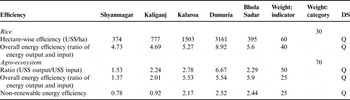
The energy efficiency for rice production (Table 3) in Dumuria is better than in other areas, largely on account of good productivity in comparison with inputs used. Among all study areas the energy efficiency ratio for rice production is poorest in Shyamnagar and Kaliganj with output/input being 1.8, while the largest ratio (output/input = 3.4) was obtained in Dumuria. However, even this best ratio lags behind energy gains for production of grain crops around the world, where ratio values of 8 or higher have been achieved (Hülsbergen et al., Reference Hülsbergen, Feil, Biermann, Rathke, Kalk and Diepenbrock2001). Of all the inputs, chemical fertilizers and pesticides make up the greatest share (68–84%) of total energy at the various sites. Diesel for irrigation is also a significant component of the non-renewable energy sources except in Shyamnagar and Bhola Sadar, where farmers depend largely on rain, stored rainwater and surface water for irrigation purposes. Renewable energy sources include human and bullock labor. Human energy ranged between 76 and 114 person days ha−1 to produce and harvest a crop of rice.
Efficiency indicators.

DS, Data source; Q, Questionnaire.
As a second measure of efficiency, energy balance (taking into account embodied energy in renewable inputs, fuel and fertilizer, as well as human labor) for all crops and aquatic products in the agro-ecosystem was calculated. Measured in this way, Kalaroa, Dumuria and Bhola Sadar show very similar efficiency ratios of 2.1 ± 0.1. This was considerably higher than the ratios for Shyamnagar (0.57) and Kaliganja (0.78); the low values reflect the greater energy intensity of inputs for producing shrimp and other aquatic products. It is interesting, however, that human labor intensity per hectare in aquatic areas is about half that of land-based crops. In shrimp cultivation, human labor is limited to gher preparation, for security of the gher and during shrimp harvesting time, whereas in diversified agriculture human labor is used throughout the cropping season for land preparation, sowing crops, pest and weed management, and harvesting.
Using the ratio of monetary value of product outputs over cost of inputs, Dumuria stood out, having a ratio of 6.67. This was in part due to high productivity of rice and good prices gained, but also to the relatively small amounts of fertilizer used to achieve this gain. The very low ratio for Shyamnagar reflects the large money expenditures required for labor in gher preparation, chemicals, breeding stock and so forth in shrimp production that give only limited gain to the farmers. In large part, the decline in production and profitability is due to the White Spot Shrimp Virus (WSSV) which has devastated the shrimp population throughout parts of the southwestern coastal region since 2001 (Alam, Reference Alam2007). Frequent storms and occasional cyclones are a further challenge of maintaining ghers in this part of the exposed coast.
Durability
In terms of response to pest infestations within both land and aquatic systems, the highest durability was evidenced in Bhola Sadar, where 65% of farmers grow crops without resorting to chemical pesticide applications (Table 4). In Shyamnagar, not surprisingly, the vast majority of shrimp farmers resorted to such pesticides, especially to control the WSSV that has become common after the cyclone Aila event in 2009. After Aila, however, some issues such as improved availability of seed due to government support and better climate awareness, along with a continuing strong shrimp market, have all supported a good durability score in Shyamnagar. Many farmers in the agriculturally diverse areas of Dumuria, Kalaroa and Kaliganj spoke of the value of using an integrated pest management system in growing rice, vegetables and fish. Where chemicals are employed to control insects when growing rice, extensive spraying may be required. During the FGDs, the farmers of the study areas reported that on average, spraying three times is required during a single rice season. This means that in places where three crops are grown in a year, pesticide use can be extensive.
Durability indicators.

Note: All values in this table were obtained from the questionnaire using diverse scales, normalized to a scale of 0–1.
DS, Data source; Q, Questionnaire.
In the case of durability issues, the remotely situated Bhola Sadar faced the greatest financial challenge. As a result, farmers there reported the largest number of years when their income fell below a critical level, while the strategically placed Kalaroa and Dumuria faced the least stress.
The ability to cope with stress is strengthened when farmers have access to good sources of information and advice through training or opportunities to speak to knowledgeable persons. Among the study areas, the score for agricultural knowledge was found to be quite variable and was highest in Dumuria, where 23% of farmers have received agricultural training provided by the upazila agricultural office. Educational status of farmers in Kalaroa was relatively poor (Table 6) and this may explain in part why this was the area where the lowest percentage (3%) of farmers received agricultural training. Some farmers in Kaliganj and Shyamnagar received training concerning how to grow crops in salinity-affected fields. Across most of the study area, only between 4 and 12% of farmers take advice for agricultural activities from a block supervisor, a government employee who promotes agricultural extension in villages. Seeking advice from this official is not very common; instead most farmers rely on improving their agriculture by trial and error methods or by taking suggestions from fellow farmers. Only very few respondents, 18%, received training on climate change awareness and adaptation of agriculture. In the case of Bhola Sadar, no farmer had any kind of climate awareness training, which is surprising given that it is located in a very vulnerable part of the coast. Unlike the other sites, many respondents in Kalaroa and Dumuria indicated that they regularly submit their soils for testing and follow the advice provided as a result of the test. No farmer from Bhola Sadar did any soil testing prior to engaging in agriculture.
Compatibility
Most areas provide a protected water supply for drinking purposes. Shyamnagar is an exception to this, and it is not surprising that water-related illnesses are more significant at that site than at any other; people there use open pond water for domestic and, in some cases, drinking purposes. Arsenic (As) contamination is another problem in many parts of Bangladesh. In the study area, the Dumuria water supply gave evidence of frequent high levels of As, and there are limited problems in both Shyamnagar and Kalaroa as well (Table 5).
Compatibility indicators.

1 Values obtained from the questionnaire using diverse scales, normalized to a scale of 0–1.
DS, Data source; Q, Questionnaire; FO, Field observation.
On all counts, Kalaroa, Dumuria and Bhola Sadar were seen to be areas of more diverse cropping and where a substantially greater natural bioenvironmental setting had been maintained than in either Kaliganj or Shyamnagar. In both the latter places, the landscape has been modified severely and is reduced almost exclusively to either paddy fields or shrimp ghers. Crop richness is highest in Bhola Sadar and lowest in Shyamnagar. In Bhola Sadar, Kalaroa, Dumuria and Kaligonj, farmers are growing 17, 16, 10 and 6 types of crops in a year, respectively, while in Shyamnagar only rice and shrimp are cultivated. Field observations of ecosystem services followed the pattern of Foley et al. (Reference Foley, Defries, Asner, Barford, Bonan, Carpenter and Snyder2005). An aggregate indicator gave the highest score to Bhola Sadar and very good scores to Dumuria and Kalaroa but rated Kaliganj and Shyamnagar poorly. The farmer-respondents also acknowledged that the overall environmental condition is poor in Shyamnagar and Kaliganj. In these two areas, during shrimp fry collection from the river estuary the transporting and sorting process results in a very large wastage of fry of both penaeid shrimps and other commercially important species, including fish. During the field visit it was observed that when the fry collectors use mosquito nets to catch shrimp fry, many other species of fry are killed in the process. Later when the shrimp fry are separated, the other species are simply discarded. This has become a serious biodiversity concern for the water bodies in Shyamnagar and Kaliganj. In almost every case, according to the local fishermen, there are only a limited variety and number of fish in the river. Many farmers also noted that due to bagda shrimp cultivation, crop diversification has been severely undermined because it is no longer possible to grow non-rice crops due to the increased salinity of water and soil. In some places even rice, which has some tolerance to salinity, cannot be grown. According to the farmers and the upazila officer, the overall environmental conditions of Shyamnagar became worse after the 2009 cyclone.
Equity
The value for education was found to be highest in Dumuria, where the farmers’ educational status as well as that of both their male and female children's education was good in comparison with other areas (Table 6). The lowest indicator value for education was in Bhola Sadar, where 50% of respondents are illiterate, and children's education is not well developed. Bhola Sadar has been deprived of educational facilities in part due to its isolated geographical location, and in spite of recent government initiatives, the percentage of illiterate male (12.8%) and female children (9.1%) remains high in this area. Note the surprising feature that the percentage of illiterate male children is slightly greater than that of female children. The same feature was observed in Kalaroa. It was found that many children of landless and marginal farmers are illiterate because families engaged them in economic activities such as agricultural activities and also in selling of agricultural products in the rural market. Except in Bhola Sadar, the percentage of illiterate children in the other areas was always <7% and in Dumuria there are no illiterate children. In general, it was found that the respondents are strongly supportive of children's education because of awareness created by the government, media and NGOs. The government of Bangladesh has an active policy and plans to promote education among children as part of achieving one of the Millennium Development Goals.
Equity indicators.

1 Values obtained from the questionnaire using diverse scales, normalized to a scale of 0–1; US$1 = Tk. 75.
DS, Data source; Q, Questionnaire.
Economics-related issues in the study areas were measured using both direct and indirect ways. As a simple measure of provision of physical services, the availability of electric power was assessed. Dumuria, which is close to the Khulna district headquarters, had the best provision of electrical power. There is no public electricity supply in Bhola Sadar or Shyamnagar, and kerosene and other fuels are used for lighting and cooking. It is significant that in Shyamnagar a number of farmers are generating some electricity using solar panels. Access to electronic media was good through most of the coastal area.
Even where electricity connections are good as in Kaliganj, Kalaroa and Dumuria, many farmers complained of not receiving a continuous supply. There was a frequently held opinion that having electricity helps to generate income (water pumps for irrigation), aids education and provides better health facilities. The variable extent of household connections to electricity is clear evidence of regional differences of economic development, as well as variations depending on farm size and income.
The yearly average agricultural income of farmers is highest in Kaliganj, a feature also mirrored in the value of farm assets. This is in large part because average land holding of respondents is greatest there. But also, both rice and bagda shrimp are the main crops of this area and Kalinganj has been spared much of the WSSV disruption of shrimp ghers that was endemic in regions further south. The other three areas all had moderately good average incomes, with the variety of agricultural and aquatic products providing multiple sources of income. On a per hectare basis, the average income was in the order Dumuria > Kalaroa > Kaliganj > Bhola Sadar > Shyamnagar as noted in the Efficiency category above. Considering size of land holdings, incomes vary considerably; a landless farmer earns less than US$100 per year in Shyamnagar and Kaliganj, whereas incomes of large-landholding farmers vary from US$3433 in Bhola Sadar to US$13,490 in Kaliganj. It is clear that sufficient land is a prerequisite for a good annual income.
In terms of personal assets, many small, medium and large farmers own a television (TV) set, and one or more bicycles, along with agricultural equipment such as a water pump and a power tiller. Some large and medium landholding families have a refrigerator as well. In contrast, most of the landless and marginal farmers throughout the study areas had few of these assets. One surprising thing, however, was that almost every farm family has a mobile phone. Farm assets are somewhat limited in both Bhola Sadar and Shyamnagar although in Shyamnagar some medium and large farmers have TV and other electronic goods. Some small and marginal farmers informed us that they had owned a TV before the 2009 cyclone, but they lost most of their assets in that event.
The average wage of a farm laborer is highest in Dumuria, where there is a demand for labor all year round due to the wide diversity of agricultural activities there. In Shyamnagar and Kaliganj, laborers are required only at the time of preparation of the ghers, an activity that typically requires about 8 weeks each year. In Kaliganj and Shyamnagar, female laborers work alongside male laborers in rice fields and ghers. Due to the conservative nature of society in the case of Bhola, female laborers are not allowed to work in the fields. Therefore, there is a shortage of laborers and wages are relatively high. The gender-based wage differential is significant throughout the five upazilas, with women making between US$0.67 and 1.06 per day compared with men who make US$2.00–2.13. Because most laborers would be employed for between 90 and 240 days per year, the total annual income from agriculture is often low.
In the case of health, the overall score was relatively good in Dumuria, Kalaroa and Kaliganj and significantly poorer in the other two places. Most small, middle and large farmers were able to produce sufficient staple food on their own farm in these areas and in Bhola Sadar. Almost every landless farmer is, of course, required to access rice from the market unless their wages are paid in part with rice itself. Many marginal and some small farmers also buy staple foods from the market. Because only a single crop can be grown each year and the yield is usually relatively poor, most households in Shyamnagar must also supplement their own supply from the market. The per person average calorie intake per day was calculated on the basis of rice intake ranged from 1540 kcal in Shyamnagar to 2060 kcal in Dumuria. In 2008, the Bangladesh Institute of Development Studies found that the mean total food energy considering all ages of males and females was approximately 1900 kcal per day. In this respect, the energy intake from the staple food (rice) is likely above the national average in Dumuria, Kalaroa and Bhola Sadar. Nevertheless, these energy values indicate that even in the more productive areas, there could be a substandard level of nutrition in many households depending on the landholding size and the composition of the family. Clearly there are other aspects of nutrition which are required for good health as well.
Respondents in all study areas obtain medical treatment from a variety of health providers, such as upazila hospitals or clinics, union health centers, pharmacies or minimally trained village doctors or kabirazes (traditional/herbal healers who have a longstanding involvement in rural communities). Most of the respondents from Dumuria reported that they have convenient access to health care facilities because they are near a large urban area. As expected, access to good facilities is lowest in Shyamnagar and Bhola Sadar. A large number of respondents of Shyamnagar, Kaliganj, Kalaroa and Bhola Sadar take treatment from the local pharmacy and village doctors. As in Dumuria, many respondents of Kaliganj and Kalaroa also have convenient access to upazila health offices, but in Bhola Sadar, a very small number of respondents go there for treatment. Throughout the study areas, large and medium farmers prefer to visit upazila health offices or clinics, whereas landless to small farmers more frequently choose the local pharmacy, village doctors or a kabiraz for treatment.
Sanitation is an important public health concern. Most homes had their own toilets and these were classified as either pucca (a solid structure constructed of concrete) or semi-pucca (partial wood or corrugated steel). Compared with many other low-income countries, these household toilets are quite good, again due to government initiatives as part of achieving one of the Millennium Development Goals. In the five study areas, usage of open toilets by respondents was limited to one household in Shyamnagar and two in Bhola Sadar, all three being landless farmers. Importantly, almost every respondent expressed that they use soap and water after returning from the toilet as part of hygienic practices.
As another measure of equity in health terms, cooking facilities were measured, with the highest value given to liquefied petroleum gas (LPG) and the lowest value to firewood and other biomass types. Where various forms of biomass are used for cooking, women and children are exposed to smoke and this may have serious health impacts in the future. Firewood, leaves and agricultural waste, including dried cow dung were the main sources of household energy for cooking in every part of the study area. Because of this, the indicator value of cooking facilities tends to be low throughout. Furthermore, because a lot of agricultural waste is used for cooking, the fields are deprived of natural manures for use as soil enrichment. It was found that the maximum use of such secondary material occurred in Kalaroa. Among respondents in Kaliganj only, a small number (6%) of respondents use LPG as cooking fuel.
The participation of women in the work force and in political life within the community was also measured. The workforce score was highest in Dumuria. There, the women participate in a wide range of household agricultural activities such as sun-drying the crops, seed preservation, vegetable gardening, feeding shrimp/fish and preparing fish feed, working in the field, animal nursing, raising chickens and ducks as well as other general agricultural work. Women in Kaliganj and Kalaroa also actively participate in household agricultural activities. Participation is much less in Shyamnagar and Bhola Sadar due to the emphasis on shrimp cultivation in Shyamnagar and to the conservative society in Bhola Sadar. In these two study areas, women have less opportunity to be involved in agricultural activities. However, some women grow vegetables for family consumption in the homestead area. Shrimp are often sold from the gher directly to the trader or brought to a market in a nearby town, so women have fewer chances to work on agricultural activities. In general, apart from agricultural activities, women of the study areas are also involved in other household work such as cooking, washing clothes and dishes, cleaning household and yard, collecting fuel and drinking water, sewing and mending clothes, nursing the sick and child care.
Women's participation at the local government level is crucial, enabling them to have a voice in decision-making on issues that affect the community. As a result of a 1997 law, the government of Bangladesh ensures women's participation in the Union Parishad (Union Council), which is the smallest rural administrative and local government unit in the country. Each Union Parishad has nine constituencies and one chairperson position open for competition by both men and women. In addition, each block of three constituencies has one reserved seat for directly elected women. Thus the reserved ratio is three reserved seats for women for every nine non-reserved seats or 25%. Among the study areas, however, it was found that not more than the minimum 25% representatives within the Union Parishad are women.
Discussion
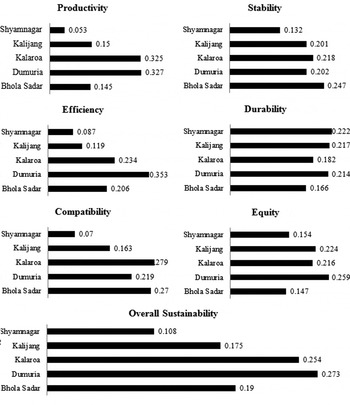
Aggregating the overall scores of all categories and their respective weightings, MCDA analysis shows that the relative performance of agriculture in terms of agricultural sustainability is highest in Dumuria (Fig. 2). Among the six categories, the scores for productivity, efficiency and equity are highest at that site, and its scores in the other three categories are also good. In this respect, it is worthwhile mentioning that, during the field visit, almost every farmer in Dumuria expressed satisfaction regarding their present agricultural practices.
Relative sustainability levels of the study areas, assessed within six categories.

On the other hand, as expected based on field observations, the lowest score for agricultural sustainability is observed in Shyamnagar. Both farmers and upazila officials are concerned about the agricultural sustainability of the area. Productivity of both shrimp and rice is very poor. Repeated bagda cultivation is hampered by recurring disease and occasionally by cyclones; furthermore, the production of rice is limited due to the impacts of salinity. While saline water intrusion is a naturally occurring phenomenon even in the absence of shrimp culture, massive shrimp cultivation has clearly had an additional impact in destroying the natural setting for crop production and affecting the scores for compatibility and efficiency. It is noteworthy that in the past several years, the government and a number of NGOs have been promoting the reclamation of abandoned shrimp ghers in areas of relatively high elevation, and the return of these areas to ecological rice production.
Kaliganj scores better in terms of almost all categories compared with Shyamnagar. Being situated about 80 km to the north, it is somewhat less exposed to cyclones and salt-water incursions, so productivity and associated benefits remain quite good in the area. Nevertheless, farmers expressed concerns about the emerging shrimp virus problem and negative effects of shrimp cultivation on the traditionally more diverse agro-ecology system. Some farmers opined that they were considering adjusting their agriculture practices to be more like those of Dumuria.
In the overall score, Kalaroa scored second highest after Dumuria. Farmers in Kalaroa follow traditional cropping patterns and methods, modified to some degree by improved irrigation and pest management. Shrimp cultivation occupies a much smaller fraction of the land and its impacts on agro-biodiversity are limited.
As has been noted, Bhola Sadar is in an area that is subject to frequent cyclones and is isolated from the mainland. Largely unmodified traditional farming practices are still followed, maintaining comparatively rich agro-biodiversity. Stability is high due to excellent soil quality, availability of fresh water and efficient drainage. Some farmers are aware of integrated rice, fish and vegetable systems and are interested in adopting some of the newer methods, but they are not sure about the success of these systems as the physical environment of this area is different from that of the other study areas.
In calculating overall sustainability, categories were weighted as 30, 20, 15, 10, 10 and 15 for productivity, stability, efficiency, durability, compatibility and equity, respectively. The weighting for indicators and sub-indicators is found in Tables 1–6.
The scores for individual categories indicate the relative ranking of sustainability for the five agricultural systems, and good scores in certain areas suggest opportunities for wider adoption of sustainable practices in other parts of the coastal region. Most particularly, the aggregated high score of the categories in Dumuria suggests that many sustainability principles are observed in management of the prawn–rice–vegetable-based integrated agricultural systems. Farmers there have the potential to be good trainers for implementing some aspects of their system in other parts of the coastal region, especially in shrimp-intensive areas. There are limitations in the opportunities to make changes, however, because of the different and significant biogeographical characteristics in each part of the coastal region.
It is important to note that the methodology provided here provides a relative assessment limited to the study area. In some categories, it is possible to make comparisons with what has been achieved elsewhere, and this indicates that there are further possibilities for improvement. In particular, there is a need to improve energy efficiency in all areas and also productivity gains are still possible. Other categories are more site-specific, but clearly there is a need to ensure the continuing quality of water and soil resources and to maintain and enhance the diversity of crops and surrounding vegetation throughout the entire coastal region.
To assess and draw a broad picture of agricultural sustainability, a major challenge of the study was selecting appropriate indicators for each category and identifying and obtaining appropriate primary and secondary data for those indicators. During the field survey, some respondents appeared to be reluctant to interact freely with the investigators, and some participants in FGDs did not contribute actively. Within these limitations, it was still possible to obtain a good body of data from the random samples, focus groups, discussions with experts and government documents.
There have been numerous other approaches for assessing agricultural sustainability, most making use of indicators and often assigning the indicators to different categories (OECD, 2001; Walker, Reference Walker2002). Although there are differences in each of the proposed assessments, there are also many commonalities, with soil and water properties, use of chemicals, biodiversity and economic resilience being measured in various ways. Unlike some studies, the present work considers productivity to be of prime importance and is therefore part of the overall sustainability assessment; efficiency in resource use is measured, and social issues are considered an important aspect of sustainability in the village setting (vanLoon et al., Reference vanLoon, Patil and Hugar2005).
Furthermore, among the various comprehensive studies (Van Der Werf and Petit, Reference Van Der Werf and Petit2002; Van Cauwenbergh et al., Reference Van Cauwenbergh, Biala, Bielders, Brouckaert, Franchois, Garcia Cidad and Peeters2007; Bockstaller et al., Reference Bockstaller, Guichard, Makowski, Aveline, Girardin and Plantureux2009; Sadok et al., Reference Sadok, Angevin, Bergez, Bockstaller, Colomb, Guichard and Doré2009), only a few have dealt with the issue of aggregating diverse data. Dantsis et al. (Reference Dantsis, Douma, Giourga, Loumou and Polychronaki2010) proposed a MCDA-based methodological framework for assessing and comparing the sustainability of agriculture on a regional scale in Greece, using easily obtained indicators through an empirical study and utilizing questionnaires completed during interviews with farm managers. Their study bears some resemblance to the present study in terms of data collection through a questionnaire survey, data structuring using MUVT, and data analysis by utilizing a web-based MCDA technique (web-HIPRE). They used 21 indicators based on three pillars of sustainability (environment, economy and society). The final level of sustainability of different agricultural systems was generated by assigning weights and then aggregating the results within the categories using MCDA. While our approach follows a similar pattern, by subdividing sustainability into six categories it becomes possible to examine more closely and specifically where there are particular strengths and weaknesses in each situation. The overall score is of interest in itself but, more importantly, it directs those assessing sustainability to investigate further down through categories and to the indicators themselves.
While there has been considerable work directed toward the challenges faced in coastal agriculture in Bangladesh, there has been no systematic and comprehensive sustainability assessment. An effective management plan to mitigate negative sustainability issues has become urgent. Islam and Haque (Reference Islam and Haque2004) argued for the importance of using research findings in formulating and implementing new management approaches for coastal management. Socially equitable, ecologically and biotechnically sound shrimp cultivation is required in Bangladesh. Although researchers have addressed the issue of agricultural sustainability, they have not attempted to provide a quantitative or semi-quantitative measure of sustainability. In this respect, the present study is unique in that it is the first attempt to measure sustainability of present agricultural practices in coastal regions. Despite some limitations, the present study has been able to use a systematic indicator-based approach supported by MCDA aggregation that contributes to assessing the sustainability of agriculture in each study area. Clearly, this assessment provides evidence to show the success of systems that allow for substantial diversity in cropping and aquaculture, such as those followed by many farmers in Kalaroa and Dumuria. In large part, the diversity is dependent on access to water of adequate quality, either from riverine sources or collected rainwater. Sites more exposed to the ocean are subject to the challenges of seawater incursions with resulting soil and water salinity, and this limits options in crop and aquaculture selection. Better access to larger urban centers with marketing facilities is another advantage shared by the more inland sites in the study. This is also a factor that contributes to a number of social and technological benefits, as reflected in the equity category.
Conclusions
Agricultural sustainability in five sites within the Bangladesh coastal region was assessed and compared by measuring indicators of productivity, stability, efficiency, durability, compatibility and equity, and aggregating them using MCDA methodology. Measuring agricultural sustainability in this way produces a useful summary of sustainability issues and also provides some vital learning experiences. Choosing indicators to satisfy assessment within the six categories is an iterative process where it is necessary to make use of past experience, expert opinion and advice from local farmers and their families, all things being considered within the requirement of having indicators that can be readily measured in the field or determined from secondary information. Combining multiple pieces of diverse types of data expressed in the indicators was another challenge and it was found that MCDA can be a useful tool for this purpose. Weighting of results within and between various categories is required and this should be done in a clear and transparent way. In the end, a holistic and interdisciplinary approach was developed for assessing and comparing the sustainability level of agricultural systems and it has the potential to become useful as a framework for future analyses of sustainability. Further comprehensive assessment-based investigations are needed to understand the present coastal agricultural practices and to facilitate improvements wherever possible in aspects identified within the categories, in order to close the sustainability gaps of different agricultural systems.
Acknowledgements
This MSc research project has received funding from the Natural Sciences and Engineering Research Council of Canada and Queen's University, Canada. We are also grateful for the advice and guidance provided by Professor Dara Shamsuddin of Jahangirnagar University.