Introduction
In recent years there have been calls for a combined approach to eating disorder and obesity prevention with young adolescents in school settings, due to the overlap in risk factors for both (Wilksch & Wade, Reference Wilksch, Wade, Paxton and Hay2009a ; Austin, Reference Austin2011). Dieting, body dissatisfaction, media use, depressive symptoms and perfectionism have been found to increase the risk of both disordered eating and unhealthy weight gain (Stice et al. Reference Stice, Presnell, Shaw and Rohde2005; Haines et al. Reference Haines, Neumark-Sztainer, Wall and Story2007; Neumark-Sztainer et al. Reference Neumark-Sztainer, Wall, Haines, Story, Sherwood and van den Berg2007). An intervention that can reduce these risk factors could have a preventative effect for both problems.
To date only one program has evaluated this approach with young adolescent girls and boys in school settings, while a second program has been investigated with late-adolescent girls. Both programs were developed as obesity-prevention programs but also measured eating disorder outcomes. Planet Health (Gortmaker et al. Reference Gortmaker, Peterson, Wiecha, Sobol, Dixit, Fox and Laird1999), a 2-year program for girls and boys in grades 6–8, was found to reduce the growth of purging behaviors (vomiting, laxatives and diet pills: Austin et al. Reference Austin, Field, Wiecha, Peterson and Gortmaker2005), by targeting traditional obesity-prevention goals: reduced television viewing and consumption of high-fat foods, increased fruit and vegetable intake and physical activity levels. However this program was not included in the current randomized controlled trial (RCT) as the aim was to evaluate lower-intensity programs (i.e. eight lessons in duration) that might be more readily introduced in school settings. The Healthy Weight program (Stice et al. Reference Stice, Marti, Spoor, Presnell and Shaw2008) reduced the risk of eating pathology by 61% and obesity by 55% in female university and high-school students with high levels of body concern relative to controls over a 3-year follow-up. This was not a classroom-based program but a 3-h intervention that targeted traditional obesity-prevention goals (e.g. healthy eating and physical activity) in small groups. This program was deemed not suited to the young adolescent sample in the current study given its explicit focus on eating and exercise, where younger participants in a universal setting might not benefit from such a direct approach.
Life Smart, an eight-lesson program for early-adolescent girls and boys, was developed and pilot tested in preparation for the current RCT as a program to reduce obesity risk factors (Wilksch & Wade, Reference Wilksch and Wade2013). A central theme is that health is comprised of more than just weight, eating and exercise, including content related to physical activity, sleep, thinking styles, managing emotions and social support, thus addressing weight gain risk factors beyond the traditional targets. In the pilot study, a significant effect was found for shape and weight concern but in the absence of a follow-up, it was not possible to meaningfully assess the impact on body mass index (BMI).
It is also feasible that existing eating disorder-prevention programs might promote better health outcomes. Two such programs were investigated in this study. The first, Media Smart, targets media internalization, an eating disorder risk factor which refers to investment in societal ideals of size and appearance to the point that they become rigid, guiding principles. This is a prospectively identified risk factor that has been found to lead to eating pathology both directly (Field et al. Reference Field, Camargo, Taylor, Berkey and Colditz1999) and through the dual-pathway model of bulimic pathology (Stice, Reference Stice2001). Media Smart has been evaluated through a program of Australian research involving a pilot study (237 girls and boys; Wilksch et al. Reference Wilksch, Tiggemann and Wade2006), a RCT over a 2.5-year follow-up (540 girls and boys; Wilksch & Wade, Reference Wilksch and Wade2009b ), supplementary analyses of this RCT by participant risk status (Wilksch, Reference Wilksch2010), exploration of moderators of outcome in this RCT (Wilksch & Wade, Reference Wilksch and Wade2014), and a controlled effectiveness trial examining delivery by the usual classroom teacher (Wilksch, Reference Wilksch2013). The RCT revealed significant benefits to Media Smart participants on a range of risk factors, with girls having significantly lower shape and weight concern scores at the 2.5-year follow-up than their control counterparts. Weight concern is considered the most robust and proximal eating disorder risk factor (McKnight Investigators, 2003; Jacobi & Fittig, Reference Jacobi, Fittig and Agras2010). There were also significant effects for body dissatisfaction, depression and dieting which have also been found to increase the risk of obesity (e.g. Franko et al. Reference Franko, Striegel-Moore, Thompson, Schreiber and Daniels2005; Neumark-Sztainer et al. Reference Neumark-Sztainer, Wall, Haines, Story, Sherwood and van den Berg2007).
The second program is Happy Being Me, a three-lesson program that has been evaluated in controlled trials with grade 7 Australian girls (n = 194: Richardson & Paxton, Reference Richardson and Paxton2010) and with grade 5 and 6 girls and boys from the UK (n = 88: Bird et al. Reference Bird, Halliwell, Diedrichs and Harcourt2013). The program addresses the eating disorder risk factors of internalization of social appearance ideals and appearance comparisons, which have been prospectively linked with increases in body dissatisfaction, dieting, bulimic symptoms and disordered eating (Stice, Reference Stice2001; Paxton et al. Reference Paxton, Eisenberg and Neumark-Sztainer2006). The first study found significant benefits at the 3-month follow-up for body dissatisfaction, media internalization, dieting, appearance conversations, appearance teasing and self-esteem. The British trial found that girls experienced benefits at the 3-month follow-up for body satisfaction and media internalization. For the purpose of the current trial this program was extended to eight sessions, including components on eating concerns, and was called the Helping, Encouraging, Listening and Protecting Peers (HELPP) initiative.
The aim of this research was to investigate the efficacy of an obesity-prevention program (Life Smart) and two eating disorder-prevention programs (Media Smart and HELPP) against each other and a no-intervention control condition with young adolescent girls and boys from pre- to post-intervention and over a 12-month follow-up. The primary outcome variables were weight concerns and BMI, whilst secondary outcome variables included risk factors for eating disorders (e.g. eating concerns, media internalization) and obesity (e.g. physical activity, screen time).
Method
Participants
A total of 1316 grade 7 and grade 8 girls (n = 840; 64%) and boys (n = 476) from 12 schools, across three Australian states (South Australia n = 355; Victoria n = 467; Western Australia n = 494), participated (mean age = 13.21 years, s.d. = 0.68 years). In each school, one grade was the intervention year level (e.g. grade 7) while the other grade (e.g. grade 8) served as no-intervention control participants who would attend their usual classes. Classes in the intervention grade were randomly allocated to one of the three programs. Where the intervention grade had at least three classes, each class would receive a different program. This approach of randomization of class (rather than school) is informed by Cochrane Review recommendations that this is a more methodologically rigorous approach than randomization based on school, given that students within the same school are thought to be more alike than compared with other schools (Pratt & Woolfenden, Reference Pratt and Woolfenden2002). While this approach might carry the risk of students from differing classes in the same school discussing their respective program content, leading to contamination effects, this could be considered to strengthen confidence in any observed differences between the programs given that this contamination effect would make the groups more similar on outcome measures. A higher proportion of control students was from grade 8 (73%) rather than grade 7 (27%), while a higher proportion of intervention participants was in grade 7 (70%) rather than grade 8 (30%). The balance of intervention participants in each grade was approximately: Life Smart (40%); Media Smart (30%); and HELPP (30%).
Of the schools, 10 were co-educational (girls and boys n = 1169; 89%) and two were girls-only (n = 147; 11%). Schools were public (n = 3), private (n = 4) and Catholic (n = 5), where the latter are typically considered more similar to public schools in regard to sociodemographic factors. Classes participated with recruitment, interventions and outcome assessments between May 2011 and July 2013. Whilst information relating to participant race and ethnicity was not collected, socio-economic status was obtained from the Australian government's Index of Community Socio-Educational Advantage (ICSEA) whereby 1000 represents the mean, with a standard deviation of 100 (Australian Curriculum, Assessment and Reporting Authority, 2011). The mean ICSEA rating was 1104 (range = 972–1183), indicating above average socio-economic advantage, consistent with anecdotal reports from program presenters suggesting a predominantly Caucasian sample as reflecting Australian society.
Procedure
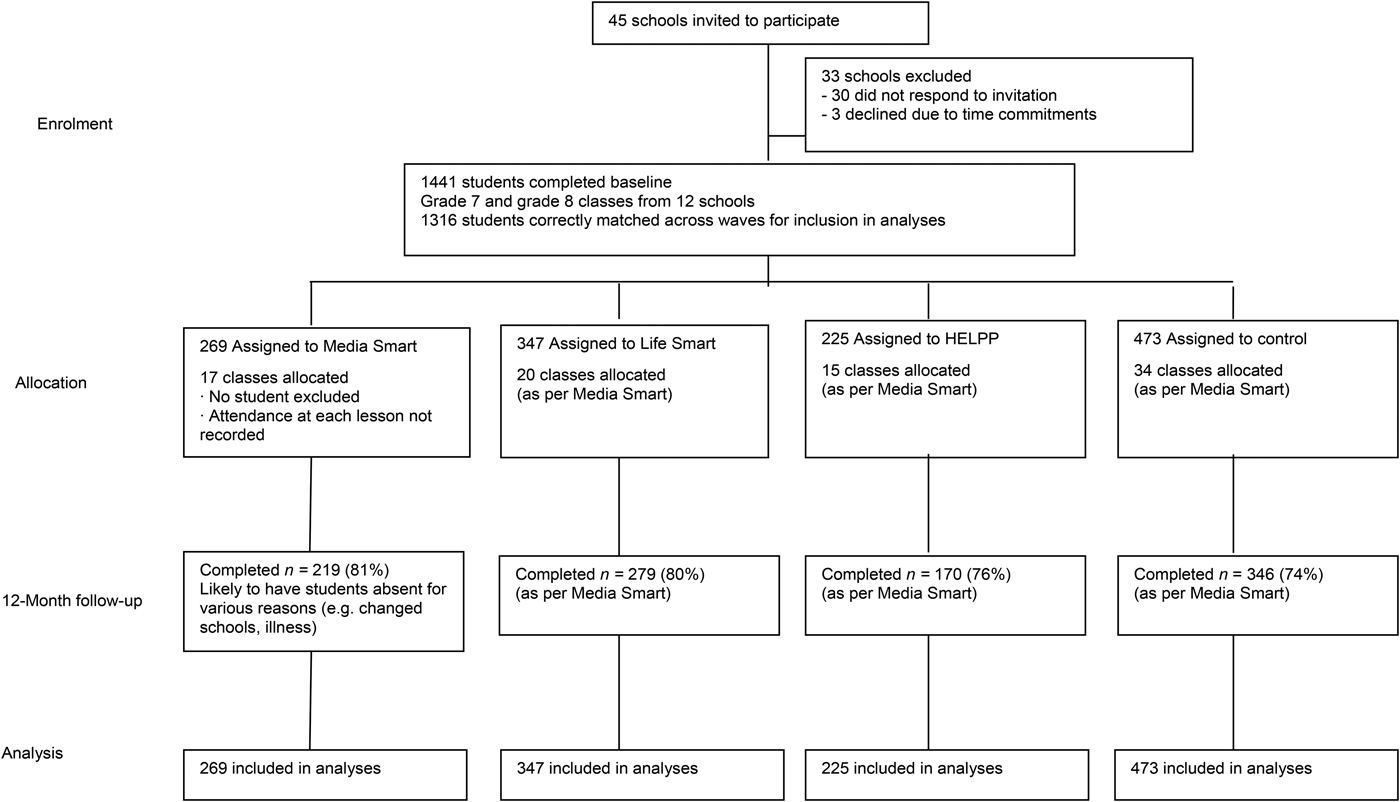
Approval for this research was received from five institutional review boards and each school principal. Schools were invited to participate based on a staff member previously expressing an interest in body image programs (n = 4) or where schools were geographically located within 1 h of the participating university in that state (n = 8). Allocation of grade (7 and 8) to either programs or control condition was completed at random, as was allocation of individual intervention classes to the respective programs. As can be seen from Fig. 1, 12 schools agreed to participate. Following parental consent for assessment completion, students completed baseline questionnaires and then had health assessments (height, weight and blood pressure) completed in private by two research assistants. Care was taken to ensure that participants were not able to view their measurements in order to protect against any possible iatrogenic effects. Students in an intervention would then receive their allocated program over the following 4 weeks, while control students would participate in their usual class lessons. Assessments were then completed at post-program and at the 6- and 12-month follow-ups.
Participant flow chart. HELPP, Helping, Encouraging, Listening and Protecting Peers initiative.

Interventions
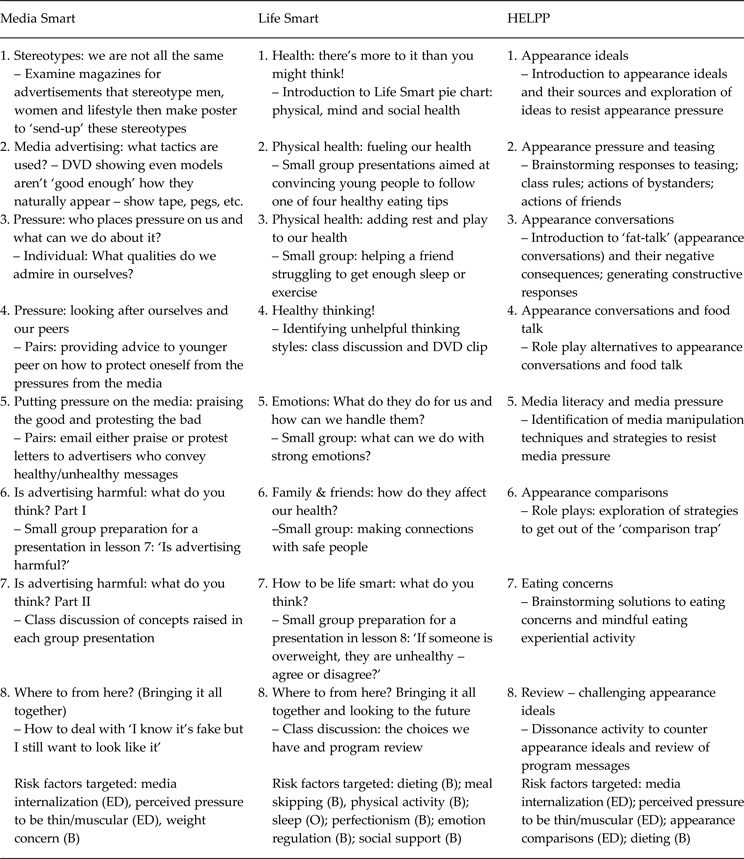
All three programs were developed around the evidence-based principles of being interactive; avoiding psychoeducation about eating disorders and obesity; and having multiple sessions (Stice et al. Reference Stice, Shaw and Marti2007) with eight lessons of 50-min duration delivered at the rate of two lessons per week. Table 1 provides example learning activities from each program and the risk factors targeted. It can be seen that Media Smart and HELPP targeted similar eating disorder risk factors, while Life Smart targeted a wider range of both shared and obesity risk factors. The programs were presented by postgraduate psychology students who had attended a training session run by the program developers covering principles of effective program delivery followed by three 2-h workshops for each intervention. Presenters received training in all three programs and were required to deliver each program in order to reduce the likelihood of presenter effects contaminating program outcomes.
Overview of the three programs including example activities from each lesson and risk factors targeted

HELPP, Helping, Encouraging, Listening and Protecting Peers Initiative; B, both risk factors (i.e. both eating disorder and obesity); ED, eating disorder risk factor; O, obesity risk factor.
Measures
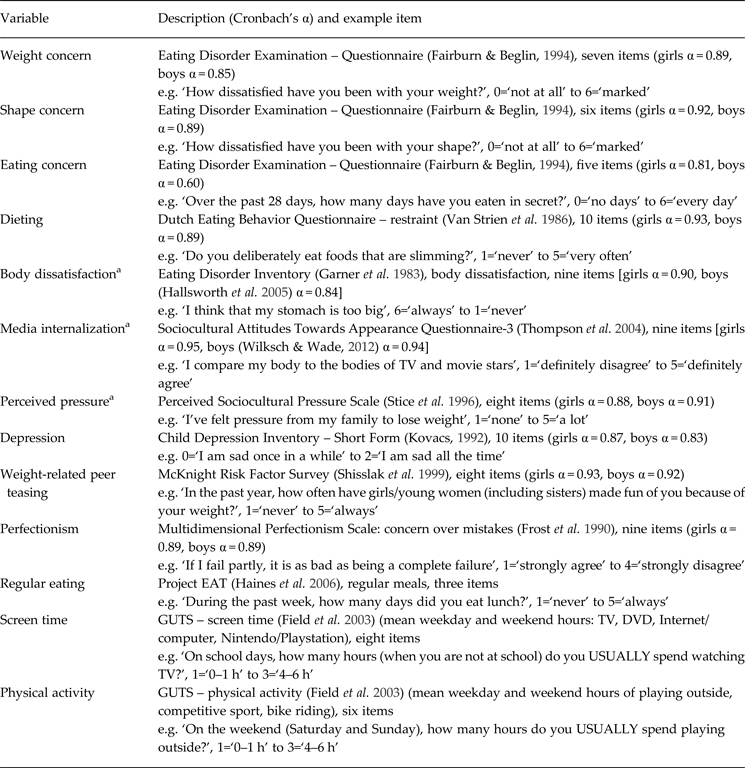
Eating disorder risk factor measures were selected based upon the evidence supporting their construct validity (e.g. Garner et al. Reference Garner, Olmstead and Polivy1983; Fairburn & Beglin, Reference Fairburn and Beglin1994; Thompson et al. Reference Thompson, van den Berg, Roehrig, Guarda and Heinberg2004) and use in previous prevention trials with early adolescents (Wilksch et al. Reference Wilksch, Durbridge and Wade2008; Wilksch & Wade, Reference Wilksch and Wade2009b ), while weight gain risk factor measures were selected based upon their use in large-scale longitudinal risk factor studies: Project Eating Amongst Teens (Haines et al. Reference Haines, Neumark-Sztainer, Eisenberg and Hannan2006) and the Growing Up Today Study (Field et al. Reference Field, Austin, Taylor, Malspeis, Rosner, Rockett, Gillman and Colditz2003). All measures had good internal reliability in the current study (see Table 2), with the exception of ‘eating concerns’ for boys (retained for use in the analyses for girls only). Higher scores indicated higher levels of risk for all but the regular eating and physical activity scales, where higher scores indicated lower levels of risk.
Summary and description of self-report measures

EAT, Eating Among Teens; GUTS, Growing Up Today Study.
a These scales had one or more items that differed for girls and boys.
Statistical analyses
Baseline data
Baseline differences across the four groups were analysed separately for girls and boys using analyses of variance with an α level of 0.05. Effect sizes (ES) for post-hoc between-group differences at baseline were calculated using Cohen's d [mean of group 1 − mean group 2/(pooled s.d. group 1 and group 2)], where 0.2 = small, 0.5 = moderate, and 0.8 = large.
Repeated measures for risk factors and health assessments
Linear mixed-model analyses were conducted to assess the efficacy of the three programs, compared with the control condition and each other. To assess for main effects and interactions involving group (group × time × gender; group × time), baseline observations were used as a covariate to ensure that any observed effects were due to changes at post-program and follow-up and not due to variation in scores at baseline or measurement error. This involved a 4 (group: Media Smart, Life Smart, HELPP, control) × 3 (time: post-program, 6-month follow-up; 12-month follow-up) × 2 (gender: girls, boys) mixed within-between design. This approach allows for direct comparisons between the groups at post-program and follow-up assessments. The α level for testing for main effects and interactions was 0.05 with Bonferroni-adjusted post-hoc analyses, and Cohen's d between-group effect sizes reported for significant comparisons. This methodology was also employed to investigate outcomes by state and school class to investigate any impact of site on the results.
Due to requirements imposed by an institutional review board, participant names were not recorded at assessment points but, instead, participants answered a series of questions (e.g. ‘What is the first letter of your mother's name?’) to generate a uniquely identifying code at each assessment point to match over each wave of data collection. A three-wave minimum match criterion (75% of possible observations) was used to avoid any inadvertent duplicate data that would result from within-participant errors within and across waves using this approach. Thus while 1441 participants completed baseline measures, the analyses were conducted with a total sample of 1316 participants or 91% of the baseline sample. The proportion of missing data was consistent across the four groups and logistic regression analyses showed there were no baseline differences on our primary outcome variables between participants who completed a minimum of three waves of data collection and those who did not: weight concerns [odds ratio (OR) 1.09, 95% confidence interval (CI) 0.90–1.33] and BMI (OR 0.98, 95% CI 0.95–1.02).
Clinical significance
We explored the frequency of participants who developed clinical levels of shape concern or weight concern by the 12-month follow-up. This was defined as a mean item shape concern or weight concern of ≥4 as this is considered indicative of clinical levels of concern (Fairburn & Beglin, Reference Fairburn and Beglin1994) and suggestive of current or future disordered eating (Gowers & Shore, Reference Gowers and Shore2001). Participants with clinical levels of concern at baseline were excluded from this analysis [128 girls (15%); 10 boys (2%)]. Logistic regressions examined differences in the proportion of new cases of clinical concern between the groups for girls and boys. Baseline level of clinical shape and weight concern was entered at step 1 and group allocation at step 2, where this was conducted separately for girls and boys. The same procedure was applied to participants’ weight status using a combined variable of overweight and obesity (BMI percentile ≥ 85) with those participants meeting this criterion at baseline excluded [160 girls (20%); 77 boys (17%)].
Results
Baseline measures
Investigating baseline scores by group and gender revealed significant differences between groups for girls on regular eating (F 3,769 = 5.40, p = 0.001) and BMI (F 3,808 = 3.71, p = 0.011). Post-hoc analyses showed that control girls (mean = 4.55, s.d. = 0.57) were eating more regularly than Life Smart (mean = 4.39, s.d. = 0.69, ES = 0.25) and HELPP girls (mean = 4.28, s.d. = 0.86, ES = 0.39). Media Smart girls (mean = 19.78, s.d. = 3.42) had a significantly lower BMI than HELPP girls (mean = 21.01, s.d. = 3.76, ES = 0.33). The only significant group baseline difference for boys was for perfectionism (F 3,424 = 3.20, p = 0.023), where Media Smart boys (mean = 1.87, s.d. = 0.73) scored significantly lower than control boys (mean = 2.17, s.d. = 0.79, ES = 0.38).
Repeated measures for risk factors and health assessments
Interactions between group, time and gender
Results are presented in Table 3 for girls and boys, where effect sizes are reported for significant between-group comparisons for participants of the same gender. Significant group × time × gender interactions were found for weight concern (F 8,968 = 5.00, p < 0.001), shape concern (F 8,952 = 3.85, p < 0.001), eating concern (F 8,775 = 3.15, p = 0.002), body dissatisfaction (F 8,1048 = 4.06, p < 0.001, ES = 0.17), dieting (F 8,1057 = 4.49, p < 0.001), media internalization (F 8,1076 = 2.22, p = 0.024), depression (F 8,1024 = 2.28, p = 0.021), weight-related teasing (F 8,1031 = 2.32, p = 0.018), perfectionism (F 8,1061 = 2.44, p = 0.013), perceived pressure (F 8,805 = 3.92, p < 0.001) and regular eating (F 8,1018 = 1.98, p = 0.046). Table 3 indicates that for weight concern and shape concern, both Media Smart and HELPP girls scored significantly lower than Life Smart but not control girls at the 12-month follow-up. For eating concern, both Media Smart and control girls scored significantly lower than HELPP girls at 6 months while control girls scored lower than Life Smart girls at 12 months. On perceived pressure, both Media Smart and control girls scored significantly lower than HELPP girls at 6 months.
Mixed models estimated marginal means for eating disorder risk factors by group (4) and time (3)

MS, Media Smart; LS, Life Smart; HP, Helping, Encouraging, Listening and Protecting Peers (HELPP); C, control; s.e.=standard error; ES, effect size.
The effect of the baseline value has been statistically removed to allow for direct comparisons across program attendance, gender and time. Significant effects are indicated by: a=group, b=group × time, c=group × time × gender.
d ES (Cohen's d) for Bonferroni-adjusted post-hoc testing of significant between-groups difference by gender at post-program, 6-month- and 30-month follow-ups (p<0.05). Although girls and boys are presented in separate tables, the analyses were conducted simultaneously.
For boys, Media Smart participants showed significant benefits at post-program for body dissatisfaction, media internalization, weight-related peer teasing, perfectionism, and at the 6-month and 12-month follow-ups for media internalization and depression. The only significant benefit experienced by Life Smart boys was on body dissatisfaction at post-program, while these boys had significantly higher levels of media internalization at post-program and the 6-month follow-up and higher levels of depression at the 6-month and 12-month follow-ups. HELPP boys experienced significant benefits on media internalization at post-program and at the 6-month follow-up and on depression at the 6-month follow-up; however, HELPP boys reported significantly higher levels of being a victim of weight-related peer teasing than Media Smart boys at post-program.
Interactions between group and time
A group × time interaction was found for physical activity (F 6,1097 = 3.51, p = 0.002), where Life Smart participants (mean = 1.58, s.e. = 0.02) scored significantly higher than control participants (mean = 1.50, s.e. = 0.02, ES = 0.23) at post-program while Media Smart participants (mean = 1.59, s.e. = 0.02) scored significantly higher than both HELPP (mean = 1.49, s.e. = 0.03, ES = 0.28) and control participants (mean = 1.49, s.e. = 0.02, ES = 0.27) at 6 months.
Main effect of group
A main effect for group was found for screen time (F 3,1088 = 3.42, p = 0.017), where the Media Smart group (mean = 1.57, s.e. = 0.02) had a significantly lower mean score (across post-program, 6-month- and 12-month follow-up assessment points) than the control group (mean = 1.63, s.e. = 0.01, ES = 0.20).
Impact of state and school class
Significant differences across states were found for regular eating (F 2,1165 = 5.37, p = 0.005) and screen time (F 2,1087 = 5.29, p = 0.005), where in both cases, this was due to differences between South Australian and Victorian participants (mean score across the post-program and follow-up assessment points). Post-hoc testing revealed that: HELPP participants in South Australia (mean = 4.54, s.e. = 0.08) were eating significantly more regularly (i.e. skipping fewer meals) than HELPP participants in Victoria (mean = 4.30, s.e. = 0.08, ES = 0.33); and Life Smart participants in both South Australia (mean = 1.61, s.e. = 0.03, ES = 0.27) and Western Australia (mean = 1.54, s.e. = 0.03, ES = 0.51) had significantly lower screen time than Life Smart participants in Victoria (mean = 1.70, s.e. = 0.03). The Victorian schools were public schools, whereas those in South Australia and Western Australia were Catholic or private schools.
Dieting (F 26,1100 = 1.66, p = 0.021) and screen time (F 26,1010 = 1.55, p = 0.040) were the only variables where a significant effect for school class was found. Post-hoc testing showed no differences for dieting while for screen time the significant difference occurred between a school class in Victoria and one in Western Australia, consistent with the effect of state for this variable.
Clinical significance
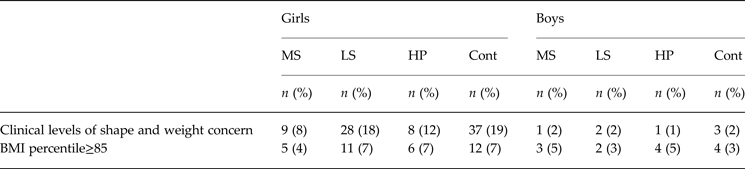
Of participants with 12-month follow-up data (653 girls, 365 boys), a total of 82 girls (12.5%) developed clinical levels of concern about shape and weight by the 12-month follow-up, while just seven boys (1.9%) experienced such an increase. Table 4 provides the frequency and percentage of participants from each condition that developed these concerns by the 12-month follow-up. A logistic regression revealed that Media Smart girls had half the likelihood of control girls of developing clinical levels of shape and weight concern (β = 0.51, 95% CI 0.28–0.94, p = 0.030), while the comparisons for the other two programs with the control group were not significant. The same procedure was applied to participants’ weight status (BMI percentile ≥ 85) and at the 12-month follow-up there were no significant differences across groups in new cases for either girls or boys.
Discussion
The aim was to assess whether one or more of the programs could reduce risk factors for both disordered eating and obesity. For the primary outcome variable of weight concerns, a significant effect at the 12-month follow-up was shown where both Media Smart and HELPP girls had significantly lower concerns relative to Life Smart but not control girls. However, Media Smart girls had a significantly lower incidence of new cases (8%) with clinical concerns about shape and weight at the 12-month follow-up compared with control girls (19%). No significant differences were found for the other primary outcome variable, BMI. Across secondary outcomes variables, a range of significant effects was found; however, many of these were due to comparisons between interventions rather than with the control group. Physical activity was the only variable where girls in an intervention group (Media Smart) reported significantly lower risk than the control group (post-program and 6-month follow-up), while a significant increase in risk was found relative to the control group for both HELPP girls (eating concern and perceived pressure at the 6-month follow-up) and Life Smart girls (eating concern at the 12-month follow-up). For boys, an intervention group experienced significant benefit relative to the control group for body dissatisfaction (Media Smart and Life Smart at post-program), media internalization (Media Smart at each time point, HELPP at post-program and at the 6-month follow-up), depression (Media Smart at 12-month follow-up) and perfectionism (Media Smart at post-program). However, HELPP boys reported significantly lower levels of physical activity at the 12-month follow-up than control boys. Taken collectively, there were four key findings that emerged from this RCT.
Number and percentage of new cases who had clinical levels of weight concern or who became overweight by the 12-month follow-up

MS, Media Smart; LS, Life Smart; HP, Helping, Encouraging, Listening and Protecting Peers (HELPP) initiative; Cont, control; n, number of new cases; %, percentage of participants within that group who developed clinically significant levels of shape concern/weight concern or body mass index (BMI) percentile of 85 or more.
First, the 12-month follow-up findings for both Media Smart and HELPP for weight and shape concerns were promising given that this is one of the most important risk factors for disordered eating (McKnight Investigators, 2003; Jacobi & Fittig, Reference Jacobi, Fittig and Agras2010). The finding that Media Smart girls had half the rate of onset of control girls of clinical concerns about shape and weight at the 12-month follow-up provides a step towards the clinically relevant outcomes investigated in targeted prevention trials (e.g. Taylor et al. Reference Taylor, Bryson, Luce, Cunning, Doyle, Abascal, Rockwell, Dev, Winzelberg and Wilfley2006) and adds to the previous 2.5-year follow-up where girls had significantly lower weight concerns than controls (Wilksch & Wade, Reference Wilksch, Wade, Paxton and Hay2009a ). This was the first time that the impact of HELPP (or Happy Being Me) had been evaluated on shape concern and weight concern and thus this result requires further investigation.
Second, a clear pattern emerged where Media Smart participants experienced significant benefit on more variables than other interventions for both girls (five variables, seven post-hoc comparisons) and boys (six variables, 10 post-hoc comparisons). Whilst only six of these findings were present at the 12-month follow-up, Media Smart girls and boys were the only group to not experience a significant increase in risk relative to another group on any variable. Possible explanations for the positive findings for Media Smart in this and previous studies include: it is concise and focuses on fewer risk factors, ensuring content is thoroughly learned where this might be more effective than targeting multiple risk factors with less time spent on each (e.g. Life Smart); it strikes a balance between relevant learning content without providing detail about potentially risky topics (e.g. in-depth analysis of appearance-based conversations); media is a topic of interest to both girls and boys that is well-suited to the age group investigated. It was also an important finding that Media Smart participants were engaging in more physical activity than HELPP and control participants at the 6-month follow-up. Although these significant differences did not continue to the 12-month follow-up, the findings suggest the potential for an eating disorder prevention program to show benefits to other health outcomes. We also found that Media Smart encouraged participants to spend less time consuming screen media in general. These findings suggest that a longer-term efficacy RCT to assess the impact on weight gain is indicated, as is an effectiveness RCT involving usual school teachers delivering the program, as well as replication by an independent research team (Becker et al. Reference Becker, Bull, Schaumberg, Cauble and Franco2008).
Third, this was the first time that the eight-lesson HELPP program was evaluated, rather than the three-lesson Happy Being Me from which HELPP was developed, and the first time any version was evaluated beyond a 3-month follow-up. Whilst HELPP produced significant benefits for girls (weight and shape concern) and boys (media internalization and depression), only one of these was against the control group (boys on media internalization), with the remainder compared with Life Smart. Conversely, HELPP produced significantly poorer outcomes than the control group on two variables for girls at the 6-month follow-up (eating concern and perceived pressure to be thin) and on physical activity for boys at the 12-month follow-up, whilst there were further variables where HELPP had poorer outcomes than Media Smart (e.g. screen time for boys at the 12-month follow-up). One reason for the difference on eating concerns at the 6-month follow-up is that HELPP specifically included classes on healthy eating and mindful eating. It is possible that while these are helpful aspects to address in high-risk groups, they may draw unwarranted attention to eating behaviors in young universal samples. Further efficacy trials over longer follow-up periods are required to tease out why increased scores on some risk factors might be occurring and whether helpful impacts are sustained. The mixed outcomes of the current trial were not consistent with the previous evaluations (Richardson & Paxton, Reference Richardson and Paxton2010; Bird et al. Reference Bird, Halliwell, Diedrichs and Harcourt2013). Given that the earlier studies were conducted with younger children it is possible the content may be more suited to this age group. Results suggest that HELPP is not suited to obesity prevention, and further evaluations are required to understand pattern of change over time.
Fourth, with the exception of body dissatisfaction at post-program for boys, Life Smart did not result in lower eating disorder or obesity risk and indeed girls recorded worsened scores on four variables, while boys reported increased risk on three variables relative to the other interventions. Whilst only one of these differences was in comparison with the control group (i.e. eating concern for girls at the 12-month follow-up), the program clearly showed insufficient value. It is not immediately apparent as to the reason for these outcomes, especially given the positive findings for weight concerns in the pilot study (Wilksch & Wade, Reference Wilksch and Wade2013). Given that Life Smart was developed to prevent obesity through a thoughtful lens to body image, it does raise the question of how other obesity-prevention programs (developed without these considerations) might have an impact upon eating disorder risk factors. It is rare for obesity-prevention programs to measure potential harm (Carter & Bulik, Reference Carter and Bulik2008) and these results indicate that such evaluations should be required.
In all, six limitations were present in this study. First, apart from eating concerns, disordered eating was not measured due to previous experiences of the researchers that some parents have concerns regarding their child completing such measures, even though research suggests these questions are of minimal risk (Celio et al. Reference Celio, Bryson, Killen and Taylor2003). Second, it would have been preferable to have more objective measures of dieting and physical activity. Third, the method of coding of participants imposed by an ethics review board interfered with accurately matching participants across waves. However, this issue was managed conservatively, resulting in strong confidence as to the accuracy of matching. Fourth, despite the use of randomization, baseline differences were found and were conservatively managed with the use of these scores as a covariate, although it is preferable for randomization to ensure no pre-existing differences. Fifth, independent adherence assessments of presenter program fidelity were not completed. Finally, the follow-up period was shorter than some universal eating disorder prevention trials (Wilksch & Wade, Reference Wilksch and Wade2009b ; González et al. Reference González, Penelo, Gutiérrez and Raich2011).
There were also strengths of this study, including the: evaluation of multiple programs; effort to replicate previously evaluated programs; large sample size; inclusion of multiple sites to increase external validity; delivery by non-specialist presenters; and, inclusion of clinically relevant outcomes. Overall, these results indicate that universal prevention might be a promising and relatively low-intensity approach to reducing risk factors for both problems.
Acknowledgements
During this trial, S.M.W. held a research fellowship funded by the South Australian Centre for Intergenerational Health and now holds a research fellowship funded by the National Health and Medical Research Council. S.B.A. is supported by the Ellen Feldberg Gordon Fund for Eating Disorders Research and the US Maternal and Child Health Bureau, Health Resources and Services Administration, training grants MC00001 and the Leadership Education in Adolescent Health Project 6T71-MC00009. This research was funded by a Butterfly Research Institute Grant. The authors thank the school students and staff for their participation in this research, along with the postgraduate students who assisted with data collection and program delivery.
Declaration of Interest
S.M.W. and T.D.W. are authors of Media Smart, where sales of the program fund further eating disorder prevention research. S.J.P. is an author of the HELPP program and is currently a consultant to Dove, Unilever.