Over-confidence is the worst quality that a restorer might possess. Those who set about saving for posterity the medieval cathedrals of England during the nineteenth and twentieth centuries have been amongst the most over-confident restorers we have known, destroying ‘considerably more medieval architecture … through [acts of] restoration than through [wanton] demolition’.Footnote 1 The treatment of King John’s effigy at Worcester, between 1872 and 1930, provides us with an example in microcosm of the ways in which royal sepulchral monuments located in ecclesiastical buildings were treated by those under whose care they languished. The concern in this article, therefore, is with the modern painted history of the monument that celebrates the life of King John; a history which begins in 1872 when discussions began concerning the future of the royal tombs that were housed in Worcester Cathedral.
For the wider context of the preservation of royal sepulchral monuments in general we have to look back to 1841, when the Select Committee on National Monuments and Arts reported its findings concerning public access to Westminster Abbey and St Paul’s Cathedral for the ‘encouragement of civilisation and the improvement of public taste’. It became apparent to the committee, as it pursued its investigations into the monuments at Westminster, that the structures in place for preserving the tombs – royal and non-royal – were highly unsatisfactory. Henry Hart Milmam, Canon Treasurer at the abbey, described in his testimony how the tombs in his care had been, and were currently being, maintained. Before 1826, the Gentlemen of the Choir had taken all the receipts from paying visitors and applied what portion of them was necessary to clean the abbey’s monuments.Footnote 2 After the coronation of George iv, on 19 July 1821, the royal monuments had been repaired at public expense.Footnote 3 By 1841, the entry fees were being applied to an annual round of monument cleaning under the supervision of the renowned sculptor Francis Chantrey, a fact confirmed by Edward Blore, the abbey’s architect, who did not think that the monuments were under his particular care.Footnote 4 Of especial concern were the royal monuments, which were in a ‘great state of mutilation’.Footnote 5 Pressed on what he would recommend concerning the future restoration of these sepulchral monuments, Blore replied that he thought that the monuments were ‘dangerous things to touch’ because ‘under the denomination of restoration [one] might do more harm than good’. The example that he chose to use – almost presciently so in the case of the effigy of King John, as will become evident later – was the one of the ‘old picture’, which if one paints over it, one may create ‘a very exact copy of the old picture, but it is not the old picture’.Footnote 6
The conclusion reached by the Select Committee was that the general public should be allowed into cathedrals in order to see the works of art that lay therein, especially the sepulchral monuments. But if this policy of access were to be successful, the committee opined, then ‘increased attention [would need to be] paid to the preservation of ecclesiastical edifices, and of the royal and other monuments’ that they contained.Footnote 7 This had been the recommendation of John Britton, the noted antiquary and topographer and author, amongst other things, of a monumental survey of the cathedrals of England,Footnote 8 who had expressed the view that the government should set up an institute or commission for the protection of great buildings and the monuments that lay within them on the model recently set up by the French.Footnote 9
The frenzied restoration of churches and cathedrals which was taking place in the middle of the nineteenth century added a further impetus to demands for the protection of tombs of national importance, not just in the abbey, but also elsewhere.Footnote 10 In 1845, money was allotted for the restoration of the tombs of Henry iv and the Black Prince at Canterbury, though it seems that little work was actually completed. In 1854, Gilbert Scott reported on the tombs in Westminster Abbey, but, despite a vote from the Treasury of £2,500 to effect the work, the royal tombs remained untouched until 1869. The following year the question was raised concerning the responsibility for royal tombs. The resultant report, compiled by the First Commissioner, A S Ayrton,Footnote 11 concluded that unless legislation were to be forthcoming, the Office of Works could hardly be held financially responsible for monuments over which it had no control. That conclusion did not stop Ayrton seeking further funds for the restoration of the royal tombs at the abbey later in 1870.
In February 1869, Ayrton’s predecessor, A H Layard, had asked the Society of Antiquaries of London to report and advise on the condition of all the tombs and monuments at that time in existence in ‘cathedrals, churches, and other public places’.Footnote 12 The Society set up a Sepulchral Monuments Committee, chaired by the then director, Charles Spencer Percival, which reported in 1872 to the Office of Works. The report consisted of an appendix, which listed all the sepulchral monuments known to the Society’s Fellows that dated from before 1760, with a note as to their location and condition, and was prefaced by an introduction setting out the Committee’s concerns. The original letter from the Office of Works initiating the inquiry had expressed the view that the government wished to protect what sepulchral monuments survived and to preserve them for the future. The Society agreed with this stated aim. The Council of the Society affirmed at its meeting of 23 February 1869 (which set up the Sepulchral Monuments Committee) that it had ‘always considered it one of the Society’s highest functions to protect [sepulchral] monuments from the ravages of decay and from the still more injurious processes known under the name of “restoration” ’, noting further that it had granted sums of money in the past in pursuance of this object.
In its report published in 1872, the Committee argued that, since no one could predict which monuments might in the future come under threat from their careless custodians, if the Office of Works were to decide to bring under its protection monuments deemed worthy of preservation, that protection should apply to all sepulchral monuments, whether carefully kept, as those at Westminster (the Dean was a member of the committee), or deemed to be under threat.Footnote 13 The committee noticed the example of the Hungerford Chapel in Salisbury Cathedral, destroyed in 1790 in the name of ‘restoration’. James Wyatt’s work on the cathedral in the 1790s, when he cleared the grounds of its headstones, moved sepulchral monuments, and even presided over the ‘loss’ of Richard Beauchamp’s tomb, was eighty years later being held up as an example of how restoration, badly handled, could do so much damage.Footnote 14 Evidently, the arrival of the Society’s report on the desk of the First Commissioner came as some surprise, since he informed the Society that the commissioning of the report ‘had not been made with Treasury sanction and that it was not his intention to lay it before Parliament’.Footnote 15 Ayrton was in a position to know, having been Parliamentary Secretary to the Treasury in February 1869. In that post he had kept a tight rein on the expenditure of the Office of Works. The report was, nevertheless, presented to Parliament in June 1872.Footnote 16
The desire to preserve such tombs as still existed was just one aspect of the preservation movement that emerged in the last third of the nineteenth century. This gradual awakening to the importance of the historic built environment was also visible in the Ancient Monuments Protection Act of 1882.Footnote 17 The Act, sponsored by John Lubbock, MP, had been unsuccessfully proposed as early as 1873, and by 1880 a list of ancient monuments thought worthy of preservation had been compiled and published in preparation for the eventual passing of the Act.Footnote 18 It was in the face of this movement that those who came to ‘restore’ the effigy of King John were working. And even more remarkably still, it was under the care of the very same Office of Works, which had initiated the setting up of the Society’s Sepulchral Monuments Committee, that the effigy of King John at Worcester was treated in the manner which this article seeks to uncover.
The restoration of Worcester Cathedral was an extraordinary undertaking, whether or not one agrees with the outcome of the efforts of its principal architects, Abraham Perkins and Gilbert Scott.Footnote 19 By 1872, work was reaching its final stages, and it was becoming apparent that, by contrast with the restoration work already completed and with the prospect of a new floor being laid, the tomb of King John and the mortuary chapel of Prince Arthur were looking decidedly shabby and in need of restoration work. With that thought in mind, on 27 March 1872, the Dean and Chapter of Worcester wrote to the Treasury requesting that £650 be allocated to restoration work which would be undertaken ‘without impairing their historical and archaeological value’.Footnote 20 On 29 April, George Buckler, an itinerant Assistant Surveyor of the Office of Works,Footnote 21 was commissioned with the task of visiting the cathedral – undertaken on 8 May – and writing a report, which he duly submitted on 13 May 1872. In this he made his recommendations as to what should be done with John’s altar tomb, which he called, in his report, ‘a dingy relic’.Footnote 22
Let the effigy and the tomb be carefully cleansed of all impurities which have been laid over their surfaces and let the defective joints in the masonry be carefully stopped, leaving the chipped or broken edges as evidences of antiquity. It would (in my opinion) be injurious to attempt to replace the lost features, to renew the sharp edges of the sculptor’s work, or to place in the royal hands a sceptre which might be of questionable design. The proposed new floor is to be several inches lower than the old one, a narrow step will therefore have to be fitted around the base of the tomb … the shields might (to use an artist’s term) be ‘touched up’, or be re-emblazoned, and the effigy and the supporters [ie the two bishops] be re-gilt. Under such circumstances I should see no impropriety in placing a metal crown on the head, without doing any injury to the remains of the stone crown, so that the metal crown could be at any time removed and the stone crown reassume its present dilapidated form.Footnote 23
Buckler was keen to recommend that ‘the less such relics of antiquity are interfered with the better’ and that in itself, the condition of the tomb was ‘a record of the past’ which should be preserved, a sentiment very much in keeping with the times.Footnote 24 He estimated that the repairs on the tombs of John and Prince Arthur would come to £175, while the regilding of King John’s tomb would cost £35, much less than the estimate given by Gilbert Scott. Buckler’s report had its desired effect, and, by 17 May 1872, £250 had been allocated to the work which was to be carried out under the direction of an officer of the Office of Works.Footnote 25 This was to be George Buckler himself, who employed Messrs Henry Poole and Sons, ornamental, ecclesiastical and monumental masons of south-west London,Footnote 26 to undertake the work of restoring John’s effigy and tomb; Poole and Sons had been used extensively by Gilbert Scott at Westminster Abbey, particularly to repair the royal tombs, and had been commissioned to do the work on the floor at Worcester.Footnote 27
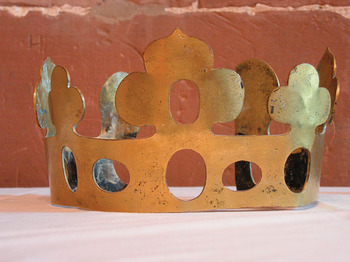
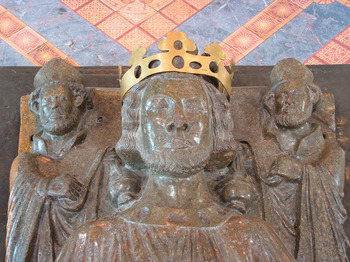
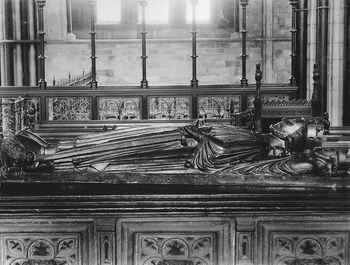
The funds having been allocated, restoration work was carried out over the winter of 1872–3. On 3 February 1873, The Times reported that repair work had been done on King John’s tomb as part of the general refurbishment being carried out on the cathedral. The tomb had been ‘scraped’ and no attempt had been made to restore the paintwork, though the intention to ‘recrown him’ with a newly made metal crown was announced (in 1930 this new crown was described as being made of tin) (figs 1 and 2).Footnote 28 The recrowning was deemed ‘by no means pleasing’ by The Times’s correspondent in his notice of 12 April that year and the gilt work, which had been completed by this point too, was deemed to be ‘most glaring’ (fig 3).Footnote 29 A letter to The Times from Albert Hartshorne,Footnote 30 published on 16 October, expressed the view that ‘it [was] somewhat startling, in the face of … reliable evidence as to the proper colours, to find that the whole figure had been lately gilt from head to foot, with the strange addition of a second crown in gilt metal placed over the original carved one’. Hartshorne went on to opine that the ‘gilding should be removed … and that [the effigy] should be carefully painted according to the ancient authorities’.Footnote 31 Hartshorne’s attack was the first of many that the work on the effigy was to suffer, and his letter prompted a defence from Buckler in which he averred that he had seen no colour on the effigy when it had been repaired and he remained convinced that the gilding work had been the correct way to proceed.Footnote 32
The metal crown affixed to the effigy’s head by Poole and Sons between February and April 1873. By courtesy of the Dean and Chapter, Worcester. Photograph: Chris Guy

The effigy recrowned. By courtesy of the Dean and Chapter, Worcester. Photograph: Chris Guy

The effigy before the gilding was removed. By courtesy of the Conway Library, Courtauld Institute of Art, London

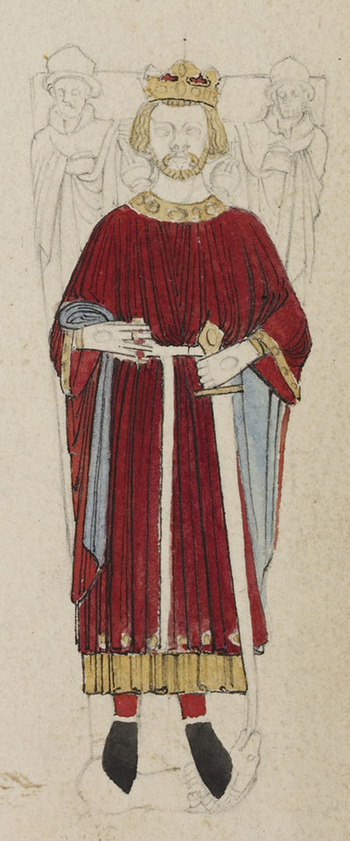
Even in private correspondence, Buckler continued to defend his opinion.Footnote 33 Buckler’s problem was, however, that there was considerable evidence to show that the effigy had the remains of colouring before he had had it gilded. Sometime between 27 September and 3 October 1813, Charles Stothard had made a drawing of King John’s tomb (fig 4), later published in his Monumental Effigies.Footnote 34 Stothard was a draughtsman of considerable ability who had been employed by the Society of Antiquaries of London as its official artist.Footnote 35 Scholarly opinion has long been supportive of the quality and accuracy of Stothard’s work and if anything his reputation grows the more that scholars examine his work. Paul Binski, for example, used Stothard’s drawings extensively for his study of the Painted Chamber at Westminster.Footnote 36 In a recent investigation of Stothard’s work on effigies in France, Richard Knowles has concluded that this artist ‘had an exceptionally accurate eye for taking in detail and the genius of his pencil was able to detect it with an absolute veracity’.Footnote 37 It was Stothard’s evidence that Buckler’s critics used against him. But other observers had also seen colour in the effigy. In 1823, Charles Wild thought that the effigy ‘appeared to have been formerly (perhaps originally) coloured’.Footnote 38 In 1862, Matthew Bloxam, writing in The Gentleman’s Magazine, described the colour of the effigy in such a way as to make it clear that he had observed it in person and had not simply copied his words from Stothard.Footnote 39 In 1854 a plaster cast of the effigy had been taken for display in the Crystal Palace at Sydenham, which was also painted. We do not know the identities of the artists who made the cast of King John for Digby Wyatt and Owen Jones, the men who were commissioned with the task of gathering the plaster casts for the Palace, but later evidence makes it clear that the cast was made from the original.Footnote 40
Charles Stothard’s original drawing of King John’s effigy. By courtesy of the Department of Prints and Drawings, British Museum

Despite the initial criticism of Buckler’s work, the effigy remained in its gilded state for the remainder of the century. In 1900, while undertaking research for his volume on Worcester in the Bell’s Cathedral series, E F Strange wrote to the Office of Works enquiring whether they had any documentation that he might look at ‘of the evidence on which the effigy was gilded instead of being coloured as before’. Viscount Esher, the Secretary of the Office of Works, was minded to allow Strange to have access to the documents.Footnote 41 In his publication, however, Strange simply quoted Bloxam’s description verbatim adding only the comment that ‘fortunately no attempt was made to restore the sculpture; but the effigy is not improved in appearance by the gold leaf with which it is covered from head to foot’.Footnote 42
The attack on the gilded image was renewed by William St John Hope at a meeting of the Society of Antiquaries of London in January 1907 where he expressed the view that the effigy of King John had been ‘disfigured’ by the application of ‘gold-leaf’.Footnote 43 He made the same point to Canon J M Wilson in 1912.Footnote 44 The Canon communicated St John Hope’s views to the Worcester Chapter along with an offer by the antiquary to superintend the cleaning process. The Chapter, encouraged by Dean William Moore Ede (1908–34), gave Wilson the task of investigating further, and he reported his findings to the Chapter on 20 November 1913.Footnote 45 In his report, Canon Wilson concluded that the gilding of King John’s effigy had been placed there on the basis of ‘mistaken evidence’, and his views were endorsed by the collective presence. It was reported at this meeting, too, that William St John Hope offered ‘personally to remove the gilding’. So long as the Dean and Chapter did not wish him to restore the original colouring, the expense of removing the gilding would be, in St John Hope’s reported view, ‘trifling’.Footnote 46 The minuted response of the Dean and Chapter was as follows: ‘Since sufficient knowledge appears to be available for restoring the original colouring, it would be best to remove the gilding and to restore the colouring at one and the same time’.Footnote 47
Despite Wilson’s extensive research in the archives, which he later published in an article in the Proceedings of the Worcestershire Archaeological Society,Footnote 48 the effigy remained in its gilded state undisturbed for a further decade.Footnote 49 Then, just after Christmas 1925–6, the whole question as to what should happen to the effigy was opened again when James Milner, Director of the National Portrait Gallery (NPG), asked for permission to take a bronze cast of the effigy for the NPG’s collection.Footnote 50 Milner had written to the Bishop of Worcester, Ernest Pearce, on 30 December 1925 seeking the bishop’s permission for the enterprise.Footnote 51 The bishop responded that he ‘could not move a hassock’ in his cathedral and encouraged Milner to approach the Dean and Chapter whose responsibility the cathedral fabric was.Footnote 52 The Dean of Worcester, Moore Ede, wrote to Milner on 6 January 1926 giving permission for the effigy to be cast, though suggesting that before the cast was made it would be wise to ‘remove the piece of him which the Board of Works fastened round his head to represent the crown’. Moore Ede also opined that the request to take a cast reopened the whole issue of the restoration of the effigy. He hoped, he said in his letter to Milner, that a ‘wiser and more artistic Board of Works’ could be encouraged to restore the effigy in a more sympathetic manner, and he suggested that Milner contact the Office of Works concerning the matter.Footnote 53
Whether or not Milner took Moore Ede’s advice is unclear, but that the Dean and Chapter sought expert opinion seems likely. On 9 March 1926, it was reported to the Chapter that a letter had been received from the Commissioner of the Board of Works detailing the penalties for tampering with monuments of ‘national importance’. Remarkably, John’s effigy was not amongst the monuments scheduled by the commissioner’s letter. The Dean and Chapter were free to do as they willed.Footnote 54 They waited, however, to hear further from the experts in London who had reopened the question of what to do with King John’s effigy. Despite the fact that in May 1926, Charles Kingsley Adams of the NPG made a visit to Worcester to see the effigy,Footnote 55 that wound remained untended until the following autumn. Then, in late September 1926, Richard Bedford, Deputy Keeper of the Department of Architecture and Sculpture at the Victoria and Albert Museum (V&A), together with Paul Ryan, visited Worcester to assess the possibility of making a cast. On 2 October, Eric Maclagan, the Director and Secretary of the V&A, wrote to James Milner to report Bedford’s findings. Maclagan said in this letter that he had heard that there was some question over whether the gilding should be removed and wondered if Milner knew anything about the proposal.Footnote 56 Milner’s response showed that he did and that he wished to seek the opinion of the experts at the V&A as to how the operation might be effected.Footnote 57 The V&A expert, Bedford, was of the opinion that the figure could be cleaned without damage to it, so long as ‘due care is taken’.Footnote 58 Maclagan was evidently worried about the prospect of cleaning the effigy too. He saw it as a specialist job which could only properly be done by the Art Workroom men of the V&A. And then Maclagan raised the issues that he saw as crucial before any attempt could be made to clean the object: whose responsibility was the monument? Should the King be approached for his permission before any cleaning took place? Would the Dean and Chapter defray the cost of cleaning? From a different perspective, Maclagan’s letter raises another important question: was it likely that any traces of the original colour remained, especially if the effigy had been scraped before the gilding was applied? Certainly Bedford could not see anything of the original colour when he inspected the monument that September,Footnote 59 though, four years later, E W Tristram was of the opinion that he could detect paint beneath the gilding.Footnote 60
On 21 October 1926, Milner wrote to the Dean of Worcester regarding the making of a cast of the effigy of King John and raised the three questions deemed in need of answering before events could proceed. Milner emphasized the fact that, because of the General Strike that had battered the UK economy during that year, he doubted whether the government could pay for the cleaning of the effigy.Footnote 61 In his response to Milner, Moore Ede denied the need to consult the King, since the King was constitutionally represented on the Board of Works, which he claimed was responsible for royal tombs; he refused to accept that the Dean and Chapter were financially responsible for the upkeep of the effigy; and he refused to defray the cost of cleaning the gilding from the effigy because of lack of funds: ‘we can do it and do it by our own clerk of works who is as competent as anyone you could send down’, Moore Ede wrote, and concluded that the financial situation meant nothing should be done at that time.Footnote 62 History, alas, does not record Maclagan’s thoughts on the Dean’s response, but they must have been of despair. The minute of the correspondence in the Dean and Chapter minute book simply records that ‘the dean reported correspondence with the Victoria and Albert Museum as to [King John’s] tomb’.Footnote 63
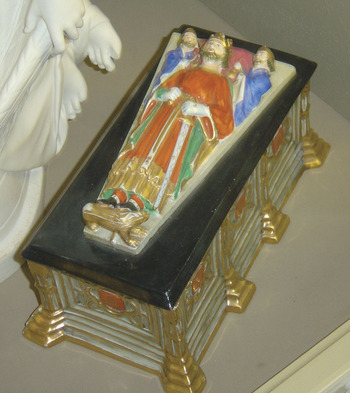
Undeterred by the NPG’s view on the financial situation, in July 1927 the Dean and Chapter approached the Office of Works directly. In a meeting between Canon Cronshaw and Major Broad, the question of the cost of cleaning the tomb was raised again.Footnote 64 On 3 August, the Office of Works confirmed that it was not its responsibility to fund the cleaning of the monument.Footnote 65 Another two-and-a-half years’ of silence followed before, in early January 1930,Footnote 66 Moore Ede began the process which would lead to the decisive move in the history of the cleaning of the effigy. In that month, the Dean launched an appeal for the restoration of the tomb.Footnote 67 A leaflet was printed, entitled ‘Proposed Restoration of the Tomb of King John’, where the tomb was described as being in a ‘deplorably shabby’ condition in contrast to the recently repainted tombs of the Beauchamp and Wylde families, ‘restored by the piety of their descendants’. The proposal, outlined in the leaflet, was to ‘remove the false crown cut out of a piece of tin’ and ‘to recover its primitive and long familiar aspect’. The money raised would, the leaflet declared, also be used to repaint the effigy along the lines suggested by any remaining pigment after the gilding had been removed and by reference to the porcelain ‘model of the tomb made by Messrs Chamberlain … in the early part of the eighteenth [sic] century’ (fig 5).Footnote 68 The estimated cost of the operation was between £70 and £80. A list of subscribers was published, along with a letter from the King’s secretary expressing His Majesty’s ‘approval for the proposal’. All this general support hid the fact that the Chapter was divided on the issue of restoration. On 30 January 1930, at a crucial meeting in deciding the future of the effigy, on the motion of Canon J H F Peile (1926–40) and seconded by Dean Moore Ede, it was proposed that John’s tomb should be restored. Canon T A Lacey (1918–38) and Canon H P Cronshaw (1922–30), in the laconic words of the minute book, ‘voted against the motion’. In the event, the motion was declared ‘carried’.Footnote 69 The Dean’s determination to have his way was clearly crucial in driving the project forward.
Chamberlain and Co.’s model of King John’s tomb and effigy, c 1845–8, measuring 233mm long × 125mm wide× 130mm high. By courtesy of the Worcester Porcelain Museum. Photograph: David Morrison

On 8 February, the Dean wrote to the Cathedral Architect, Harold Breakspear, soliciting his advice. Breakspear’s response made it clear that he was in favour of the restoration plan, so long as it was properly supervised.Footnote 70 On the same day, Moore Ede had also sought the permission of the King for his venture. He received the permission which he required on 13 February.Footnote 71 On 22 February, an article under the name of the Dean of Worcester appeared in Berrow’s Worcester Journal announcing the Dean and Chapter’s intentions towards the monument.Footnote 72 On 15 March, Moore Ede, having been prompted to do so by the Bishop of Worcester, wrote to the Director and Secretary of the V&A, soliciting his advice.Footnote 73 On 18 March, Maclagan wrote to the Dean expressing his view that the Chapter needed an expert to advise them and directed him to E W Tristram at the Royal College of Art on the basis of the work that he had done at Westminster. It was Maclagan’s view that to restore the painting without expert advice would be to run the risk of being ‘more misleading than the present modern coat of gilding’.Footnote 74 Moore Ede had to admit that he had already commissioned the work from Messrs Bridgeman and Son of Lichfield and that he had only delayed the work at the prompting of the Bishop of Worcester, who was evidently worried by the Dean’s intentions towards the monument.Footnote 75 Maclagan shared the Bishop’s concern. In a memorandum to his colleague Martin Hardie on 20 March asking him to contact Tristram personally, he expressed the desire to ‘prevent the work falling into incompetent hands’.Footnote 76 He wrote to the Dean on 22 March, saying that Tristram was willing to give his advice on the treatment of the tomb for five guineas plus his travelling expenses.Footnote 77 He took the opportunity to reiterate his view, confirmed later by Tristram, that the proposal to repaint the effigy was a mistake. Moore Ede’s response was resolute, however. It had been proposed to ‘restore the colours as given in Mr St John Hope’s letter of Aug 31, 1913, assisted by the colouring of the Porcelain model in the museum’, and he was determined to go ahead with the plan.Footnote 78 It was not the intention to ‘renew the jewels’.Footnote 79 Tristram’s visit happened on 28 March,Footnote 80 and on 29 March, Moore Ede wrote enclosing the art historian’s fee and reiterating his determination to repaint the effigy since this was the expectation on which the money had been raised.Footnote 81 Tristram’s reply, written on 3 April, expressed the view that the Dean was not committed to repainting by his appeal since to ‘repaint would certainly not be “to restore the original colour” ’. He notified the Dean that he had communicated ‘the results of his visit to Maclagan’ and that it was Maclagan’s view that ‘the only right procedure is to remove the modern gilt and to restore, by cleaning, as much of the original colour as possible without repainting’. Tristram further said that it was both his and Maclagan’s view that this advice would be ‘supported by the large body of instructed antiquarian opinion throughout the country’. And if the Dean were in doubt about the advice he was receiving, he was encouraged to consult the Society of Antiquaries for their opinion as an ‘entirely impartial body’.Footnote 82
Tristram was too late, however. Moore Ede had already engaged the services of Bridgeman and Son to remove the gesso and gilding;Footnote 83 this work started almost as soon as Tristram left Worcester,Footnote 84 and was certainly completed by 25 April when Tristram wrote again to the Dean, presumably in response to an enquiry by him, expressing his exasperation at the Dean’s activities.
I am not surprised that little of the original colour was found in King John’s effigy. To work down to it by means of a ‘paint remover’, the method which I was given to understand was being used, could only end in fatal results. That there was original colour in the effigy I could see for myself, and in competent hands the work of recovery could have been carried out successfully I feel confident.Footnote 85
By 25 April 1930, therefore, the deed had been done: King John’s effigy had been cleaned up; in Tristram’s view so cleaned up as to remove the paint which would have originally adorned the effigy. He was not alone in condemning the actions of the Dean. Canon Lacey, one of those who had voted against Moore Ede’s plans at the meeting of the Chapter on 30 January 1930, maintained his stance of opposition to the project protesting ‘against such alterations’ at the Chapter meeting of 30 April 1930.Footnote 86 Tristram’s recommendation to the Dean and Chapter was now that they should wax-polish the effigy in order to preserve it and any paint that might remain after the rough treatment it had received at the hands of Messrs Bridgeman and Son and their paint stripper.
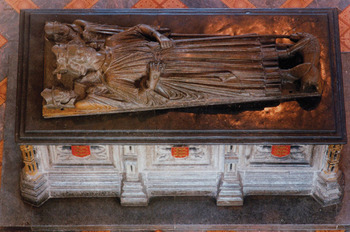
By 4 June, the effigy had been polished according to Tristram’s instructions,Footnote 87 and on 2 July the Chapter authorized Moore Ede to have the altar tomb repainted as ‘it is shown in the Porcelain model made by Chamberlain about 1820 [sic]’,Footnote 88 as long as he left the effigy untouched.Footnote 89 Evidently, however, the effect was not pleasing. Moore Ede wrote in his Memorandum on the affair that ‘after some progress had been made, it was discovered that the whole tomb was made of marble. It seemed that the best treatment would be to remove all paint, both that recently put on and what old paint remained and to polish the whole tomb, repainting the shields and regilding the four corner columns as they had been evidently gilded before.’ The work was completed on 27 September 1930,Footnote 90 and reported to the next Chapter meeting on 1 October that year (fig 6).Footnote 91
King John’s tomb and effigy at Worcester, November 2007. By courtesy of the Dean and Chapter, Worcester. Photograph: Chris Guy

Moore Ede’s dogmatic approach to the monument under his care is revealed in the memorandum which he wrote – in his own hand, but referring to himself in the third person – about the affair sometime between the end of the work on the effigy and his death in June 1935. It was he, Moore Ede wrote, who launched the appeal to remove the ‘gold paint’ and ‘repaint [the effigy] in the way described by Stothard and St John Hope’. He wrote that ‘when the gilt was removed it was found that the figure was made of Purbeck marble and that it had originally been polished’ and that it had ‘probably been painted in the fourteenth century’. ‘It was therefore decided to repolish the figure and not repaint.’Footnote 92 Yet Moore Ede had had the opinion of the director of the V&A and one of the leading figures in medieval polychromy in his day, E W Tristram, to assure him otherwise. Tristram had written to Moore Ede on 25 April 1930 with his view that the effigy ‘would not have been polished and as an afterthought painted. All evidence tends to show that mediaeval monuments were almost invariable painted and gilt. Effigies have seldom suffered from much repainting. Certainly the colours I saw in the King John were the original.’Footnote 93 With an irony that would not have been lost on those who watched on helplessly from Worcester and from London, Moore Ede had opined just weeks before he was to embark on his own ill-judged act of restoration of King John’s tomb and effigy that the renovation undertaken by the Office of Works in 1873 had amounted to an act of ‘vandalism’.Footnote 94 The Dean, however, was not a man to appreciate the humour of the moment, recording in his Memorandum the optimistic view that the work was completed to ‘universal approval’.
In his 1997 study of the polychromy of Worcester Cathedral, David Park, FSA, noted that there were still some fragmentary remains of medieval paint lodged in the deepest crevices of King John’s effigy.Footnote 95 Although these deposits were too small to be subjected to scientific analysis, he nevertheless took the view that it is likely that they represented the last vestiges of the paintwork that seems to have covered John’s image from its earliest days. To Park, this was confirmation that Stothard had been right when he had observed that John’s effigy had been painted. Park especially noted the veracity of Stothard’s representation of the red vermilion ‘on the draperies’, which Park’s work confirmed must have been present when Stothard took his drawings in 1814. Whether or not that paint was medieval, we cannot, in the current state of the discipline, say with confidence. Perhaps one day the techniques will be available to test the last vestiges of the paint which successive custodians of the effigy have (albeit reluctantly and inadvertently) left for future generations to study.
The experience of King John’s effigy at Worcester also confirms the judgement expressed by the Society of Antiquaries’ Sepulchral Monuments Committee in 1872. It had concluded that all monuments of value ought to be brought under the protection of the state so that they might be saved from the dangers inherent in ‘constantly changing custodians of these monuments’ who might conceivably bring about a ‘change in taste’. The Committee summed up matters thus: ‘a church which today seems liable to no molestation, may tomorrow, at the suggestion of an ambitious architect, an ignorant committee, or a speculator in glazed tiles, be turned inside out – chantry chapels destroyed, and tombs needlessly removed from the honored graves which they once marked … the modest slabs which recorded the burial of persons of historical importance allowed to be broken and carried away’.Footnote 96 What the Committee could not predict, however, was that monuments might also need protecting from overly enthusiastic officers employed by the state. George Buckler, in the face of considerable evidence to the contrary, but with the authority vested in him by his position as an officer of the arm of government responsible for the upkeep of ancient monuments,Footnote 97 perpetrated a catastrophic ‘restoration’ on John’s effigy by authorizing the gilding of this monument in 1873.
That said, the failure of government to take real responsibility for sepulchral monuments led, in the end, to the removal of the gilding in a calamitous manner in 1930. Successive officers of the Office of Works had refused to concede the fact that the Office had responsibility for the upkeep of King John’s effigy, despite the fact that their predecessors had once seen it as their duty to preserve these monuments of national importance.Footnote 98 Repeated pleas from the Dean and Chapter of Worcester from 1912 onwards for the Office of Works to take responsibility for the work failed to elicit the desired response. Even at the last minute, when, in 1926, the Office of Works was asked to identify monuments of national importance under the care of the Dean and Chapter at Worcester, the Office failed to mention King John’s tomb, or, indeed, the tomb of Arthur, elder son of King Henry vii, of whose sepulchre the Dean and Chapter also had care.Footnote 99 It is small wonder that Dean Moore Ede felt forced to take matters into his own hands.
The question of who owned responsibility for the financial cost of caring for church monuments continued on beyond 1930 and the cleaning of John’s effigy. In 1933, the Dean and Chapter of Christ Church Canterbury asked where the responsibility lay for the upkeep of the tombs of Henry iv and the Black Prince. Needless to say, the Office of Works vehemently denied any duty of care for the tombs. In 1939, the same request came from the Dean and Chapter of Gloucester for their tomb of Edward ii, prompting the Office of Works to launch an internal inquiry into royal tombs with the intention of seeing what had been done to them in the past and to resolve, once and for all, the extent of the government’s responsibility for their upkeep.Footnote 100 This inquiry noted that, from 1841, when the Select Committee of the House of Commons recommended that ‘means should be adopted to keep royal and other monuments in repair in cathedrals … to exhibit them to the public’,Footnote 101 until 1874 (when expenditure on the tomb of Edward ii at Gloucester was approved), the government had accepted financial responsibility for the upkeep of royal tombs at Westminster Abbey and Canterbury, Gloucester and Worcester cathedrals.
The advent of the 1882 Ancient Monuments Act seems, however, to have given the Office of Works its excuse for giving up that responsibility. Each successive National Monuments Act (1882, 1900, 1913 and 1931) had excluded from the legislation ecclesiastical buildings currently in use for religious purposes.Footnote 102 This had given the Office of Works a reason, albeit (as this later generation of officials noted) on the basis of a misreading of the various Acts, which it could use to fend off requests for money for the upkeep of royal tombs. The internal report of May 1939 concluded that the Ancient Monument Acts merely meant that the Office of Works could not ‘impose our will upon a cathedral body … but that there can be no reason why the Treasury, if it should think fit, should not agree to bear, or contribute to the cost of maintaining royal tombs in cathedrals’. The report equally acknowledged the fact that the Treasury’s likely response was to say ‘no’ to any such request given the financial constraints it faced in 1939. Indeed, the Treasury replied to the Office of Works by return claiming that although ‘moved’ by the request, it was not ‘moved enough’ and that the cleaning of the tomb of Edward ii at Gloucester hardly merited the urgent call that other pressing matters had on the government’s purse. That said, Patrick Duff, Secretary to the Office of Works, did find for the cathedral an ‘anonymous’ ex gratia payment of £15 – acquired ‘deviously’ – to help towards the expenses of the work needed.Footnote 103 Clearly, not all bureaucrats are stone-hearted enforcers of public policy.
When war broke out later that year, the question of what to do with the sepulchral monuments of England once again became pressing. The bomber was the machine of terror which, those in the government thought, was always going to get through air defences to force Britain into submission. Despite this pessimistic belief, the government still took a long time to protect the country’s heritage of cathedral monuments. At Worcester, for example, the Office of Works did not inspect the royal tombs in the cathedral until August 1942. On 19 November 1942, the Chief Inspector of Ancient Monuments reported that the royal tombs at Worcester (and Gloucester) had been protected.Footnote 104 He was, however, being ‘economical with the actuality’, as the records of the Dean and Chapter at Worcester show. The Dean and Chapter sent letter after letter to the Chief Inspector requesting help in protecting the tombs of John and Arthur. They met with little help other than technical advice from the Ministry of Works. Indeed, one letter, of 5 August 1941, told the Dean that he would need a licence to use labour and materials for the protection of the royal tombs. While King John’s effigy was removed to the crypt and bricked up by 1 October 1941, it was not until December 1942 that work could begin on protecting the royal tombs themselves; work which was only completed in February 1943.Footnote 105
From 1875,Footnote 106 therefore, the state washed its hands of the care of royal monuments in part, perhaps, and on a generous reading of the evidence, because it shrank from confronting a powerful Church of England convinced of the primacy of its religious mission; but also because it believed the Church when it assured the state that it was a competent authority to preserve the ecclesiastical heritage of the country.Footnote 107 The tension between those who look to the mission of the Church and those who seek to preserve the ecclesiastical architecture of the past has been a part of the debate over cathedrals for at least the last two centuries. In 1984, Ian Dunlop, Canon and Chancellor of Salisbury Cathedral, also an art historian, expressed most cogently and clearly the problem that confronted, and still confronts, those who have care of cathedrals, which is ‘to preserve the historic beauty of the buildings without impeding their use for worship today or tomorrow, for without this they lose their life and become museums’. He opined that the situation as it stood in 1984 was unacceptable because it allowed a dean and chapter carte blanche to do as they wished in their cathedrals in the pursuit of liturgical relevance. This, Dunlop argued, was to place the balance too much in favour of men ‘who are not primarily appointed for their good taste or sense of history’. Yet he himself recognized that although the removal of the choir screen at Salisbury in the eighteenth century was an act that would not have been countenanced in a more enlightened age, as a canon of that great cathedral, he could see how its removal had improved the cathedral from the point of view of those who worked and worshipped in it.Footnote 108 This is the conundrum lying at the heart of cathedrals which the Church of England sought to address in legislation that finally reached the statute books in 1990.Footnote 109
In July 1977 – after much lobbying by the Church of England – the then Labour government agreed to start providing funds for churches in use, though cathedrals did not qualify for aid at this point.Footnote 110 In return for this financial concession, the government demanded that the Church of England ‘complete a review of its procedures for controlling building work’ in return for which the Church would be allowed to keep ecclesiastical exemption from the legislation on historic monuments and buildings.Footnote 111 Only with the revolutionary proposals of the Faculty Jurisdiction Commission submitted to the General Synod in July 1984, led by the Bishop of Chichester, Eric Kemp (who, by a strange twist of fate, had been at one time Dean of Worcester and had taken a keen interest in the treatment of King John’s effigy), was it proposed that cathedrals be brought within the system of state aid for churches in use.Footnote 112 In return for state aid, however, the cathedrals had to submit themselves to legislation concerning the care of the buildings and the contents under their control. The final agreement, reached in 1990 and enshrined in the legislation of that year, was that approval by individual fabric advisory committees would be required for all alterations to cathedrals except in instances where the work was to be done ‘by the administrative body in furtherance of its duties under the constitution and statutes of the cathedral church with respect to the ordering of services or otherwise in furtherance of the mission of the cathedral church’. Crucially, however, it was to be the fabric advisory committee who were to determine if the work proposed met the criterion of the ‘furtherance of the mission of the cathedral church’, subject to an appeal to the Cathedral Fabric Commission and further, in exceptional circumstances, to a Commission of Review.
Major alterations to the ‘fabric of the cathedral church or any building within the precinct of the cathedral church which is being used for ecclesiastical purposes … or which would result in the disturbance of archaeological remains … or which would involve the disposal of any objects owned by the cathedral … which have been deemed to be of outstanding architectural, archaeological, artistic or historical interest’ were only to be undertaken subject to approval by the Cathedrals Advisory Commission.Footnote 113 In short, the administrative officers of the cathedrals of England were henceforth to be answerable to an expert committee for any major work which they wished to undertake. The aims of those who in 1872 had drawn up the Report from the Society of Antiquaries’ Sepulchral Monuments Committee urging the government to apply protection ‘to the whole list of monuments deemed worthy of preservation, whatever their now existing state of repair, and whatever the immediate probability of their careful preservation by the local authorities, or their liability to injury, whether from carelessness, ignorance or malice’, had, after nearly 120 years and as far as Anglican cathedrals were concerned,Footnote 114 finally found voice in effective legislative action.Footnote 115
Acknowledgements
This article has been written with the aid of the archivists and librarians at various repositories: David Morrison at Worcester Cathedral; Bryony Millan at the National Portrait Gallery; James Sutton at the Victoria and Albert Museum, Wendy Cook at the Worcester Porcelain Museum and Geoffrey Fisher at the Courtauld Institute. All were wonderfully helpful and generous with their time. Brian Ayers, Philip Lankester and the Journal’s anonymous reader also made valuable comments that have added substantially to any qualities this article may possess. My colleague, Larry Butler, patiently guided me through some of the intricacies of modern record keeping.
Abbreviations and Bibliography
- Abbreviations
- CCBD
Church of England, Cathedral and Church Buildings Division, Church House
- NPG
The National Portrait Gallery, London
- TNA
The National Archives
- V&A Archive
Victoria and Albert Museum Archive, London
- WCM
Worcester, Dean and Chapter Library and Muniments