Implications
Social behaviour of animals is of great relevance for their health, welfare and productivity, which may decline due to receipt of harmful social behaviour, such as aggressions. Results of this study suggest that breeding for reduced harmful social behaviour in Large White sows is possible, without losing productivity of the animals. Ultimately, such an approach might lead to a higher collective appreciation of the discipline of swine production.
Introduction
Due to increased public concern about animal welfare in livestock production systems and changed legislation in the European Union (e.g. The Council of the European Union, 2001), behaviour traits, which are related to welfare in swine, have come into focus (Brown et al., Reference Brown, Dewey, Delange, Mandell, Purslow, Robinson, Squires and Widowski2009).
Mixing pigs into new social groups is a routine procedure experienced several times during the life of commercial pigs (Rodenburg and Turner, Reference Rodenburg and Turner2012). Invariably, the mixing of unfamiliar group members is accompanied with aggressions in order to establish a new rank order (Ewbank, Reference Ewbank1976). Most aggressive encounters lead to skin lesions, social stress and therewith a suppression of immunocompetence (Muirhead, Reference Muirhead1983; Morrow-Tesch et al., Reference Morrow-Tesch, McGlone and Salak-Johnson1994), reduced profitability, longevity and welfare of the animals (reviewed by Kongsted, Reference Kongsted2004). For delivery of non-reciprocated bullying and reciprocated fighting, moderate heritabilities were found (Turner et al., Reference Turner, Roehe, D’Eath, Ison, Farish, Jack, Lundeheim, Rydhmer and Lawrence2009; Appel et al., Reference Andersen, Berg and Bøe2013). Therefore, selection against aggressiveness seems to be possible and may benefit the welfare of the animals (Turner et al., Reference Turner, Roehe, Mekkawy, Farnworth, Knap and Lawrence2010; Tönepöhl, Reference Tönepöhl2012).
Maternal behaviour as well as aggressive behaviour at mixing of unfamiliar pigs is associated with productivity and welfare in pig housing. A main function of maternal behaviour is the minimisation of neonatal mortality (Barnett et al., Reference Barnett, Hemsworth, Cronin, Jongman and Hutson2001). However, during farrowing and lactation most sows are still individually confined in crates. With a growing societal concern for animal welfare, there is an increasing interest in abolishing farrowing crates (van Nieuwamerongen et al., Reference Vangen, Holm, Valros, Lund and Rydhmer2014) and therewith maternal behaviour traits gain importance. Vital components of maternal behaviour and accordingly good maternal care are a proper bonding between mother and offspring, nursing behaviour, responsiveness and attentiveness towards the offspring, as well as protectiveness of the offspring towards intruders (reviewed by Grandinson, Reference Grandinson, Rydhmer, Strandberg and Thodberg2005).
Several different tests have been described in the literature to characterise maternal behaviour in sows (reviewed by Hellbrügge, Reference Hellbrügge2007). Information about the genetic variance of maternal behaviour in sows is rare and available heritabilities are generally low (Grandinson et al., Reference Grandinson2003; Løvendahl et al., Reference Løvendahl, Damgaard, Nielsen, Thodberg, Su and Rydhmer2005; Hellbrügge et al., Reference Hellbrügge and Henne2008). It is important to note that the restraint of sows for generations may have reduced the selection pressure for some aspects of maternal behaviour (Kirkden et al., Reference Kirkden, Broom and Andersen2013). Løvendahl et al. (Reference Løvendahl, Damgaard, Nielsen, Thodberg, Su and Rydhmer2005) reported that due to genetic correlations in their study, less aggressive sows were more responsive to the handling of their piglets. In contrast, in a study by Hellbrügge et al. (Reference Hellbrügge and Henne2008), a positive genetic correlation was found between aggressive behaviour in groups and results from a first separation test. Thus, there is inconclusive information about the implications of integrating behaviour traits into pig breeding programmes. The aim of the present study was to estimate genetic parameters for maternal behaviour traits in Large White sows under commercial farm conditions.
Material and methods
Data
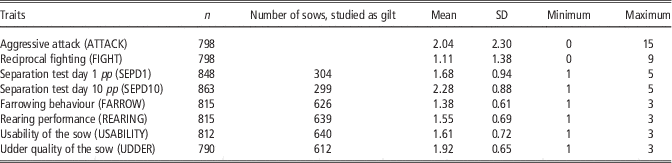
Data were collected from January 2008 to April 2012 on a nucleus farm of the pig breeding company BHZP GmbH, Dahlenburg, Germany. Data for the separation test of the sows were only available for the years 2010 and 2011. Data for maternal behaviour traits included 2022 purebred litters of 848 purebred Large White sows, that is, on average there were 2.4 litters/sow included in this study. The mean parity number of the tested sows was 2.45±1.55. The herd-monitoring software db.Planer (version V1209; BHZP GmbH) was used on the nucleus farm. Not all gilts and sows were observed in all traits (Table 1). Pedigrees of tested animals were traced back four generations, resulting in a pedigree file comprising 1803 animals.
Recorded behaviour traits and number of phenotyped gilts and sows

pp=postpartum.
Behaviour traits
All behaviour traits used in the present study were designed to be recorded with low extra time and labour, so that these traits may fulfil the requirements for integration into the daily workflow of commercial nucleus farms. Each animal was identified via an ear tag.
Agonistic behaviour in groups
After leaving the rearing unit at an average age of 217±17.7 days, gilts were moved to one of four identically constructed pens in the gestation building. The pens were equipped with partly slatted floors and electronic sow feeders (Mannebeck GmbH, Schüttorf, Germany). Pens had a free surface area of 71 m². The average size of the newly mixed groups of gilts was 18 (range: 14 to 22 animals). For enrichment a scratch brush was installed in every pen. Animals were fed a commercial pelleted diet (12.2 MJ metabolisable energy); the amount was restricted to 2.8 kg feed/animal per day. From group housing in the rearing unit, on average, 4.00±2.31 gilts were acquainted with each other. The groups were composed on average of 58% (range: 47% to 68%) purebred Large White and 42% (range: 32% to 53%) purebred Pietrain gilts. All gilts were individually marked by a double-sided, numbered ear tag.
The testing period lasted for 30 min and started when the last gilt had entered the pen in the gestation building. During the testing time the observer stood in an alley outside of the pen, from which she had a good view of the whole test area. All data were collected alternately by one of two trained observers. Records for agonistic behaviour were collected from 798 Large White gilts and included the behaviour traits described below.
All agonistic encounters shown by the newly mixed gilts were recorded (adapted from Hellbrügge, Reference Hellbrügge2007 and as described in Appel et al., Reference Andersen, Berg and Bøe2013). Aggressive behaviour was subdivided into aggressive attacks (i.e. non-reciprocal aggression) and reciprocal fighting (i.e. reciprocal aggression). Based on this distinction, the trait ATTACK was defined as aggressive interaction, such as biting or snapping, of one gilt directed at another group member. The recipient might show a submissive reaction or respond aggressively to engage in a reciprocal fight. The frequency of the trait ATTACK per gilt was documented by the observer. The identity of the attacked gilt, which fled or was displaced from the area instead of retaliating, was not recorded. FIGHT was defined as reciprocal fighting, in which two or more involved pigs were seen to be pushing, head knocking or biting the opponent(s). For the trait FIGHT, the frequency of fights was documented for all of the involved gilts. Further information about the observed behaviour traits is presented in Appel et al. (Reference Andersen, Berg and Bøe2013).
Maternal behaviour (sows’ responses in the separation test)
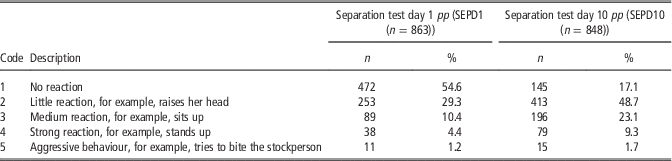
Traits which were associated with maternal behaviour were recorded during the lactation period in the farrowing unit. One week before the expected farrowing date the sows were placed in the farrowing compartments. Each farrowing compartment included 12 farrowing pens; all farrowing pens – equipped with farrowing crates – were of the same type with the dimensions 2.46×1.95 m. The farrowing crates were arranged diagonally to the aisle. The sows were managed in a 3-week batch farrowing system with a 4-week lactation period. During the first 2 to 12 h after birth of the last piglet and again around the 10th day after farrowing (10.68±1.57 (mean±SD) days; range: 7 to 15 days postpartum (pp)) of life, all piglets underwent procedures, such as tail docking and teeth grinding (day 1 pp), and were individually weighed (day 1 pp and day 10 pp). The reaction of the sows towards the separation from their litter, while the piglets were weighed and handled outside the pen in the aisle, was documented on both occasions (separation test day 1 pp and separation test day 10 pp) by four different observers (adapted from Hellbrügge et al., Reference Hellbrügge and Henne2008). The sow’s maximum reaction towards the separation of her litter was classified according to five categories ranging from (1) no reaction to (5) aggressive reaction (Table 2). All farrowing considered for this study were attended and supervised by the nucleus farm staff.
Description of the sows’ maximum response categories in the separation tests on day 1 postpartum (pp) (SEPD1) and day 10 pp (SEPD10)

Performance of the lactating sow
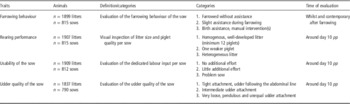
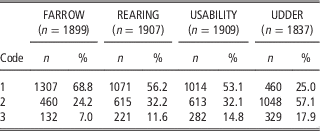
Traits associated with the sow’s performance during lactation included behavioural and performance traits (Table 3). The traits farrowing behaviour (i.e. need of birth assistance, FARROW), rearing performance (i.e. litter quality at day 10 pp, REARING) and usability (i.e. additional labour input during lactation period e.g. for treatments, USABILITY) were recorded using a three-point score (Table 4) and were evaluated by the herd manager of the nucleus farm. It has to be noted that there is no clear definition of the complex trait usability. The trait udder quality (i.e. udder attachment, UDDER) was evaluated by one person from the breeding division.
Definitions of the traits associated with sows’ performance and number of phenotyped animals

pp=postpartum.
Frequencies of the sows in categories in the traits associated with lactating sow’s performance

FARROW=farrowing behaviour of the sow; REARING=rearing performance of the sow; USABILITY=usability of the sow during lactation; UDDER=udder quality of the sow.
Statistical analysis
Analysis of fixed effects
Data analysis at the phenotypic level was performed using the SAS 9.2 statistical software package (SAS Institute, Inc., Cary, NC, USA). In spite of significant deviations in the scored traits from a normal distribution (P<0.05), all traits were nevertheless analysed using parametric methods due to robustness of these methods to deviations from normality (Geng et al., Reference Geng, Schneeman and Wang1982; Littell et al., Reference Littell, Milliken, Stroup, Wolfinger and Schabenberger2006) and due to greater efficiency of parametric methods compared with non-parametric methods. The significance of the fixed effects and their interactions was tested with the procedure MIXED. For this purpose, basic models were defined based on results from earlier studies (e.g. Hellbrügge, Reference Hellbrügge2007; Tönepöhl et al., Reference Tönepöhl, Appel, Voss, König, Borstel and Gauly2013). These models included test batch (see below for definition) and test pen as fixed effects for the analysis of agonistic behaviour and farrowing batch and parity as fixed effects for the analysis of the maternal behaviour traits and performance of the lactating sow.
Agonistic behaviour in groups: a test batch was defined as a group of gilts, whose behaviour was observed in three consecutive tests, which were conducted within a 9-week period (26 classes). For agonistic behaviour traits (ATTACK and FIGHT, respectively) of gilts the influence of the fixed effect test batch was assessed.
Maternal behaviour (sows’ responses in the separation test): due to low numbers of observations, for a better allocation of the levels ‘4’ and ‘5’ of the sow’s reaction at the first separation test (2 to 12 h pp, SEPD1) and second separation test (around day 10 pp, SEPD10), these scores were combined for the traits to score ‘4’. A group of sows which gave birth to their piglets within a period of 9 weeks (13 classes) was defined as a farrowing batch. The fixed effect of the parity was divided into three classes, where parity ‘1’ and parity ‘2’ were individual classes and all parities ⩾‘3’ were in the third class. The following fixed effects were considered for the analysis of the behaviour traits SEPD1 and SEPD10 in the farrowing unit: farrowing batch, parity, observer (four classes) and the permanent environmental effect of the sow (pesow).
Performance of the lactating sow: for the traits related to the lactating sow’s performance the fixed effects farrowing batch and parity were included in the model, as well as the permanent environmental effect of the sow.
Statistical significance was accepted at P<0.05. Non-significant effects other than those included in the basic models and described above were not included in the final models. These non-significant effects included, for example, the number of gilts that were acquainted for the traits describing agonistic behaviour.
Pearson correlations were used to calculate phenotypic correlations between the behaviour traits and performance of the sow.
Heritabilities and genetic correlations
The variance components of the agonistic behaviour traits and maternal behaviour traits were estimated univariately using the VCE 4 package (Neumaier and Groeneveld, Reference Neumaier and Groeneveld1998). The genetic correlations between the observed traits were estimated bivariately. Thus, the final models for behaviour as well as performance traits were
Agonistic behaviour in groups (ATTACK and FIGHT):
 $$y_{{ijk}} \,{\equals}\,test\,batch_{i} {\plus}test\,pen_{j} {\plus}e_{{ijk}} $$
Maternal behaviour (sows’ responses in the separation test, SEPD1 and SEPD10):
 $$y_{{ijklm}} \,{\equals} \, farrowing\,batch_{i} {\plus}partity_{j} {\plus}observer_{k} {\plus}pe_{{sowl}} {\plus}e_{{ijklm}} $$
Performance of the lactating sow (FARROW, REARING, USABILITY, UDDER):
 $$y_{{ijkl}} \,{\equals} \, farrowing\,batch_{i} {\plus}partity_{j} {\plus}pe_{{sowk}} {\plus}e_{{ijkl}} $$
Results
Agonistic behaviour in groups
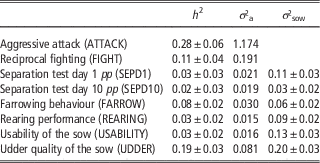
The frequency of the trait ATTACK per gilt ranged from 0 to 15, with a mean of 2.04±2.30. Large White gilts were involved in zero to nine reciprocal aggressions (FIGHT), the mean value for the trait FIGHT was 1.11±1.38. The relatively high standard deviations of the parameters indicated great differences in the agonistic behaviour of the individuals after mixing with unfamiliar conspecifics. The effect test batch significantly impacted the occurrence of agonistic interactions in Large White gilts. The number of unacquainted animals had no significant effect on ATTACK and FIGHT. Low to moderate heritabilities could be estimated for the observed agonistic behaviour traits. The heritability for the trait ATTACK was h 2=0.28±0.06 and for the trait FIGHT the heritability was h 2=0.11±0.04.
Maternal behaviour (sows’ responses in the separation test)
The sows showed, with a mean value of 2.28±0.88, a numerically stronger reaction towards the separation of their piglets at SEPD10 compared with their response within the first 2 to 12 h after birth (1.68±0.94, mean±SD). There was no significant difference between the behaviour of the sows at different parities at SEPD1 and SEPD10. The test batch did not influence the response of the sows at the two separation tests, but the scores at SEPD10 were significantly affected by the observer. Heritabilities of a low magnitude were estimated for SEPD1 and SEPD10. The standard errors were high and in the range with the corresponding heritabilities (Table 5).
Heritabilities (±SE), additive genetic variance (σ²a) and random permanent effect of the sow (σ²sow) for behaviour traits (ATTACK, FIGHT, SEPD1 and SEPD10) and sows’ performance traits evaluated during lactation

pp=postpartum.
Performance of the lactating sow
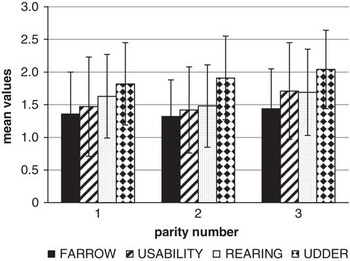
All traits associated with the sow’s performance during lactation were affected significantly by the test batch as well as by the parity number. For the traits FARROW, REARING and USABILITY of the sow, the second parity sows received the lowest and therefore best scores (Figure 1). Primiparous sows had the best scores for the trait UDDER, and there is a gradual deterioration of the trait UDDER with higher parities. Variance components are given in Table 5. The conformation trait UDDER had the highest heritability.
Mean values (with standard error bars) of farrowing behaviour (FARROW), rearing performance (REARING), usability of the sow (USABILITY) and udder quality of the sow (UDDER) for sows in different parities.

Correlations between the behavioural traits
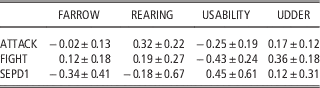
Among the two traits concerning agonistic behaviour (ATTACK and FIGHT, respectively), a high genetic correlation with low standard error (r g =0.97±0.03) was found. However, with this correlation the part–whole relationship between the behaviour traits ATTACK and FIGHT has to be considered, that is, gilts which were involved in reciprocal fighting (FIGHT) were simultaneously also recorded for the trait ATTACK. Negative genetic correlations between agonistic behaviour traits of newly mixed gilts and the trait SEPD1 were estimated (r g =−0.22±0.26 and r g =−0.41±0.33 for ATTACK and FIGHT, respectively). Thus, more aggressive sows (ATTACK and FIGHT, respectively) tended to be genetically predisposed to be less responsive in the first separation test.
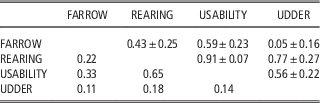
The estimated genetic correlation between the traits SEPD1 and SEPD10 was highly positive (r g =0.98±0.24). A negative genetic correlation was estimated between the traits SEPD10 and the trait USABILITY of the lactating sow (r g =−0.27±0.29). Sows with farrowing complications were less responsive in SEPD1 (r g =−0.34±0.41). Sows that showed more aggressive attacks needed less extra labour input (e.g. for caring) by the farm staff during lactation (r g =−0.25±0.19). Positive genetic correlations were found between the trait REARING and aggressive behaviour traits (r g =0.32±0.22 and r g =0.19±0.27 for ATTACK and FIGHT, respectively). More aggressive sows had higher (poorer) scores for REARING and UDDER (Table 6). For all genetic correlations high standard errors were estimated. Among the traits REARING and UDDER a genetic correlation of high magnitude was estimated. This implies that sows with a better udder also had more uniform and marketable piglets at their side on day 10 pp. Table 7 shows the genetic and phenotypic correlations between the lactating sow’s performance traits.
Genetic correlations within the behaviour traits and traits for sows’ performance during lactation

FARROW=farrowing behaviour of the sow; REARING=rearing performance of the sow; USABILITY=usability of the sow during lactation; UDDER=udder quality of the sow; ATTACK=aggressive attack at mixing; FIGHT=reciprocal fighting at mixing; SEPD1=separation test day 1 postpartum.
Genetic correlations (above diagonal) and phenotypic correlations (below diagonal) within the traits for sows’ performance during lactation

FARROW=farrowing behaviour of the sow; REARING=rearing performance of the sow; USABILITY=usability of the sow during lactation; UDDER=udder quality of the sow.
Discussion
Agonistic behaviour traits
The estimated heritabilities in this study for the traits ATTACK and FIGHT in Large White gilts agree with the findings of Løvendahl et al. (Reference Løvendahl, Damgaard, Nielsen, Thodberg, Su and Rydhmer2005), who likewise found low to moderate heritabilities for frequencies of mild and severe attacks of mixed sows. Appel et al. (Reference Andersen, Berg and Bøe2013) found moderate heritabilities for the traits ATTACK and FIGHT in purebred Pietrain gilts. For non-reciprocal aggression and reciprocal aggression of 70.5 days old pigs, Turner et al. (Reference Turner, Roehe, D’Eath, Ison, Farish, Jack, Lundeheim, Rydhmer and Lawrence2009) as well as D’Eath et al. (Reference D’Eath, Roehe, Turner, Ison, Farish, Jack and Lawrence2009) found heritabilities of a moderate to high magnitude. Turner et al. (Reference Turner, Roehe, D’Eath, Ison, Farish, Jack, Lundeheim, Rydhmer and Lawrence2009) noted that selection against post-mixing lesions could not only reduce immediate aggression at mixing, but also translate into a long-term impact on injures from aggression, even after dominance relationships are established. However, for a more thorough understanding of aggressiveness, in future studies it should additionally be recorded whether an attack resulted in a fight and whether an individual pig initiated the fight or not.
Maternal behaviour (sows’ responses in the separation test)
Sows were less responsive towards the SEPD1 than to the SEPD10. The slow reactive behaviour of the sows at the SEPD1 may be affected by the physical exhaustion of farrowing (Hellbrügge et al., Reference Hellbrügge and Henne2008; Tönepöhl, Reference Tönepöhl2012; Voß et al., Reference Voß, Appel and Henne2013). In the present study, sows which needed birth assistance (e.g. provoked by a prolonged parturition) reacted less towards SEPD1. In accordance with the studies by Grandinson et al. (Reference Grandinson2003) and Vangen et al. (Reference van Nieuwamerongen, Bolhuis, van der Peet-Schwering and Soede2005) it can be assumed that the parity number and therewith the experience of the sow has no effect on their reaction at the separation test. Heritabilities for SEPD1 and SEPD10 were low and in the range with heritabilities in the literature for the behaviour traits observed during the time in the farrowing unit (Grandinson et al., Reference Grandinson2003; Løvendahl et al., Reference Løvendahl, Damgaard, Nielsen, Thodberg, Su and Rydhmer2005; Hellbrügge et al., Reference Hellbrügge and Henne2008). For the evaluation of the traits SEPD1 and SEPD10, it must be considered that there is a conflict: on the one hand sows that are highly responsive towards their litter are preferred, but on the other a high responsiveness of a sow may go along with more posture changes, which can increase the risk of crushing (Damm et al., Reference Damm, Vestergaard, Schrøder-Petersen and Ladewig2000; Wischner, Reference Wischner2009).
Performance of the lactating sow
Farrowing behaviour
The heritability for the trait FARROW was in the range with the results of few studies, which analysed the genetic variation of farrowing behaviour traits, even though the definitions of the traits differ slightly. Holm et al. (Reference Holm, Bakken, Vangen and Rekaya2004) observed the necessity of birth assistance (h 2=0.05) in Norwegian Landrace sows. The need of birth assistance in Large White sows was recorded by the farmers in a study by Canario et al. (Reference Canario, Roy, Gruand and Bidanel2006). They found heritabilities of h 2=0.05 and h 2=0.03 (considered as continuous and binary trait, respectively) for this trait. These low heritabilities may indicate that the frequency and therewith the variation in farrowing behaviour and birth assistance depends to a large extent on environmental factors, such as the management of the farm and the breed of the sows.
Litter size, farrowing duration and the application of birth intervention are found to be risk factors for the occurrence of sow infections in the periparturient period, like the coliform mastitis (Gerjets, Reference Gerjets2011). Post-parturient disorders, like coliform mastitis, might affect serious economic losses due to lower productivity of affected sows and higher pre-weaning piglet mortalities (Gerjets and Kemper, Reference Gerjets and Kemper2009). Results of the present study show that good farrowing behaviour is associated with good rearing performance and low extra work per sow. Despite the low heritability, selection for the trait FARROW might even decrease the risk for post-parturient disorders.
Rearing performance
Piglet survival and the number of weaned piglets have been identified as some of the main factors affecting the economic performance of pig production. Concerning the trait REARING, it should be noted that components of this trait like carefulness with body position changes or lying down, less aggressiveness towards piglets, high milk production and good nursing behaviour can be also attributed to the trait USABILITY of the sow.
The highest piglet mortality is observed within the first 5 days pp with >50% of all pre-weaning, predominantly from crushing and starvation (Grandinson et al., Reference Grandinson2003; Hellbrügge, Reference Hellbrügge2007). In literature, heritabilities of low magnitude were found for the number of weaned piglets (Serenius and Stadler, Reference Serenius and Stadler2004; Sevón-Aimonen et al., Reference Sevón-Aimonen, Haltia and Uimari2012). Due to challenges associated with increasing prolificacy, the trait REARING including aspects, which were associated directly with maternal ability, such as piglet’s growth and milk yield, are of great relevance and will gain importance in future. This trait is suitable for commercial pig farming, for example, for closed herd systems.
Usability of the sow
Although currently implemented in practice (Voß et al., Reference Voß, Appel and Henne2013), there is no clear definition of the complex trait USABILITY. The usability and with that the (extra) labour input per sow has recently been given greater focus because of increasing herd size, resulting in decreased time spent per animal and a higher amount of unskilled workers on commercial pig farms. Nowadays, sows have to adapt quickly and without causing difficulty to new staff, unacquainted conspecifics and husbandry technology. In the farrowing unit sows should have a good voluntary feed intake and a low medication frequency, so that the labour input per sow and the resulting costs are low. Due to the high genetic correlation between the trait USABILTY and the trait REARING, an autocorrelation can be assumed. Extra work per lactating sow, for example, that provoked by post-parturient disorders, might go along with a lower number of weaned piglets and an increase of antibiotic use. Literature in this field is rare. Only Vangen et al. (Reference van Nieuwamerongen, Bolhuis, van der Peet-Schwering and Soede2005) estimated in their study, based on questionnaires sent to Norwegian nucleus farms, a low heritability for the question: ‘Is the sow’s overall behaviour good for you as farmer (in relation to aggressiveness, fear and handling)?’, which includes some aspects of the trait USABILITY.
Udder quality of the sow
Litter size is included in the goal of most pig breeding programmes. To wean large numbers of fast growing uniform piglets a healthy udder of the sow with well-functioning mammary glands is important (Nielsen et al., Reference Nielsen, Pedersen and Sørensen2001). For piglets’ survival even the number of teats is critical – each piglet needs a teat. The quality of the udder is also important for the longevity of the sow. Engblom et al. (Reference Engblom, Lundeheim, Dalin and Andersson2007) reported that udder problems, including low or no milk production as well as mastitis and udder abscesses, are the second most frequent involuntary culling reason of sows in Sweden. Morphological and genetic studies on the sows’ udder are scarce and restricted to functional teat number in terms of milk production. The estimated heritability of the total number of teats and the number of functional teats, both at 3 weeks of age and at 100 kg live weight, was in the range h 2=0.36 to 0.42 (Chalkias et al., Reference Chalkias, Rydhmer and Lundeheim2013). However, selection for greater teat number has practical difficulties and may have undesirable side-effects, that is, if it is associated with a longer spine and associated defects (Rutherford et al., Reference Rutherford, Baxter, D’Eath, Turner, Arnott, Roehe, Ask, Sandoe, Moustsen, Thorup, Edwards, Berg and Lawrence2013). Although rare in sows, udder conformation in cows, sheep and goats have been well studied, as this determines the aptitude for mechanical milking (e.g. Berry et al., Reference Berry, Buckley, Dillon, Evans and Veerkamp2004; Pritchard et al., Reference Pritchard, Coffey, Mrode, Moore and Wall2010). Due to the adequate heritability for the trait UDDER in the present study, it can be assumed that a selection for good udder quality and firm udder attachment also in higher parities seem to be practicable. The genetic correlation between UDDER and REARING was on a high level. Thus, results of the present study indicate that by a selection for udder quality, a higher number of piglets can be weaned and subsequently marketed. In addition, the sows’ longevity might increase as udder problems are a frequent culling reason (Engblom et al., Reference Engblom, Lundeheim, Dalin and Andersson2007). This might have positive effects on the profitability of the pig farms and the welfare of the animals.
Correlations of the behavioural traits
The genetic correlation between ATTACK and FIGHT was on a high positive level, indicating that these behaviour traits share the same genetic basis beyond that imposed by the part–whole relationship. The genetic correlation fell into range with genetic correlations between reciprocal aggression and the delivery of non-reciprocal aggression reported in other studies (Turner et al., Reference Turner, D’Eath, Roehe and Lawrence2008; D’Eath et al., Reference D’Eath, Roehe, Turner, Ison, Farish, Jack and Lawrence2009; Appel et al., Reference Andersen, Berg and Bøe2013). A high positive genetic correlation was also found between SEPD1 and SEPD10, which indicates that these behaviour traits assessed at different points in time measured the same dimension of personality and therefore have a similar genetic background. The lower reaction towards SEPD1 compared with SEPD10 might be provoked by the exhaustion after parturition. Løvendahl et al. (Reference Løvendahl, Damgaard, Nielsen, Thodberg, Su and Rydhmer2005) also found a favourable (negative) genetic correlation between the response of the sow to their piglets being handled and fewer mild and severe aggressions at the mixing of sows. The results indicate that less aggressive sows were stronger responding mothers. In a study of Andersen et al. (Reference Appel, Voß, Tönepöhl, König von Borstel and Gauly2005), sows which were not performing any fatal crushing within one lactation had a more protective mothering style and avoided conflicts to a larger extent in a grouping situation than those who crushed several of their offspring. In contrast, the genetic correlation in a study of Hellbrügge et al. (Reference Hellbrügge and Henne2008) showed that aggressive sows were more responsive towards their litters in the separation test, especially on the day of giving birth. Due to the negative genetic correlation between response to separation tests and aggressiveness in the present study, it can be supposed that breeding for lower aggressiveness in pigs has no unfavourable effect on maternal behaviour.
The correlations between the trait USABILITY and agonistic behaviour traits point out that more aggressive sows at the time of mixing needed lower work time input during the period of housing in the farrowing unit. It might be that aggressive sows are physically stronger, so that these sows do not need any extra supervision during lactation. Contrary to this, calmer sows at mixing showed a better rearing performance. All sow performance traits, which were evaluated during lactation, were positively correlated. Considerable autocorrelations between these traits can be assumed (Hellbrügge and Henne, Reference Hellbrügge, Tölle, Bennewitz, Henze, Presuhn and Krieter2010). Nevertheless, a good rearing performance is supported by a good and persistent udder quality, low extra time per sow and no complications at farrowing. A successful farrowing without any assistance even decreases the risk of post-parturient disorders (Preissler et al., Reference Preissler, Tetens, Reiners, Looft and Kemper2013).
All traits within the present study could be recorded with low extra time. For example, for traits associated with agonistic behaviour, recording time was on average 1.67 min/animal (range: 1.36 to 2.14). Especially, the agonistic behaviour traits as well as traits associated with the sow’s performance during lactation seem to be possible management and selection criteria and therefore can be established in commercial pig and nucleus farms. Due to low heritabilities and a lack of significant correlations with other traits, the separation test does not characterise maternal behaviour well.
Conclusion
Behaviour traits, such as maternal ability or aggressive behaviour, will likely further gain importance in pig breeding programmes in addition to traits such as litter size, growth rate, carcass attributes and feed efficiency due to current trends in pig production. The results of the present study suggest that breeding simultaneously for both reduced aggression and good maternal ability is possible. Therefore, the implementation of these traits for selection in commercial pig farms is feasible and desirable.
Acknowledgements
This study was performed within the project ‘Investigations of possibilities to integrate behaviour traits in pig breeding programmes’, funded by the Federal Ministry of Food, Agriculture and Consumer Protection (BMELV) via the Federal Office for Agriculture and Food (BLE) in the framework of the programme ‘Innovation facilitation’ (PGI-06.01-28-1-35.026-08). The authors thank the staff of the ‘BHZP GmbH’ for their support during the recording of the data.