Introduction
Digital interventions (e.g. websites and mobile phone-based programmes) can help smokers to stop (Chen et al., Reference Chen, Madan, Welton, Yahaya, Aveyard and Bauld2012; Civljak, Sheikh, Stead, & Car, Reference Civljak, Sheikh, Stead and Car2010; Myung, McDonnell, Kazinets, Seo, & Moskowitz, Reference Myung, McDonnell, Kazinets, Seo and Moskowitz2009; Shahab & McEwen, Reference Shahab and McEwen2009; Whittaker et al., Reference Whittaker, Borland, Bullen, Lin, McRobbie and Rodgers2009), and could benefit particular groups such as pregnant women (Naughton, Prevost, Gilbert, & Sutton, Reference Naughton, Prevost, Gilbert and Sutton2012; Pollak et al., Reference Pollak, Lyna, Bilheimer, Farrell, Gao and Swamy2013). Regular interaction with pregnant smokers could afford healthcare providers (HCPs), primarily midwives and stop smoking advisers, valuable insights into effective methods of providing smoking cessation support for this population. In addition, their frequent contact with pregnant women may enable them to act as portals for accessing any digital smoking cessation interventions that might be developed.
Frequent appointments during pregnancy represent a valuable opportunity for HCPs to keep health behaviour change in mind, monitor smoking status and provide brief smoking cessation support for women (NICE, 2010a). In the UK, pregnant smokers have to be referred to, or book an appointment at, a stop smoking service in order to benefit from more intensive face-to-face behavioural support and pharmacotherapy (i.e. nicotine replacement therapy: NRT) (NICE, 2010b). Uptake of these interventions is low (Tappin et al., Reference Tappin, McAskill, Bauld, Eadie, Shipton and Galbraith2010) and barriers to smoking cessation support can be identified at each step: identification of pregnant smokers, referral to specialist smoking cessation services, engagement with services, and smoking cessation treatment (Beenstock et al., Reference Beenstock, Sniehotta, White, Bell, Milne and Araujo-Soares2012; Tappin et al., Reference Tappin, McAskill, Bauld, Eadie, Shipton and Galbraith2010). According to pregnant smokers, reasons for their reluctance to engage with smoking cessation services include negative feelings about smoking cessation services and speaking with someone face-to-face, and/or having difficulties accessing healthcare facilities (Herberts & Sykes, Reference Herberts and Sykes2012; Ingall & Cropley, Reference Ingall and Cropley2010; Ussher, Etter, & West, Reference Ussher, Etter and West2006). Barriers identified by HCPs include lack of time and competing priorities during appointments, fear of causing guilt and shame, and putting extra pressure on pregnant smokers (Abatemarco, Steinberg, & Delnevo, Reference Abatemarco, Steinberg and Delnevo2007; Beenstock et al., Reference Beenstock, Sniehotta, White, Bell, Milne and Araujo-Soares2012; Herberts & Sykes, Reference Herberts and Sykes2012; Price, Jordan, & Dake, Reference Price, Jordan and Dake2006; Thyrian et al., Reference Thyrian, Hannöver, Röske, Scherbarth, Hapke and John2006).
There might be scope for digital interventions to address some of the barriers associated with smoking cessation during pregnancy, since these programmes do not require face-to-face contact, are available any time, and appear to be acceptable for pregnant smokers (Naughton, Jamison, & Sutton, Reference Naughton, Jamison and Sutton2013; Naughton et al., Reference Naughton, Prevost, Gilbert and Sutton2012; Pollak et al., Reference Pollak, Lyna, Bilheimer, Farrell, Gao and Swamy2013). However, there are currently no evidence-based smoking cessation websites or smartphone applications specifically designed for pregnant smokers. Equally, there is no published information on what would constitute an effective digital smoking cessation intervention for this population in terms of content, features and mode of delivery. This study solicited HCPs’ views regarding the use of digital smoking cessation interventions with pregnant women to inform the design and delivery of such interventions.
Methods
Research design
Two qualitative focus groups were conducted. The focus group design was chosen because it allowed the collection of detailed information on HCPs’ views and attitudes, elaborated through discussion (Finch & Lewis, Reference Finch, Lewis, Ritchie and Lewis2003; Krueger, Reference Krueger2002). Ethical approval for this study was obtained from the UCL Research Ethics Committee (Project ID: 4322/001). Informed consent was sought from the participants, and confidentiality and anonymity were assured. Participants received no financial incentives, but lunch and refreshments were provided.
Sample
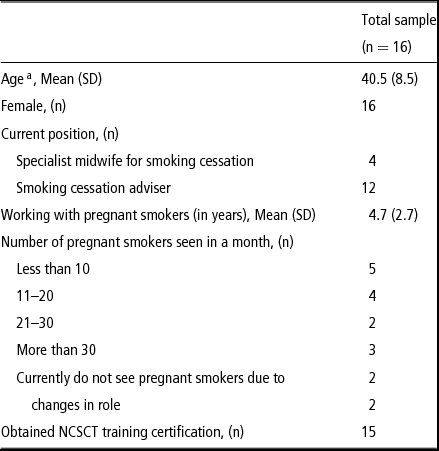
Participants were recruited from a network of HCPs who provided smoking cessation support for pregnant smokers in England. This network meets three to four times a year with organised speakers and workshop activities on topics of interest, and the focus group discussions were arranged for one of these meetings. One focus group was scheduled for the morning session of the meeting and one for the afternoon. The chair of the network sent the initial e-mail invitation to everyone on the network's mailing list (135 people), inviting them to attend the meeting and the focus groups, and subsequent email reminders were sent prior to the meeting. Of the 20 people who expressed interest in participating, 16 were available at the time the groups were convened (13 and 3 participants, respectively). These 16 individuals comprised HCPs, specialist stop smoking advisers for pregnancy (n = 12) and specialist midwives for smoking cessation (n = 4), from 11 different NHS Trusts across London and South East England. Table 1 shows the participants’ characteristics.
Focus groups participants’ demographic and professional characteristics
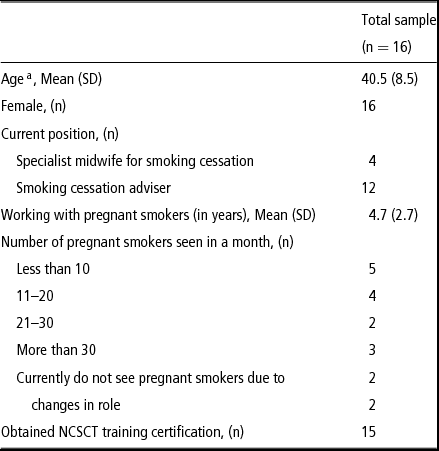
a Not reported: n = 2; NCSCT: National Centre for Smoking Cessation and Training
Procedures and Measures
Prior to the main focus group discussion, participants completed a short demographic and work-related questionnaire that asked their age, gender, position currently held, length of time working with pregnant smokers, average number of pregnant smokers seen monthly, and completion of the National Centre for Smoking Cessation and Training (www.ncsct.co.uk) training programme. Data obtained from the questionnaires were used for contextual understanding of the focus group discussions only.
During the main focus groups, one of the authors (IT) followed a semi-structured interview schedule to ensure that the same issues were covered in each group. This included questions on the participants’ views of digital smoking cessation interventions for pregnant smokers, and how these programmes might address the problems they face when providing face-to-face support for this population. Additionally, participants were asked to imagine that they were developing a highly-tailored website, smartphone application and text messaging service for pregnant smokers and then report what would seem important regarding content, format/delivery, and fitting to personal needs. Finally, to facilitate the discussion, IT guided the participants through two previously developed digital smoking cessation interventions – an iPhone app (SF28, www.sf28.co.uk) and a pilot pregnancy version of an interactive smoking cessation website (StopAdvisor) (Michie et al., Reference Michie, Brown, Geraghty, Miller, Yardley and Gardner2012) – and asked them what they thought about the programmes.
Each group session lasted approximately one hour and was designed and carried out in accordance with well-established focus group principles (Finch & Lewis, Reference Finch, Lewis, Ritchie and Lewis2003; Krueger, Reference Krueger2002; Krueger & Casey, Reference Krueger and Casey2009). At the beginning of the discussion, the facilitator (IT) introduced herself and her assistant (MR) to the participants. She explained that the aim was to explore HCPs’ views on digital smoking cessation interventions as part of an ongoing process of developing a digital intervention package for pregnant smokers, and also that they had the right not to answer any questions and to withdraw at any time without giving a reason. She reminded the participants that her only role was to moderate the discussion and encouraged everyone to share both positive and negative comments with the group at all times, emphasising that she had not been involved in developing any of the interventions that might be mentioned during the group. Finally, she asked the participants to briefly introduce themselves to each other by saying their names and identifying the NHS Trust that employed them.
Data analysis
Data were analysed thematically (Braun & Clarke, Reference Braun and Clarke2006) from a naïve realist epistemological position; that is, based on the assumption that the world is knowable, and perceived directly as it is (Madill, Jordan, & Shirley, Reference Madill, Jordan and Shirley2000). First, IT transcribed the focus group discussions verbatim to familiarise herself with the dataset. MR and all participants were then asked to provide feedback on the transcripts to ensure face validity. After reading through the transcripts several times, IT coded the transcripts manually around both a priori and emergent themes, and MR checked the coding for consistency. Where appropriate, data were assigned multiple codes and recurrent themes and sub-themes were identified in an iterative process. The coded data were then reviewed to identify: i) HCPs’ views of the potential value of using digital smoking cessation interventions with pregnant smokers; ii) HCPs’ views of the potential limitations of using digital smoking cessation interventions with pregnant smokers; and iii) HCPs’ recommendations for digital smoking cessation interventions for pregnant smokers. In presenting the findings, illustrative quotations have been selected to represent core issues and an anonymised coding system (comprising each individual's study number and focus group) has been used to identify participants. Data analysis was conduced manually and no qualitative software was used.
Results
There was no observable sign of any disagreements (either verbally or non-verbally) between participants in each focus group at any point during the discussions, and participants reached a consensus on different topics quickly. All themes but one were identified in both specialist midwives and stop smoking advisers’ accounts. In terms of the recommendations for digital smoking cessation interventions for pregnant smokers, only stop smoking advisers contributed to the ‘Tailoring of the messages’ theme.
HCPs’ views of the potential value of using digital smoking cessation interventions with pregnant smokers
Anonymity for pregnant smokers
HCPs emphasised that a key benefit of delivering smoking cessation support via digital devices was the anonymity they afforded users. This could address pregnant smokers’ reticence to declare their smoking status and engage those who were not interested in receiving face-to-face HCP support. Thus, HCPs reported that, although pregnant women tend not to participate in group behavioural support, they may be more likely to use peer-to-peer support in an anonymous online environment:
“I suppose for those who are struggling or those that want to admit their smoking without being judged, [a digital intervention] is great because it's like ‘they don't know what I actually look like’, ‘they’re not gonna recognise me’. ‘I’m just gonna be like maybe a number or I can maybe just give my first name’.”(P3FG1, stop smoking adviser)
Increased reach of smoking cessation support
Increasing the reach of smoking cessation support was also consistently raised by HCPs as an important potential strength of digital smoking cessation interventions. First, digital interventions provided an alternative model of support that could attract greater numbers of pregnant smokers:
“If there is an alternative out there that works for maybe just a few per cent more that, either way, out of hours or it [the smoking cessation clinic] just doesn't work emotionally, then I think it's good to have many different types of models.” (P2FG2, stop smoking adviser)
Secondly, digital interventions could offer easier access to support. In this regard, HCPs argued that pregnant smokers require a lot more time and effort to engage, particularly in terms of arranging the time and date of appointments, than smokers from the general population; therefore, digital interventions might reach those who struggle to attend face-to-face support because of travel and transport problems or lack of time. Thirdly, digital interventions might be attractive to a very wide range of women from pre-conception to post-partum, including teenagers, who do not attend any HCP support, do not return after their first appointment, or say that they do not want any help with smoking cessation.
Consistent quality of advice
The HCPs in the study noted that pregnant smokers are often misinformed about smoking and smoking cessation in pregnancy. In particular, they felt that pregnant smokers lacked knowledge about the effects of active and passive smoking on children's health, and that inconsistent messages about treatments were given to them by different health professionals. Consequently, HCPs felt that a digital intervention could serve as a much-needed source of consistent evidence-based information and a portal for accessing up-to-date research findings:
“If the midwife is saying and the GP is saying and the app has the same language, they’re more likely to [use NRT]. So have a quite a unified message.” (P2FG2, stop smoking adviser)
Availability on demand
A further benefit of digital smoking cessation interventions identified by the HCPs was its availability on demand. Digital interventions could provide on-going motivational support for pregnant smokers because they could be delivered throughout pregnancy and postpartum and between face-to-face appointments. Being available any time also meant that digital aids could play an important role in cravings management and in pre/post-partum relapse prevention:
“These women who have actually stopped, they need someone to keep saying they’re doing well, so they just need to continue along the path without relapsing.” (P2FG1, specialist midwife)
Furthermore, digital programmes could offer more intensive support than face-to-face meetings because appointments were invariably time-limited:
“I think perhaps what I could personally do, but have less time to do, is lots of. . . follow up motivational [work], say text or things like that. I do, but it's quite client-dependent rather being a consistent thing.” (P1FG2, stop smoking adviser)
A supporting role for face-to-face treatment
One final potential benefit of digital smoking cessation interventions related to their ability to support face-to-face counselling. Thus, HCPs argued that linking digital programmes directly with smoking cessation clinics could both facilitate self-referral and initiate calls to smoking cessation advisers. Additionally, they thought that the quality of the initial assessment during face-to-face support might be enhanced if smokers could share their electronic data with the smoking cessation clinics. Ultimately, this might then reduce the costs associated with smoking cessation service provision:
“It [a digital intervention] can save the NHS loads of money. Because they could run alongside each other. . . You know, people we’ve seen weekly could then be seen fortnightly and then once a month. . . It could definitely be a money-saving.” (P1FG1, specialist midwife)
HCPs’ views of the potential limitations of using digital smoking cessation interventions with pregnant smokers
Lack of access among those most economically disadvantaged
Unequal access to digital smoking cessation interventions across social groups was identified as a potentially important limitation to their use. Specifically, HCPs felt that people from lower socio-economic groups would benefit less from this type of support, since they might not possess appropriate digital devices to access the programmes:
“A lot of my clients don't have Internet access, iPhones, you know. They are lucky if they have enough money to put electricity in their meter. So, you know, it's gonna be quite a large proportion of the society that you actually cannot target unless you have something like this in a pharmacy or a children's centre.” (P4FG1, stop smoking adviser)
Need for high levels of self-motivation
Beyond this, HCPs highlighted the difficulties of engaging pregnant smokers with any type of smoking cessation support (e.g. leaflets, one-to-one or group support) and noted that this is because they tend to have low confidence in their own ability to stop smoking and be motivated externally. Thus, HCPs commented that whilst digital aids were potentially attractive for pregnant smokers, they might in practice only be suitable for those who are highly motivated to stop smoking:
“I think the populations here that we can actually talk about, based on this intervention, is, you know, smokers who really want to quit and haven't got as many issues. So, a not so hard-to-reach population, will quit their own, and this might be perfect for them to just give them a bit of a motivation.” (P11FG1, stop smoking adviser)
Lack of human contact
In order for pregnant smokers to accept smoking cessation support and to explore women's underlying motivational forces to smoking, HCPs believed that they required a good rapport with their clients. To establish this, they stressed the importance of satisfying pregnant smokers’ need to discuss other problems in their life (e.g. financial problems or relationship issues) during appointments, and noted that this would be hard to achieve through digital interventions:
“Sometimes you have to deal with all those other issues to get to smoking, and it's gonna be quite difficult using digital alone.” (P4FG1, stop smoking adviser)
Equally, HCPs argued that it was easier to establish intensive one-to-one support at the pregnant smoker's home, where the woman would feel secure. In consequence, the feasibility of a standalone digital smoking cessation intervention without face-to-face support was questioned in both focus groups.
Inability to use expired-air carbon monoxide (CO) monitoring
HCPs also stated that the inability to monitor pregnant smokers’ progress and to validate their smoking status by expired-air CO monitoring was an important limitation of digital interventions, particularly as this raised problems in linking data to the quit targets of smoking cessation services. Furthermore, participants noted that CO monitoring would be missed not just as a validation but also as a motivational tool:
“Having the CO reading keeps them motivated as well, doesn't it? They can actually see the difference there. That would be missing.” (P13FG1, stop smoking adviser)
Negative impact on smoking cessation medication
Finally, HCPs stressed that pregnant smokers have to be encouraged and supported to use NRT and were concerned that it would be more difficult for those engaging in digital smoking cessation interventions both to obtain medication and use it most effectively:
“Who is to check they’re using their medication properly? They’re over medicating or, as normal, they’re under medicating. . . I’m really doubtful.” (P1FG1, specialist midwife)
HCPs’ recommendations for digital smoking cessation interventions
Content
In terms of content, HCPs felt that it was particularly important that digital smoking cessation interventions addressed a broad range of issues, including pregnant smokers’ negative perceptions about smoking cessation support, second-hand smoke exposure, cannabis use, the short- and long-term effects of smoking on children's health, the benefits of quitting smoking and being a non-smoker in the future as well as relapse prevention. The ability of smoking cessation support to facilitate mothers’ bonding with their babies was also deemed valuable:
“I think something that helps them making the connection with the baby as well. Sometimes it can be an issue with actually connecting to the baby. That's why they sort of cancel, because they haven't made that sort of connection. So this would be for them to focus on, you know, plugging away that this is what happens to your baby this week. All that sort of stuff that will help them to make that connection.” (P1FG2, stop smoking adviser)
In addition, participants in both focus groups emphasised that providing information about pharmacological support would be necessary and pregnant smokers’ negative perceptions about NRT use, as well as their lack of knowledge about appropriate ways of using NRTs, would have to be addressed:
“So to make it clear that NRT is safe to use in pregnancy. The only thing you can't use is this, this, this. But having it really clear.” (P3FG1, stop smoking adviser)
Format and delivery
With regards to format and delivery, inclusion of a clear explanation regarding the nature of the support offered and how the digital smoking cessation programme worked were recommended. HCPs additionally argued that interventions should be easy to follow, provide interactivity, and contain more visuals than textual information:
“Things you can click on. Pictures are quite interactive. If you have lots of pictures and you can click on them to get to various points. Yeah, basically interactive.” (P2FG2, stop smoking adviser)
Further suggestions included enabling users to ask questions, receive daily tips (e.g. advice on changing their daily routines), and access the smoking cessation support in different languages. Other intervention features mentioned by HCPs included a saver calculator to help women monitor how much money they had saved by quitting smoking and a distraction game to help them cope with cravings:
“Just crossed my mind to have like a game add-on to it. ‘Cos we’re always talking about being bored, like ‘bash the craving to head’ sort of game.” (P12FG1, stop smoking adviser)
Establishing an understanding environment with continuous support and encouragement around the digital intervention was also seen as pivotal.
“I think generally just keeping that person going and checking, I guess: ‘Have you smoked?’ ‘No.’ Then ‘Great’. . . ‘Congratulations’ or a motivational feedback. If they have [smoked], more about: ‘OK, it's not the end of the world. This happens.’ You know, all sort of normalizing stuff, that again, we [HCPs] would do to help them getting back on track again.” (P1FG2, stop smoking adviser)
Reflecting this, sending motivational messages, engaging women's partners, promoting smoking cessation clinics, and including the option of peer-to-peer support were viewed as likely to be useful, alongside providing positive reinforcements by means of collectable rewards (e.g. hearts, stars), incentives (e.g. vouchers), and congratulations for each smoke-free day:
“If they can have an online interface where they can have a chat to see how others are doing. To meet all these young girls who have [the] same experiences, struggles.” (P12FG1, stop smoking adviser)
Importantly, however, HCPs noted that pregnant smokers should not be expected to send or reply to messages for extra support, and that they should be given supplementary motivational messages around their quit date.
Tailoring of the messages
In terms of tailoring support to personal needs, HCPs stated that women's preferences for the frequency, number and timing of motivational messages should be taken into account and confidentiality should be respected – with support still provided for those who did not want to declare any of their personal details. In particular, individualised messages, which included the pregnant woman's name, motivations and reasons for stopping smoking, were considered likely to enhance the success of the intervention. It was recommended that the programme should continuously monitor and record women's self-reported smoking status, levels of motivation, confidence and cravings. These could then provide the basis to further personalise messages in order to meet each individual smoker's needs.
“That can be something they could do, not necessarily every day but every few days, just like you know, ‘Out of ten, whatever, where is your motivation at?’. Just sort of to see and if it starts to drop, then ‘Oh, you can see your motivation dropped, what can we do about that?’ Because we know that it actually happens. It may be about confidence as well. You know, if they have smoked, what was that about? You know what I mean? Just keeping a track of that, and having a motivational thing at that point.” (P1FG2, stop smoking adviser)
Discussion
HCPs indicated that digital interventions offer a range of potential benefits that could make them useful for pregnant smokers. However, important limitations and recommendations regarding their design and delivery need to be considered and addressed. Our findings suggested that digital smoking cessation interventions may help to overcome the barriers to accessing face-to-face smoking cessation support, as previously noted by service providers (Abatemarco et al., Reference Abatemarco, Steinberg and Delnevo2007; Price et al., Reference Price, Jordan and Dake2006; Tappin et al., Reference Tappin, McAskill, Bauld, Eadie, Shipton and Galbraith2010) and pregnant women (Herberts & Sykes, Reference Herberts and Sykes2012; Ingall & Cropley, Reference Ingall and Cropley2010; Ussher et al., Reference Ussher, Etter and West2006). However, and also consistent with the literature, convenience (Naughton et al., Reference Naughton, Jamison and Sutton2013), anonymity (Szwajcer, Hiddink, Koelen, & Woerkum, Reference Szwajcer, Hiddink, Koelen and Woerkum2005) and the provision of information over and above HCP support (Huberty, Dinkel, Beets, & Coleman, Reference Huberty, Dinkel, Beets and Coleman2012) are likely to be important in motivating pregnant women to seek health information via digital sources.
One of the main limitations of using digital interventions identified in the focus groups related to poor access to technology amongst women from lower socio-economic groups. Although studies from different countries have consistently found that the majority of pregnant women have access to the Internet and actively use this channel to seek health information (Gao, Larsson, & Luo, Reference Gao, Larsson and Luo2013; Huberty et al., Reference Huberty, Dinkel, Beets and Coleman2012; Larsson, Reference Larsson2009), disparities between ethnic groups in overall Internet use and seeking online smoking cessation information/support have been reported (Laz & Berenson, Reference Laz and Berenson2013). Whilst there are many potential benefits of digital interventions, our findings therefore support Naughton et al. (Reference Naughton, Jamison and Sutton2013) who have argued that it is still necessary to provide pregnant women with the option of speaking to someone face-to-face.
Significantly, our findings showed good concordance with behaviour change techniques (BCTs) used in behavioural support for smoking cessation. BCTs have been proposed as the observable and replicable ‘active ingredients’ of behavioural support interventions and the smallest units with potential to change behaviour (Michie et al., Reference Michie, Richardson, Johnston, Abraham, Francis and Hardeman2013). Michie et al. have developed a taxonomy of 93 individual BCTs and incorporating these into the design of behaviour change interventions is likely to enhance the end product by enabling the assessment of the effectiveness of specific intervention components, replication of the findings and fidelity in implementation (Michie et al., Reference Michie, Richardson, Johnston, Abraham, Francis and Hardeman2013).
A number of the recommendations on specific intervention components made within the focus groups referred directly to BCTs. For example, giving advice on and facilitating the use of social support, facilitating relapse prevention, providing rewards contingent on successfully stopping smoking and providing information on the consequences of smoking and smoking cessation are already evidence-based for specialist pregnancy behaviour support for smoking cessation (Lorencatto, West, & Michie, Reference Lorencatto, West and Michie2012). Giving advice on pharmacotherapy is evidence-based for generic smoking cessation behavioural support (Michie, Hyder, Walia, & West, Reference Michie, Hyder, Walia and West2011) and giving advice on changing routine has been associated with short-term abstinence in the general population (West, Walia, Hyder, Shahab, & Michie, Reference West, Walia, Hyder, Shahab and Michie2010).
This study has a number of limitations. First, the study had a small sample size, as only 20 of the 135 people approached regarding the focus groups responded and 16 participated. Consequently, results from the two focus group discussions should not be generalised to all HCPs working with pregnant smokers in the UK. Moreover, those who took the time to participate may therefore have been motivated by especially positive or negative personal views (perhaps seeing digital interventions as an exciting innovation or conversely as a threat to their professional expertise). However, mitigating these concerns, participants were recruited from a large geographic region, had diverse demographic characteristics, and did not give any impression of biased or extreme views in the focus group discussions.
Our findings suggest that future digital smoking cessation aids for pregnant smokers need to establish a positive atmosphere with continuous support and rewarding experiences to increase women's motivation and confidence in stopping smoking. Emphasis should also be placed on providing social support and addressing women's negative preconceptions regarding medication use and face-to-face support, as well as increasing their awareness of the health consequences of smoking and quitting. A digital intervention targeted at pregnancy could potentially support women in bonding with their babies and also provide opportunities for monitoring and receiving feedback on their smoking cessation progress. Ideally, digital interventions should complement, rather than replace, face-to-face smoking cessation support in pregnancy.
To the best of our knowledge, this study is the first to explore HCPs’ views on digital interventions; a rapidly evolving new approach to aid behaviour change, such as smoking cessation. HCPs who participated in this study expressed a wide range of reasons why digital interventions might be a useful complement to face-to-face support in helping pregnant smokers to quit smoking.
Acknowledgements
IT, LS and RW are part of the UK Centre for Tobacco and Alcohol Studies. We are grateful to all the study participants.
Financial support
We are grateful for the Society for the Study of Addiction for funding IT's PhD. RW is funded by Cancer Research UK.
Conflict of interest
IT, JN and MR do not have any conflict of interest. LS has received honoraria for talk and travel expenses from manufacturers of medications for smoking cessation to attend meetings and workshops. RW has undertaken research and consultancy for companies that develop and manufacture smoking cessation medications. He has a share of a patent for a novel nicotine delivery device.
Ethical standards
The authors assert that all procedures contributing to this work comply with the ethical standards of the relevant national and institutional committees on human experimentation and with the Helsinki Declaration of 1975, as revised in 2008.