Introduction
Problems with everyday memory are commonly reported in patients with neurological disorders (Kapur & Pearson, Reference Kapur and Pearson1983; Mateer, Sohlberg, & Crinean, Reference Mateer, Sohlberg and Crinean1987; Thompson & Corcoran, Reference Thompson and Corcoran1992). To date, rehabilitation efforts have mainly focused on one-to-one interventions with patients who have sustained a traumatic brain injury (TBI) (as opposed to other etiologies) (e.g., Berg, Koning-Haanstra, & Deelman, Reference Berg, Koning-Haanstra and Deelman1991; Kaschel et al., Reference Kaschel, Della Sala, Cantagallo, Fahlbock, Laaksonen and Kazen2002). Individual attention and tailored interventions could be more successful, but group-based interventions are more economical, with the potential to make cognitive rehabilitation accessible to more patients, and, therefore, need to be evaluated. There have been fewer outcome studies of group-based memory rehabilitation in neurological populations, but these too have primarily involved patients with TBI (e.g., Ryan & Ruff, Reference Ryan and Ruff1988; Schmitter-Edgecombe, Fahy, Whelan, & Long, Reference Schmitter-Edgecombe, Fahy, Whelan and Long1995; Thickpenny-Davis & Barker-Collo, Reference Thickpenny-Davis and Barker-Collo2007). The efficacy of memory rehabilitation in this population has been supported in several reviews (e.g., Cicerone et al., Reference Cicerone, Langenbahn, Braden, Malec, Kalmar, Fraas and Ashman2011; Rees, Marshall, Hartridge, Mackie, & Weiser, Reference Rees, Marshall, Hartridge, Mackie and Weiser2007).
Studies of group-based memory rehabilitation for patients with neurological disorders other than TBI are extremely rare. The positive effects of memory rehabilitation groups for patient with epilepsy are starting to emerge (Helmstaedter et al., Reference Helmstaedter, Loer, Wohlfahrt, Hammen, Saar, Steinhoff and Schulze-Bonhage2008; Radford, Lah, Thayer, & Miller, Reference Radford, Lah, Thayer and Miller2011), but there is still insufficient evidence regarding the effectiveness of such intervention after stroke (Nair & Lincoln, Reference Nair and Lincoln2007). For studies that have involved patients with different types of neurological etiologies (including TBI), outcome results have been mixed, with some studies indicating success on particular objective memory tests (e.g., wordlist learning but not visual memory; Hildebrandt, Bussmann-Mork, & Schwendemann, Reference Hildebrandt, Bussmann-Mork and Schwendemann2006) and others showing significant changes on measures of strategy use (Jennett & Lincoln, Reference Jennett and Lincoln1991; Wilson & Moffat, Reference Wilson and Moffat1992), but not on memory tasks.
Although questionnaires have frequently been used to evaluate the impact of training on everyday functioning, with subjective reports from neurological populations, poor self-awareness of memory ability is a key concern (Fleming & Strong, Reference Fleming and Strong1995). Some memory rehabilitation studies have found improvements on questionnaires when they were completed by an informant, but not when they were completed by the patient (Kaschel et al., Reference Kaschel, Della Sala, Cantagallo, Fahlbock, Laaksonen and Kazen2002; Thickpenny-Davis & Barker-Collo, Reference Thickpenny-Davis and Barker-Collo2007). In fact, the discrepancy between self- and other-report on the Comprehensive Assessment of Prospective Memory (CAPM) has been used to gauge self-awareness and demonstrate its importance in rehabilitation contexts (Fleming et al., Reference Fleming, Riley, Gill, Gullo, Strong and Shum2008; Roche, Fleming, & Shum, Reference Roche, Fleming and Shum2002). Moreover, when subjective outcome measures are used, scores may improve as a result of “feel good” or expectancy effects (Berg et al., Reference Berg, Koning-Haanstra and Deelman1991; Thickpenny-Davis & Barker-Collo, Reference Thickpenny-Davis and Barker-Collo2007). As such, although subjective measures can provide insight into everyday functional outcomes, self-report has its limitations and it is important to consider a range of objective and subjective memory outcomes, including the observations of relatives or friends if possible.
In previous group-based memory rehabilitation studies, changes in prospective memory (PM) have rarely been specifically considered, despite this being an important aspect of everyday memory function (Kinsella et al., Reference Kinsella, Murtagh, Landry, Homfray, Hammond, O'Beirne and Ponsford1996; Mateer & Sohlberg, Reference Mateer and Sohlberg1988). When the Rivermead Behavioural Memory Test (Wilson, Cockburn, & Baddeley, Reference Wilson, Cockburn and Baddeley1985), which has a PM component, was used to evaluate outcome, no improvement was found after group-based training (Hildebrandt et al., Reference Hildebrandt, Bussmann-Mork and Schwendemann2006; Jennett & Lincoln, Reference Jennett and Lincoln1991; Schmitter-Edgecombe et al., Reference Schmitter-Edgecombe, Fahy, Whelan and Long1995; Wilson & Moffat, Reference Wilson and Moffat1992). PM changes have yet to be evaluated using a measure with alternate versions and following group-based training in the use of both external and internal strategies.
In one of the few studies to examine which factors predict better outcome, Malec, Goldstein, and McCue (Reference Malec, Goldstein and McCue1991) found that, for 18 TBI patients, better training outcome was correlated with better baseline memory performance (moderate as opposed to severe impairment) as well as with longer time since injury (range, 12–204 months), but not with age or education. Indeed, evidence to date indicates that group-based memory training is not appropriate for patients with very severe memory disorders (Cicerone et al., Reference Cicerone, Langenbahn, Braden, Malec, Kalmar, Fraas and Ashman2011) whereas within the mild-moderate range of impairment, people with more memory difficulties seem to have more to gain from intervention (e.g., Evans & Wilson, Reference Evans and Wilson1992; Fleming, Shum, Strong, & Lightbody, Reference Fleming, Shum, Strong and Lightbody2005). In addition, factors such as mood and self-awareness have been found to influence outcome from group-based neuropsychological intervention to improve everyday coping skills following TBI (Anson & Ponsford, Reference Anson and Ponsford2006). The impact of these predictors of response to group-based memory rehabilitation has not yet been investigated.
The current study aimed to evaluate the effectiveness of memory rehabilitation in neurological outpatients (mainly stroke or epilepsy)—an under-studied group who could stand to benefit from such treatment. We administered a diversified, group-based memory training program (Radford, Say, Thayer, & Miller, Reference Radford, Say, Thayer and Miller2010), used a waitlist controlled design similar to one used by Craik and colleagues (Reference Craik, Wincour, Palmer, Binns, Edwards, Bridges and Stuss2007) and determined outcome using objective and subjective measures of anterograde and prospective memory as well as self-reported strategy use. Potential predictors of outcome were investigated, including baseline memory, time since onset, mood and self-awareness of memory function.
Method
This study received approval from Sydney South West Area Health Service (RPAH zone) and University of Sydney Human Research Ethics Committees.
Participants
One hundred and fifty-seven community dwelling neurology outpatients with memory complaints were invited to participate. Inclusion criteria were (i) memory complaints, (ii) English as their language of choice, (iii) proximity to the hospital, (iv) age between 18 and 70 (older patients were not invited to minimize the chance of including those with an underlying neurodegenerative condition), (v) estimated Full Scale IQ ≥ 80. Patients with a history of psychiatric (other than a mood) disorder and those with progressive lesions were excluded. Of these, 80 provided written informed consent and underwent baseline assessment. The recruitment flow diagram is depicted in Figure 1.
Recruitment flow diagram.

Participants were assigned to one of two groups: (1) Early training group (ETG; n = 38) or (2) Late training group (LTG; n = 42). Group allocation was assigned using a stratified randomization procedure and the software program “Minim” (Evans, Day, & Royston, 2004), which allows predetermined variables relevant for group matching to be entered into a database for each participant. Each subject's allocation is generated by factoring in previous allocations and balancing the predetermined variables across groups. In the current study, “matching” variables included: Sex; Age; Estimated full-scale IQ; Etiology; and Baseline Memory (RAVLT Delayed Recall score from Assessment 1 was chosen because it encapsulated encoding, retention and retrieval aspects of memory). Fifty-six participants (30 in ETG, 26 in LTG) completed both the training and pre/post assessments, and were included in outcome analyses. For the three ETG participants who could not complete Assessment 3 (see Fig. 1), mean change scores for the ETG (Assessment 2 to Assessment 3) were used to extrapolate their Assessment 3 scores. Results for a sub-sample of participants with epilepsy have been previously reported (Radford et al., Reference Radford, Lah, Say and Miller2011).
Measures
Objective memory outcome measures
Three parallel forms of the Rey Auditory Verbal Learning Test (RAVLT), involving 15-item wordlists, were used to measure anterograde memory function following the standard test administration procedure (Lezak, Howieson, & Loring, Reference Lezak, Howieson and Loring2004; Rey, Reference Rey1958). The scores examined were total number of words recalled over the five learning trials (Total Learning) and number of words recalled after 20 min (Delayed Recall).
The Royal Prince Alfred Prospective Memory Test (RPA-ProMem) was used as an objective measure of PM function (Radford, Lah, Say, & Miller, Reference Radford, Lah, Say and Miller2011). This measure of PM features three parallel test forms (delayed alternate form reliability = .71) and consists of two time- and two event-based PM tasks. For example, “In 15 minutes time… remind me to move my car…” (time-based) or “At the end of our session… ask me for an information sheet…” (event-based). Each type of PM task is assessed at two time intervals: short (within the assessment session) or long (within 1 week of the assessment). Participants are instructed to: “…use any techniques that you think might help you remember…” Responses are scored out of three for each task (maximum total score = 12).
Subjective memory outcome measure
The Comprehensive Assessment of Prospective Memory (CAPM) (Roche et al., Reference Roche, Fleming and Shum2002) is a questionnaire assessing the frequency of common PM failures over the preceding month. It has adequate test–retest reliability (.76) and has been shown to differentiate between TBI and control groups (Chau, Lee, Fleming, Roche, & Shum, Reference Chau, Lee, Fleming, Roche and Shum2007; Roche et al., Reference Roche, Fleming and Shum2002). Self-report (CAPM-Self), as well as the report of a relative or friend (CAPM-Other), were sought. The number of patients who lived with another person who could complete the other-report version of the questionnaires was limited to 46 at baseline and 37 post-training. The outcome score was calculated by dividing the total by the number of items validly endorsed (i.e., excluding no response or “N/A” items), with a higher score indicating more memory problems.
An estimate of self-awareness of memory function was also calculated by determining the absolute discrepancy between scores from the self- and other-report versions of the CAPM from the first assessment and the scale reversed so that higher scores on the Self-Awareness variable indicated better self-awareness.
Strategy use
Two approaches were taken to measuring strategy use. (1) Number of Strategies Used: participants were first asked to write down which strategies they used to support their memory. The number of internal and external strategies generated were reviewed and tallied. (2) Types of Strategies Used: secondly, they were given a checklist of compensatory memory strategies, based on an existing list (Intons-Peterson & Fournier, Reference Intons-Peterson and Fournier1986). Six strategies were added to the original 16-item list to include technological advances in memory aids (e.g., electronic navigation devices), as well as additional strategies that were specifically addressed during training (e.g., diaries). Strategy definitions were provided (as per Intons-Peterson & Fournier, Reference Intons-Peterson and Fournier1986) and participants could seek clarification on strategies if necessary. Participants rated the frequency with which they used each of 10 internal and 12 external memory strategies, from “daily” (3 points) down to “not at all” (0 points).
Other measures
The National Adult Reading Test, revised version (NART-R) was used to estimate premorbid IQ (Nelson & Willison, Reference Nelson and Willison1991). Mood was measured using the short form of the Depression Anxiety Stress Scale (DASS-21) (Lovibond & Lovibond, Reference Lovibond and Lovibond1995) on which subjects respond to 21 “symptomatic” statements, indicating frequency of occurrence within the past week. Higher scores indicate more symptoms of depression. The DASS-21 has been validated in patients with acquired brain injury; with the depression scale most sensitive and reliable in neurological patients (Ownsworth, Little, Turner, Hawkes, & Shum, Reference Ownsworth, Little, Turner, Hawkes and Shum2008).
Memory Training Program
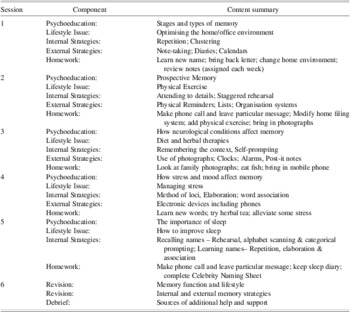
The manualized, group-based memory intervention spanned six weekly sessions of two hours (including breaks). The intervention was conducted in a clinical assessment/research unit of an acute care hospital. Groups involved 9–15 participants with two group leaders (neuropsychologists) and 1–2 student assistants. Each session involved education about memory and the factors influencing optimal memory function as well as training in the use of compensatory strategies (both internal/mental strategies and external memory aids). Group exercises and discussion were used in sessions and homework tasks were set to encourage practice and generalization of strategy use between sessions. The 2-hour sessions were divided into approximately: 15 min for reviewing homework and information from previous sessions; 20–30 min of didactic instruction; 60–80 min for practicing strategies and discussing their application; and 10 min for a break. Table 1 provides a summary of this memory intervention and full details (including instructional guidelines, description of practice exercises, handouts and other supporting materials) can be found in Radford et al. (Reference Radford, Say, Thayer and Miller2010).
Overview of memory training program (based on, with permission: Radford et al., Reference Radford, Say, Thayer and Miller2010)

Procedure
A waitlist controlled trial design was used, with the LTG forming a waitlist control group and the ETG undergoing additional follow-up assessment 12 weeks after the completion of training (Fig. 1). Three assessments were conducted at 12-week intervals (Assessment 1 to 2: M = 11.92 weeks, SD = 2.26; Assessment 2 to 3: M = 11.91 weeks, SD = 1.69). The objective and subjective measures of memory were given at each of these assessment sessions. On average, training commenced 3.21 weeks (SD = 1.86) after the last pre-training assessment. The first post-training assessment was conducted approximately 1 month (M = 4.40 weeks; SD = 1.55) after the final training session (delayed to ensure CAPM ratings reflected the post-training period). Participants had to attend at least four of six training sessions to be retained in the study, with the majority attending all six sessions (M = 5.45; SD = .63).
For objective outcome measures, three alternate test forms were administered, with the order of administration counterbalanced across participants. At baseline, a brief interview of relevant demographic and clinical history was conducted; the NART-R and DASS-21 were also administered. Memory strategy use was measured in the assessments just before and just after the training. Assessors were not blind to the participant's training condition.
Statistical Analysis
Data were screened to ensure assumptions for analyses were met, based on guidelines described in Howell (Reference Howell2007) and in Tabachnick and Fidell (Reference Tabachnick and Fidell1996). For variables where the distribution was positively skewed in either the ETG or the LTG, outlier cases were identified and allocated a score one unit higher than the next most extreme score. Partial eta square (ηp 2) values are provided as an indication of effect size. Given our sample size, we would expect all statistically significant effects to be of moderate-large magnitude (Cohen, Reference Cohen1992).
Outcome analyses
All data were analyzed using SPSS (version 15.0) with alpha levels set at .05. One-way analyses of variance (ANOVA) and χ2 tests were used to examine differences between the groups at baseline.
To examine training effectiveness, we used repeated measures ANOVA with Time of Assessment (3 levels) as the within-subject factor and Group (2 levels) as the between-subjects factor. Specifically, we examined (a) scores across the three Assessments (main effect of time) for the combined group of participants, to look for general improvements over the course of the training program. Next, planned comparisons were used to look for training-specific changes on memory outcome measures, comparing changes between the two groups from (b) Assessment 1 to Assessment 2 (during which the ETG received training) and (c) Assessment 2 to Assessment 3 (during which the LTG received training). We also compared (d) change across the 12-week follow-up period within the ETG (Assessment 2 to Assessment 3) to look for maintenance of training effects.
The clinical significance of these outcomes was also examined using reliable change indices (RCIs) (Jacobson & Truax, Reference Jacobson and Truax1991), across the training period. Previously reported test–retest reliability and normative data (standard deviations) were used to calculate this for RAVLT (Geffen, Butterworth, & Geffen, Reference Geffen, Butterworth and Geffen1994; Geffen, Moar, & O'Hanlon, Reference Geffen, Moar and O'Hanlon1990) and CAPM variables (Chau et al., Reference Chau, Lee, Fleming, Roche and Shum2007). The RCI cut-off scores (based on a 90% confidence interval) were: RAVLT Learning ± 9; RAVLT Delay ± 4; CAPM-Self ± .46. That is, individual improvement (or deterioration) needed to be of greater magnitude than the cut-off score to be considered a “reliable change.”
Finally, for strategy use, the Number of Strategies Used (internal and external), as spontaneously reported pre- and post-training, were compared using repeated measures ANOVA. Wilcoxon signed-rank tests were used to assess pre-post training changes in frequency of use ratings on the Types of Strategies Used checklist.
Individual predictors of outcome
Partial correlation analyses were used to examine the baseline predictors of training outcomes, while controlling for baseline performance. Criterion variables were pre-post training change scores, whereby positive change scores reflected improvement. Pre-post training change was calculated across the first time interval (Assessment 1 to 2) for the ETG and across the second time interval (Assessment 2 to 3) for the LTG. In addition to initial level of performance (degree of impairment) on each measure, we focused on three baseline predictors that have been previously linked to rehabilitation outcomes: Time Since Onset, Depression and Self-awareness of memory function.
Results
Baseline Comparisons
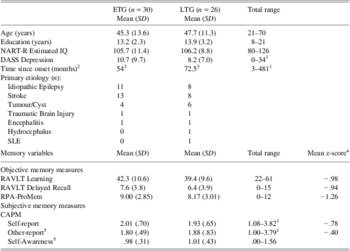
For the 56 participants who completed training, no significant between-group differences (ETG compared to LTG) were found at baseline (Table 2). Also, there were no significant differences in gender distribution between the groups (ETG: 47% female; LTG: 43% female). Forty-five (80%) of participants had evidence of memory impairment (i.e., scored in bottom 10% of normative sample on at least one memory measure).
Baseline (Assessment 1) demographics, clinical characteristics and cognitive function

1Range after adjustment for outliers; 2Onset for epilepsy patients = first seizure; 3Median values shown; 4Mean z-scores for ETG and LTG groups combined, calculated using previously reported healthy control data (Chau et al., Reference Chau, Lee, Fleming, Roche and Shum2007; Geffen et al., Reference Geffen, Moar and O'Hanlon1990; Radford et al., Reference Radford, Lah, Thayer and Miller2011); 5Sample-size reduced; ETG = Early Training Group; LTG = Late Training Group; NART-R = National Adult Reading Test, revised version; DASS = Depression, Anxiety Stress Scale; SLE = Systemic Lupus Erythematosus; RAVLT = Rey Auditory Verbal Learning Test; RPA-ProMem = Royal Prince Alfred Prospective Memory Test; CAPM = Comprehensive Assessment of Prospective Memory.
There was little difference on baseline variables between the 56 who completed training and the 24 who dropped out, with the exception of the NART-R estimated FSIQ, which was significantly higher (F 1,77 = 4.49; p = .04; ηp 2 = .06) for the participants who completed the training program (Mean = 106.0; SD = 10.2) compared to those who dropped out (Mean = 100.3; SD = 12.1). Furthermore, analyses revealed that waitlist (LTG) dropouts had significantly higher levels of Depression symptoms (Mean = 16.13; SD = 12.23; F 1,40 = 7.26; p = .01;, ηp 2 = .15) at baseline compared to participants in the LTG who completed the training program (Mean = 8.15; SD = 7.00).
Objective Memory Outcomes
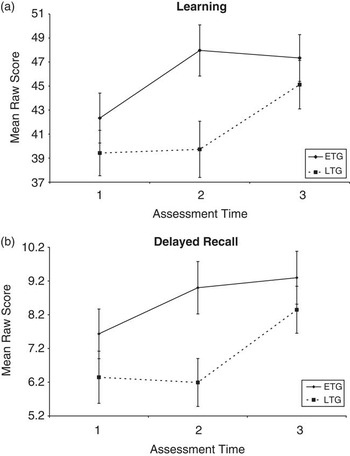
Figure 2 shows the RAVLT Learning outcomes. For the combined groups, there was a significant improvement (main effect of time) across the three training assessments (F 2,108 = 10.04; p < .001; ηp 2 = .16). Furthermore, both groups showed a training-related effect: ETG performance improved significantly more than the LTG from Assessment 1 to Assessment 2 (F 1,54 = 4.54; p = .04; ηp 2 = .08) and the LTG improved significantly more than the ETG from Assessment 2 to 3 (F 1,54 = 5.82; p = .02; ηp 2 = .10). Moreover, in the ETG, results obtained at 3-month follow-up (Assessment 3) were comparable with results obtained 2–3 weeks after completion of training (Assessment 2), indicating maintenance of training gains (F 1,29 = .13; p = .72; η 2 = .01).
Anterograde memory. (a) RAVLT Learning (total number of words correctly recalled across five learning trials; higher scores indicate better memory). (b) RAVLT Delayed Recall (total number of words correctly recalled after 20-min delay/number of words correctly recalled on learning trial 5; higher scores indicate better memory). Mean scores obtained by the Early Training Group (ETG) and Late Training Group (LTG) on three consecutive assessments. Error bars represent the standard error of the mean.

The pattern of results was similar for RAVLT Delayed Recall scores (see Fig. 2). Overall, there was a significant improvement from Assessment 1 to Assessment 3 (F 2,108 = 10.53; p < .001; ηp 2 = .16). In the ETG, the increase across the training interval in the number of words recalled after a delay was not statistically significant relative to the waitlisted LTG (F 1,54 = 3.28; p = .08; ηp 2 = .06), but the LTG showed a significant training effect (greater change score from Assessment 2 to 3 than the ETG) (F 1,54 = 5.37; p = .02; ηp 2 = .09). Again there was no significant decline across the maintenance period for the ETG (F 1,29 = .23; p = .64; η 2 = .01). Further analysis of changes in RAVLT Retention scores (Delayed Recall score/Trial 5 Learning score) revealed no significant training effects, indicating that gains in RAVLT Delayed Recall scores largely reflect more effective learning strategies as opposed to better 30-min retention.
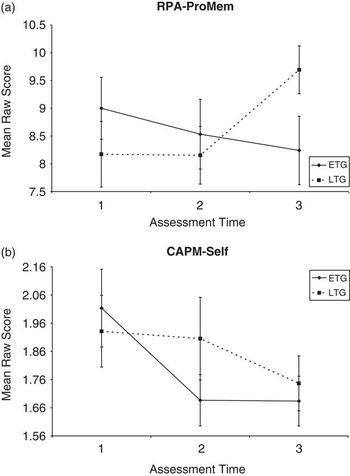
Results for the RPA-ProMem are presented in Figure 3. The analysis revealed no significant main effect of time (F 2,108 = .91; p = .41; ηp 2 = .02). Moreover, planned contrasts revealed that the ETG did not improve with training (Assessment 1 to Assessment 2) relative to the waitlisted LTG (F 1,54 = .23; p = .63; ηp 2 = .00), nor did the LTG improve with training (Assessment 2 to Assessment 3) relative to the ETG (F 1,54 = 3.47; p = .07; ηp 2 = .06). There was no significant change in RPA-ProMem scores across the maintenance period for the ETG (F 1,29 = .19; p = .66; η 2 = .01).
Prospective memory. (a) RPA-ProMem (total score; higher scores indicate better memory). (b) Comprehensive Assessment of Prospective Memory Self-report (total score for CAPM-Self; lower scores indicate better memory, that is, fewer reported prospective memory failures in the preceding month). Mean scores obtained by the Early Training Group (ETG) and Late Training Group (LTG) on three consecutive assessments. Error bars represent the standard error of the mean.

Subjective Memory Outcomes
As can be seen in Figure 3, there was a significant overall improvement (main effect of time) in CAPM-Self ratings (ε = .85; F 2,108 = 9.23; p < .001; ηp 2 = .15). Planned comparisons revealed that the ETG improved significantly more than the LTG (waitlist control) from Assessment 1 to Assessment 2 (F 1,54 = 4.23; p = .04; ηp 2 = .07). However, the change for the LTG compared to the ETG from Assessment 2 to 3 was not significant (F 1,54 = 2.00; p = .16; ηp 2 = .04). Scores did not change significantly across the maintenance period within the ETG, indicating training gains were stable at follow-up assessment (F 1,29 = .00; p = .97; η 2 = .00).
For CAPM-Other ratings, a significant improvement was found across the training period for the combined groups (main effect of time; ε = .72; F 2,70 = 4.03; p = .04; ηp 2 = .10). However, there were no significant training-specific gains for the ETG compared to the waitlisted LTG (F 1,35 = .01; p = .92; ηp 2 = .00) or for the LTG compared to the ETG in the second time interval (F 1,35 = 1.0; p = .32; ηp 2 = .03). There was also no significant change across the maintenance period within the ETG (F 1,20 = .37; p = .55; η 2 = .02).
Clinical Significance
On RAVLT Learning and Delayed Recall, 30.4% and 32.1% of participants demonstrated positive reliable changes, respectively, and performance on these variables declined in only a small proportion of participants (RAVLT Learning: 5.4%; RAVLT Delayed Recall: 3.6%). That is, at post-training assessment, the participants demonstrating reliable improvements were able to recall at least nine more words during learning trials and/or four more words following a 20-min delay, compared to their pre-training performance. Similarly, on the self-report prospective memory questionnaire (CAPM-Self), 21.4% of participants reported reliable improvements and relatively few participants declined (3.6%).
Strategy Use
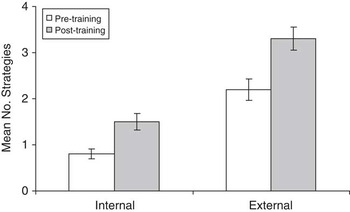
In moving from the pre- to post-training assessment, there was a significant increase in the Number of Strategies Used that participants spontaneously reported (main effect of time; F 1,49 = 28.41; p < .001; ηp 2 = .37). Participants used an increased number of both Internal and External memory strategies (strategy × time interaction ns), however, as can be seen in Figure 4, participants reported using significantly more external aids (main effect of strategy type; F 1,49 = 85.33; p < .001; ηp 2 = .64).
Self-report of number of internal and external strategies used. Error bars represent the standard error of the mean.

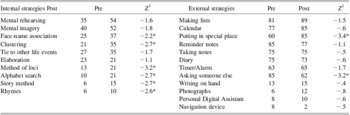
The Types of Strategies Used checklist revealed a significant increase in the frequency of use of several internal memory strategies. Significantly increased use was reported for alphabet search, face-name association, method of loci, rhyming, story method, and clustering (Table 3). For the 12 external aids, a significant increase in frequency of use was reported for just one (“putting [things] in a special place”). Interestingly, a significant decrease was found in the reported frequency of “asking someone else” as a memory strategy.
Percentage of patients that endorsed using strategies weekly or more frequently on the Types of Strategies Used checklist and pre-post training change in frequency of strategy use

*Pre-post change sig. p < .05; 1Wilcoxon Signed Ranks Test, compares frequency of strategy use reported pre-training to post-training.
Predictors of Training Outcomes
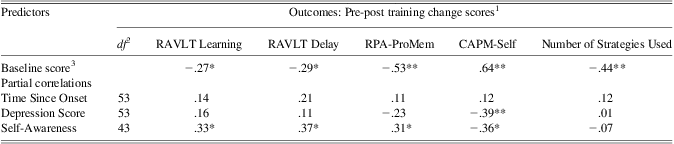
The baseline score on each memory measure was significantly correlated with the respective outcome change score; poorer baseline performance predicted greater gains (see Table 4). Self-awareness of memory function was positively correlated with pre-post training gains for RAVLT Learning, RAVLT Delayed Recall and RPA-ProMem, and negatively correlated with improvement in CAPM-Self ratings. A lower baseline level of Depression predicted better outcomes on CAPM-Self, but Time Since Onset was not a significant predictor in our sample.
Correlations between baseline (Assessment 1) predictors of memory training outcomes and pre-post training change scores
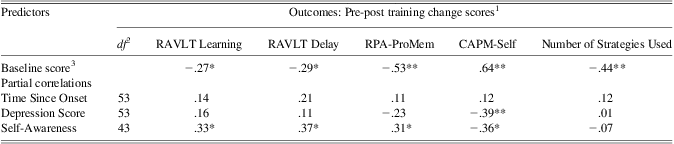
1Higher change scores indicate better outcome (improvement) across all measures; 2df = degrees of freedom, reduced for Number of Strategies Used; 3Pearson correlation between baseline and change score on the same measure; *p < .05; **p < .01 (2-tailed); RAVLT = Rey Auditory Verbal Learning Test; RPA-ProMem = Royal Prince Alfred Prospective Memory Test; CAPM = Comprehensive Assessment of Prospective Memory.
Discussion
This study demonstrated that group-based memory training is effective for outpatients with everyday memory problems resulting from a range of non-progressive neurological conditions. At a group level, the benefits of training were observed on measures of anterograde memory and self-report of PM function in daily life. Moreover, a good proportion of patients demonstrated clinically significant improvement (i.e., reliable change) on these measures and post-training gains were maintained at 3-month follow-up. In addition, participants reported an increase in strategy use following training, which has been a consistent finding across previous studies of this nature (Jennett & Lincoln, Reference Jennett and Lincoln1991; Thickpenny-Davis & Barker-Collo, Reference Thickpenny-Davis and Barker-Collo2007; Wilson & Moffat, Reference Wilson and Moffat1992). As with reports of healthy adults (Intons-Peterson & Fournier, Reference Intons-Peterson and Fournier1986) and past results from patients with acquired brain injury (Evans, Wilson, Needham, & Brentnall, Reference Evans, Wilson, Needham and Brentnall2003), external strategies were used most commonly. Nevertheless, reported use of both internal and external strategies increased after training. Of note, the only strategy that reduced following training was “asking someone else” to remember.
As with many previous studies, training effectiveness was not demonstrated on all memory outcome measures. Although a significant overall improvement (from Assessment 1 to Assessment 3) was apparent for informant ratings on the CAPM, these changes were not specific to the training period. Instead, the results for this measure suggested a general positive effect of enrolling in the study.
This was the first study to investigate the effect of diversified, group-based memory training on a specific objective measure of PM (the RPA-ProMem). Unfortunately, in contrast to anterograde memory performance, we found that PM performance did not improve. This was despite the fact that strategies to aid both anterograde and prospective memory were discussed and practiced during the training program. Previous studies have also shown poor or non-significant objective PM outcome in the context of positive anterograde memory change following memory training (Andrewes, Kinsella, & Murphy, Reference Andrewes, Kinsella and Murphy1996; Hildebrandt et al., Reference Hildebrandt, Bussmann-Mork and Schwendemann2006) and some have suggested that more intensive and repetitive training approaches may be necessary (e.g., Furst, Reference Furst1986; Raskin & Sohlberg, Reference Raskin and Sohlberg1996). Training aimed at remediating the attention and executive skills thought to underlie PM function has also been recommended (Fish et al., Reference Fish, Evans, Nimmo, Martin, Kersel, Bateman and Manly2007; Fleming et al., Reference Fleming, Riley, Gill, Gullo, Strong and Shum2008). This could be investigated further by comparing the effectiveness of alternative memory training programs at improving PM.
Patient heterogeneity in our sample was exploited to investigate how different individual factors influence the success of memory training. Baseline memory score was the only significant predictor of training changes found consistently across outcome measures in our study. Indeed, severity of memory impairment has arguably been the strongest predictor of training outcome that has emerged to date (Malec et al., Reference Malec, Goldstein and McCue1991; Ryan & Ruff, Reference Ryan and Ruff1988). Our sample included mainly patients with preserved functional independence and mild-moderate memory impairment (average baseline memory scores fell approximately one standard deviation below the normal mean), as previous evidence suggests that training in the use of compensatory memory strategies, particularly group-based training, is not appropriate for patients with more severe memory impairment (Cicerone et al., Reference Cicerone, Langenbahn, Braden, Malec, Kalmar, Fraas and Ashman2011; Rees et al., Reference Rees, Marshall, Hartridge, Mackie and Weiser2007).
Level of depression was a significant independent predictor of benefit from training, with higher levels of depression attenuating subjective PM gains. As such, engagement in depression treatment initially, followed by memory training may be a worthwhile approach for such patients. Consistent with previous findings linking self-awareness with rehabilitation success (Anson & Ponsford, Reference Anson and Ponsford2006; Dirette, Reference Dirette2002; Noe et al., Reference Noe, Ferri, Caballero, Villodre, Sanchez and Chirivella2005), we found that better self-awareness was associated with improvement on objective measures of both anterograde and prospective memory. As such, those commencing the training program with more accurate perceptions of memory function may have been able to identify and apply appropriate strategies to compensate for their particular difficulties more successfully than those with initially poor awareness. Again, pre-training efforts to improve self-awareness might lead to increased benefits of compensatory memory interventions.
On the other hand, time since onset was not associated with outcome, as has been found in other studies of memory training in non-acute patients with acquired brain injuries (e.g., Jennett & Lincoln, Reference Jennett and Lincoln1991; Radford et al., Reference Radford, Lah, Thayer and Miller2011; Wilson & Moffat, Reference Wilson and Moffat1992). In fact, in one study that did find a relationship (Malec et al., Reference Malec, Goldstein and McCue1991), results indicated that longer time since onset was associated with better memory outcome. This suggests that it is “never too late” for memory rehabilitation.
Our study might have benefitted from inclusion of more neuropsychological tests of memory outcome. For instance, tests of associative learning (e.g., face/names associations) might be particularly good for demonstrating use of internal strategies (Hampstead, Sathian, Moore, Nalisnick, & Stringer, Reference Hampstead, Sathian, Moore, Nalisnick and Stringer2008). Similarly, additional “non-memory” measures might have enhanced understanding of the specificity of outcome or potentially broader effects on general level of functioning and quality of life. There are also limitations to subjective measures of strategy use (i.e., better post-training ratings could be related to exposure to terminology and/or realizing they already use some strategies). Objective evidence of effective strategy use (e.g., monitoring diary entries) would help to verify this but, given the range of strategies presented in this intervention, an individualized approach to such assessment might be necessary.
Another limitation in the design of the current study was the lack of blinding to treatment allocation for assessment; the same clinicians were involved in both the conduct of training groups and outcome assessment. Unfortunately, this control procedure was not possible given the limited resources available to conduct the present study, but would strengthen future studies. Future studies might also consider inclusion of alternate treatment control groups to help differentiate between the effects specific to memory training groups and those associated with group-based interventions in general. For TBI patients, Wilson and Moffat (Reference Wilson and Moffat1992) found memory improvement for both memory strategy and problem-solving (alternate treatment control) training groups, but no significant advantage for memory training on most outcomes.
In addition, the current study did not set out to determine if any particular course component was more important than others; there is good evidence to support internal and external strategy training components (Cicerone et al., Reference Cicerone, Langenbahn, Braden, Malec, Kalmar, Fraas and Ashman2011). In future, alternative types of memory groups could be compared: perhaps one focused on education or discussion; the other incorporating instruction and practice in strategy use. It could be that a diversified memory program, such as the one under investigation, is more than the sum of its parts and the most effective approach in diverse clinical groups. Indeed, Sohlberg et al. (Reference Sohlberg, Kennedy, Avery, Coelho, Turkstra, Ylvisaker and Yorkston2007) identified the need for a better understanding of training components as a key issue to be addressed in future rehabilitation research to refine the effectiveness of intervention and generalizability across treatment contexts.
In terms of analyses, there are concerns regarding the multiple comparisons in this study and the risk of Type I error. However, a range of outcome measures was needed to understand the effects on memory function. Furthermore, our approach to analyses (including direct comparisons of change across the treatment and waitlist/control periods using predefined contrasts of interest) reduced the chance of drawing erroneous conclusions regarding observed positive effects.
Importantly, the present study had several methodological strengths over previous studies. These included an adequate sample size for detecting medium-large effects (Cohen, Reference Cohen1992); alternate test forms for repeated assessment to minimize practice effects; and inclusion of both objective and subjective outcome measures. Moreover, this was the first study to demonstrate the effectiveness of compensatory memory training in groups of patients with non-progressive neurological disorders other than TBI. This has implications for the provision of rehabilitation services to outpatients beyond specialist rehabilitation centers and into general neurology units dealing with a wide range of patients, including those with a history of epilepsy or stroke.