Introduction
There is a growing interest in estimating societal economic cost of dementia (Wimo et al., Reference Wimo, Jonsson and Winblad2006; Wimo et al., Reference Wimo, Winblad and Jönsson2010; Wimo et al., Reference Wimo, Jönsson, Bond, Prince and Winblad2013; Wimo et al., Reference Wimo2016) worldwide. The overall societal cost is made up of direct and indirect cost. While both are hard to estimate, direct costs are harder because access to actual insurer claims or utilization data is usually restricted to researchers. Current estimates available in the literature, and in particular for developing countries such as Colombia, are imputed using the basic assumption that there is a relationship between the direct costs and resources for dementia care and the gross domestic product (GDP) per capita (Jacobzone et al., Reference Jacobzone, Cambois, Chaplain and Robine1998). This assumption is methodologically weak because it does not account for differences in what is covered by the health system or the health insurer, the cultural context, the availability of drugs, treatments and procedures, prices, and the effect on use and access of cost-sharing mechanisms, to name a few. Less is known about direct costs by severity and how costs vary because of the presence of other comorbidities. In this paper, we use claims data from a mid-size health insurer in Colombia, to accurately estimate observed expenses associated with patients with dementia by severity and by number of chronic conditions. Also, a regression analysis is performed to estimate attributable cost to dementia given the presence of other chronic conditions.
Methods
This is a descriptive study on administrative data for years 2011 to 2013 using de-identified claims from an HMO in Colombia under an academic agreement with our University (Icesi). The dataset is prepared annually and submitted to the national government for regulation purposes and can be audited, a reason to believe in its accuracy.
The HMO is a mid-size insurer, with an average monthly enrollment for 2013 of 819,984 covered lives. The national market share of this HMO is 4% in the contributory scheme, but has the largest market share in the third largest (by GDP) region in Colombia, the Southwest. Similarly, the population enrolled in this HMO is representative of the low-salaried working population of the country, as 80% of the populations covered are workers and their families earning less than two minimum wages. Colombia's healthcare system is designed under the managed competition model in which the government defines the benefits package and all HMO competing in the market must provide the same benefits package.
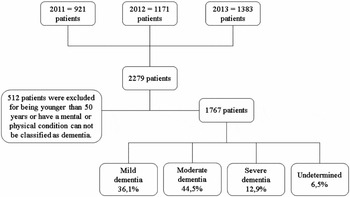
This is a rich dataset, with a total number of claims available for 2013 of 12 million records. The database includes the following fields for each patient: identification (ID), age, sex, municipality where service was provided, provider ID, primary diagnosis, date of service, type of service (i.e. procedural or pharmacological), type of facility (i.e. inpatient, outpatient, emergency), type of reimbursement (i.e. capitated, fee-for-service), units, payment by HMO, and any payment by user (i.e. deductible, user fee). Since each patient may get services more than once, or receive more than one service on each visit (as outpatient or inpatient), claims were grouped by ID to obtain the number of patients per year and period. Figure 1 illustrates the inclusion algorithm for participants in this study.
Flow diagram of inclusion process. Period 2011–2013.

To extract from the database those patients with AD, we built an a priori algorithm with increasing theoretical specificity for dementia, as follows: first, we selected all patients with a dementia-related ICD-10 diagnosis either from outpatient clinic consultation or from hospital discharges. We used the following diagnoses: F00, F01, F02.0, F02.1, F02.2, F02.3, F02.4, F02.8, F03, F32, F41.2, F51.9, F69, F92, F99, G10, G20, G23.9, G30, G91, G31. Second, from the database of the selected patients with a suspected dementia diagnosis, we excluded those less than 50-years-old, as well as those with a physical or psychiatric entity unrelated to dementia (i.e. schizophrenia, mental retardation, delirium related to a medical or traumatic condition, etc.).
We classified disease stage as mild, moderate, or severe using drug-dispensing records, plus diagnoses of other diseases and procedures that indicate the worsening of the functional state of the patients. We followed Budson and Solomon's functional classification of dementia severity (Budson and Solomon, Reference Budson and Solomon2016).
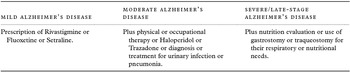
Patients with mild stage dementia usually seek consultation to confirm the diagnosis of AD or other types of dementia and to receive prescriptions for anti-dementia and anti-depressive medications. Patients at moderate dementia stage need the same medications prescribed at mild stage plus physical and occupational therapy as well as diagnosis and treatment of comorbidities such as urinary infection or pneumonia. Patients at the severe stage demand around-the-clock attention and require nutrition evaluation, or use of gastrostomy for nutritional needs, or tracheostomy for respiratory failure (Table 1). It is worth noting that the definitions of severity include comorbidity such as treatment of urinary tract infection, which may explain why costs would increase with increasing severity. For that reason, costs in this study must be interpreted as all-condition costs.
Criteria for staging dementia according to the functional state

Last, we classified as undetermined those patients older than 50 years with diagnosis of dementia, but without further diagnosis or drug prescription available. To validate the concordance of the used criteria, we conducted a pilot study done by a trained physician and the neurologist to obtain and classify a group of dementia patients. One of us, (YT) a senior clinical neurologist, confirmed the diagnosis of dementia in a random sample of 100 participants, and confirmed that using our algorithm the diagnosis of dementia is reliable in all selected participants.
The presence of other comorbidities was evaluated using a similar approach; first, using ICD-10 codes, then a general physician (GP) reviewed each other service and drug paid for by the HMO by patient and inferred from that information other comorbidities.
As mentioned before the actual payment to the provider by the insurer is recorded in the data, thus monetary outlays were aggregated using spreadsheet. We use the exchange rate of 1,838 COL per 1 USD to convert figures to US dollars to allow for international comparisons, such exchange rate is the average for years 2011–2013. To avoid the effect of changes in enrollment along the years, the analysis uses only people fully enrolled during the three years.
Last, to explore the additional expense associated with the progression of dementia accounting for the confounding effect of other chronic conditions, age, sex, and other factors we run multivariate regression analyses. The dependent variable is the annual expense by patient by year. The independent variables of interest are indicators for each severity stage identifies: moderate (i.e. indicator takes the value of 1 if moderate and 0 otherwise), severe, and undefined (reference category is mild). The confounding factors accounted for are as follows: age and age squared; an indicator for whether male; an indicator for each year (reference category is 2011) to take into account inflation and other changes specific to that year. To account for comorbidities, we use four different specifications: a set of 47 indicators for each condition identified in the population; a set of four indicators for whether there is a diagnosis of cancer, diabetes, renal failure, or hypertension (a set of seven indicators for the number of additional chronic conditions (i.e. 1 additional, 2 additional, 3 additional, etc.); and a set of six indicators for groups of diagnosis codes: cardiovascular disease, neurological disease, rheumatic disease, metabolic disease, psychiatric disease, and genetic disease.
Data were analyzed using the Stata software package (V.14, StataCorp, College Station, Texas, USA). The study protocol was approved by the Ethics Committee of Universidad Icesi (Act0069).
The design of the study described is limited in several ways. A comprehensive study of the costs of dementia would also look at in-home, day care, and residential care as well as lost income for family caregivers. There is, however, no secondary data on such costs, and it is out of the scope and budget of our project to collect household data. Inherently in the use of claims data is the risk of underdiagnosis of those patients in the early stages, which may go untreated or treated under diagnosis such as depression and sleep disorders instead of dementias and thus being excluded because our inclusion criteria. The use of drugs as classification criteria may also be problematic, as reviewers pointed out. In our case, we used Sertraline because patients at the moderate stage additionally require medications for other neuropsychiatric symptoms (sadness, insomnia, restlessness), assuming these ones as symptoms of progression/deterioration of the dementia, not as a comorbid primary disorders such as depression or anxiety. Also, we included Trazadone because is widely used as a symptomatic treatment of the behavioral disorders associated with the worsening of dementia. Behavioral disturbances are commonly seen in moderate stage of dementia. These include insomnia and affective and mood disturbances. With these limitations in mind, the next section gives results.
Results
A total of 340 dementia patients were found in participants 50 years of age and older that were enrolled for the full three years, 57% females and 43% males. The distribution by dementia stage was as follows: mild 21%, moderate 53%, severe 17%, and undetermined 9%. Tables 2 and 3 present results covering all expenses per patient, including not only those associated with dementia but all other conditions. The period prevalence for this insurer was 9.6 per thousand for participants ≥50 years (95%CI:9.23–10.14); and 62.5 per thousand for those ≥75 years (95%CI:58.9–66.3). There is a dearth of information on the prevalence of dementia in developing countries, in particular in Colombia. The only study to estimate dementia prevalence involving a nationally representative sample was EPINEURO, with data collected in 1995 and 1996. Age-adjusted prevalence was 8.1 per thousand in the over 50 population and 34.2 per thousand for those over 75 years.
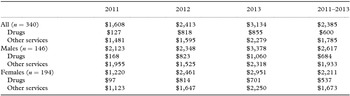
Insurer direct expense for patients with dementia in Colombia 2011–2013 (US Dollars)

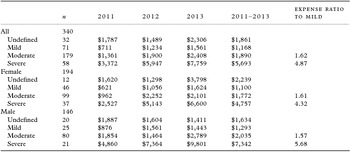
Insurer direct expense for patients with dementia by severity (US Dollars)

Table 2 gives direct expense to insurers. On the average expenses per year were USD$2,385 USD per patient, out of which $600 were for drugs and $1,785 were for all other services, roughly a 25% and 75% split, respectively. In 2013, the top five drugs accounted for 75% of the total cost (49% Rivastigmina, 12% outpatient drugs, 8% Trastuzumab, 4% Insuline Glargine, 4% Risperidona). Direct costs to the insurer increased year by year, $1,608 (2011), $2,413 (2012), and $3,134 (2013), increments of 50% and 30%, respectively. By gender, we found that, on the average direct expense for males is 18% higher than for females.
Table 3 gives direct expense to the insurer by severity. As expected, expenses increased with severity. Direct expense for a patient with a mild dementia was $1,168. When compared to a mild patient, a patient in the moderate stage will use 62% more resources ($1,890) and a patient in the severe stage 387% more resources ($5,693). Similarly, direct costs to the insurer increased on average year by year for each severity category. By gender, males use more resources than females on average for each severity category.
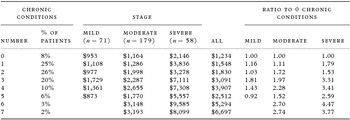
Table 4 gives direct expense to insurers by number of additional chronic conditions and severity. On average for the three years, a patient with no other condition than AD implied payments for USD 1,233. By severity, a patient in the mild stage was associated with annual expenses of USD 953, a patient in the moderate stage with USD 1,164, and a patient in the severe stage with USD 2,146. It is important to note that only 8% of the patients had AD as the only chronic condition, 25% had one additional chronic condition, 26% two additional conditions, and 20% three additional conditions. In addition to the dollar figures, the last three columns present the expense ratio of each additional chronic condition to patients with only dementia as chronic condition. Interestingly for those in mild stage, there is no clear pattern, although a higher number of additional chronic conditions is associated with higher expenditures, it does not increases monotonically. For those in the moderate stage, expenses increase with the number of chronic conditions with one exception, for instance, one additional condition increase expenses by 11%, two by 72%, and 4 by 128%. A similar pattern is seen for the severe patients, but here the increase is larger, for instance, one additional condition increase expenses by 79%, three by 231%, and six by 347%.
Average insurer direct expense for patients with dementia by severity and number of additional chronic conditions (US Dollars)

Last, Table 5 gives results on the four regression analyses conducted. After accounting for comorbidities, age, sex, and year-specific effects, the results suggest that a severe patient is associated with payments in excess of $2,984 USD per year on average than a mild patient to the insurer, and that in the case of patients in the moderate stage the excess payments are positive but not statistically different as compared to those in the mild stage.
Attributable costs by severity stages of AD patients using regression analyses

All models include age, age squared, sex, and year specific. Model 1 includes 43 indicators for specific conditions; Model 2 includes indicators for cancer, diabetes, renal failure, or hypertension; Model 3 includes indicators for number of chronic conditions; Model 4 includes indicators for whether present cardiovascular disease, neurological disease, rheumatic disease, metabolic disease, psychiatric disease, and genetic disease.
t statistics in parentheses. *p < 0.05, **p < 0.01, ***p < 0.001.
Robust standard errors clustered at the patient level.
Discussion
A previous estimate of direct costs of dementia for Colombia using an indirect method was USD $663.2 for 2009 (Wimo et al., Reference Wimo, Winblad and Jönsson2010). Using actual claims data from an insurer, the observed average payment is estimated to be USD $1,234 for 2011–2013 for a patient with AD as the only chronic condition, and USD$2,385 for all AD patients regardless of the number of chronic conditions. As we documented, it is likely that some of the difference is accounted for by increase in heath costs over time; however, even updating the USD$663 figure at a 30% annual rate the average for 2011–2013 would be USD$1,490, which is still 60% less than our observed estimate. It is also worth noting than during the years 2009–2013 there were no major inclusions of new drugs for the treatment of AD in the benefits package in Colombia. Also, it is likely that some of the difference might be attributable to the population mix of the HMO that allowed us access to its data; however, the difference in the percentage of people 50 and older between the HMO and the general population is 3.0 percentage points (18.5% HMO and 21.5% population). It is worth noting that procedures and drug prices in Colombia are negotiated between insurers and providers using a national schedule for procedures and pharmacy benefits managers for drugs; thus, prices do not differ substantially among insurers. In addition, procedures and drugs included in our analysis were not blockbuster technologies.
To put this number into context, for the same period (2011–2013), the country's current expenditure on health per capita was USD $828. Our results show that the imputed estimated direct cost per capita of AD for Colombia in worldwide studies may be underestimated by almost 60%.
However, our estimate for 2013 of total direct cost was USD$3,134. This number is close to the average for lower middle income countries (USD$3,865) estimated in the most recent worldwide cost of dementia study (Wimo et al., Reference Wimo2016).
The only other study with data for South America was a retrospective observational and cross-sectional study performed by interviewing patients and their caregivers in Argentina [7]. In 2001 US dollars, the authors found for non-institutionalized patients direct costs of USD$3,189, although this is not strictly comparable with our results because it includes USD$222 for paid caregivers. This figure, however, includes costs of associated pathologies, because their method of direct cost estimation deducts the costs for healthy participants from those for AD patients. The Argentina study found that 88% of total AD had comorbidities, a similar percentage to what we found with a larger sample: 92%.
In regression analysis, we estimated that attributed cost to a severe patient is in excess of $2,984 USD as compared to a patient in the mild stage. This figure is lower than that found in Argentina (US$5960) or developed countries.
Along the lines of other studies, we found that direct costs increase according to dementia severity, a high prevalence of other pathologies, and also showed an annual increase in direct costs to insurers of double digits. These are all key findings for the economic evaluation of the disease and its burden to healthcare systems in developing countries.
Conflict of interest
None.
Description of authors’ roles
S Prada designed the study, supervised the statistical analyses and wrote the paper. Y Takeuchi co-designed the clinical algorithm, supervised clinical classification, and assisted with writing. A Merchan-Galvis collected the data, was responsible for carrying out the clinical analysis, and assisted with writing the paper. Y Araujo co-designed the study, supervised data analyses, and wrote software code.