





1. Introduction
The dynamic environment of a dense stellar system such as an open cluster is deeply tied to binary formation and evolution: high stellar density creates more opportunities for binaries to form, be disrupted, or participate in exchange interactions, and these interactions drive the global evolution of the cluster by injecting energy into the system (Hut et al. Reference Hut, McMillan and Goodman1992). As a consequence, formation and evolution of binary transient systems – typically a compact object interacting with a companion – are affected by the cluster environment. These systems, along with other magnetically-driven types of active binaries, can be strong in X-ray and may have an optical counterpart.
M67 (NGC 2682) is relatively old (and thus dynamically evolved) for an open cluster at 4 Gyr. It has been extensively observed in multiple wavelengths, in both surveys and targeted observations (e.g. van den Berg et al. Reference van den Berg, Tagliaferri, Belloni and Verbunt2004; Reyes et al. Reference Reyes, Stello and Hon2024). Recently, Hunt & Reffert (Reference Hunt and Reffert2024) published the most complete open cluster catalogue, with over 5600 Milky Way open clusters, to date using data from Gaia Data Release 3 (Gaia Collaboration et al. 2016; Gaia Collaboration et al. 2023). Building off previous models by Hurley et al. (Reference Hurley, Pols, Aarseth and Tout2005), we use the state-of-the-art direct N-body code nbody6++gpu (Wang et al. Reference Wang, Spurzem and Aarseth2015; Kamlah et al. Reference Kamlah, Leveque and Spurzem2022) to model M67.
2. Simulations
We carried out several simulations with slightly varying input parameters. All were initialised with
 $N=24\,000$
particles with
 $N_\mathrm{b} = 12\,000$
primordial binaries (i.e. an initial binary fraction of 0.5). Metallicity Z was chosen to be between 0.01–0.02. Initial positions and velocities were generated from a Plummer model and the system is assumed to start in virial equilibrium at zero-age main sequence. Stellar masses were selected from the initial mass function (IMF) given by Kroupa (Reference Kroupa2001) in the range of 0.08–150 M
 $_\odot$
. Initial masses for binary stars are also chosen from the Kroupa IMF and are either used as is, i.e. random pairings, or redistributed according to a chosen mass-ratio distribution. Initial binary separations were chosen from a Gaussian distribution in
 $\log P$
(Duquennoy & Mayor Reference Duquennoy and Mayor1991). A maximum semimajor axis was also imposed on the primordial binaries’ initial orbits, ranging between 10–100 au. Initial binary eccentricities were selected either from a thermal distribution or from an exponentially decreasing distribution (Duquennoy & Mayor Reference Duquennoy and Mayor1991). The cluster is put in a circular orbit at 8.0 kpc around a
 $10^{11}$
M
 $_\odot$
Galactic centre. M67 is estimated to be around 4 Gyr old (Reyes et al. Reference Reyes, Stello and Hon2024, and references therein), so we evolve the models to at least that point, following the dynamical, stellar, and binary evolution with nbody6++gpu, and investigate the state of the cluster around this age.
3. Preliminary results
To construct colour-magnitude diagrams (CMDs) of the evolved clusters, MIST bolometric correction tablesFootnote † were used to convert physical stellar parameters to Gaia G, BP, and RP magnitudes. These were then shifted down by a distance modulus of 9.73, corresponding to a parallax of 1.1325 mas, and right by a reddening of
 $E(B-V)=0.041$
. One model is presented in Figure 1 as an example, alongside the same for Gaia-observed M67 members, as determined by Hunt & Reffert (Reference Hunt and Reffert2024). Also in this figure are XMM and Chandra X-ray sources associated with M67 members, as determined by Dage et al. (in prep). The model CMD matches the Gaia CMD well in terms of overall shape, however the number of model blue stragglers on the CMD do not match the Gaia cluster. In particular, the model shown in the figure has 10 blue stragglers (cf. 30 in observations). The average total cluster masses at 4 Gyr in the models is around 2500 M
 $_\odot$
, which matches the estimate of 2762 M
 $_\odot$
given by Hunt & Reffert (Reference Hunt and Reffert2024).
Colour-magnitude diagram for M67. Shown are the Gaia DR3 cluster members as determined by Hunt & Reffert (Reference Hunt and Reffert2024) (light circles), an N-body model at 4 Gyr (dark circles), XMM sources (
 $+$
symbols), and Chandra sources (
 $\times$
symbols). The model CMD has been truncated below Gaia’s limiting magnitude.

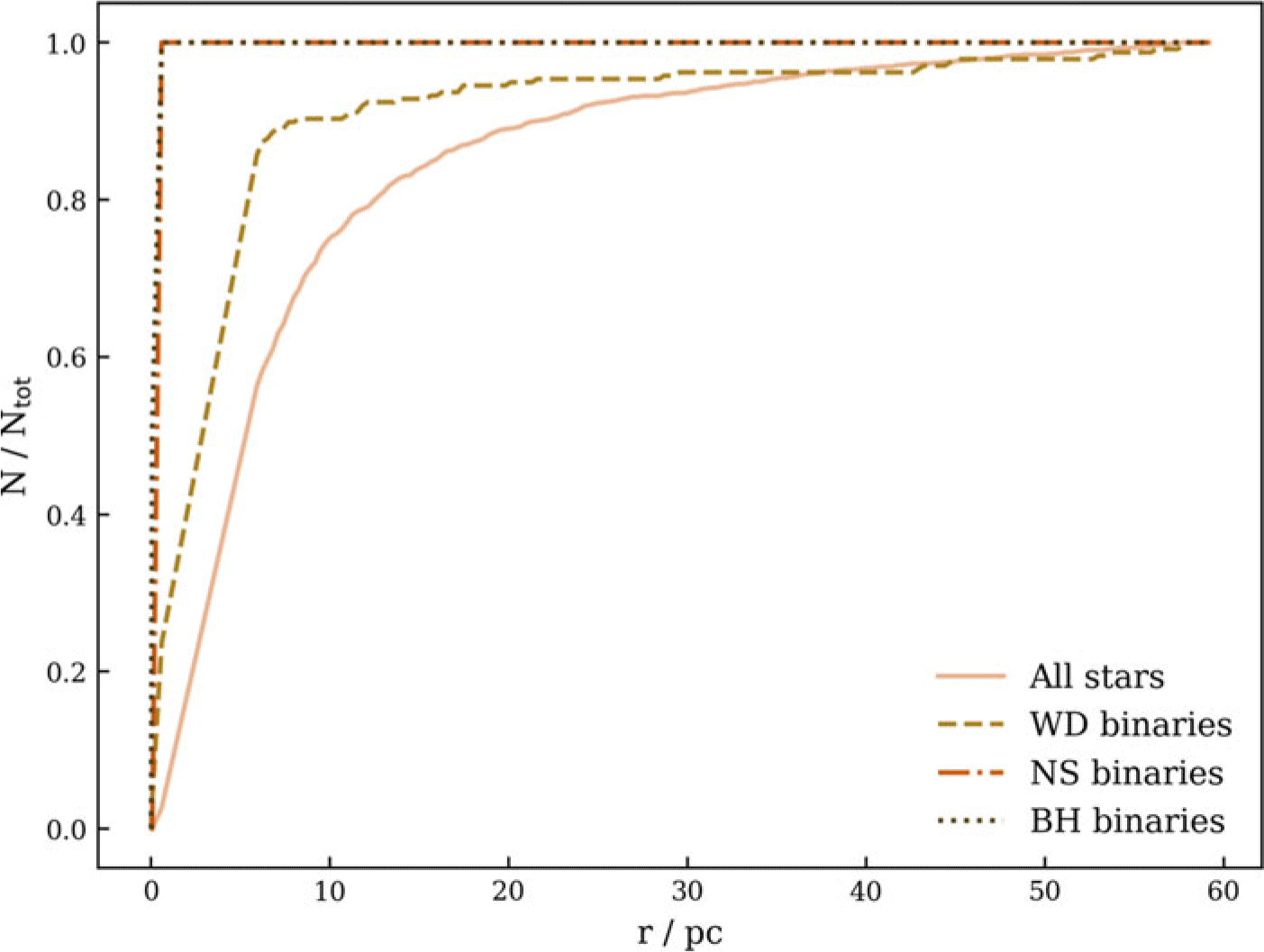
We begin to investigate the populations of compact remnant binaries within the model cluster. Figure 2 shows that all types of binaries containing compact remnants are relatively centrally located, which is an expected consequence of the mass segregation process. In particular, for the model shown in the figure, at 4 Gyr there are 8 black hole binaries, 2 neutron star binaries, and 237 white dwarf binaries out of a total 1043 binaries. Further work is being done to understand these binary populations in detail.
Cumulative radial distribution functions for stars in the same N-body model as Figure 1 at 4 Gyr. Shown are all stars in the cluster (solid line), all white dwarf binaries (dashed line), neutron star binaries (dot-dash line), and black hole binaries (dotted line).

4. Future
Further work is being done to better match the number of blue stragglers in the models to that seen in the observations. Additionally more investigation into the compact binary populations in the models is needed. Ultimately we aim to similarly investigate the binary transient systems in other Milky Way open clusters.
Supplementary material
To view supplementary material for this article, please visit https://doi.org/10.1017/S1743921325104134

 +
 ×


 Open access

