INTRODUCTION
Mild traumatic brain injuries (mTBI), also known as concussions, are a public health concern, resulting in several hundred thousand emergency department (ED) visits in the United States yearly (Taylor, Bell, Breiding, & Xu, Reference Taylor, Bell, Breiding and Xu2017). Although a relatively fast recovery (within a month post-injury) is the expected outcome for most pediatric patients, studies estimate that 10–30% of youth have protracted recovery based on the presence of lingering post-concussive symptoms (PCS; Babcock, Byczkowski, Wade, Ho, Mookerjee, & Bazarian, Reference Babcock, Byczkowski, Wade, Ho, Mookerjee and Bazarian2013; Mayer, Stephenson, et al., Reference Mayer, Stephenson, Dodd, Robertson-Benta, Pabbathi, Shaff and Quinn2020; Takagi et al., Reference Takagi, Hearps, Babl, Anderson, Bressan, Clarke and Anderson2020; Zemek et al., Reference Zemek, Barrowman, Freedman, Gravel, Gagnon, McGahern and Osmond2016). Most research deems individuals as “recovered” once they are both asymptomatic as well as free of cognitive impairments (Haider et al., Reference Haider, Leddy, Pavlesen, Kluczynski, Baker, Miecznikowski and Willer2018). While numerous studies have been conducted examining the factors that predict persistent PCS in patients with pediatric mild traumatic brain injuries (pmTBI; Brooks et al., Reference Brooks, Daya, Khan, Carlson, Mikrogianakis and Barlow2016; Howell et al., Reference Howell, Zemek, Brilliant, Mannix, Master and Meehan2018; Lau, Kontos, Collins, Mucha, & Lovell, Reference Lau, Kontos, Collins, Mucha and Lovell2011; Lau, Collins, & Lovell, Reference Lau, Collins and Lovell2012; Takagi et al., Reference Takagi, Hearps, Babl, Anderson, Bressan, Clarke and Anderson2020, Zemek et al., Reference Zemek, Barrowman, Freedman, Gravel, Gagnon, McGahern and Osmond2016), few have specifically addressed the factors that predict cognitive outcomes (Babikian, McArthur, & Asarnow, Reference Babikian, McArthur and Asarnow2013; Beauchamp et al., Reference Beauchamp, Aglipay, Yeates, Desire, Keightley, Anderson and Zemek2018), especially on computerized testing.
The clinical approach to evaluating mTBI has evolved substantially, with the increased implementation of commercialized test batteries, such as Cogstate, ImPACT, or ANAM, to acutely assess and monitor recovery following injury (Belanger, Curtiss, Demery, Lebowitz, & Vanderploeg, Reference Belanger, Curtiss, Demery, Lebowitz and Vanderploeg2005; Belanger & Vanderploeg, Reference Belanger and Vanderploeg2005; McCrory et al., Reference McCrory, Meeuwisse, Aubry, Cantu, Dvorak, Echemendia and Turner2013). An ever-growing body of research indicates group differences in cognitive performance between pmTBI patients and healthy control (HC) participants in the sub-acute (SA) phase of injury, with some evidence of lingering deficits months post-injury, especially in domains of executive functions, memory, and attention on both clinical and experimental measures of cognition (Baillargeon, Lassonde, Leclerc, & Ellemberg, Reference Baillargeon, Lassonde, Leclerc and Ellemberg2012; Catale, Marique, Closset, & Meulemans, Reference Catale, Marique, Closset and Meulemans2009; Howell, Osternig, Van, Mayr, & Chou, Reference Howell, Osternig, Van, Mayr and Chou2013; Keightley et al., Reference Keightley, Singh, Chen, Gagnon, Leonard, Petrides and Ptito2014; Moore et al., Reference Moore, Pindus, Raine, Drollette, Scudder, Ellemberg and Hillman2016, Reference Moore, Sicard, Pindus, Raine, Drollette, Scudder and Hillman2019; Parks et al., Reference Parks, Moore, Wu, Broglio, Covassin, Hillman and Pontifex2015; Pontifex et al., Reference Pontifex, Broglio, Drollette, Scudder, Johnson, O’Connor and Hillman2012).
In contrast to studies exploring predictors of persistent PCS, few studies have investigated factors associated with lingering cognitive outcomes in pmTBI patients. Babikian and colleagues (Reference Babikian, McArthur and Asarnow2013) examined the relative contribution of indexes of injury severity, clinical symptomatology, demographic factors, and premorbid functioning in predicting cognitive performance on a battery of paper-and-pencil tests in pmTBI patients. Premorbid variables (parental education, premorbid behavior, learning disabilities, and school achievement) that antedated the injury were the only predictors of cognitive impairments at 1 month and 1 year post-injury. Similarly, Beauchamp and colleagues (Reference Beauchamp, Aglipay, Yeates, Desire, Keightley, Anderson and Zemek2018) found that premorbid variables and acute (at the time of presentation to ED) cognitive functioning (measured by the Standardized Assessment of Concussion; McCrory et al., Reference McCrory, Meeuwisse, Johnston, Dvorak, Aubry, Molloy and Cantu2009) were the best predictors of cognitive outcomes at 1 month post-injury, although only acute cognitive functioning was predictive at 4 months post-injury. However, it is unclear if these results would replicate using computerized test batteries, which are increasingly implemented in clinical settings. Further, the findings of these two studies are limited by the fact that the symptomatic status of patients in the follow-up sessions was not considered. Previous studies in children and adults indicated that patients who were still reporting PCS a month following mTBI also exhibited worse cognitive performance on the test batteries compared to those who were symptom-free, suggesting a potential relationship between persistent symptomatology and cognitive impairments (Collie, Makdissi, Maruff, Bennell, & McCrory, Reference Collie, Makdissi, Maruff, Bennell and McCrory2006; Gardner, Howell, & Iverson, Reference Gardner, Howell and Iverson2020; Meehan, III, Mannix, Stracciolini, Elbin, & Collins, Reference Meehan, Mannix, Stracciolini, Elbin and Collins2013).
Because cognitive impairments can have serious adverse effects resulting in impaired academic performance, school absenteeism, depressed mood, loss of social activities, and lower quality of life, preemptive identification of children at risk for developing cognitive impairments would allow for appropriate recommendations and intervention to be prescribed to reduce long-term complications. Current predictive models of cognitive performance following pmTBI remain elusive (Babikian et al., Reference Babikian, McArthur and Asarnow2013; Beauchamp et al., Reference Beauchamp, Aglipay, Yeates, Desire, Keightley, Anderson and Zemek2018), mainly due to the methodological limitations of those few studies available. Further, although some demographic and injury characteristics were identified in acute and SA phases of injury as prognosticators of slow recovery based on the presence of persistent PCS (Brooks et al., Reference Brooks, Daya, Khan, Carlson, Mikrogianakis and Barlow2016; Howell et al., Reference Howell, Zemek, Brilliant, Mannix, Master and Meehan2018; Lau et al., Reference Lau, Kontos, Collins, Mucha and Lovell2011, Reference Lau, Collins and Lovell2012; Takagi et al., Reference Takagi, Hearps, Babl, Anderson, Bressan, Clarke and Anderson2020), including the 5P clinical risk score (Zemek et al., Reference Zemek, Barrowman, Freedman, Gravel, Gagnon, McGahern and Osmond2016), it has yet to be determined whether pmTBI patients with persistent PCS also exhibit persistent cognitive impairments.
Accordingly, the objective of this study was two-fold. The first objective was to determine whether group differences in cognitive performance on a computerized test battery (Cogstate brief battery, Cogstate Ltd., New Haven, CT) could be observed between pmTBI patients and HC in the SA (1–11 days) and early chronic (EC; approximately 4 months) phases of injury. Based on results from prior studies using the Cogstate battery (Cole, Arrieux, Ivins, Schwab, & Qashu, Reference Cole, Arrieux, Ivins, Schwab and Qashu2018; Nelson et al., Reference Nelson, LaRoche, Pfaller, Lerner, Hammeke, Randolph and McCrea2016a; Sicard et al., Reference Sicard, Moore and Ellemberg2018, Reference Sicard, Moore and Ellemberg2019), we expected significant group differences on all tasks of the Cogstate brief battery in the SA phase, with only those tasks measuring aspects of higher cognition, such as visual learning/memory and working memory (i.e., One-Card Learning and 1-Back tasks), to show differences in the EC phase. The second objective was to determine the best predictors of lower cognitive performance in pmTBI patients for tasks showing a group difference. We expected the ongoing severity of PCS (measured by a standardized symptom checklist) to be a significant predictor of cognitive performance at SA, but not EC, since the PCS would be largely resolved by that time. Similar to previous results (Babikian et al., Reference Babikian, McArthur and Asarnow2013; Beauchamp et al., Reference Beauchamp, Aglipay, Yeates, Desire, Keightley, Anderson and Zemek2018), premorbid variables (parental education, premorbid reading abilities, and presence of learning disability/attention-deficit hyperactivity disorder (ADHD)) were predicted to be significant predictors of cognitive performance during the EC phase of injury, as opposed to ongoing PCS. Finally, we hypothesized that the 5P clinical risk score would be a significant predictor of cognitive performance, irrespective of the phase of injury (Howell et al., Reference Howell, Zemek, Brilliant, Mannix, Master and Meehan2018; Zemek et al., Reference Zemek, Barrowman, Freedman, Gravel, Gagnon, McGahern and Osmond2016).
METHODS
Participants
In total, 222 patients (8–18 years old) diagnosed with a pmTBI were consecutively recruited as part of an ongoing longitudinal study from local ED and urgent care settings between April 2016 and November 2019. Data collection was completed during SA (1–11 days post-injury) and EC (approximately 4 months) injury phases. Inclusion criteria were based on the American Congress of Rehabilitation Medicine (Kay et al., Reference Kay, Harrington, Adams, Anderson, Berrol, Cicerone and Malec1993) and the Zurich Concussion in Sports Group guidelines (McCrory et al., Reference McCrory, Meeuwisse, Aubry, Cantu, Dvorak, Echemendia and Turner2013). Specifically, pmTBI patients were enrolled if they experienced a closed head injury with a Glasgow Coma Score ≥13 (if available), and either loss of consciousness (limited to 30 min), post-traumatic amnesia (limited to 24 hr), alteration in mental status at the time of injury, or at least two new symptoms following injury. Both uncomplicated and complicated pmTBI patients were included (see “Results” section). Additionally, 170 age- and sex-matched HC were recruited from the local community and assessed at corresponding time-points relative to pmTBI patients to control for neurodevelopmental confounds and/or practice effect associated with repeat assessment.
Exclusion criteria for all participants included (1) history of (a) previous head injury with greater than 30 min of loss of consciousness, (b) neurological diagnosis, (c) any psychiatric disorders other than adjustment disorder, (d) developmental disorder (including autism spectrum disorder or intellectual disability), or (e) substance abuse/dependence, or (2) if they or their guardian were non-English speaking. Patients with pmTBI were also excluded if traumatic care included general anesthesia. Additional exclusion criteria for HC included a parent report of diagnosis of ADHD or a learning disability (LD). Urine-based drug screens were conducted for all participants at each visit, and those with positive tests were excluded from further analyses. The study was approved by the Institutional Review Board and the research was conducted per the Helsinki Declaration. Participants provided informed consent according to the University of New Mexico Health Sciences Center guidelines.
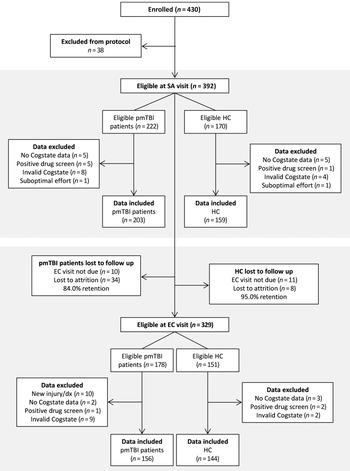
See Figure 1 for a flowchart of participants’ inclusion in analyses. In total, 392 participants (222 pmTBI patients; 170 HC) were eligible for SA visit. At the SA visit, 10 participants were excluded for not having Cogstate data (i.e., technical problems or arm in an orthopedic cast, preventing completion of the task; 5 pmTBI patients; 5 HC), 6 for positive drug screens (5 pmTBI patients; 1 HC), 12 reporting an invalid Cogstate performance (see Supplemental Material for validity criteria; 8 pmTBI patients; 4 HC), and 2 for having both a score suggestive of suboptimal effort on a measure of performance validity and impaired performance on multiple tasks on the Cogstate (1 pmTBI patient; 1 HC). Thus, 362 participants were included in the SA analyses (203 pmTBI patients; 159 HC).
Flowchart of enrollment and inclusion in the analyses within the sub-acute (SA) and early chronic (EC) phases of injury for patients with a pediatric mild traumatic brain injury (pmTBI) and heathy controls (HC).

Of the 392 participants who were eligible for the study, 21 (10 pmTBI patients; 11 HC) were not yet due for their EC visit at the time of data export, while an additional 42 (34 pmTBI patients; 8 HC) were lost to attrition (88.7% retention). Ten pmTBI patients were excluded due to sustaining an additional pmTBI or receiving a diagnosis of a mental health disorder between visits. Five participants (2 pmTBI patients; 3 HC) were excluded for missing EC visit Cogstate data, 3 for positive drug screens (1 pmTBI patient; 2 HC), and 11 for invalid Cogstate performance on more than two tasks (9 pmTBI patients; 2 HC). Thus, 300 participants were included in the EC analyses (156 pmTBI patients; 144 HC). See Supplemental Material Tables S1 and S2 for comparison between included participants, excluded participants, and those with attrition.
Procedures
A Common Data Element battery of clinical and neuropsychological measures was administered at each visit as part of the greater ongoing study. The current study focuses primarily on computerized cognitive testing and PCS. The Post-Concussion Symptom Inventory (PCSI; child report) was completed at each visit to assess ongoing symptoms (Gioia, Schneider, Vaughan, & Isquith, Reference Gioia, Schneider, Vaughan and Isquith2009; Sady, Vaughan, & Gioia, Reference Sady, Vaughan and Gioia2014). Premorbid intellectual functioning was assessed through the Reading subtest of the Wide Range Achievement Test 4 (WRAT-4; Wilkinson, & Robertson, Reference Wilkinson and Robertson2006), and a short version of the Test of Memory and Malingering (TOMMe10) allowed for the assessment of response validity (Denning, Reference Denning2012).
Participants completed the Cogstate brief battery under the supervision of a trained research assistant in a quiet testing environment on both visits. The Cogstate brief battery is comprised of four computerized cognitive tasks that were developed to measure processing speed, attention, visual learning, and working memory (details on the tasks can be found in Supplemental Materials). The Cogstate battery has shown evidence of construct validity (Cole, Arrieux, Ivins, Schwab & Qashu., Reference Cole, Arrieux, Ivins, Schwab and Qashu2018; Collie, Maruff, Darby, & McStephen, Reference Collie, Maruff, Darby and McStephen2003a, Collie et al., Reference Collie, Maruff, Makdissi, McCrory, McStephen and Darby2003b; Maruff et al., Reference Maruff, Thomas, Cysique, Brew, Collie, Snyder and Pietrzak2009; Schatz & Putz, Reference Schatz and Putz2006) and adequate test–retest reliability (Falleti, Maruff, Collie, & Darby, Reference Falleti, Maruff, Collie and Darby2006; Nelson et al., Reference Nelson, LaRoche, Pfaller, Lerner, Hammeke, Randolph and McCrea2016a). Norms have been established for the Detection and Identification tasks for children aged 4 and up, whereas the One-Card Learning and 1-Back tasks have been normed for children aged 6 and above (Cogstate, 2018). The robust psychometric properties of the Cogstate battery and normative properties for younger children were the primary motivation for inclusion in the current study. As per Cogstate guidelines, primary outcome variables included three different reaction time variables (RT; mean of log10 transformed reaction times for correct responses for Detection, Identification, and 1-Back tasks), as well as one accuracy variable (ACC; arcsine transformation of the square root of the proportion of correct responses for One-Card Learning task).
Statistical Analyses
Descriptive statistics were used to summarize baseline characteristics. Nonparametric and chi-square tests were used as appropriate to compare demographic variables between groups at both visits, as well as to compare those who were included in EC analyses and those who only completed the SA visit within diagnosis groups. A series of analysis of covariance (ANCOVAs) were conducted to explore between-group (pmTBI and HC) differences in performance on the Cogstate brief battery within each visit, with initial assessments of parental education and premorbid intellectual functioning (WRAT-4 Reading subtest) as covariates. Bonferroni corrections were applied across factorial terms and covariates to control for familywise error for RT variables (p = .05/3 = .017), whereas no correction was applied to the single accuracy comparison. A less conservative analytic approach was also conducted, in which the premorbid variables were not entered as covariates (see Supplemental Analyses for results). The latter approach permits comparison with previous studies using the Cogstate battery that did not use covariates as well as addressing potential statistical concerns with the use of covariates in observational studies (Miller & Chapman, Reference Miller and Chapman2001).
For any task showing a significant group difference during the SA visit, multiple linear regressions were used to examine which variables predicted performance within pmTBI. All predictors (chosen a priori based on previous studies; Babikian et al., Reference Babikian, McArthur and Asarnow2013; Beauchamp et al., Reference Beauchamp, Aglipay, Yeates, Desire, Keightley, Anderson and Zemek2018; Zemek et al., Reference Zemek, Barrowman, Freedman, Gravel, Gagnon, McGahern and Osmond2016) were entered simultaneously, then removed using backward elimination based on their lack of association with the dependent variable. The variable with the smallest partial correlation with the dependent variable is considered for removal (probability of F-value = .10). If it meets the criterion for elimination, it is removed and the variable remaining in the equation with the smallest partial correlation is considered next, and so on. The procedure stops when there are no variables in the equation that satisfy the removal criteria. Predictors consisted of premorbid intellectual functioning, parental education, presence of LD or ADHD, the 5P clinical risk score, and the PCSI total score. Analyses were performed using SPSS 25.0 (IBM Corp).
RESULTS
Neuroimaging Results
A minority of pmTBI patients (31.5%) underwent a computed tomography (CT) scan as part of routine care in the ED. All participants underwent structural imaging on a 3T Siemens Trio scanner with a 32-channel head coil during the SA visit. All findings were noted by board-certified neuroradiologists who were blinded to patient diagnosis. Only 11 participants included in the analyses would be considered as having sustained complicated pmTBI, as indicated by a positive CT scan or by probable radiological common data elements (rCDE) on their magnetic resonance imaging scan (Mayer, Cohen, et al., Reference Mayer, Cohen, Wertz, Dodd, Shoemaker, Pluto and Yeates2020). All analyses were repeated without complicated pmTBI patients, but did not significantly change.
Demographics
The average days post-injury for the SA visit was 7.38 ± 2.18 (range = 1–11, median = 8, mode = 9), with only 17 pmTBI patients tested within the first 72 hr. The average days post-injury for the EC visit was 130.85 ± 15.20 (range = 101–194, median = 130.85). Statistical power was insufficient to compare cognitive performance between pmTBI patients who were tested within 72 hr of injury and those who were tested after this period.
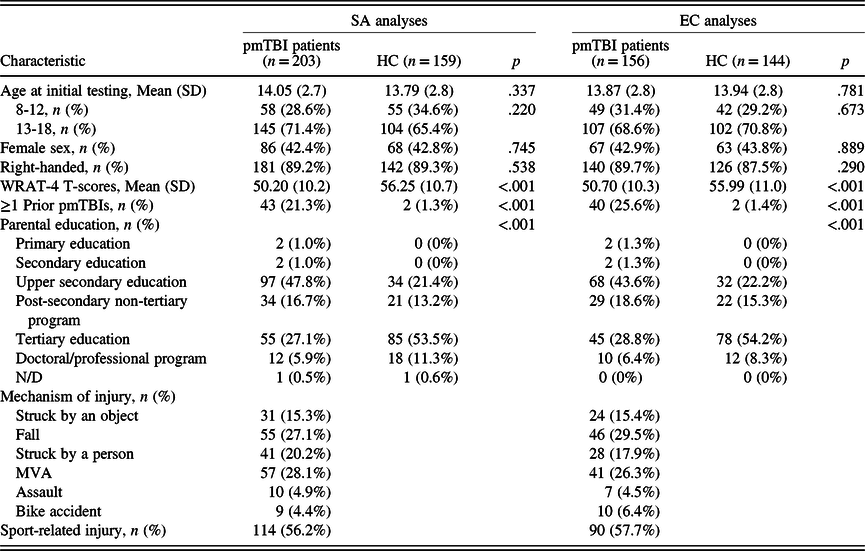
No differences between pmTBI patients and HC were observed (either SA sample or EC subgroup) on sex, age, or handedness (p’s ≥ .220). The HC group had higher WRAT-4 T-scores and parental education relative to pmTBI patients (p’s < .001; see Table 1 for details). Further, pmTBI patients had a higher proportion of individuals with a history of prior head injuries than the HC group (p < .001).
Demographic comparisons between participants included in the sub-acute (SA) and early chronic (EC) analyses

Note. EC = Early Chronic; HC = Healthy Controls; pmTBI = Pediatric Mild Traumatic Brain Injuries; MVA = Motor Vehicle Accident; SA = Sub-Acute; WRAT-4 = Wide Range Achievement Tests-4, Reading subtest.
The results from an analysis comparing participants who completed only the SA visit due to attrition (Supplemental Table S1) or new exclusions (Supplemental Table S2) are presented in Supplemental Materials. The pmTBI patients who completed both SA and EC visits had a higher proportion of individuals with a history of prior pmTBI than those who did not come back for the EC visit (Table S1). No significant differences (all p’s ≥ .067) were found on key demographic variables (age, sex, prior pmTBIs, ADHD/LD, WRAT-4 T-scores, parental education) between those who were included and those who were excluded at the EC (Table S2).
Between-Group Differences on the Cogstate Brief Battery
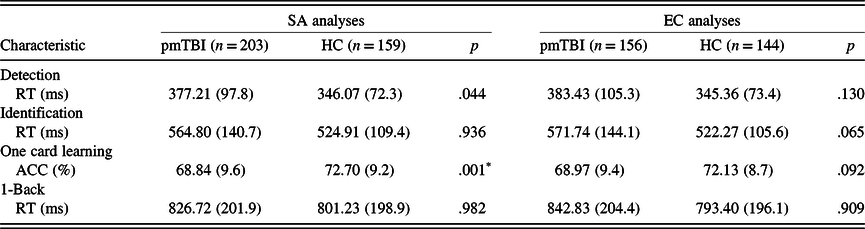
At the SA visit, ANCOVAs revealed a significant main effect of group for One-Card Learning ACC when controlling for parental education and WRAT-4 T-scores, F = 10.95, p = 0.001, partial η 2 = 0.03, with the pmTBI patients performing less accurately than HC (see Table 2). No other main effect of groups was significant in the SA phase for any other tasks (p’s ≥ .044, partial η 2 ≤ 0.01). At the EC phase of injury, no group main effects were significant for RT (p’s ≥ .065, partial η 2 ≤ 0.01) or ACC (p’s ≥ .092, partial η 2 ≤ 0.01).
Main effect of group on Cogstate performance at sub-acute (SA) and early chronic visit. Data is presented as Mean (SD).

Note. ACC = Accuracy (untransformed); EC = Early Chronic Visit; HC = Healthy Controls; PCSI = % of symptoms endorsed on Post-Concussive Symptom Inventory; pmTBI = Pediatric Mild Traumatic Brain Injuries; RT = Reaction Time (untransformed); SA = Sub-Acute Visit.
Predictors of Lower Performance
Following the observed group difference in accuracy on the One-Card Learning task at the SA visit, a multiple regression was used to examine which injury-related (i.e., PCSI at SA and 5P clinical risk scores) and premorbid (LD/ADHD, WRAT-4 T-scores, and parent education) measures best predicted performance in the SA phase of injury for pmTBI patients only. All statistical assumptions (including normality of residuals, noncollinearity, and homoscedasticity) were met. The initial model with all the predictors entered was significant (R 2 = 0.08, adj. R 2 = 0.05, F(5,158) = 2.71, p = .022), with only 5P clinical risk score and ongoing PCS as significant predictors (p’s ≤ .010). The final backward elimination model, which removed the presence of LD/ADHD, WRAT-4 T-scores, and parental education terms, was significant (R 2 = 0.07, adj. R 2 = 0.05, F(2,161) = 5.654, p = .004). In this model, only the 5P clinical risk score and ongoing PCS were retained as significant predictors (both p’s ≤ .017; see Supplemental Materials Table S3 for the full model). Specifically, higher 5P clinical risk score and higher ongoing PCS were predictors of lower accuracy on the One-Card Learning task.
DISCUSSION
The current study investigated whether differences in cognitive performance would be observed between pmTBI patients and HC in the SA (approximately 1 week post-injury) and EC (4 months post-injury) phases of injury and determined the best predictors of such cognitive outcome in pmTBI patients. Results indicated that pmTBI patients were less accurate than controls on the One-Card Learning task, a measure of visual learning (Maruff et al., Reference Maruff, Thomas, Cysique, Brew, Collie, Snyder and Pietrzak2009), at approximately 1 week but not 4 months post-injury when controlling for premorbid variables. No group differences were observed on the remaining tasks at either visit. Follow-up analyses revealed that the 5P clinical risk score and severity of ongoing PCS were better predictors of accuracy on visual learning at 1 week post-injury relative to premorbid characteristics.
Previous studies indicated that up to 35% of athletes exhibited cognitive deficits after symptoms resolve (Makdissi et al., Reference Makdissi, Darby, Maruff, Ugoni, Bukner and McCrory2010). Contrary to our hypothesis, most Cogstate tasks did not show a group difference in the SA phase of injury. This result may be because some participants had already recovered by the time of initial testing, which was on average 6–8 days post-injury. In adult athletes, the Cogstate battery had the requisite sensitivity to detect cognitive impairments in the acute phase (within 48 hr) of injury (Louey et al., Reference Louey, Cromer, Schembri, Darby, Maruff, Makdissi and Mccrory2014; Makdissi et al., Reference Makdissi, Darby, Maruff, Ugoni, Bukner and McCrory2010; Nelson et al., Reference Nelson, LaRoche, Pfaller, Lerner, Hammeke, Randolph and McCrea2016a). Specifically, when controlling for preinjury cognitive function and comparing performance to a large group of controls, athletes with an acute mTBI showed significant decline on all Cogstate tasks, with the frequency of impaired performance ranging from 45 to 90% (Louey et al., Reference Louey, Cromer, Schembri, Darby, Maruff, Makdissi and Mccrory2014). These cognitive deficits on the Cogstate battery were most pronounced when athletes were still symptomatic, with evidence of recovery in most individuals by 6–8 days post-injury (Louey et al., Reference Louey, Cromer, Schembri, Darby, Maruff, Makdissi and Mccrory2014; Nelson et al., Reference Nelson, LaRoche, Pfaller, Lerner, Hammeke, Randolph and McCrea2016a), the time-frame during which most individuals were first examined for the current study. The current results extend these previous findings by suggesting that pmTBI patients also show recovery on most measures within a week of injury.
Similarly, the group difference on the One-Card Learning task did not persist at 4 months post-injury, suggesting recovery of cognitive functioning on computerized testing by the EC phase. This finding is consistent with previous work using the Cogstate battery in pmTBI samples. Specifically, Crowe and colleagues (2016) showed that cognitive performance returned to baseline levels at day 30 post-injury in children aged 10–17. However, their nonsignificant results may have been due to a lack of statistical power (n = 10). More recently, no difference was observed between adolescent rugby players on the Cogstate battery with 0, 1–2, or 3+ lifetime pmTBIs approximately 1 year post-injury (Gardner et al., Reference Gardner, Howell and Iverson2020).
In the current study, no group difference was found on the working memory task (1-Back task). This finding contrasts with those from recent studies using the Cogstate brief battery in asymptomatic university athletes that observed group differences between those who sustained a mTBI (6+ months from injury) and teammate controls on the 1-Back and 2-Back tasks (Sicard et al., Reference Sicard, Moore and Ellemberg2018, Reference Sicard, Moore and Ellemberg2019). These inconsistencies in findings might be due to other inherent differences in methods (e.g., severity of injury, time since injury, inclusion/exclusion criteria) in lieu of age. An important factor for the current study is the inclusion of parental education and estimates of premorbid reading abilities (WRAT-4 Reading subtest) as covariates in analyses, as group differences were observed for two of the four cognitive tasks (Detection reaction time and One-Card Learning accuracy) at both the SA and EC visits when these covariates were omitted from the models. Because premorbid factors, such as parental education and intelligence, are associated with cognitive performance even in the absence of a brain injury (Ardila, Rosselli, Matute, & Guajardo, Reference Ardila, Rosselli, Matute and Guajardo2005; Doniger, Simon, & Schweiger, Reference Doniger, Simon and Schweiger2008; Noble et al., Reference Noble, Houston, Brito, Bartsch, Kan, Kuperman and Sowell2015), including these variables in the analysis represents a more conservative statistical approach.
However, it is also important to note that between-group differences in the current study were observed on the covariates, with HC exhibiting higher scores on the WRAT-4 Reading subtest and higher parental education. Controlling for shared variance (e.g., controlling for anxiety when comparing individuals with and without depression) has been criticized (Miller & Chapman, Reference Miller and Chapman2001) because it may reduce the construct validity of the target variable (i.e., in this case it may not accurately represent the performance on the One-Card Learning task) since the shared variance may be part of the construct of interest. Group differences in parental education and reading ability could arise from a recruitment bias rather than a feature of the injury such as attentional deficits, which renders the use of an ANCOVA legitimate (Overall & Woodward, Reference Overall and Woodward1977). Indeed, the estimate of premorbid ability is based on measures considered relatively resistant to neurological impairment in adults (Doniger, Simon, & Schweiger, Reference Doniger, Simon and Schweiger2008; Green et al., Reference Green, Melo, Christensen, Ngo, Monette and Bradbury2008; Orme, Johnstone, Hanks, & Novack, Reference Orme, Johnstone, Hanks and Novack2004), yet the findings in adults may not apply to children due to the highly variable nature of neurodevelopment (Davis, Bernat, & Reynolds, Reference Davis, Bernat and Reynolds2018).
In accordance with our hypothesis, follow-up analyses indicated that the severity of ongoing PCS was a significant predictor of lower One-Card Learning accuracy during the SA visit in pmTBI patients. This finding is consistent with previous studies showing that individuals with ongoing PCS performed worse on the Cogstate battery than recovered individuals in adult Australian football players (Collie et al., Reference Collie, Makdissi, Maruff, Bennell and McCrory2006) and male university athletes (Chen, Johnston, Collie, McCrory, & Ptito, Reference Chen, Johnston, Collie, McCrory and Ptito2007). While the association of lower cognitive performance and increased severity of PCS were described in adult populations, to the best of our knowledge, the current study is the first examining the relative contribution of ongoing PCS to cognitive functioning on computerized testing in children and adolescents. The 5P clinical risk score was also a significant predictor of lower One-Card Learning task accuracy approximately 1 week post-injury, suggesting its potential utility in predicting performance on a computerized battery in the SA phase of injury. However, the final regression model explained only 4.1% of the variance, highlighting the need for future work on predictors of cognitive performance.
Interestingly, and contrary to group contrasts, premorbid variables such as parental education and WRAT-4 T-scores were not significantly associated with One-Card Learning accuracy within the pmTBI group. This is contrary to our hypothesis and previously published studies. Specifically, Babikian and colleagues (2013) indicated that premorbid characteristics including parental education, premorbid behavior, learning problems, and school achievement exclusively explained cognitive outcomes at 1 month post-injury in children aged 10–17, assessed by a battery of nine traditional neuropsychological tests. Similarly, Beauchamp and colleagues (2018) showed that acute injury characteristics may also be associated with cognitive outcomes in the chronic phase of injury, with premorbid characteristics, acute cognitive screening on Standardized Assessment of Concussion, and acute PCS reported by parents being predictive of cognitive performance at 1 month post-injury in children aged 6–17. The discrepancies in findings may be attributed to the type of tests administered (computerized vs. paper-and-pencil), methodological differences (time since injury), different outcome measures (continuous vs. binary), or different statistical models. Moreover, although premorbid conditions such as ADHD and LD may represent a risk factor for injury (Grigorian et al., Reference Grigorian, Nahmias, Dolich, Barrios, Schubl, Sheehan and Lekawa2019; Iverson et al., Reference Iverson, Wojtowicz, Brook, Maxwell, Atkins, Zafonte and Berkner2020; Nelson et al., Reference Nelson, Guskiewicz, Marshall, Hammeke, Barr, Randolph and McCrea2016b; Salinas et al., Reference Salinas, Dean, LoGalbo, Dougherty, Field and Webbe2016), their impact on outcomes has been debated. Specifically, previous studies have suggested that ADHD and LD may result in more pronounced cognitive impairments post-injury (Babikian et al., Reference Babikian, McArthur and Asarnow2013; Beauchamp et al., Reference Beauchamp, Aglipay, Yeates, Desire, Keightley, Anderson and Zemek2018; Kaye et al., Reference Kaye, Sundman, Hall, Williams, Patel and Ketcham2019; Mautner et al., Reference Mautner, Sussman, Axtman, Al-Farsi and Al-Adawi2015), whereas others have reported no impact on persistent PCS, which include cognitive outcomes, during systematic reviews (Iverson et al., Reference Iverson, Gardner, Terry, Ponsford, Sills, Broshek and Solomon2017).
This study is not without its limitations. First, some consideration must be given to the possibility that practice effects may have affected performance at the EC visit. However, studies in healthy adults showed that performance on the Cogstate battery was stable over very short (four times in 2 hr) and long (1 month) periods (Collie et al., Reference Collie, Maruff, Darby and McStephen2003a; Falleti et al., Reference Falleti, Maruff, Collie and Darby2006). Second, the current study employed a single computerized battery, and therefore does not allow for comparison with other commercially available computerized batteries. Third, the current sample excluded children with premorbid psychological conditions, such as depression and anxiety, which have been consistently shown as a predictor of worse outcomes in adults (Silverberg et al., Reference Silverberg, Gardner, Brubacher, Panenka, Li and Iverson2015; Waljas et al., Reference Waljas, Iverson, Lange, Hakulinen, Dastidar, Huhtala and Ohman2015). Fourth, pmTBI is heterogeneous in both injury type (e.g., mechanism of injury, location of impact, rotational forces) and clinical presentation (e.g., cognitive, fatigue, neurosensory, emotional symptoms; Lumba-Brown et al., Reference Lumba-Brown, Teramoto, Bloom, Brody, Chesnutt, Clugston, Collins and Ghajara2020), thus making stratification of prognosis more challenging than other types of disorders. However, this is not a limitation of this study per se but rather a critique of the field.
CONCLUSIONS
In contrast to studies exploring predictors of lingering PCS, few studies have specifically addressed the factors that predict cognitive outcomes on computerized testing in pmTBI patients, although most criteria suggest that individuals are recovered once they are both asymptomatic and free of cognitive impairments (Haider et al., Reference Haider, Leddy, Pavlesen, Kluczynski, Baker, Miecznikowski and Willer2018). Cognitive outcomes, as measured by the Cogstate brief battery, were associated with the severity of ongoing PCS and the 5P clinical risk score 1 week post-injury. Premorbid variables that were previously identified as predictors of cognitive outcomes on traditional neuropsychological tests (Babikian et al., Reference Babikian, McArthur and Asarnow2013; Beauchamp et al., Reference Beauchamp, Aglipay, Yeates, Desire, Keightley, Anderson and Zemek2018), such as parental education, estimates of reading abilities, and ADHD/LD, did not contribute to cognitive performance on the Cogstate brief battery in pmTBI patients when also considering PCS load. Findings on the presence of cognitive impairments in the chronic phases of pmTBI remain mixed (Moore, Kay, & Ellemberg, Reference Moore, Kay and Ellemberg2018), with accumulating evidence suggesting cognitive recovery within a few weeks post-injury or insufficient sensitivity of the clinical measures to detect the subtle cognitive impairments (Crowe et al., Reference Crowe, Collie, Hearps, Dooley, Clausen, Maddocks and Anderson2016; Louey et al., Reference Louey, Cromer, Schembri, Darby, Maruff, Makdissi and Mccrory2014; Moore et al., Reference Moore, Pindus, Raine, Drollette, Scudder, Ellemberg and Hillman2016; Nelson et al., Reference Nelson, LaRoche, Pfaller, Lerner, Hammeke, Randolph and McCrea2016a; Pontifex, O’Connor, Broglio, & Hillman, Reference Pontifex, O’Connor, Broglio and Hillman2009). These mixed findings highlight the need for more studies investigating the factors contributing to lower cognitive performance as assessed by both computerized testing and traditional paper-and-pencil tests following pmTBI.
ACKNOWLEDGMENTS
This research was supported by grants from the National Institutes of Health to Andrew R. Mayer (grant numbers NIH 01 R01 NS098494-01A1, and R01 NS098494-03S1A1). The NIH had no role in study review, data collection and analysis, decision to publish, or preparation of the manuscript.
CONFLICT OF INTEREST
Jason A. Cromer is a full-time employee and shareholder of Cogstate Ltd. The other authors have nothing to disclose.
SUPPLEMENTARY MATERIAL
To view supplementary material for this article, please visit https://doi.org/10.1017/S1355617720001228