Implications
This study reports on fatty acid (FA) metabolism of Iberian (IB) piglets suckling over a 34-day lactation period. It suggests that an increased supply of linoleic acid (LA), α-linolenic acid (LNA) and some of their long-chain derivatives, specifically arachidonic (ARA) and docosahexaenoic acids (DHA), may be an effective way to increase the amounts of these essential FA in piglet tissues. This practice would presumably improve the observed low efficiency in the use of milk energy for growth in comparison with piglets of lean genotypes.
Introduction
In a previous study (Aguinaga et al., Reference Aguinaga, Gómez-Carballar, Nieto and Aguilera2011a), we found that the slow rate of growth of the IB suckling piglet could be explained as a result of its limited capacity for protein accretion and a poor efficiency in the use of milk protein and energy for body deposition, compared with data found in suckling piglets from lean genotypes (Noblet and Etienne, Reference Noblet and Etienne1987; Jentsch et al., Reference Jentsch, Beyer, Schiemann and Hoffmann1995). Our estimates of the partial efficiencies of utilization of metabolizable energy (ME) for protein accretion and fat deposition suggest that the IB piglet requires considerably more energy per unit of protein accreted than conventional or lean pig genotypes, as reported by Pluske and Dong (Reference Pluske and Dong1998). The energy cost of fat deposition was observed to be at the top of the range of reported values for early-weaned piglets (Campbell and Dunkin, Reference Campbell and Dunkin1983; Gädeken et al., Reference Gädeken, Oslage and Böhme1985). The low efficiency of utilization of milk protein by the IB suckling piglet could be explained by a marked shortage in His supply, and suboptimal provision of Arg, Gly and Ala (Aguinaga et al., Reference Aguinaga, Gómez-Carballar, Nieto and Aguilera2011b). The present study uses data from the experiment of Aguinaga et al. (Reference Aguinaga, Gómez-Carballar, Nieto and Aguilera2011a) in an attempt to identify likely causes for the comparatively higher energetic cost of body fat deposition in the suckling IB piglet. A preliminary analysis of the IB sow milk revealed low relative percentages of LA and, above all, of LNA and of most of their polyunsaturated derivatives when compared with values published for milk of conventional breeds (Alston-Mills et al., Reference Alston-Mills, Iverson and Thompson2000; Bazinet et al., Reference Bazinet, McMillan and Cunnane2003; de Quelen et al., Reference de Quelen, Boudry and Mourot2010). This fact might have negative implications in early postnatal development (de Quelen et al., Reference de Quelen, Boudry and Mourot2010) and, eventually, reduce the energetic efficiency of growth. Among factors known to affect lipid and FA deposition in pigs, genotype has deserved particular attention (Wood et al., Reference Wood, Enser, Fisher, Nute, Sheard, Richardson, Hughes and Whittington2008). Interestingly, no single study on the whole-body FA balance has been made on sow-reared piglets of obese genotypes. Consequently, in this study the comparative slaughter approach applied to whole-body FA balance was used to determine the intake and deposition of dietary FA, and their disappearance via oxidation or further metabolism.
Material and methods
Procedures used in these experiments were approved by the Bioethical Committee of Spanish National Research Council.
A detailed account of animals and experimental procedures has been fully reported by Aguinaga et al. (Reference Aguinaga, Gómez-Carballar, Nieto and Aguilera2011a). In short, two trial replicates were made, each with eight pure-bred IB sows of similar genetic background, age and live weight, in their third pregnancy. Within trial, four sows were used for the assessment of milk intake, litter growth and piglet nutrient balance, and the other four sows for milk sample collection. During gestation, the sows consumed restrictedly a gestation diet based on (g/kg) corn (24), wheat (500), wheat bran (200), field pea (85), corn gluten feed (50), sunflower meal (45%), barley sprouts (50) and lard (10), that contained per kg as-fed 12.13 MJ ME, 34 g total lipids, 140 g CP and 5.5 g Lys. The FA profile (g FA/100 g FA methyl esters (FAME)) calculated according to Fundación Española para el Desarrollo de la Nutrición Animal (Reference Folch, Lees and Sloane Stanley2010) was: Saturated FA (SFA), 30.2; monounsaturated FA (MUFA), 28.9; LA, 37.1; LNA, 3.03. The week before farrowing, the sows were fed a lactation feed based on (g/kg) corn (100), wheat (250), barley (250), field pea (200), sunflower meal (88), barley sprouts (50) and lard (26), containing per kg as-fed 12.76 MJ ME, 55 g total lipids, 144 g CP and 6.8 g Lys, provided at a level of 1% of BW. This diet contained (g FA/100 g FAME): SFA, 31.7; MUFA, 39.5; LA, 25.6; LNA, 2.20. Sows and litters were permanently provided with water, but litters had no access to creep feed or sow feed. The environmental temperature (ET) of the farrowing room was 27±2°C in the first trial and 22±2°C in the second. Shortly after birth, litter size was equalized to six piglets by cross-fostering when necessary. Milk intake was determined weekly from day 5 of lactation by the weigh–suckle–weigh technique, following Lewis et al. (Reference Lewis, Speer and Haught1978).
The comparative slaughter procedure was used to determine nutrient and energy retention. Within each litter, one piglet at birth and four piglets at 35 days of age were anaesthetized and subsequently bled. Body compartments (eviscerated carcass – split into carcass, and head, feet and tail as a whole (HFT) – blood and viscera, including the emptied gastrointestinal tract) were weighed and kept at −20°C until analysis.
Colostrum and milk samples were collected from four sows between ~10 and 35 h postpartum and on days 5, 12, 19, 26 and 34 of lactation, respectively, as described by Aguinaga et al. (Reference Aguinaga, Gómez-Carballar, Nieto and Aguilera2011a). Samples were stored at −20°C until analysed.
Chemical analysis
All analyses in colostrum, milk and in piglet tissues were performed in duplicate, following procedures described by Aguinaga et al. (Reference Aguinaga, Gómez-Carballar, Nieto and Aguilera2011a).
FA in colostrum, milk and freeze-dried samples of piglets’ body compartments were extracted as described by Folch et al. (1957), with small modifications (doubled extraction with the solvent mixture, implying 150 min in orbital shaker at room temperature; extracted lipids dissolved in heptane). Methylation of FA was performed according to Kramer and Zhou (Reference Kramer and Zhou2001). Tricosanoic acid (C23:0) (Larodan Fine Chemicals, Malmö, Sweden) was used as internal standard. FAME were identified by gas chromatography using a reference standard mixture, a gas chromatograph equipped with a flame ionization detector (PerkinElmer Autosystem Gas Chromatograph; PerkinElmer, Hopkinton, MA, USA) and a capillary column (Teknokroma, Sant Cugat del Vallès, Barcelona, Spain; phase: TR-CN100, 60 m×0.25 mm i.d. and 0.20 µm film thickness). Areas of peak were quantified based on the reference standard mixture, with correction for recovery of the internal standard. The FA profile was expressed as a percentage of identified FA, as g/kg of fat or as FA : fat ratio.
Calculations
Within each trial, the average daily intake of an FA was calculated from the intake of milk, determined individually from measurements performed weekly throughout lactation, mean fat concentration at each day of milk sampling, an average content of 0.944 and 0.946 g total FA/g milk fat in trials 1 and 2, respectively, and the corresponding relative FA profile (g FA/100 g total FA). A fixed coefficient of digestibility of 0.98 was assumed for sow milk fat and FA, based on the average value reported for the apparent digestibility of sow milk fat by Jentsch et al. (Reference Jentsch, Beyer, Schiemann and Hoffmann1995). The relative contribution of body compartments to empty BW were on average 55.9%, 22.6% and 14.4% for carcass, HFT and viscera at birth, and 65.6%, 15.4% and 14.4% on day 35 of life, respectively. The contribution of blood to fat and FA deposition was not considered, due to its low fat content (3.09 g/kg, on average). Within a body compartment, an average value for total FA : fat ratio was taken as constant for all pigs to recalculate total FA in the lipid fraction of this body compartment (0.80, 0.82 and 0.76 for carcass, HFT and viscera, respectively). The complementary fraction to unity would be constituted by unidentified FA, glycerol and the unsaponifiable fraction. The FA content of the three body compartments was calculated as their respective fat content multiplied by their respective (assumed) total FA : fat ratio and the corresponding analysed FA profile.
Usually, it is not possible to estimate the oxidation rate for non-essential FA because accreted FA originate from both the digestible FA ingested and de novo-synthesized FA. However, in the current study, to estimate oxidation rate of non-essential FA it was assumed that under the feeding conditions imposed to the IB suckling piglets in the present experiment, lipogenesis was negligible, as previously found by Mersmann et al. (Reference Mersmann, Houk, Phinney and Underwood1973) in piglets of a conventional genotype suckling up to 35 days of age when no creep feed was provided. Then, deposited essential and non-essential FA throughout lactation (FAdep) was calculated as follows:
 $${\rm FA}_{{{\rm dep}}} \,({\rm g)\,{\equals}\,FA}_{{{\rm 34{\minus}d \;lact}{\rm .}}} \,({\rm g)}{\minus}{\rm FA}_{{{\rm at \;birth}}} \,({\rm g)}$$
where FA34-d lact. and FAat birth are whole-body content of each specific FA after 34 days of lactation and at birth, respectively.
Consequently, an average value of the oxidation rate of each digestible FA provided with milk – essential and non-essential – and of their sum throughout the 34-day lactation can be estimated from their deposition rate (1−deposition rate), a variable experimentally determined. In addition, the whole-body FA balance method allows quantitative estimation of the partition of LA (C18:2n-6) and LNA (C18:3n-3) – as essential FA, and therefore, of dietary origin, exclusively – between deposition, conversion to n-6 and n-3 polyunsaturated FA (PUFA) (dihomolinolenic acid (DGLA, C20:3n-6) and ARA (20:4n-6) from LA; eicosapentaenoic acid (EPA, C20:5n-3), docosapentaenoic acid (DPA, C22:5n-3) and DHA (C22:6n-3) from LNA), and disappearance or apparent oxidation. Synthesis of ARA exists when ARA deposited>ARA ingested, so:
 $$\eqalignno{ & {\rm ARA}\,{\rm synthesized{\equals}ARA}\,{\rm deposited}{\minus}{\rm ARA}\,{\rm ingested} \cr & {\rm Then,}\,{\rm LA}\,{\rm converted}\,{\rm to}\,{\rm ARA{\equals}ARA}\,{\rm deposited}{\minus}{\rm ARA}\,{\rm ingested,}\,\cr{\rm and}\,{\rm LA}\,{\rm oxidized{\equals}LA}\,{\rm disappeared}{\minus}{\rm LA}\,{\rm converted}\,{\rm to}\,{\rm ARA} \cr & {\rm Similarly,}\,{\rm LNA}\,{\rm converted}\,{\rm to}\,{\rm their}\,{\rm derivatives{\equals}}\cr\left( {{\rm EPA}\,{\rm deposited}{\minus}{\rm EPA}\,{\rm ingested}} \right){\rm {\plus}}\cr\left[ {\left( {{\rm DPA}\,{\rm deposited}{\minus}{\rm DPA}\,{\rm ingested}} \right){\rm {\plus}}\left( {{\rm DHA}\,{\rm deposited}{\minus}{\rm DHA}\,{\rm ingested}} \right)} \right]{\rm ,}\,{\rm and} \cr & {\rm LNA}\,{\rm oxidized{\equals}LNA}\,{\rm disappeared}{\minus}{\rm LNA}\,{\rm converted}\,{\rm to}\,{\rm their}\,{\rm derivatives} $$
Amazingly, it was found that the deposition rate of some of these n-6 and n-3 FA derivatives was consistently extremely low. Consequently, it was assumed that these conversions of LA to DGLA and ARA, and of LNA to EPA, DPA and DHA were negligible. In this way, LA and LNA disappearance was assumed to equal their oxidation. With these premises, an average value for the oxidation rate of non-essential (SFA+MUFA) FA (OXSFA+MUFA) can be calculated from the following equation:
 $$\eqalignno{ \left( {\sum{\rm SFA}\,({\rm g){\plus}}\sum{\rm MUFA}\,({\rm g)}} \right){\rm {\times}}\left( {{\rm OX}_{{{\rm SFA{\plus}MUFA}}} } \right)\cr\quad\quad{\rm \,{\equals}\,Total}\,{\rm FA}\,({\rm g){\times}}\left( {{\rm OX}_{{{\rm Total}\,{\rm FA}}} } \right){\minus}\cr\left[ {{\rm n{\minus}6}\,{\rm PUFA}\,({\rm g){\times}}\left( {{\rm OX}_{{{\rm n{\minus}6 PUFA}}} } \right){\rm {\plus}n{\minus}3}\,{\rm PUFA}\,({\rm g){\times}}\left( {{\rm OX}_{{{\rm n{\minus}3}\,{\rm PUFA}}} } \right)} \right]$$
where (OXTotal FA), (OXn-6 PUFA) and (OXn-3 PUFA) are average oxidation rates of total ingested FA, n-6 PUFA and n-3 PUFA, respectively. Only major non-essential FA (myristic (C14:0), palmitic (C16:0), palmitoleic (C16:1n-7), stearic (C18:0) and oleic (C18:1n-9) acids) were considered to estimate the average oxidation rate.
Statistical analyses
Data on milk yield, milk fat content and FA composition were analysed by a repeated-measures two-way ANOVA randomized design with period of lactation and trial replicate as main factors. As reported by Aguinaga et al. (Reference Aguinaga, Gómez-Carballar, Nieto and Aguilera2011a), differences between the two trials concerning milk yield and milk fat content were rather small, and the trial effect was seldom significant. Consequently, the experimental data were re-arranged into a single trial and re-analysed by a repeated-measures ANOVA using the MIXED procedure of SAS (SAS, 2003). This statistical approach was also followed for milk FA content, although some differences in FA composition between trials were found and interactions between sub-periods and trial replicate were encountered. The GLM procedure of SAS (Statistical Analysis Systems Institute, 2004) was used to analyse by one-way ANOVA the data on (i) piglets’ intake and net deposition of FA; (ii) net deposition : intake ratios and (iii) FA composition of body compartments, with trial replicate as variation factor. This statistical approach was also used to discern on the effect of age (birth v. weaning) on whole-body FA composition. Piglet was considered as the experimental unit. Results are expressed as least squares means and SEM. Statistical significance was assessed using Tukey’s t test. The level of significance was set to 5%.
Results
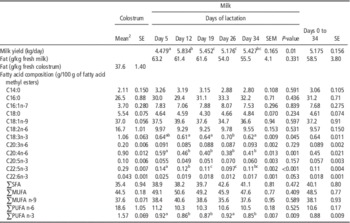
As reported by Aguinaga et al. (Reference Aguinaga, Gómez-Carballar, Nieto and Aguilera2011a), the IB sows consumed their whole daily ration in both trials. The mean values for milk production, milk fat content and relative FA profile at days of measurement appear in Table 1. Total milk yield was on average 5.175±0.156 kg in the 34-day lactation, and tended to differ between trials (P=0.090). Milk production (and consequently piglet milk intake (g/day)) achieved a maximum at day 12 and levelled off thereafter (P<0.01). Colostral fat content was 39.0 and 36.2 g/kg, in trials 1 and 2, respectively, considerably lower than that observed in fresh milk (62.3 and 55.9 g/kg, respectively). Throughout the nursing period, the piglets grew at an average rate of 168±3 g/day.
The effect of days of lactation on fat content and fatty acid profile of Iberian sows’ milk throughout a 34-day nursing periodFootnote 1

SFA=saturated fatty acid; MUFA=monounsaturated fatty acid; PUFA=polyunsaturated fatty acid.
∑SFA=C10:0+C12:0+C14:0+C16:0+C17:0+anteiso-C18:0+C18:0+C20:0+C22:0+C24:0.
∑MUFA=C14:1n-9+C16:1n-7+C18:1n-9t+C18:1n-7t+C18:1n-9+C18:1n-7+C20:1n-9+C22:1n-9+C24:1n-9.
∑MUFA n-9=C14:1n-9+C18:1n-9t+C18:1n-9+C20:1n-9+C22:1n-9+C24:1n-9.
∑PUFA n-6=C18:2n-6+C18:3n-6+C20:2n-6+C20:3n-6+C20:4n-6+C22:2n-6+C22:4n-6.
∑PUFA n-3=C18:3n-3+C20:3n-3+C20:5n-3+C22:5n-3+C22:6n-3.
a,b,cWithin a row, means without a common superscript letter differ (P<0.05).
1 Determined in four sows in each of the two trials performed.
2 A composite sample built from samples taken between 10 and 35 h postpartum was analysed in duplicate within trial.
Fatty acid profile of Iberian sow colostrum and milk
No differences in the relative composition of FA in milk were observed between lactation sub-periods, except for LNA (P<0.05), ARA (P=0.001), DPA (P<0.001) and total n-3 PUFA (P<0.01) (Table 1). These FA showed increased relative concentration in milk samples taken on day 5 of lactation with respect to later stages of lactation. The relative concentrations of palmitic acid, oleic acid and LA achieved in all 80.2% of colostral FA. The average relative content of LNA in the colostral fat was double than that found in milk. On average, MUFA attained 44.5% and 48.5% of total FA in the IB sow colostrum and milk, respectively, and palmitic and oleic acids achieved in all 63.4% and 68.4% of total colostrum and milk FA, respectively. In milk fat, the sum of relative concentrations of myristic, palmitic, palmitoleic, stearic and oleic acids accounted for 95.5% of total non-essential FA content. Long-chain PUFA were in sow milk at low relative concentrations, particularly n-3 derivatives. In the IB sow milk, the LA : LNA ratio attained, on average, a value of 14.6 (9.23/0.63) and 15.2 (9.90/0.65) in trials 1 and 2, respectively; correspondingly, the n-6 : n-3 PUFA ratio achieved average values of 11.6 (10.2/0.883) and 12.3 (10.9/0.886). Additional data on the FA relative profile of colostrum and milk are reported in Supplementary Table S1.
Fatty acid composition of piglets’ body fat
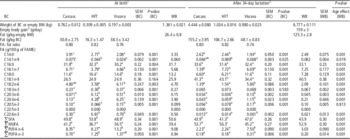
Table 2 presents information on fat content (g/kg empty BW) and on FA relative composition of body compartments and whole-body of the IB piglets at birth and after 34 days of lactation. A detailed account on these subjects is given online in Supplementary Tables S2 and S3. A fivefold increase in fat content was observed in the body of the piglets over lactation (P<0.001). Most of this fat was present in the carcass (102±14 g/kg empty BW; 81.4% whole-body fat). Viscera showed the lowest contribution (6.88±0.66 g fat/kg empty BW). With age, a general change in whole-body FA concentration was observed (P<0.02 to 0.001), with outstanding differences for oleic acid, whose relative concentration increased markedly, and for stearic, LA, LNA, n-6 PUFA, and DHA – but not EPA – that showed great reductions. At weaning, oleic and palmitic acids presented the highest relative concentrations. Total SFA, PUFA n-6 and PUFA n-3 of piglets were higher at birth than at 35 days of age (P<0.001), whereas the opposite trend was found for total MUFA (P<0.001). As a result, MUFA : SFA ratio was highest at weaning (P<0.001). At both stages of growth DPA was at concentrations below the limit of detection. The LA : LNA and n-6 PUFA : n-3 PUFA ratios in the empty body of the piglets increased from 17.4 and 9.70 to 31.1 and 15.3, from birth to day 35 of life, respectively.
The fat content and fatty acid (FA) relative profile of different body compartments (BC) and whole body (WB) of Iberian piglets at birth and at 35 days of age. Effect of age on WB FA profile

HFT=head, feet and tail; FAME=fatty acid methyl esters; SFA=saturated fatty acid; MUFA=monounsaturated fatty acid; PUFA=polyunsaturated fatty acid.
∑SFA=C12:0+C14:0+C16:0+C17:0+anteiso-C18:0+C18:0+C20:0+C22:0+C24:0.
∑MUFA=C14:1 n-9+C16:1n-7+C18:1 n-9t+C18:1n-7t+C18:1 n-9+C18:1n-7+C20:1 n-9+C24:1 n-9.
∑MUFA n-9=C14:1n-9+C18:1n-9t+C18:1n-9+C20:1n-9+C24:1n-9.
∑PUFA n-6=C18:2n-6+C18:3n-6+C20:2n-6+C20:3n-6+C20:4n-6.
∑PUFA n-3=C18:3n-3+C20:3n-3+C20:5n-3+C22:5 n-3+C22:6n-3.
a,b,cWithin a row and age, means without a common superscript letter differ (P<0.05).
1 Fat and FA composition were determined in four piglets (one piglet per litter) in each of the two trials performed.
2 Fat composition was determined in 16 piglets (4 litters×4 piglets/litter) and FA in 8 piglets (4 litters×2 piglets/litter) in each of the two trials performed, respectively.
3 Determined in 24 piglets (4 litters×6 piglets/litter) in each of the two trials performed.
The utilization of fatty acids by the suckling piglets
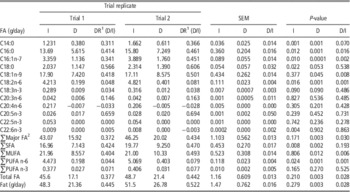
The average daily intake of milk per piglet in the 34-day lactation tended to be higher in trial 2 (832 and 893 g; P=0.066; Aguinaga et al., Reference Aguinaga, Gómez-Carballar, Nieto and Aguilera2011a), implying relatively small differences in piglet’s daily supply of digestible protein (43.8 and 47.7 g; P=0.050), lactose (43.9 and 55.9 g; P<0.001) and energy (3750 and 4026 kJ ME; P=0.066), but not of digestible fat (49.9±5.0 g; P=0.279). Although differences were small, there was a trial effect on daily intake of most individual FA (P=0.022 to 0.001), but not for oleic, LNA (P=0.090) and most of long-chain FA (P>0.05, Table 3). An average daily intake of 47.2±4.7 g of total FA was calculated, 93.3% of which was accounted for by myristic, palmitic, palmitoleic, stearic, oleic acids and LA.
Intake and net deposition of major fatty acids, essential fatty acids and their derivatives of the sow’s milk by the suckling Iberian piglets slaughtered on day 35 of life

FA=fatty acids; I=intake; D=deposition; DR=deposition rate; SFA=saturated fatty acid; MUFA=monounsaturated fatty acid; PUFA=polyunsaturated fatty acid.
1 The rate of oxidation is calculated as 1−DR. It is assumed that conversions of C18:2n-6 to C20:3n-6 and C20:4n-6, and of C18:3n-3 to C20:5n-3, C22:5n-3 and C22:6n-3 were negligible.
2 Total major non-essential FA, essential FA and their derivatives.
The daily rate of net deposition of FA by the suckling IB piglet appears also in Table 3. The tabulated values refer to major non-essential FA, essential FA and their derivatives. Significant differences in deposition of fat and total FA were found between trials (P<0.01) as a result of the improved efficiency in deposition of total FA absorbed in trial 2 (0.377 v. 0.442; P<0.05). In this trial, all major FA and essential FA showed their highest net deposition (g/day; P<0.001 to 0.05; P=0.053 and 0.090 for stearic acid and LNA, respectively). Also, fractional deposition achieved the highest daily rates in this trial (P<0.001 to 0.05; P=0.070 for myristic acid). Palmitic and oleic acids contributed up to 80.3%, on average, to the total FA deposited in the empty body of the IB piglets. Meanwhile, the daily deposition of LA derivatives and of LNA and its derivatives was found to be noticeably low (<0.02 g, on average) for most of them in the limit of detection. Comparatively, net deposition of LA was somewhat higher. Amazingly, none of ARA and DHA supplied or synthesized from their precursors was deposited. Instead, some of the ARA present in the tissues of the IB piglet at birth disappeared, presumably by conversion into other bioactive compounds or by β-oxidation. As reported by Aguinaga et al. (Reference Aguinaga, Gómez-Carballar, Nieto and Aguilera2011a), on average, 24.2±0.8 g of fat were deposited daily in the empty body of the IB suckling piglets. After the FA analysis of the lipid fraction in milk and body compartments, an average fractional deposition for total FA of 0.409 can be calculated (Table 3); then, 0.591 of the absorbed (non-essential and essential) FA ingested were apparently oxidized. From Table 3, fractional oxidation rates of 0.939 and 0.926 for the n-6 and n-3 PUFA series can be calculated (1−deposition rate). An overall rate of disappearance (via oxidation or further metabolic conversions) of 0.546 for the major non-essential FA (myristic, palmitic, palmitoleic, stearic and oleic acids) was estimated according to equation (2). This figure compares well with the value that can be calculated from Table 3 (0.554) and suggests that the fractional net deposition of these FA achieved an overall value of 0.446.
Discussion
Fatty acid profile of Iberian sow colostrum and milk
Although FA in colostrum and milk tend to follow dietary fat composition (Darragh and Moughan, Reference Darragh and Moughan1998; de Quelen et al., Reference de Quelen, Boudry and Mourot2010), a trend for a higher relative concentration of MUFA and much lower relative levels of PUFA was observed in IB milk fat in comparison with milk of conventional or obese breeds consuming diets in which, as in the present study, animal fat was used as main source of FA, although level of fat inclusion may differ (Alston-Mills et al., Reference Alston-Mills, Iverson and Thompson2000; Bazinet et al., Reference Bazinet, McMillan and Cunnane2003; de Quelen et al., Reference de Quelen, Boudry and Mourot2010; Vicente et al., Reference Vicente, Isabel, Cordero and López-Bote2013). The most striking event concerns the low relative concentration observed in the IB sow milk for LA (9.57%, on average) and, above all, for LNA (0.642%, on average) and some of their polyunsaturated derivatives (i.e. ARA, 0.451%; EPA, 0.057%; DHA, 0.018%, on average). This FA profile and a comparatively lower fat content results in a poor daily provision of essential FA, particularly of n-3 PUFA. Dietary provision of LA and LNA must ensure an adequate rate of synthesis of long-chain n-6 and n-3 PUFA in the body of the suckling piglet. Furthermore, as these FA compete for the same desaturases and elongases, the n-6 : n-3 PUFA ratio is critical to avoid an imbalance that might impair the development of many physiological functions (Uauy et al., Reference Uauy, Mena and Rojas2000; de Quelen et al., Reference de Quelen, Boudry and Mourot2010).
Fatty acid composition of the suckling piglets
Compared with piglets from conventional genotypes, the IB piglet at birth shows increased fat content (26.4±0.8 g/kg empty BW). Noblet and Etienne (Reference Noblet and Etienne1986) and Le Dividich et al. (Reference Le Dividich, Esnault, Lynch, Hoo-Paris, Castex and Peinian1991) reported values of 12 and 14 g/kg empty BW, respectively, in Large White piglets, and Jentsch et al. (Reference Jentsch, Beyer, Schiemann and Hoffmann1995) reported 11 g/kg empty BW in piglets of the German Landrace breed. The low body fat content of the new-born pig seems to be the result of a limited and selective placental transfer of free FA (Thulin et al., Reference Thulin, Allee, Harmon and Davis1989; Rooke et al., Reference Rooke, Shanks and Edwards2000), and a low capacity of the foetus for de novo synthesis of FA from precursors as glucose or lactate transported across the placenta (Duee et al., Reference Duee, Pegorier, Darcy-Vrillon and Girard1996). Furthermore, most of this fat is structural fat and, therefore, not available for mobilization.
In the study of Aguinaga et al. (Reference Aguinaga, Gómez-Carballar, Nieto and Aguilera2011a), an average empty body gain of 159 g/day and a daily fat deposition between birth and weaning of 24.2 g were obtained. This deposition rate is somewhat lower than that of 28.7 g/day that was reported by Noblet and Etienne (Reference Noblet and Etienne1987) in Large White piglets weaned at only 22 days of age, in line with the slower average growth rate observed in the IB piglet adjusted for a similar period of lactation (185 v. 195 g/day, respectively), but greater than that of 20 g/day, obtained by Jentsch et al. (Reference Jentsch, Beyer, Schiemann and Hoffmann1995) in piglets from German Landrace sows weaned at 26 days of age, showing an average daily gain of 161 g.
In two independent studies, Bazinet et al. (Reference Bazinet, McMillan and Cunnane2003) and de Quelen et al. (Reference de Quelen, Boudry and Mourot2010) studied the FA composition of tissues from piglet suckling sows that during part or the whole gestation and lactation were offered standard diets either supplied with corn oil or a mixture of tallow and linseed (Bazinet et al., Reference Bazinet, McMillan and Cunnane2003), or with lard or linseed oil (de Quelen et al., Reference de Quelen, Boudry and Mourot2010), to alter markedly the dietary provision of LA and LNA and some of their long-chain derivatives. Bazinet et al. (Reference Bazinet, McMillan and Cunnane2003) found that piglets suckled from sows consuming the high LNA diet have a significantly lower relative proportion of LA and far greater relative concentrations of LNA and EPA, but not DHA, in carcass. de Quelen et al. (Reference de Quelen, Boudry and Mourot2010) observed that the carcass of the piglets born from sows receiving the linseed oil-based diet contained at birth greater relative proportions of LNA, EPA, DPA and DHA, but not of LA or ARA. After 21 days of suckling, LA, but not ARA, content was greater in the carcass of piglets from the linseed oil treatment group. The proportions of LNA, EPA, DPA and DHA were also greater in the carcass of the latter group. Consequently, it is clear that the level of intake of LA and LNA and their long-chain derivatives influences their deposition in the body of the pig. Compared with the piglets from sows receiving the lard-based diets of the experiment by de Quelen et al. (Reference de Quelen, Boudry and Mourot2010), the IB piglets had in their carcass at birth similar relative proportions of SFA and MUFA, greater concentrations of n-6 PUFA, particularly of ARA, and a much lower relative content of n-3 PUFA, specifically of EPA, DPA and DHA and, to a lesser extent, of LNA. After 34 days of lactation, the IB piglets showed in their carcass greater relative proportions of SFA and MUFA, and far lower concentrations of n-6 and n-3 PUFA, particularly of LNA, DPA and DHA. Noticeably, in the study of de Quelen et al. (Reference de Quelen, Boudry and Mourot2010), greater relative concentrations of n-6 and, above all, n-3 PUFA were found both in colostral and milk fat, in comparison with values obtained in the present study. Then, the following questions arise: Is this different status the result of differences in the net supply of n-6 and n-3 PUFA to the IB piglet with milk? Is there a genotype-linked factor limiting n-6 and n-3 PUFA deposition in the IB suckling piglet? Following the first question, an improvement of the n-3 PUFA status of the new-born pig could be attained by the incorporation to the diet of the gestating and/or lactating sow of any source rich in n-3 PUFA, that is, fish oil, in agreement with data reported by Rooke et al. (Reference Rooke, Sinclair and Edwards2001) and Lauridsen and Danielsen (Reference Lauridsen and Danielsen2004). Nevertheless, it should be taken into account that the subsequent increased incorporation of DHA into piglet tissues might be accompanied by reductions in ARA, as found by Rooke et al. (Reference Rooke, Shanks and Edwards2000).
The results of a collaborative study of our research group (Barea et al., Reference Barea, Isabel, Nieto, López-Bote and Aguilera2013) are relevant to the second question. In this study, a comparison was made on the pattern of changes of FA in subcutaneous fat of two pig genotypes which differ profoundly in growth rate and composition of growth: 32 IB and Landrace×Large White barrows were offered one of the two diets differing in CP content (13% or 17% as-fed) throughout the growing and finishing stages of growth. A pair-fed procedure (0.8×ad libitum intake of IB pigs) was used. Subcutaneous fat samples were taken at the dorsolumbar region at ~38, 50, 65, 90 and 115 kg BW. Pig genotype affected the FA composition of both subcutaneous backfat layers. At 50 kg BW, higher contents of stearic acid and total SFA and lower contents of palmitoleic, LA, LNA and total PUFA were detected in both fat layers of IB compared with Landrace×Large White pigs. At 115 kg BW, MUFA contents (mainly oleic acid) were higher in IB pigs in both layers. This would indicate genotype differences (i.e. inhibition or activation) in the desaturation of stearic acid, suggesting possible differences in desaturase activity between the obese and lean pig genotypes. A higher desaturase activity could be related to an increase in the energetic cost related to the desaturation process (Nelson and Cox, Reference Nelson and Cox2000). Increased proportions of LA and PUFA were found in Landrace×Large White pigs, irrespective of the stage of growth and backfat layer. Our results suggested genetic variation in de novo lipid synthesis and in the pattern of FA unsaturation The higher proportions in LA and PUFA (exclusively from dietary origin) in backfat from Landrace×Large White pigs could be explained by a lower de novo lipid synthesis in this leaner crossbreed. Thus, both breeds consumed the same quantity of LA, but because of a greater de novo synthesis (of SFA and MUFA) the proportion of LA was lower in the IB genotype (i.e. dilution effect). Nevertheless, the dilution effect would be compatible with a theoretical increased β-oxidation of LA and LNA.
Utilization of milk fatty acids by the suckling piglet
Aguinaga et al. (Reference Aguinaga, Gómez-Carballar, Nieto and Aguilera2011a) determined the nutrient and energy balance of the IB suckling piglets used in the present study. Nutrient and energy deposition between birth and weaning were on average 27.4±0.5 g/day protein, 24.2±0.8 g/day fat and 1615±40 kJ/day energy. On average, 51.5% of the milk fat ingested and absorbed was oxidized. An improved efficiency in deposition of fat and all major FA and essential FA absorbed was found in trial 2. However, this effect cannot be attributed to the lower ET at which this trial was performed, due to the confounding effect of ET and trial replicate. In support of a preferential deposition of fat from dietary fat, there is evidence of a low lipogenic capacity in the suckling pig. Mersmann et al. (Reference Mersmann, Houk, Phinney and Underwood1973) observed that the de novo synthesis of FA appeared to have been suppressed in suckling piglets up to 35 days of age when no creep feed was supplied. In contrast, piglets fed creep feed showed increased rate of lipogenesis. Le Dividich et al. (Reference Le Dividich, Esnault, Lynch, Hoo-Paris, Castex and Peinian1991) found a close relationship between the amount of fat deposited in the body of the neonatal pig and the level of colostral fat and concluded that body fat deposition did not result from lipogenesis, because fat deposition was negligible when fat in colostrum was at the lowest content (10 g/kg). Furthermore, the increasing resemblance in the FA profile of body fat and fat ingested as the latter increased support their conclusion. Present results are in line with these previous observations: after 34 days of lactation, palmitic, palmitoleic, stearic and oleic acids are in the whole body of the IB piglet at relative concentrations very close to those found in the milk consumed, suggesting direct deposition. On the contrary, the LA and LNA provided were massively oxidized. The data of the present experiment also indicate that FA from milk fat and fat stored in the body of the suckling piglet are β-oxidized at a rate that varies with their degree of unsaturation and chain length, in agreement with Leyton et al. (Reference Leyton, Drury and Crawford1987). These authors used a radioisotope tracer technique to study the oxidation rates of FA in weaning rats placed in a metabolism chamber, and observed that the longer the chain length of the SFA, the slower its oxidation rate. Lauric acid was the most efficient energy substrate. Oleic acid was β-oxidized at a similar rate than lauric acid and LNA approached their rates of oxidation. LA was oxidized at a higher rate than any of its metabolites, with ARA showing the slowest rate. Vicente et al. (Reference Vicente, Isabel, Cordero and López-Bote2013) in weanling piglets provided evidence that this selective β-oxidation according to unsaturation and chain length involved also previously stored FA. Sanz et al. (Reference Sanz, López-Bote, Menoyo and Bautista2000) found a lower abdominal fat deposition in broiler chickens fed diets enriched in LA by the incorporation of sunflower oil to a basal feed, compared with those fed the basal diet added of tallow. These authors explained that this reduced fat deposition is a result of increased β-oxidation rate of the polyunsaturated dietary fat and reduced endogenous lipogenesis.
In the IB suckling piglet, although surplus amounts of LA with respect to requirements (National Research Council (NRC), 2012) – and, presumably, of LNA – were present in the diet, conversion of these essential FA to n-6 and n-3 long-chain PUFA seems to have been disrupted at a single or at several steps of the corresponding desaturation/elongation pathway. Negligible amounts of n-6 and n-3 long-chain PUFA were synthesized from LA and LNA, whereas all of ARA, DPA and DHA supplied with milk was used as precursors of bioactive compounds or were β-oxidized, resulting in a total disappearance of these essential PUFA, a partition that cannot be measured directly by the whole-body FA balance method (in tracer studies, Leyton et al. (Reference Leyton, Drury and Crawford1987) observed in the rat that about 48%, 64% and 14% of the tracer was recovered as CO2 for LA, LNA and ARA in 24 h). This fact cannot be attributed to a hypothetic imbalanced n-6 PUFA : n-3 PUFA ratio in the diet of the IB piglet, able per se to cause a negative impact either in the synthesis of ARA, via the sequential action of ∆6-desaturase, elongase and ∆5-desaturase, and of elongase and ∆5-desaturase for DPA and DHA synthesis. After the experiment of de Quelen et al. (Reference de Quelen, Boudry and Mourot2010), it seems that not only a balanced n-6 PUFA : n-3 PUFA ratio, but also an adequate exogenous supply of some preformed derivatives, specifically ARA and DHA, must be provided to achieve substantial rates of deposition of these FA derivatives or for metabolic conversion from precursors to ensure an optimal growth and development. Essential FA are structural components of all tissues. The brain, retina and other neural tissues are particularly rich in long-chain PUFA, specially, in ARA and DHA. It is still not well known to which extent the conversion of LA and LNA to longer-chain PUFA should occur during the foetal and early postnatal stages of life to ensure a normal development of key physiological processes as cell membrane synthesis, immune function or production of various eicosanoids (Uauy et al., Reference Uauy, Mena and Rojas2000), and when these processes are compromised. It is likely that under practical production systems, the provision of creep feed to the suckling pig would increase the exogenous amount of LA, LNA and some preformed derivatives, eliminating a potential imbalance, a subject that warrants future research efforts. In addition, it is arguable whether a reduction in the synthesis of n-6 PUFA derivatives from LA, and particularly that of ARA and of DHA from LNA, can be related to an increased oxidation of LA and LNA.
The particular scheme in the metabolism of FA described in the IB suckling piglet can be associated with the increased energy cost of fat deposition found in this pig genotype, as reported by Aguinaga et al. (Reference Aguinaga, Gómez-Carballar, Nieto and Aguilera2011a). In this study, partial efficiencies in the use of ME for protein and fat deposition were estimated as 0.373 (1/2.67) and 0.696 (1/1.44), corresponding to energy costs of 63.55 kJ ME/g protein accreted and 57.31 kJ ME/g of fat deposited in the body of the suckling piglet, respectively. The energy cost of fat deposition was found to be at the top of the range of values reported for early-weaned piglets (Campbell and Dunkin, Reference Campbell and Dunkin1983; Gädeken et al., Reference Gädeken, Oslage and Böhme1985). Also, at later stages of growth, from 10 to 150 kg BW, at which we analysed the response of the IB pig to energy supply in terms of energy partition into protein accretion and fat deposition, and the energetic efficiency of the processes involved (Nieto et al., Reference Nieto, Lara, Barea, García-Valverde, Aguinaga, Conde-Aguilera and Aguilera2012), we have shown that, irrespective of BW and level of feeding, ME costs for protein accretion and fat deposition attain 60 and 62 kJ/g, considerably greater than in conventional or lean pig genotypes (NRC, 2012). Consequently, our observations in IB suckling piglets (Aguinaga et al., Reference Aguinaga, Gómez-Carballar, Nieto and Aguilera2011a) and in IB pigs at later stages of growth (Nieto et al., Reference Nieto, Lara, Barea, García-Valverde, Aguinaga, Conde-Aguilera and Aguilera2012) support the existence of genetic variation in the efficiency of energy use. Focussing on fat accretion, in the IB suckling piglet, we have concomitant high degree of FA unsaturation, low rates of deposition of some n-6 PUFA, and above all, n-3 PUFA derivatives, and extremely high rates of β-oxidation of LA and LNA associated with an increased energy cost of fat deposition. High rates of LA and LNA β-oxidation may result in increased recycling of their carbon skeleton to de novo-synthesized FA, a process that requires energy, as found by Cunnane and Yang (Reference Cunnane and Yang1995). At later stages of growth, our results suggest a genetic variation in the de novo lipid synthesis and pattern of FA unsaturation. Higher desaturase activity in the IB pig, in comparison with a lean pig genotype under the same nutritional regime (Barea et al., Reference Barea, Isabel, Nieto, López-Bote and Aguilera2013) can be associated with lower efficiency of energy utilization for fat deposition found by Nieto et al. (Reference Nieto, Lara, Barea, García-Valverde, Aguinaga, Conde-Aguilera and Aguilera2012).
In conclusion, the IB sow milk provides to the suckling piglet less fat than conventional or lean breeds. Although FA profile is within the range of values reported for colostrum and milk of obese and conventional porcine breeds, LA and, particularly, LNA and some of their polyunsaturated derivatives are at comparatively lower relative proportions. Most of ingested LA and LNA by the suckling piglet is β-oxidized. Negligible amounts of ARA and DHA are deposited in piglet tissues during the lactating period. This pattern in the relative profile of FA in body fat stores can be associated – or, at least, is concomitant – with an increased energy cost of body fat accretion, and contributes to the low efficiency of use of milk energy for piglet growth. To improve ARA and DHA deposition the exogenous supply of preformed long-chain PUFA would be presumably required. Further research is needed to challenge this hypothesis.
Acknowledgements
This study has been supported by grant nos. AGR-395 and AGL2011-25360 from Junta de Andalucía and Ministry of Economy and Competitiveness, respectively. M. A. Aguinaga was the recipient of a grant from Junta de Andalucía. The authors thank A. Navarro and F. Funes for skilful technical assistance, and Sánchez Romero Carvajal Jabugo S.A. (Puerto de Santa María, Cádiz) for their helpful collaboration.
Supplementary material
To view supplementary material for this article, please visit http://dx.doi.org/10.1017/S175173111600080X