




Introduction
Public health emergencies, such as the COVID-19 pandemic, create a sudden and disproportionate demand for skilled health care personnel, severely challenging the surge capacity of global health systems. These crises necessitate a fundamental re-evaluation of health care delivery and offer critical opportunities for transformative policy innovation. 1 In Israel, the baseline shortage of nursing personnel reported at 5.0 per 1,000 population compared to the Organization for Economic Cooperation and Development (OECD; Paris, France) average of 8.8 represents a significant vulnerability during prolonged health crises. 2
Historically, the expansion of the nursing workforce in Israel has not kept pace with rapid population growth, creating a chronic reliance on efficient workforce optimization during emergencies. Reference Natanson, Weiss and Ben-Shimon3 The COVID-19 pandemic underscored the vital contribution of nursing students as a potential auxiliary workforce. Reference Buchan, Catton and Shaffer4
In Israel, nursing education is regulated by the Ministry of Health (Jerusalem, Israel), requiring a core curriculum of 2,648 hours, where approximately one-third is dedicated to clinical placement. Reference Grinberg, Nissanholtz-Gannot and Sela-Vilensky5 To achieve licensure as a Registered Nurse (RN), graduates must pass the Governmental Licensing Examination in Nursing (GLEIN), which assesses the essential competencies, knowledge, and clinical attitudes required for safe practice. Reference Greiner and Knebel6,Reference Algoso and Peters7
Critically, nursing students often have limited exposure to independent RN roles during their studies, yet they are expected to demonstrate clinical readiness immediately upon registration. Reference Law and Chan8 International models, such as those in Australia and Canada, utilize nurses in assistant roles to bolster student confidence and skills. Reference Algoso, Ramjan, East and Peters9,Reference Crevacore, Duffield and Twigg10 Similarly, research in the United States has shown that clinical work experience during the final stages of education is associated with superior academic performance. Reference Warner, Barrow and Berken11 In Israel, standard nonemergency regulations strictly prohibit undergraduate nursing students from engaging in paid clinical nursing employment or exercising delegated clinical responsibilities prior to passing the GLEIN. Reference Nissanholtz-Gannot, Rosen and Hirschfeld12
Consequently, the acute nursing shortage during the COVID-19 pandemic served as a direct regulatory catalyst, prompting the Israeli Ministry of Health to implement unprecedented policy flexibility by granting temporary clinical work permissions to advanced nursing students for the first time. This policy allowed students to engage in paid clinical practice with expanded responsibilities, specifically under high-acuity crisis surge conditions, prior to taking their licensing exams.
Grounded in Kolb’s Experiential Learning Theory and Kirkpatrick’s evaluation framework (focusing on Level 2: Knowledge and Competence Acquisition), this study evaluated the impact of emergency clinical employment on academic performance and GLEIN outcomes. To assess this policy intervention, a quasi-experimental design with a historical control group was utilized, comparing students who worked during the crisis surge with a historical pre-pandemic control group following the standard curriculum.
Methods
Study Design and Setting
This study employed a quasi-experimental design with a historical control group to evaluate the impact of emergency clinical work permissions during the COVID-19 pandemic surge. Study design and reporting followed the TREND (Transparent Reporting of Evaluations with Nonrandomized Designs) guidelines. Because a randomized controlled trial was ethically and logistically infeasible during an active public health emergency, a quasi-experimental comparative design using a historical control group provided the most rigorous feasible methodology. The study was conducted at an academic nursing school in Israel, comparing students from the “Career Retraining to Nursing” program scheduled for the national licensing examination (GLEIN).
Participants and Selection Criteria
The study population comprised students enrolled in an intensive academic career retraining nursing track. In Israel, this program represents an accelerated, first-entry nursing pathway designed for individuals holding a bachelor’s degree in a non-nursing discipline (eg, biological or social sciences). Crucially, participants held no prior nursing licensure, formal health care qualifications, or clinical nursing experience prior to program entry.
Inclusion required completion of the academic nursing curriculum and registration for the national licensing exam (GLEIN). To establish a reliable baseline comparison, a historical control group was drawn from the immediate pre-pandemic cohort who completed the identical 2,648-hour curriculum under standard regulatory conditions without clinical employment. The intervention group consisted of final-year students from the pandemic cohort who utilized temporary regulatory flexibility to work in acute in-patient hospital wards for approximately four weeks during the initial surge prior to taking the GLEIN. Exclusion criteria applied to students from traditional four-year Bachelor of Science in Nursing (BSN) tracks or those sitting for the exam outside these specified cohort periods.
As this was a retrospective quasi-experimental study, the sample size was determined by the total number of eligible students during the study period, and no a priori sample size calculation was performed. The participant screening, inclusion criteria, and cohort allocation process are illustrated in Figure 1.
Participant Selection and Allocation Flow Diagram.
Abbreviations: GLEIN, Government Licensing Examination in Nursing; TREND, Transparent Reporting of Evaluations with Nonrandomized Designs

Data Collection and Variables
Anonymized data were extracted from official institutional records. Study variables encompassed demographic characteristics (age, gender, country of birth, and marital status), academic performance indicators (mean grades from the preceding year and final cumulative program grades), and the primary outcome measure: GLEIN scores. Clinical work experience during the crisis was documented as the primary independent variable.
Ethical Considerations
The study was approved by the Institutional Ethics Committee of Soroka Medical Center, Beer-Sheva, Israel (Approval No. MOPR-016-21). To ensure privacy, all data were de-identified prior to analysis. Consequently, the requirement for informed consent was waived by the ethics committee.
Statistical Analysis
Descriptive statistics were used to summarize the data, with categorical variables presented as frequencies and percentages and continuous variables as means and standard deviations (SD). Comparisons of categorical data between the work experience and control groups were performed using the chi-square test or Fisher’s exact test, as appropriate. Continuous variables were compared using Mann-Whitney U tests.
The relationships between academic, demographic, and work-related variables were evaluated using Pearson correlation coefficients. To identify the independent predictors of GLEIN scores, a stepwise multiple linear regression analysis was conducted. Variables were entered into the model using stepwise criteria. (P < .05 for entry and P >.10 for removal). Demographic characteristics (age and gender) were introduced in the first step (Model 1), cumulative final program grades in the second step (Model 2), and crisis period clinical work experience in the final step (Model 3). Statistical significance was defined as a two-tailed P < .05. Multicollinearity was assessed using the Variance Inflation Factor (VIF), with values below five indicating no significant multicollinearity.
All statistical analyses were performed using SPSS software, version 28 (IBM Corp; Armonk, New York USA).
Results
Participant Characteristics
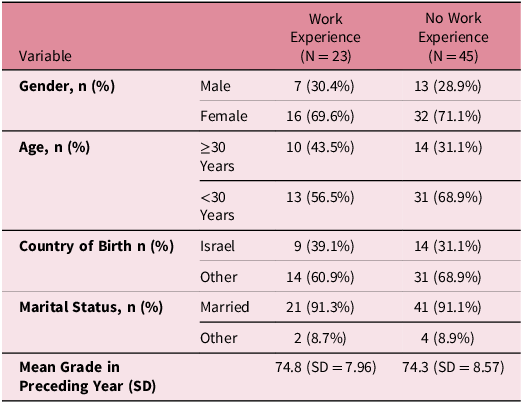
A total of 68 students were included in the analysis: 23 students who utilized the emergency regulatory change to work in hospital wards during the initial COVID-19 surge (March 2020), and 45 students who followed the standard curriculum without such employment. The cohort was predominantly female (70%), under the age of 30 (67%), and married (>90%). Approximately one-third of the participants were Israeli born. No notable differences were observed between the work experience and control groups regarding demographic characteristics or mean grades from the preceding academic year [74.8 (SD = 7.96) versus 74.3 (SD = 8.57), respectively], ensuring baseline comparability (Table 1).
Demographic Data of the Study Participants

Table 1. Long description
A table comparing demographic data of study participants with and without work experience. The table has 5 rows and 4 columns. Column headers are Variable, Work Experience (N=23), and No Work Experience (N=45). Row labels are Gender, Age, Country of Birth, Marital Status, and Mean Grade in Preceding Year. Row 1: Gender, Male, 7 (30.4 percent), 13 (28.9 percent); Female, 16 (69.6 percent), 32 (71.1 percent). Row 2: Age, >=30 Years, 10 (43.5 percent), 14 (31.1 percent); <30 Years, 13 (56.5 percent), 31 (68.9 percent). Row 3: Country of Birth, Israel, 9 (39.1 percent), 14 (31.1 percent); Other, 14 (60.9 percent), 31 (68.9 percent). Row 4: Marital Status, Married, 21 (91.3 percent), 41 (91.1 percent); Other, 2 (8.7 percent), 4 (8.9 percent). Row 5: Mean Grade in Preceding Year, 74.8 (SD 7.96), 74.3 (SD 8.57).
Impact on Academic and Licensing Performance
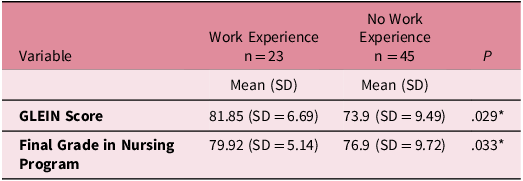
Students in the work experience group achieved significantly higher final program grades compared to those without clinical employment [79.92 (SD = 5.14) versus 76.9 (SD = 9.72); difference, 3.02 (95% CI, 0.28–5.76); P = .033]. Furthermore, the work experience group demonstrated superior performance on the GLEIN, with significantly higher mean scores [81.85 (SD = 6.69) versus 73.9 (SD = 9.49); difference, 7.95 (95% CI, 0.70–15.20); P = .029] (Table 2).
Comparison of Final Grades between Students With and Without Work Experience

Table 2. Long description
The table compares final grades and GLEIN scores between students with and without work experience. It has 3 rows and 5 columns. The columns are labeled Variable, Work Experience n=23, No Work Experience n=45, and P. The rows are labeled GLEIN Score and Final Grade in Nursing Program. For GLEIN Score, the mean for Work Experience is 81.85 with a standard deviation of 6.69, and for No Work Experience, it is 73.9 with a standard deviation of 9.49. The P value is 0.029. For Final Grade in Nursing Program, the mean for Work Experience is 79.92 with a standard deviation of 5.14, and for No Work Experience, it is 76.9 with a standard deviation of 9.72. The P value is 0.033.
Abbreviation: GLEIN, Government Licensing Examination in Nursing.
Correlation and Regression Analysis
Bivariate analysis revealed a significant moderate positive correlation between crisis period work experience and GLEIN scores (r = 0.355; Table 3).
Correlation Among Research Variables

Table 3. Long description
A table with six rows and five columns displaying correlation coefficients among research variables. The columns are labeled Work Experience, Age, Gender, Final Grade in Nursing Program, and GLEIN Score. The rows are labeled with the same variables. Each cell contains a correlation coefficient value. Row 1: Work Experience, 1. Row 2: Age, 0.213, 1. Row 3: Gender, 0.061, 0.160, 1. Row 4: Final Grade in Nursing Program, 0.235, 0.192, 0.128, 1. Row 5: GLEIN Score, 0.355, 0.151, 0.141, 0.901, 1.
Abbreviation: GLEIN, Government Licensing Examination in Nursing.
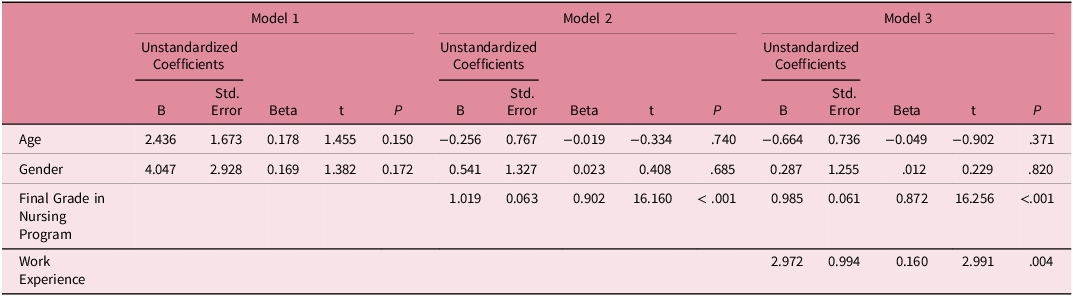
Stepwise multiple linear regression was conducted to identify independent predictors of GLEIN performance (Table 4). Model diagnostics confirmed that regression assumptions (normality of residuals, linearity, and homoscedasticity) were satisfied. Demographic variables (gender and age) did not significantly contribute to the model (Model 1). Notably, after adjusting for academic performance, clinical work experience remained a significant independent predictor, accounting for additional variance in GLEIN scores (Model 3; P = .004).
Regression Analysis to Determine the Factors Predicting GLEIN Score

Table 4. Long description
A table with three models comparing the impact of different variables on GLEIN performance using multiple linear regression. The table has 4 rows and 15 columns. Column headers are Model 1 Unstandardized Coefficients B, Model 1 Unstandardized Coefficients Std. Error, Model 1 Beta, Model 1 t, Model 1 P, Model 2 Unstandardized Coefficients B, Model 2 Unstandardized Coefficients Std. Error, Model 2 Beta, Model 2 t, Model 2 P, Model 3 Unstandardized Coefficients B, Model 3 Unstandardized Coefficients Std. Error, Model 3 Beta, Model 3 t, Model 3 P. Row labels are Age, Gender, Final Grade in Nursing Program, Work Experience. Row 1: Age, 2.436, 1.673, 0.178, 1.455, 0.150, 0.767, 0.256, -0.334, 0.740, 0.664, 0.736, 0.049, -0.902, 0.371. Row 2: Gender, 4.047, 2.928, 0.169, 1.382, 0.172, 0.541, 1.327, 0.023, 0.408, 0.685, 0.287, 1.255, 0.12, 0.229, 0.820. Row 3: Final Grade in Nursing Program, 1.019, 0.063, 0.902, 16.160, <.001, 0.985, 0.061, 0.872, 16.256, <.001. Row 4: Work Experience, 2.972, 0.994, 0.160, 2.991, 0.004.
Abbreviation: GLEIN, Government Licensing Examination in Nursing.
Discussion
The COVID-19 pandemic necessitated unprecedented intellectual flexibility in health care regulations. The findings of this study demonstrate that the Israeli Ministry of Health’s decision to grant temporary clinical work permissions to senior nursing students was not merely an emergency staffing solution, but also a potent educational intervention. The results show that students who engaged in clinical work during the crisis achieved significantly higher scores on the GLEIN compared to their peers, even after adjusting for prior academic performance.
Synergistic Effect of Crisis Period Clinical Work
While general real-world clinical employment during nursing education such as the Assistant in Nursing models in Australia or nurse externships in the United States has been shown to enhance academic and licensure outcomes, Reference Morris13–Reference Dobrowolska, Chiappinotto and Cabrera15 the operational context of a public health emergency introduces unique developmental drivers. In contrast to routine clinical practice, the crisis environment exposed nursing students to an expanded scope of practice, rapid operational adaptations, and high-acuity decision making under severe surge capacity conditions. Practicing under these high volume, pressure-filled circumstances likely accelerated students’ clinical reasoning and prioritization skills beyond what traditional clinical placements provide. Through the lens of Kolb’s Experiential Learning Theory, this immersive crisis environment transformed theoretical knowledge into applied clinical competence via active experimentation and immediate reflective practice under pressure. Evaluating these outcomes within Kirkpatrick’s framework (specifically Level 2: Knowledge and Competence Acquisition), emergency clinical employment facilitated higher-level cognitive synthesis and clinical judgment. As Roush, et al Reference Roush, Opsahl and Ferren16 noted, intensive clinical internships during the pandemic not only improved licensing pass rates but also enhanced professional socialization and long-term retention factors critical for health care system resilience.
Predictors of Licensing Success
However, the fact that work experience remained significant in Model 3 (Table 4) even after controlling for program grades suggests that hands-on experience in a disaster setting develops specific competencies such as prioritization under pressure and clinical reasoning that extend beyond theoretical academic achievement and are not fully captured by traditional classroom assessments. This finding suggests that clinical practice provides an additional dimension of competence beyond theoretical academic achievement, including applied clinical reasoning, prioritization under pressure, and real-world decision-making skills that are not fully captured by academic evaluations.
Demographics and Adaptive Strategies
Interestingly, age and gender were not significant predictors in this cohort, despite studies elsewhere suggesting that older students may face higher failure rates. Reference Amankwaa, Agyemang-Dankwah, Boateng and Finlayson17–Reference Lai, Fu and Peng19
The homogeneity of the Career Retraining cohort comprising college graduates with non-nursing degrees undertaking their first formal nursing education may explain this lack of demographic variance. Because none of the participants possessed prior clinical nursing background or licensure, baseline professional exposure was consistent across both study groups. This baseline cohort homogeneity ensures that observed differences in GLEIN performance are attributable to the emergency clinical work intervention rather than baseline clinical experience or demographic variance.
Implications for Disaster Preparedness
Traditionally, nursing students in Israel were restricted from clinical employment until full licensure. This study provides empirical evidence that this regulatory framework can be flexibly adapted during public health emergencies without compromising student academic readiness. In the context of public health preparedness, integrating advanced students into the workforce during surges should be viewed as a dual-purpose policy strategy: it offers immediate surge capacity for hospitals while simultaneously enhancing student competence and examination readiness. While the empirical findings of this study are bound by educational metrics rather than direct measures of patient care quality or systemic resilience, they offer valuable operational insights for public health policy and disaster preparedness.
Limitations
Several limitations warrant consideration. The clinical work period was relatively brief (approximately one month), and the retrospective limited the study’s ability to account for prior health care experience before the pandemic. Additionally, the sample size of the work experience group was small (n = 23). Furthermore, because standard regulations in Israel strictly prohibit routine paid clinical employment for undergraduate nursing students, this study evaluated the overall impact of an emergency policy intervention as a whole. Consequently, this study design cannot fully isolate the additive effect of practicing specifically under crisis/surge conditions from the baseline pedagogical benefits associated with general clinical work experience. However, the statistical significance of the findings, despite the small sample, underscores the robustness of the impact of clinical work on examination outcomes.
Conclusions
The results of this study demonstrate that emergency regulatory flexibility allowing senior nursing students to engage in clinical work during a public health crisis was positively associated with academic achievement and performance on national licensing examinations. While these findings directly reflect educational and examination outcomes rather than direct clinical safety or patient care quality, they indicate that controlled clinical integration during emergencies can enhance academic readiness. Educational institutions and health care policymakers may consider adaptive clinical placements as a viable policy mechanism to support workforce surge capacity while simultaneously supporting student licensure success.
Author Contributions
All authors met the four ICMJE criteria for authorship. RTM: Investigation, drafting, and final approval; NZ: Conceptualization and review; SR: Formal analysis; YD and MF: Data curation and investigation; NA and NI: Methodology, review, and editing. All authors have reviewed and agreed to the final version of the manuscript.
Competing Interests
The authors declare that there are no competing interests.
Declaration of AI and AI-Assisted Technologies
During the preparation of this work, the author used Gemini (developed by Google; Mountain View, California USA) in order to perform linguistic editing, improve the flow of the text, and ensure grammatical accuracy. After using this tool, the author reviewed and edited the content as needed and takes full responsibility for the content of the publication.



 Open access

